
TEST REVIEW Explain the behavior of solids liquids

TEST REVIEW
Explain the behavior of solids, liquids, and gases in terms of the kinetic theory. 1. Know the three parts to the K-M theory. 1. All matter is composed of small particles. The small particles are in constant, random motion. All particles have perfectly elastic collisions – there is no change in total kinetic energy (KE). 2. 3.
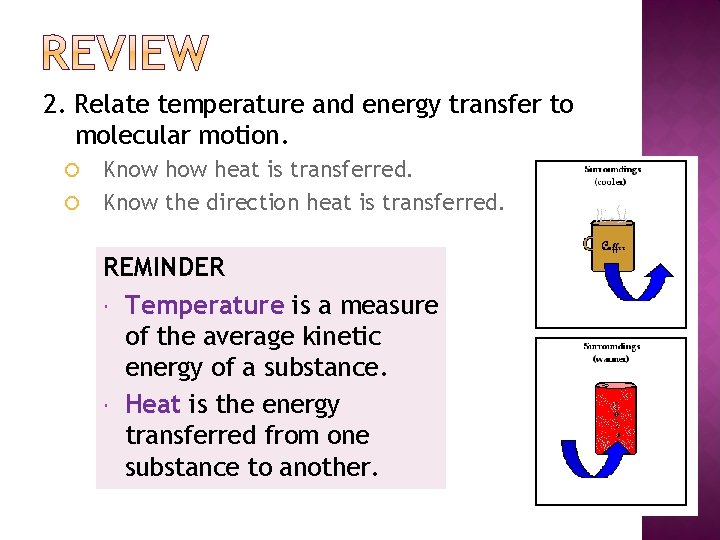
2. Relate temperature and energy transfer to molecular motion. Know heat is transferred. Know the direction heat is transferred. REMINDER Temperature is a measure of the average kinetic energy of a substance. Heat is the energy transferred from one substance to another.
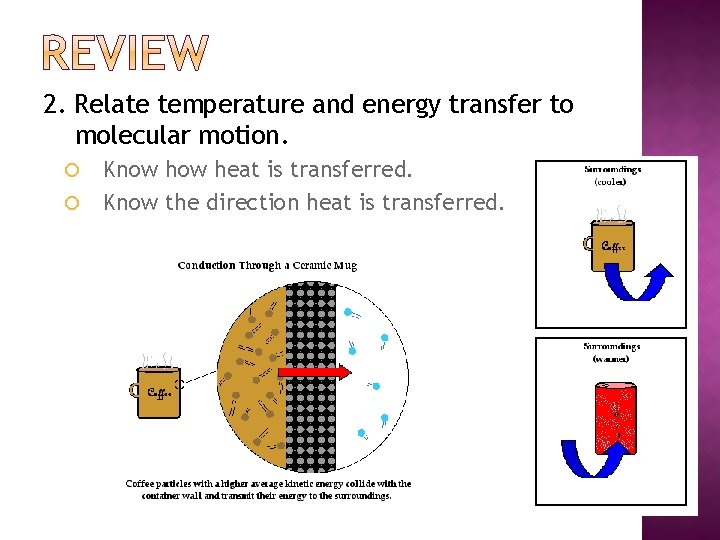
2. Relate temperature and energy transfer to molecular motion. Know heat is transferred. Know the direction heat is transferred.
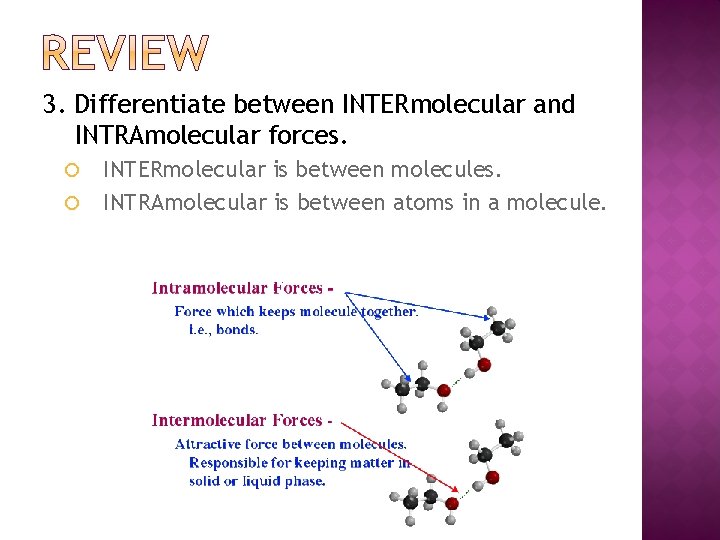
3. Differentiate between INTERmolecular and INTRAmolecular forces. INTERmolecular is between molecules. INTRAmolecular is between atoms in a molecule.
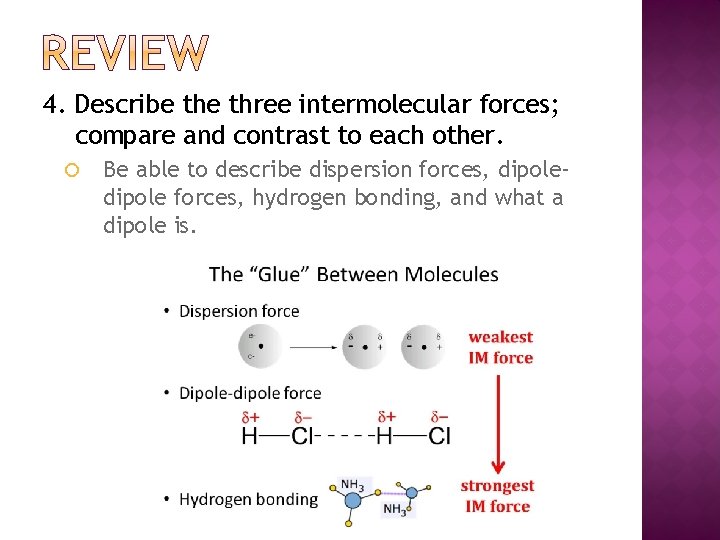
4. Describe three intermolecular forces; compare and contrast to each other. Be able to describe dispersion forces, dipole forces, hydrogen bonding, and what a dipole is.
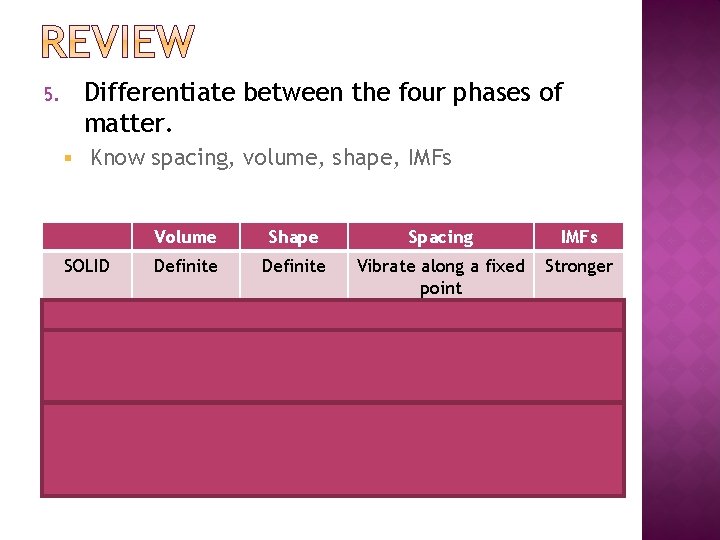
Differentiate between the four phases of matter. 5. § Know spacing, volume, shape, IMFs Volume Shape Spacing IMFs SOLID Definite Vibrate along a fixed point Stronger LIQUID Definite No Definite Slid past each other Strong GAS No Definite Behave independently of each other Very Weak PLASMA No Definite Electrons knocked off atom; behave independently of positive nucleus Weakest
Describe solids by crystalline structure, energy, spacing, energy, and intermolecular forces. 6. can have a crystalline structure or an amorphous structure. - Solid atoms/molecules are very close together – high density. - Solid particles vibrate around a fixed point. - Have strong IMFs. -
7. Describe liquids in terms of vapor pressure, density, spacing, energy, and intermolecular forces. - High vapor pressure means high evaporation and low vapor pressure means low evaporation. Liquids have lower densities than solids. Increased spacing between atoms compared to solids. Liquid particles can slid past each other but remain bound. Have weaker IMFs than solids but much strong IMFs than gases.
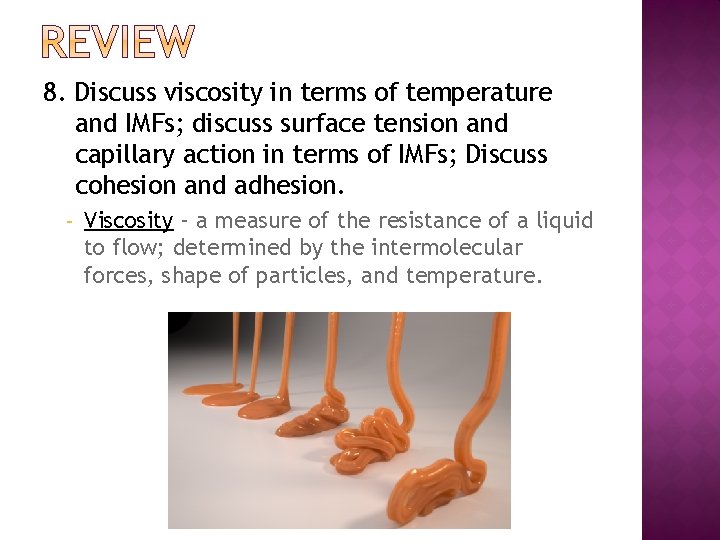
8. Discuss viscosity in terms of temperature and IMFs; discuss surface tension and capillary action in terms of IMFs; Discuss cohesion and adhesion. - Viscosity – a measure of the resistance of a liquid to flow; determined by the intermolecular forces, shape of particles, and temperature.
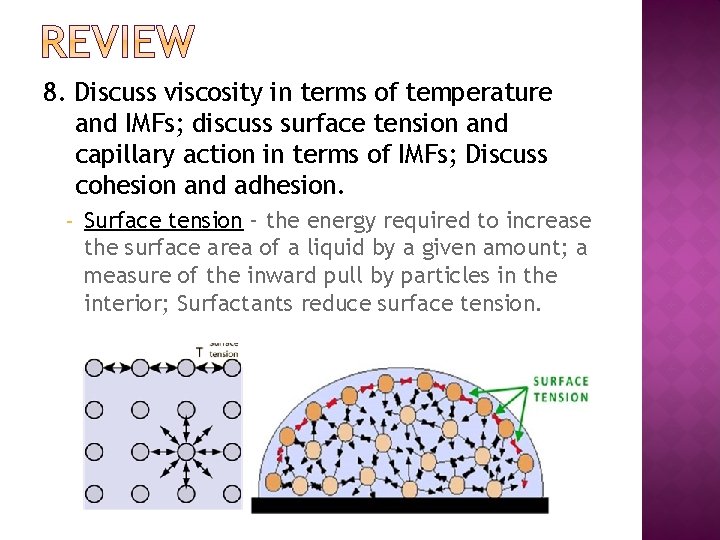
8. Discuss viscosity in terms of temperature and IMFs; discuss surface tension and capillary action in terms of IMFs; Discuss cohesion and adhesion. - Surface tension – the energy required to increase the surface area of a liquid by a given amount; a measure of the inward pull by particles in the interior; Surfactants reduce surface tension.
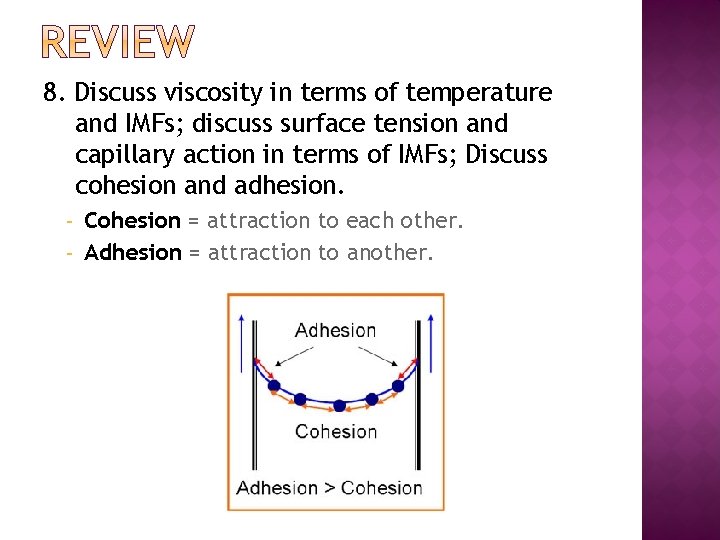
8. Discuss viscosity in terms of temperature and IMFs; discuss surface tension and capillary action in terms of IMFs; Discuss cohesion and adhesion. Cohesion = attraction to each other. - Adhesion = attraction to another. -
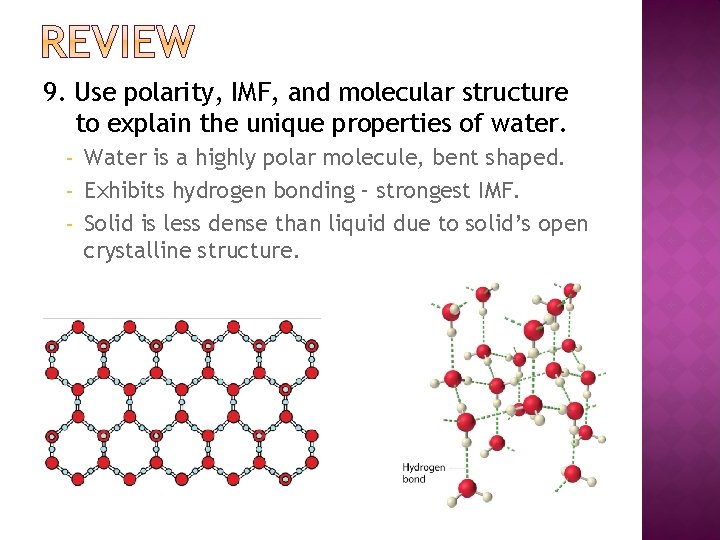
9. Use polarity, IMF, and molecular structure to explain the unique properties of water. Water is a highly polar molecule, bent shaped. - Exhibits hydrogen bonding – strongest IMF. - Solid is less dense than liquid due to solid’s open crystalline structure. -
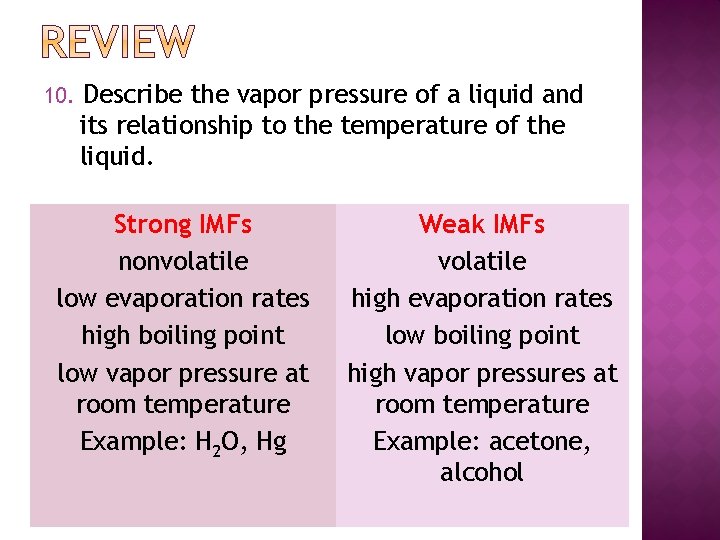
10. Describe the vapor pressure of a liquid and its relationship to the temperature of the liquid. Strong IMFs nonvolatile low evaporation rates high boiling point low vapor pressure at room temperature Example: H 2 O, Hg Weak IMFs volatile high evaporation rates low boiling point high vapor pressures at room temperature Example: acetone, alcohol
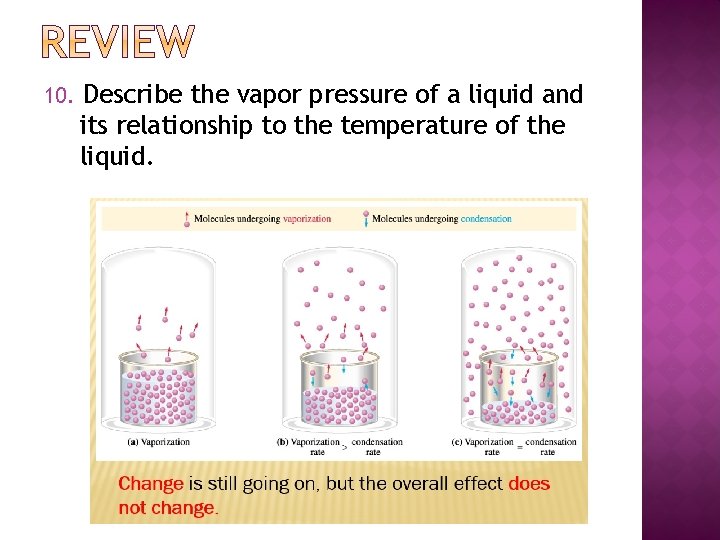
10. Describe the vapor pressure of a liquid and its relationship to the temperature of the liquid.
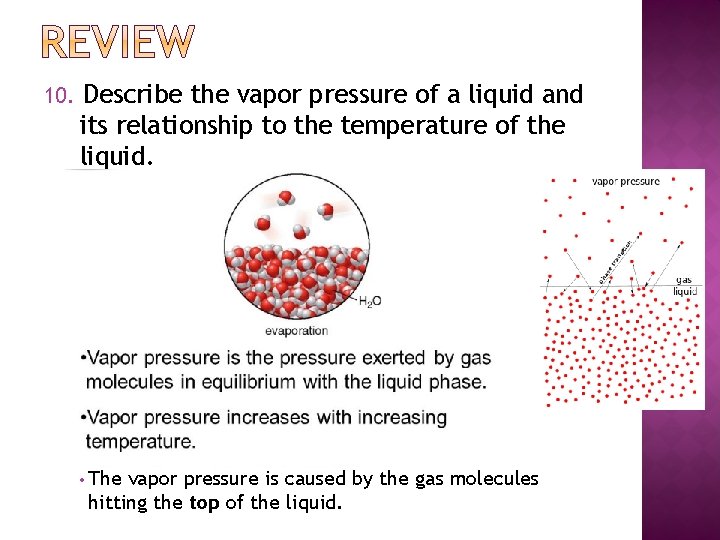
10. Describe the vapor pressure of a liquid and its relationship to the temperature of the liquid. • The vapor pressure is caused by the gas molecules hitting the top of the liquid.
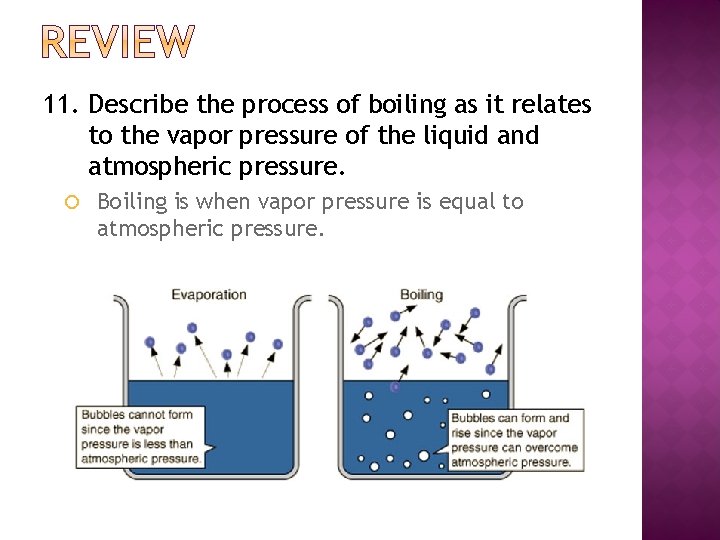
11. Describe the process of boiling as it relates to the vapor pressure of the liquid and atmospheric pressure. Boiling is when vapor pressure is equal to atmospheric pressure.
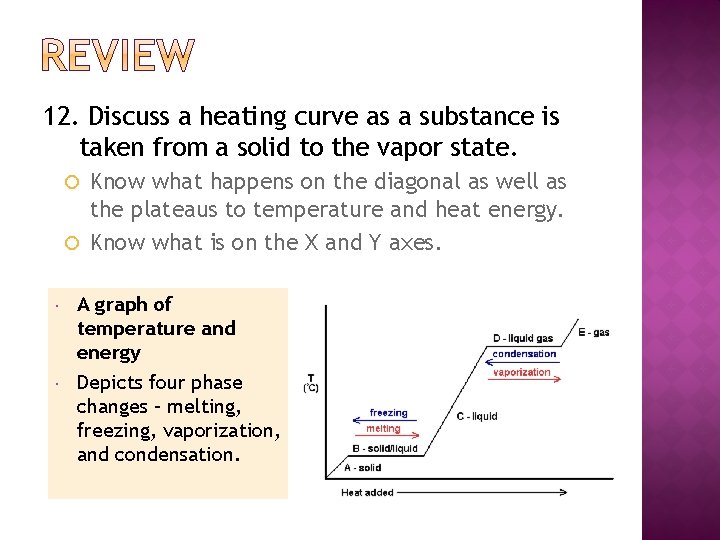
12. Discuss a heating curve as a substance is taken from a solid to the vapor state. Know what happens on the diagonal as well as the plateaus to temperature and heat energy. Know what is on the X and Y axes. A graph of temperature and energy Depicts four phase changes – melting, freezing, vaporization, and condensation.
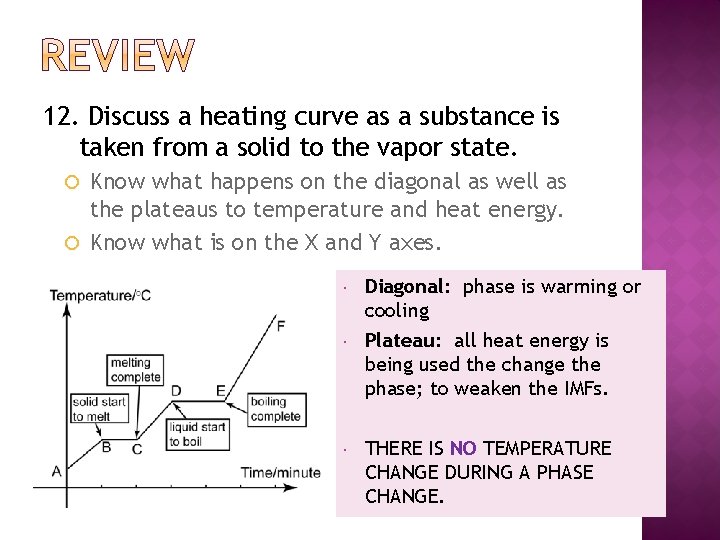
12. Discuss a heating curve as a substance is taken from a solid to the vapor state. Know what happens on the diagonal as well as the plateaus to temperature and heat energy. Know what is on the X and Y axes. Diagonal: phase is warming or cooling Plateau: all heat energy is being used the change the phase; to weaken the IMFs. THERE IS NO TEMPERATURE CHANGE DURING A PHASE CHANGE.
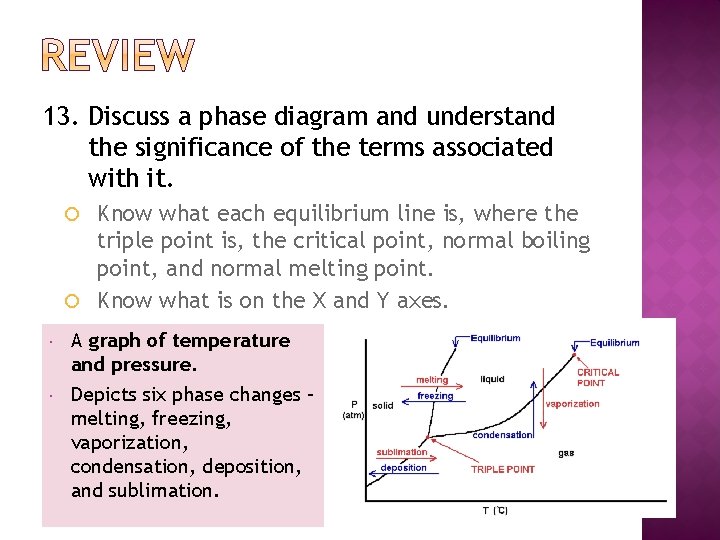
13. Discuss a phase diagram and understand the significance of the terms associated with it. Know what each equilibrium line is, where the triple point is, the critical point, normal boiling point, and normal melting point. Know what is on the X and Y axes. A graph of temperature and pressure. Depicts six phase changes – melting, freezing, vaporization, condensation, deposition, and sublimation.
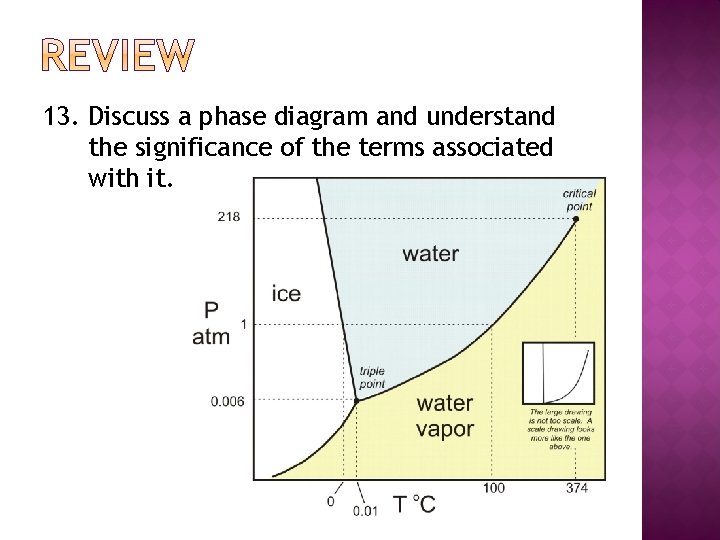
13. Discuss a phase diagram and understand the significance of the terms associated with it.
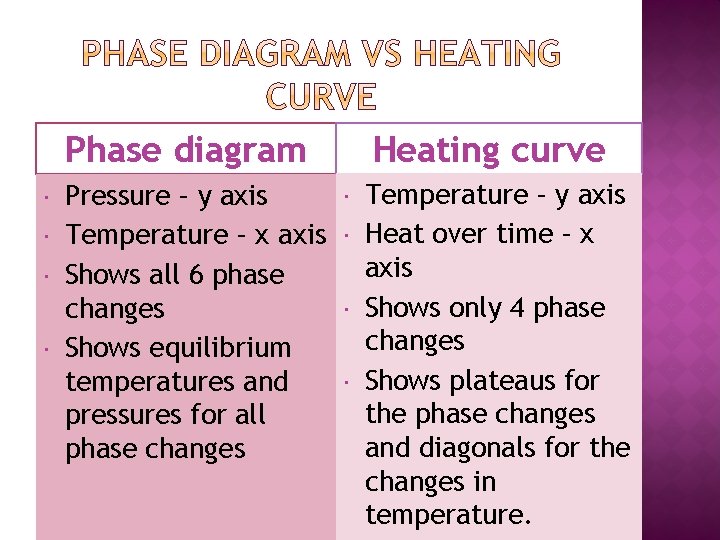
Phase diagram Pressure – y axis Temperature – x axis Shows all 6 phase changes Shows equilibrium temperatures and pressures for all phase changes Heating curve Temperature – y axis Heat over time – x axis Shows only 4 phase changes Shows plateaus for the phase changes and diagonals for the changes in temperature.
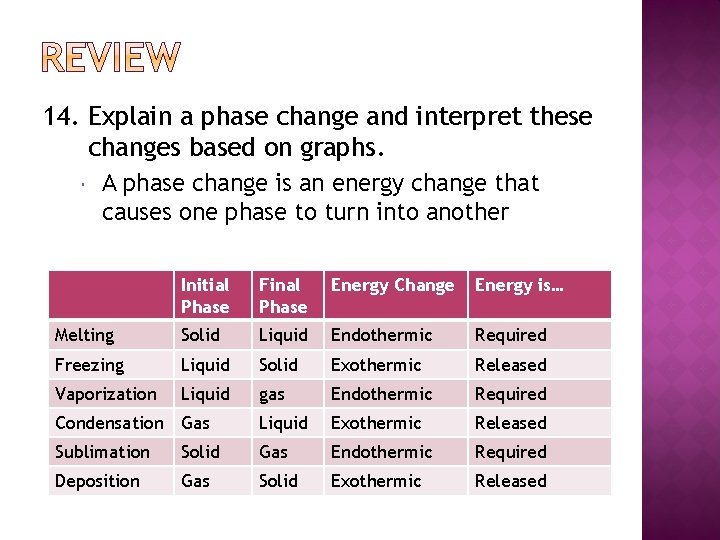
14. Explain a phase change and interpret these changes based on graphs. A phase change is an energy change that causes one phase to turn into another Initial Phase Final Phase Energy Change Energy is… Melting Solid Liquid Endothermic Required Freezing Liquid Solid Exothermic Released Vaporization Liquid gas Endothermic Required Condensation Gas Liquid Exothermic Released Sublimation Solid Gas Endothermic Required Deposition Gas Solid Exothermic Released
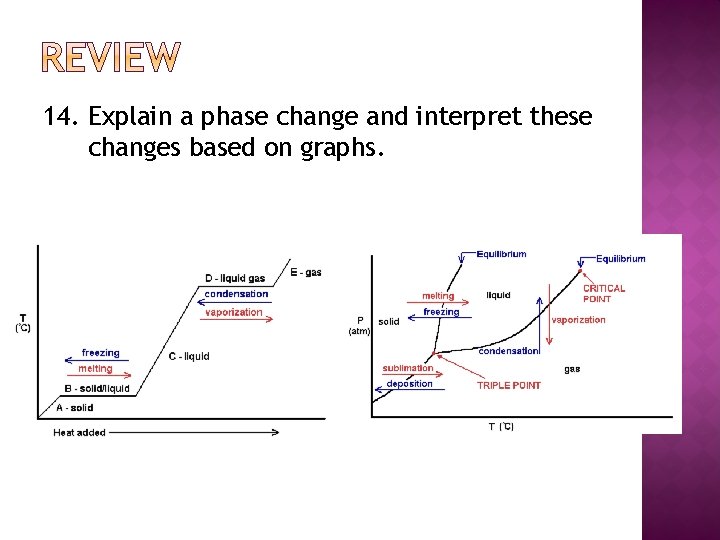
14. Explain a phase change and interpret these changes based on graphs.
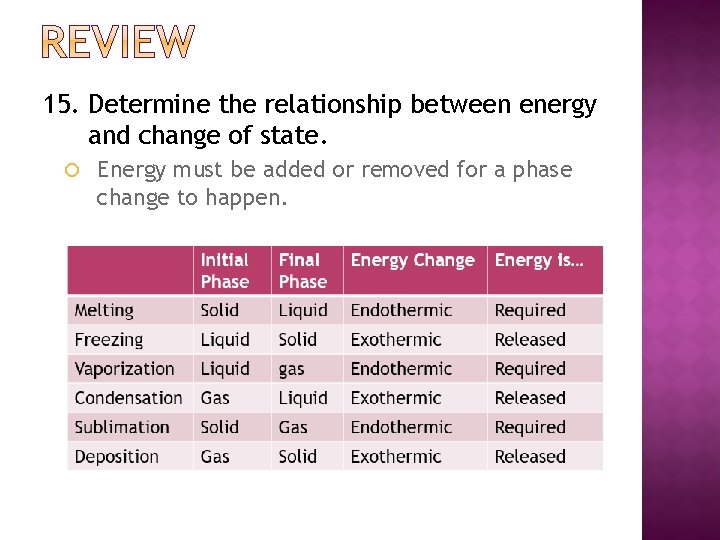
15. Determine the relationship between energy and change of state. Energy must be added or removed for a phase change to happen.
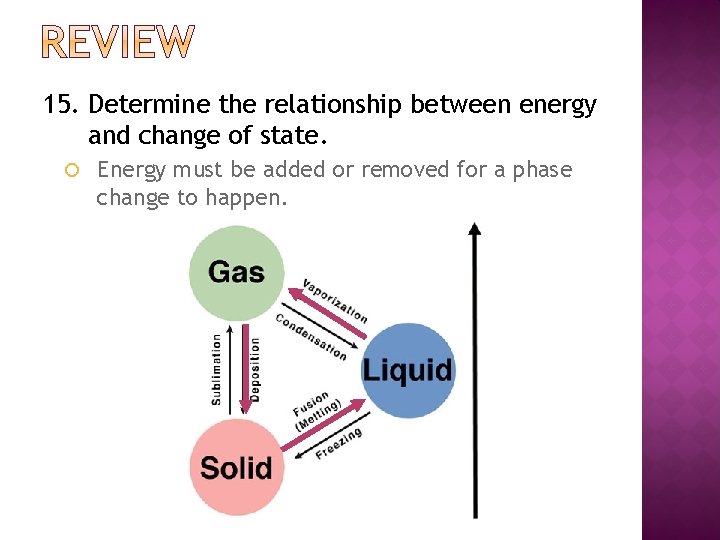
15. Determine the relationship between energy and change of state. Energy must be added or removed for a phase change to happen.
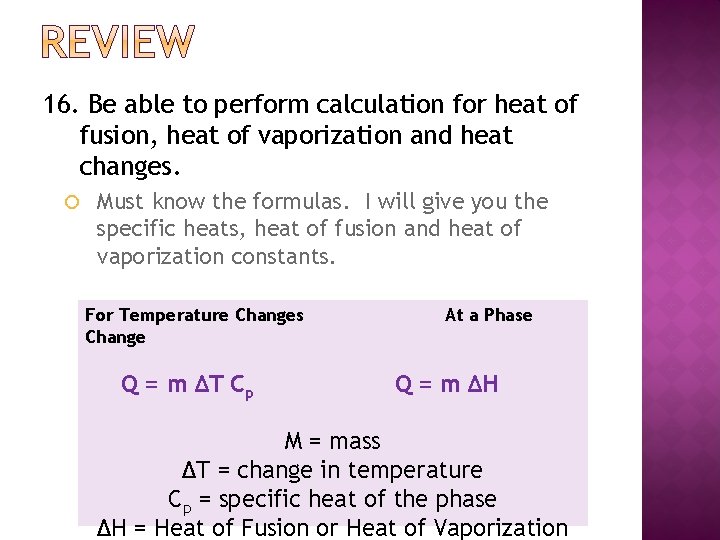
16. Be able to perform calculation for heat of fusion, heat of vaporization and heat changes. Must know the formulas. I will give you the specific heats, heat of fusion and heat of vaporization constants. For Temperature Changes Change Q = m ΔT Cp At a Phase Q = m ΔH M = mass ΔT = change in temperature Cp = specific heat of the phase ΔH = Heat of Fusion or Heat of Vaporization
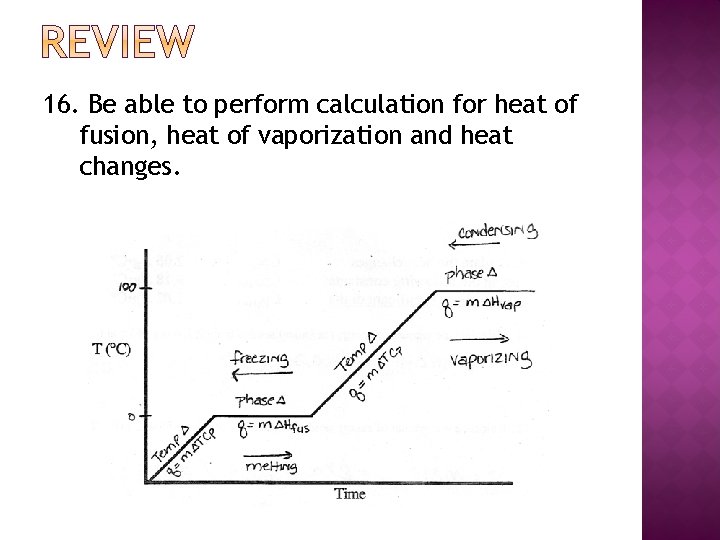
16. Be able to perform calculation for heat of fusion, heat of vaporization and heat changes.
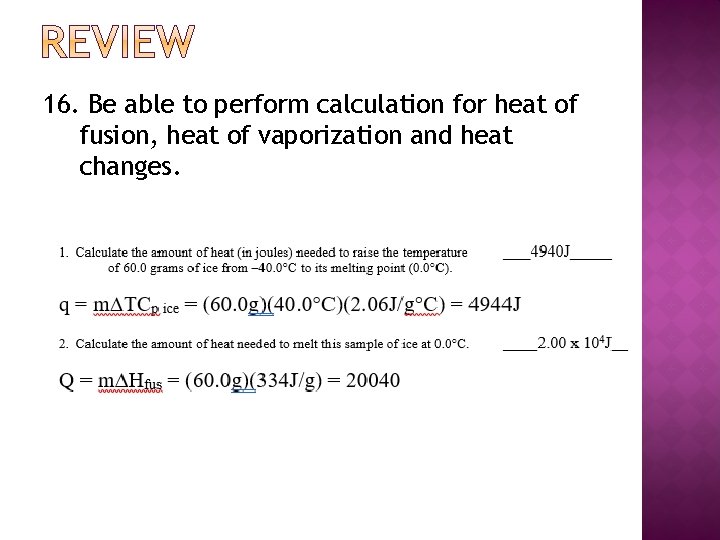
16. Be able to perform calculation for heat of fusion, heat of vaporization and heat changes.
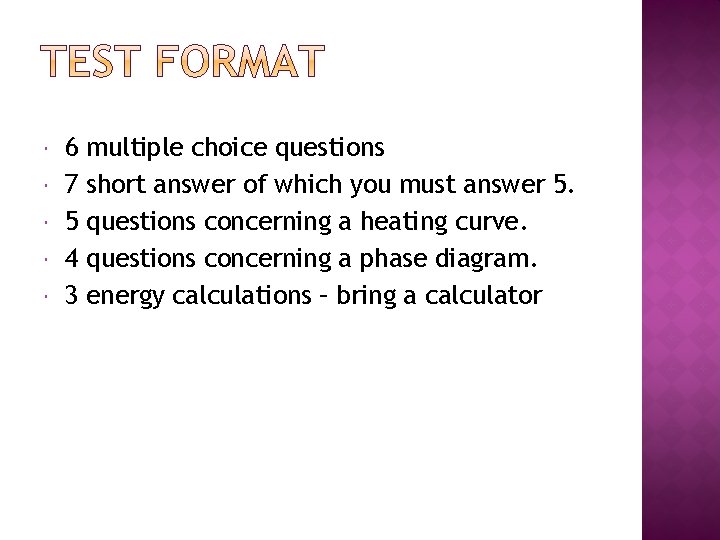
6 7 5 4 3 multiple choice questions short answer of which you must answer 5. questions concerning a heating curve. questions concerning a phase diagram. energy calculations – bring a calculator
- Slides: 30