
TEST PREPARATION ADAPTED FROM THE UNIVERSITY OF ILLINOIS




- Slides: 21
TEST PREPARATION ADAPTED FROM THE UNIVERSITY OF ILLINOIS PREVIOUSLY PRESENTED AS PART OF THE SERVICES OF THE DISABILITY RESOURCES AND EDUCATIONAL SERVICES DEPARTMENT OF THE UNIVERSITY OF ILLINOIS
TEST PREPARATION STRATEGIES Know what to study. 1. 2. Review the topics on the syllabus. 3. 4. 5. Review notes – what did the professor spend the most time talking about? 6. Ask the professor or TA if you are “on the right track” with your study plan. If you created a study guide like we discussed earlier in this class, then consider sending an electronic copy to them – they can let you know you are on the right track AND they will also know you are a serious student – might help later when you need a reference letter. 7. Some final exams are “cumulative”. This means that they cover material from the beginning of the semester. Therefore, it is important to keep all previous tests that are handed back to you to study from. Professor or TA (teaching assistant) may mention topics that will be on the exam in class (or you can ask). Review main points in reading assignments Are details like names and dates important to study or are the “big concepts” (e. g. , the move from an agrarian to an industrial society) more important to know?
TEST PREPARATION STRATEGIES Who should you study with? *Should you study by yourself or with others? 1. Those who get confused or doubt themselves when studying with others are better off studying alone. 2. Those whose learning styles indicate that they are social learners are better off studying in a group (or at least with one other person).
TEST PREPARATION STRATEGIES How should you study? *Know the format of the test – for example, multiple-choice or essay. *Multiple-choice is the most common format for introductory classes, but always check!
HOW TO STUDY FOR A MULTIPLE-CHOICE EXAM: 1. Focus on studying details like definitions, lists, etc. 2. Review words in bold print in textbooks 3. Review information you have highlighted or taken notes on in the text 4. Summarize and put information on note cards (works best for definitions of new vocabulary or concepts and lists of processes)
HOW TO STUDY FOR A MULTIPLE-CHOICE EXAM: 5. Group note cards by topic or some other similarity to make it easier to study from them. 6. Don’t just study individual cards or facts; make associations/connections between them. 7. Study examples of terms/concepts. 8. Complete practice test questions, if available. Focus on the application of information. 9. Remember to “quiz” yourself to be sure you can recall the information.
HOW TO STUDY FOR EXAM: AN ESSAY 1. Study the “big” overall concepts of the class as well as some relevant examples of each concept. 2. Ask yourself questions that your professor might ask (if you don’t get study guide questions). Include “What”, “Who”, “Where”, “When” and (especially) “How” and “Why” questions. Writing down the answers to your questions becomes your own study guide.
HOW TO STUDY FOR EXAM: AN ESSAY 3. Some classes require you to apply the knowledge you have to a specific situation. Practice by making up possible questions. For example, “How would Franklin Delano Roosevelt look at our political system today? ” In order to answer the question, you have to know what Roosevelt thought in his day, you would have to know about our political system today and you would have to be able to apply this knowledge to answer the question.
HOW TO STUDY FOR EXAM: AN ESSAY 4. Study not only the definitions of terms and concepts but examples of those terms and concepts and make associations/ connections between terms and concepts. Also, practice being able to apply the information (for example, if you were given a case study).
HOW TO STUDY FOR A MATH EXAM: 1. Practice what you are learning by completing homework problems and extra example problems, if necessary, for you to understand the process and the formulas needed. 2. Math classes are usually cumulative – every new topic builds upon what you have learned previously. Because of this, it is important not to wait until the last minute to learn all the material. As you learn a new topic, check to see how it relates to something you have already learned.
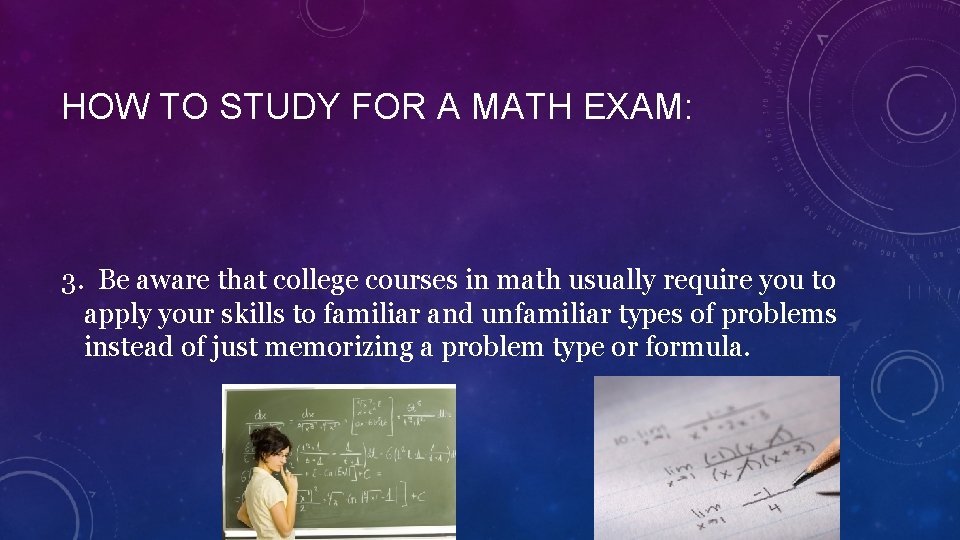
HOW TO STUDY FOR A MATH EXAM: 3. Be aware that college courses in math usually require you to apply your skills to familiar and unfamiliar types of problems instead of just memorizing a problem type or formula.
4. APPLY PÓLYA'S FOUR-STEP PROCESS: 1. ) What quantity is the problem asking you to solve? 2. ) Which skills, procedures or formulas can be used to solve the problem? 3. ) Solve the problem. 4. ) Review your solution. Does it seem reasonable? If not, review the steps you took to solve the problem to check for mistakes. From: George Pólya, How to Solve It, Princeton University Press, Princeton (1945)
OTHER ALTERNATIVE PROBLEM SOLVING TECHNIQUES: 1. 2. 3. 4. 5. Draw a picture or diagram of the problem Make a list of steps Work the problem backward from the answer Try to “reason it out” Try alternative example problems of the same type.
HOW TO DO “WORD PROBLEMS”/ APPLIED PROBLEMS: 1) Convert the problem into mathematics. 2) Draw a picture and label it with all the quantities (numbers or variables) mentioned in the problem. In order to finish converting the problem into mathematics, find equations which describe relationships among the variables, and describe the goal of the problem mathematically.
HOW TO DO “WORD PROBLEMS”/ APPLIED PROBLEMS: 3) Solve the problem you have come up with using the four-step process above or other problem-solving strategies. 4) Once you have solved the problem mathematically, convert the math back to words so that you have now solved the original applied problem.
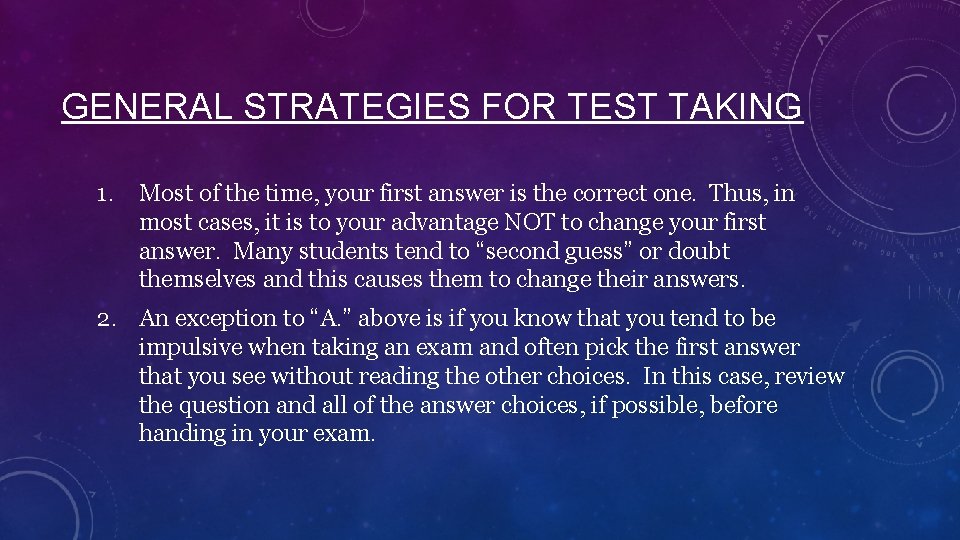
GENERAL STRATEGIES FOR TEST TAKING 1. Most of the time, your first answer is the correct one. Thus, in most cases, it is to your advantage NOT to change your first answer. Many students tend to “second guess” or doubt themselves and this causes them to change their answers. 2. An exception to “A. ” above is if you know that you tend to be impulsive when taking an exam and often pick the first answer that you see without reading the other choices. In this case, review the question and all of the answer choices, if possible, before handing in your exam.
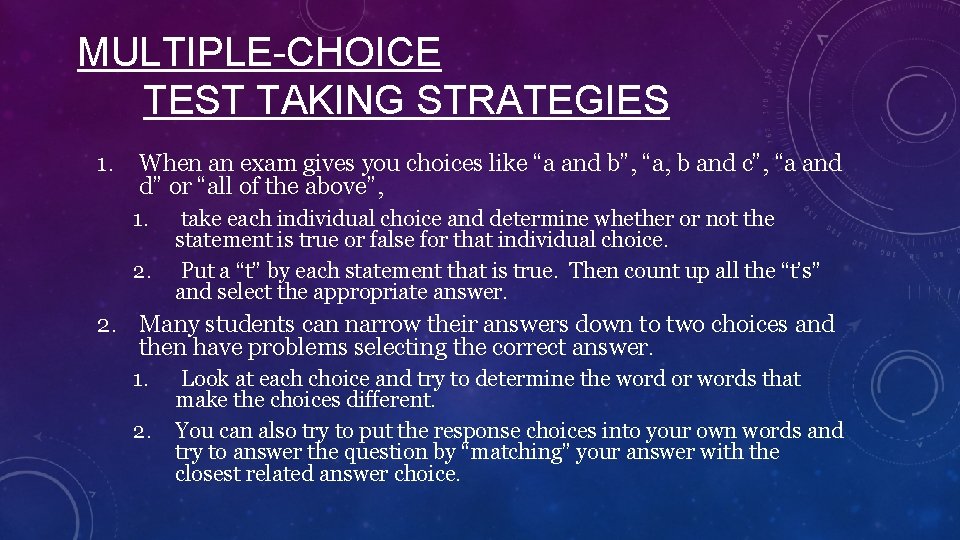
MULTIPLE-CHOICE TEST TAKING STRATEGIES 1. When an exam gives you choices like “a and b”, “a, b and c”, “a and d” or “all of the above”, 1. 2. take each individual choice and determine whether or not the statement is true or false for that individual choice. Put a “t” by each statement that is true. Then count up all the “t’s” and select the appropriate answer. 2. Many students can narrow their answers down to two choices and then have problems selecting the correct answer. 1. 2. Look at each choice and try to determine the word or words that make the choices different. You can also try to put the response choices into your own words and try to answer the question by “matching” your answer with the closest related answer choice.
REFLECTION QUESTION: What other strategies have worked for you?
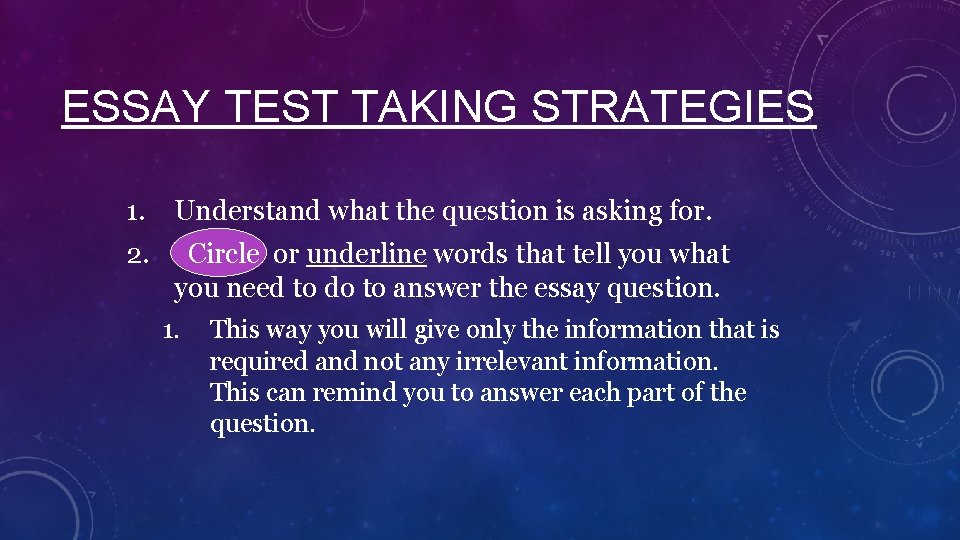
ESSAY TEST TAKING STRATEGIES 1. Understand what the question is asking for. 2. Circle or underline words that tell you what you need to do to answer the essay question. 1. This way you will give only the information that is required and not any irrelevant information. This can remind you to answer each part of the question.
ESSAY TEST TAKING STRATEGIES 2. Should be organized with a thesis and written in paragraph form, unless your instructor informs you otherwise. Sometimes, students lose points in their answer if it is unorganized and their points are hard to follow. To combat this, be sure to proofread/review your answer. Also, be sure to “back up”/support your points with examples.
QUESTIONS?