
Test of Silent Word Reading Fluency Second Edition
- Slides: 17
Test of Silent Word Reading Fluency Second Edition Presented by: Tanisha Baker Maria Barta Dr. Dianne Reed Houston Baptist University
Test of Silent Word Reading Fluency Is a theoretically sound, research-based method of assessing the silent reading ability of schoolage students in a quick, accurate and costefficient way.
Description of the Test • Has 7 components: manual, the administration & scoring instructions, the Supplemental Scoring Practice Booklet, 4 equivalent forms (A, B, C, D) • Test provides raw scores, age & grade equivalents, index scores, percentile ranks • Can be used by classroom teachers, special education teachers, reading specialists, school psychologist, speech pathologists or any other professionals Back to school
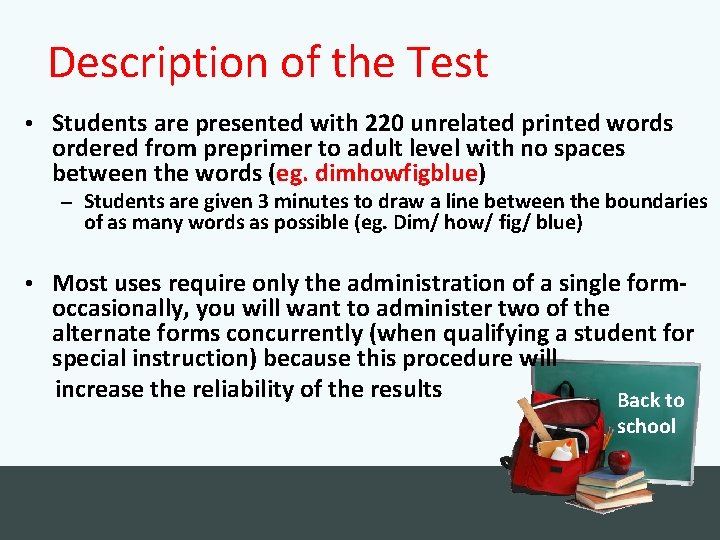
Description of the Test • Students are presented with 220 unrelated printed words ordered from preprimer to adult level with no spaces between the words (eg. dimhowfigblue) – Students are given 3 minutes to draw a line between the boundaries of as many words as possible (eg. Dim/ how/ fig/ blue) • Most uses require only the administration of a single form- occasionally, you will want to administer two of the alternate forms concurrently (when qualifying a student for special instruction) because this procedure will increase the reliability of the results Back to school
Purpose • Measures a student’s ability to recognize printed words accurately and efficiently • Measures a student’s current reading skill level by identifying the number of printed words they can recognize in a 3 minute time period.
Aspects of Reading Measured by the Test TOSWRF-2 primarily a measure of word identification, word comprehension & reading speed (also known as silent reading fluency) • Because test scores reflect competence in so many aspects of reading, its results can also be BACK taken as a valid estimate of general T O reading ability and can be used to S C H O O L identify poor readers with confidence
Aspects of Reading Measured by the Test The ability to recognize words quickly is called fluency and described by Ehri (1998, 2000) as being essential to efficient reading. • Whether presented orally (as in oral reading) or silently (as in silent reading), the ability to recognize printed words quickly is influenced considerably by the extent of a student’s vocabulary knowledge B A CK TO S CHO O L • Speed in recognizing words promotes both fluency & comprehension. Slow word recognition is a common characteristics of poor readers (Stein, 2001).
Uses of the Test Identification- Early identification of those who are at-risk is the key to preventing reading failure Universal Screening- Efficient & cost effective universal screening measure since the test can be easily administered to individuals, small groups of students or entire classes in less than 6 minutes and scored quickly Comprehensive Diagnostic Assessment- Once identified, a more comprehensive assessment can help determine the causes of reading difficulties, the specific reading skills that need remediation, and the types of intervention required
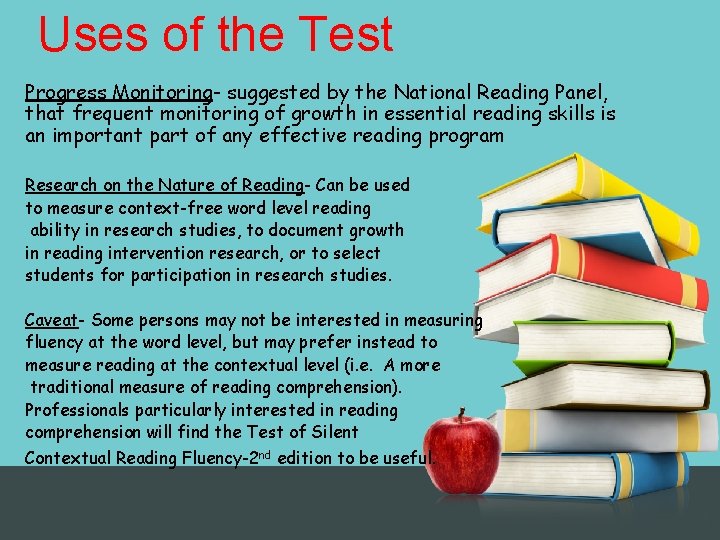
Uses of the Test Progress Monitoring- suggested by the National Reading Panel, that frequent monitoring of growth in essential reading skills is an important part of any effective reading program Research on the Nature of Reading- Can be used to measure context-free word level reading ability in research studies, to document growth in reading intervention research, or to select students for participation in research studies. Caveat- Some persons may not be interested in measuring fluency at the word level, but may prefer instead to measure reading at the contextual level (i. e. A more traditional measure of reading comprehension). Professionals particularly interested in reading comprehension will find the Test of Silent Contextual Reading Fluency-2 nd edition to be useful.
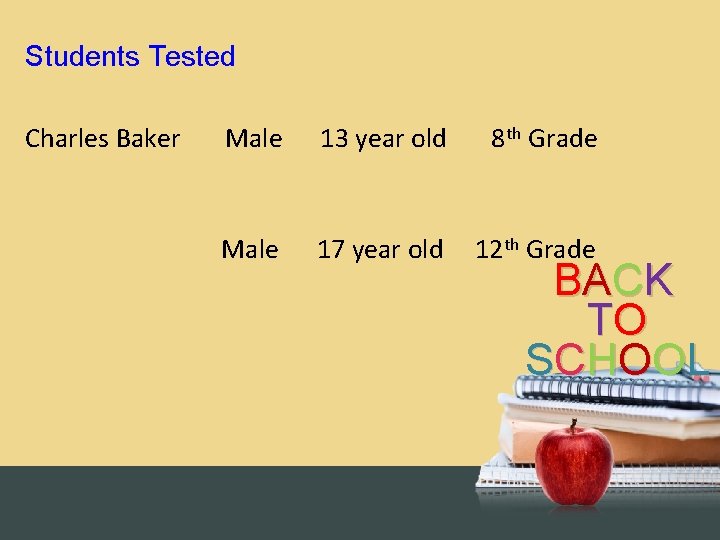
Students Tested Charles Baker Male 13 year old 8 th Grade Male 17 year old 12 th Grade B A CK TO S CHO O L
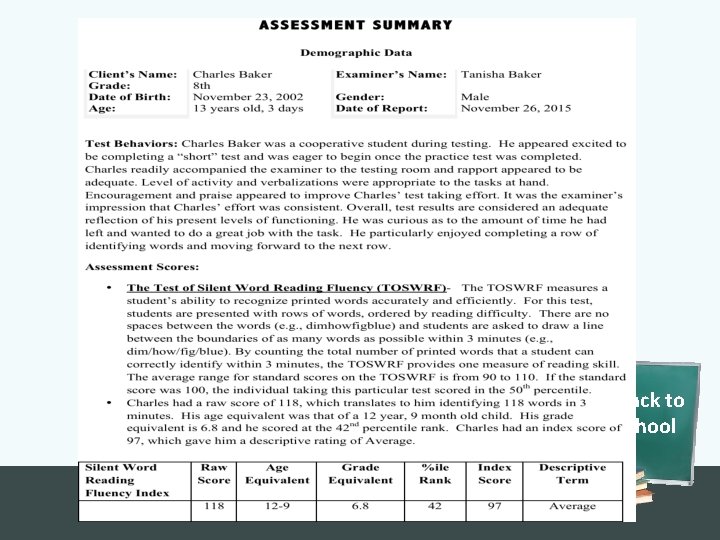
Back to school
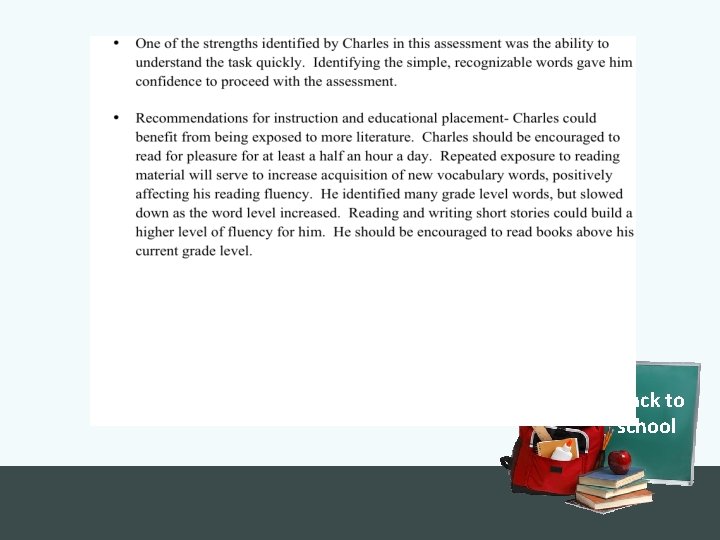
Back to school
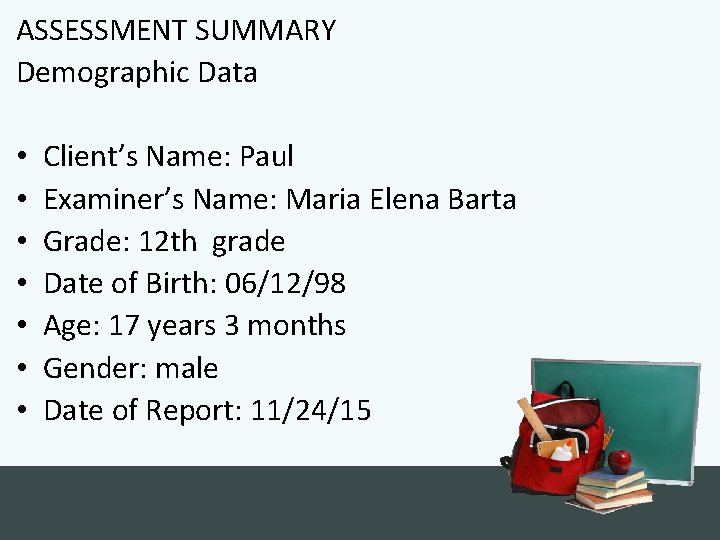
ASSESSMENT SUMMARY Demographic Data • • Client’s Name: Paul Examiner’s Name: Maria Elena Barta Grade: 12 th grade Date of Birth: 06/12/98 Age: 17 years 3 months Gender: male Date of Report: 11/24/15
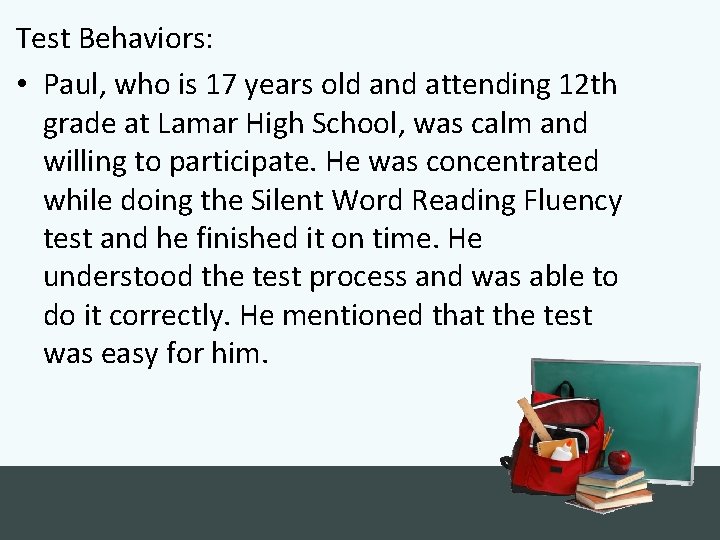
Test Behaviors: • Paul, who is 17 years old and attending 12 th grade at Lamar High School, was calm and willing to participate. He was concentrated while doing the Silent Word Reading Fluency test and he finished it on time. He understood the test process and was able to do it correctly. He mentioned that the test was easy for him.
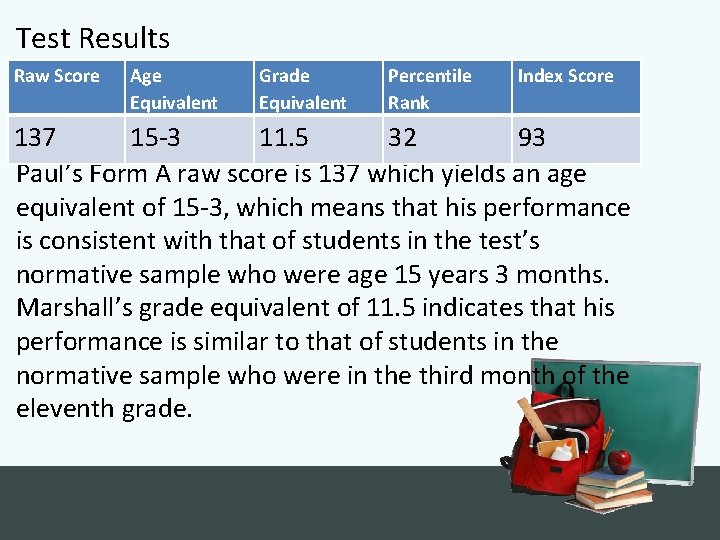
Test Results Raw Score Age Equivalent Grade Equivalent Percentile Rank Index Score 137 15 -3 11. 5 32 93 Paul’s Form A raw score is 137 which yields an age equivalent of 15 -3, which means that his performance is consistent with that of students in the test’s normative sample who were age 15 years 3 months. Marshall’s grade equivalent of 11. 5 indicates that his performance is similar to that of students in the normative sample who were in the third month of the eleventh grade.
References: § Nancy Mather, Donald D. Hammill, Elizabeth A. Allen, and Rhia Roberts (2014). Test of Silent Word Reading Fluency, Second Edtion. § Product Categories: . (n. d. ). Retrieved December 1, 2015, from http: //www. proedinc. com/custom er/product. Lists. aspx? Search. Type=C ategory. Brand&id. Category=2
References Ehri, L. C. (1998). Grapheme-phoneme knowledge is essential for learning to read words in English. In J. L. Metsala & L. C. Ehri (Eds. ). Word recognition in beginning literacy (pp. 3 -40). Mahwah, NJ: Erlbaum. Ehri, L. C. (2000). Learning to read and learning to spell: Two sides of a coin. Topics in Language Disorders, 20(3), 19 -36. B A CK TO S CHO O L Stein, J. (2001). The neurobiology of reading difficulties. In M. Wolf (Ed. ), Dyslexia, efficiency, and the brain (pp. 333 -355). Austin, TX: PRO-ED