
Test of Silent Word Reading Fluency Presented by
Test of Silent Word Reading Fluency Presented by Chinwe Okenyi EDSP 5311 Dr. Fontenot Houston Baptist University, Spring 2016
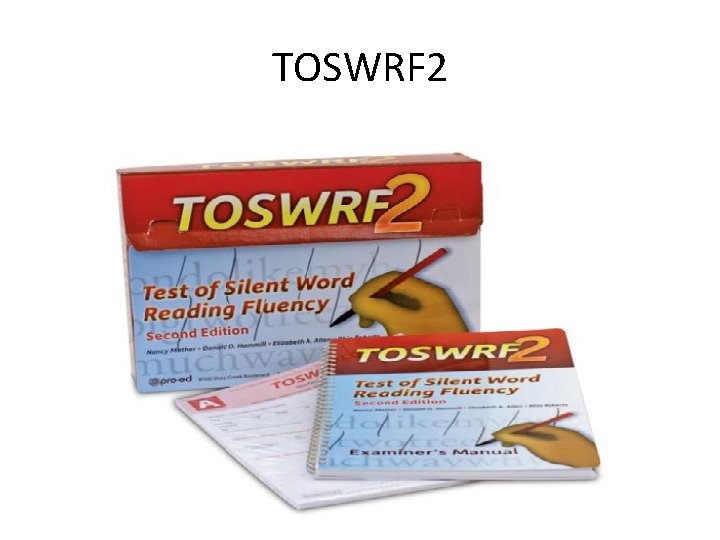
TOSWRF 2
What is Test of Silent Word Reading Fluency? Is a theoretically sound, research-based method of assessing the silent reading ability of school-age students in a quick, accurate and cost-efficient way.
Test Description • The test has 7 components: manual, the administration & scoring instructions, the Supplemental Scoring Practice Booklet, 4 equivalent forms (A, B, C, D) • Test provides raw scores, age & grade equivalents, index scores, percentile ranks • The test be used by classroom teachers, special education teachers, reading specialists, school psychologist, speech pathologists or any other professionals
Test Description • Students are presented with 220 unrelated printed words ordered from preprimer to adult level with no spaces between the words (eg. dimhowfigblue) – Students are given 3 minutes to draw a line between the boundaries of as many words as possible (eg. Dim/ how/ fig/ blue) • Most uses require only the administration of a single form- occasionally, you will want to administer two of the alternate forms concurrently (when qualifying a student for special instruction) because this procedure will increase the reliability of the results
Purpose § Measures a student’s ability to recognize printed words accurately and efficiently. § Measures a student’s current reading skill level by identifying the number of printed words they can recognize in a 3 minute time period.
Aspects of Reading Measured by the Test • TOSWRF-2 primarily a measure of word identification, word comprehension & reading speed ( which is also known as silent reading fluency) • Because test scores reflect competence in so many aspects of reading, its results can also be taken as a valid estimate of general reading ability and can be used to identify poor readers with confidence
Aspects of Reading Measured by the Test § The ability to recognize words quickly is called fluency as describe by Ehri (1998, 2000) as being essential to efficient reading. § Silently as in silent reading is the ability to recognize printed words quickly as it is influenced by the extend of a student’s vocabulary knowledge § Speed in recognizing words promotes both fluency and comprehension. § Slow word recognition is a common characteristics of poor readers (Stein, 2001)
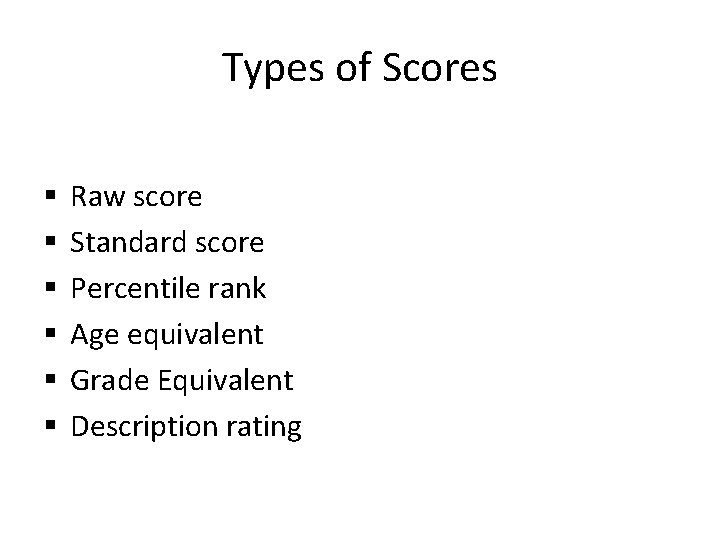
Types of Scores § § § Raw score Standard score Percentile rank Age equivalent Grade Equivalent Description rating
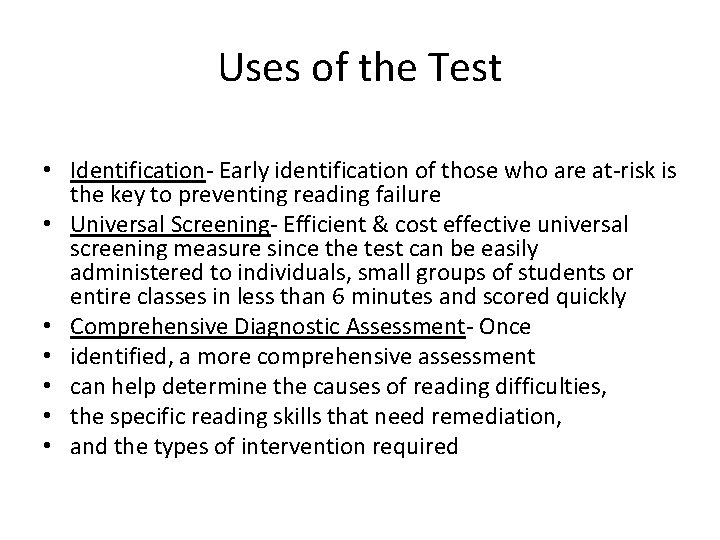
Uses of the Test • Identification- Early identification of those who are at-risk is the key to preventing reading failure • Universal Screening- Efficient & cost effective universal screening measure since the test can be easily administered to individuals, small groups of students or entire classes in less than 6 minutes and scored quickly • Comprehensive Diagnostic Assessment- Once • identified, a more comprehensive assessment • can help determine the causes of reading difficulties, • the specific reading skills that need remediation, • and the types of intervention required
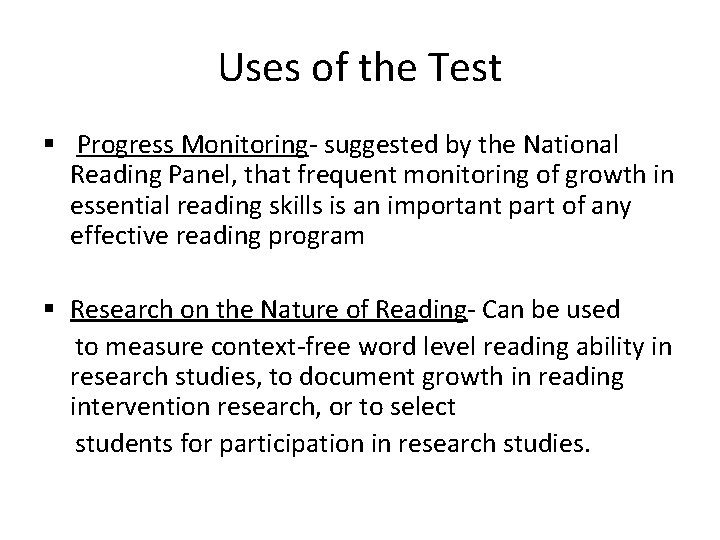
Uses of the Test § Progress Monitoring- suggested by the National Reading Panel, that frequent monitoring of growth in essential reading skills is an important part of any effective reading program § Research on the Nature of Reading- Can be used to measure context-free word level reading ability in research studies, to document growth in reading intervention research, or to select students for participation in research studies.
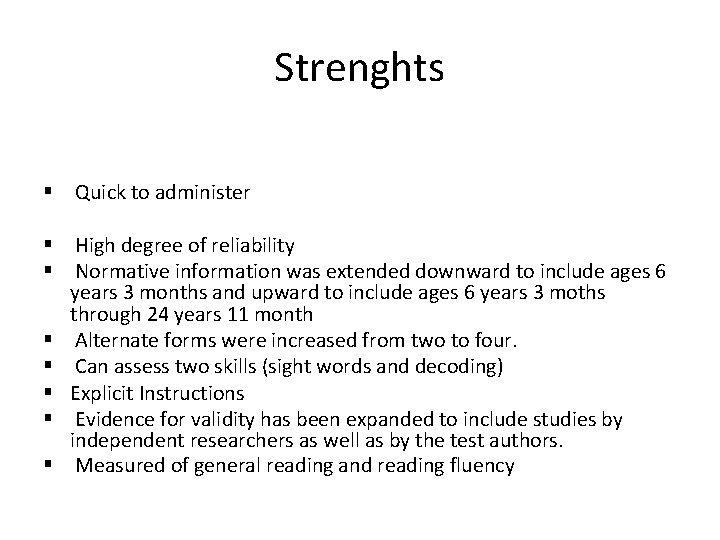
Strenghts § Quick to administer § High degree of reliability § Normative information was extended downward to include ages 6 years 3 months and upward to include ages 6 years 3 moths through 24 years 11 month § Alternate forms were increased from two to four. § Can assess two skills (sight words and decoding) § Explicit Instructions § Evidence for validity has been expanded to include studies by independent researchers as well as by the test authors. § Measured of general reading and reading fluency
Limitation § Expensive § Valid yet mention to continue researching § Normative data not fully equitable
- Slides: 13