
Test of QZSS L 1 SAIF Based on
Test of QZSS L 1 -SAIF Based on the MADOCA Real-Time Products The 8 th Multi-GNSS Asia Conference 14 -16 Nov. , 2016 @Manila, Philippines Takeyasu Sakai National Institute of Maritime, Port and Aviation Technology Kazutoshi Satoh and Yaka Wakabayashi Japan Aerospace Exploration Agency
Introduction • QZSS (Quasi-Zenith Satellite System) program: – Regional navigation service by the signals broadcast from highelevation angle by a combination of three or more satellites on the inclined geosynchronous (quasi-zenith) orbit. – Broadcasts GPS-like ranging signals on three frequencies and two augmentation signals, L 1 -SAIF and LEX. • L 1 -SAIF augmentation signal developed by ENRI: – Submeter accuracy wide-area differential correction service on L 1 single frequency mainly for mobile users. – No hardware impact; Antenna and receiver front-end are common with GPS and SBAS. • The MADOCA project of JAXA: – JAXA has been conducting the MADOCA project since 2011. – MADOCA is actually capable of real-time operation: Clock and orbit estimation available in real-time. – Conducted a trial to apply the MADOCA real-time products to the L 1 SAIF message generation. 2

QZSS: Quasi-Zenith Satellite System • Functional Capability: – GNSS Positioning Service – GNSS Augmentation Service – Messaging Service • Coverage: Asia and Pacific Region • Signals: – L 1 C/A, L 1 C, L 2 C and L 5 • Interoperable with GPS – L 1 S (L 1 -SAIF) on 1575. 42 MHz • For Submeter class augmentation – L 6 (LEX) on 1278. 75 MHz • For Centimeter class augmentation • The first QZSS satellite, QZS-1 “MICHIBIKI” was launched in 2010. • The operational service with four satellites constellation will be established in 2018. – Additional three satellites will be launched in 2017. 3
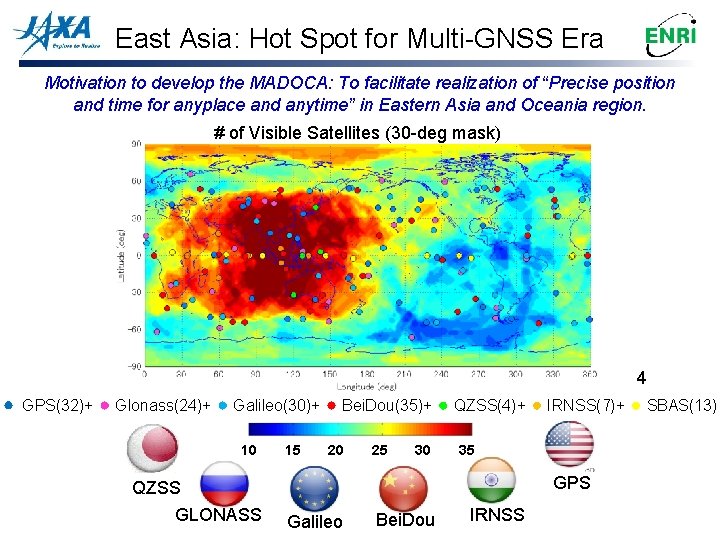
East Asia: Hot Spot for Multi-GNSS Era Motivation to develop the MADOCA: To facilitate realization of “Precise position and time for anyplace and anytime” in Eastern Asia and Oceania region. # of Visible Satellites (30 -deg mask) 4 GPS(32)+ Glonass(24)+ Galileo(30)+ Bei. Dou(35)+ QZSS(4)+ IRNSS(7)+ 10 15 20 25 30 35 QZSS GLONASS GPS Galileo Bei. Dou IRNSS SBAS(13)
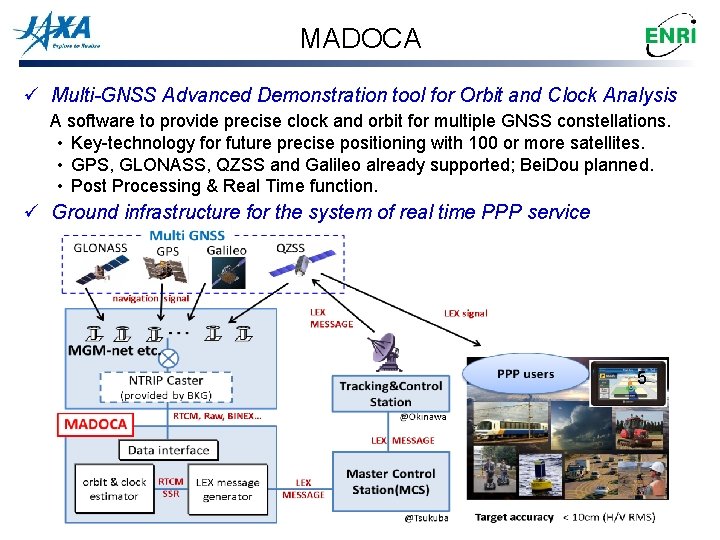
MADOCA ü Multi-GNSS Advanced Demonstration tool for Orbit and Clock Analysis A software to provide precise clock and orbit for multiple GNSS constellations. • Key-technology for future precise positioning with 100 or more satellites. • GPS, GLONASS, QZSS and Galileo already supported; Bei. Dou planned. • Post Processing & Real Time function. ü Ground infrastructure for the system of real time PPP service 5
Status of Development • Phase 1: June 2011 to March 2013 – Design and implementation of the software from scratch. – Verification by post-processing and simulation. • Since April 2013 – Broadcasting MT 12 via QZS-1 "Michibiki" LEX channel. ü Replacing MT 10 and 11 for improving PPP user positioning accuracy. – Support GPS, QZSS and GLONASS (Since Nov. 2013). • Phase 2: Feb. 2014 up to now – Continuous improvements of accuracy, stability and reliability on clock and orbit estimations. – Real-time distribution via internet: Available since Sept. 2014. – Recent works: Ø Supporting Bei. Dou. Ø New features: FCB and local ionosphere/troposphere products. Ø Multiple-sensor integration to PPP for severe environment. 6
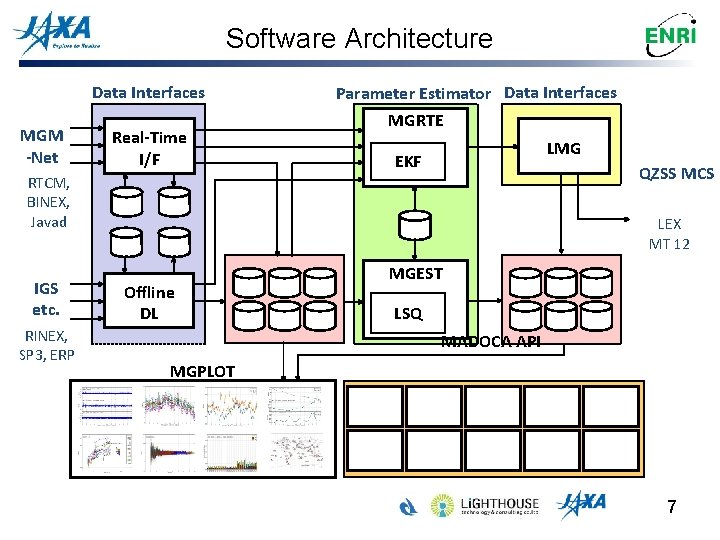
Software Architecture Data Interfaces MGM -Net Real-Time I/F Parameter Estimator Data Interfaces MGRTE LMG EKF QZSS MCS RTCM, BINEX, Javad IGS etc. RINEX, SP 3, ERP LEX MT 12 Offline DL MGEST LSQ MADOCA API MGPLOT 7
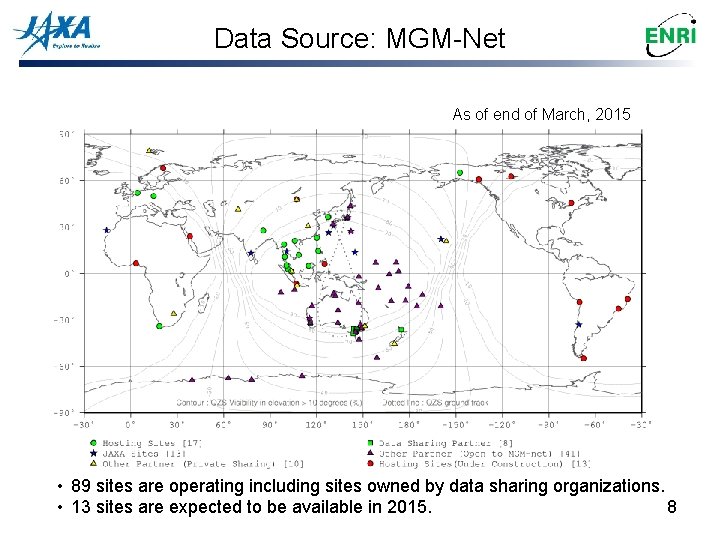
Data Source: MGM-Net As of end of March, 2015 • 89 sites are operating including sites owned by data sharing organizations. 8 • 13 sites are expected to be available in 2015.
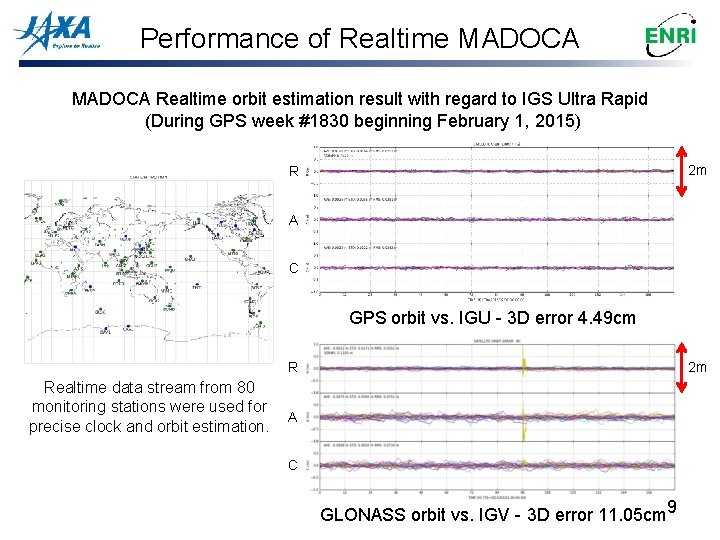
Performance of Realtime MADOCA Realtime orbit estimation result with regard to IGS Ultra Rapid (During GPS week #1830 beginning February 1, 2015) 2 m R A C GPS orbit vs. IGU - 3 D error 4. 49 cm 2 m R Realtime data stream from 80 monitoring stations were used for precise clock and orbit estimation. A C GLONASS orbit vs. IGV - 3 D error 11. 05 cm 9
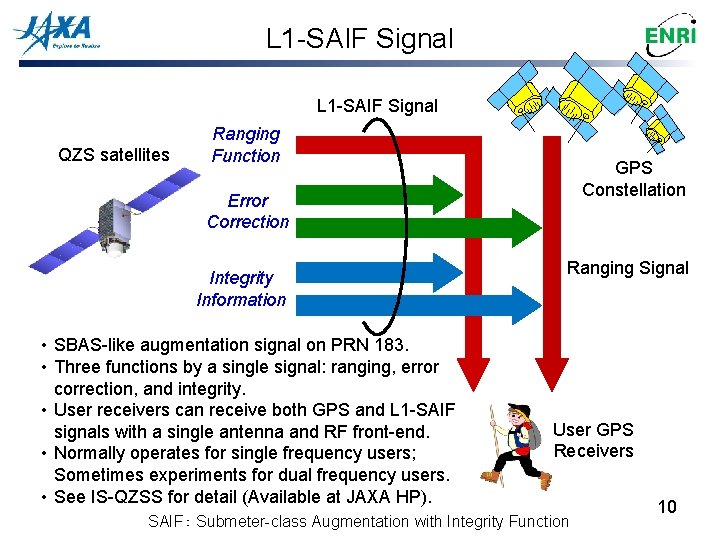
L 1 -SAIF Signal QZS satellites Ranging Function GPS Constellation Error Correction Integrity Information • SBAS-like augmentation signal on PRN 183. • Three functions by a single signal: ranging, error correction, and integrity. • User receivers can receive both GPS and L 1 -SAIF signals with a single antenna and RF front-end. • Normally operates for single frequency users; Sometimes experiments for dual frequency users. • See IS-QZSS for detail (Available at JAXA HP). Ranging Signal User GPS Receivers SAIF: Submeter-class Augmentation with Integrity Function 10
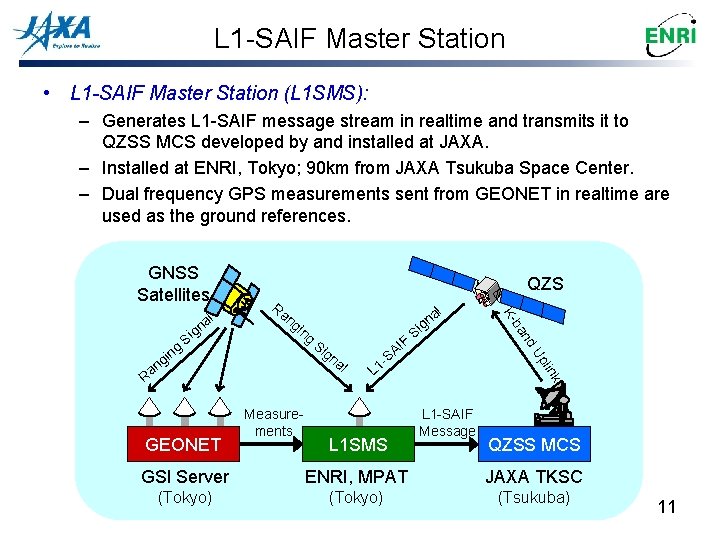
L 1 -SAIF Master Station • L 1 -SAIF Master Station (L 1 SMS): – Generates L 1 -SAIF message stream in realtime and transmits it to QZSS MCS developed by and installed at JAXA. – Installed at ENRI, Tokyo; 90 km from JAXA Tsukuba Space Center. – Dual frequency GPS measurements sent from GEONET in realtime are used as the ground references. GNSS Satellites Si gn al SA IF Si L 1 SMS k Measurements g n pli GEONET in a gn d. U ng gi n Ra l ng n ba gn Si Ra K- al QZS L 1 -SAIF Message QZSS MCS GSI Server ENRI, MPAT JAXA TKSC (Tokyo) (Tsukuba) 11
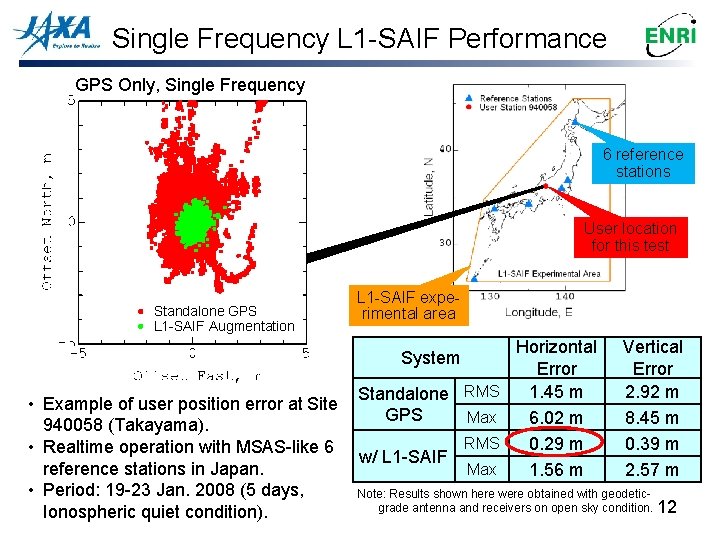
Single Frequency L 1 -SAIF Performance GPS Only, Single Frequency 6 reference stations User location for this test Standalone GPS L 1 -SAIF Augmentation L 1 -SAIF experimental area Horizontal Error 1. 45 m Standalone RMS GPS Max 6. 02 m RMS 0. 29 m w/ L 1 -SAIF Max 1. 56 m System • Example of user position error at Site 940058 (Takayama). • Realtime operation with MSAS-like 6 reference stations in Japan. • Period: 19 -23 Jan. 2008 (5 days, Ionospheric quiet condition). Vertical Error 2. 92 m 8. 45 m 0. 39 m 2. 57 m Note: Results shown here were obtained with geodeticgrade antenna and receivers on open sky condition. 12
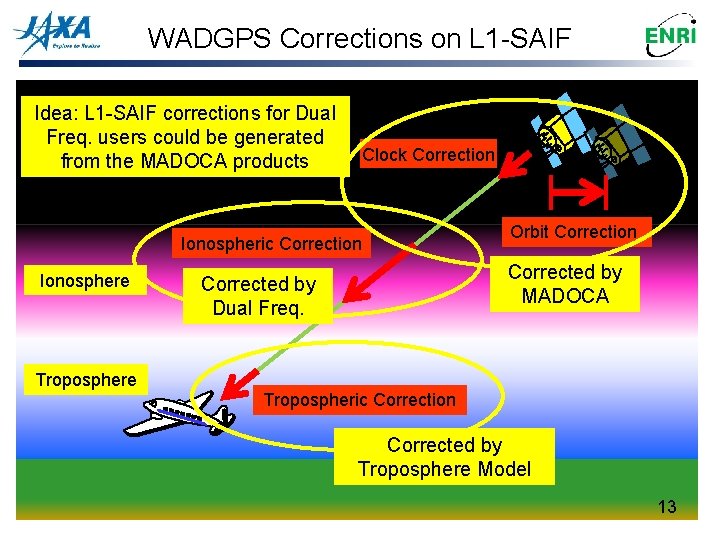
WADGPS Corrections on L 1 -SAIF Idea: L 1 -SAIF corrections for Dual Freq. users could be generated from the MADOCA products Clock Correction Ionospheric Correction Ionosphere Orbit Correction Corrected by MADOCA Corrected by Dual Freq. Troposphere Tropospheric Correction Corrected by Troposphere Model 13
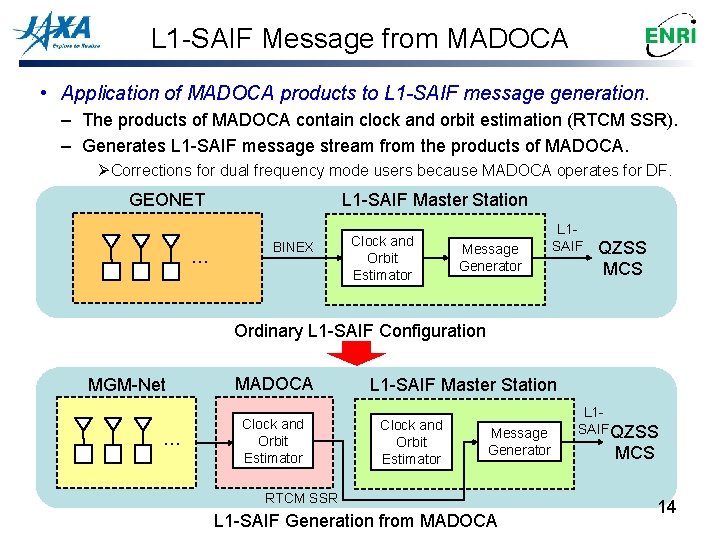
L 1 -SAIF Message from MADOCA • Application of MADOCA products to L 1 -SAIF message generation. – The products of MADOCA contain clock and orbit estimation (RTCM SSR). – Generates L 1 -SAIF message stream from the products of MADOCA. Ø Corrections for dual frequency mode users because MADOCA operates for DF. GEONET … L 1 -SAIF Master Station BINEX Clock and Orbit Estimator Message Generator L 1 SAIF QZSS MCS Ordinary L 1 -SAIF Configuration MGM-Net … MADOCA Clock and Orbit Estimator L 1 -SAIF Master Station Clock and Orbit Estimator Message Generator RTCM SSR L 1 -SAIF Generation from MADOCA L 1 SAIF QZSS MCS 14
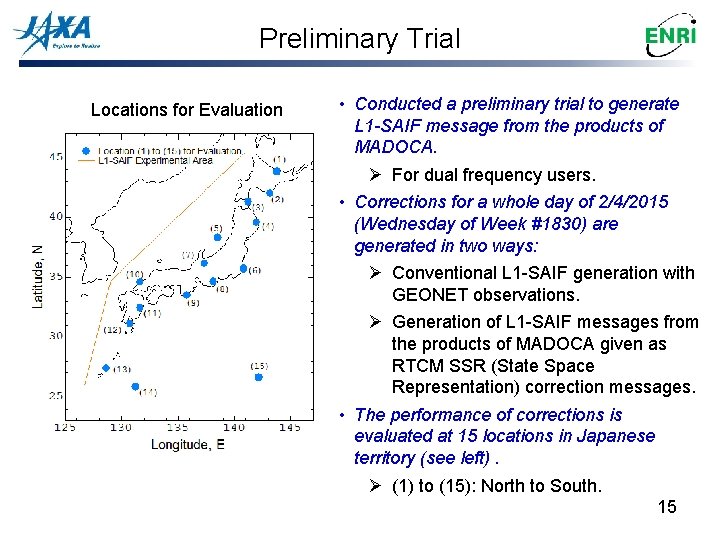
Preliminary Trial Locations for Evaluation • Conducted a preliminary trial to generate L 1 -SAIF message from the products of MADOCA. Ø For dual frequency users. • Corrections for a whole day of 2/4/2015 (Wednesday of Week #1830) are generated in two ways: Ø Conventional L 1 -SAIF generation with GEONET observations. Ø Generation of L 1 -SAIF messages from the products of MADOCA given as RTCM SSR (State Space Representation) correction messages. • The performance of corrections is evaluated at 15 locations in Japanese territory (see left). Ø (1) to (15): North to South. 15
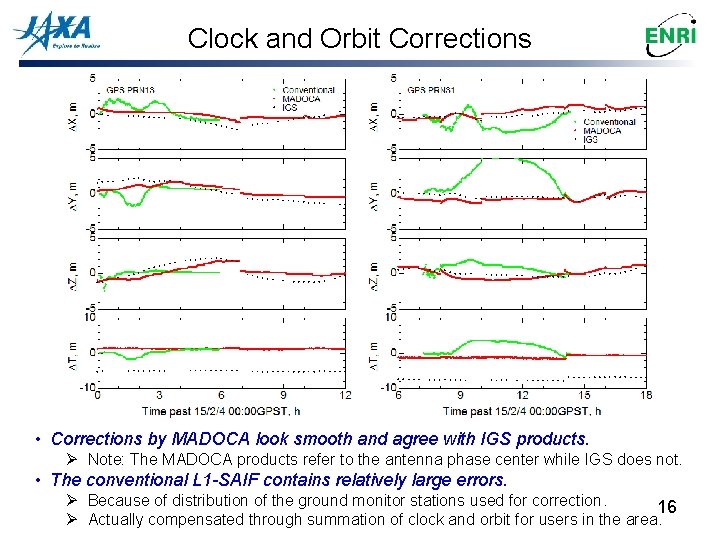
Clock and Orbit Corrections • Corrections by MADOCA look smooth and agree with IGS products. Ø Note: The MADOCA products refer to the antenna phase center while IGS does not. • The conventional L 1 -SAIF contains relatively large errors. Ø Because of distribution of the ground monitor stations used for correction. 16 Ø Actually compensated through summation of clock and orbit for users in the area.
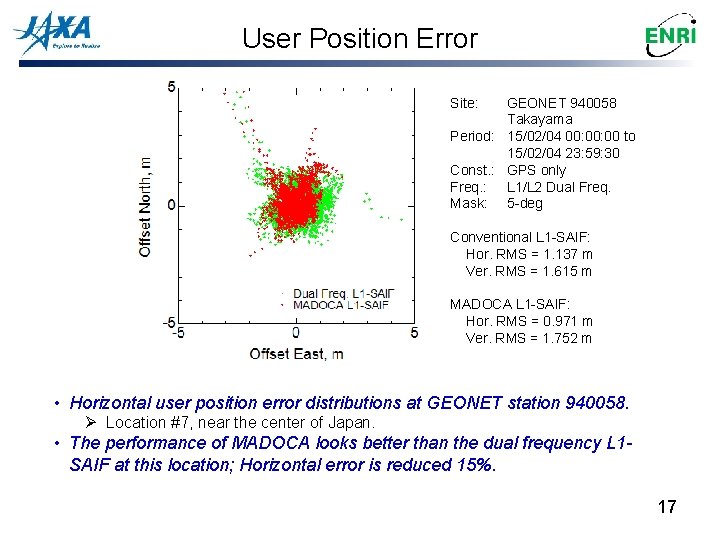
User Position Error Site: GEONET 940058 Takayama Period: 15/02/04 00: 00 to 15/02/04 23: 59: 30 Const. : GPS only Freq. : L 1/L 2 Dual Freq. Mask: 5 -deg Conventional L 1 -SAIF: Hor. RMS = 1. 137 m Ver. RMS = 1. 615 m MADOCA L 1 -SAIF: Hor. RMS = 0. 971 m Ver. RMS = 1. 752 m • Horizontal user position error distributions at GEONET station 940058. Ø Location #7, near the center of Japan. • The performance of MADOCA looks better than the dual frequency L 1 SAIF at this location; Horizontal error is reduced 15%. 17
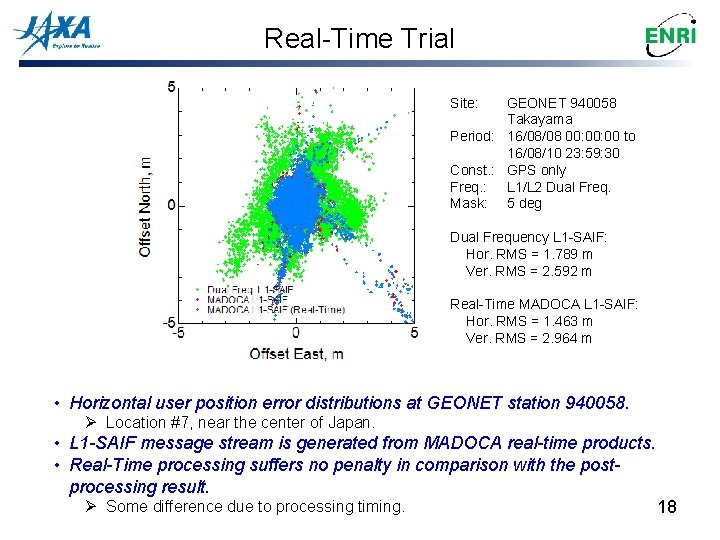
Real-Time Trial Site: GEONET 940058 Takayama Period: 16/08/08 00: 00 to 16/08/10 23: 59: 30 Const. : GPS only Freq. : L 1/L 2 Dual Freq. Mask: 5 deg Dual Frequency L 1 -SAIF: Hor. RMS = 1. 789 m Ver. RMS = 2. 592 m Real-Time MADOCA L 1 -SAIF: Hor. RMS = 1. 463 m Ver. RMS = 2. 964 m • Horizontal user position error distributions at GEONET station 940058. Ø Location #7, near the center of Japan. • L 1 -SAIF message stream is generated from MADOCA real-time products. • Real-Time processing suffers no penalty in comparison with the postprocessing result. Ø Some difference due to processing timing. 18
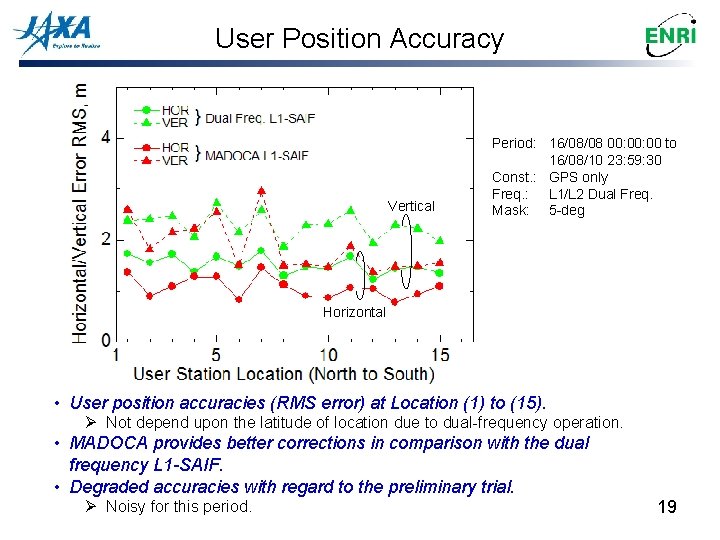
User Position Accuracy Vertical Period: 16/08/08 00: 00 to 16/08/10 23: 59: 30 Const. : GPS only Freq. : L 1/L 2 Dual Freq. Mask: 5 -deg Horizontal • User position accuracies (RMS error) at Location (1) to (15). Ø Not depend upon the latitude of location due to dual-frequency operation. • MADOCA provides better corrections in comparison with the dual frequency L 1 -SAIF. • Degraded accuracies with regard to the preliminary trial. Ø Noisy for this period. 19
Conclusion • The MADOCA project of JAXA: – Multi-GNSS Advanced Demonstration tool for Orbit and Clock Analysis: Ongoing project since 2011. – Capable of providing the precise clock and orbit estimation in realtime. Ø Realtime distribution via internet available since Sept. 2014. • L 1 -SAIF message generation from the products of MADOCA. – Confirmed that the products of MADOCA can be transmitted via L 1 SAIF messages. – The performance is comparable with the dual frequency L 1 -SAIF. – Verified the real-time operation. • Further developments: – Testing the performance outside Japan. – Supporting GLONASS, Galileo, QZSS, and/or Bei. Dou satellites. Contact: Dr. Takeyasu Sakai <sakai@mpat. go. jp> 20
- Slides: 20