
Test Ful Automatic UnitTest Generation for Java Classes

- Slides: 10
Test. Ful: Automatic Unit-Test Generation for Java Classes Matteo Miraz, Pier Luca Lanzi DEI – Politecnico di Milano (Italy)
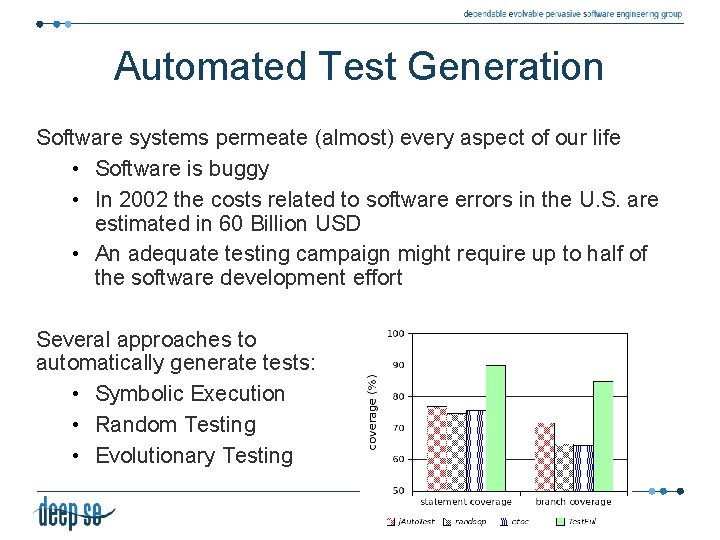
Automated Test Generation Software systems permeate (almost) every aspect of our life • Software is buggy • In 2002 the costs related to software errors in the U. S. are estimated in 60 Billion USD • An adequate testing campaign might require up to half of the software development effort Several approaches to automatically generate tests: • Symbolic Execution • Random Testing • Evolutionary Testing
Our Approach: Test. Ful Focuses on Java Classes • Features may be state-dependent Fitness Function: • Designed to maximize the number of features exercised • Composed by Statement, Branch & DU pairs coverage Efficiency Enhancements: • Local search to tackle difficult branches • Seeding to start from a better initial population • Fitness Inheritance to reduce the test execution costs
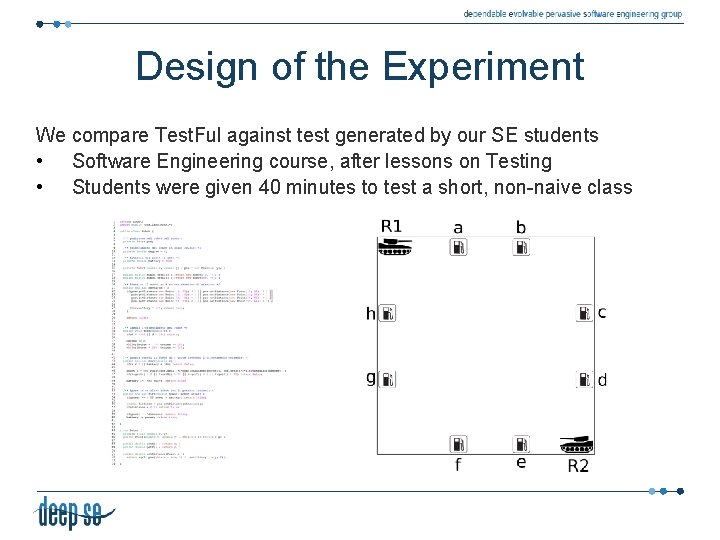
Design of the Experiment We compare Test. Ful against test generated by our SE students • Software Engineering course, after lessons on Testing • Students were given 40 minutes to test a short, non-naive class
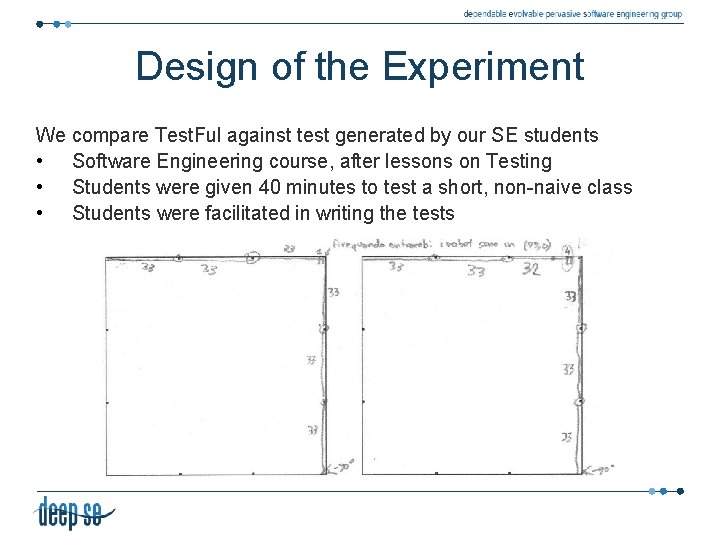
Design of the Experiment We compare Test. Ful against test generated by our SE students • Software Engineering course, after lessons on Testing • Students were given 40 minutes to test a short, non-naive class • Students were facilitated in writing the tests
Design of the Experiment We compare Test. Ful against test generated by our SE students • Software Engineering course, after lessons on Testing • Students were given 40 minutes to test a short, non-naive class • Students were facilitated in writing the tests • Automated approaches run on the same class for 10 minutes • The comparison was made on the test quality • Measured with mutation score • We used the Mann–Whitney–Wilcoxon U statistical test The experiment was inspired to: S. Mouchawrab et. al. , Assessing, Comparing, and Combining State Machine-Based Testing and Structural Testing: A Series of Experiments, IEEE Transactions on Software Engineering, 2010
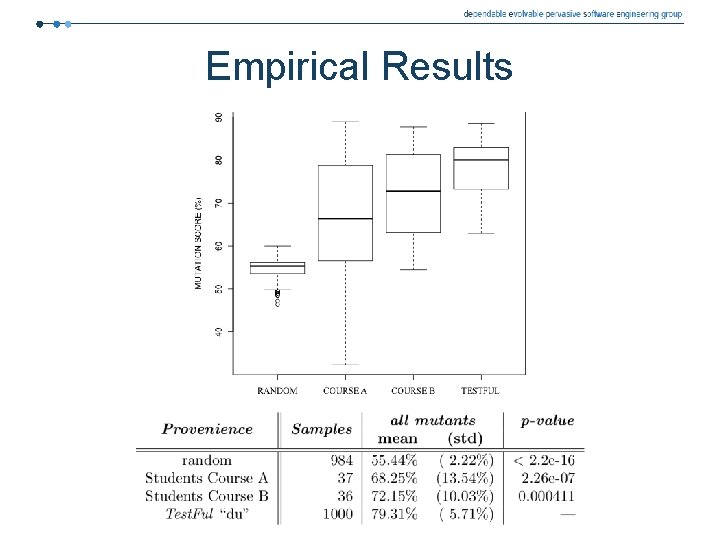
Empirical Results
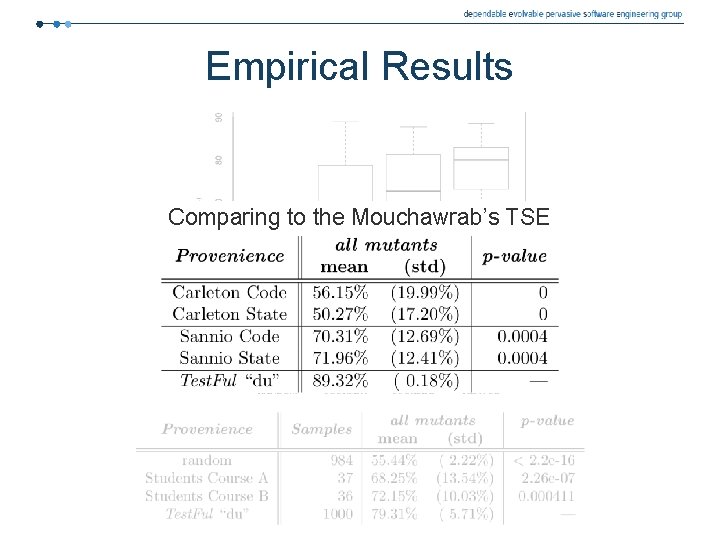
Empirical Results Comparing to the Mouchawrab’s TSE
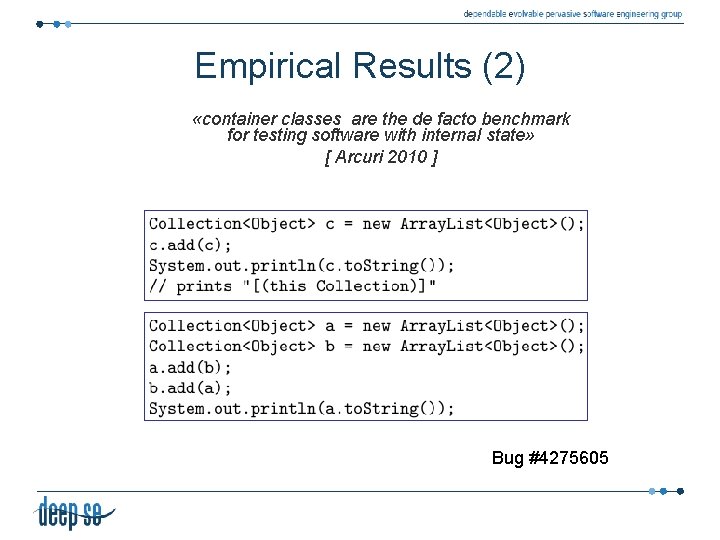
Empirical Results (2) «container classes are the de facto benchmark for testing software with internal state» [ Arcuri 2010 ] Bug #4275605
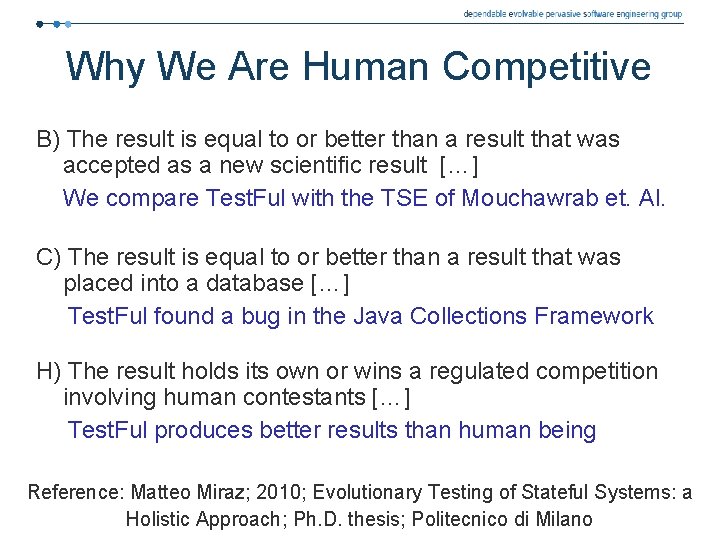
Why We Are Human Competitive B) The result is equal to or better than a result that was accepted as a new scientific result […] We compare Test. Ful with the TSE of Mouchawrab et. Al. C) The result is equal to or better than a result that was placed into a database […] Test. Ful found a bug in the Java Collections Framework H) The result holds its own or wins a regulated competition involving human contestants […] Test. Ful produces better results than human being Reference: Matteo Miraz; 2010; Evolutionary Testing of Stateful Systems: a Holistic Approach; Ph. D. thesis; Politecnico di Milano