
Test Format 28 Multiple Choice Questions 1 5

- Slides: 80
Test Format • 28 Multiple Choice Questions (1. 5 points each) • 3 Matching sections – Memory Check Revisited (Combination of the two sides into 1, 18 questions each word used once) – Phases of Mitosis (6 phases used once) – Campaign Posters (24 cell types, each used once) • 4 Short Answer Questions
Unit 2 Review
1 8 15 22 29 36 43 50 57 64 71 2 9 16 23 30 37 44 51 58 65 72 The Game Board 3 10 17 24 31 38 45 52 59 66 73 4 11 18 25 32 39 46 53 60 67 74 5 12 19 26 33 40 47 54 61 68 75 6 13 20 27 34 41 48 55 62 69 76 7 14 21 28 35 42 49 56 63 70 77
1 • When analyzing a specimen under a microscope, why do we stain the specimen? Answer: Most cell parts appear clear under the bright light of a microscope. Staining them gives them color and therefore makes it easier to see.
2 • When a chromosome copies itself, the copy is referred to by this “relative” term. Answer: sister
3 • This membrane junction are impermeable junctions that bind cells together into leakproof sheets? Answer: tight junctions
4 • This is a nonfunctioning unit in a cell. Answer: inclusion.
5 • This type of tissue is also known as fat, and it used to insulate the body and protect it from extreme conditions. Answer: Adipose Tissue
6 • This is another name for a red blood cell. Answer: erthrocyte
7 • Describe what happens during diffusion. Answer: Substances move from areas of high concentration to areas of low concentrations until eventually there is an equal concentration in all areas.
8 • When analyzing a specimen under a microscope, why must the sample be very thin? Answer: This is to allow light to pass through the sample and to allow only one layer of cells to be observed at a time
9 • In this phase, chromosomes appear as threadlike coils at the start, but each chromosome is copied by the end. Answer: interphase
10 • This is the process in which a pressure gradient actually pushes a solute containing fluid from a higher pressure to a lower pressure. Answer: filtration
11 • This refers to when a cell moves a large amount of substances out of the cell Answer: exocytosis
12 • What occurs if a solution is hypotonic and a cell was placed into it? Answer: The cell would swell and possibly rupture
13 • This is the process during protein synthesis when the DNA is copied by RNA. Answer: transcription
14 • This type of tissue is made up of connective tissue sheets that attach to the body’s skeleton and help the body with movement by contracting. Answer: skeletal muscle
15 • This type of connective tissue forms the cushionlike disks between the vertebrae. Answer: fibrocartilage
16 • This attaches skeletal muscles to bones. Answer: tendons
17 • This is also known as osseous tissue. Answer: bone
18 • This word mean one layer of cells. Answer: simple
19 • In this phase, centrioles appear and begin to move to opposite ends of the cell while spindle fibers forms between the poles. Answer: prophase
20 • In a homogenous mixture, this is the substance that dissolves the other material. Answer: solvent
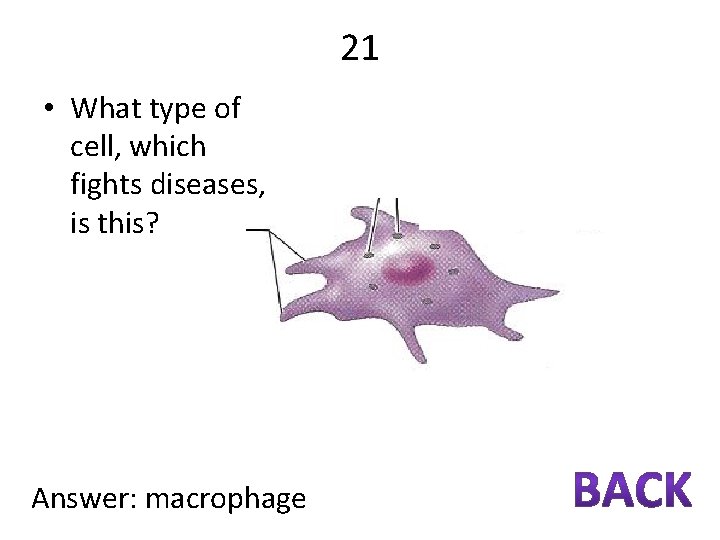
21 • What type of cell, which fights diseases, is this? Answer: macrophage
22 • This broad type of tissue if used for support. Answer: connective
23 • This type of tissue consists of several layers of cells that have a flattened shape and are the most common type of epithelium cell. Answer: stratified squamous epithelium
24 • In this phase, chromatids attach to the spindle fibers. Answer: metaphase
25 • Give two examples of tissues undergoing the aging process and what happens to the tissue as it ages. Answer: epithelial membranes lose their elasticity and began to sag We begin to “dry out” as exocrine glands become less active Endocrine glands produce less hormones so the body processes they control become less effective Bones become porous and weaker Muscles begin to atrophy (deteriorate)
26 • This refers specifically to when liquid material is taken into the cell. Answer: pinocytosis
27 • This broad type of tissue is used for control. Answer: nervous
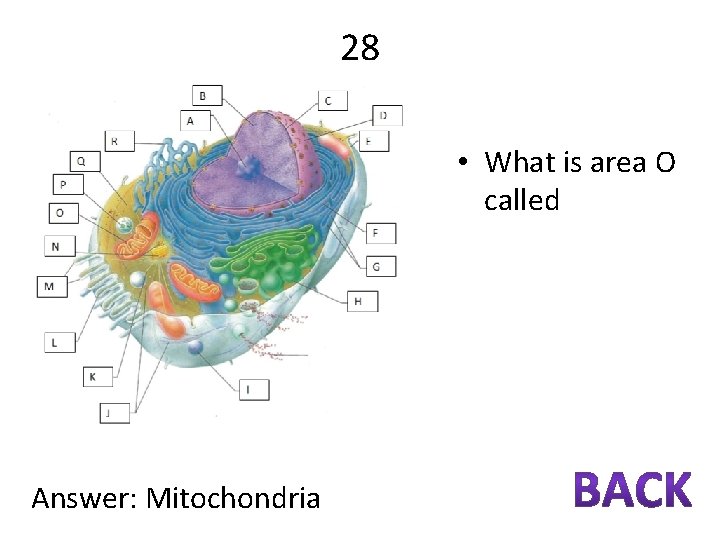
28 • What is area O called Answer: Mitochondria
29 • What occurs if a solution is hypertonic and a cell was placed into it? Answer: it would shrink
30 • This type of tissue help to insulate and protect the delicate neurons. Answer: Supporting cells of the nervous tissue
31 • In this phase, chromatids separate and begin to move to opposite ends of the cell. Answer: anaphase
32 • What is inflammation and how does it help the healing process. Answer: A swelling of a tissue. It is used by the body to keep the injured area from moving and thus prevents further damage
33 • This is a fragile, transparent barrier that consists of two lipid layers arrange “tail to tail” Answer: plasma membrane
34 • small, dark-staining round body where ribosomes are assembled Answer: nucleolus
35 • This is what the fluid inside the cell is referred to. Answer: intracellular fluid
36 • These detoxify the cell of poisonous materials and deactivate free radicals using oxidase enzymes. Answer: peroxisomes
37 • This type of tissue is a specialized impulseconducting cell that gathers information and controls body functions. Answer: neurons
38 • In this phase, two nuclei form and the chromosomes appear as chromatin. Answer: telophase
39 • This cell type covers and lines body organs. Answer: epithelial cells
40 • These are the “wires” that help to resist pulling forces on the cell. Answer: intermediate filaments
41 • Why are stratified epithelial tissues better for protection purposes than simple epithelial tissues? Answer: Stratified epithelial tissue has multiple layers of cells, which means there are more cells to absorb the damage
42 • This is the female cell of reproduction. Answer: oocyte
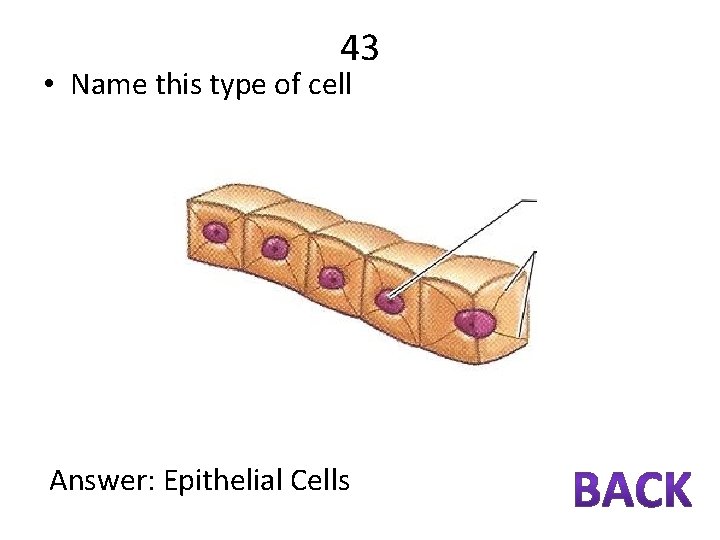
43 • Name this type of cell Answer: Epithelial Cells
44 • This is a slick membrane that lines the ventral body cavity and covers the organs in the cavity. Answer: serosae
45 • The lower surface of an epithelial tissue is known as this. Answer: the basement membrane
46 • These are tiny fingerlike projections that greatly increase the surface area for faster absorption Answer: microvilli
47 • In this phase, cell membranes moves inward to create two daughter cells. Answer: cytokinesis
48 • This refers to a increase in size in an organ or body area. Answer: hyperplasia
49 • This is the term used when a cell loses its ability to divide when it becomes fully mature. Answer: amitotic
50 • These are tiny, bilobed, dark bodies that are the protein making factories of the cell Answer: ribosomes
51 • This type of tissue is a cobwebby tissue that is the most widely distributed connective tissue that cushions the body organs. Answer: areolar tissue
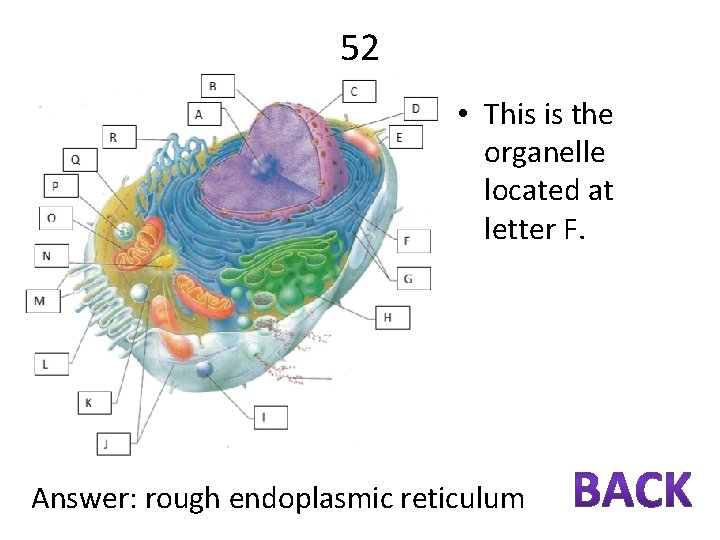
52 • This is the organelle located at letter F. Answer: rough endoplasmic reticulum
53 • This type of tissue travels throughout the body in a fluid matrix called plasma and has a variety of functions including transporting oxygen and carbon dioxide. Answer: blood
54 • This is known as an abnormal mass of proliferating cells. Answer: neoplasm
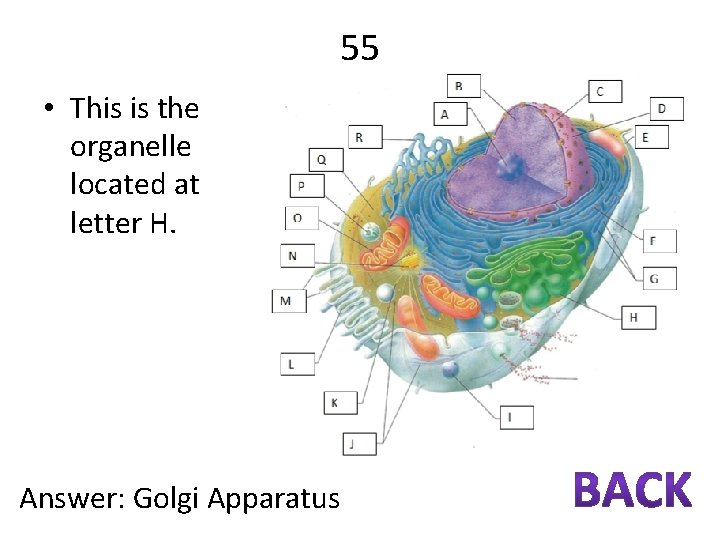
55 • This is the organelle located at letter H. Answer: Golgi Apparatus
56 • This is a sequence of three nucleotides forming a unit of genetic code in a transfer RNA molecule that corresponds to the complementary information on a messenger RNA. Answer: anticodon
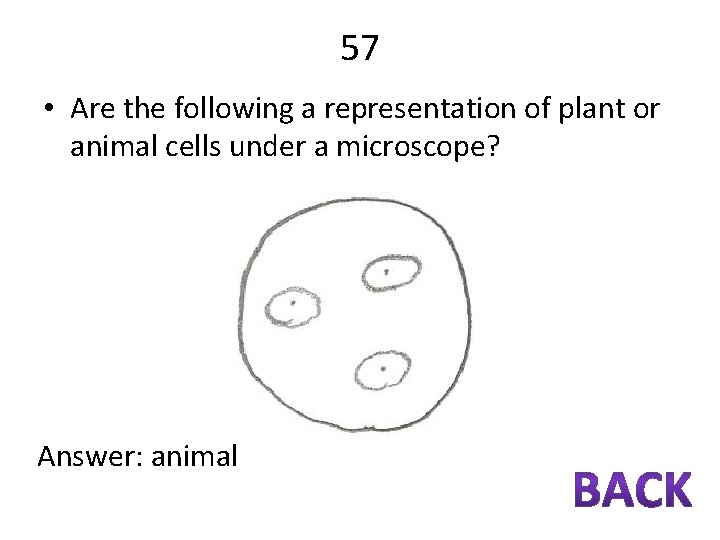
57 • Are the following a representation of plant or animal cells under a microscope? Answer: animal
58 • In a homogenous mixture, this is the substance that is dissolved the other material. Answer: solute
59 • What are three main regions of a cell? Answer: plasma membrane, nucleus, and cytoplasm
60 • Name an example of passive transport. Answer: facilitated diffusion, osmosis, filtration, or diffusion
61 • This membrane junction allows to adjacent cells to communicate with each other by allowing molecules to pass directly from on cell to the other. Answer: gap junction
62 • This type of RNA is a cloverleaf-shaped molecule that carries amino acids to the ribosome. Answer: transfer RNA
63 • This is defined as a DNA segment that carries the information for building one protein or polypeptide chain. Answer: gene
64 • This type of RNA molecule is a long, singular nucleotide strand that resemble half of a DNA molecule that carries the information from the nucleus to the ribosomes in the cytoplasm. Answer: messenger RNA
65 • This refers to a decrease in size in an organ or body area. Answer: atrophy
66 • This is the process during protein synthesis when the protein is made as the information is being read and decoded. Answer: translation
67 • This is the technique the body uses to repair tissues which results in scar tissue. Answer: fibrosis
68 • This is what the fluid outside the cell is referred to. Answer: Interstitial fluid
69 • This refers specifically to when solid material is taken into the cell and is referred to as “cell eating”. Answer: phagocytosis
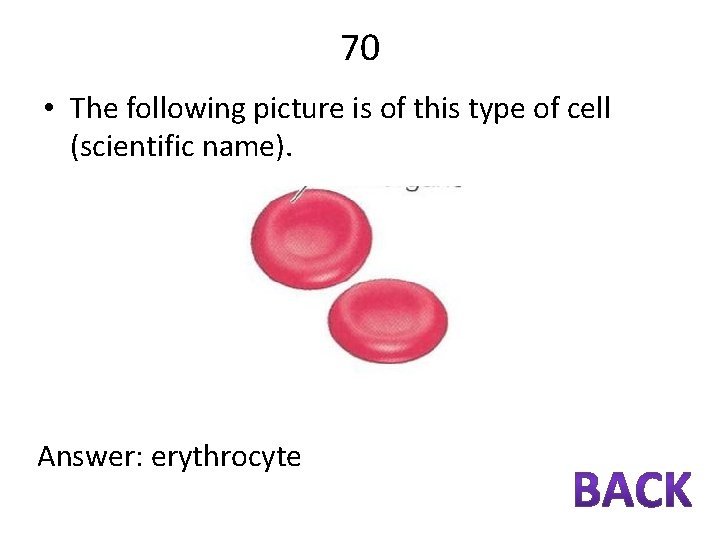
70 • The following picture is of this type of cell (scientific name). Answer: erythrocyte
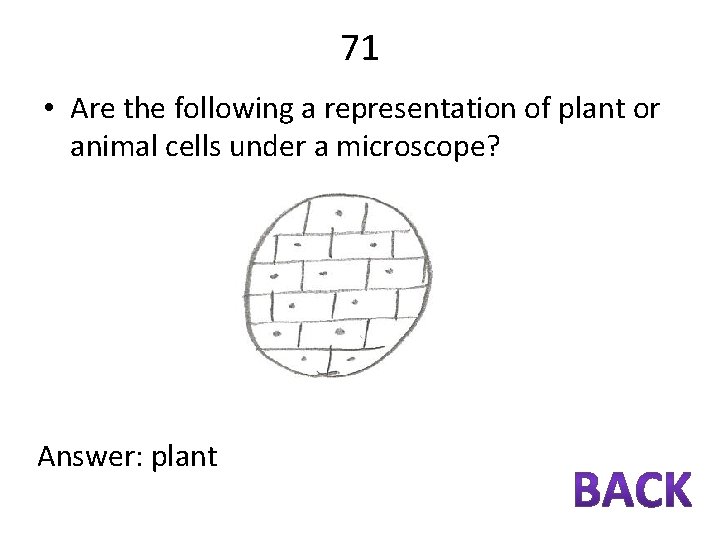
71 • Are the following a representation of plant or animal cells under a microscope? Answer: plant
72 • Name an example of active transport in a cell. Answer: solute pumping (or sodium potassium pump), bulk transport (or endo and exo cytosis)
73 • These are special pores created by proteins that allow water into the cell. Answer: aquaporins
74 • When a tissue is injured, the body sets a series of events into motion. Which of the following is NOT true? – The surface epithelium regenerates – The capillaries become less permeable – Phagocytes concentration increases – Granulation tissue forms Answer: The capillaries become less permeable
75 • During active transport process, cells use this molecule to power the movement. Answer: ATP
76 • This is the movement of water through a selectively permeable membrane from areas of high concentration to low concentration. Answer: osmosis
77 • The elongated shape of this cell lies along the cable-like fibers that it secretes. It also has an abundant rough ER and large Golgi apparatus to make and secrete the protein building blocks of these cells. Answer: fibroblast