
Test Driven Development Gayatri Madhubala Software Testing Types
Test Driven Development --Gayatri --Madhubala
Software Testing Types Black box testing Load testing White box testing Stress testing Unit testing Performance testing Incremental integration testing Usability testing Integration testing Install/uninstall testing Functional testing Recovery testing System testing Security testing End-to-end testing Compatibility testing Sanity testing Comparison testing Regression testing Alpha testing Acceptance testing Beta testing

Testing tools Unit Testing Tools Unittest 2 Nose Gui Testing Tools Pywinauto Gui auto … Mock Testing Tools Mock Py. Mock Web Testing Tools windmill Selenium svn. Mock. . Fuzz Testing Tools Pester Peach. Fuzzer. . Code. Coverage Tools Coverage . . Integration Testing Tools Buildout bitten. . . Source codechecking Tools pylint
Unit Testing . . run completely by itself, without any human input. Unit testing is about automation. . . . determine by itself whether the function it is testing has passed or failed, without a human interpreting the results. . . . run in isolation, separate from any other test cases (even if they test the same functions). Each test case is an island Goal Isolate each part of the program and show that the individual parts are correct. Benifits . . A unit test provides a strict, written contract that the piece of code must satisfy. As a result, it affords several benefits. Unit tests find problems early in the development cycle Limitations- -Testing cannot be expected to catch every error in the program
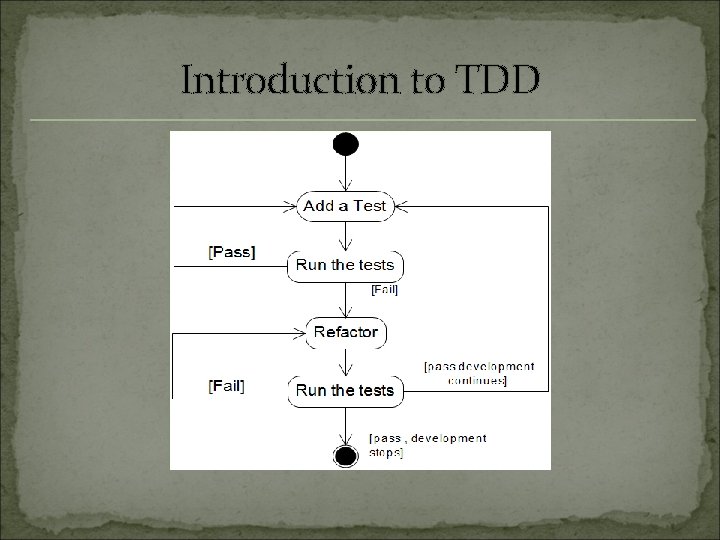
Introduction to TDD
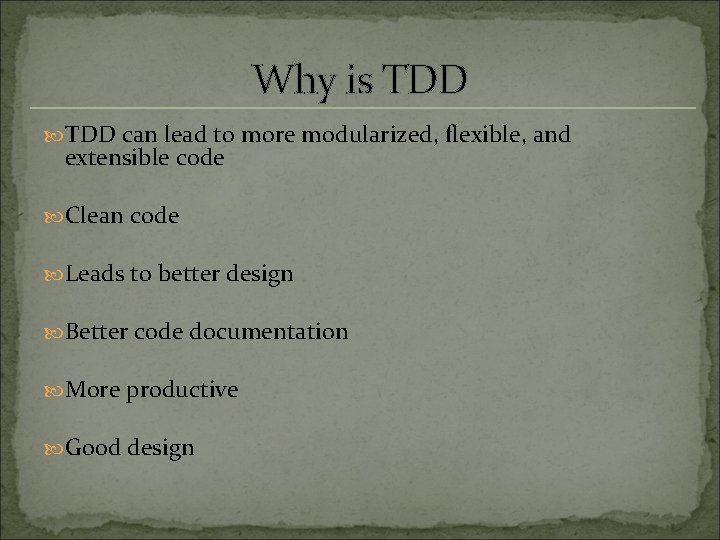
Why is TDD can lead to more modularized, flexible, and extensible code Clean code Leads to better design Better code documentation More productive Good design
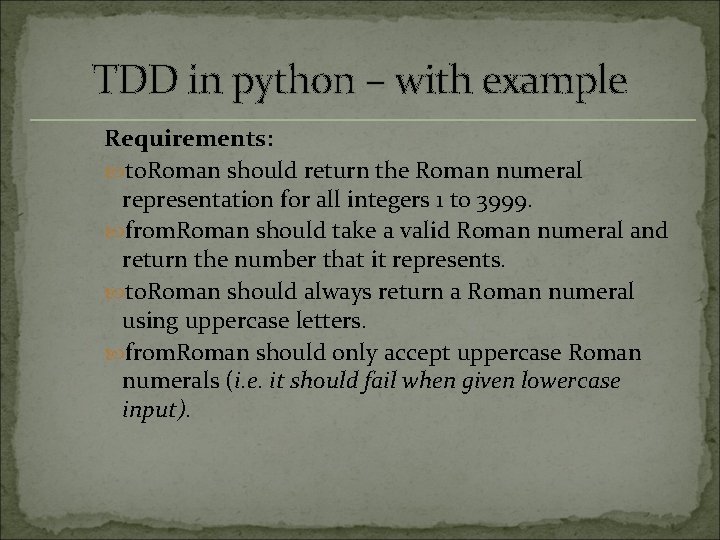
TDD in python – with example Requirements: to. Roman should return the Roman numeral representation for all integers 1 to 3999. from. Roman should take a valid Roman numeral and return the number that it represents. to. Roman should always return a Roman numeral using uppercase letters. from. Roman should only accept uppercase Roman numerals (i. e. it should fail when given lowercase input).

TDD in python – with example, Continue. . #roman. py """Convert to and from Roman numerals""" #Define exceptions class Roman. Error(Exception): pass class Out. Of. Range. Error(Roman. Error): pass class Not. Integer. Error(Roman. Error): pass class Invalid. Roman. Numeral. Error(Roman. Error): pass def to. Roman(n): """convert integer to Roman numeral""" pass def from. Roman(s): """convert Roman numeral to integer""" pass
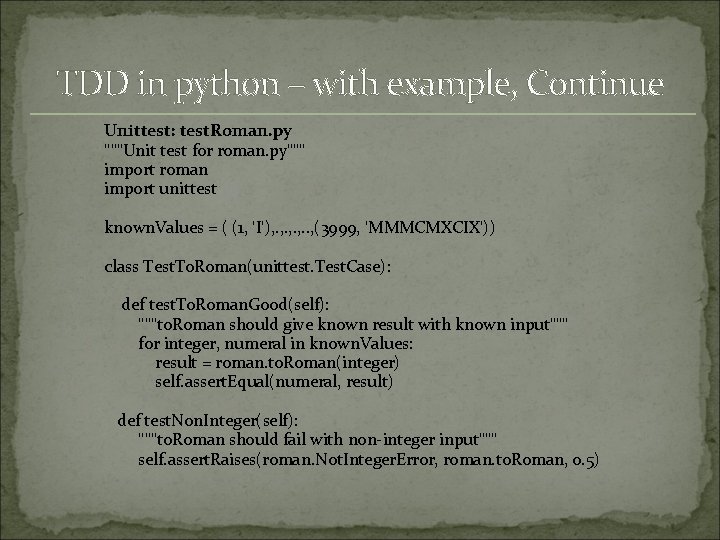
TDD in python – with example, Continue Unittest: test. Roman. py """Unit test for roman. py""" import roman import unittest known. Values = ( (1, 'I'), . , (3999, 'MMMCMXCIX')) class Test. To. Roman(unittest. Test. Case): def test. To. Roman. Good(self): """to. Roman should give known result with known input""" for integer, numeral in known. Values: result = roman. to. Roman(integer) self. assert. Equal(numeral, result) def test. Non. Integer(self): """to. Roman should fail with non-integer input""" self. assert. Raises(roman. Not. Integer. Error, roman. to. Roman, 0. 5)
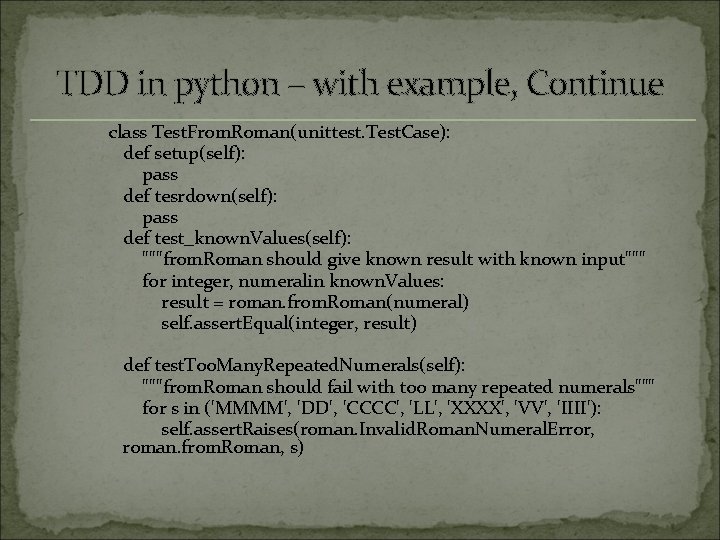
TDD in python – with example, Continue class Test. From. Roman(unittest. Test. Case): def setup(self): pass def tesrdown(self): pass def test_known. Values(self): """from. Roman should give known result with known input""" for integer, numeralin known. Values: result = roman. from. Roman(numeral) self. assert. Equal(integer, result) def test. Too. Many. Repeated. Numerals(self): """from. Roman should fail with too many repeated numerals""" for s in ('MMMM', 'DD', 'CCCC', 'LL', 'XXXX', 'VV', 'IIII'): self. assert. Raises(roman. Invalid. Roman. Numeral. Error, roman. from. Roman, s)
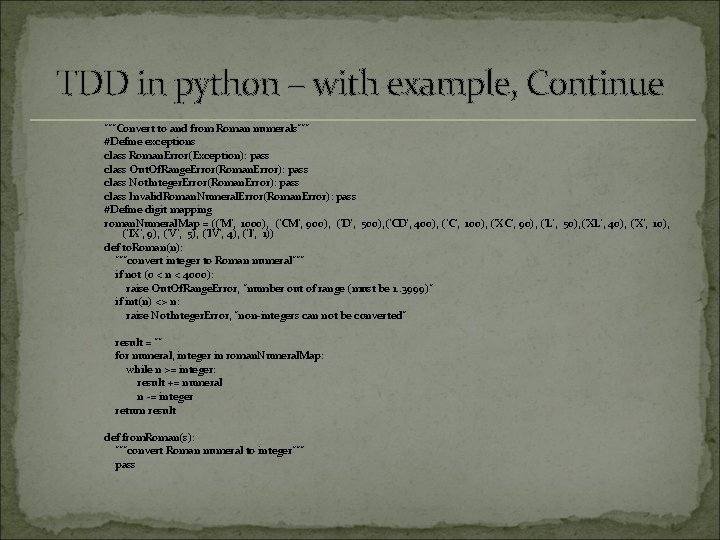
TDD in python – with example, Continue """Convert to and from Roman numerals""" #Define exceptions class Roman. Error(Exception): pass class Out. Of. Range. Error(Roman. Error): pass class Not. Integer. Error(Roman. Error): pass class Invalid. Roman. Numeral. Error(Roman. Error): pass #Define digit mapping roman. Numeral. Map = (('M', 1000), ('CM', 900), ('D', 500), ('CD', 400), ('C', 100), ('XC', 90), ('L', 50), ('XL', 40), ('X', 10), ('IX', 9), ('V', 5), ('IV', 4), ('I', 1)) def to. Roman(n): """convert integer to Roman numeral""" if not (0 < n < 4000): raise Out. Of. Range. Error, "number out of range (must be 1. . 3999)" if int(n) <> n: raise Not. Integer. Error, "non-integers can not be converted" result = "" for numeral, integer in roman. Numeral. Map: while n >= integer: result += numeral n -= integer return result def from. Roman(s): """convert Roman numeral to integer""" pass
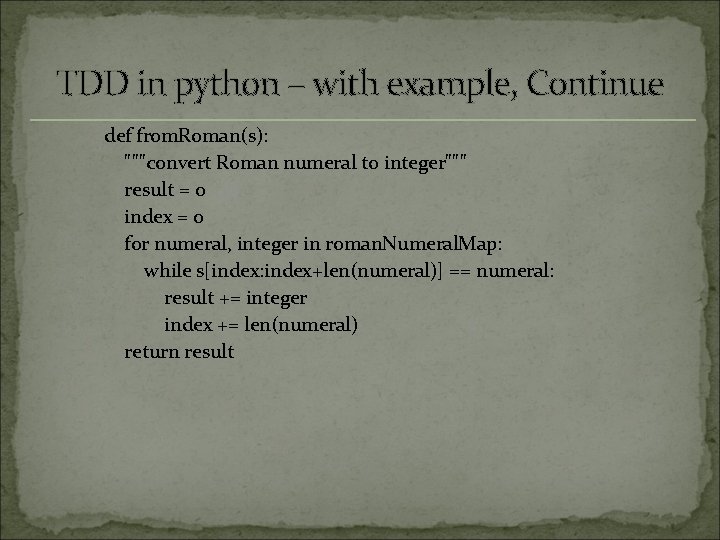
TDD in python – with example, Continue def from. Roman(s): """convert Roman numeral to integer""" result = 0 index = 0 for numeral, integer in roman. Numeral. Map: while s[index: index+len(numeral)] == numeral: result += integer index += len(numeral) return result
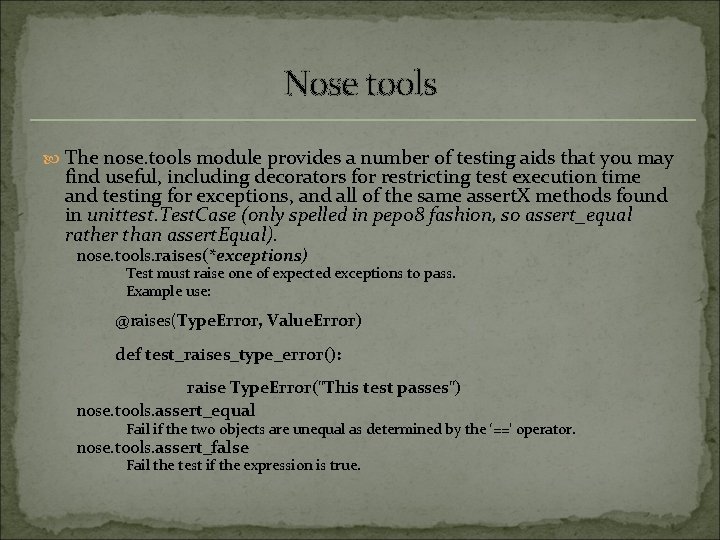
Nose tools The nose. tools module provides a number of testing aids that you may find useful, including decorators for restricting test execution time and testing for exceptions, and all of the same assert. X methods found in unittest. Test. Case (only spelled in pep 08 fashion, so assert_equal rather than assert. Equal). nose. tools. raises(*exceptions) Test must raise one of expected exceptions to pass. Example use: @raises(Type. Error, Value. Error) def test_raises_type_error(): raise Type. Error("This test passes") nose. tools. assert_equal Fail if the two objects are unequal as determined by the ‘==’ operator. nose. tools. assert_false Fail the test if the expression is true.
Thank you – Q&A
- Slides: 14