
Test Data Generators Lecture 5 Why Distinguish Instructions

- Slides: 43
Test Data Generators Lecture 5
Why Distinguish Instructions? • Functions always give the same result for the same arguments • Instructions can behave differently on different occasions • Confusing them (as in most programming languages) is a major source of bugs – This concept a major breakthrough in programming languages in the 1990 s – How would you write do. Twice in C?
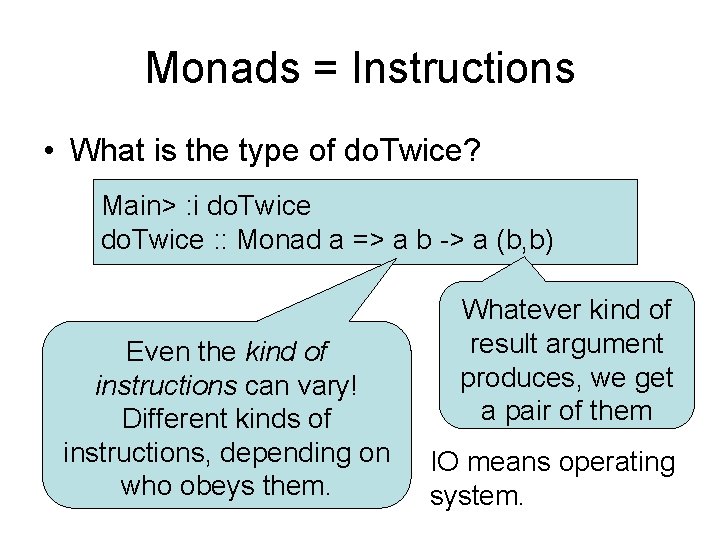
Monads = Instructions • What is the type of do. Twice? Main> : i do. Twice : : Monad a => a b -> a (b, b) Even the kind of instructions can vary! Different kinds of instructions, depending on who obeys them. Whatever kind of result argument produces, we get a pair of them IO means operating system.
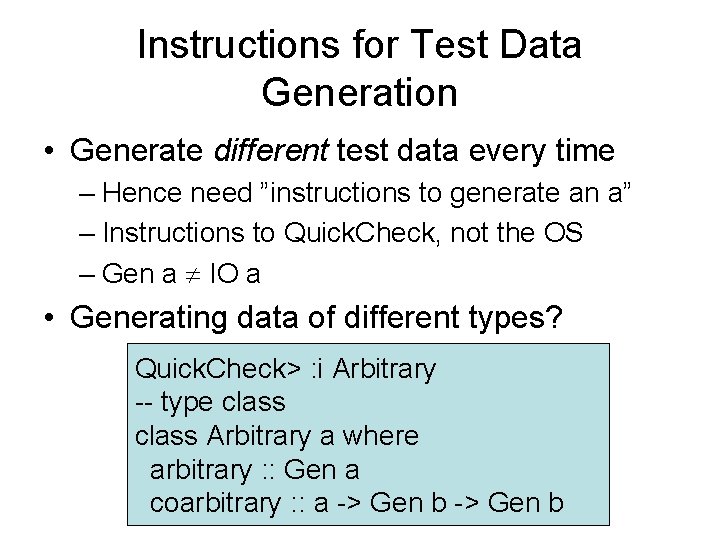
Instructions for Test Data Generation • Generate different test data every time – Hence need ”instructions to generate an a” – Instructions to Quick. Check, not the OS – Gen a IO a • Generating data of different types? Quick. Check> : i Arbitrary -- type class Arbitrary a where arbitrary : : Gen a coarbitrary : : a -> Gen b
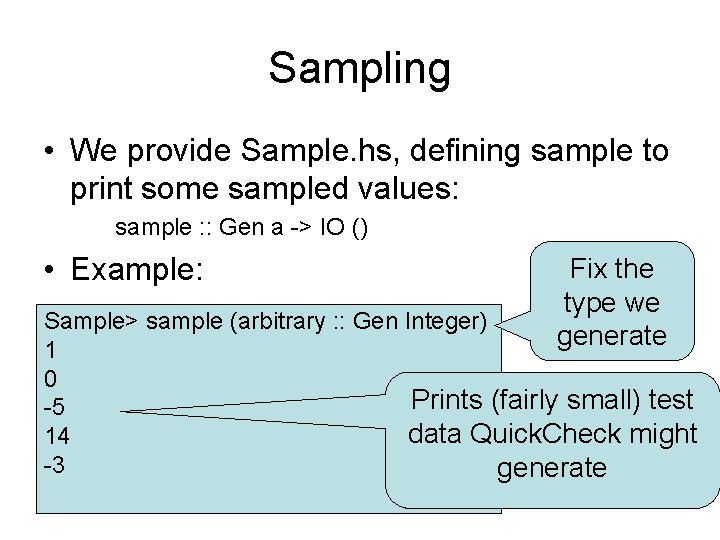
Sampling • We provide Sample. hs, defining sample to print some sampled values: sample : : Gen a -> IO () • Example: Fix the type we generate Sample> sample (arbitrary : : Gen Integer) 1 0 Prints (fairly small) test -5 data Quick. Check might 14 -3 generate
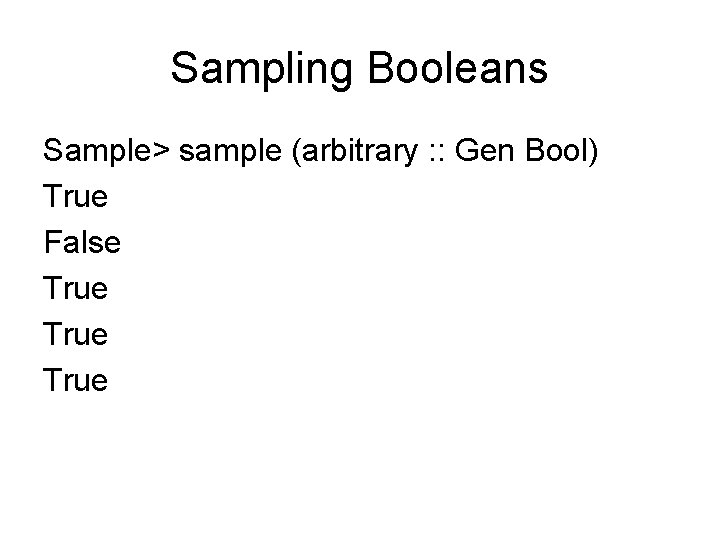
Sampling Booleans Sample> sample (arbitrary : : Gen Bool) True False True
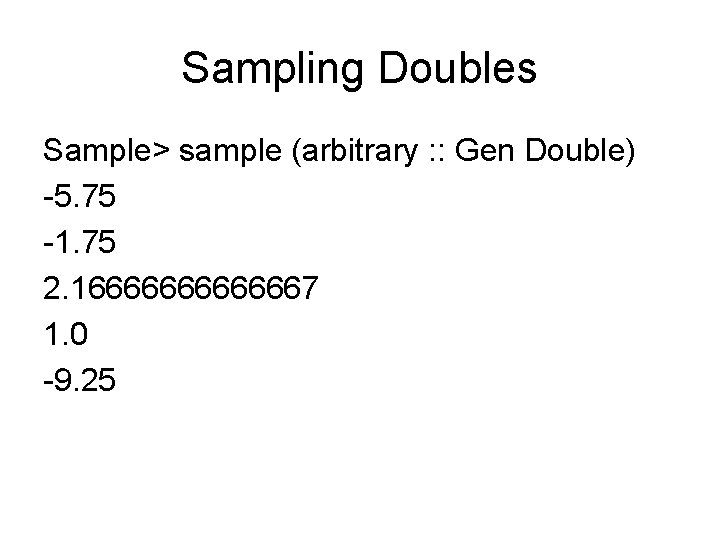
Sampling Doubles Sample> sample (arbitrary : : Gen Double) -5. 75 -1. 75 2. 16666667 1. 0 -9. 25
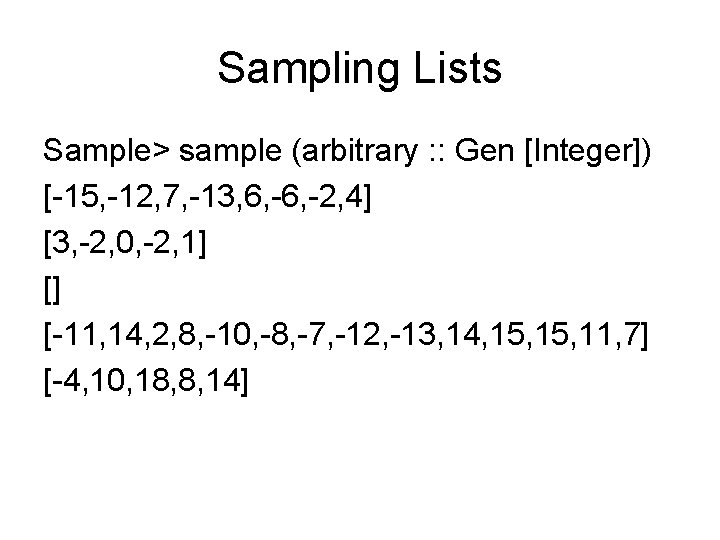
Sampling Lists Sample> sample (arbitrary : : Gen [Integer]) [-15, -12, 7, -13, 6, -2, 4] [3, -2, 0, -2, 1] [] [-11, 14, 2, 8, -10, -8, -7, -12, -13, 14, 15, 11, 7] [-4, 10, 18, 8, 14]
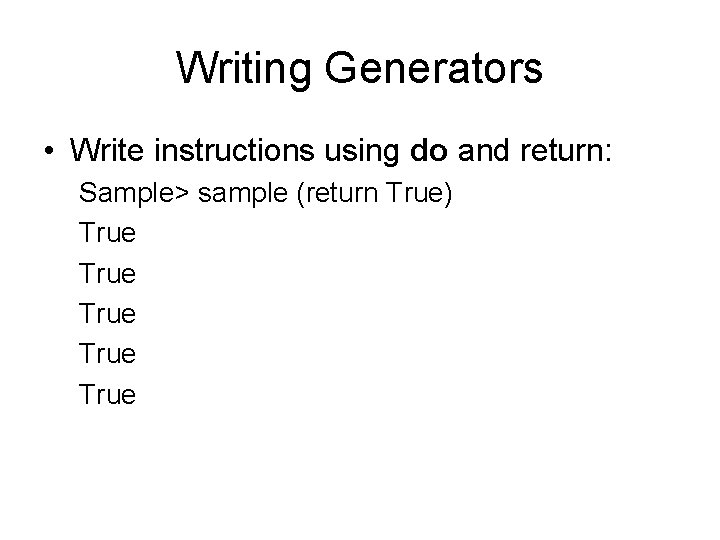
Writing Generators • Write instructions using do and return: Sample> sample (return True) True True
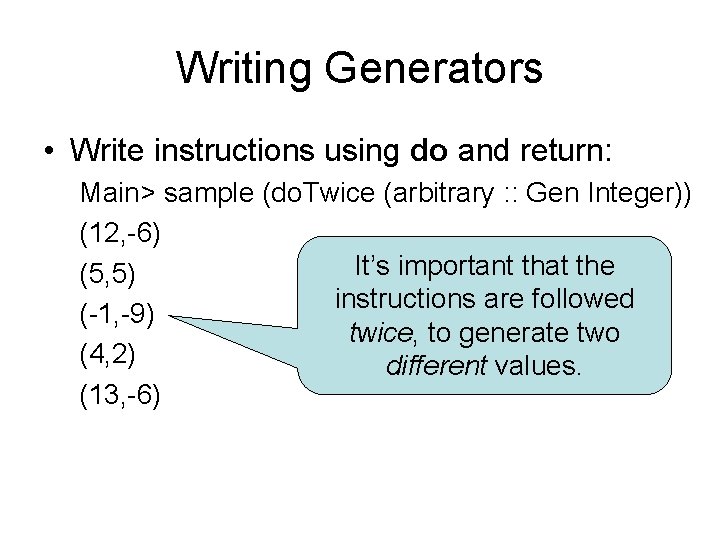
Writing Generators • Write instructions using do and return: Main> sample (do. Twice (arbitrary : : Gen Integer)) (12, -6) It’s important that the (5, 5) instructions are followed (-1, -9) twice, to generate two (4, 2) different values. (13, -6)
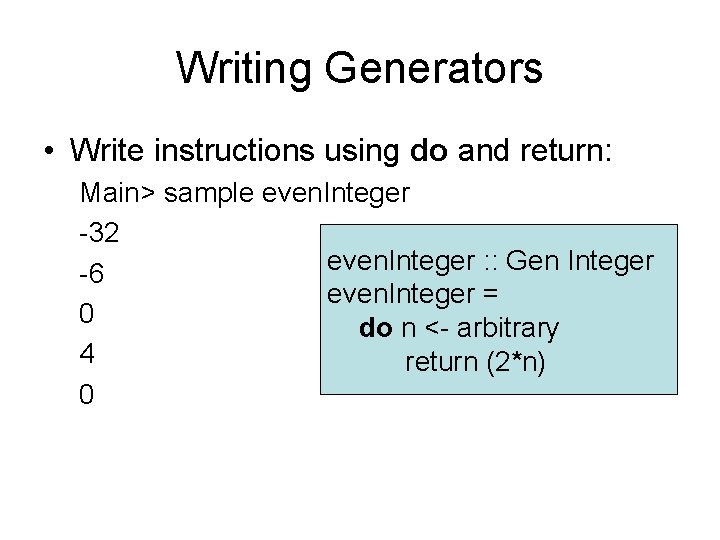
Writing Generators • Write instructions using do and return: Main> sample even. Integer -32 even. Integer : : Gen Integer -6 even. Integer = 0 do n <- arbitrary 4 return (2*n) 0
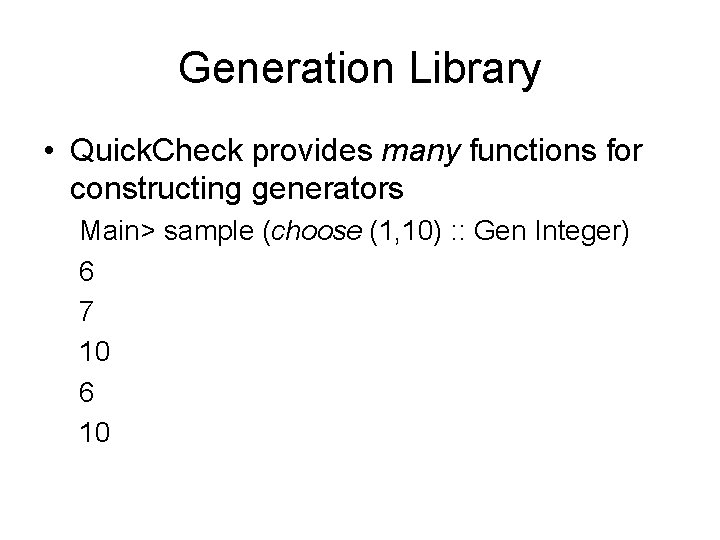
Generation Library • Quick. Check provides many functions for constructing generators Main> sample (choose (1, 10) : : Gen Integer) 6 7 10 6 10
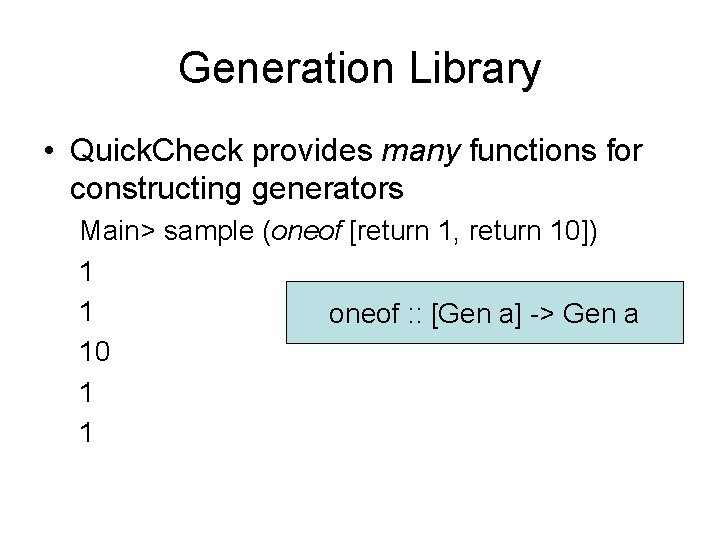
Generation Library • Quick. Check provides many functions for constructing generators Main> sample (oneof [return 1, return 10]) 1 1 oneof : : [Gen a] -> Gen a 10 1 1
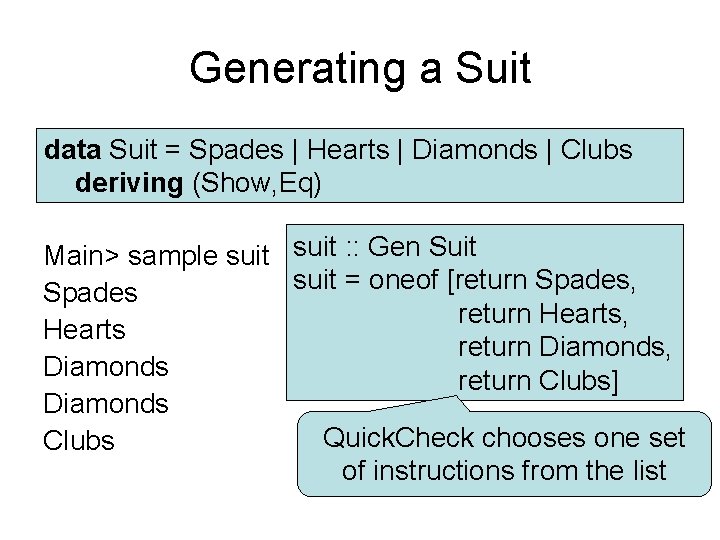
Generating a Suit data Suit = Spades | Hearts | Diamonds | Clubs deriving (Show, Eq) Main> sample suit : : Gen Suit suit = oneof [return Spades, Spades return Hearts, Hearts return Diamonds, Diamonds return Clubs] Diamonds Quick. Check chooses one set Clubs of instructions from the list
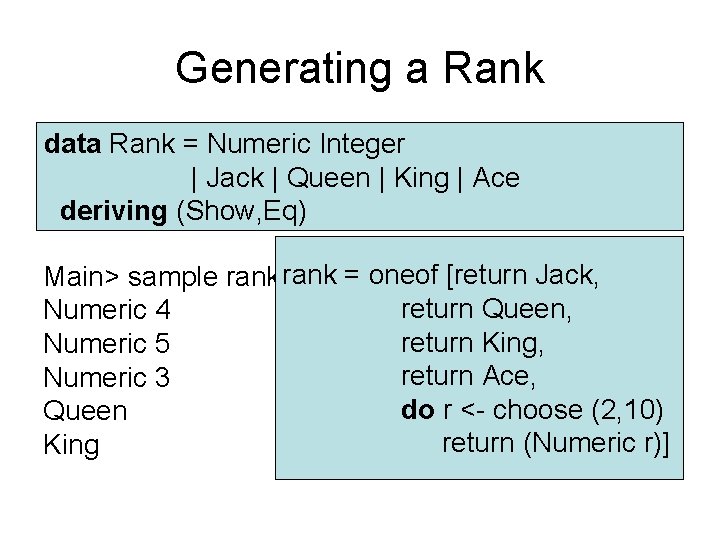
Generating a Rank data Rank = Numeric Integer | Jack | Queen | King | Ace deriving (Show, Eq) Main> sample rank = oneof [return Jack, return Queen, Numeric 4 return King, Numeric 5 return Ace, Numeric 3 do r <- choose (2, 10) Queen return (Numeric r)] King
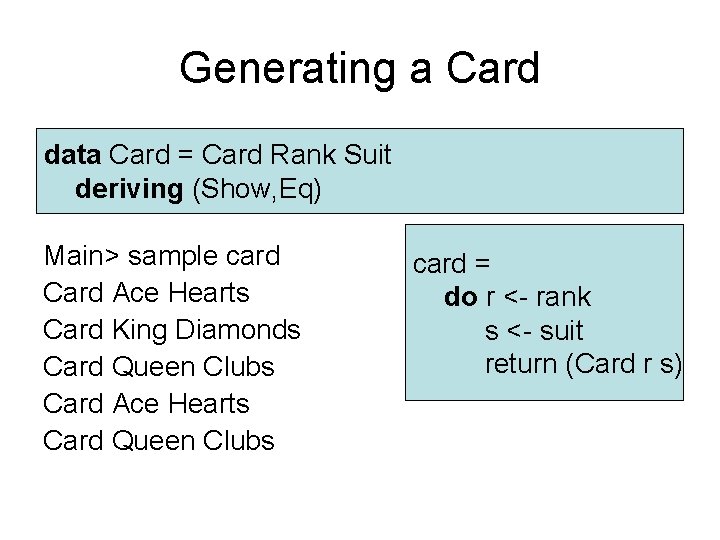
Generating a Card data Card = Card Rank Suit deriving (Show, Eq) Main> sample card Card Ace Hearts Card King Diamonds Card Queen Clubs Card Ace Hearts Card Queen Clubs card = do r <- rank s <- suit return (Card r s)
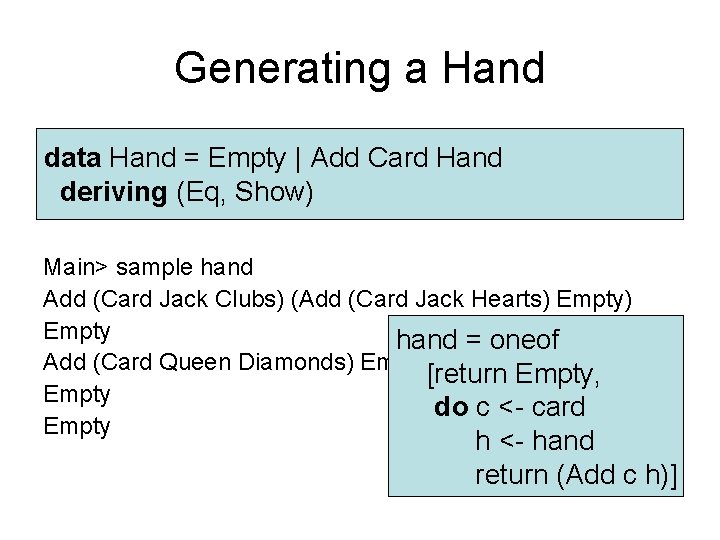
Generating a Hand data Hand = Empty | Add Card Hand deriving (Eq, Show) Main> sample hand Add (Card Jack Clubs) (Add (Card Jack Hearts) Empty hand = oneof Add (Card Queen Diamonds) Empty [return Empty, Empty do c <- card Empty h <- hand return (Add c h)]
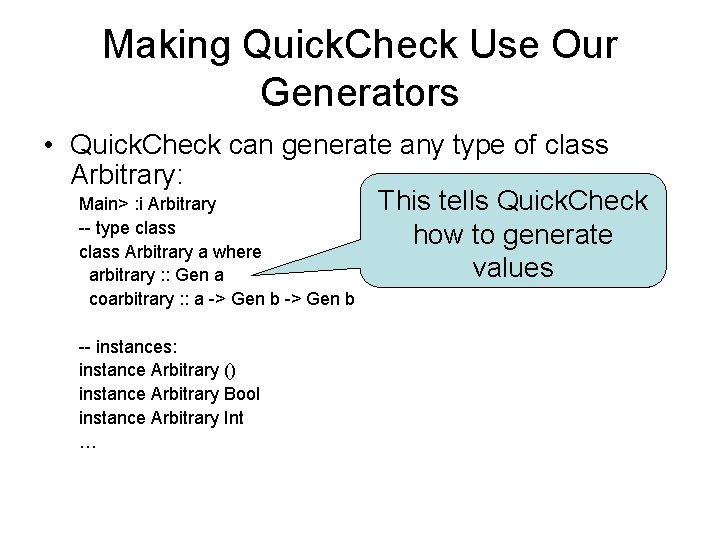
Making Quick. Check Use Our Generators • Quick. Check can generate any type of class Arbitrary: This tells Quick. Check Main> : i Arbitrary -- type class how to generate class Arbitrary a where values arbitrary : : Gen a coarbitrary : : a -> Gen b -- instances: instance Arbitrary () instance Arbitrary Bool instance Arbitrary Int …
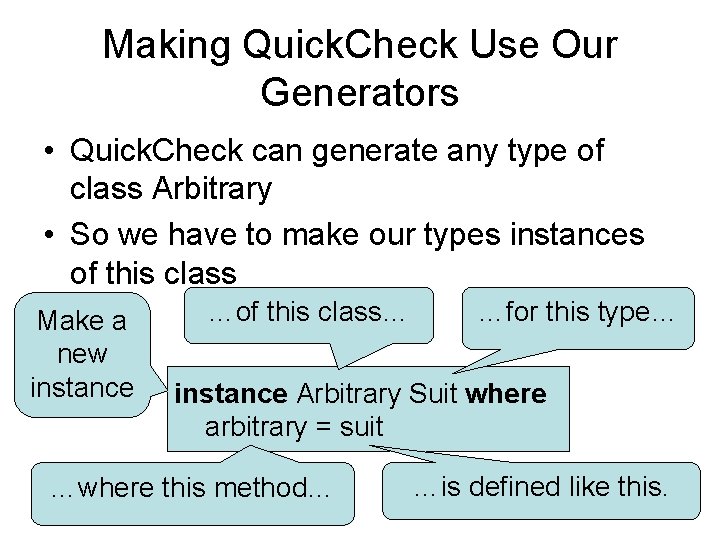
Making Quick. Check Use Our Generators • Quick. Check can generate any type of class Arbitrary • So we have to make our types instances of this class Make a new instance …of this class… …for this type… instance Arbitrary Suit where arbitrary = suit …where this method… …is defined like this.
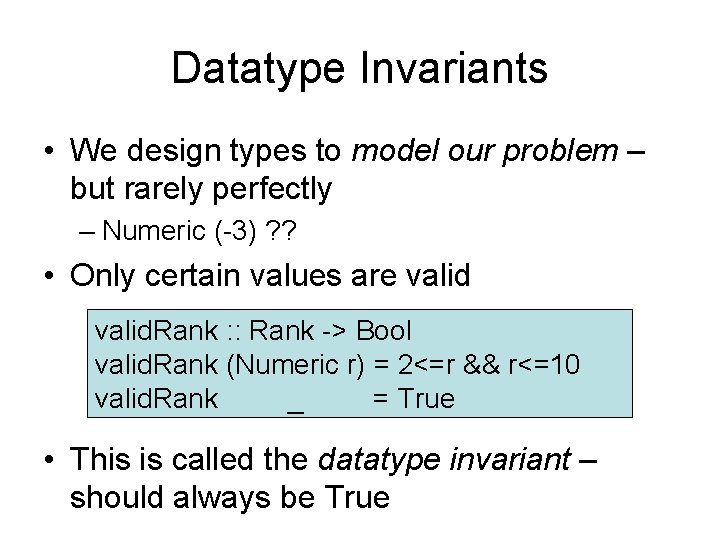
Datatype Invariants • We design types to model our problem – but rarely perfectly – Numeric (-3) ? ? • Only certain values are valid. Rank : : Rank -> Bool valid. Rank (Numeric r) = 2<=r && r<=10 valid. Rank _ = True • This is called the datatype invariant – should always be True
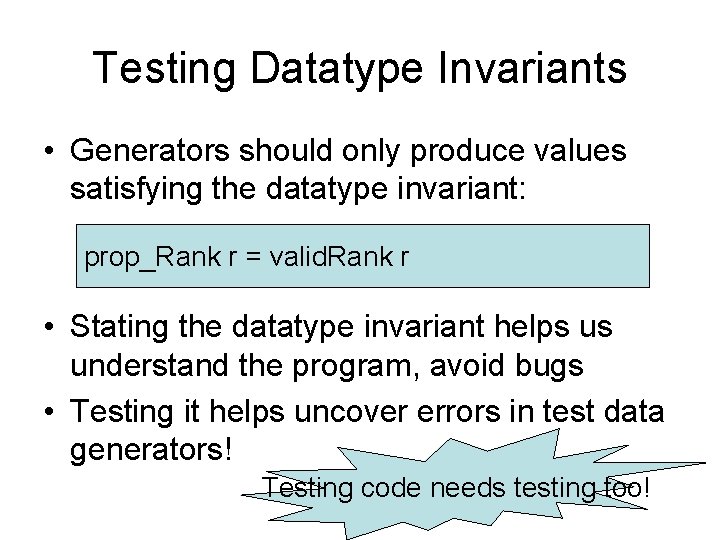
Testing Datatype Invariants • Generators should only produce values satisfying the datatype invariant: prop_Rank r = valid. Rank r • Stating the datatype invariant helps us understand the program, avoid bugs • Testing it helps uncover errors in test data generators! Testing code needs testing too!
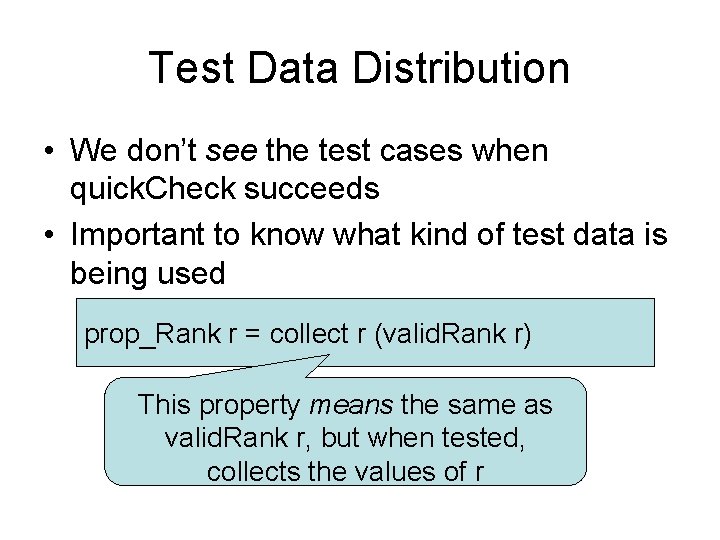
Test Data Distribution • We don’t see the test cases when quick. Check succeeds • Important to know what kind of test data is being used prop_Rank r = collect r (valid. Rank r) This property means the same as valid. Rank r, but when tested, collects the values of r
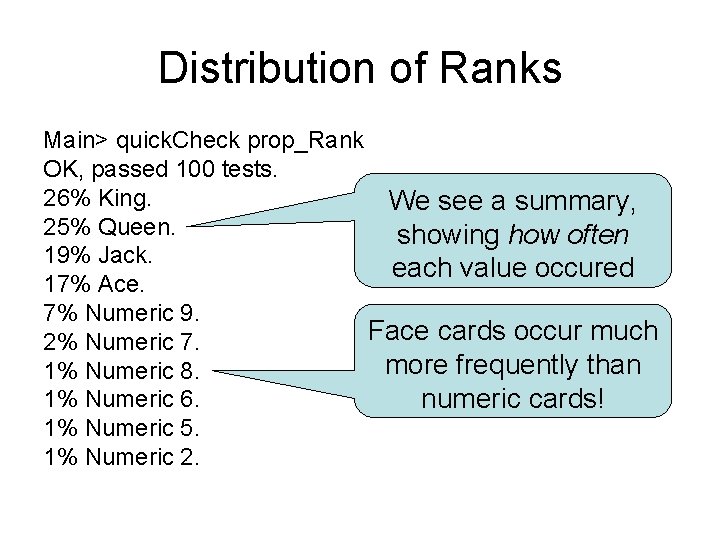
Distribution of Ranks Main> quick. Check prop_Rank OK, passed 100 tests. 26% King. We see a summary, 25% Queen. showing how often 19% Jack. each value occured 17% Ace. 7% Numeric 9. Face cards occur much 2% Numeric 7. more frequently than 1% Numeric 8. 1% Numeric 6. numeric cards! 1% Numeric 5. 1% Numeric 2.
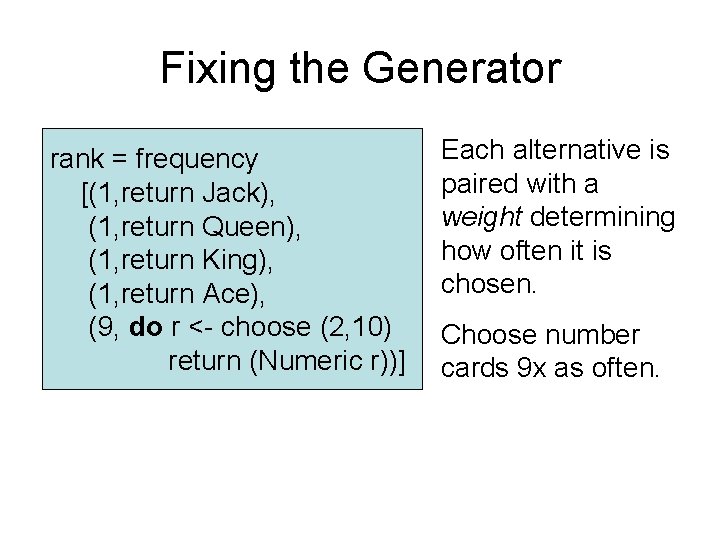
Fixing the Generator rank = frequency [(1, return Jack), (1, return Queen), (1, return King), (1, return Ace), (9, do r <- choose (2, 10) return (Numeric r))] Each alternative is paired with a weight determining how often it is chosen. Choose number cards 9 x as often.
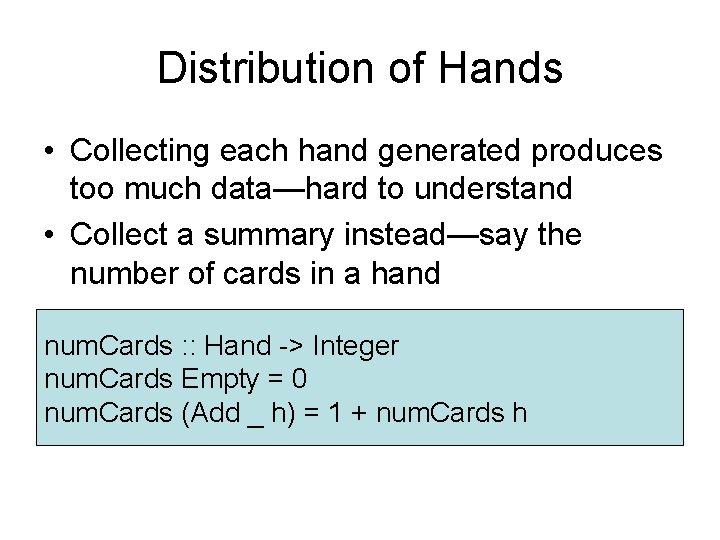
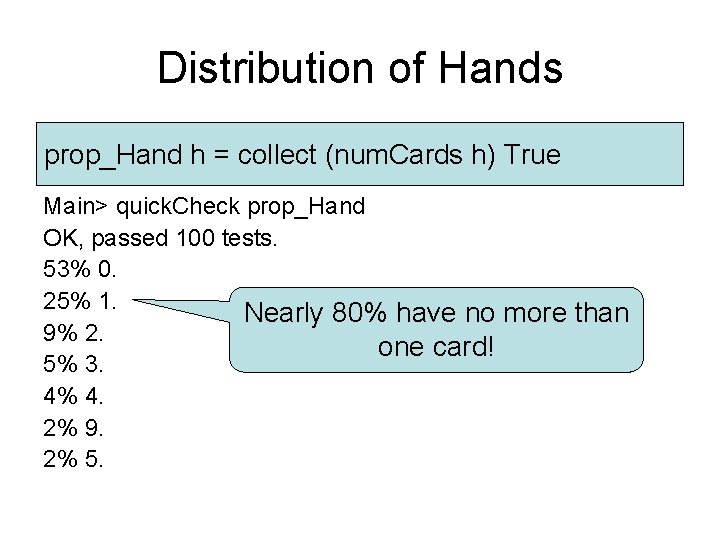
Distribution of Hands • Collecting each hand generated produces too much data—hard to understand • Collect a summary instead—say the number of cards in a hand num. Cards : : Hand -> Integer num. Cards Empty = 0 num. Cards (Add _ h) = 1 + num. Cards h
Distribution of Hands prop_Hand h = collect (num. Cards h) True Main> quick. Check prop_Hand OK, passed 100 tests. 53% 0. 25% 1. Nearly 80% have no more than 9% 2. one card! 5% 3. 4% 4. 2% 9. 2% 5.
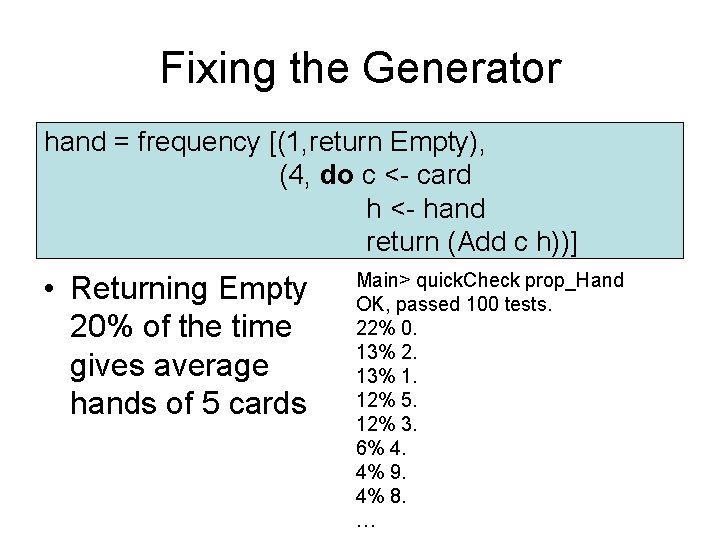
Fixing the Generator hand = frequency [(1, return Empty), (4, do c <- card h <- hand return (Add c h))] • Returning Empty 20% of the time gives average hands of 5 cards Main> quick. Check prop_Hand OK, passed 100 tests. 22% 0. 13% 2. 13% 1. 12% 5. 12% 3. 6% 4. 4% 9. 4% 8. …
Datatype Invariant? prop_Hand h = collect (num. Cards h) True We’re not testing any particular property of Hands • Are there properties that every hand should have?
Testing Algorithms
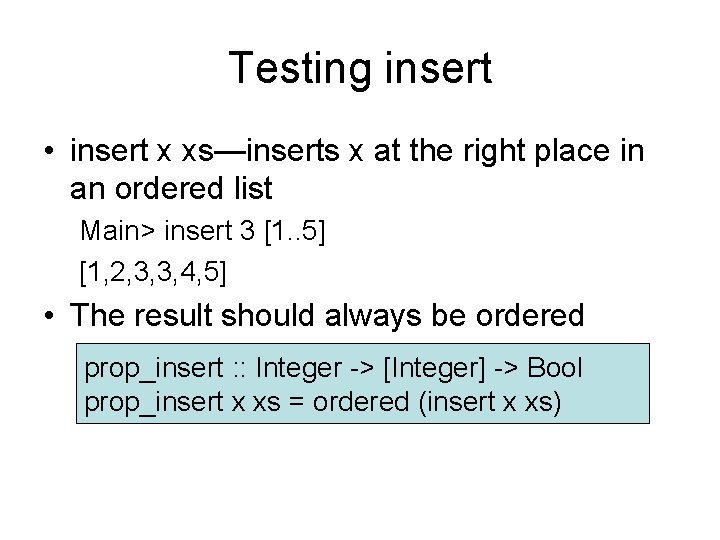
Testing insert • insert x xs—inserts x at the right place in an ordered list Main> insert 3 [1. . 5] [1, 2, 3, 3, 4, 5] • The result should always be ordered prop_insert : : Integer -> [Integer] -> Bool prop_insert x xs = ordered (insert x xs)
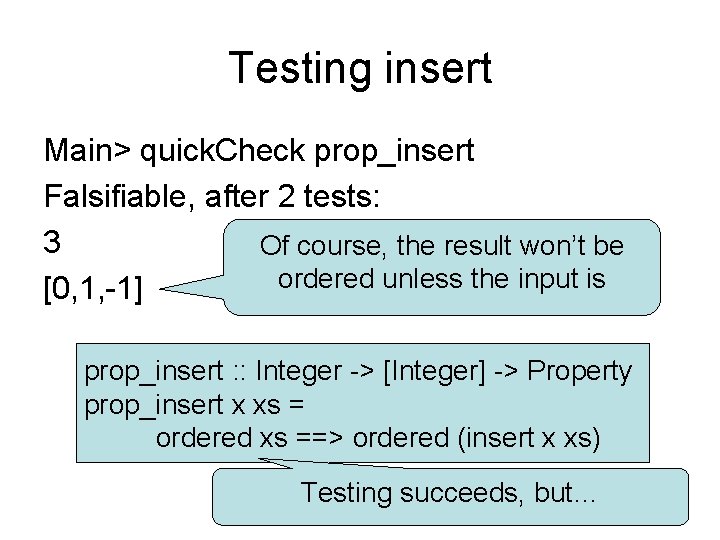
Testing insert Main> quick. Check prop_insert Falsifiable, after 2 tests: 3 Of course, the result won’t be ordered unless the input is [0, 1, -1] prop_insert : : Integer -> [Integer] -> Property prop_insert x xs = ordered xs ==> ordered (insert x xs) Testing succeeds, but…
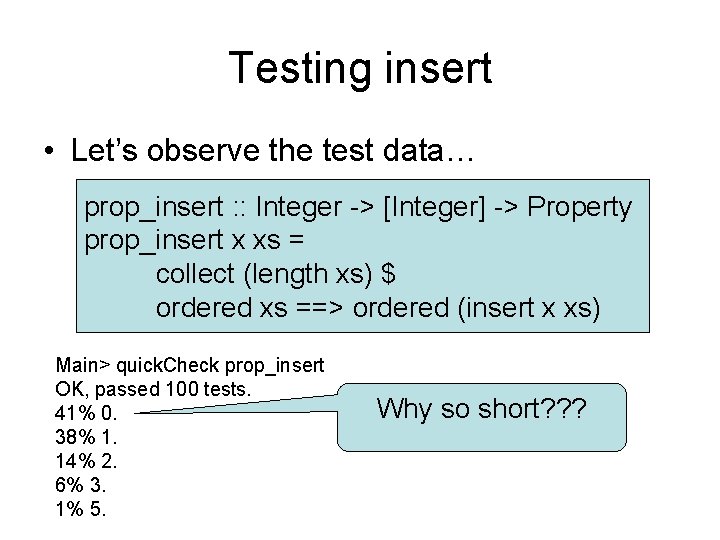
Testing insert • Let’s observe the test data… prop_insert : : Integer -> [Integer] -> Property prop_insert x xs = collect (length xs) $ ordered xs ==> ordered (insert x xs) Main> quick. Check prop_insert OK, passed 100 tests. 41% 0. 38% 1. 14% 2. 6% 3. 1% 5. Why so short? ? ?
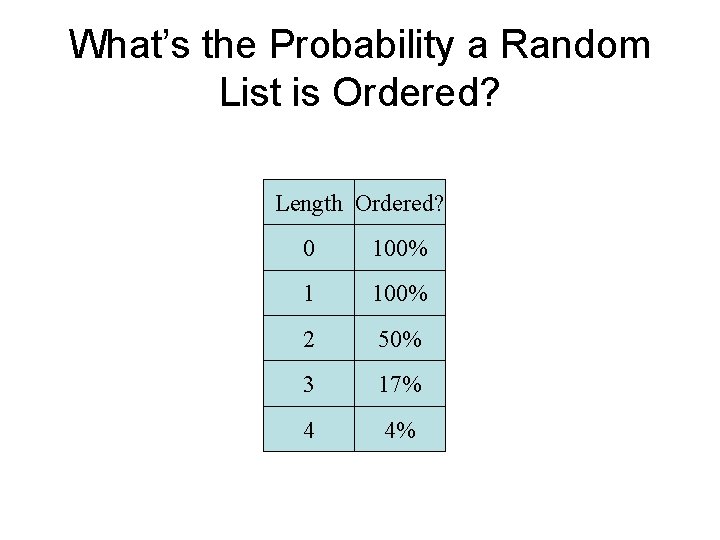
What’s the Probability a Random List is Ordered? Length Ordered? 0 100% 1 100% 2 50% 3 17% 4 4%
Generating Ordered Lists • Generating random lists and choosing ordered ones is silly • Better to generate ordered lists to begin with—but how? • One idea: – Choose a number for the first element – Choose a positive number to add to it for the next – And so on
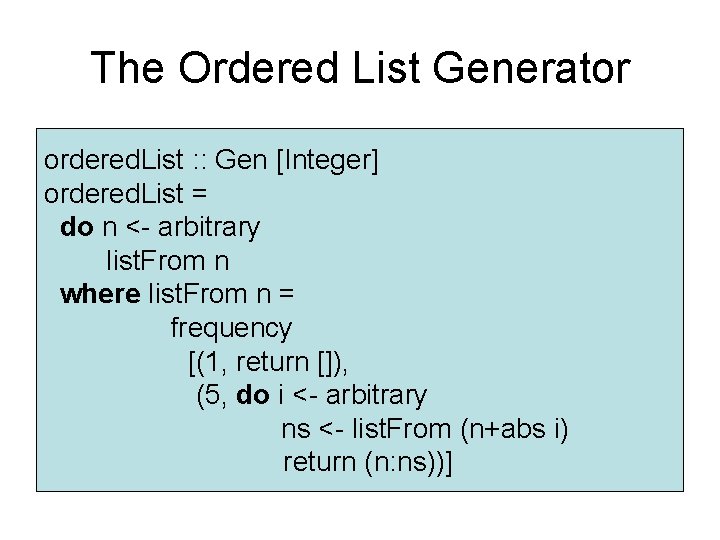
The Ordered List Generator ordered. List : : Gen [Integer] ordered. List = do n <- arbitrary list. From n where list. From n = frequency [(1, return []), (5, do i <- arbitrary ns <- list. From (n+abs i) return (n: ns))]
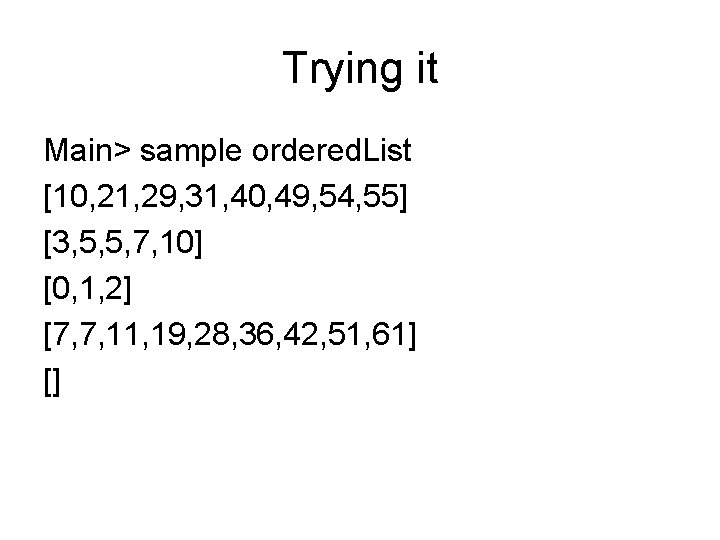
Trying it Main> sample ordered. List [10, 21, 29, 31, 40, 49, 54, 55] [3, 5, 5, 7, 10] [0, 1, 2] [7, 7, 11, 19, 28, 36, 42, 51, 61] []
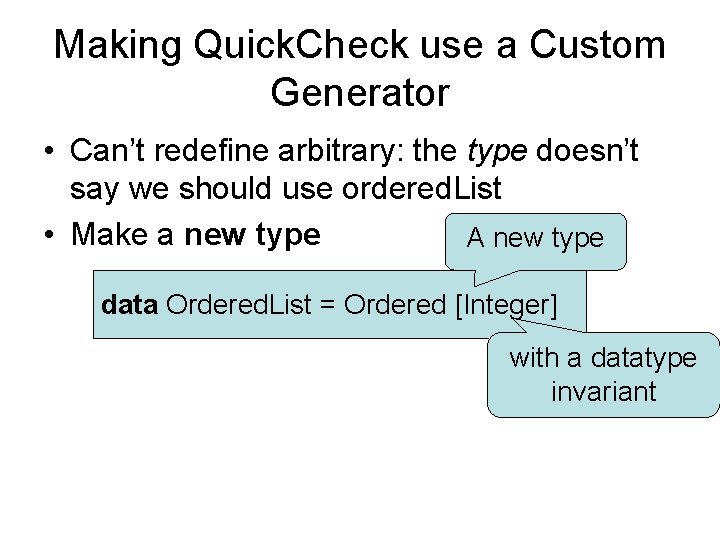
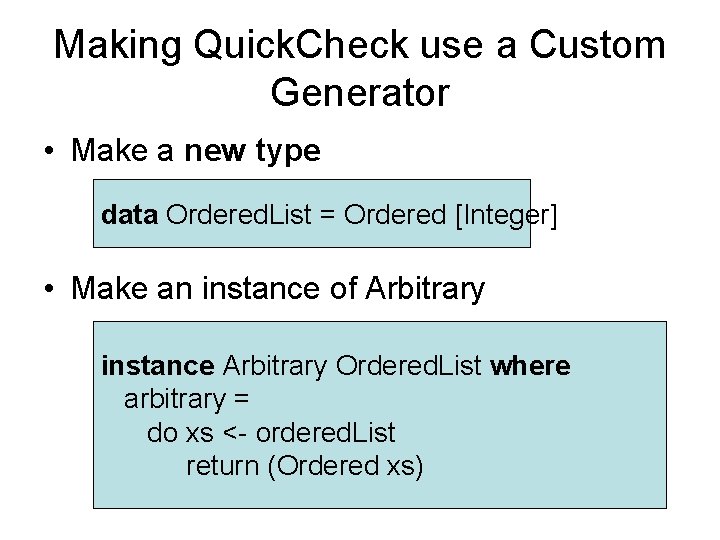
Making Quick. Check use a Custom Generator • Can’t redefine arbitrary: the type doesn’t say we should use ordered. List • Make a new type A new type data Ordered. List = Ordered [Integer] with a datatype invariant
Making Quick. Check use a Custom Generator • Make a new type data Ordered. List = Ordered [Integer] • Make an instance of Arbitrary instance Arbitrary Ordered. List where arbitrary = do xs <- ordered. List return (Ordered xs)
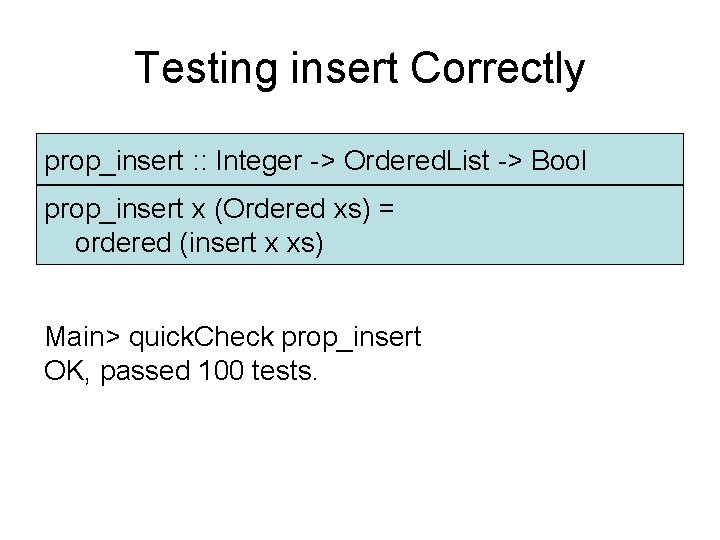
Testing insert Correctly prop_insert : : Integer -> Ordered. List -> Bool prop_insert x (Ordered xs) = ordered (insert x xs) Main> quick. Check prop_insert OK, passed 100 tests.
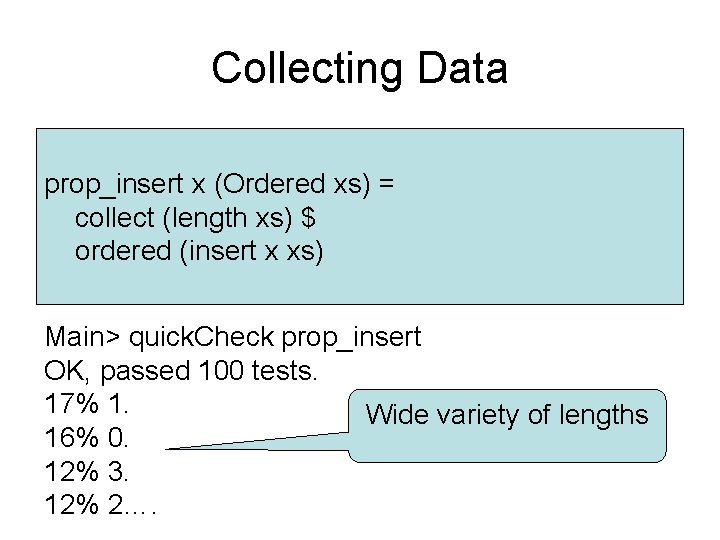
Collecting Data prop_insert x (Ordered xs) = collect (length xs) $ ordered (insert x xs) Main> quick. Check prop_insert OK, passed 100 tests. 17% 1. Wide variety of lengths 16% 0. 12% 3. 12% 2….
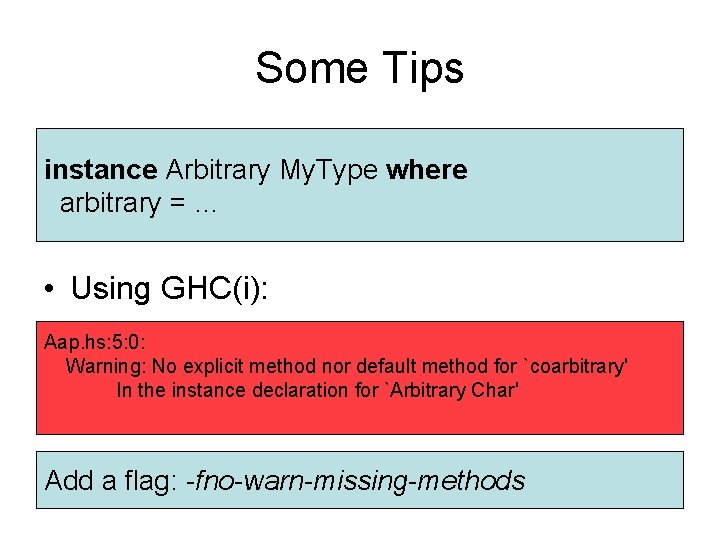
Some Tips instance Arbitrary My. Type where arbitrary = … • Using GHC(i): Aap. hs: 5: 0: Warning: No explicit method nor default method for `coarbitrary' In the instance declaration for `Arbitrary Char' Add a flag: -fno-warn-missing-methods
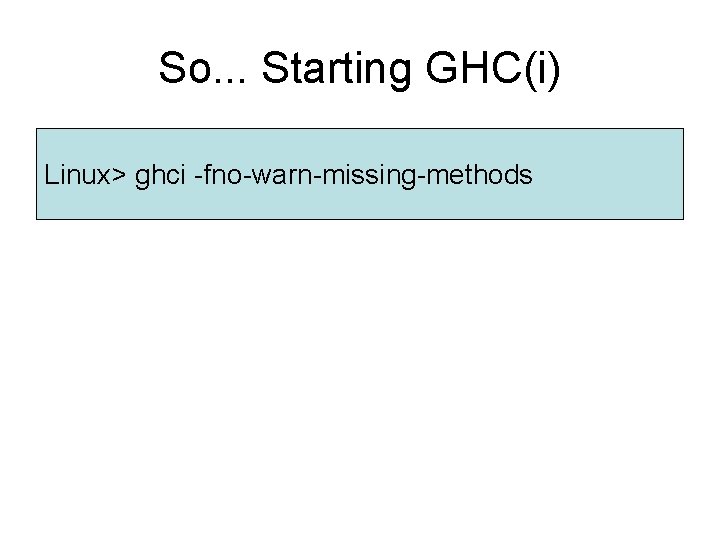
So. . . Starting GHC(i) Linux> ghci -fno-warn-missing-methods
Reading • About I/O: Chapter 18 of the text book • About Quick. Check: read the manual linked from the course web page. – There also several research papers about Quick. Check, and advanced tutorial articles.