
Test Case Generation and Reduction by Automated Input
Test Case Generation and Reduction by Automated Input. Output Analysis Prachi Saraph, Mark Last, and Abraham Kandel
Introduction �Black-Box Testing � Apply an Input � Observe the corresponding output � Compare Observed output with expected �Large Number of Inputs Huge number of Test Cases
Introduction �Choose most important test cases and removing the redundant ones �How? �Manual �Automatic
Input-Output Analysis �Identifies the input attributes which affect the value of a particular output �Concentrates on relationships between inputs and outputs
Machine Learning Approaches �NN-based mechanism for identification of test cases that are likely to find faults C. Anderson et al. , 1995 �NN is used to detect faults in mutated versions of software (Regression Testing) M. Vanmali, 2002 �IFN is used to identify I-O relationships M. Last et al. , 2003
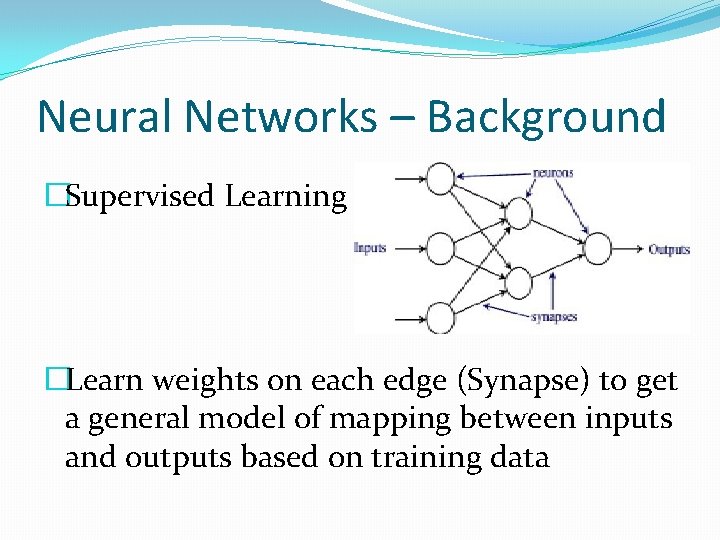
Neural Networks – Background �Supervised Learning �Learn weights on each edge (Synapse) to get a general model of mapping between inputs and outputs based on training data
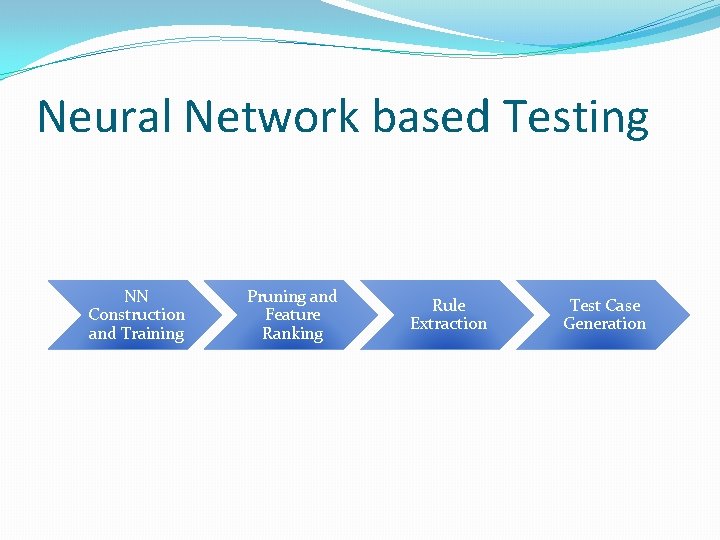
Neural Network based Testing NN Construction and Training Pruning and Feature Ranking Rule Extraction Test Case Generation
Phase I : NN Construction and Training � 3 -Layer Feed Forward Network using EBP �Obtaining Training Set: �Randomize input values �Feed them into the original software �Storing output generated NN Construction and Training
Phase II (a) : NN Pruning �Less important connections Lower Weights �Pruning: �Remove edges with lower weights as long as the predictive accuracy after removing a link stays within the acceptable limits Pruning and Feature Ranking
Phase II (b) : Feature Ranking �Method 1 (Sorting): �Sort inputs according to the product {weights from input layer to hidden layer * Corresponding weights from hidden layer to output layer} �Method 2 (Pruning): �Apply pruning method until all edges are removed �Note the order in which input nodes get all their nodes removed Pruning and Feature Ranking
Phase III : Rule Extraction �Express I-O relations pertained by pruning as if-then rules �Use clustering to discretize hidden unit activation values �Link Inputs to outputs through discretized hidden values Rule Extraction
Phase IV : Test Case Generation �After the completion of the pruning phase the possible data values of the attributes are used as equivalence classes to build test cases Test Case Generation
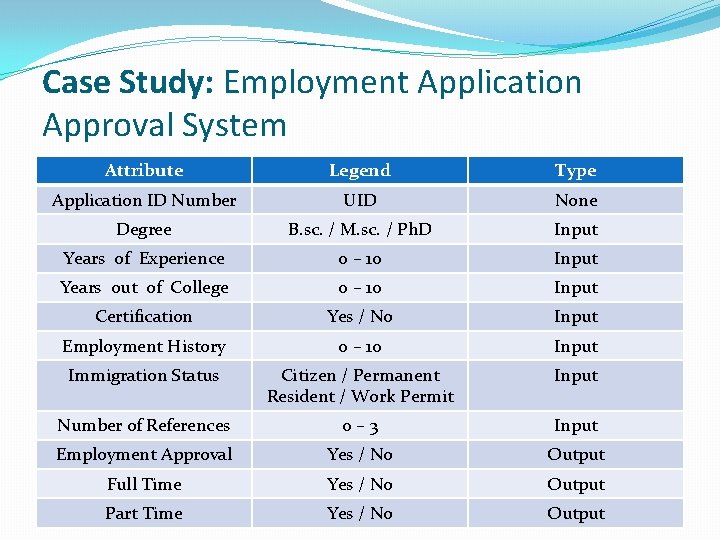
Case Study: Employment Application Approval System Attribute Legend Type Application ID Number UID None Degree B. sc. / M. sc. / Ph. D Input Years of Experience 0 – 10 Input Years out of College 0 – 10 Input Certification Yes / No Input Employment History 0 – 10 Input Immigration Status Citizen / Permanent Resident / Work Permit Input Number of References 0– 3 Input Employment Approval Yes / No Output Full Time Yes / No Output Part Time Yes / No Output
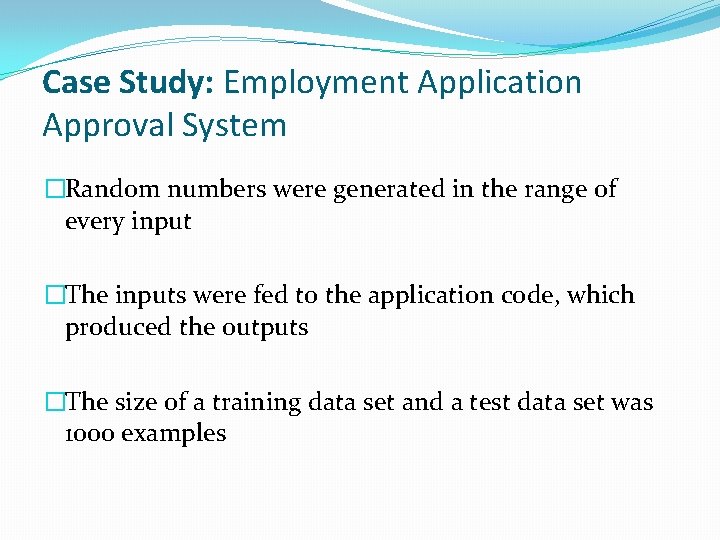
Case Study: Employment Application Approval System �Random numbers were generated in the range of every input �The inputs were fed to the application code, which produced the outputs �The size of a training data set and a test data set was 1000 examples
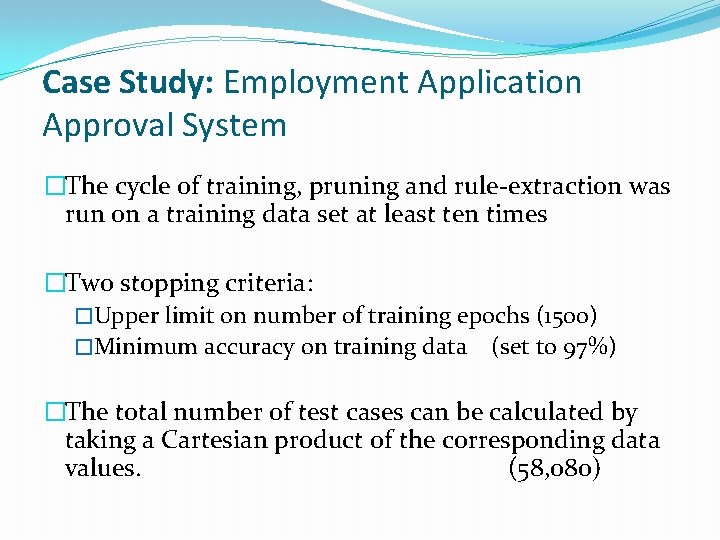
Case Study: Employment Application Approval System �The cycle of training, pruning and rule-extraction was run on a training data set at least ten times �Two stopping criteria: �Upper limit on number of training epochs (1500) �Minimum accuracy on training data (set to 97%) �The total number of test cases can be calculated by taking a Cartesian product of the corresponding data values. (58, 080)
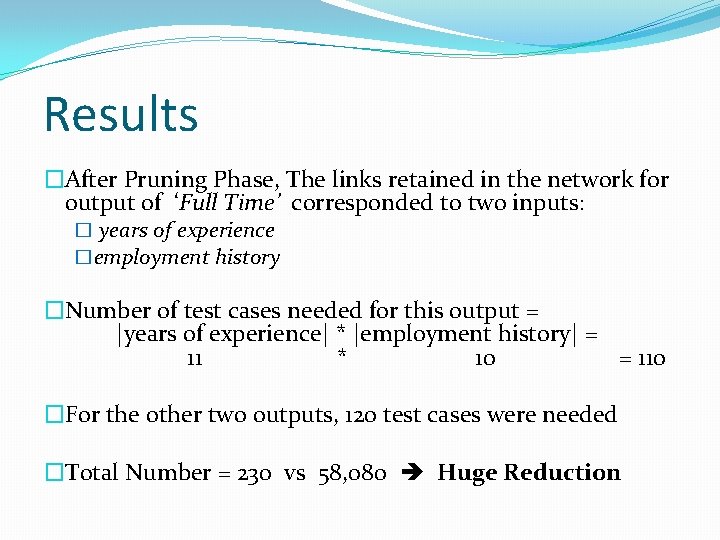
Results �After Pruning Phase, The links retained in the network for output of ‘Full Time’ corresponded to two inputs: � years of experience �employment history �Number of test cases needed for this output = |years of experience| * |employment history| = 11 * 10 = 110 �For the other two outputs, 120 test cases were needed �Total Number = 230 vs 58, 080 Huge Reduction
Rule Extraction Phase �By clustering hidden unit activation levels and determining ranges of inputs that can generate each level, the following was found: �Values 4 – 10 for the input attribute ‘years of experience’ resulted in activation value of 1 while the rest of the values resulted in activation value of -1 �Values 6 – 10 for the input attribute ‘Employment History’ generated activation value of 1 and the rest generated a value of -1
Results �For this output ‘Full Time’ the following rule is generated: If (years of experienc. M) and (employment histop=6) Employment Hours: Full Time=Yes (1) Else Employment Hours: Full Time=No (0) �By investigating the code, the accuracy of this rule turned out to be 100%
Test cases after rule-extraction phase �By investigating previous extracted rules, We can build two equivalence classes for each of the two influential inputs � Years of experience 1 : [0 -3] � Years of experience 2 : [4 -10] � Employment history 1: [1 -5] � Employment history 2: [6 -10] �Each equivalence class can be represented by one value
Yet More Test case Reduction �Thus, to cover combinations of these two input attributes, we need 4 test cases for this output instead of previous 110 �By repeating the procedure for each of the other outputs, we get 10 test cases for the whole application �Those 10 test cases carry some redundancies, so applying some minimization algorithm can further reduce them to 4 test cases!!
Drawbacks �Generating and running random test cases to create the training set incurs some overhead that wasn’t addressed properly in the paper �The method they propose for generating the training set implicitly assumes that you have a fault-free version of the program (which is not always the case) �The authors didn’t actually give a basis or an experimental framework for choosing the NN learning or pruning parameters
Digging Deeper �Although the authors didn’t mention it explicitly, their approach is mainly useful in regression testing �Another idea is to utilize this approach in Oracle generation out of the specifications of the program (By providing I-O pairs that are valid under specifications as he training set)

Questions ?

Thank You
- Slides: 24