
Test and measurements by Dr AZZA ATYA Lecturer
Test and measurements by Dr. AZZA ATYA Lecturer of Physical Therapy Basic Sciences Department Faculty of Physical Therapy

LEVELS OF MEASUREMENTS
Levels of measurements are categories for measuring variables. From the least to the most sensitive, scales are: nominal, ordinal, interval and ratio
Nominal level of measurements n n n It is used to classify or categorize data. It does not imply any type of magnitude but simply category, they can not be ordered or added. A clinical example would be arthritis. Arthritic patients could be categorized into patients with osteoarthritis, rheumatoid arthritis, psoriatic arthritis, or traumatic arthritis. The differentiation is simply according to the type of disease nominal level takes place in all of subcategories
Ordinal level of measurements n n n It does indicate more than rank order of the objects. The numbers do not imply definite magnitude, nor they imply that the categories are the same in terms of the quantity that they represent i. e. It does not imply that the intervals between the numbers are equal. The values of ordinal measurements can be summarized by frequency of occurrence, by percentage of the whole, or by counting the members in the category. Ordinal measurement level is not appropriate for arithmetical computation. Simply ordinal level of measurement can be extension to a, b, c. . . , n. in which it indicates that a > b > c>. . . n in some property
Interval level measurement n It include all the qualities of the ordinal level measurements and also include units that are equal in size. Also the distances between levels are equal. n This permit the use of arithmetic operations and the zero point is arbitrary. e. g. : centigrade temperature measurement, where zero does not indicate the absence of heat but rather is an arbitrary point
The ratio level of measurements it include all the qualities of the interval level of measurement it is most sensitive measurements. n it has the highest level of validity and also include a zero point that is absolute, e. g. : Kelvin scale of temperature where zero degrees Kelvin is absolute zero and indicate the absence of heat. n In ratio level of measurements arithmetic operations are possible. Numbers on the scale indicate the actual quantitative data of measured property n
RELIABILITY, OBJECTIVITY AND VALIDITY Measurement must be reliable and objective, and the results must be valid n Reliability: is the repeatability and the extent to which comparable results are achieved every time a test is repeated n The key to reliability for manual muscle testing is to follow the standard procedure, performing the test in the same way each time and in the same way that otherapists perform it. n Reliability is increased if therapist gives clear instructions to the patient n
Types of reliability. 1 Interrater reliability means that another person who performs the test should arrive at the same results, to an acceptable extend. n. 2 Intrarater reliability means that one person should come up with the same results on every repetition of the test within acceptable level n
Objectivity: means that the findings are reported without distortion by personal opinion or feelings. n Therapists should not let concern for the patient to influence the results of an evaluation procedure. n In manual muscle testing, the most difficult area in which to be objective is deciding whether the resistance the patient can tolerate is minimal, moderate, or maximal. n If the patient's weakness is unilateral, therapist should test the opposite side and use the result as the baseline for normal. n If the patient has bilateral involvement, therapist must relay on experience in testing other patients and normal subjects to know what is normal for a particular muscle in a person of a given age, sex, size, and occupation
n Validity: means that a test actually measures what it is supposed to measure. For a muscle test to be valid, n therapist must know the location and function of the muscle being tested n the location and function of surrounding muscles. n Validity of assessment means that therapist evaluate exactly what they say they are going to do.
MANUAL MUSCLE TESTING n Definition: Manual muscle testing is a procedure for the evaluation of the function and strength of individual muscle and muscles group based on effective performance of a movement in relation to the forces of gravity and manual resistance through the available ROM
The purpose of muscle test: n Is to provide information that may be of assistance to a number of health professionals in differential diagnosis, treatment planning and prognosis, n but it has limitations in the treatment of neurological disorders where there is an alteration in muscle tone if reflex activity is altered or if there is a loss of cortical control due to lesions of the central nervous system
n To assess muscle strength, therapist must have a sound knowledge of anatomy (including joint motions, muscle origin and insertion, and muscle function) and surface anatomy (to know where a muscle or its tendon is best palpated n The therapist must be a keen observer and be experienced in muscle testing to detect minimal muscle contraction, movement, and/or muscle wasting and substitutions or trick movements
n Muscular strength: The maximal amount of tension or force that a muscle or muscle group can voluntarily exert in one maximal effort, when type of muscle contraction, limb velocity, and joint angle are specified. n Muscular Endurance: The ability of a muscle or a muscle group to perform repeated contractions against resistance, or maintain the an isometric contraction for a period of time
n Range of muscle work: The full range refers to the muscle changing from a position of full stretch and contracting to a position of maximal shortening. The full range is divided into parts, outer, inner, and middle ranges. n Outer range: Is from a position where the muscle is on full stretch to a position halfway through the full range of motion. n Inner range: Is from a position halfway through the full range to a position where the muscle is fully shortened. Middle range: Is the portion of the full range between the mid-point of the outer range and the midpoint of the inner range n
Active insufficiency: n When muscle crosses two or more joints, occurs when the muscle produces simultaneous movement at all of the joints it crosses and reaches such a shortened position that it no longer has the ability to develop effective tension. When a muscle is placed in a shortened position of active insufficiency it is described as putting the muscle on slack
n Functional classification of muscle: Prim Mover or agonist: A muscle or muscle group that makes the major contribution to movement at the joint. n Antagonist: A muscle or a muscle group that has an opposite action to the prime mover's. The antagonist relaxes as the agonist moves the part through a ROM. n Synergist: A muscle that contracts and works a long with the agonist to produce the desired movement. Three types of synergists are described n

n Neutralizing synergists: or counter acting Muscles contracted to prevent unwanted movements produced by the prime mover. For ex. When the long finger flexors contract to produce finger flexion the wrist extensors contract to prevent wrist flexion from occurring

Conjoint synergists: Two or more muscles that work together to produce the desired movement. The muscles contracting alone would be unable to produce the movement. For ex. : Wrist extension is produced by contraction of extensor carpiradialis longus and brives and extensor carpiulnaris.
Stabilizing or Fixating Synergists: Muscle that prevent movement or control the movement at joints proximal to the moving joint to provide a fixed or stable base from which the distal moving segment can effectively work. For ex. : If the elbow flexors contract to lift an object off a table anterior to the body, the muscles of the scapula and glenohumeral joint must contract to either allow slow controlled movement or no movement to occur at the scapula and glenohumeral joint to provide the elbow flexors with a fixed origin from which to pull. n
Muscle testing assessment procedure: n 1. Explanation and instruction: n 2. Assessment of normal muscle strength: n 3. Patient position: n 4. Stabilization: n 5. Substitution and trick movements: (normal ms, body wight, position, external force)
n Screen test: is a method used to streamline the muscle strength assessment, avoid unnecessary testing, and avoid fatiguing and/or discouraging the patient. The therapist may screen the patient through the information gained from: n 1. The previous assessment of the patient's active range of motion. n 2. Reading the patient's chart or previous muscle test result and/or. n 3. Observing the patient perform functional activities e. g: shaking the patients hand may indicate the strength of grasp, i. e. the finger flexors.
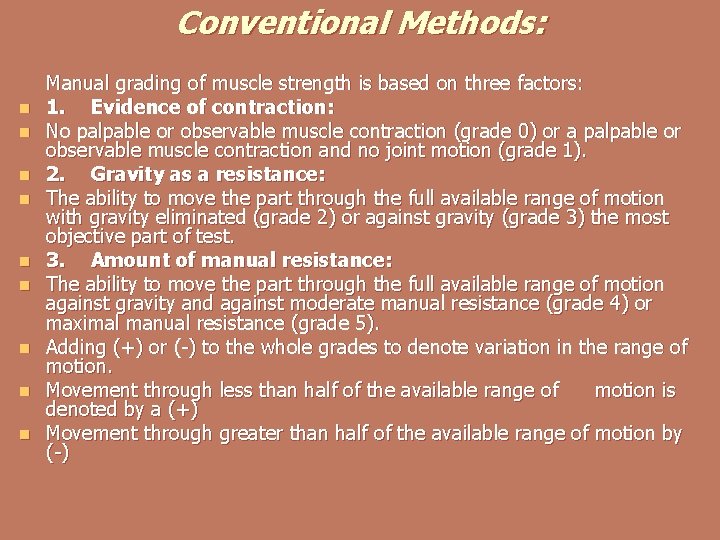
Conventional Methods: n n n n n Manual grading of muscle strength is based on three factors: 1. Evidence of contraction: No palpable or observable muscle contraction (grade 0) or a palpable or observable muscle contraction and no joint motion (grade 1). 2. Gravity as a resistance: The ability to move the part through the full available range of motion with gravity eliminated (grade 2) or against gravity (grade 3) the most objective part of test. 3. Amount of manual resistance: The ability to move the part through the full available range of motion against gravity and against moderate manual resistance (grade 4) or maximal manual resistance (grade 5). Adding (+) or (-) to the whole grades to denote variation in the range of motion. Movement through less than half of the available range of motion is denoted by a (+) Movement through greater than half of the available range of motion by (-)
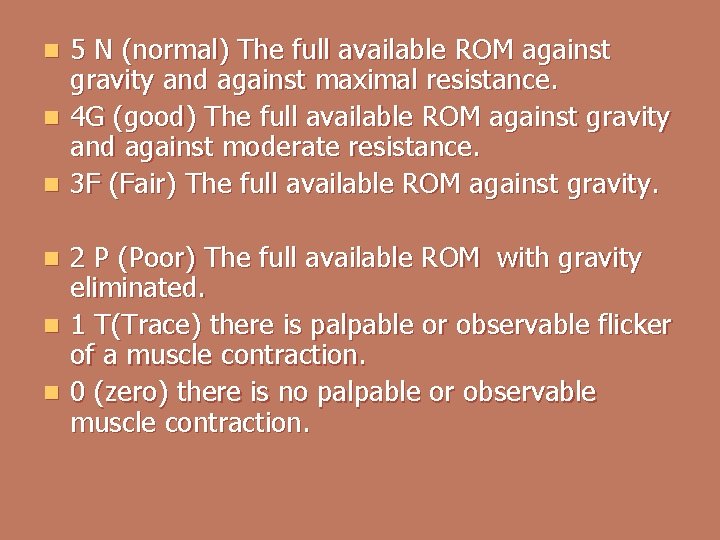
5 N (normal) The full available ROM against gravity and against maximal resistance. n 4 G (good) The full available ROM against gravity and against moderate resistance. n 3 F (Fair) The full available ROM against gravity. n 2 P (Poor) The full available ROM with gravity eliminated. n 1 T(Trace) there is palpable or observable flicker of a muscle contraction. n 0 (zero) there is no palpable or observable muscle contraction. n
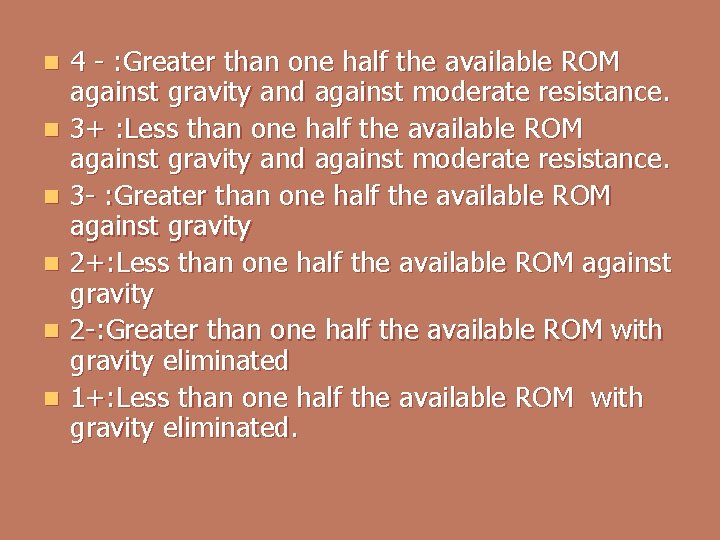
n n n 4 - : Greater than one half the available ROM against gravity and against moderate resistance. 3+ : Less than one half the available ROM against gravity and against moderate resistance. 3 - : Greater than one half the available ROM against gravity 2+: Less than one half the available ROM against gravity 2 -: Greater than one half the available ROM with gravity eliminated 1+: Less than one half the available ROM with gravity eliminated.
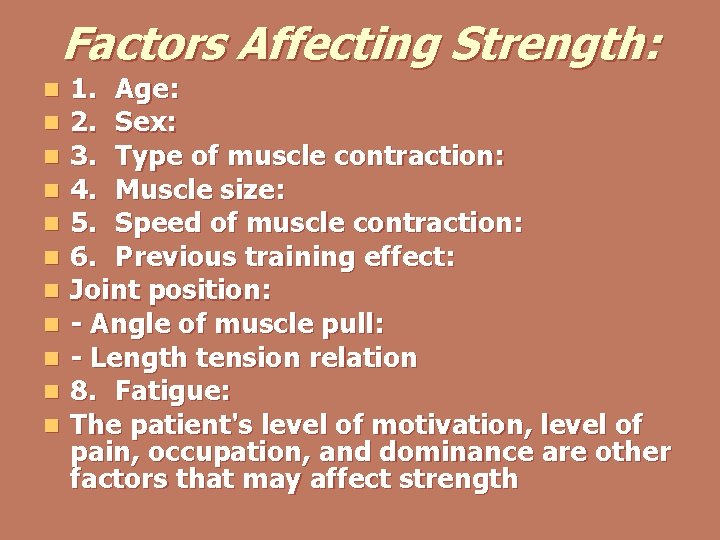
Factors Affecting Strength: n n n 1. Age: 2. Sex: 3. Type of muscle contraction: 4. Muscle size: 5. Speed of muscle contraction: 6. Previous training effect: Joint position: - Angle of muscle pull: - Length tension relation 8. Fatigue: The patient's level of motivation, level of pain, occupation, and dominance are other factors that may affect strength
contraindication n Inflammation is present in the region. n Pain is present. pain will inhibit muscle contraction and will not give an accurate indication of muscle strength. Testing muscle strength in the presence of pain may cause further injury

precautions: n n patient with a history of cardiovascular problems. patients who have experienced abdominal surgery or patients with herniation of the abdominal wall to avoid unsafe level stress on the abdominal wall. In situations where fatigue may be detrimental to or exacerbate the patients condition. Patients with extreme debility, for example mal nutrition, malignancy, and sever chronic obstructive pulmonary disease.

- Slides: 30