
Test and analyze expenditures 1 OnSite Review cont
- Slides: 65
Test and analyze expenditures 1
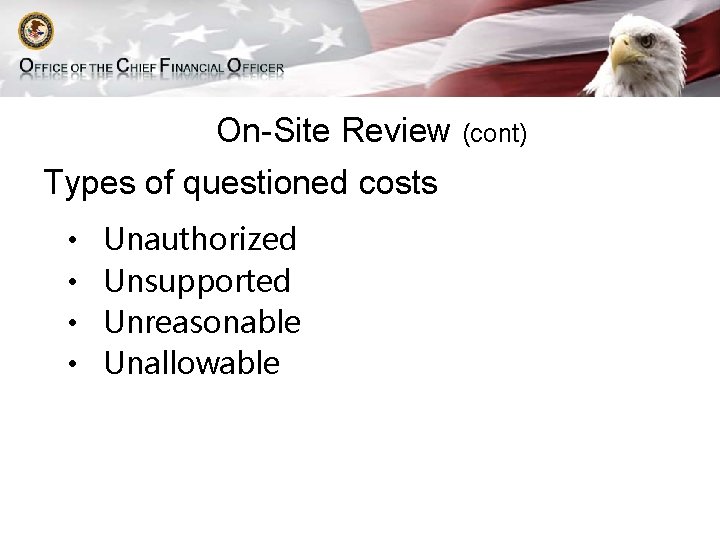
On-Site Review (cont) Types of questioned costs • • Unauthorized Unsupported Unreasonable Unallowable
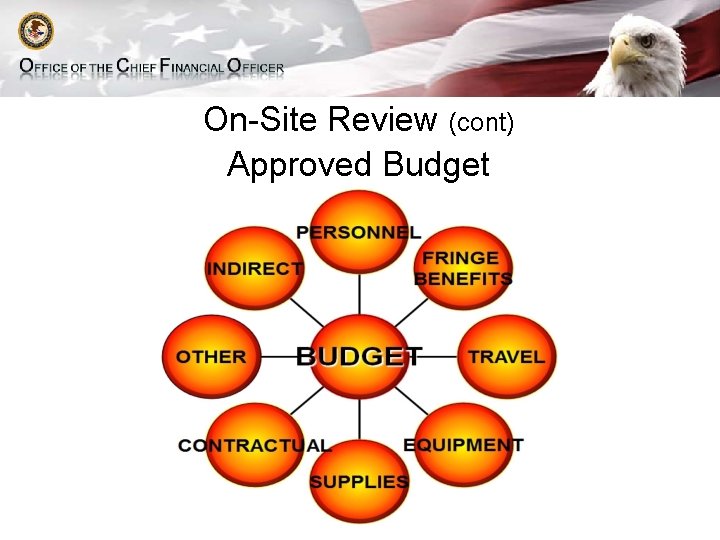
On-Site Review (cont) Approved Budget
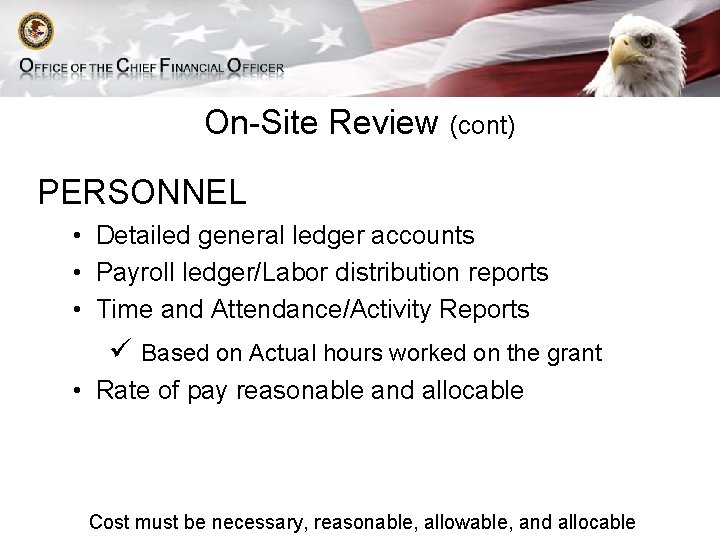
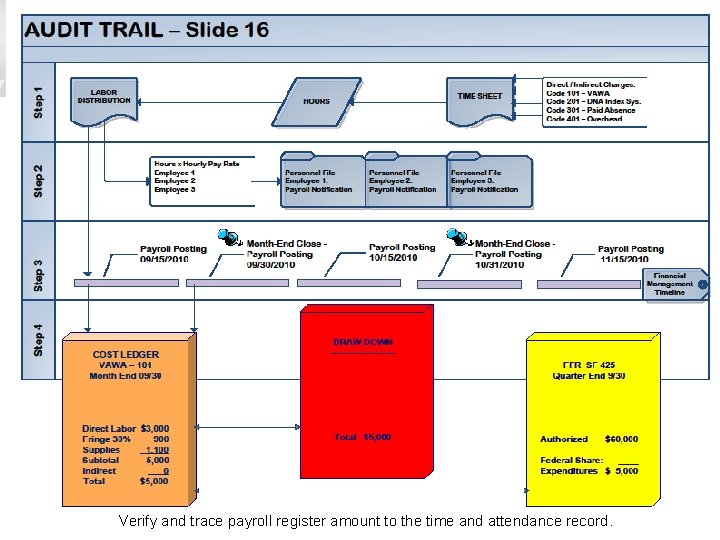
On-Site Review (cont) PERSONNEL • Detailed general ledger accounts • Payroll ledger/Labor distribution reports • Time and Attendance/Activity Reports ü Based on Actual hours worked on the grant • Rate of pay reasonable and allocable Cost must be necessary, reasonable, allowable, and allocable
Verify and trace payroll register amount to the time and attendance record.
On-Site Review (cont) Frequent Monitoring Findings Personnel • Staff timesheets/records not signed/certified by individual or supervisor • Staff time not properly documented • Staff time not properly allocated to various activities 6
On-Site Review (cont) Frequent Monitoring Findings Personnel (cont) • Charges and costs not based on actual after-the-fact records, but on budgeted or pre-established amounts or percentages • Did not maintain certification for employees working 100% on the grant • Not in the approved budget
On-Site Review (cont) FRINGE BENEFITS • A Separate line item (not included in salaries) • Type of rate ü Approved fringe benefit rate, if applicable ü Breakdown – (i. e. , FICA, health, retirement, workman’s comp) • Proportionate to salaries Cost must be necessary, reasonable, allowable, and allocable
On-Site Review (cont) Frequent Monitoring Findings Fringe Benefits • • Not proportionate with salaries Fringe benefits not clearly defined (i. e. FICA, health insurance, retirement, etc. ) • • Excessive fringe for executives Not in the approved budget 9
On-Site Review (cont) TRAVEL • Travel Authorizations ü ü Purpose of trip Relation to project Approved in the budget Approval of authorizing official • Travel Voucher ü ü Timely submission Receipts Cost must be necessary, reasonable, allowable, and allocable
On-Site Review (cont) Frequent Monitoring Findings Travel • • • Premium travel without prior approval from awarding agency Excessive lodging/per diem charges Unreasonable costs (i. e. early bird check in, premium sitting, etc) Fines and penalties Not in the approved budget
On-Site Review (cont) EQUIPMENT • • • Purpose/relevance to the project Lease vs. purchase analysis (vehicles & large items) Procurement process ü ü • • Capitalization threshold Competition Inventory/property records Physical inventory Cost must be necessary, reasonable, allowable, and allocable
On-Site Review (cont) Frequent Monitoring Findings Equipment • • Unable to identify Federally purchased equipment Inventory list/property records not maintained or inadequate Physical inventory not conducted Not in the approved budget
On-Site Review (cont) SUPPLIES • Relevance to project • Approved in the budget Cost must be necessary, reasonable, allowable, and allocable
On-site Review (cont) Frequent Monitoring Findings Supplies • Inadequate documentation • Not in the approved budget • Unallowable costs
On-Site Review (cont) CONTRACTUALS • Procurement process ü Competitively bid ü Sole Source (threshold approvals) ü Consultants (threshold approvals) • Excluded Parties List System Cost must be necessary, reasonable, allowable, and allocable
On-Site Review (cont) CONTRACTUALS (cont) • Signed Contract ü Scope of work ü Payment terms ü Deliverables • Supplement awards, if applicable Cost must be necessary, reasonable, allowable, and allocable
On-Site Review (cont) Frequent Monitoring Findings CONTRACTUAL • • • Contractual and consultants agreements were not maintained Consulting rate exceeds maximum allowed (no prior approval) No sole source approval for contracts over $150, 000 Work performed not in line with program goals Conflict of interest Not in the approved budget
On-Site Review (cont) OTHER • Relevance to the project • Approved in the budget Cost must be necessary, reasonable, allowable, and allocable
On-Site Review (cont) Frequent Monitoring Findings Other • • • Inadequate documentation Not in the approved budget Unallowable costs
On-Site Review (cont) INDIRECT COSTS • • Current approved negotiated agreement or approved Cost Allocation Plan Application of approved rate, if applicable (to include base) • • Election of De Minimis Rate (based on MTDC) Indirect cost budget not exceeded Recorded in accounting system Reported on Federal Financial Report (FFR) Cost must be necessary, reasonable, allowable, and allocable
On-Site Review (cont) Frequent Monitoring Findings Indirect Costs • • Expired and/or no current approved indirect cost agreement Not in the budget or exceeded approved budget Indirect costs not properly allocated Not recorded in accounting system
On-Site Review (cont) Frequent Monitoring Findings INDIRECT COSTS (cont) • • • Not reported on FFR Indirect costs recorded in accounting system do not reconcile with amounts reported on FFR Direct costs recorded as indirect costs
On-Site Review (cont) CONFERENCE COSTS • • Written policies and procedures Tracked separately in the grantee’s accounting system Prior approvals Post event reporting Cost must be necessary, reasonable, allowable, and allocable
On-Site Review (cont) Frequent Monitoring Findings Conference Costs • • No written policies and procedures Not tracked separately within accounting system No Prior approvals Post even reports not maintained
On-Site Review (cont) Frequent Monitoring Findings CONFERENCE COSTS (cont) • • • Exceed budget Exceeded threshold limitations Unallowable costs ü Trinkets ü Food and beverages (unless prior approval is obtained)
On-Site Review (cont) Subrecipient and Contractor Determinations (Title 2 CFR 200) Subrecipients. A subaward is for the purpose of carrying out a portion of a Federal award and creates a Federal assistance relationship with the subrecipient. Characteristics which support the classification of the non. Federal entity as a subrecipient include when the non-Federal entity: 1) 2) 3) 4) 5) Determines who is eligible to receive what Federal assistance; Has its performance measured in relation to whether objectives of a Federal program were met; Has responsibility for programmatic decision making; Is responsible for adherence to applicable Federal program requirements specified in the Federal award; and In accordance with its agreement, uses the Federal funds to carry out a program for a public purpose specified in authorizing statute, as opposed to providing goods or services for the benefit of the pass-through entity.
On-Site Review (cont) Subrecipient and Contractor Determinations (Title 2 CFR 200) Contractors. A contract is for the purpose of obtaining goods and services for the non-Federal entity's own use and creates a procurement relationship with the contractor. Characteristics indicative of a procurement relationship between the non-Federal entity and a contractor are when the contractor: 1) 2) 3) 4) 5) Provides the goods and services within normal business operations; Provides similar goods or services to many different purchasers; Normally operates in a competitive environment; Provides goods or services that are ancillary to the operation of the Federal program; and Is not subject to compliance requirements of the Federal program as a result of the agreement, though similar requirements may apply for other reasons.
On-Site Review (cont) Pass-Through Entities’ Responsibilities • • Subrecipient monitoring procedures – award, management, and closeout Monitoring Plan Results of monitoring Follow up on issues identified during monitoring and resolution
On-Site Review (cont) Subrecipient File Documentation • Signed award agreement or Memo of Understanding (MOU) ü Grant award special conditions passed on to subrecipients • • • Approved Budget and budget modifications Compliance with Single Audit reporting requirements Progress Reports Financial Reports Evidence of monitoring and follow up
On-Site Review (cont) Frequent Monitoring Findings Subrecipient • • • No written guidelines in awarding, managing, and closing subawards No Risk Assessment/Monitoring Plan Inadequate monitoring/follow up Excess cash-on-hand at subrecipient level Subaward not related to program objectives Subrecipients expenditures do not reconcile with accounting records.
On-Site Review (cont) Frequent Monitoring Findings Subrecipient (cont) • • • Subrecipient questioned costs Conflict of interest Program income not accounted for Match not accounted for Subaward not reported in FSRS 32
On-Site Review (cont) MATCH • • • Matching contributions are subject to audit Match separately tracked in grantee’s accounting system Identify source of match Document match If a recipient did not provide the required match by the end of the project period, an adjustment may be required and/or funds may have to be returned to OJP Cost must be necessary, reasonable, allowable, and allocable
On-Site Review (cont) Frequent Monitoring Findings Match • • Source and timing of match not identified Not properly documented, recorded, or tracked Match not reported on FFR Required match not met
On-Site Review (cont) PROGRAM INCOME • Activities that generate program income ü ü ü ü ü Interest earned on JAG and JABG grants Program income earned by subrecipients Registration/Tuition fees Sale of videos, publications, other media Rental/usage fees (DNA grants) Royalties Service Fees Membership Fees Seizures of asset Cost must be necessary, reasonable, allowable, and allocable
On-Site Review (cont) PROGRAM INCOME (cont) • • • Program income are subject to audit Must be documented by recipient Separately tracked in recipient’s accounting system Reported on FFR cumulatively Any program income earned during the project period and not utilized for the project must be refunded to the awarding agency Cost must be necessary, reasonable, allowable, and allocable
On-Site Review (cont) Frequent Monitoring Findings Program Income • • • Source of income not properly documented Not accounted for in accounting system Not reported on FFR
On-Site Review (cont) Compliance with Award Special Conditions The recipient agrees to comply with the financial and administrative requirements set forth in the current edition of the DOJ Grants Financial Guide. http: //www. ojp. usdoj. gov/financialguide
On-Site Review (cont) Compliance with Award Special Conditions (cont) ……. The recipient may not obligate, expend or draw down funds until the Office of the Chief Financial Officer (OCFO) has approved the budget and budget narrative and a Grant Adjustment Notice (GAN) has been issued to remove this special Condition…
On-Site Review (cont) Compliance with Award Special Conditions (cont) • • • Dates of drawdowns Expenditure dates Obligation dates (subawards/contracts)
On-Site Review (cont) OTHER MONITORING FINDINGS • Administrative costs on Formula awards ü Exceeded threshold amounts • Budget modifications ü Exceeded 10% of total project costs ü Change in scope ü Zero budget category • • Weakness in internal controls Possible Supplanting Cost must be necessary, reasonable, allowable, and allocable
Ten Top Monitoring Findings (FY 2016) 1. Procedures not documented or need improvement. 2. FFR do not reconcile to grantee’s accounting records. 3. FFATA reporting requirements not met. 4. Internal control weakness – procedures not followed and lack of segregation of duties. 5. Budget category not properly tracked.
Ten Top Monitoring Findings (FY 2016) 6. 7. 8. 9. 10. Excess cash-on-hand. Indirect costs charged improperly. Unreasonable cost identified. Award special conditions violated. Indirect costs not reported on FFR.
On-Site Review (cont) EXIT CONFERENCE • • • Discuss results of monitoring Explain what will happen next Provide resources (customer service number, link of financial guide, online training, etc) website
Site Review Follow up • • • Finalize site visit report documenting results of site visit Share results of site visit with program office bureaus Share results of site visit with our Office of Audit, Assessment, and Management (OAAM) if referring grantee for high risk designation Send follow up letter to grantee identifying issues noted and recommendations to resolve the issues Request Corrective Action Plan (CAP) from grantee within 30 days
Site Review Follow up (cont) CAP letter should include • • Description of each finding Specific steps to be taken to implement the recommendation Timetable for performance of each corrective action Description of monitoring to be performed to ensure implementation of the CAP
Site Review Follow up (cont) CAP received from grantee • • Review CAP and additional documentation provided Close recommendations based on adequacy of documents provided Send partial closure or closure letter Close site visit
Site Review Follow up (cont) If CAP letter not received • • • Send a first delinquent notice requesting response within 15 days If no response received, send a second delinquent notice requesting response within 15 days If no response received, a third and final delinquent noticed signed by the Assistant CFO or designee is sent requesting response within 15 days
Site Review Follow up (cont) If CAP letter not received (cont) • If grantee does not respond within 15 days from the date of the final notice: ü Unresolved questioned costs – grantee shall be referred to U. S. Department of Treasury, for collection ü No questioned costs – may be referred for administrative closure and be subject to additional administrative actions
Resources • CFR 200 – (http: //www. ecfr. gov/cgi-bin/textidx? tpl=/ecfrbrowse/Title 02/2 cfr 200_main_02. tpl ) • 2015 DOJ Grants Financial Guide – (http: //ojp. gov/financialguide/DOJ/pdfs/2015_D OJ_Financial. Guide. pdf) • 2015 Guide to Procurements under DOJ Grants and Cooperative Agreements 50
Resources (cont) • Federal Travel Regulations (http: //www. gsa. gov/graphics/ogp/FTR 201102 Complete. pdf) • GAO Green Book – Standards for Internal Control in the Federal Government (http: //www. gao. gov/assets/670/665712. pdf) • COSO Internal Control Integrated Framework - help organizations design and implement internal control
Cost Principles Analysis - Exercise
Instructions Based on what you have learned from the training, please review, analyze, and evaluate each of the following scenarios. Determine the best recommendation to remedy the issue.
Scenario #1 You received three timesheets for Johnny Bravo, Mark Lee, and Elizabeth Taylor to support personnel costs charged to the grant. However, you noticed that the timesheets are not certified by upper management.
Scenario #2 Since the inception of the grant, you noticed that the grantee charged their employees $32, 456 in fringe benefits related to retirement, social security, health insurance, and overtime.
Scenario #3 Johnny Bravo provided his travel voucher for an annual meeting at the International Association of Identification in Richmond, Virginia. The hotel receipt is a total of $470 ($235 per night). (Note: The grantee follows the GSA Per Diem Rate and the rate for Richmond, VA for lodging is $96 per day)
Scenario #4 While reviewing the grantee’s expenditures, you noticed a purchase of a Lenox Scanners for $6, 125. The grantee stated it is essential to the program. Per the grantee’s fixed asset procedures, the capitalization threshold for assets is $5, 000.
Scenario #5 You noted expenditures related to the purchase of a brand new desk for Ms. Taylor in the amount of $456 to replace her old desk damaged by a water leak that occurred last year.
Scenario #6 The grantee charged $9, 542 of indirect cost to the grant.
Scenario #7 During your testing of the transactions samples, you received several invoices from vendors that supplied PCR primers needed for the grantee’s project. The total amount is $1, 486.
Scenario #8 You received the supporting documentation for the consultant hired as a Legal Aid Attorney for the grantee’s project including the invoice with the consultant’s payments. You asked the grantee for the signed agreement and they informed you that it is archived in another county and will provide it in the near future.
Scenario #9 While you were reviewing the consultant’s invoices, you noticed that the consultant was paid $650 for four hours in one day without prior approval of the DOJ program manager.
Scenario #10 The grantee provided receipts for repairs done to the laboratory equipment. The receipts and invoices reflects the costs of repair services in the amount of $1, 200.
Scenario #11 You reviewed several airline receipts from Southwest for approved travel to the crime lab in North Carolina. You noticed that the grantee purchased early-bird check-in totaling $70. The grantee’s reason for early bird check-in is for a better seat on the plane.
Scenario #12 The grantee had a federally approved indirect cost rate agreement for FY 2007 and they submitted their budget for FY 2016 electing to use the de minimis rate of 10%.