
Test 2 PreTest OBJECTIVE Administer this Practice Test
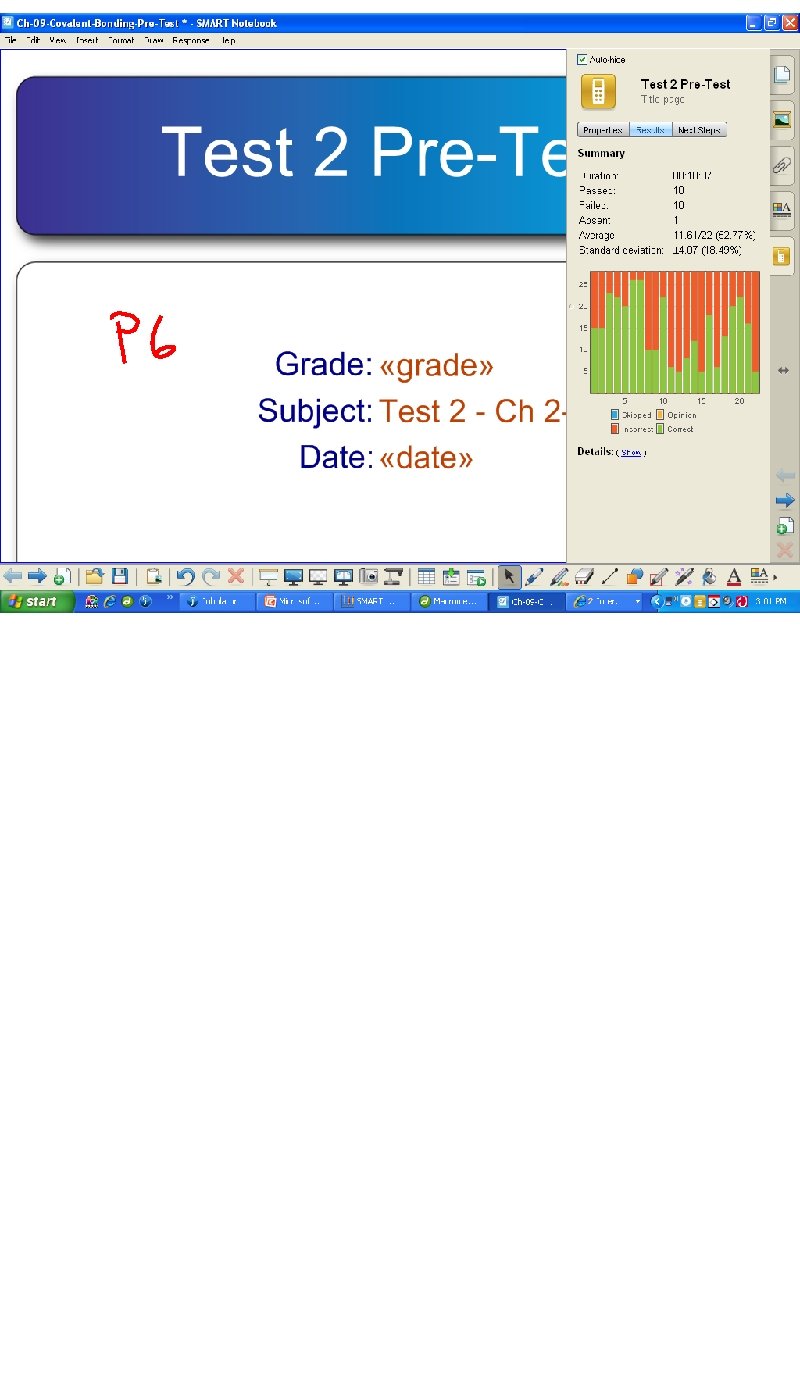
Test 2 Pre-Test OBJECTIVE: Administer this Practice Test 2 & thoroughly explain all incorrect answers. «grade» Grade: Test 2 - Ch 2 -9 Subject: «date» Date:
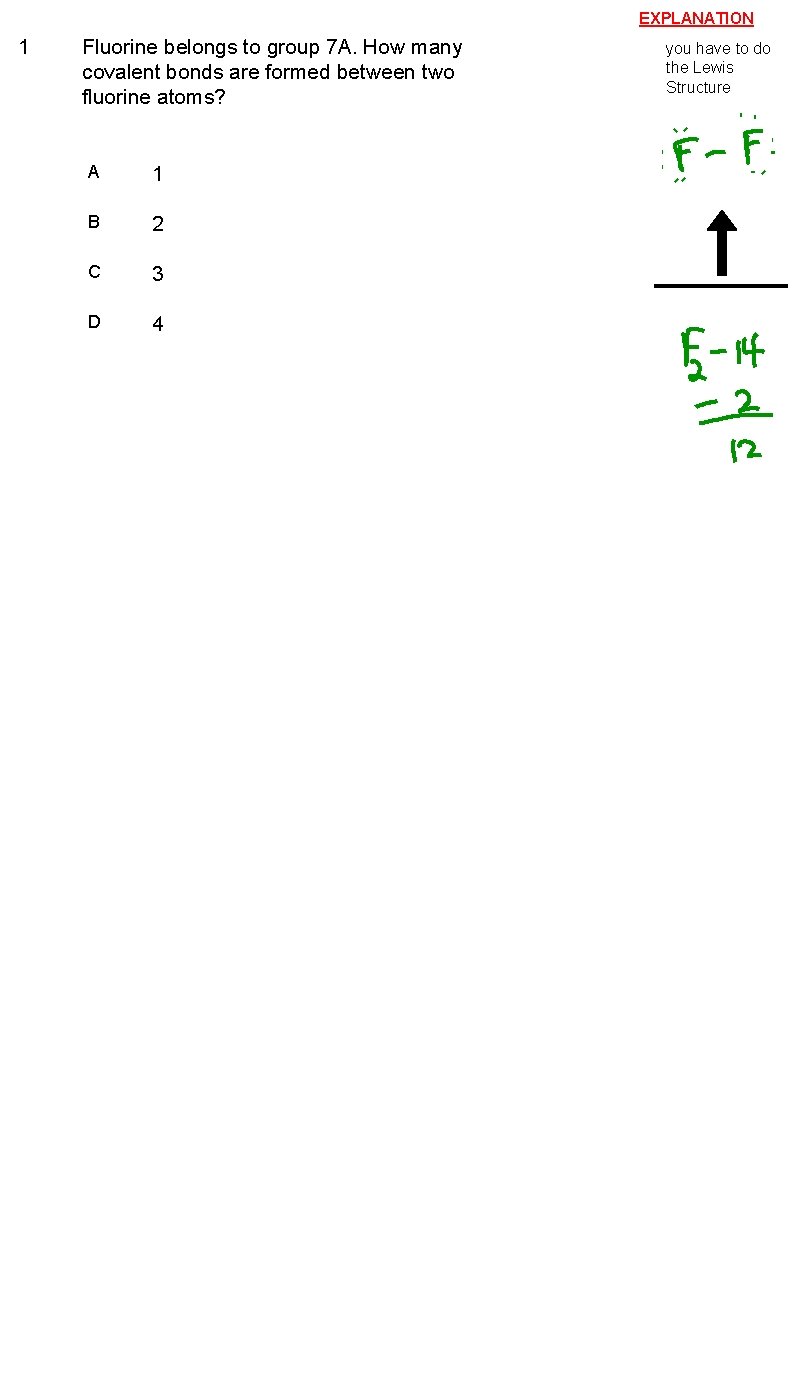
EXPLANATION 1 Fluorine belongs to group 7 A. How many covalent bonds are formed between two fluorine atoms? A 1 B 2 C 3 D 4 you have to do the Lewis Structure
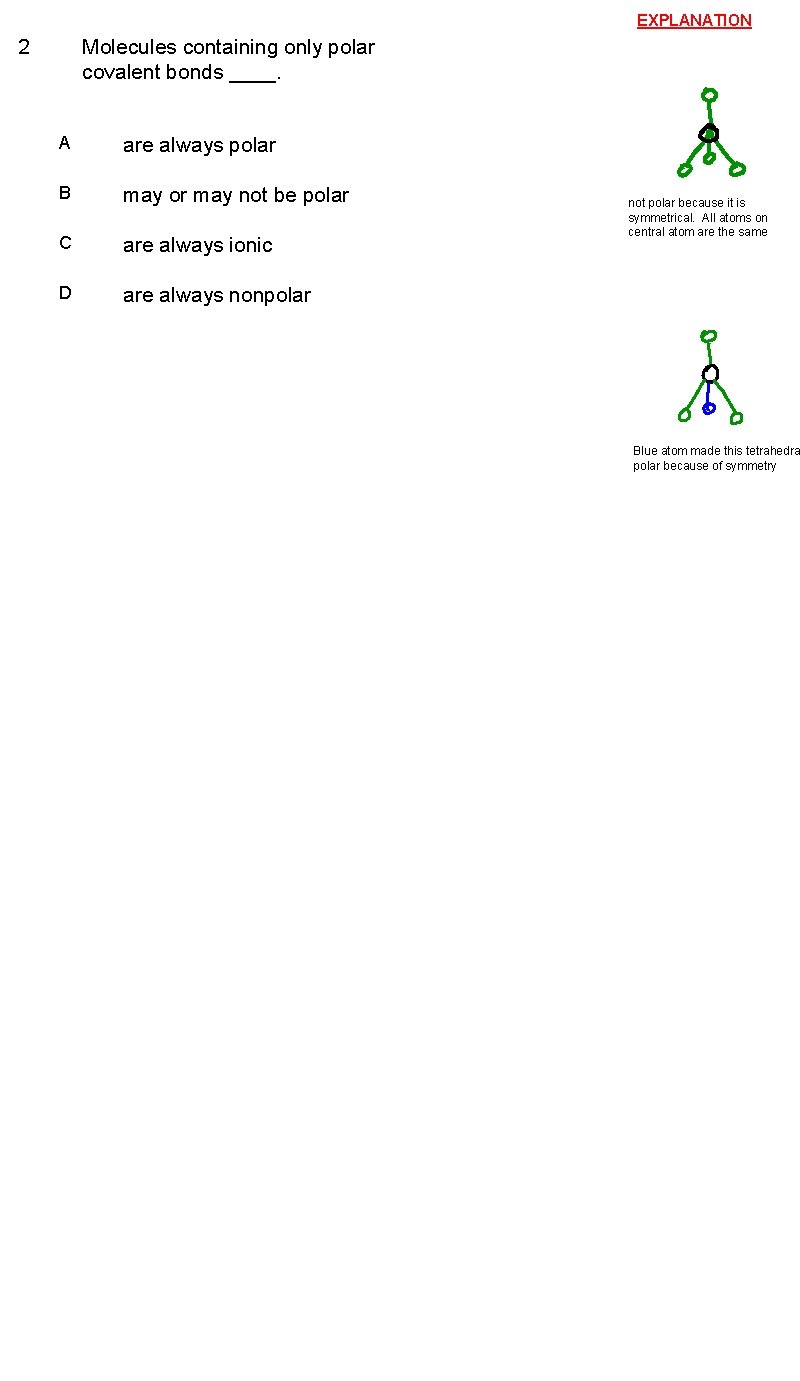
EXPLANATION 2 Molecules containing only polar covalent bonds ____. A are always polar B may or may not be polar C are always ionic D are always nonpolar not polar because it is symmetrical. All atoms on central atom are the same Blue atom made this tetrahedra polar because of symmetry
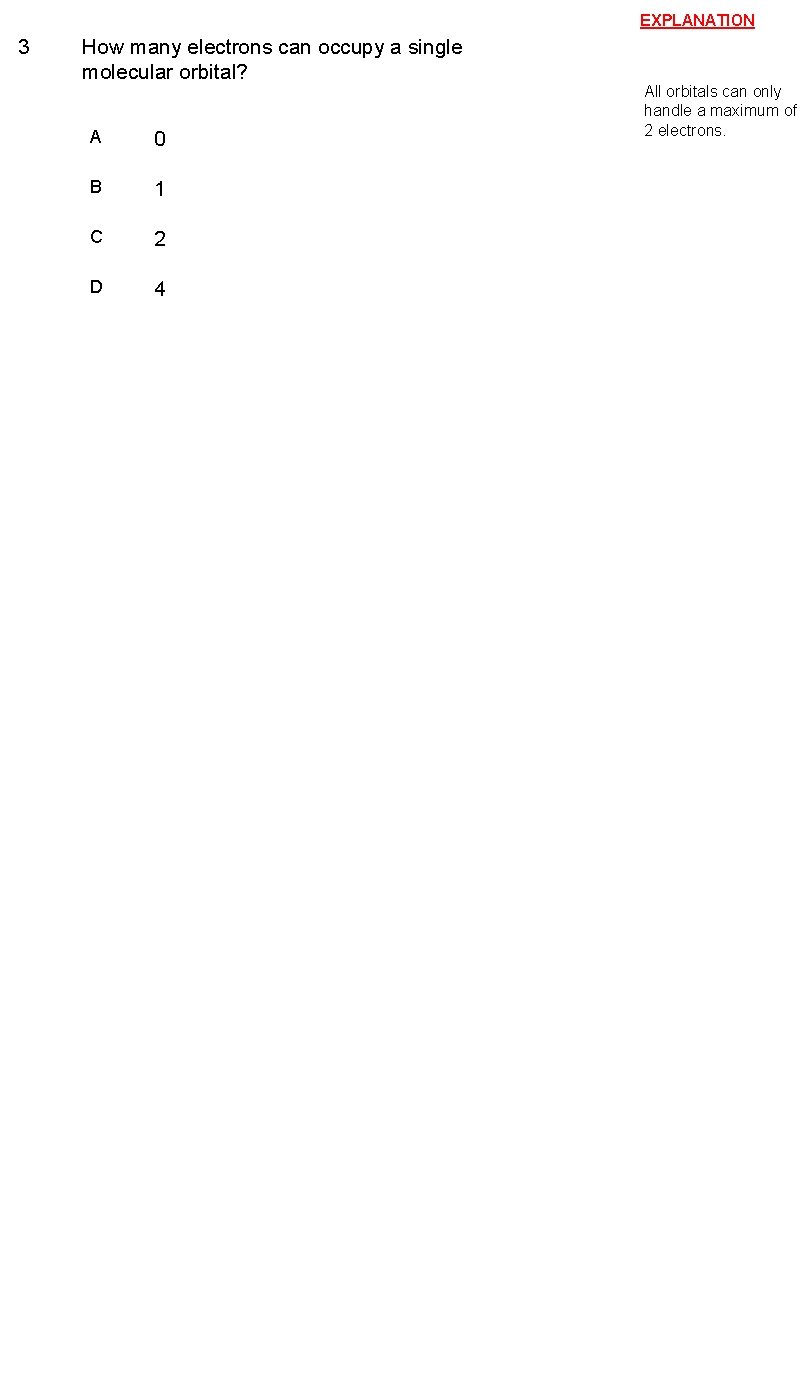
EXPLANATION 3 How many electrons can occupy a single molecular orbital? A 0 B 1 C 2 D 4 All orbitals can only handle a maximum of 2 electrons.
EXPLANATION 4 What are shared in a covalent bond? A ions B Lewis Structures C electrons D dipoles the word covalent means that electrons are being shared by 2 atoms, and not removed from one to the other.
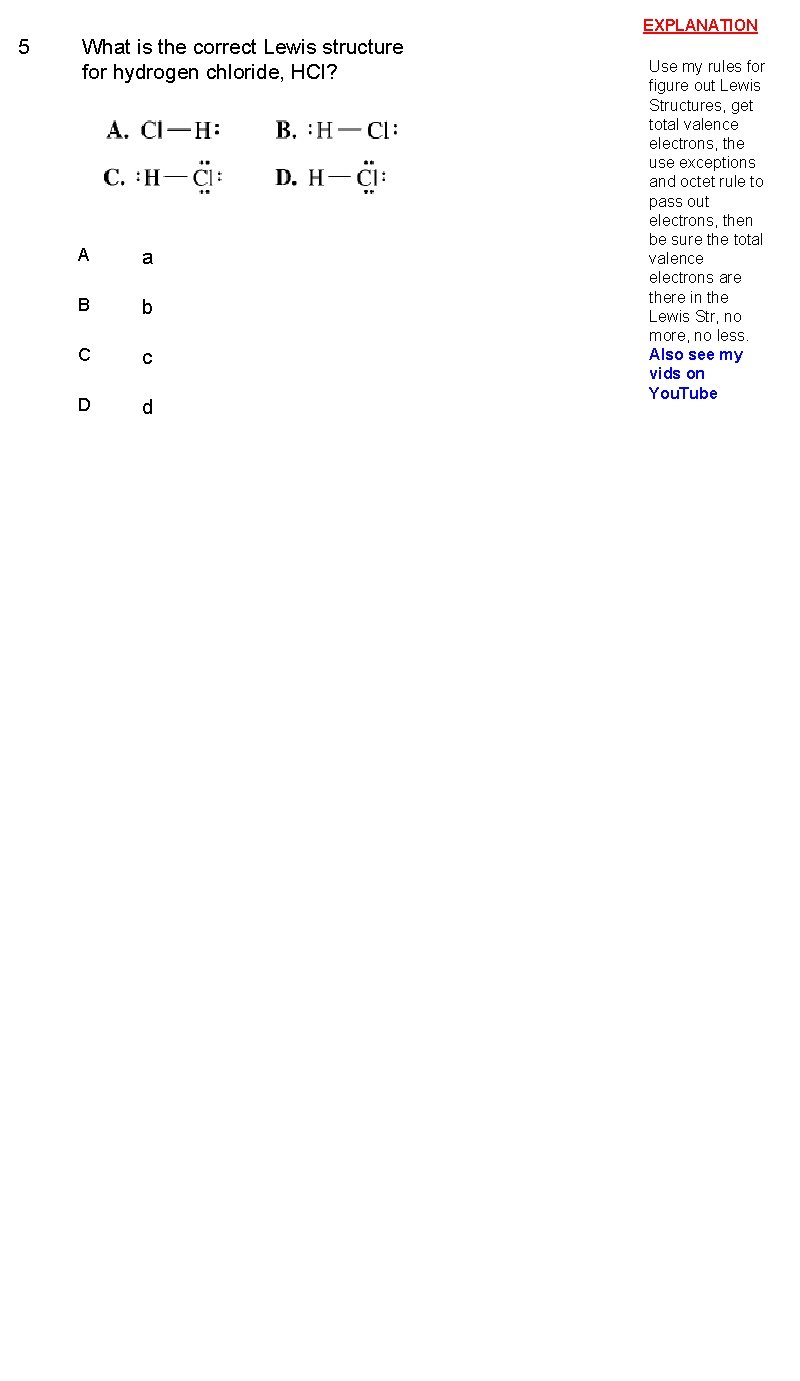
EXPLANATION 5 What is the correct Lewis structure for hydrogen chloride, HCl? A a B b C c D d Use my rules for figure out Lewis Structures, get total valence electrons, the use exceptions and octet rule to pass out electrons, then be sure the total valence electrons are there in the Lewis Str, no more, no less. Also see my vids on You. Tube
EXPLANATION 6 The symbol mm represents A micrometer B millimeter C milliliter D meter mm is a definition found in Ch 2 p. 26, combining milliprefix the base unit meter.
7 Which of the following represents a compound? A H B H-3 C H 2 O D O-16 EXPLANATION molecules of a compound have at least 2 different kinds of atoms
EXPLANATION 8 Emission of light from an atom occurs when an electron ____. A drops from a higher to a lower energy level B jumps from a lower to a higher energy level C moves within its atomic orbital D falls into the nucleus electron is excited by energy from outside atom (jumps to higher energy level), the light is given off (photon) when it drops back to its ground state
EXPLANATION 9 Trends in the properties of elements in a group or period can be explained in terms of A binding energy B atomic number C electron configuration D electron affinity outer shell electrons (valence) determine ratios with which atoms combine to make molecules
EXPLANATION 10 How many electrons are shared in a double covalent bond? A none B one C two D four each covalent bond is a "stick" and double = 2
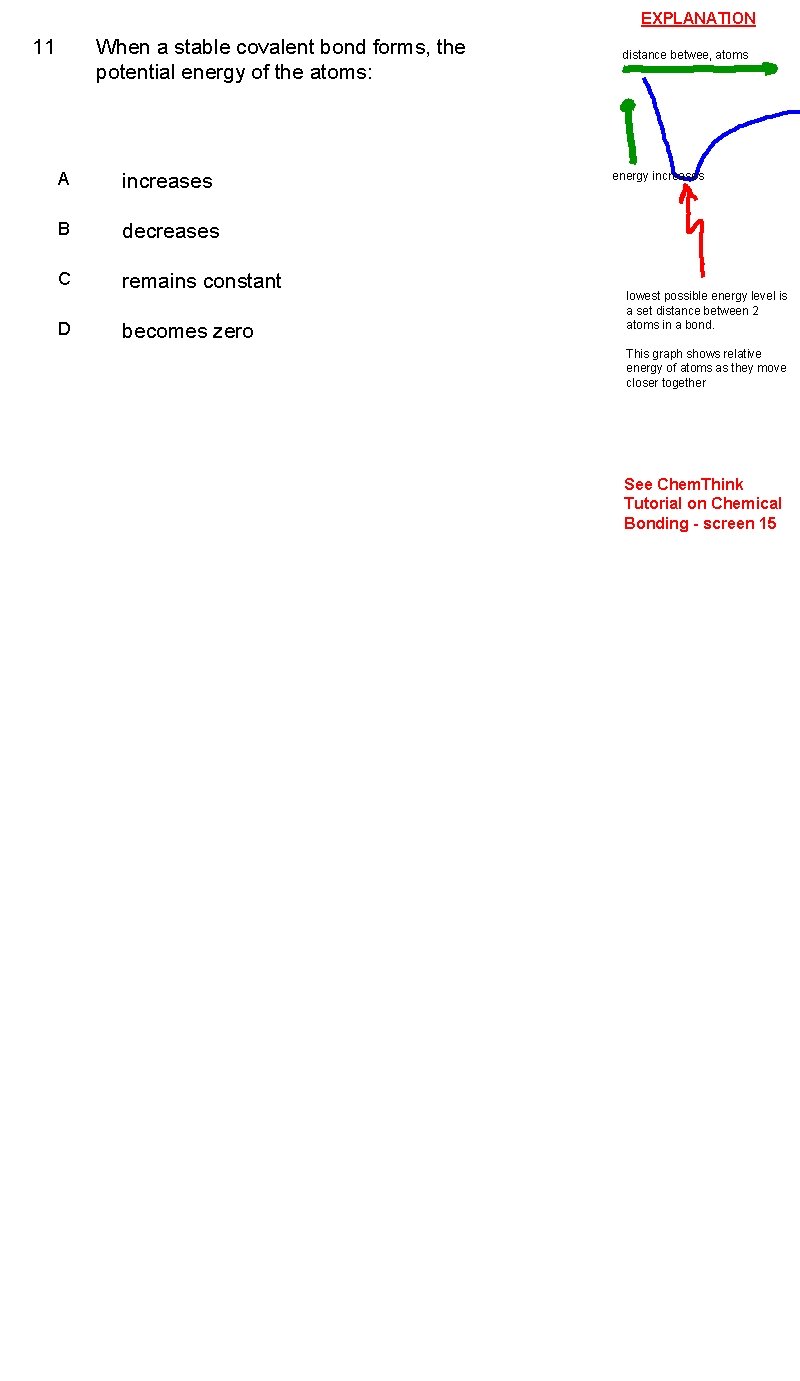
EXPLANATION 11 When a stable covalent bond forms, the potential energy of the atoms: A increases B decreases C remains constant D becomes zero distance betwee, atoms energy increases lowest possible energy level is a set distance between 2 atoms in a bond. This graph shows relative energy of atoms as they move closer together See Chem. Think Tutorial on Chemical Bonding - screen 15
12 A substance that forms a vapor is generally in what physical state at room temperature? EXPLANATION A solid B liquid C gas D liquid or solid all substances have 3 states - solid, liquid & gas. This question is asking what is the original state of a substance that can be changed into a gas.
EXPLANATION 13 Which of the following measurements (of different masses) is the most accurate? A 3. 1000 g B 3. 100 g C 3. 122 22 g D 3. 000 g The amount of accuracy a number shows is determined by the number of sig figs in the number.
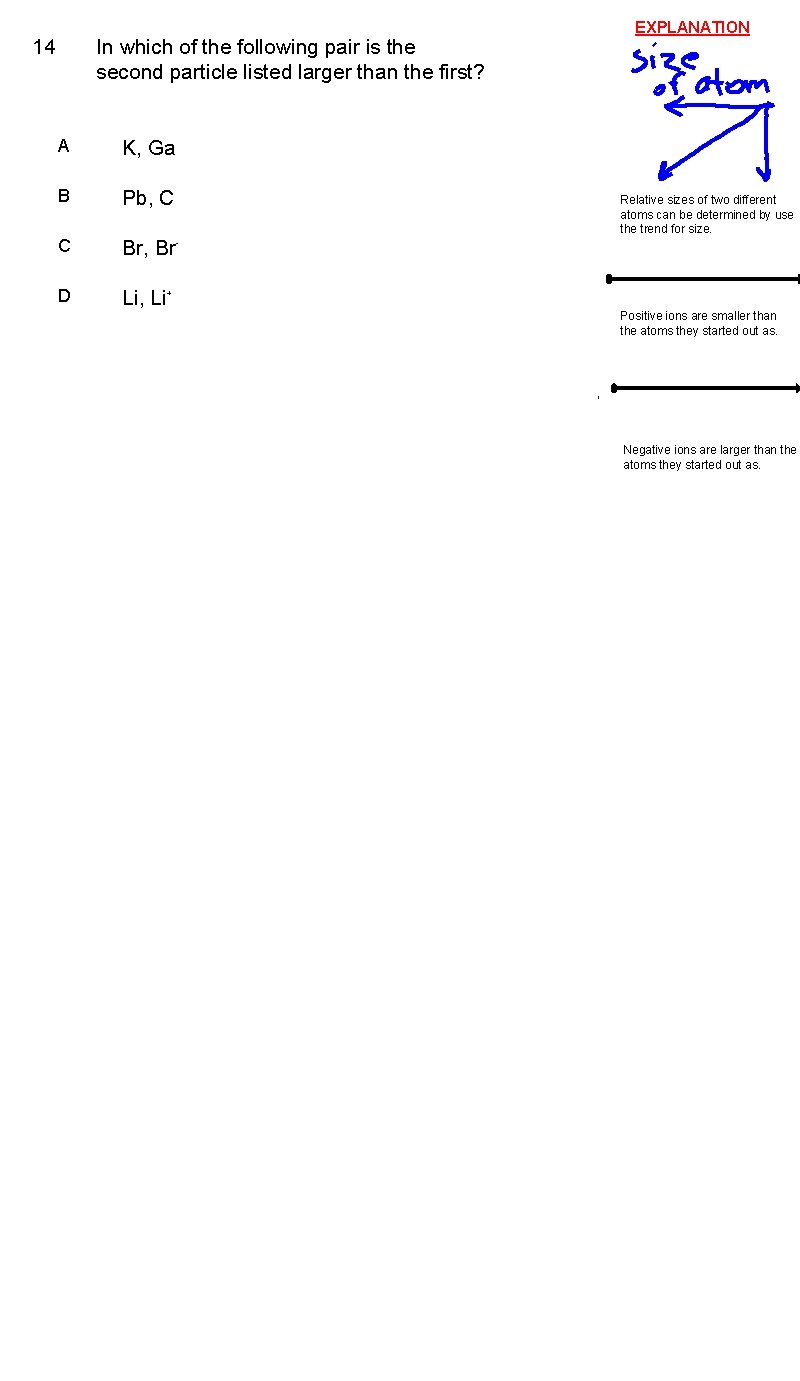
14 In which of the following pair is the second particle listed larger than the first? A K, Ga B Pb, C C Br, Br- D Li, Li+ EXPLANATION Relative sizes of two different atoms can be determined by use the trend for size. Positive ions are smaller than the atoms they started out as. Negative ions are larger than the atoms they started out as.
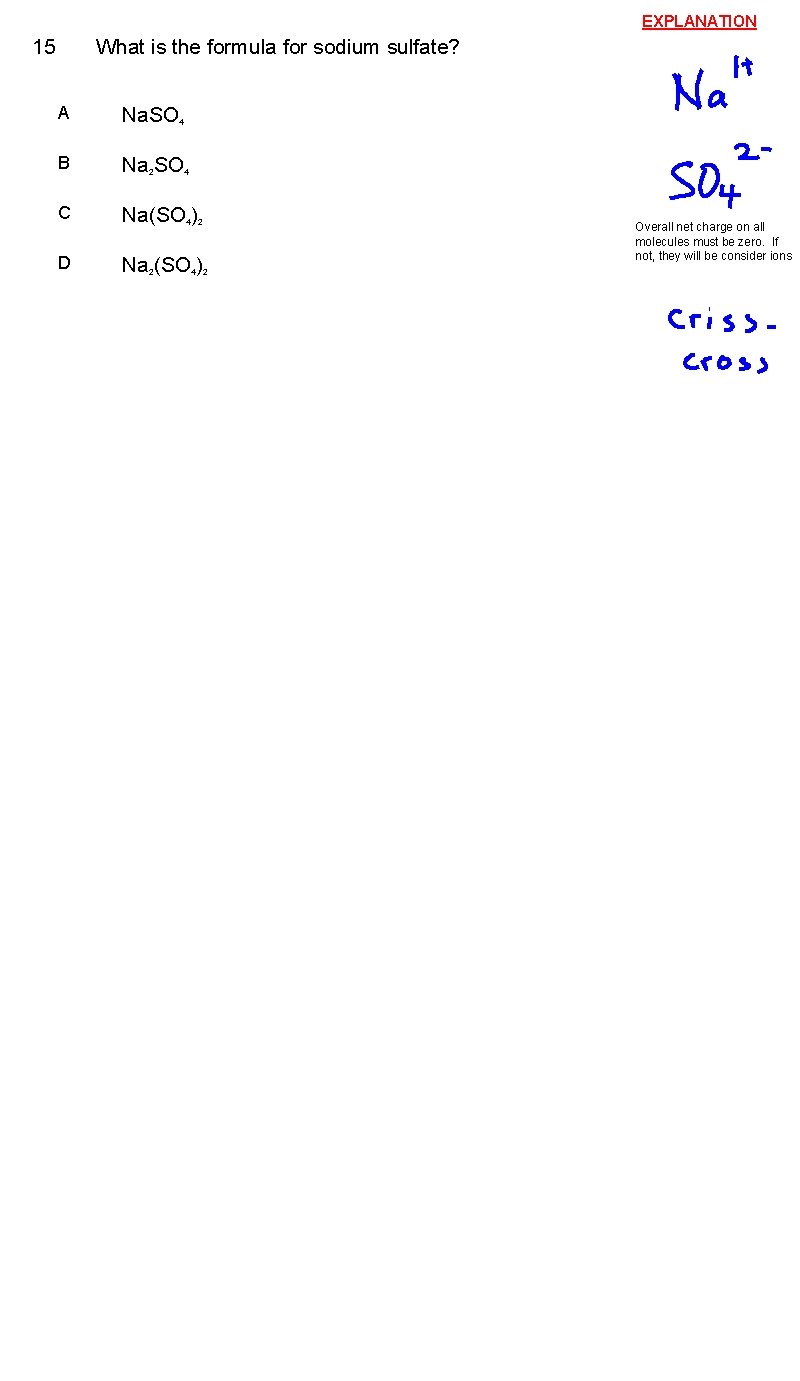
EXPLANATION 15 What is the formula for sodium sulfate? A Na. SO 4 B Na 2 SO 4 C Na(SO 4)2 D Na 2(SO 4)2 Overall net charge on all molecules must be zero. If not, they will be consider ions
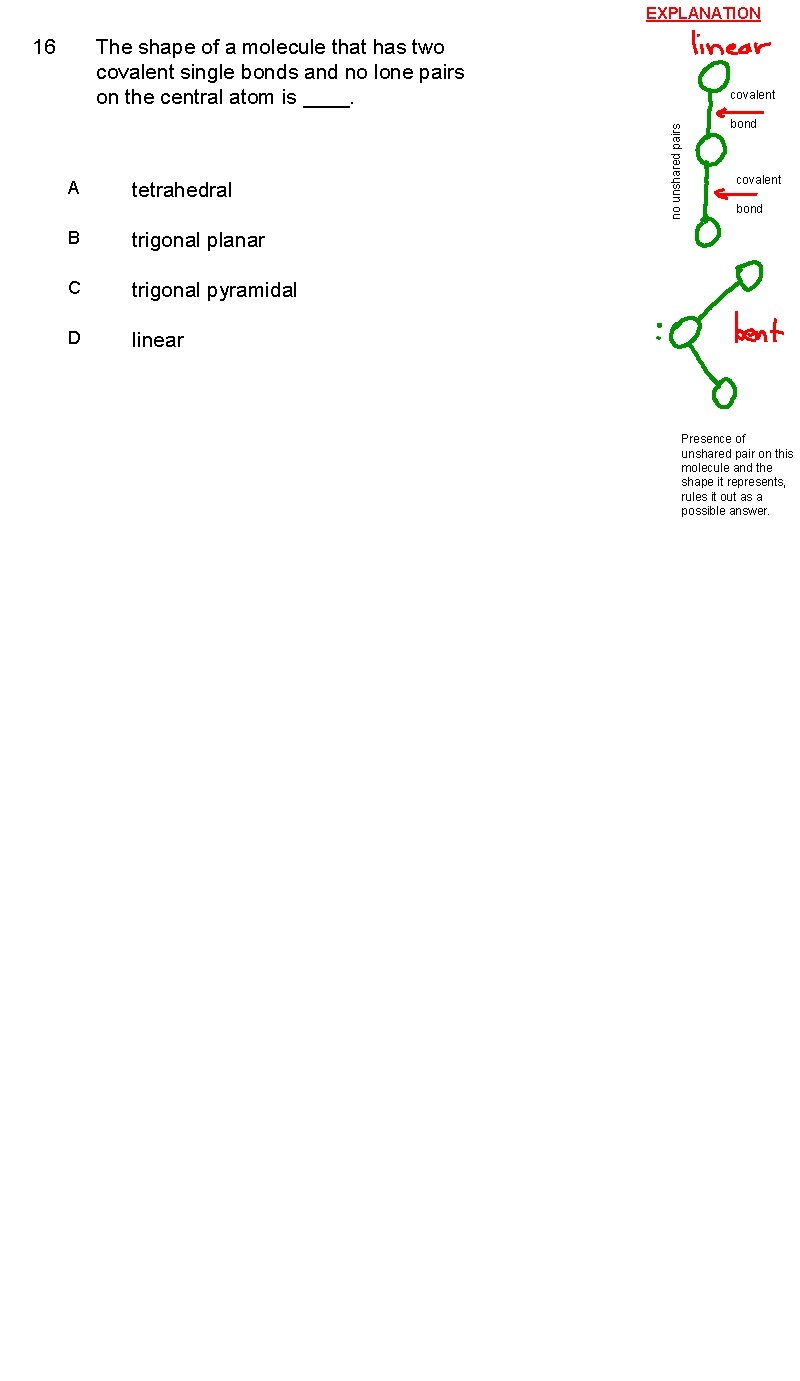
EXPLANATION The shape of a molecule that has two covalent single bonds and no lone pairs on the central atom is ____. A tetrahedral B trigonal planar C trigonal pyramidal D linear covalent no unshared pairs 16 bond covalent bond Presence of unshared pair on this molecule and the shape it represents, rules it out as a possible answer.
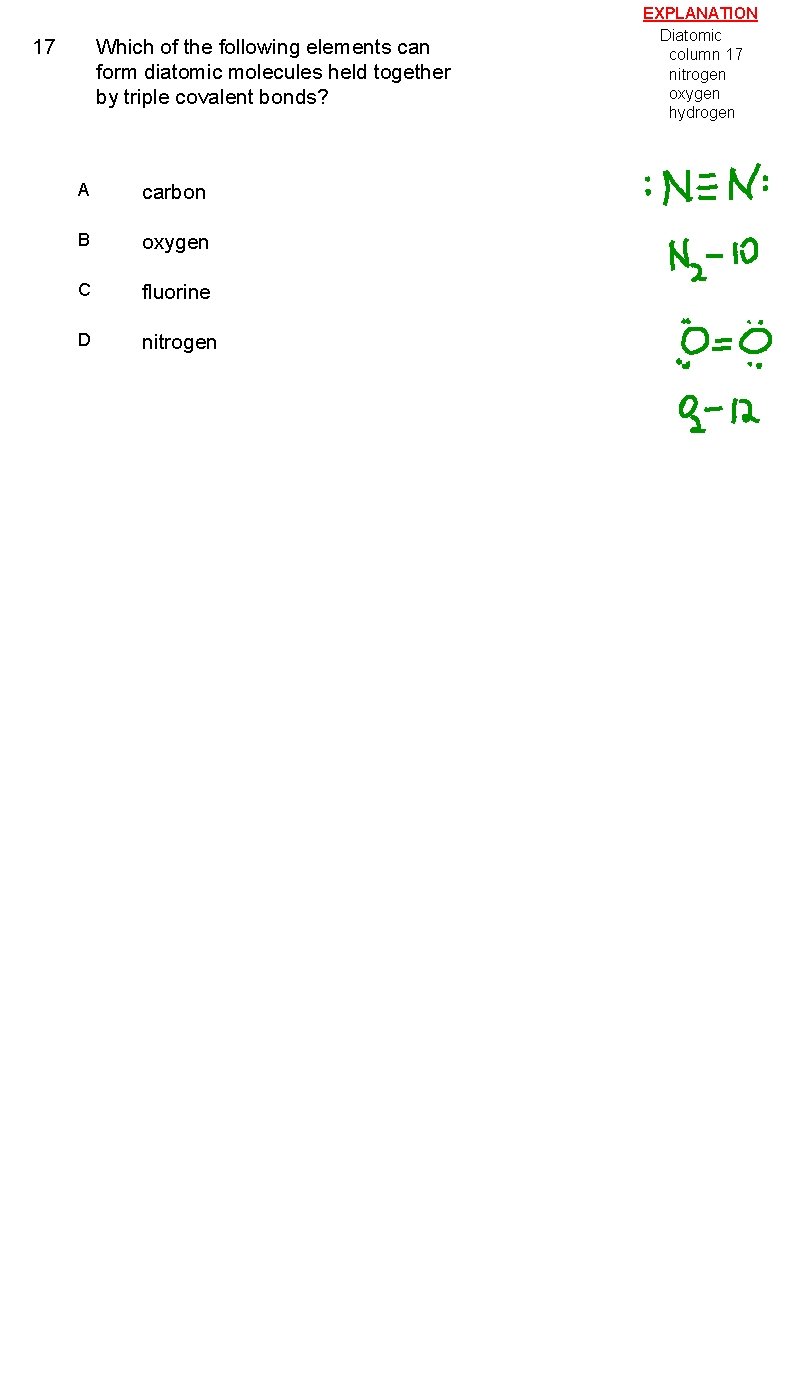
17 Which of the following elements can form diatomic molecules held together by triple covalent bonds? A carbon B oxygen C fluorine D nitrogen EXPLANATION Diatomic column 17 nitrogen oxygen hydrogen
A mutual electrical attraction between the nuclei and valence electrons of different atoms that binds the atoms together is called a(n) 18 A dipole B Lewis structure C chemical bond D London force EXPLANATION chemical bond (c) look at Chem. Think tutorial for Chemical Bonding
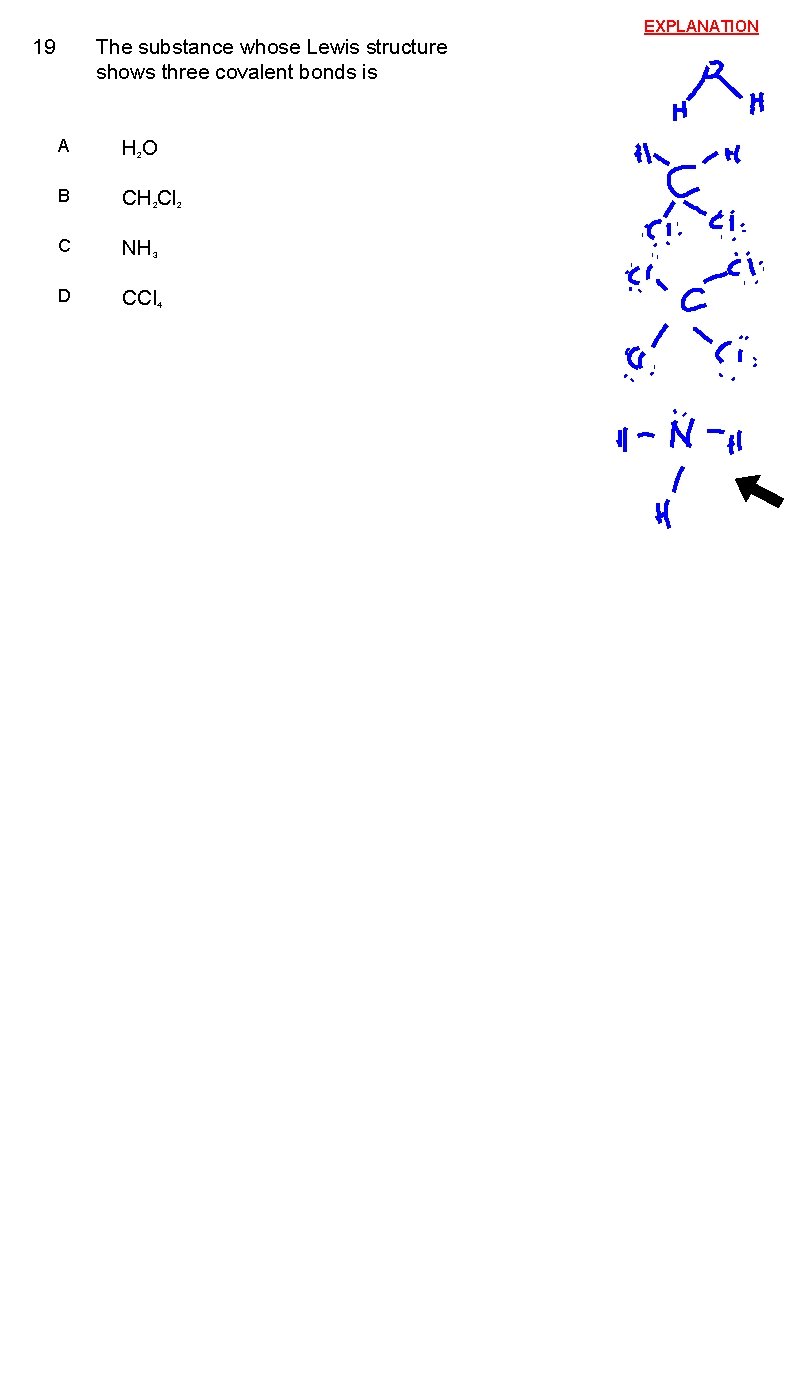
19 The substance whose Lewis structure shows three covalent bonds is A H 2 O B CH 2 Cl 2 C NH 3 D CCl 4 EXPLANATION
EXPLANATION 20 What must occur for a change to be a chemical reaction? A There must be a change in chemical properties. B There must be a change in physical properties. C The change must involve a change in mass. D The change must involve a change in volume. see Ch 3 on chem vs physical changes
EXPLANATION 21 As it travels through space, electromagnetic radiation A exhibits wavelike behavior B loses energy C varies in speed D releases photons See Ch 5 on light, p. 118 re wave and p. 122 re particle
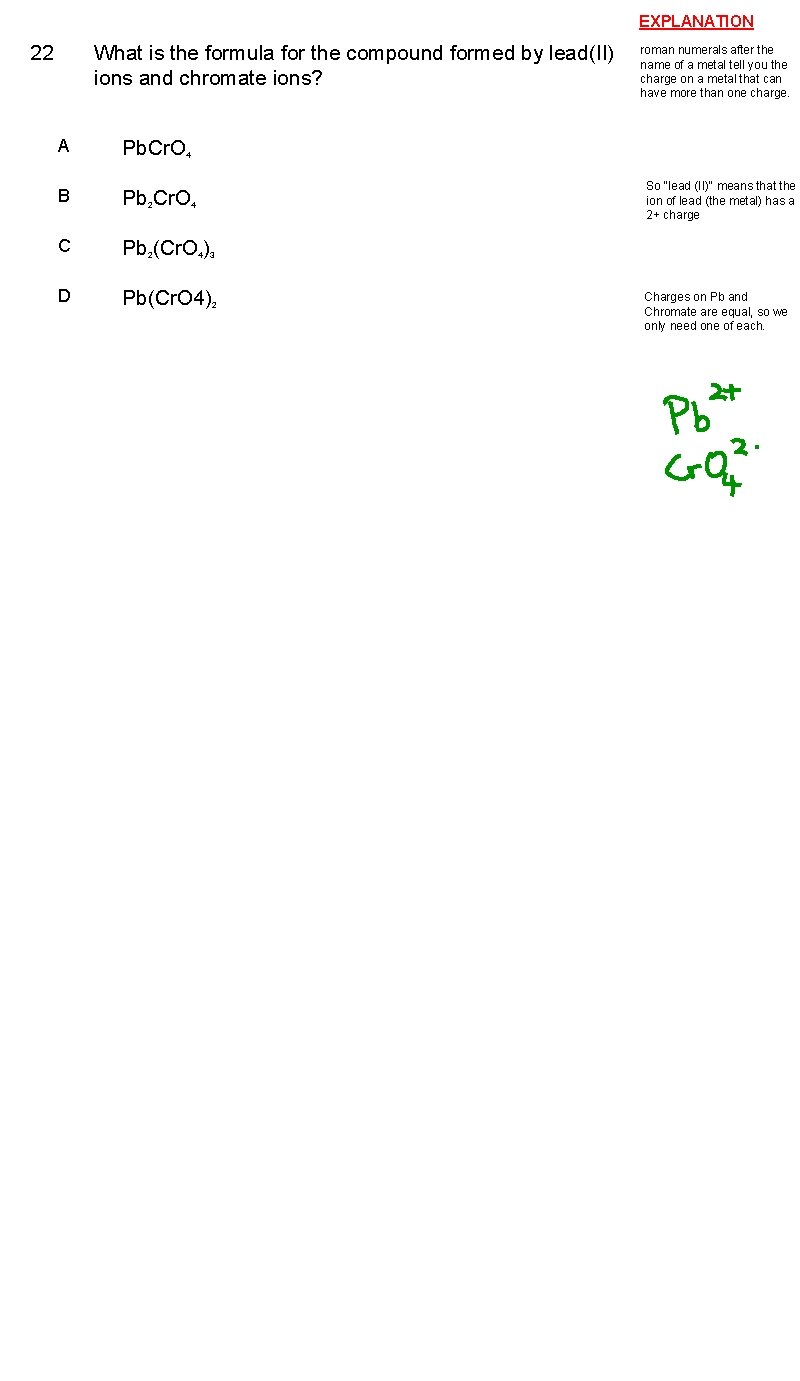
EXPLANATION 22 What is the formula for the compound formed by lead(II) ions and chromate ions? A roman numerals after the name of a metal tell you the charge on a metal that can have more than one charge. Pb. Cr. O 4 B Pb 2 Cr. O 4 C Pb 2(Cr. O 4)3 D Pb(Cr. O 4)2 So "lead (II)" means that the ion of lead (the metal) has a 2+ charge Charges on Pb and Chromate are equal, so we only need one of each.
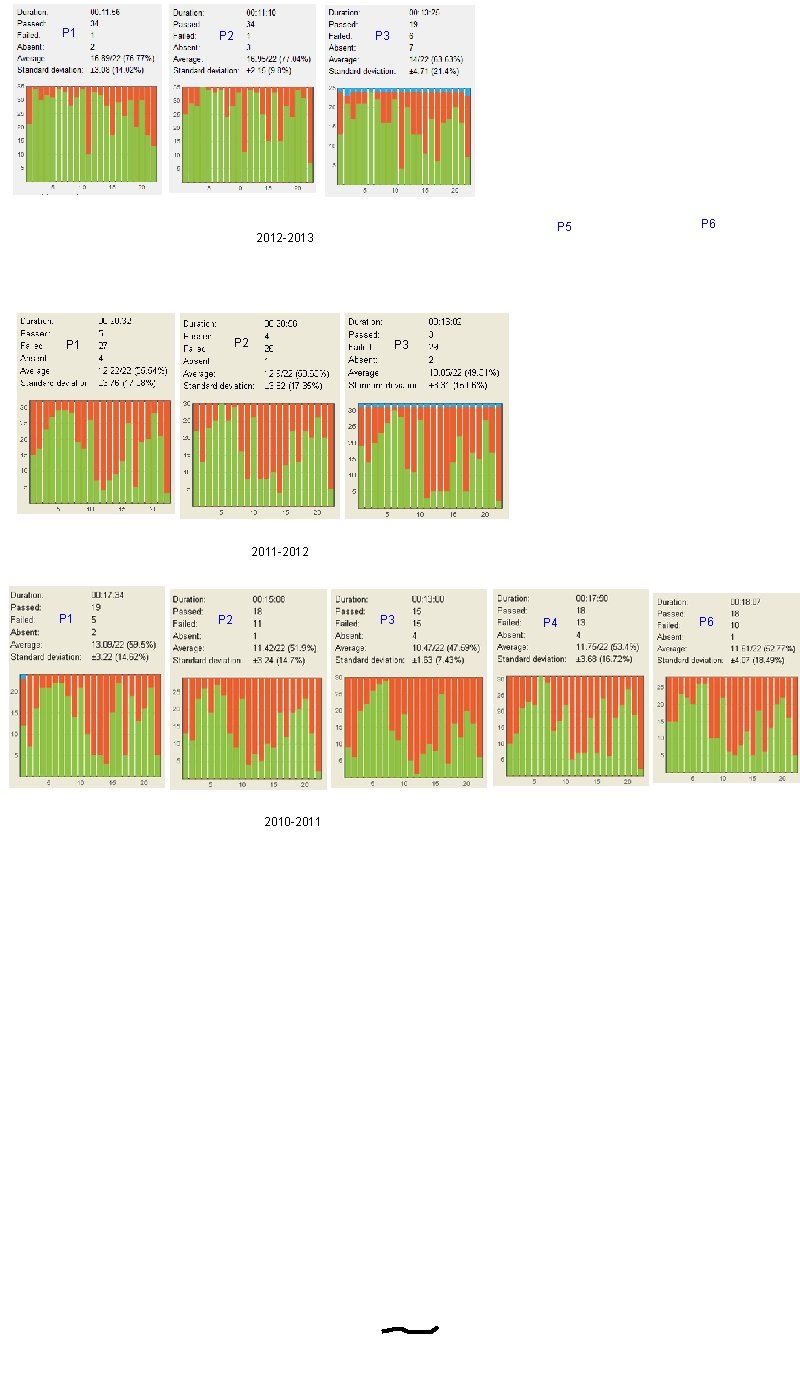
P 1 P 2 P 3 P 5 2012 -2013 P 2 P 1 P 6 P 3 2011 -2012 P 1 P 2 P 3 2010 -2011 P 4 P 6


- Slides: 27