
Tesselation Shaders Tesselation dictionary mosaic definition of tesselate
- Slides: 28
Tesselation Shaders
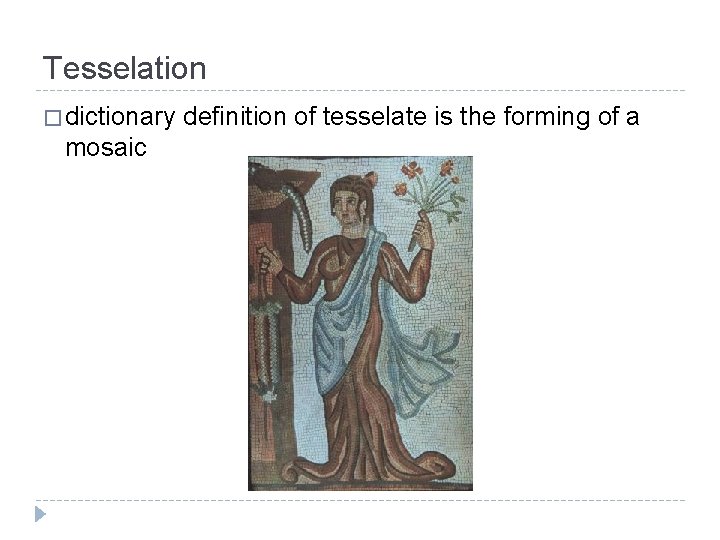
Tesselation � dictionary mosaic definition of tesselate is the forming of a
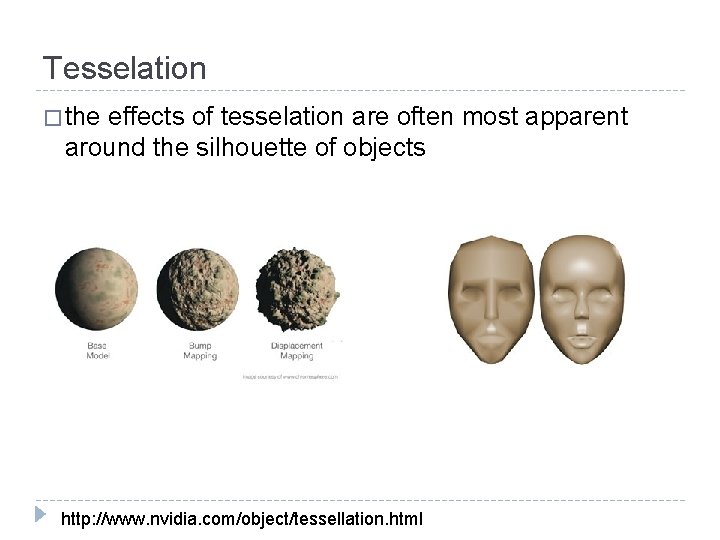
Tesselation � in computer graphics tesselation refers to the subdivision of a surface (not necessarily made up of polygons) into smaller polygons � there should be no seams between polygons � there should be no overlap of the polygons � typically used to convert a coarse model to a model with fine detail
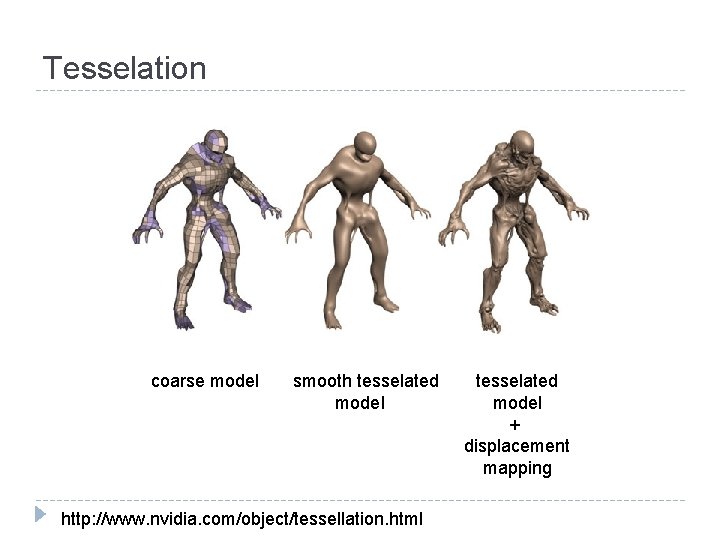
Tesselation coarse model smooth tesselated model http: //www. nvidia. com/object/tessellation. html tesselated model + displacement mapping
Tesselation � the effects of tesselation are often most apparent around the silhouette of objects http: //www. nvidia. com/object/tessellation. html
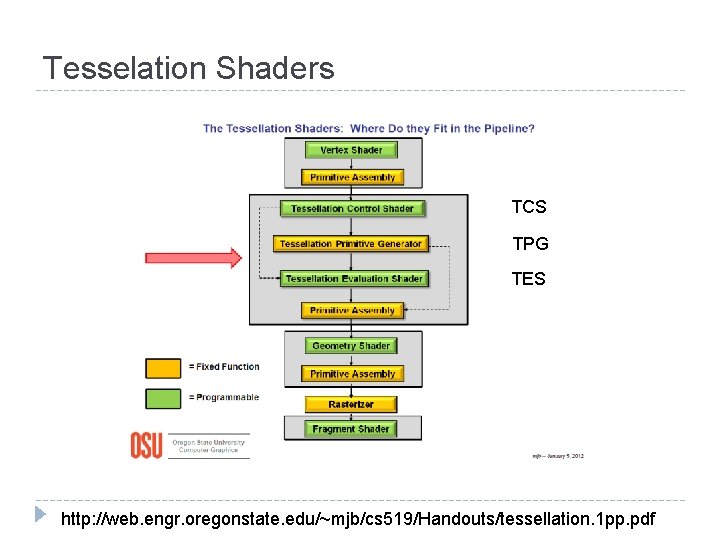
Tesselation Shaders TCS TPG TES http: //web. engr. oregonstate. edu/~mjb/cs 519/Handouts/tessellation. 1 pp. pdf
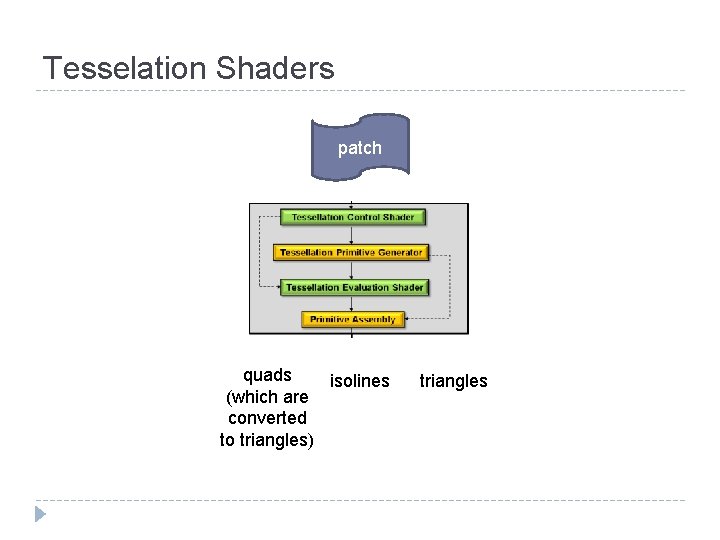
Tesselation Shaders patch quads isolines (which are converted to triangles) triangles
Patch � when a tesselation shader is active the only primitive that can be used is a patch � the GL_PATCHES type is what you would use in your Open. GL program; e. g. , gl. Begin(GL_PATCHES); gl. Vertex. . . // and so on gl. End(); � the patch is just a chunk of geometry (vertices) that is defined by the programmer
Tesselation Primitive Generator � patches are never directly rendered � tesselation primitive generator (TPG) generates the primitives that are eventually passed down the remainder of the pipeline � TPG is a fixed function stage that runs once per patch � but configurable to produce primitives based on a set of standard tesselation algorithms � TCS sets up the TPG and instructs the TPG how many primitives to generate � TES determines the vertex positions of the primitives generated by the TPG � TPG generates primitives with vertices defined in a parametric space (u, v, w) where 0 ≤ u, v, w ≤ 1
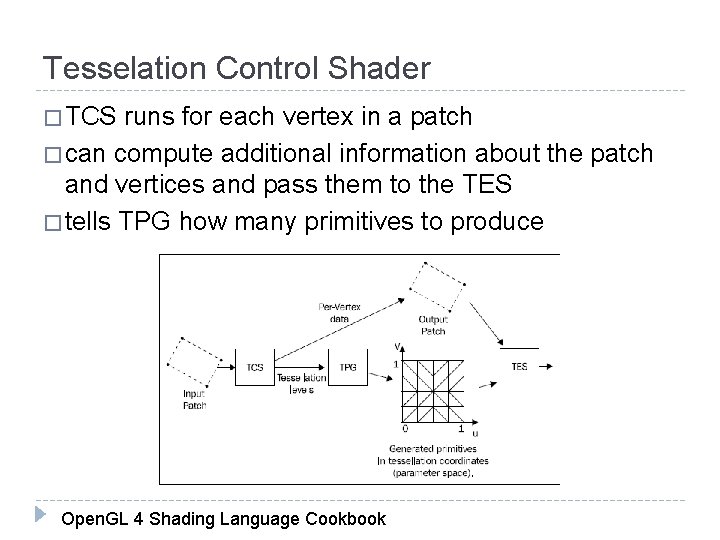
Tesselation Control Shader � TCS runs for each vertex in a patch � can compute additional information about the patch and vertices and pass them to the TES � tells TPG how many primitives to produce Open. GL 4 Shading Language Cookbook
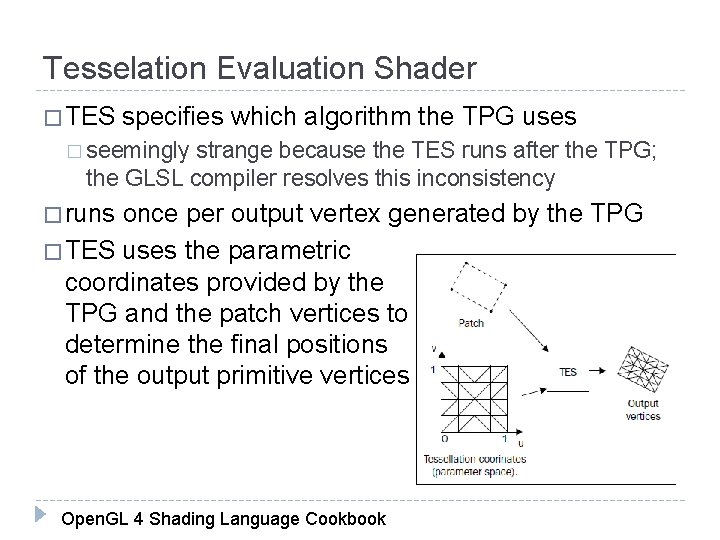
Tesselation Evaluation Shader � TES specifies which algorithm the TPG uses � seemingly strange because the TES runs after the TPG; the GLSL compiler resolves this inconsistency � runs once per output vertex generated by the TPG � TES uses the parametric coordinates provided by the TPG and the patch vertices to determine the final positions of the output primitive vertices Open. GL 4 Shading Language Cookbook
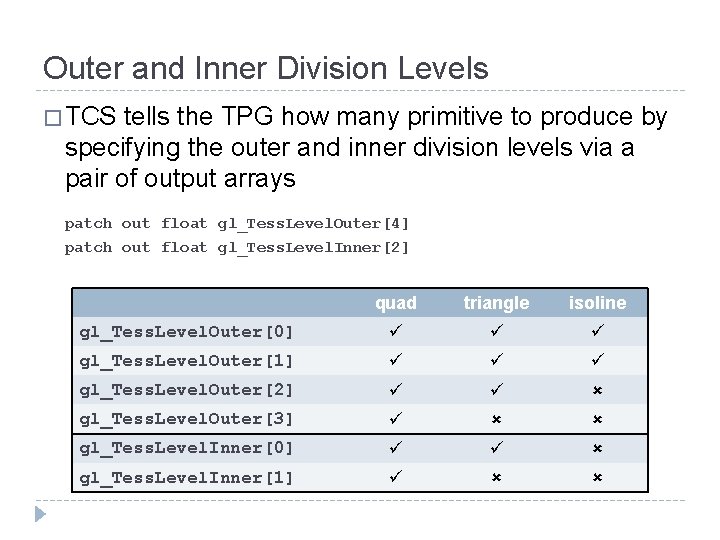
Outer and Inner Division Levels � TCS tells the TPG how many primitive to produce by specifying the outer and inner division levels via a pair of output arrays patch out float gl_Tess. Level. Outer[4] patch out float gl_Tess. Level. Inner[2] quad triangle isoline gl_Tess. Level. Outer[0] gl_Tess. Level. Outer[1] gl_Tess. Level. Outer[2] gl_Tess. Level. Outer[3] gl_Tess. Level. Inner[0] gl_Tess. Level. Inner[1]
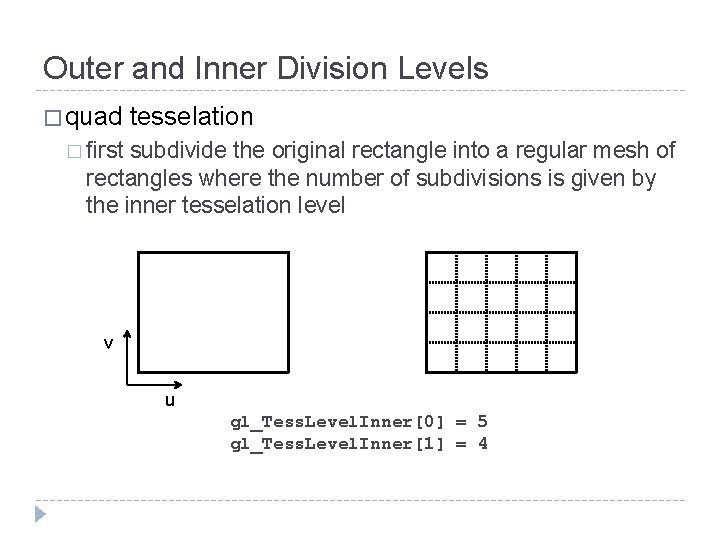
Outer and Inner Division Levels � quad tesselation � first subdivide the original rectangle into a regular mesh of rectangles where the number of subdivisions is given by the inner tesselation level v u gl_Tess. Level. Inner[0] = 5 gl_Tess. Level. Inner[1] = 4
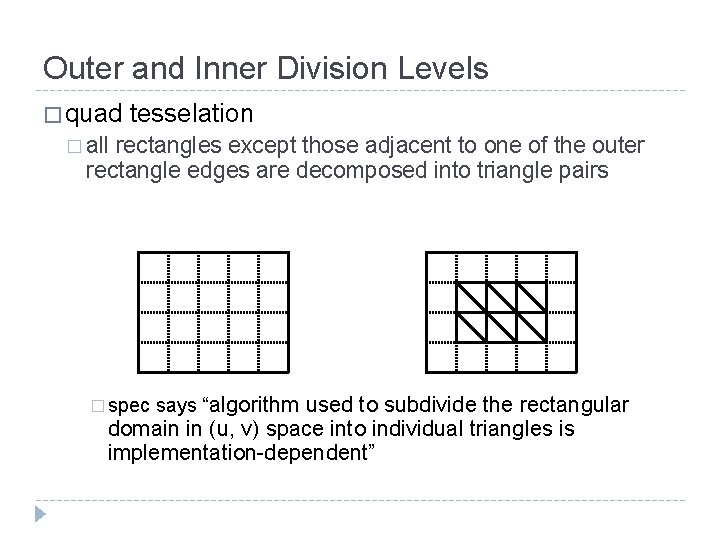
Outer and Inner Division Levels � quad tesselation � all rectangles except those adjacent to one of the outer rectangle edges are decomposed into triangle pairs � spec says “algorithm used to subdivide the rectangular domain in (u, v) space into individual triangles is implementation-dependent”
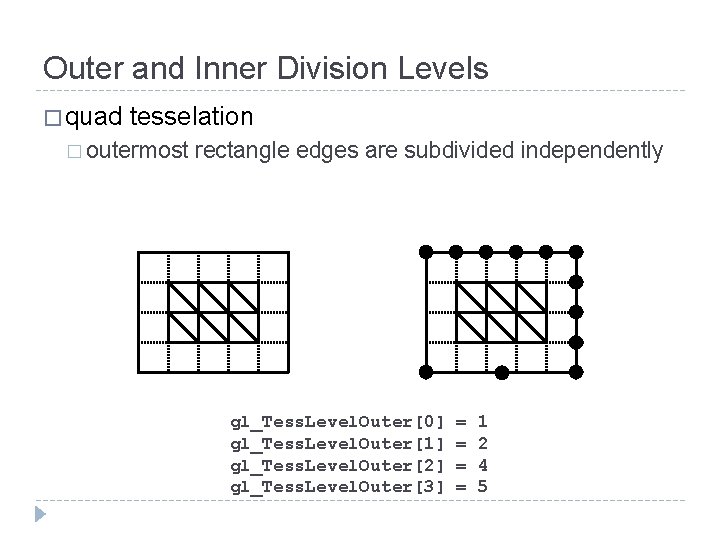
Outer and Inner Division Levels � quad tesselation � outermost rectangle edges are subdivided independently gl_Tess. Level. Outer[0] gl_Tess. Level. Outer[1] gl_Tess. Level. Outer[2] gl_Tess. Level. Outer[3] = = 1 2 4 5
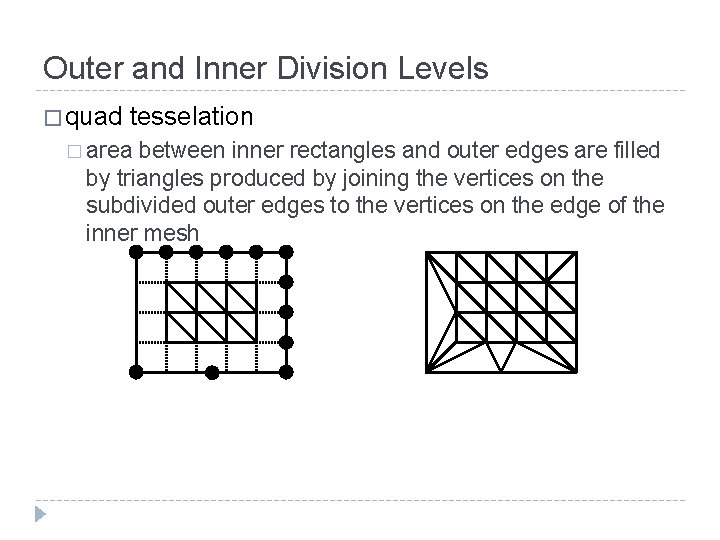
Outer and Inner Division Levels � quad tesselation � area between inner rectangles and outer edges are filled by triangles produced by joining the vertices on the subdivided outer edges to the vertices on the edge of the inner mesh
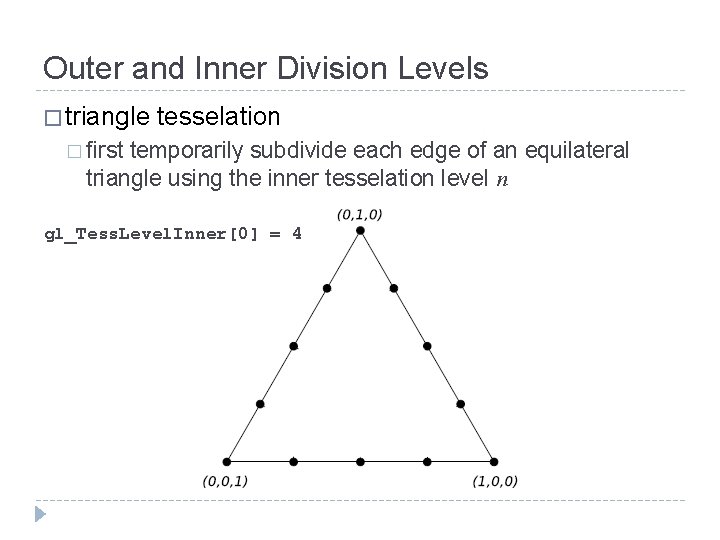
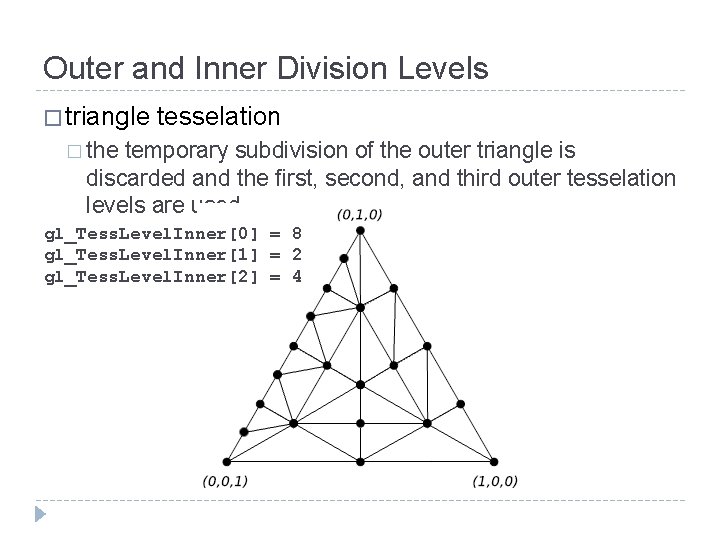
Outer and Inner Division Levels � triangle tesselation � first temporarily subdivide each edge of an equilateral triangle using the inner tesselation level n gl_Tess. Level. Inner[0] = 4
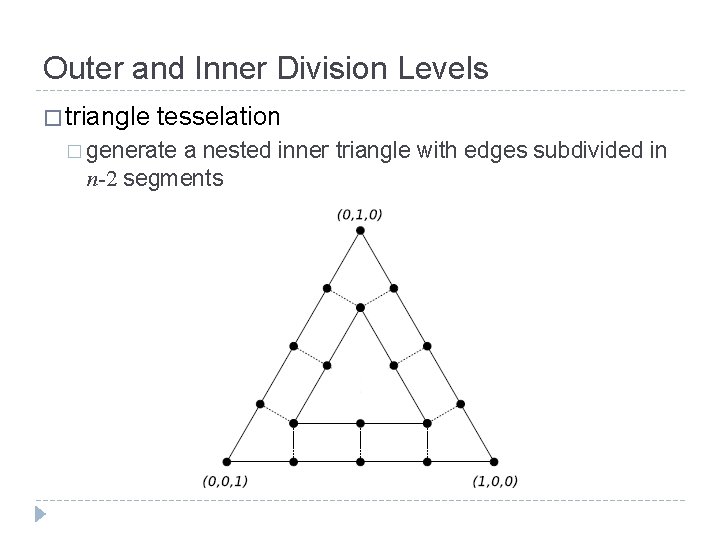
Outer and Inner Division Levels � triangle tesselation � generate a nested inner triangle with edges subdivided in n-2 segments
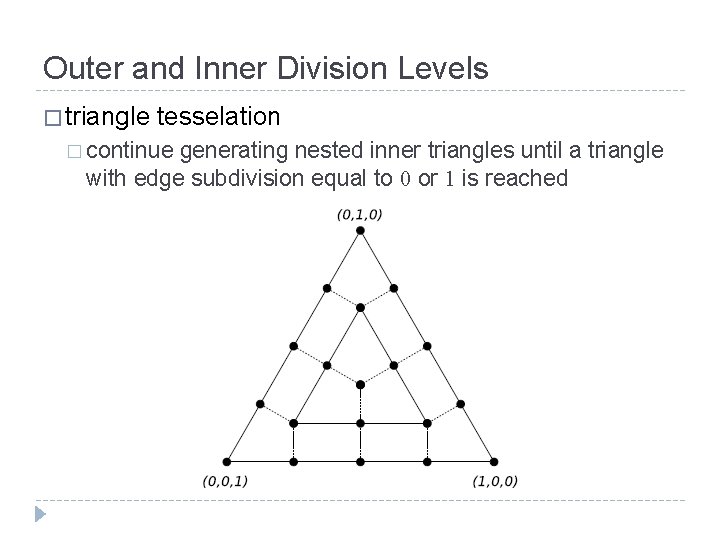
Outer and Inner Division Levels � triangle tesselation � continue generating nested inner triangles until a triangle with edge subdivision equal to 0 or 1 is reached
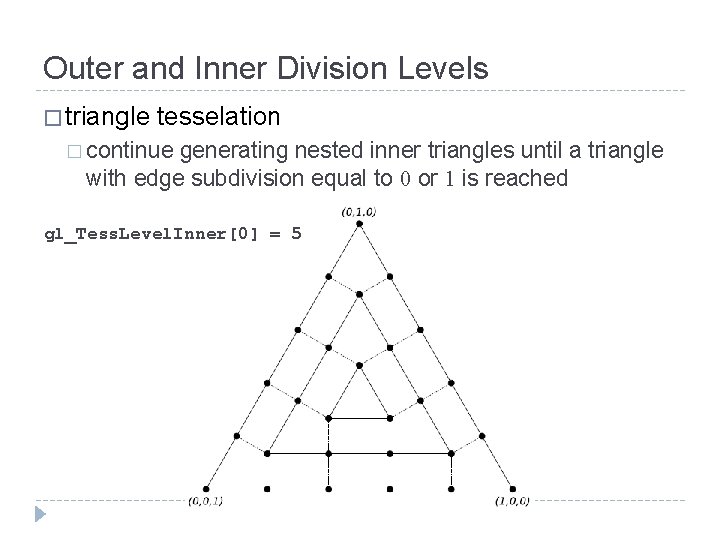
Outer and Inner Division Levels � triangle tesselation � continue generating nested inner triangles until a triangle with edge subdivision equal to 0 or 1 is reached gl_Tess. Level. Inner[0] = 5
Outer and Inner Division Levels � triangle tesselation � the temporary subdivision of the outer triangle is discarded and the first, second, and third outer tesselation levels are used gl_Tess. Level. Inner[0] = 8 gl_Tess. Level. Inner[1] = 2 gl_Tess. Level. Inner[2] = 4
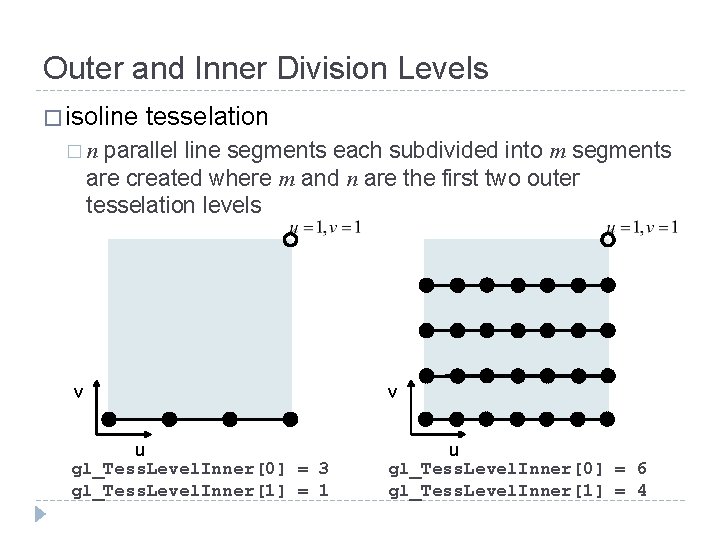
Outer and Inner Division Levels � isoline tesselation parallel line segments each subdivided into m segments are created where m and n are the first two outer tesselation levels �n v v u gl_Tess. Level. Inner[0] = 3 gl_Tess. Level. Inner[1] = 1 u gl_Tess. Level. Inner[0] = 6 gl_Tess. Level. Inner[1] = 4
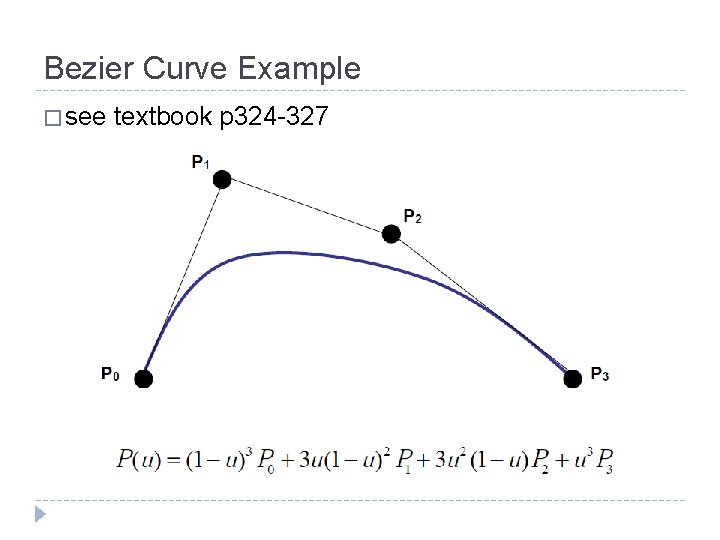
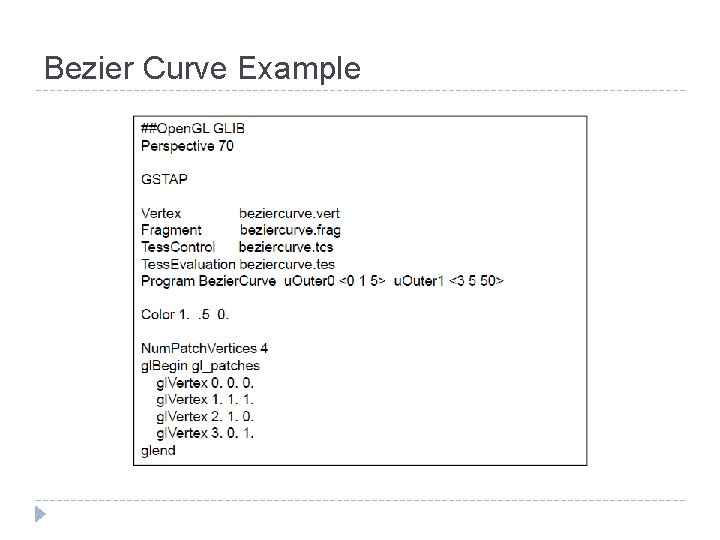
Bezier Curve Example � see textbook p 324 -327
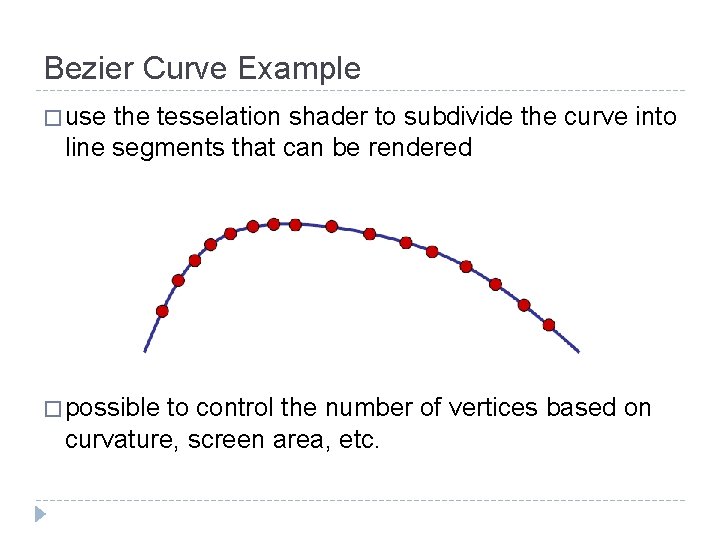
Bezier Curve Example � use the tesselation shader to subdivide the curve into line segments that can be rendered � possible to control the number of vertices based on curvature, screen area, etc.
Bezier Curve Example
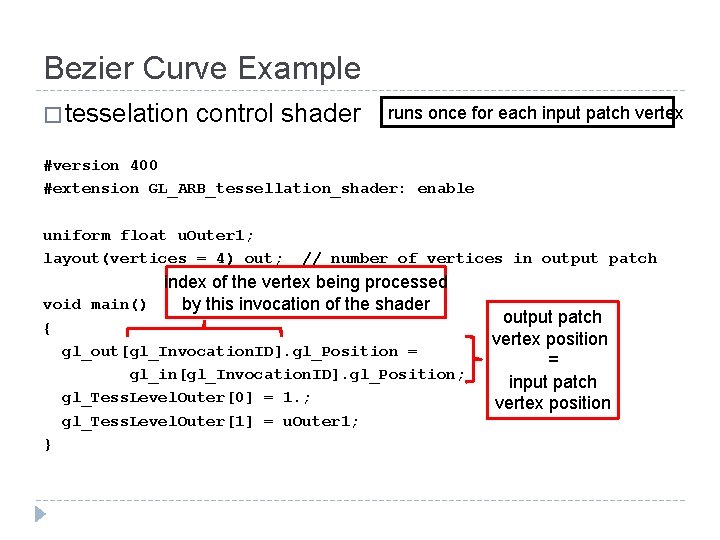
Bezier Curve Example � tesselation control shader runs once for each input patch vertex #version 400 #extension GL_ARB_tessellation_shader: enable uniform float u. Outer 1; layout(vertices = 4) out; // number of vertices in output patch index of the vertex being processed void main() by this invocation of the shader { gl_out[gl_Invocation. ID]. gl_Position = gl_in[gl_Invocation. ID]. gl_Position; gl_Tess. Level. Outer[0] = 1. ; gl_Tess. Level. Outer[1] = u. Outer 1; } output patch vertex position = input patch vertex position
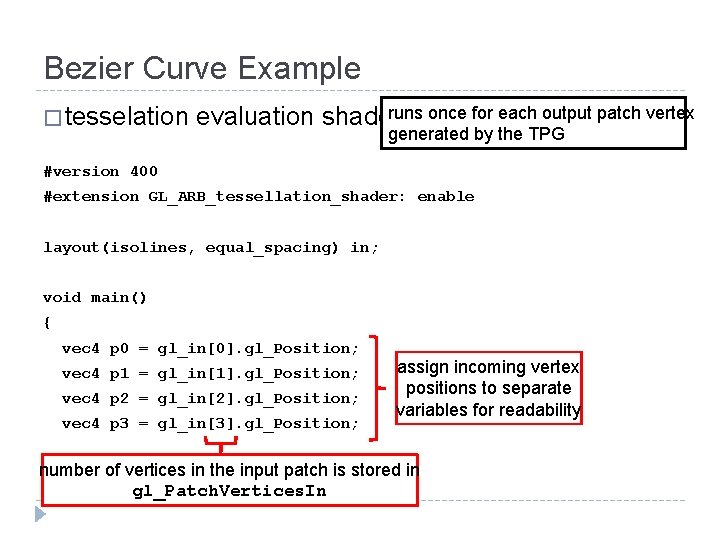
Bezier Curve Example � tesselation runs once for each output patch vertex evaluation shader generated by the TPG #version 400 #extension GL_ARB_tessellation_shader: enable layout(isolines, equal_spacing) in; void main() { vec 4 p 0 = gl_in[0]. gl_Position; vec 4 p 1 = gl_in[1]. gl_Position; vec 4 p 2 = gl_in[2]. gl_Position; vec 4 p 3 = gl_in[3]. gl_Position; assign incoming vertex positions to separate variables for readability number of vertices in the input patch is stored in gl_Patch. Vertices. In
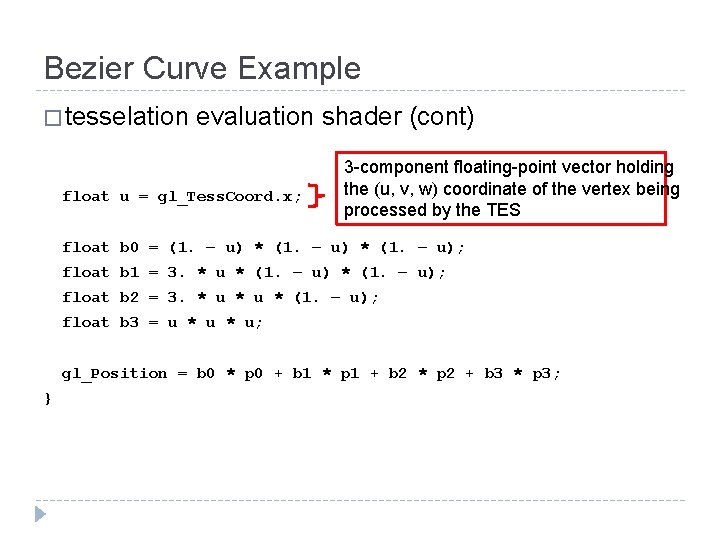
Bezier Curve Example � tesselation evaluation shader (cont) float u = gl_Tess. Coord. x; 3 -component floating-point vector holding the (u, v, w) coordinate of the vertex being processed by the TES float b 0 = (1. – u) * (1. – u); float b 1 = 3. * u * (1. – u); float b 2 = 3. * u * (1. – u); float b 3 = u * u; gl_Position = b 0 * p 0 + b 1 * p 1 + b 2 * p 2 + b 3 * p 3; }