
TESOL Methodology Week 2 Lecture A Announcements Introduction

- Slides: 84
TESOL Methodology Week 2: Lecture A Announcements Introduction to GTM
1 Announcements * For Your Information (FYI) This week • No quiz – free pass! • Special lecture format Next week • First review quiz • Standard lecture format
TESOL Methodology Grammar Translation Background Principles & Characteristics Sample Lesson Techniques Video
1 Background The Classical Method • Used to teach Latin & Greek • 500 -600 years ago Latin was the language of education, commerce, religion • By the 16 th C. – Latin replaced by national tongues • Study of Latin became model for the teaching of all foreign language
1 Background Textbook Characteristics • Statements of abstract grammar rules • Lists of vocabulary • Sentences for translation • Organized around grammar points • Grammar point intro • Explanation on rules of usage • Sample sentences • Oral work reduced to a minimum
1 Background Latin Grammar Study • • • Rote learning of grammar rules Study of declensions & conjugations Translation Practice writing sample sentences Bilingual texts & dialogues From basic proficiency to advanced grammar & rhetoric
1 Background Why Grammar Translation? • Major purpose: help Ss to read & appreciate foreign language literature • 2 birds, 1 stone: study of TL grammar leads to deeper understanding of L 1 grammar, Ss develop L 1 literacy • Foreign LL helps Ss grow intellectually • Mental gymnastics: disciplined &
1 Principles & Characteristics 2 Summary of Major Goals • Literature appreciation • Mental discipline • Intellectual development “To know everything about something rather than the thing itself”
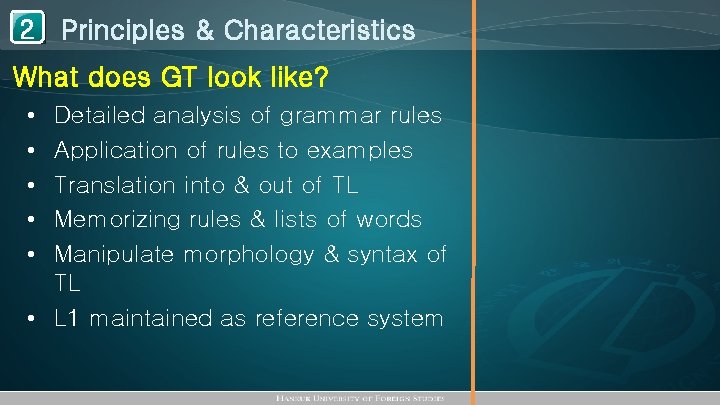
1 Principles & Characteristics 2 What does GT look like? • • • Detailed analysis of grammar rules Application of rules to examples Translation into & out of TL Memorizing rules & lists of words Manipulate morphology & syntax of TL • L 1 maintained as reference system
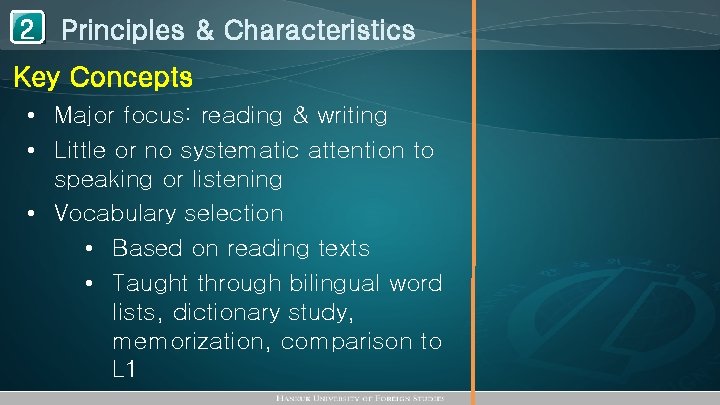
1 Principles & Characteristics 2 Key Concepts • Major focus: reading & writing • Little or no systematic attention to speaking or listening • Vocabulary selection • Based on reading texts • Taught through bilingual word lists, dictionary study, memorization, comparison to L 1
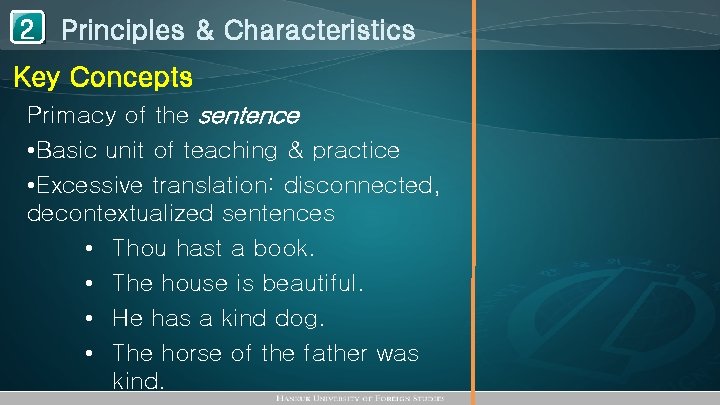
1 Principles & Characteristics 2 Key Concepts Primacy of the sentence • Basic unit of teaching & practice • Excessive translation: disconnected, decontextualized sentences • Thou hast a book. • The house is beautiful. • He has a kind dog. • The horse of the father was kind.
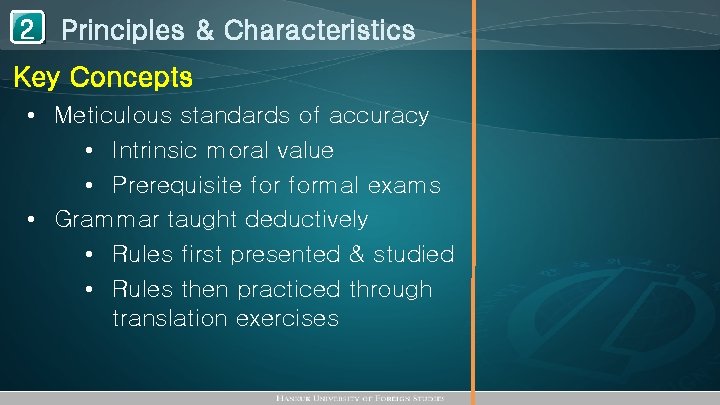
1 Principles & Characteristics 2 Key Concepts • Meticulous standards of accuracy • Intrinsic moral value • Prerequisite formal exams • Grammar taught deductively • Rules first presented & studied • Rules then practiced through translation exercises
1 Principles & Characteristics 2 Key Concepts Syllabus organization • According to pre-selected grammar points • Texts chosen or composed based on focus grammar Native Language • Medium of classroom instruction • Used to explain, compare
1 Sample Lesson 3 Exploratory Questions In this section of the lecture we will use exploratory questions to look at specific techniques from the sample lesson presented in TPLT. If you haven’t read through the sample lesson, pause and do so now. Pages 13 -17
1 Sample Lesson 3 1. Teacher’s Goal: learning to read TL literature through focus on grammar rules & vocabulary • SLT: The main text of the lesson is an excerpt from Mark Twain, all activities based on its grammar & vocabulary Goal: Develop Ss’ translation skills • SLT: Ss translate from English to Spanish, first the passage and later words
1 Sample Lesson 3 2. Role of Teacher and Students Traditional roles: T is the authority, Ss do what the T says. • SLT: Every step of the lesson is directed by T and under her control: reading, questions, vocabulary work, etc.
1 Sample Lesson 3 3. Learning / Teaching Process Grammar taught deductively • SLT: T gives Ss a grammar rule for the use of DO between two-word verbs, then Ss apply that rule to examples • SLT: similarity of Spanish -dad/-tad to English –ity is pointed out, then Ss apply that knowledge to other words
1 Sample Lesson 3 3. Learning / Teaching Process Language is learned through memorization of lists & paradigms • SLT: Ss memorize vocabulary that appeared in text passage, as well as sets of verb conjugations (e. g. drink, drank, drunk)
1 Sample Lesson 3 4. Teacher / Student Interaction Mostly T-S interaction (minimal S-T, S -S) • SLT: T directs reading of text, asks all the questions, leads activities • SLT: Ss are allowed to ask questions, but only when T asks them if they have any
1 Sample Lesson 3 5. Feelings of Students • No principles of GTM specifically relate to feelings of Ss • Major criticism: GT has little to motivate Ss, so Ts often resort to heavy disciplinary measures to keep Ss on track. In traditional “Grammar Schools, ” punishment could be quite severe.
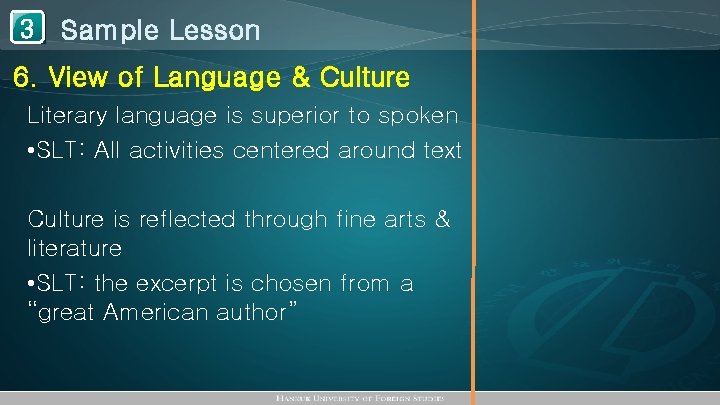
1 Sample Lesson 3 6. View of Language & Culture Literary language is superior to spoken • SLT: All activities centered around text Culture is reflected through fine arts & literature • SLT: the excerpt is chosen from a “great American author”
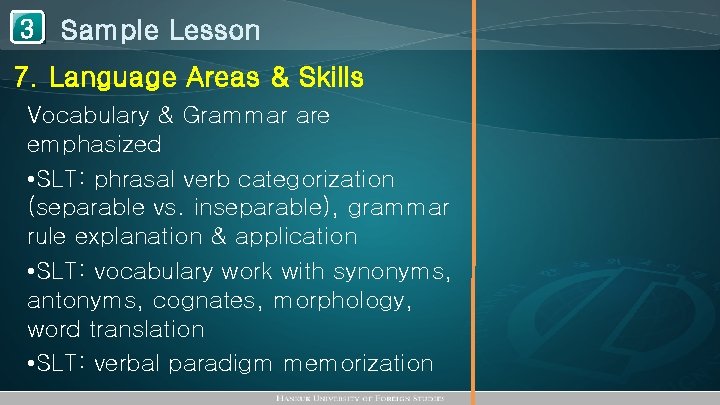
1 Sample Lesson 3 7. Language Areas & Skills Vocabulary & Grammar are emphasized • SLT: phrasal verb categorization (separable vs. inseparable), grammar rule explanation & application • SLT: vocabulary work with synonyms, antonyms, cognates, morphology, word translation • SLT: verbal paradigm memorization
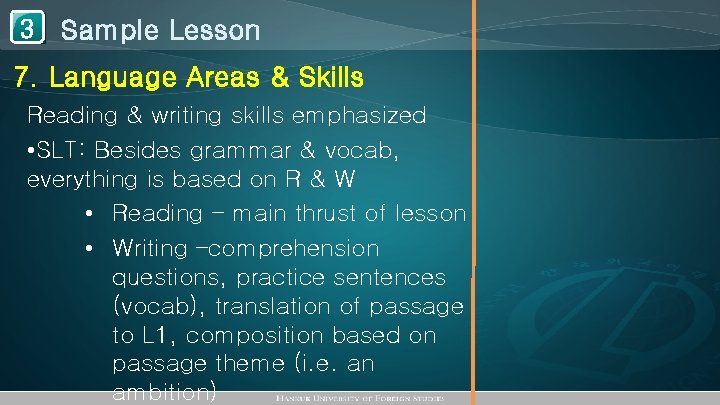
1 Sample Lesson 3 7. Language Areas & Skills Reading & writing skills emphasized • SLT: Besides grammar & vocab, everything is based on R & W • Reading – main thrust of lesson • Writing –comprehension questions, practice sentences (vocab), translation of passage to L 1, composition based on passage theme (i. e. an ambition)
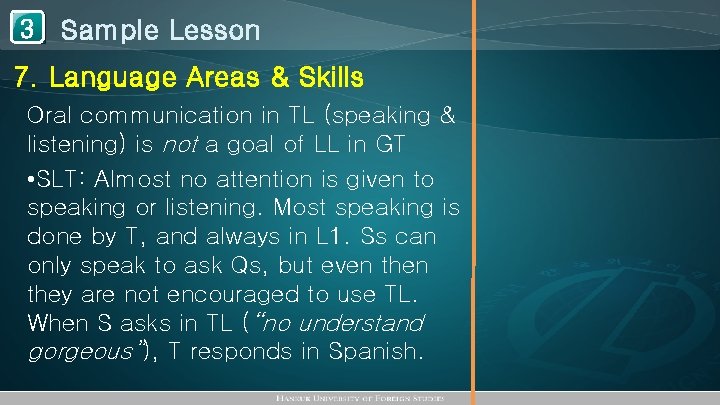
1 Sample Lesson 3 7. Language Areas & Skills Oral communication in TL (speaking & listening) is not a goal of LL in GT • SLT: Almost no attention is given to speaking or listening. Most speaking is done by T, and always in L 1. Ss can only speak to ask Qs, but even they are not encouraged to use TL. When S asks in TL (“no understand gorgeous”), T responds in Spanish.
1 Sample Lesson 3 8. Role of Native Language Native language is medium of education • SLT: Besides text, grammar paradigms & vocab, all classroom language is L 1 Meaning made clear through translation to L 1, so L 1 is base of understanding • SLT: text translated to L 1 by Ss. Meanings are checked in L 1. Vocab
1 Sample Lesson 3 9. Evaluation Translation tests, reading comp Qs, written tests on vocabulary & grammar • SLT: No actual evaluation in SL, but all activities involve discrete bundles of info which can be memorized & regurgitated, allowing for easy confirmation of knowledge about the language
1 Sample Lesson 3 10. Error Response Accuracy is essential; no errors tolerated • SLT: After giving Ss 30 minutes to work on reading comp Qs, they stop and check answers together. T calls on Ss individually to read out Qs and answer. If S makes an error, T asks another S to supply answer or gives it herself.
1 Sample Lesson 3 10. Error Response T is ultimate source of authority, so she decides what is correct, and what is worthy of correction • SLT: When a student makes a grammatical error in TL (“no understand gorgeous”), T does not dwell on it or even point it out, but just ignores it and answers Q in L 1.
1 Techniques 4 Translation of Literary Passages Since the main purpose of LL in GT is to encourage the development of skills for the reading of foreign language literature, one of the great challenges and responsibilities of the method is to choose appropriate passages. • Application: Use Literature • Application: Ask Appropriate Qs
1 Techniques 4 Questions Based on Texts 1. Comprehension Qs based on text: When did Mark Twain live? 2. Inference Qs based on understanding: Do you think the boy was ambitious? Why or why not? 3. Qs relating the passage to Ss’ own experiences: Have you ever thought of running away?
1 Techniques 4 Vocabulary Work • Antonyms / Synonyms: identifying them in the text or out of context • Defining words based on contextual understanding within text • Speak out or write practice sentences using new words • Cognates: draw attention to L 1 -TL morphologically related roots & affixes
1 Techniques 4 Grammar Work • Deductive: Present rules and patterns, apply to examples, show exceptions • Fill-in-the-blanks: provide a text or series of sentences with words missing; Ss fill in blanks to practice grammar patterns, verb tenses, vocab • Memorization: lists of phrasal verbs, grammatical paradigms like verb
1 Techniques 4 Writing • Ss prepare summaries of texts • Ss write a composition based on some topic or theme related to the text • Ss translate texts into & out of TL • SS write sample sentences, paragraphs, essays using target grammar & vocab
1 Video: Grammar Translation 5 Video Introduction In this video, you will see a demonstration of a lesson taught using the GTM, presented by Christian Correa, Argenis Plaza and Byron Farez. This is a third-year English course at the School of Educational Science of the Universidad Técnica de Machala in Ecuador.
1 Video: Grammar Translation 5 Video Introduction As you watch, look out for: • Attention to grammatical form • Activities following reading of the text • How activities are carried out. What is the T doing? What are the Ss doing? • Emphasis on importance & correctness of translation NOTE: Listen very carefully!!
1 Video: Grammar Translation 5 After the Video • What did you think? Were you able to understand everything T & Ss said? • Did you notice something about this lesson that contrasts with what we learned about GTM? • What similarities or differences can you find with your own learning XP?
TESOL Methodology Week 2: Lecture B Direct Method Homework Questions
TESOL Methodology The Direct Method Background Principles & Characteristics Sample Lesson Techniques Video
1 Background Criticism of Grammar Translation Mid 19 th c. Europe: increased need for international communication led to shift in LL goals. The new focus was learning to communicate. GT was criticized: • Makes few demands on Ts, who are trained in literature, not lg. teaching • Method without theory: no rationale or justification from linguistics, psychology, educational theory
1 Background Criticism of Grammar Translation • No connection to the natural language of real communication • Widely practiced yet not advocated – merely “the way things are done” • Foreign LL: a tedious XP of memorizing endless lists of unusable grammar rules & obscure vocabulary, attempts to produce perfect translations of stilted, literary prose
1 Background Post-GT Reform Movement • Primacy of spoken lg. should be reflected in oral-based methodology • Phonetics should be applied to teaching & teacher training (IPA 1886) • Learners should hear the language first, before seeing it in written form • Language should be presented in sentences in meaningful contexts, not as isolated, disconnected pieces
1 Background Post-GT Reform Movement • Grammar should be taught inductively, with rules pointed out only after Ss have seen their use in context • Translation should be avoided, though L 1 can be used to explain new words or check comprehension Most of these beliefs were carried out in DM and other methods, but DM took a strict, absolute stance on use
1 Background “Natural Methods” • One of the results of reform movement was the development of “Natural Methods, ” including DM and others • DM was the most popular and commercially successful NM from Europe to US (e. g. Berlitz) • NMs advocated naturalistic principles of LL, with methodologies built around observation of
1 Background “Natural Methods” • “The teacher replaces the textbook” in early stages of learning • Basis: TL can be taught without L 1 • Meaning conveyed directly through demonstration & action • Intensive oral interaction • Qs employed to present & elicit lg. • Direct & spontaneous use of TL
1 Principles & Characteristics 2 Fundamental Concepts • DM has one very basic rule: NO TRANSLATION ALLOWED • Name of the method: meaning is to be conveyed directly in TL through use of demonstration & visual aids, without using L 1 at all
1 Principles & Characteristics 2 Basic Principles & Procedures • Classroom instruction conducted exclusively in TL • Only everyday vocabulary & sentences taught • Oral communication skills built up in carefully graded progression around T-S Q&A exchanges in small, intensive classes
1 Principles & Characteristics 2 Basic Principles & Procedures • Grammar taught inductively • New teaching points introduced orally • Concrete vocabulary taught through demonstrations, objects, pictures • Abstract vocab: association of ideas • Emphasizes speech, listening comprehension, correct pronunciation & grammar
1 Principles & Characteristics 2 Berlitz Teaching Guidelines • • • Never Never translate: demonstrate explain: act make a speech: ask questions imitate mistakes: correct speak with single words: use full sentences
1 Principles & Characteristics 2 Berlitz Teaching Guidelines • Never speak too much: make Ss speak much • Never speak too slowly: speak normally • Never speak too quickly: speak naturally • Never speak too loudly speak naturally
1 Sample Lesson 3 1. Teacher Goals Ss learn how to communicate in TL • SLT: Activities conducted entirely in TL. • T asks Qs to class: What mountains are they? • Ss ask Qs, class answers together • T asks Qs about individual Ss: Is there a book on your desk? • Ss practice conversation, making and asking Qs based on models
1 Sample Lesson 3 1. Teacher Goals Ss learn how to think in TL • SLT: TL used at every step of lesson • T asks questions about map / Ss • T demonstrates vocab: you are sitting between Maria and Giovanni (no explaining) • Ss reply in TL, using full sentences to encourage vocabulary use in context, rather than memorized
1 Sample Lesson 3 1. Teacher Goals Ss learn how to think in TL • SLT: L 1 always avoided • Even when T is not using TL, he is acting out meaning or using realia to demonstrate concepts • Psychological concept of direct association between form & meaning in TL
1 Sample Lesson 3 2. Role of Teacher & Students T is director of class activities, though Ss are less passive than in GT, like “partners” in teaching-learning process • SLT: Ss have opportunities to ask their own Qs during map work & conversation time (cf. GT: Ss only speak when T asks “Any questions? ”)
1 Sample Lesson 3 3. Learning / Teaching Process Direct association of meaning with TL • SLT: L 1 never used. New words introduced through: • pictures (mountain range) • gestures (point to the clock) • environment (you are between…)
1 Sample Lesson 3 3. Learning / Teaching Process Syllabus based on practical knowledge & situations (at the bank, shopping, money) • SLT: Bulk of the lesson based on geography, supplemented by cultural exploration of country from the map
1 Sample Lesson 3 3. Learning / Teaching Process Grammar taught inductively • SLT: Students do a worksheet filling in blanks with prepositions. They have to induce appropriate use based on examples given by T or earlier practice sentences. No explicit rules are given.
1 Sample Lesson 3 3. Learning / Teaching Process Vocabulary is contextualized, not isolated • SLT: All target words are related to theme of the lesson: geographical terms (mountain range, river, ocean), location prepositions (between, in the North, on the West Coast) • SLT: Ss always ask & answer in complete sentences, not isolated
1 Sample Lesson 3 4. Student/Teacher Interaction T-S interaction • SLT: Initial map Qs, conversation Qs S-S interaction • SLT: Map Qs, conversation practice T is director/controller of interaction • SLT: directs Q&A for map, models & initiates conversation practice
1 Sample Lesson 3 5. Feelings of Students DM has no principles dealing directly with Ss feelings, though it is said that DM is intrinsically more motivating than GT • SLT: T responds directly to every S during lesson, and attention to errors shows care & concern • SLT: T asks questions about Ss themselves, recognizing them as people
1 Sample Lesson 3 6. View of Language & Culture Language is primarily spoken, not written • SLT: Majority of classroom time spent in oral presentation & practice of lg. • SLT: words & themes for everyday communication, not stiff, literary prose
1 Sample Lesson 3 6. View of Language & Culture is not just literature, but larger aspects of TL speakers’ world: history, geography, cultural concepts, issues related to daily life. • SLT: Basic source is a map • SLT: Proverb time is money is discussed, cross-cultural comparison of conceptions of time/punctuality
1 Sample Lesson 3 7. Language Areas & Skills Vocabulary emphasized over grammar • SLT: T spends a lot of time talking about vocab, answering Qs about vocab, demonstrating vocab, with grammar also worked on but done inductively (no explaining)
1 Sample Lesson 3 7. Language Areas & Skills All 4 skills worked on from the start, but oral dimension heavily emphasized • SLT: Ss read passage (out loud) • SLT: Ss write paragraph (geography of US), fill in words on map, do dictation (global integration of writing, listening, vocab, grammar, etc. ) • SLT: All other activities involve listening & speaking interaction
1 Sample Lesson 3 7. Language Areas & Skills Pronunciation is emphasized. • SLT: T spends time practicing words which may cause particular difficulty for Ss (Appalachian) • SLT: Specific work on English phonemes (river), and sound contrasts (short lax vs. tense long: river / Rio)
1 Sample Lesson 3 8. Role of Native Language The native language of the students should not be used at all in the classroom. Though other “Natural Methods” de-emphasize L 1, the DM absolutely forbids it. This is the defining feature of the method, praised by some and criticized by others. What do you think?
1 Sample Lesson 3 9. Evaluation Ss are evaluated not in terms of what they know about the language, or in their ability to recall memorized “chunks” of info, but rather on how they use the language (e. g. through oral Q&A interview or paragraph writing) • SLT: No formal evaluation, but constant ongoing assessment.
1 Sample Lesson 3 10. Error Response T tries to elicit self-correction from Ss • SLT: T provides an alternative: “What is the ocean in the West Coast…or on the West Coast? ” S hesitates, then responds again. T acknowledges correct response, has S ask again.
1 Techniques 4 Reading Aloud T calls on Ss one by one to read out sections of text (passage, play, dialogue, poem, lyrics, scripts, etc. ) During reading, T uses gestures, pictures, realia, acting to demonstrate meaning of words and larger messages.
1 Techniques 4 Q&A The centerpiece of the DM. Q&A is used throughout the lesson, exclusively in TL, and always in full sentences. T asks various Qs so that Ss can practice new vocabulary and grammar structures.
1 Techniques 4 Conversation Practice An extension of basic Q&A. T asks Ss Qs in TL containing new vocab and target grammar, with all Qs relating to each other in some larger thematic way. T can model Qs with individual Ss, then have Ss practice in pairs, encouraging them to make their own questions based on the models,
1 Techniques 4 Encouraging “self-correction” • Repeat error, offer alternative “She goes…or she went? ” • Repeat error with questioning voice “Yesterday she…goes? ” • Repeat sentence, stop before error “Yesterday she…? ”
1 Techniques 4 Fill-in-the-Blanks Also used in GT, but in DM the activity is done entirely in TL. In GT it is done deductively – the grammar rule is explained first, then applied to the exercises. In DM the Ss have no explicit rule to apply – instead they try to induce the rule from examples & practice sentences from the lesson.
1 Techniques 4 Dictation An exercise which stimulates global application of several different aspects of language. Read passage three times: 1. Normal speed – Ss just listen 2. Phrase by phrase – Ss write 3. Normal speed – Ss check their work You can also do “partial” dictations.
1 Techniques 4 Drawing (Map, etc. ) Similar to dictation, but instead of just writing down exactly what they hear, Ss draw or complete a picture according to instructions. This activity can be done in several ways, with many situations: • Town: the bank is next to the jail • Classroom: a monkey is sleeping on the teacher’s desk
1 Video: The Direct Method 5 Video Introduction In this video, you will see an English teacher named Damien Zellers teaching a lesson to a small group of elementary school students using the Direct Method. All of the students are non-native speakers of English who have been studying the language for 1 -2 years.
1 Video: The Direct Method 5 Video Introduction As you watch, pay attention to: • Various types of questions (T-S, S-S) • Various techniques of error correction • Use of complete sentences • Attention to pronunciation • Exclusive use of English NOTE: The picture gets a bit shaky at times. If you get dizzy, look away & listen.
1 Video: The Direct Method 5 After the Video • What did you think? Have you ever seen a lesson with so many Qs? ! • What types of questions and error correction elicitation techniques did the teacher use? • Why do you think the teacher had the Ss serve as camera operators? • What happens when Ss volunteer their own comments?
1 Homework Reminder 6 Belief Statement Please submit your Belief Statement as soon as possible.
1 Homework Questions 6 Question 1 Based on the sample lesson in the book and video demonstration that we watched, what are the main principles and characteristics of the Grammar Translation Method? Please provide specific example of activities or techniques from the sample lesson or video demonstration to support your answer.
1 Homework Questions 6 Question 2 How do your own language learning experiences reflect the principles and characteristic of GTM? Please provide specific example from your own language learning experience.
1 Homework Questions 6 Question 3 Based on the sample lesson in the book and video demonstration that we watched, what are the main principles and characteristics of the Direct Method? Please provide specific example of activities or techniques from the sample lesson or video demonstration to support your answer.
1 Homework Questions 6 Question 4 How do your own language learning experiences reflect the principles and characteristic of DM? Please provide specific example from your own language learning experience.