
TESDA GMEF Assessment Objectives of GMEF Assessment To
TESDA GMEF Assessment
Objectives of GMEF Assessment • To identify the status and/or progress of government agencies in mainstreaming gender and development in their respective organizations, particularly in their systems, structures, policies, programs, processes and procedures in line with the implementation of the Magna Carta of Women and other GAD mandates (e. g. CEDAW, BPf. A, MDGs/SDGs). • To identify the organization’s strengths and good practices on gender mainstreaming (GM), along with the gaps, challenges and areas of improvement as basis of partnership-building with the Philippine Commission on Women (PCW).
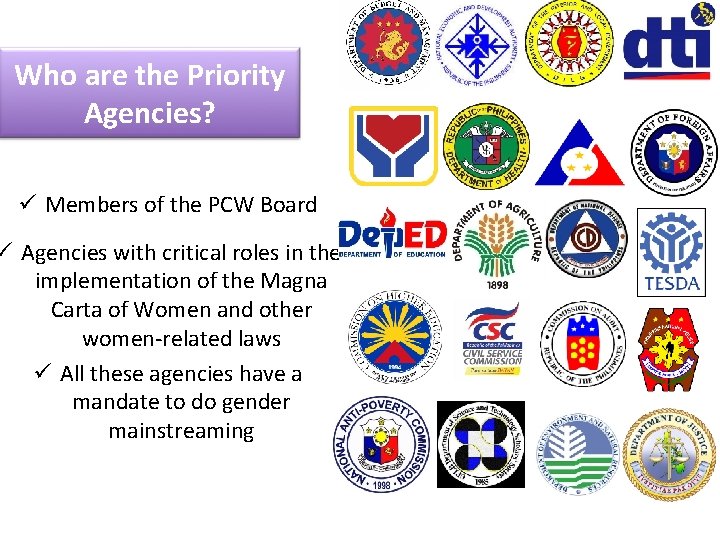
Who are the Priority Agencies? ü Members of the PCW Board ü Agencies with critical roles in the implementation of the Magna Carta of Women and other women-related laws ü All these agencies have a mandate to do gender mainstreaming
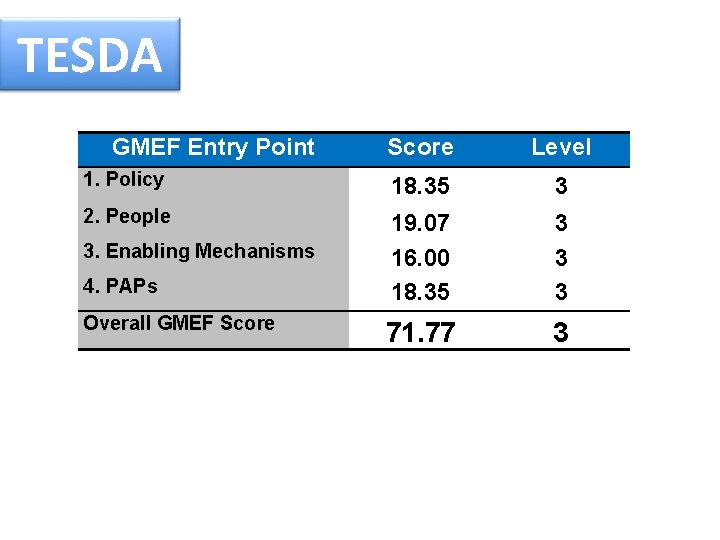
TESDA GMEF Entry Point Score Level 1. Policy 18. 35 3 2. People 19. 07 16. 00 18. 35 3 3 3 71. 77 3 3. Enabling Mechanisms 4. PAPs Overall GMEF Score
Strong Points and Areas for Improvement in GM
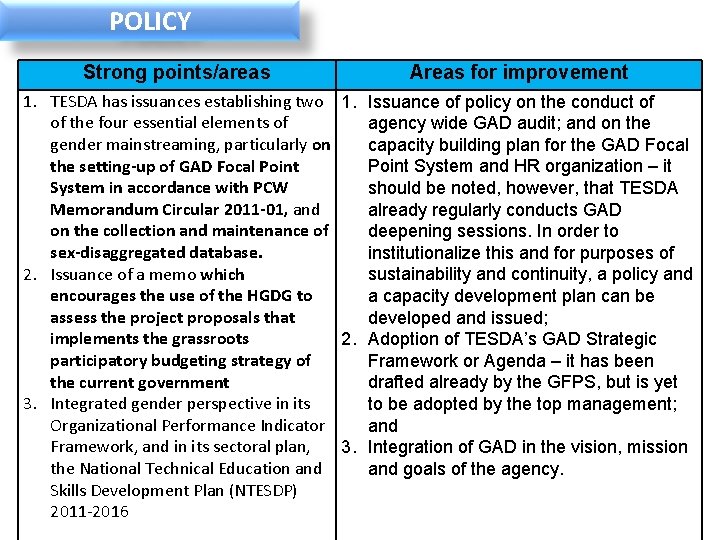
POLICY Strong points/areas Areas for improvement 1. TESDA has issuances establishing two 1. Issuance of policy on the conduct of of the four essential elements of agency wide GAD audit; and on the gender mainstreaming, particularly on capacity building plan for the GAD Focal the setting-up of GAD Focal Point System and HR organization – it System in accordance with PCW should be noted, however, that TESDA Memorandum Circular 2011 -01, and already regularly conducts GAD on the collection and maintenance of deepening sessions. In order to sex-disaggregated database. institutionalize this and for purposes of 2. Issuance of a memo which sustainability and continuity, a policy and encourages the use of the HGDG to a capacity development plan can be assess the project proposals that developed and issued; implements the grassroots 2. Adoption of TESDA’s GAD Strategic participatory budgeting strategy of Framework or Agenda – it has been the current government drafted already by the GFPS, but is yet 3. Integrated gender perspective in its to be adopted by the top management; Organizational Performance Indicator and Framework, and in its sectoral plan, 3. Integration of GAD in the vision, mission the National Technical Education and goals of the agency. Skills Development Plan (NTESDP) 2011 -2016
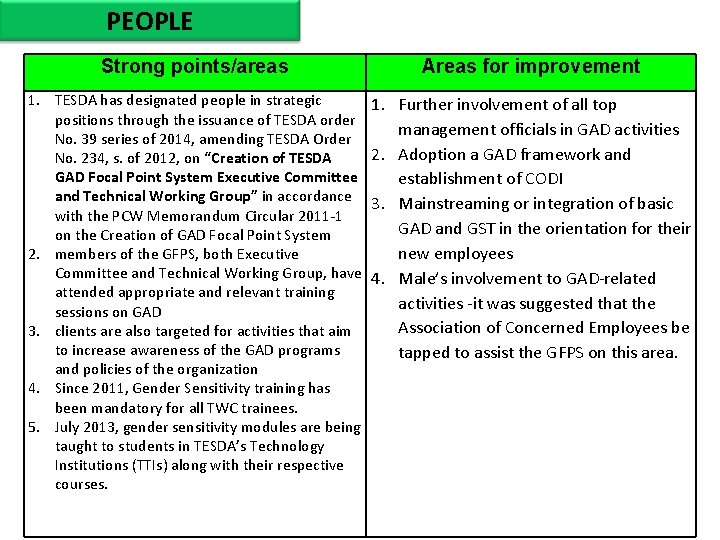
PEOPLE Strong points/areas Areas for improvement 1. TESDA has designated people in strategic positions through the issuance of TESDA order No. 39 series of 2014, amending TESDA Order No. 234, s. of 2012, on “Creation of TESDA GAD Focal Point System Executive Committee and Technical Working Group” in accordance with the PCW Memorandum Circular 2011 -1 on the Creation of GAD Focal Point System 2. members of the GFPS, both Executive Committee and Technical Working Group, have attended appropriate and relevant training sessions on GAD 3. clients are also targeted for activities that aim to increase awareness of the GAD programs and policies of the organization 4. Since 2011, Gender Sensitivity training has been mandatory for all TWC trainees. 5. July 2013, gender sensitivity modules are being taught to students in TESDA’s Technology Institutions (TTIs) along with their respective courses. 1. Further involvement of all top management officials in GAD activities 2. Adoption a GAD framework and establishment of CODI 3. Mainstreaming or integration of basic GAD and GST in the orientation for their new employees 4. Male’s involvement to GAD-related activities -it was suggested that the Association of Concerned Employees be tapped to assist the GFPS on this area.
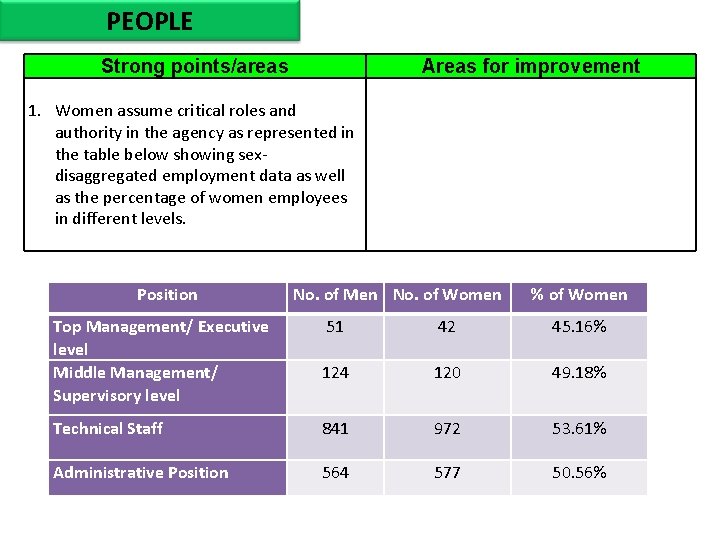
PEOPLE Strong points/areas Areas for improvement 1. Women assume critical roles and authority in the agency as represented in the table below showing sexdisaggregated employment data as well as the percentage of women employees in different levels. Position Top Management/ Executive level Middle Management/ Supervisory level No. of Men No. of Women % of Women 51 42 45. 16% 124 120 49. 18% Technical Staff 841 972 53. 61% Administrative Position 564 577 50. 56%
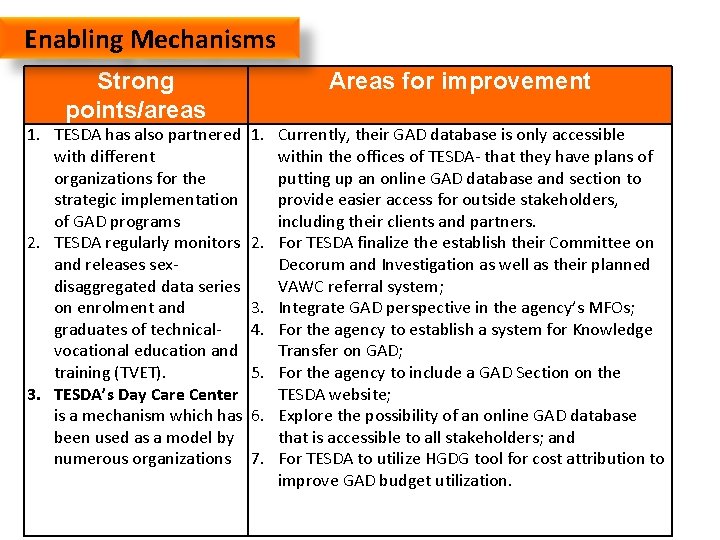
Enabling Mechanisms Strong points/areas 1. TESDA has also partnered 1. with different organizations for the strategic implementation of GAD programs 2. TESDA regularly monitors 2. and releases sexdisaggregated data series on enrolment and 3. graduates of technical 4. vocational education and training (TVET). 5. 3. TESDA’s Day Care Center is a mechanism which has 6. been used as a model by numerous organizations 7. Areas for improvement Currently, their GAD database is only accessible within the offices of TESDA- that they have plans of putting up an online GAD database and section to provide easier access for outside stakeholders, including their clients and partners. For TESDA finalize the establish their Committee on Decorum and Investigation as well as their planned VAWC referral system; Integrate GAD perspective in the agency’s MFOs; For the agency to establish a system for Knowledge Transfer on GAD; For the agency to include a GAD Section on the TESDA website; Explore the possibility of an online GAD database that is accessible to all stakeholders; and For TESDA to utilize HGDG tool for cost attribution to improve GAD budget utilization.
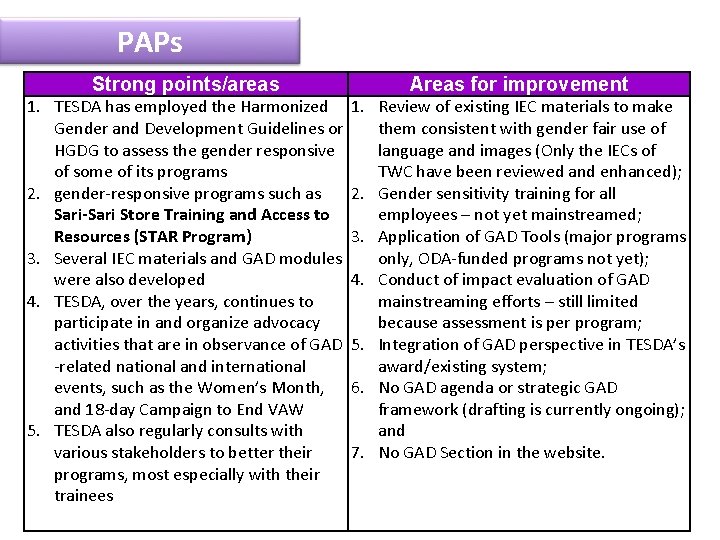
PAPs Strong points/areas 1. TESDA has employed the Harmonized 1. Gender and Development Guidelines or HGDG to assess the gender responsive of some of its programs 2. gender-responsive programs such as 2. Sari-Sari Store Training and Access to Resources (STAR Program) 3. 3. Several IEC materials and GAD modules were also developed 4. 4. TESDA, over the years, continues to participate in and organize advocacy activities that are in observance of GAD 5. -related national and international events, such as the Women’s Month, 6. and 18 -day Campaign to End VAW 5. TESDA also regularly consults with various stakeholders to better their 7. programs, most especially with their trainees Areas for improvement Review of existing IEC materials to make them consistent with gender fair use of language and images (Only the IECs of TWC have been reviewed and enhanced); Gender sensitivity training for all employees – not yet mainstreamed; Application of GAD Tools (major programs only, ODA-funded programs not yet); Conduct of impact evaluation of GAD mainstreaming efforts – still limited because assessment is per program; Integration of GAD perspective in TESDA’s award/existing system; No GAD agenda or strategic GAD framework (drafting is currently ongoing); and No GAD Section in the website.

Recommendations
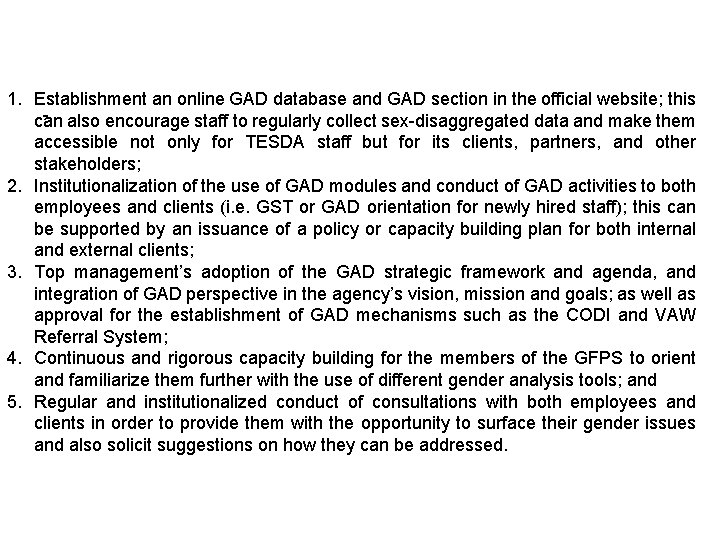
1. Establishment an online GAD database and GAD section in the official website; this can also encourage staff to regularly collect sex-disaggregated data and make them accessible not only for TESDA staff but for its clients, partners, and other stakeholders; 2. Institutionalization of the use of GAD modules and conduct of GAD activities to both employees and clients (i. e. GST or GAD orientation for newly hired staff); this can be supported by an issuance of a policy or capacity building plan for both internal and external clients; 3. Top management’s adoption of the GAD strategic framework and agenda, and integration of GAD perspective in the agency’s vision, mission and goals; as well as approval for the establishment of GAD mechanisms such as the CODI and VAW Referral System; 4. Continuous and rigorous capacity building for the members of the GFPS to orient and familiarize them further with the use of different gender analysis tools; and 5. Regular and institutionalized conduct of consultations with both employees and clients in order to provide them with the opportunity to surface their gender issues and also solicit suggestions on how they can be addressed.

Thank you!
- Slides: 14