
Terrorism History Strategy and Root Causes Do D
- Slides: 28
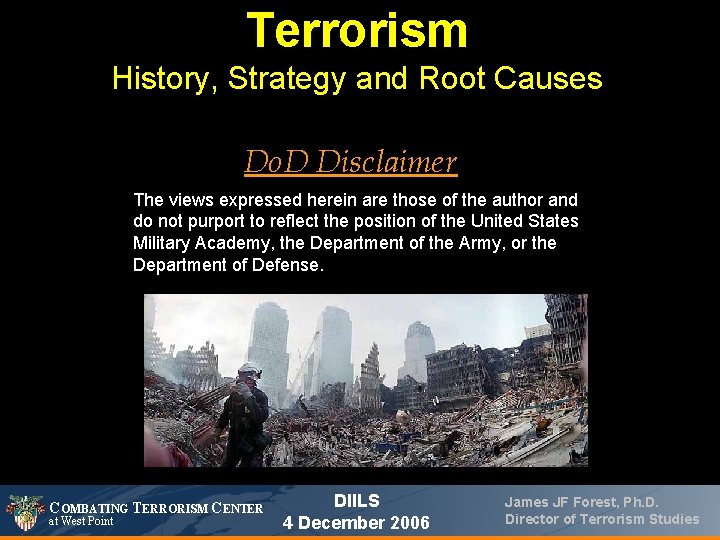
Terrorism History, Strategy and Root Causes Do. D Disclaimer The views expressed herein are those of the author and do not purport to reflect the position of the United States Military Academy, the Department of the Army, or the Department of Defense. COMBATING TERRORISM CENTER at West Point DIILS 4 December 2006 James JF Forest, Ph. D. Director of Terrorism Studies
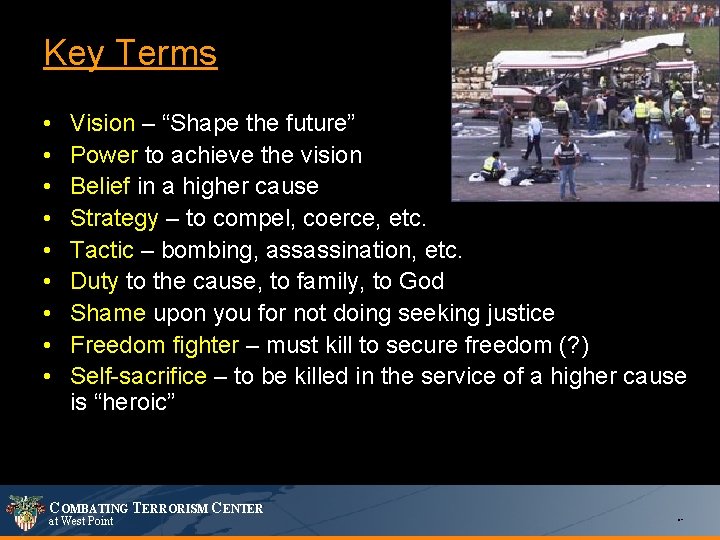
Key Terms • • • Vision – “Shape the future” Power to achieve the vision Belief in a higher cause Strategy – to compel, coerce, etc. Tactic – bombing, assassination, etc. Duty to the cause, to family, to God Shame upon you for not doing seeking justice Freedom fighter – must kill to secure freedom (? ) Self-sacrifice – to be killed in the service of a higher cause is “heroic” COMBATING TERRORISM CENTER at West Point AB 95 -5. PPT // ##
More history of terrorism • First VBIED (or “Car Bomb”) terrorist attack? New York City, September 1920 • Terrorist: Italian anarchist Mario Buda • Vehicle: Horse-drawn wagon • Target: Corner of Wall and Broad streets (directly across from JP Morgan Company) • Attack: The wagon—packed with dynamite and iron slugs— exploded at precisely noon in a fireball of shrapnel, killing 40 and wounding more than 200. COMBATING TERRORISM CENTER at West Point
More history of terrorism • Second VBIED (or “Car Bomb”) terrorist attack? Haifa, Palestine (now Israel) January, 1947 • Terrorists: Stern Gang (a pro-fascist splinter group led by Avraham Stern that broke away from the right-wing Zionist paramilitary Irgun) • Vehicle: Truck • Target: British police station in Haifa • Attack: A truckload of explosives was driven into the station, killing 4 and injuring 140. (The Stern Gang would soon use truck and car bombs to kill Palestinians as well, as part of their extremist agenda) COMBATING TERRORISM CENTER at West Point
A Brief History of Modern Terrorism • Roughly 130 -year history • 4 Waves, each roughly 40 -45 years – – Anarchist Wave Anti-Colonial/Decolonization Wave New Left Wave/Leftist anti-Western sentiment Religious Inspiration Wave • Issue to consider for each wave: – Doctrines of terror – Technology (especially for communication/propoganda) – Avenues of funding and support COMBATING TERRORISM CENTER at West Point
Certain aspects are fundamental – Desire for change – Terrorism is typically non-state in character • (Note the separate but related topic of state terrorism – typically antithetical to the desire for political change. ) • States can terrorize, but they are not terrorists. – Terrorists do not abide by norms • They target innocents • They seek psychological trauma – Pursuit of a strategy COMBATING TERRORISM CENTER at West Point
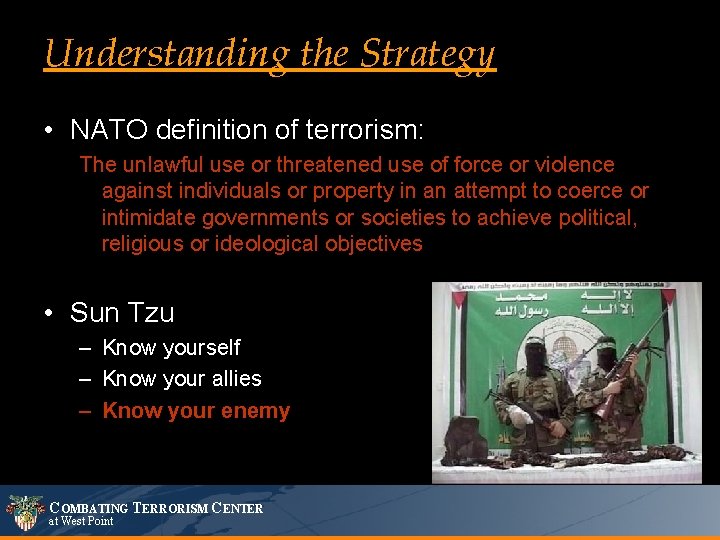
Understanding the Strategy • NATO definition of terrorism: The unlawful use or threatened use of force or violence against individuals or property in an attempt to coerce or intimidate governments or societies to achieve political, religious or ideological objectives • Sun Tzu – Know yourself – Know your allies – Know your enemy COMBATING TERRORISM CENTER at West Point
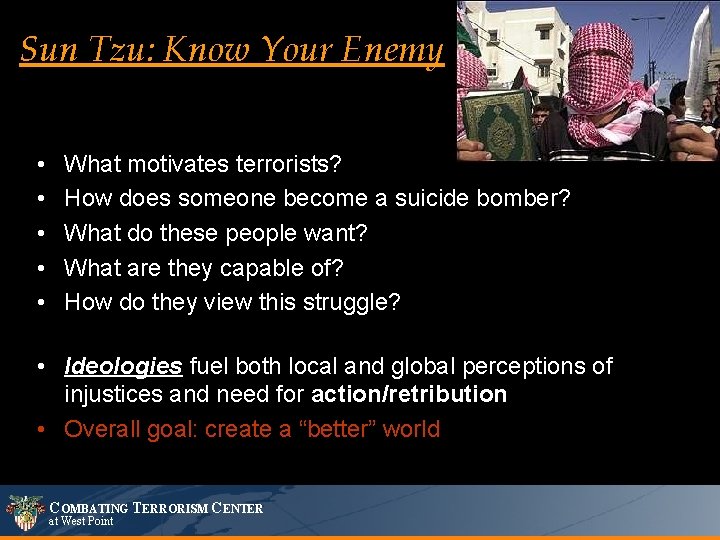
Sun Tzu: Know Your Enemy • • • What motivates terrorists? How does someone become a suicide bomber? What do these people want? What are they capable of? How do they view this struggle? • Ideologies fuel both local and global perceptions of injustices and need for action/retribution • Overall goal: create a “better” world COMBATING TERRORISM CENTER at West Point
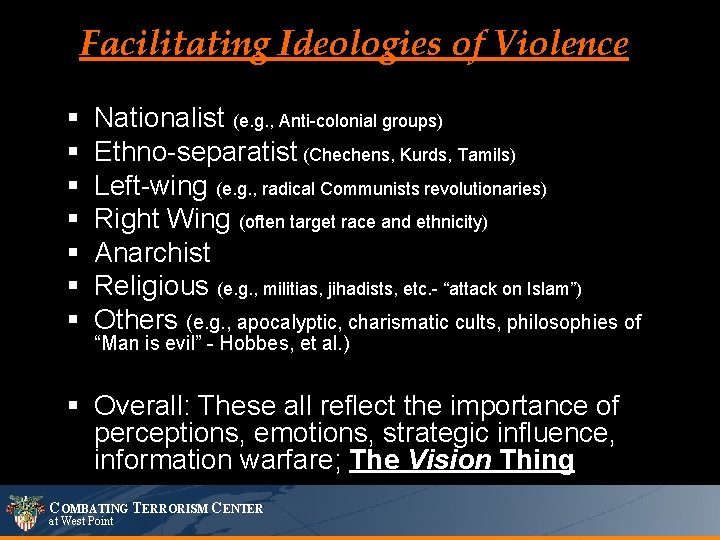
Facilitating Ideologies of Violence § § § § Nationalist (e. g. , Anti-colonial groups) Ethno-separatist (Chechens, Kurds, Tamils) Left-wing (e. g. , radical Communists revolutionaries) Right Wing (often target race and ethnicity) Anarchist Religious (e. g. , militias, jihadists, etc. - “attack on Islam”) Others (e. g. , apocalyptic, charismatic cults, philosophies of “Man is evil” - Hobbes, et al. ) § Overall: These all reflect the importance of perceptions, emotions, strategic influence, information warfare; The Vision Thing COMBATING TERRORISM CENTER at West Point
Left-wing Terrorists • Driven by liberal or idealist political concepts • Prefer revolutionary anti-authoritarian antimaterialist agendas • Typically target elites that symbolize authority • Examples: – Anarchists, Earth First, Animal Liberation Front COMBATING TERRORISM CENTER at West Point
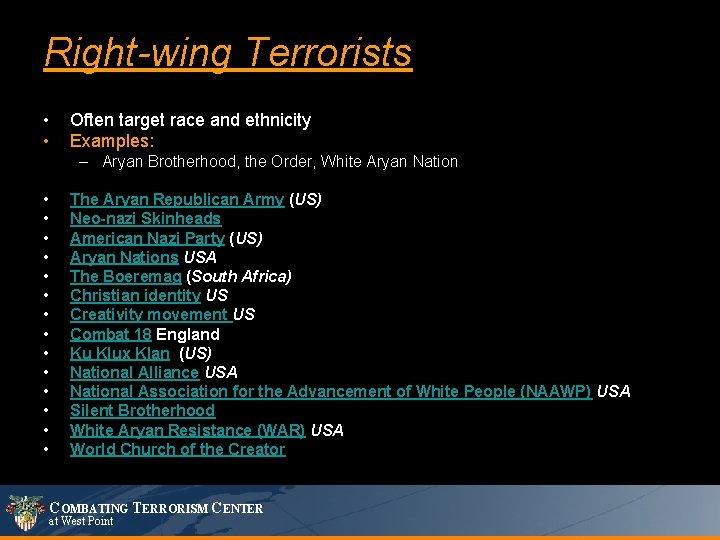
Right-wing Terrorists • • Often target race and ethnicity Examples: – Aryan Brotherhood, the Order, White Aryan Nation • • • • The Aryan Republican Army (US) Neo-nazi Skinheads American Nazi Party (US) Aryan Nations USA The Boeremag (South Africa) Christian identity US Creativity movement US Combat 18 England Ku Klux Klan (US) National Alliance USA National Association for the Advancement of White People (NAAWP) USA Silent Brotherhood White Aryan Resistance (WAR) USA World Church of the Creator COMBATING TERRORISM CENTER at West Point
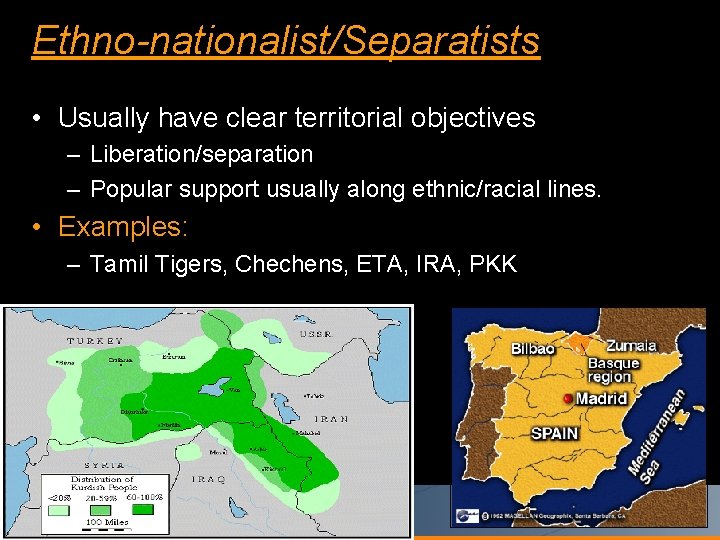
Ethno-nationalist/Separatists • Usually have clear territorial objectives – Liberation/separation – Popular support usually along ethnic/racial lines. • Examples: – Tamil Tigers, Chechens, ETA, IRA, PKK COMBATING TERRORISM CENTER at West Point
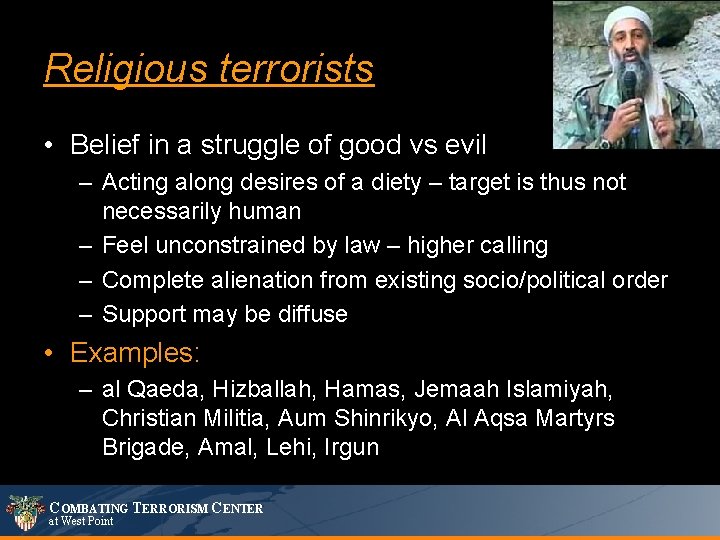
Religious terrorists • Belief in a struggle of good vs evil – Acting along desires of a diety – target is thus not necessarily human – Feel unconstrained by law – higher calling – Complete alienation from existing socio/political order – Support may be diffuse • Examples: – al Qaeda, Hizballah, Hamas, Jemaah Islamiyah, Christian Militia, Aum Shinrikyo, Al Aqsa Martyrs Brigade, Amal, Lehi, Irgun COMBATING TERRORISM CENTER at West Point
State Terrorism • Governments can engage in acts of terrorism • Examples: – French Revolution • Use of revolutionary tribunals to prop up the French republic. • Rule by fear/terror – Robespierre’s “lists” – Iraq • Saddam Hussein deployed chemical weapons in Kurdish villages, killing thousands; • Intent was to frighten other villages into stopping their political revolt • It worked COMBATING TERRORISM CENTER at West Point
State-Sponsored Terrorism • Governments can also support terrorist groups that do their bidding • Examples: – Iran, which supports Hizballah – Before 9/11, Hizballah had killed more Americans than any other terror group – Embassy bombings, kidnappings, targeted assassinations, suicide attack on Marine barracks at Beirut airport COMBATING TERRORISM CENTER at West Point
Some Strategic Objectives of Terrorism • Recognition: Gaining national or international recognition for their cause; recruiting new personnel; raising funds; demonstrating their strength • Coercion: Force a desired behavior of an individual or government • Intimidation: Prevent individuals, groups, or governments from acting • Provocation: Provoking overreaction by a government to the attack on symbolic targets or personnel, thereby gaining sympathy for their cause. • Insurgency support: Forcing the government to overextend itself in dealing with the threat, thereby allowing the insurgency to gain support and commit further attacks against the government. COMBATING TERRORISM CENTER at West Point
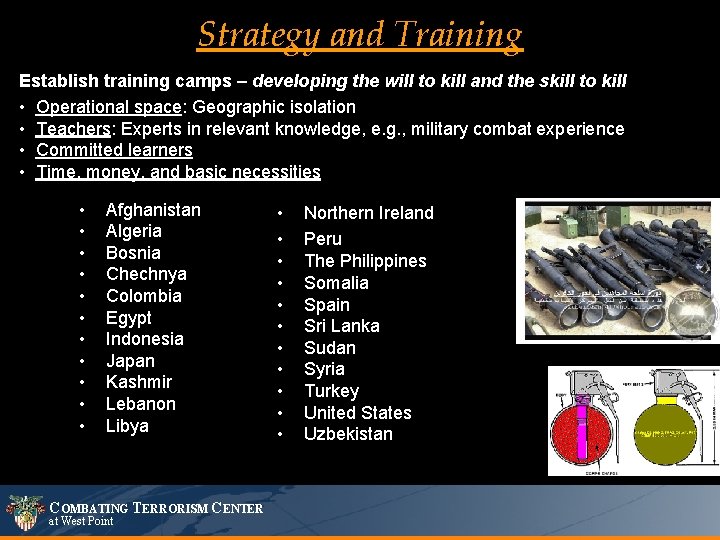
Strategy and Training Establish training camps – developing the will to kill and the skill to kill • Operational space: Geographic isolation • Teachers: Experts in relevant knowledge, e. g. , military combat experience • Committed learners • Time, money, and basic necessities • • • Afghanistan Algeria Bosnia Chechnya Colombia Egypt Indonesia Japan Kashmir Lebanon Libya COMBATING TERRORISM CENTER at West Point • • • Northern Ireland Peru The Philippines Somalia Spain Sri Lanka Sudan Syria Turkey United States Uzbekistan
Strategy and Training • Psychological dimensions • Moral disengagement – – Displacement of responsibility Disregard for/distortion of consequences Dehumanization Moral justification • Group power over behavior, personal decisions • Preparation for martyrdom COMBATING TERRORISM CENTER at West Point
Terrorism Works • In 6 of the 11 campaigns that ended terrorists achieved at least partial political gains (Pape, 2005) • Target states – Fully or partially withdrew from territory – Began negotiations – Released a terrorist leader • Represents 55% success rate – Other punishment strategies such as airpower or economic sanctions work no more 15% of the time • Suicide campaigns have been successful against a variety of democratic governments -- even hawkish ones – Reagan Administration – Netanyahu COMBATING TERRORISM CENTER at West Point
Terrorism Works • The successes of terrorism become part of a group’s ideology, which feeds recruitment and internal motivation • For al Qaida, the terrorism strategy has produced some results which benefit their ideological cause • Understanding the strategy and ideology of al Qaida (and other groups) is vital to our understanding of terrorist motivation COMBATING TERRORISM CENTER at West Point
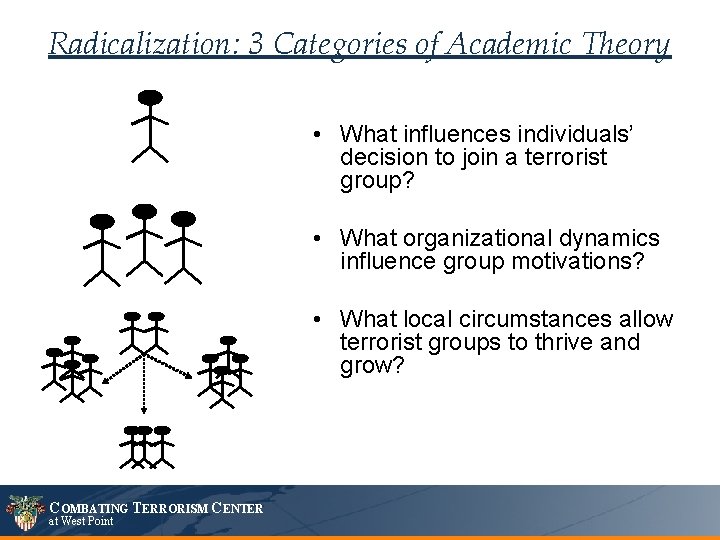
Radicalization: 3 Categories of Academic Theory • What influences individuals’ decision to join a terrorist group? • What organizational dynamics influence group motivations? • What local circumstances allow terrorist groups to thrive and grow? COMBATING TERRORISM CENTER at West Point
Individual and Group Motivations • Some Individuals who join a terrorist group willingly give up power over their behavior, personal decisions • Some draw prestige from group membership; being part of something greater than oneself • Many groups exploit need for member’s ego validation • Group membership in many cases offers individuals a sense of power over their destiny which they lack elsewhere • A powerful motivating message: “You can make a difference in this world, not only for yourselves but for your children and grandchildren” COMBATING TERRORISM CENTER at West Point
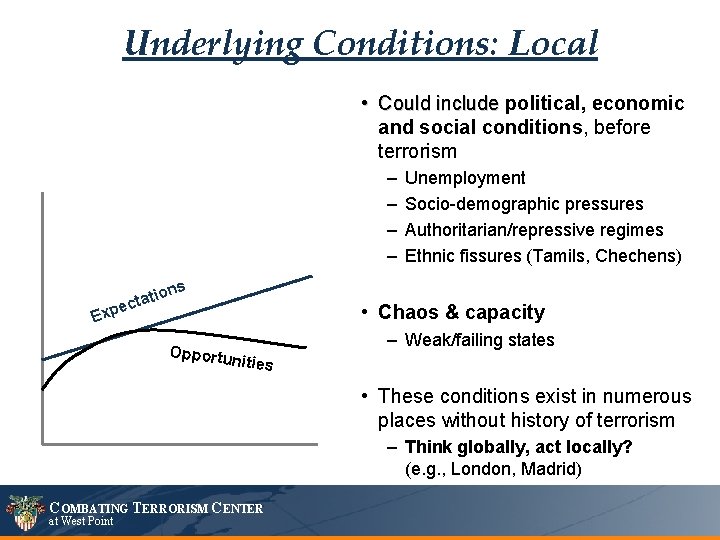
Underlying Conditions: Local • Could include political, economic and social conditions, before terrorism – – ions t a t ec Unemployment Socio-demographic pressures Authoritarian/repressive regimes Ethnic fissures (Tamils, Chechens) • Chaos & capacity Exp – Weak/failing states Opportu nities • These conditions exist in numerous places without history of terrorism – Think globally, act locally? (e. g. , London, Madrid) COMBATING TERRORISM CENTER at West Point
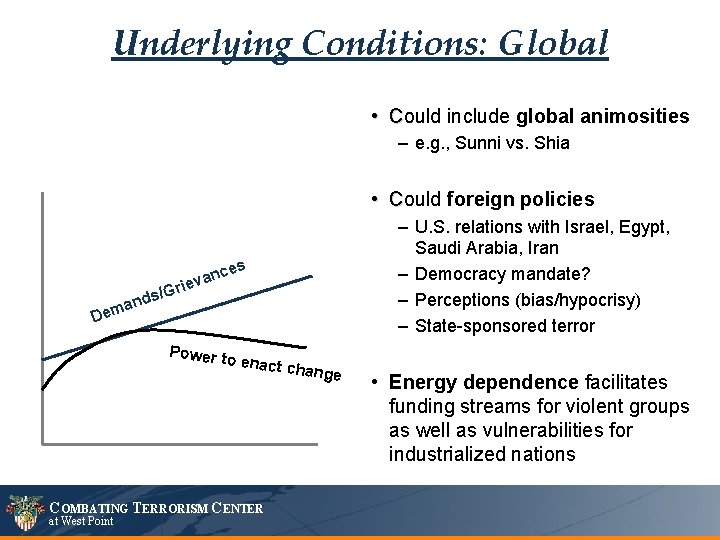
Underlying Conditions: Global • Could include global animosities – e. g. , Sunni vs. Shia • Could foreign policies – U. S. relations with Israel, Egypt, Saudi Arabia, Iran – Democracy mandate? – Perceptions (bias/hypocrisy) – State-sponsored terror s nce a v rie G / s d an Dem Power t o enact ch COMBATING TERRORISM CENTER at West Point ange • Energy dependence facilitates funding streams for violent groups as well as vulnerabilities for industrialized nations
Other Global Conditions & Facilitators • Global weapons proliferation (especially in weak/failing states) • Technology – Communication and transportation shrinks time and space; enable networked forms of terrorism (including fundraising aspects) – Weapons: invention of dynamite helped launch capabilities • Global criminal networks – Profit motive – Money laundering – Trafficking in drugs, humans, explosives, other ‘bad stuff’ • Ideologies fuel both local and global perceptions of injustices and need for action/retribution COMBATING TERRORISM CENTER at West Point
Basic trends in modern terrorism • More violent attacks (and increasing lethality) • Increasing use of suicide bombers (the ultimate smart bomb) • Religious terrorist groups most common (even insurgencies and ethnic separatist groups use religion to justify violence) COMBATING TERRORISM CENTER at West Point
What to do? § Economic and political dimensions § Create economic & political opportunities to meet aspirations § Consider foreign policy dimensions (state sponsorship, bias) § Chaos & capacity § Law enforcement, border security; containment § Weapons proliferation & criminal networks § Pressure states and private companies to prevent § Energy dependence § Alternatives to fossil fuels § The battleground of ideologies is particularly important for attacking the motivation and morale of terrorists in Iraq, Afghanistan, Pakistan, Russia, . . . § Exploit ideological vulnerabilities COMBATING TERRORISM CENTER at West Point
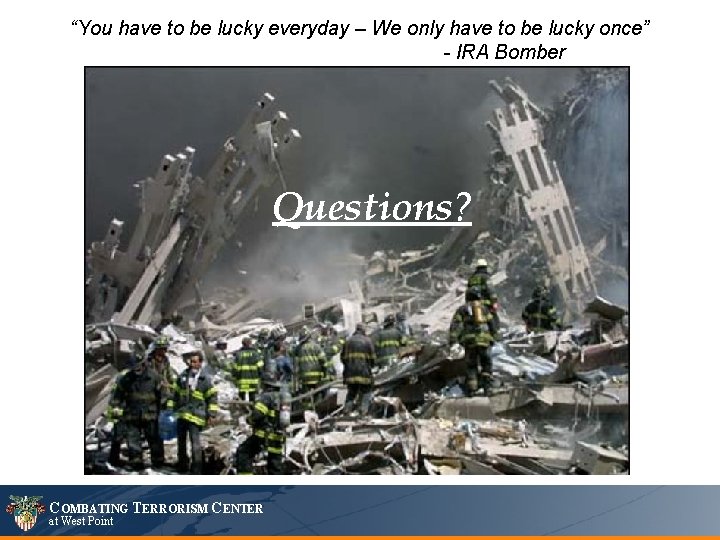
“You have to be lucky everyday – We only have to be lucky once” - IRA Bomber Questions? COMBATING TERRORISM CENTER at West Point