
Terrorism Financing and Fraud The FATFs Mutual Evaluation

- Slides: 13
Terrorism Financing and Fraud: The FATF’s Mutual Evaluation on the United Kingdom Dr Nicholas Ryder, Professor in Financial Crime, Head of Global Crime, Justice and Security Research Group Financial Action Task Force’s (FATF) Compliant Countries: Lessons for Non-Compliant Jurisdictions
Abstract • This presentation is divided into five parts: 1. Mutual Evaluation Report, 2. Terrorism financing fraud typology, 3. Identification of disjointed counter-terrorism financing (CTF) and counter-fraud policies, 4. The fraud typology as a disruptive mechanism and 5. Missed opportunities and the exchange of information. Terrorism Financing and Fraud: The FATF’s Mutual Evaluation on the United Kingdom 2
Part I: Mutual Evaluation Report – what happended since 2007? • Money laundering regime strengthened, • Deficiencies in fraud addressed, • Bribery Act (2010), • Financial Services Act (2012), • Financial Services (Banking Reform) Act (2013), • The Criminal Finances Act (2017), • Law Commission SARs report (2019), • Law Commission Asset Recovery (2020), • National Risk Assessments (2015, 2017 and 2020), • Economic Crime Plan (2019) and • Law Commission Corporate Economic Crime (2020). Terrorism Financing and Fraud: The FATF’s Mutual Evaluation on the United Kingdom 3
Part I: Mutual Evaluation Report – rating questioned? • Royal United Services Institute (2018), • Transparency International (2018), • United States Department of State Bureau of International Narcotics and Law Enforcement Affairs International Narcotics Control Strategy Report Volume II Money Laundering (2020, 198), • House of Commons Foreign Affairs Committee (2018, 11) and • Intelligence, Security Committee of Parliament (2020, 11). Terrorism Financing and Fraud: The FATF’s Mutual Evaluation on the United Kingdom 4
Part II: The Fraud Typology • Irish Republican Army (IMF, n/d), • Believed to have accrued over £ 1 m per year (Woodford and Smith, 2018), • Fraud Review (2006, 74, 135), • al Qaeda partly funded by fraud (FATF, 2008; 9/11 Commission, 2004), • Hezbollah (United States Department of Treasury, 2015), • EUROPOL (2015, 2), • ISIL (United States Department of Treasury, 2018) and • HM Inspectorate of Constabulary and Fire and Rescue Services (2019, 29). Terrorism Financing and Fraud: The FATF’s Mutual Evaluation on the United Kingdom 5
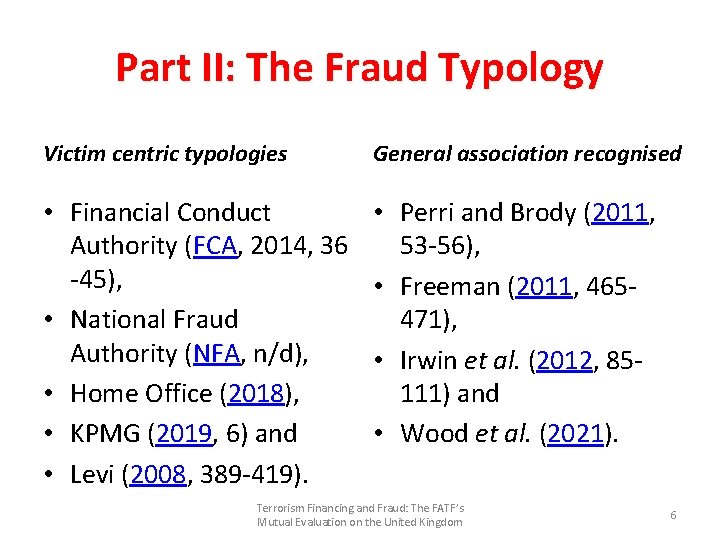
Part II: The Fraud Typology Victim centric typologies General association recognised • Financial Conduct Authority (FCA, 2014, 36 -45), • National Fraud Authority (NFA, n/d), • Home Office (2018), • KPMG (2019, 6) and • Levi (2008, 389 -419). • Perri and Brody (2011, 53 -56), • Freeman (2011, 465471), • Irwin et al. (2012, 85111) and • Wood et al. (2021). Terrorism Financing and Fraud: The FATF’s Mutual Evaluation on the United Kingdom 6
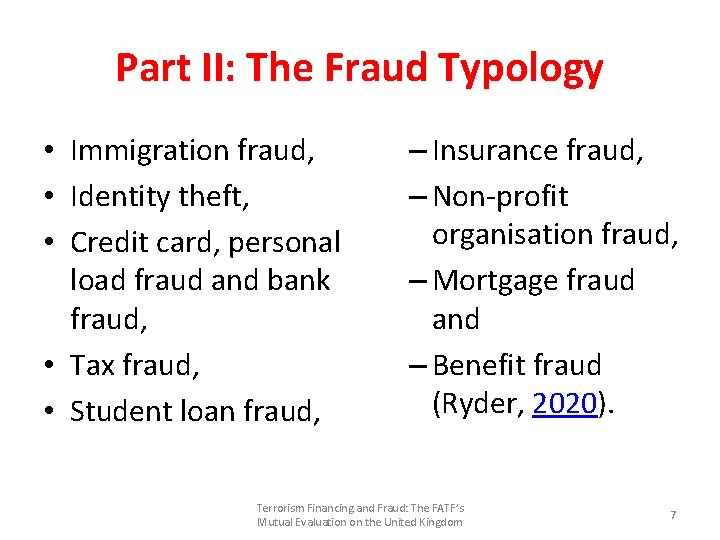
Part II: The Fraud Typology • Immigration fraud, • Identity theft, • Credit card, personal load fraud and bank fraud, • Tax fraud, • Student loan fraud, – Insurance fraud, – Non-profit organisation fraud, – Mortgage fraud and – Benefit fraud (Ryder, 2020). Terrorism Financing and Fraud: The FATF’s Mutual Evaluation on the United Kingdom 7
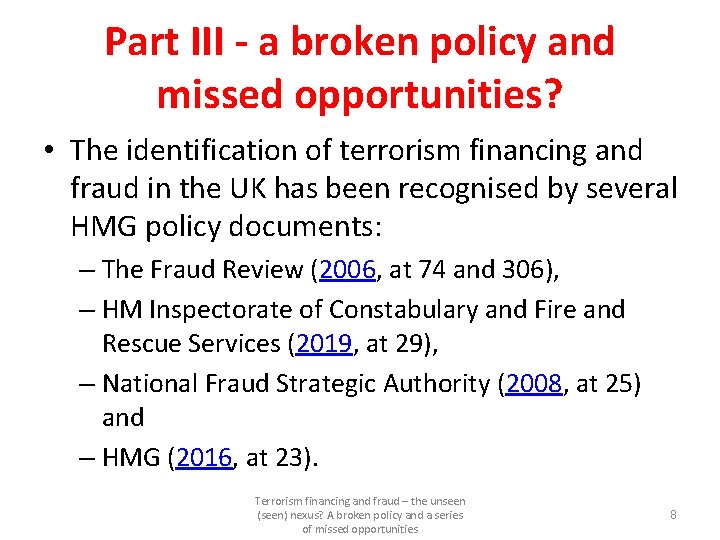
Part III - a broken policy and missed opportunities? • The identification of terrorism financing and fraud in the UK has been recognised by several HMG policy documents: – The Fraud Review (2006, at 74 and 306), – HM Inspectorate of Constabulary and Fire and Rescue Services (2019, at 29), – National Fraud Strategic Authority (2008, at 25) and – HMG (2016, at 23). Terrorism financing and fraud – the unseen (seen) nexus? A broken policy and a series of missed opportunities 8
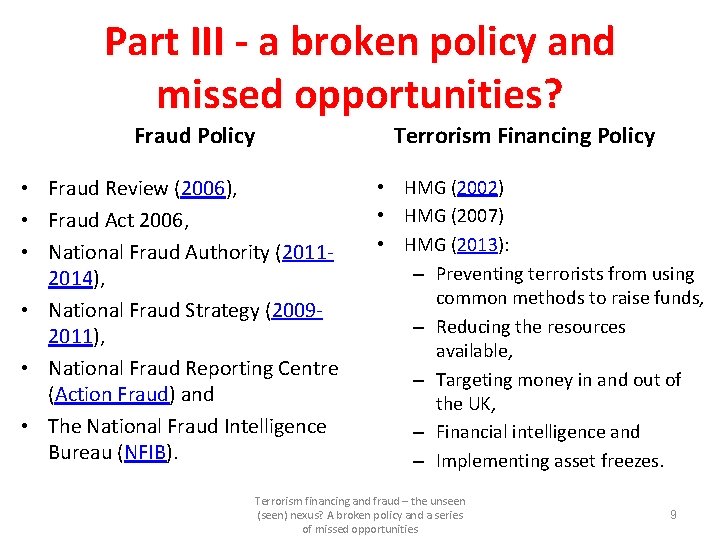
Part III - a broken policy and missed opportunities? Fraud Policy • Fraud Review (2006), • Fraud Act 2006, • National Fraud Authority (20112014), • National Fraud Strategy (20092011), • National Fraud Reporting Centre (Action Fraud) and • The National Fraud Intelligence Bureau (NFIB). Terrorism Financing Policy • HMG (2002) • HMG (2007) • HMG (2013): – Preventing terrorists from using common methods to raise funds, – Reducing the resources available, – Targeting money in and out of the UK, – Financial intelligence and – Implementing asset freezes. Terrorism financing and fraud – the unseen (seen) nexus? A broken policy and a series of missed opportunities 9
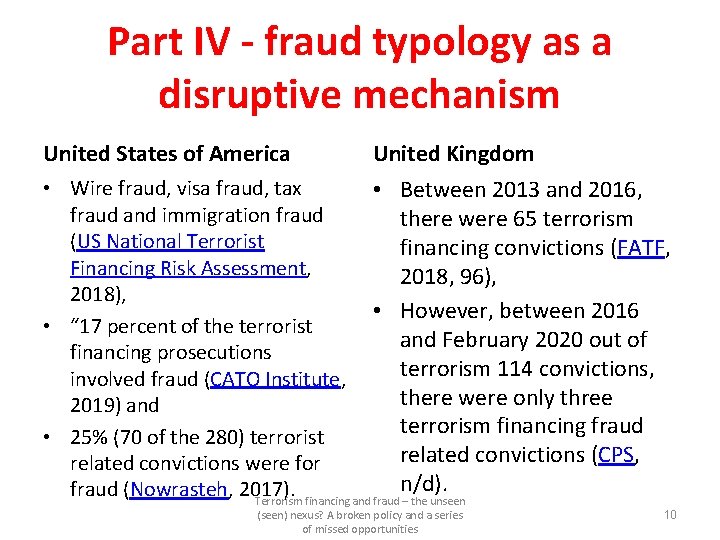
Part IV - fraud typology as a disruptive mechanism United States of America United Kingdom • Wire fraud, visa fraud, tax • Between 2013 and 2016, fraud and immigration fraud there were 65 terrorism (US National Terrorist financing convictions (FATF, Financing Risk Assessment, 2018, 96), 2018), • However, between 2016 • “ 17 percent of the terrorist and February 2020 out of financing prosecutions terrorism 114 convictions, involved fraud (CATO Institute, there were only three 2019) and terrorism financing fraud • 25% (70 of the 280) terrorist related convictions (CPS, related convictions were for n/d). fraud (Nowrasteh, 2017). Terrorism financing and fraud – the unseen (seen) nexus? A broken policy and a series of missed opportunities 10
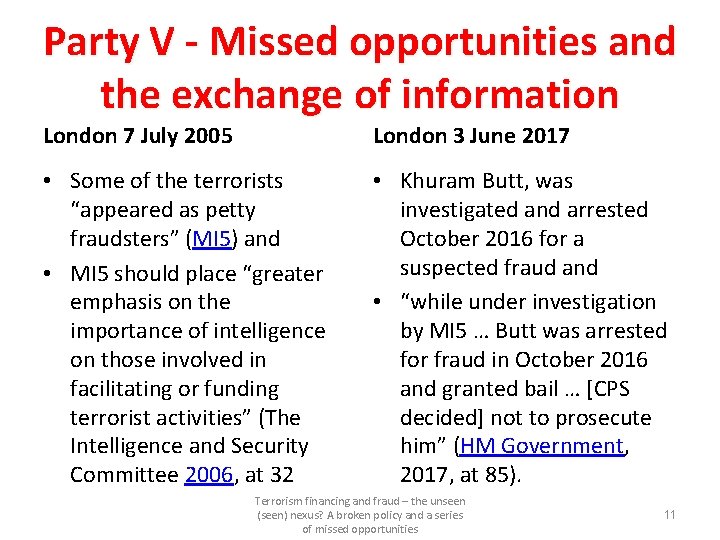
Party V - Missed opportunities and the exchange of information London 7 July 2005 London 3 June 2017 • Some of the terrorists “appeared as petty fraudsters” (MI 5) and • MI 5 should place “greater emphasis on the importance of intelligence on those involved in facilitating or funding terrorist activities” (The Intelligence and Security Committee 2006, at 32 • Khuram Butt, was investigated and arrested October 2016 for a suspected fraud and • “while under investigation by MI 5 … Butt was arrested for fraud in October 2016 and granted bail … [CPS decided] not to prosecute him” (HM Government, 2017, at 85). Terrorism financing and fraud – the unseen (seen) nexus? A broken policy and a series of missed opportunities 11
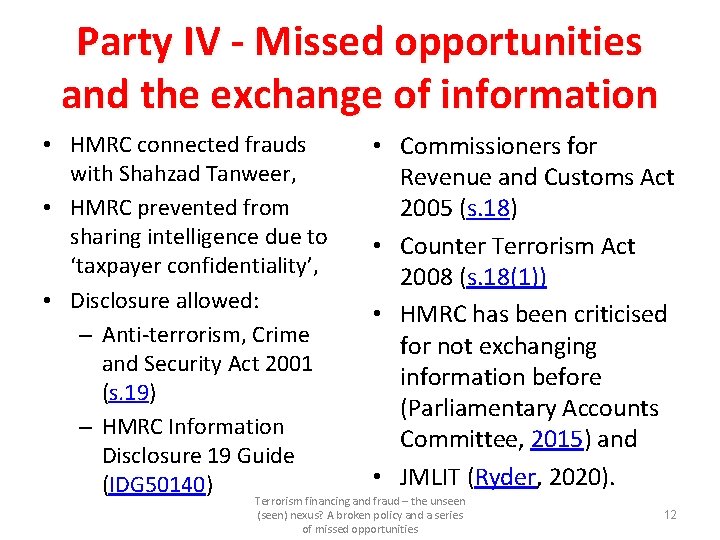
Party IV - Missed opportunities and the exchange of information • HMRC connected frauds with Shahzad Tanweer, • HMRC prevented from sharing intelligence due to ‘taxpayer confidentiality’, • Disclosure allowed: – Anti-terrorism, Crime and Security Act 2001 (s. 19) – HMRC Information Disclosure 19 Guide (IDG 50140) • Commissioners for Revenue and Customs Act 2005 (s. 18) • Counter Terrorism Act 2008 (s. 18(1)) • HMRC has been criticised for not exchanging information before (Parliamentary Accounts Committee, 2015) and • JMLIT (Ryder, 2020). Terrorism financing and fraud – the unseen (seen) nexus? A broken policy and a series of missed opportunities 12
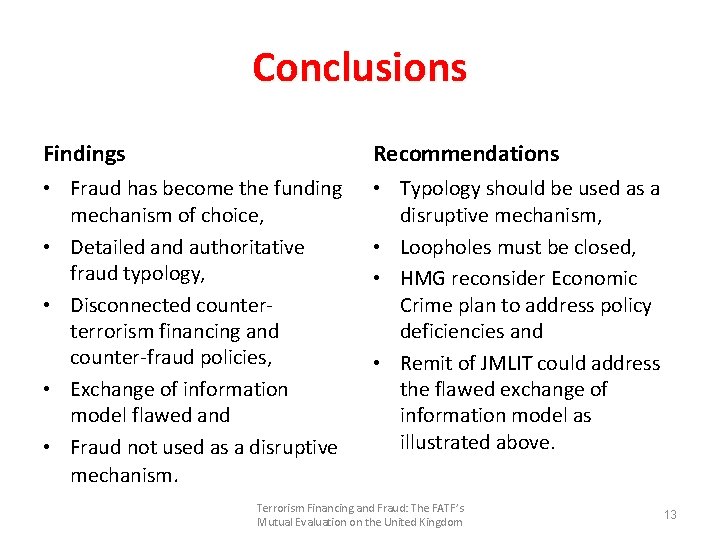
Conclusions Findings Recommendations • Fraud has become the funding mechanism of choice, • Detailed and authoritative fraud typology, • Disconnected counterterrorism financing and counter-fraud policies, • Exchange of information model flawed and • Fraud not used as a disruptive mechanism. • Typology should be used as a disruptive mechanism, • Loopholes must be closed, • HMG reconsider Economic Crime plan to address policy deficiencies and • Remit of JMLIT could address the flawed exchange of information model as illustrated above. Terrorism Financing and Fraud: The FATF’s Mutual Evaluation on the United Kingdom 13