
Territorial Morphology Relationship between a states geographic shape
Territorial Morphology Ø Relationship between a state’s geographic shape, size, relative location, and it’s political situation Ø Shape of states Ø Controls the length of its boundaries with other states l Shape affects potential for communication and conflict with neighbors Ø Shape is part of its identity Ø Shape can determine the difficulty or ease of internal administration and social unity • 5 basic shapes – – – Compact Elongated Prorupted Perforated Fragmented
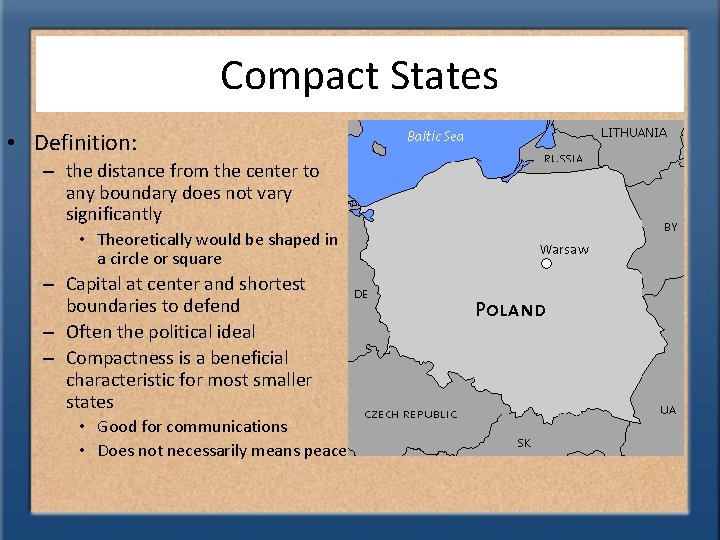
Compact States • Definition: – the distance from the center to any boundary does not vary significantly • Theoretically would be shaped in a circle or square – Capital at center and shortest boundaries to defend – Often the political ideal – Compactness is a beneficial characteristic for most smaller states • Good for communications • Does not necessarily means peace
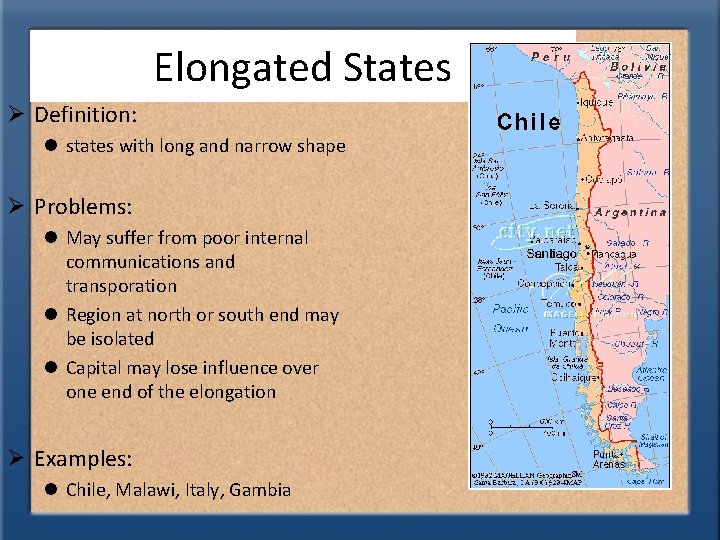
Elongated States Ø Definition: l states with long and narrow shape Ø Problems: l May suffer from poor internal communications and transporation l Region at north or south end may be isolated l Capital may lose influence over one end of the elongation Ø Examples: l Chile, Malawi, Italy, Gambia
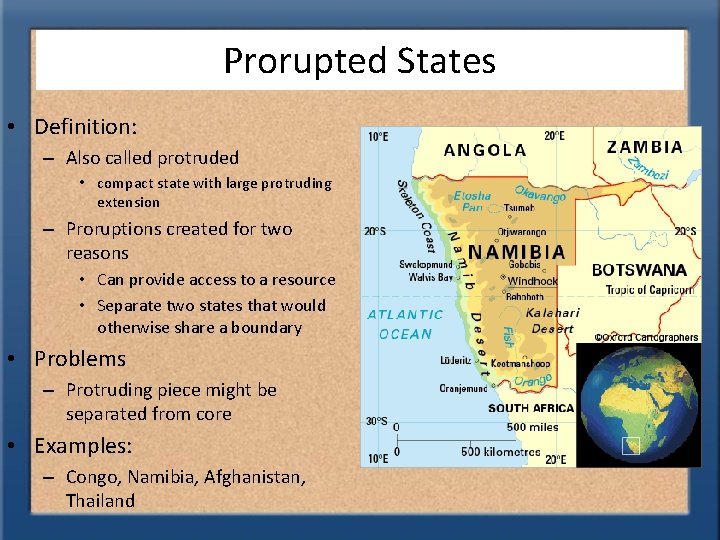
Prorupted States • Definition: – Also called protruded • compact state with large protruding extension – Proruptions created for two reasons • Can provide access to a resource • Separate two states that would otherwise share a boundary • Problems – Protruding piece might be separated from core • Examples: – Congo, Namibia, Afghanistan, Thailand
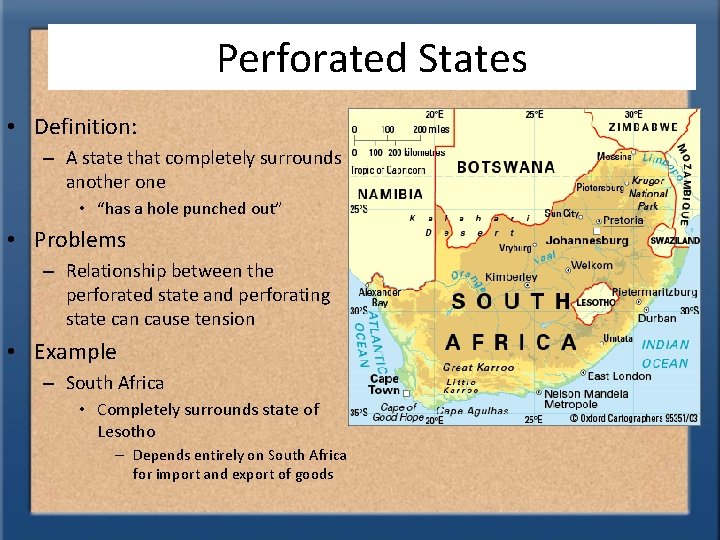
Perforated States • Definition: – A state that completely surrounds another one • “has a hole punched out” • Problems – Relationship between the perforated state and perforating state can cause tension • Example – South Africa • Completely surrounds state of Lesotho – Depends entirely on South Africa for import and export of goods
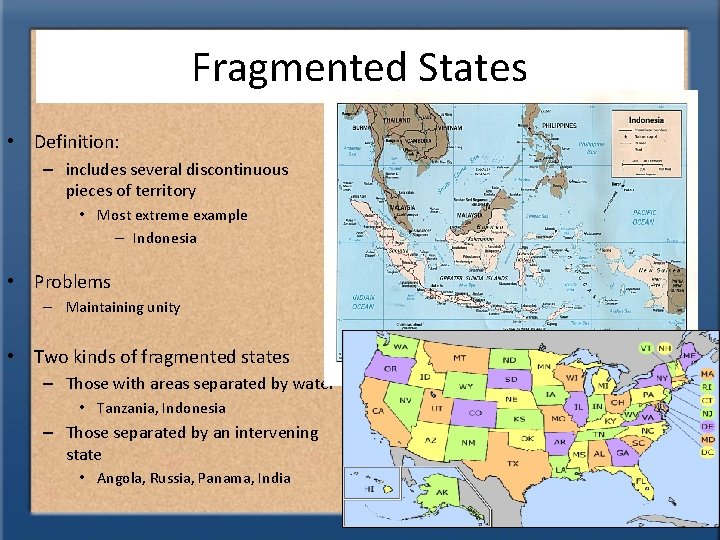
Fragmented States • Definition: – includes several discontinuous pieces of territory • Most extreme example – Indonesia • Problems – Maintaining unity • Two kinds of fragmented states – Those with areas separated by water • Tanzania, Indonesia – Those separated by an intervening state • Angola, Russia, Panama, India
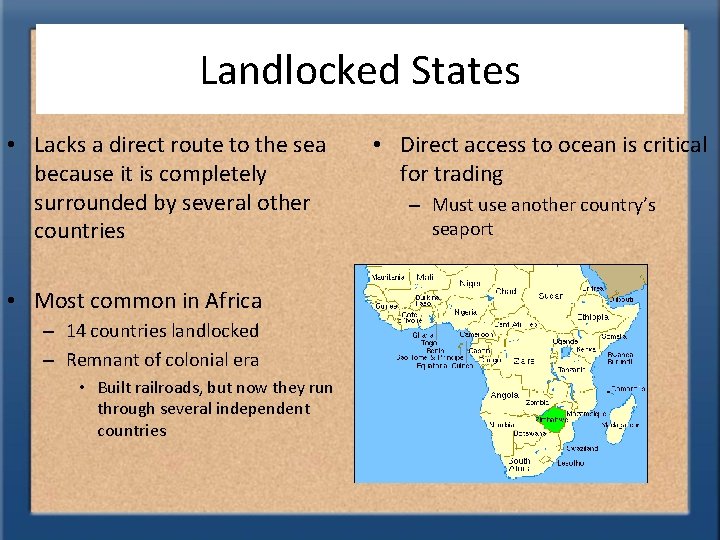
Landlocked States • Lacks a direct route to the sea because it is completely surrounded by several other countries • Most common in Africa – 14 countries landlocked – Remnant of colonial era • Built railroads, but now they run through several independent countries • Direct access to ocean is critical for trading – Must use another country’s seaport
Internal Political Organization of States • A state’s size and cultural composition are also factors in its political situation and internal organization • States are smaller in geographic size and population may be more politically unified, but not always – Microstate is a very small state • Such as Singapore – Often have a unitary government structure • The governments of states are organized according to one of two approaches Ø Unitary state Ø Power is concentrated in the central government Ø Federal state Ø Allocates strong power to units of local government within the country
Unitary vs. Federal • Unitary state – Works best in nation-states with few cultural differences l Strong sense of unity – Requires effective communications l Smaller states more likely to adopt it – Common in Europe – Some multinational states have adopted it l Can impose value of nationality – Kenya, Rwanda • Federal state – Federal states have local governments that adopt their own laws l Can empower nationalities in multinational states l Different names – States, provinces, estados – Suitable for larger states l United States, Russia, Canada, Brazil, India l Where capital is far away – Size doesn’t matter though • Belgium= federal • China= unitary
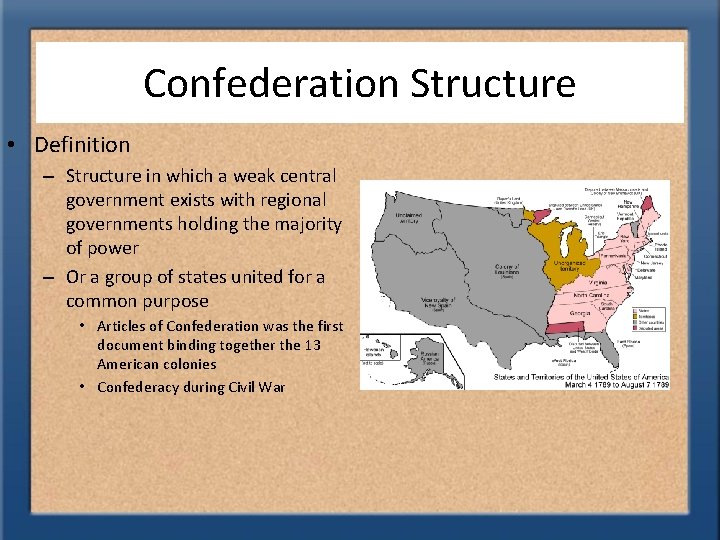
Confederation Structure • Definition – Structure in which a weak central government exists with regional governments holding the majority of power – Or a group of states united for a common purpose • Articles of Confederation was the first document binding together the 13 American colonies • Confederacy during Civil War
Trend toward Federal Government Ø In recent years there has been a strong global trend toward Federal government. Ø France Ø Good example of nation-state Ø Long tradition of Unitary government Ø Recently giving more authority to departments and communes • Poland Ø Switched from Unitary to Federal government after fall of Communist rule Ø Lack of local government led to breakdown of infrastructure Ø 1999 adopted a three-tier system of local government Ø Transition difficult Ø Lack of experience Ø Thousands of positions
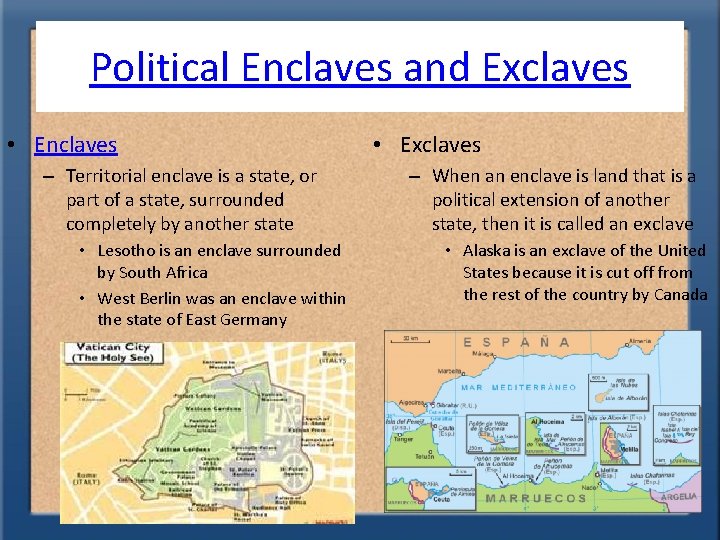
Political Enclaves and Exclaves • Enclaves – Territorial enclave is a state, or part of a state, surrounded completely by another state • Lesotho is an enclave surrounded by South Africa • West Berlin was an enclave within the state of East Germany • Exclaves – When an enclave is land that is a political extension of another state, then it is called an exclave • Alaska is an exclave of the United States because it is cut off from the rest of the country by Canada
- Slides: 12