
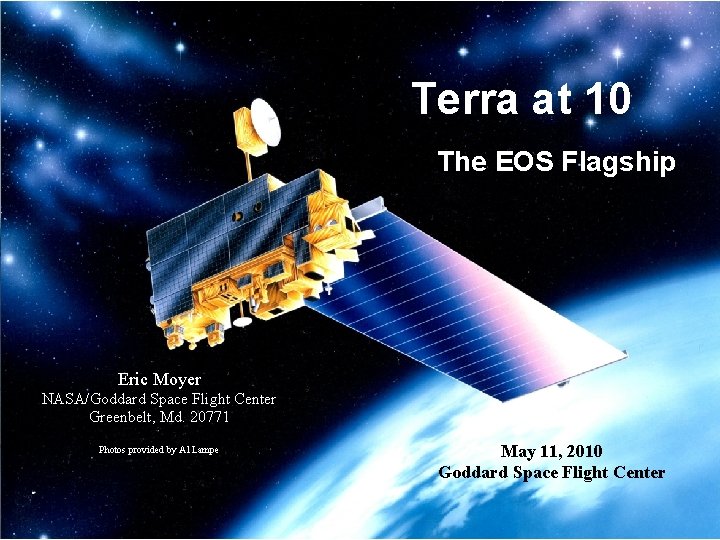
Terra at 10 The EOS Flagship Eric Moyer




- Slides: 66
Terra at 10 The EOS Flagship Eric Moyer NASA/Goddard Space Flight Center Greenbelt, Md. 20771 Photos provided by Al Lampe May 11, 2010 Goddard Space Flight Center
The satellite’s name “Terra, ” meaning Earth, was the winning entry in a nationwide student essay contest won by a high school student from St. Louis, Missouri.
A Walk down Memory Lane…. What did it take to build Terra?
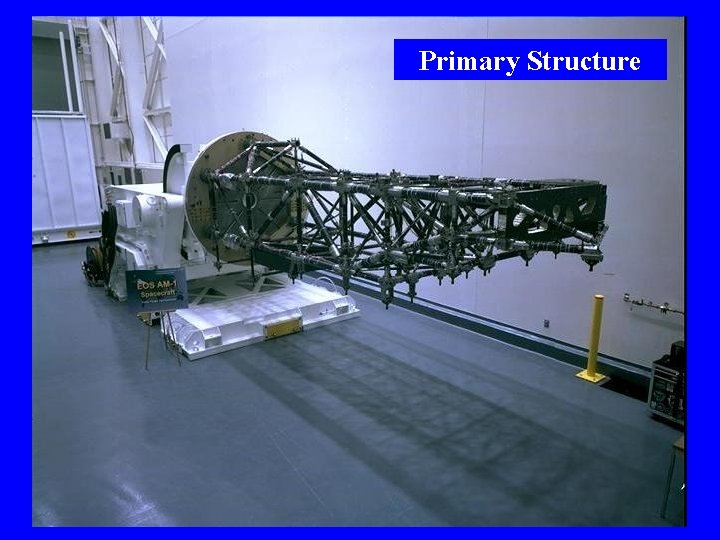
Primary Structure
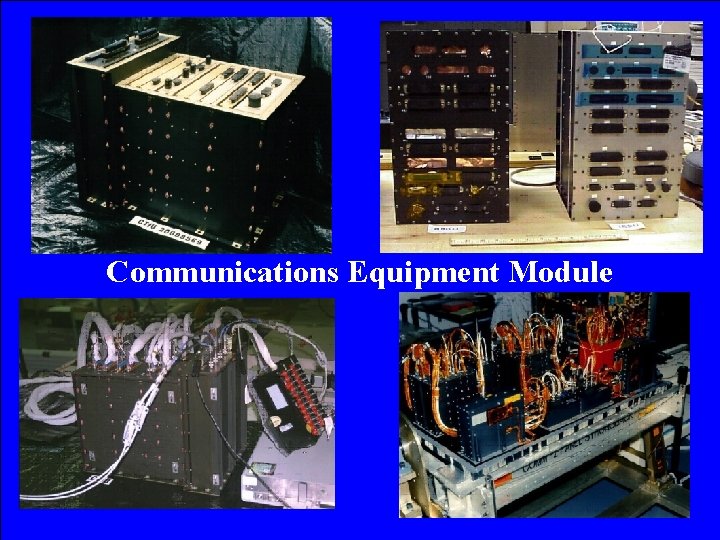
Communications Equipment Module
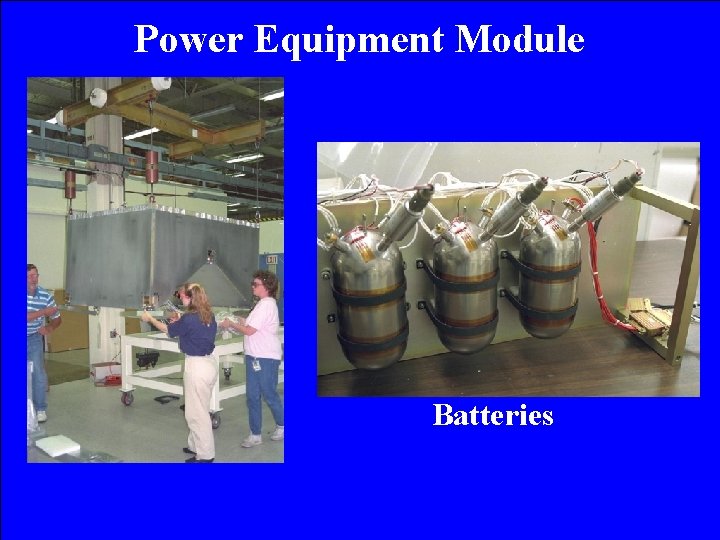
Power Equipment Module Batteries
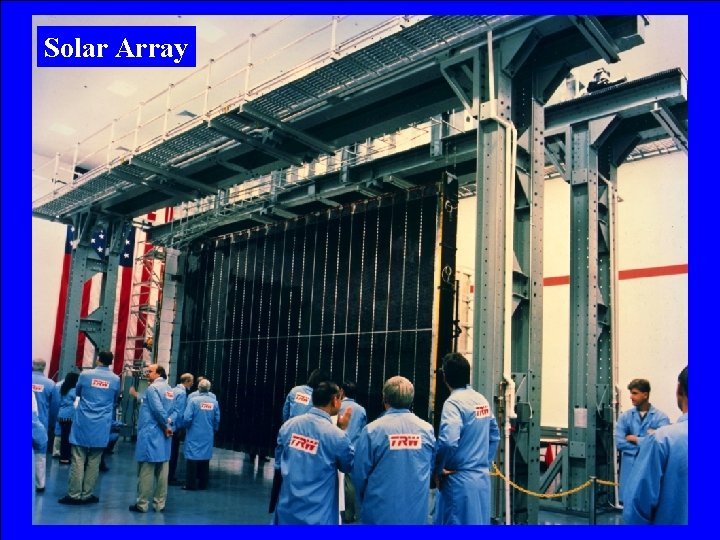
Solar Array
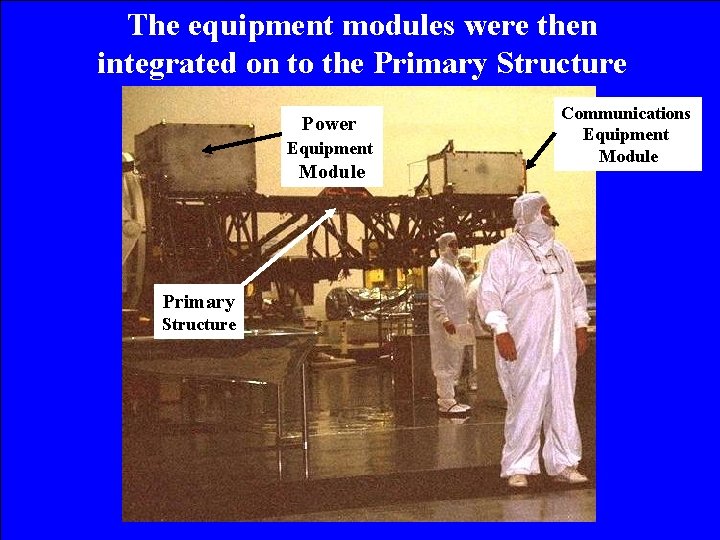
The equipment modules were then integrated on to the Primary Structure Power Equipment Module Communications Equipment Module The equipment modules were then integrated Primary on to the Structure Primary Structure
Thermal Control Subsystem
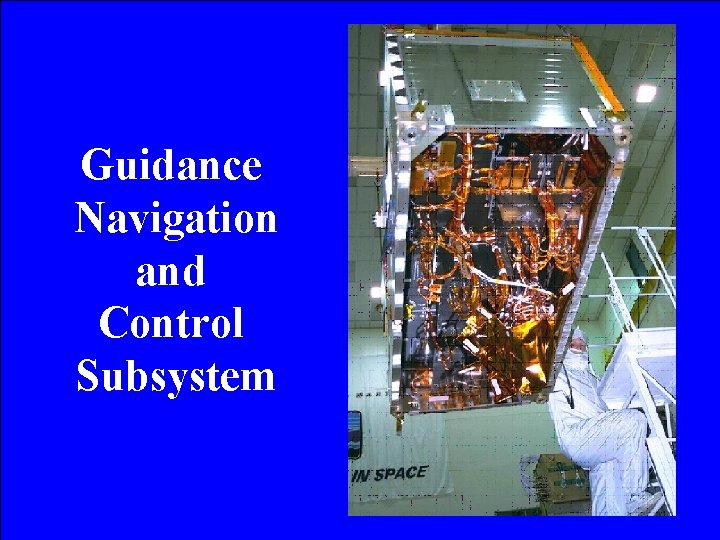
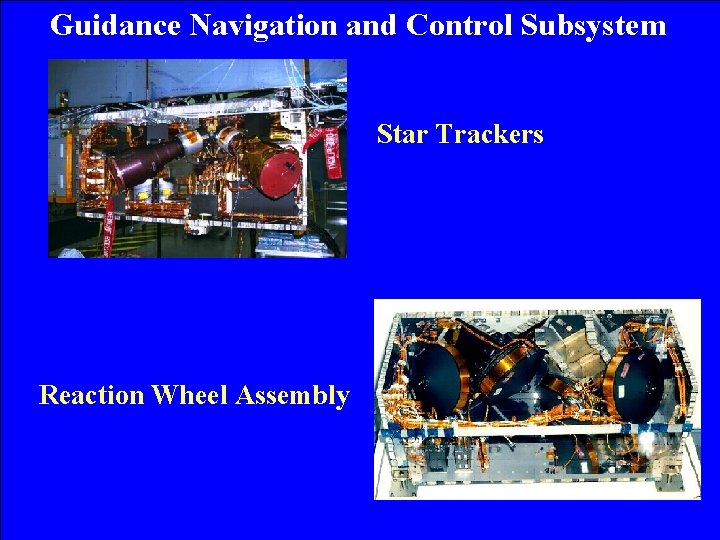
Guidance Navigation and Control Subsystem
Guidance Navigation and Control Subsystem Star Trackers Reaction Wheel Assembly
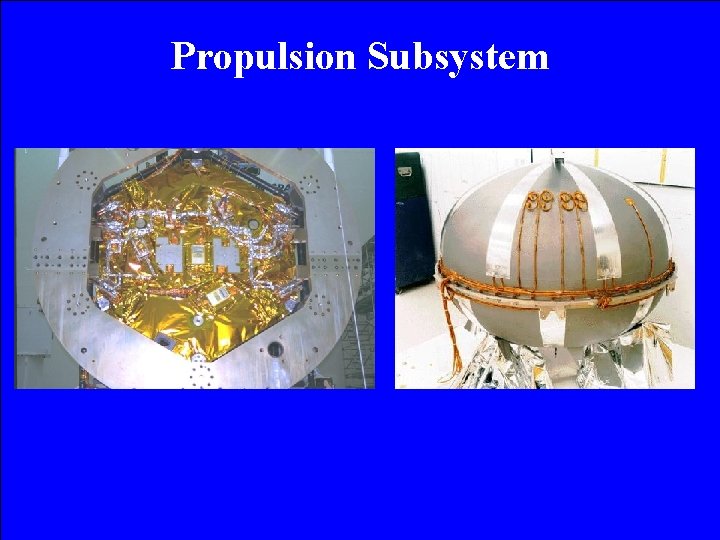
Propulsion Subsystem
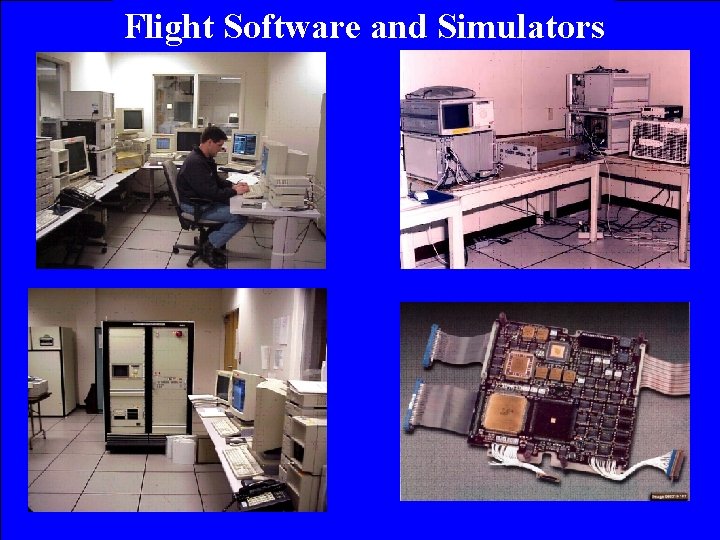
Flight Software and Simulators
Navigation TDRS On-board Navigation System (TONS) Performance has exceeded requirements
The Instruments
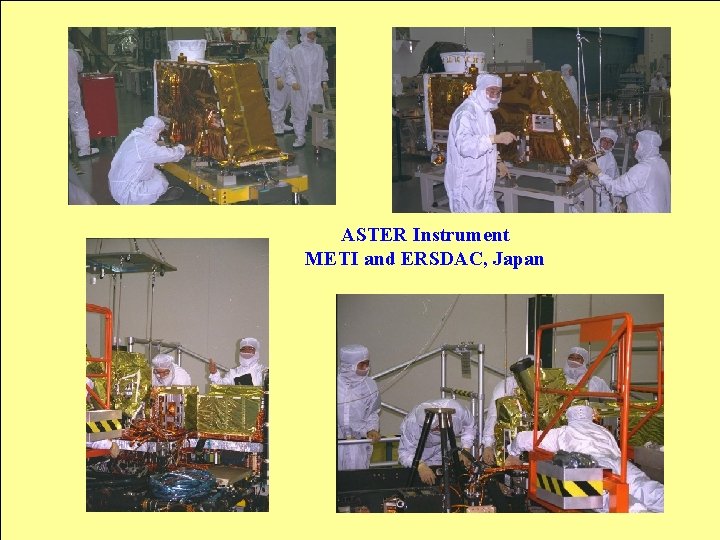
ASTER Instrument METI and ERSDAC, Japan
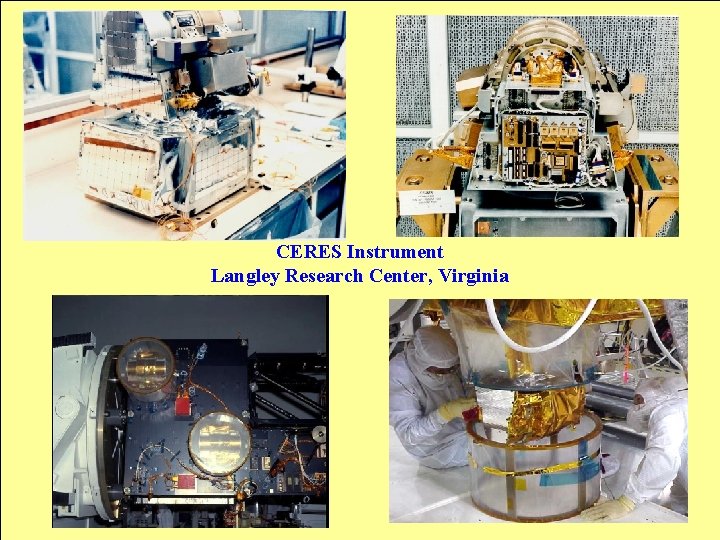
CERES Instrument Langley Research Center, Virginia
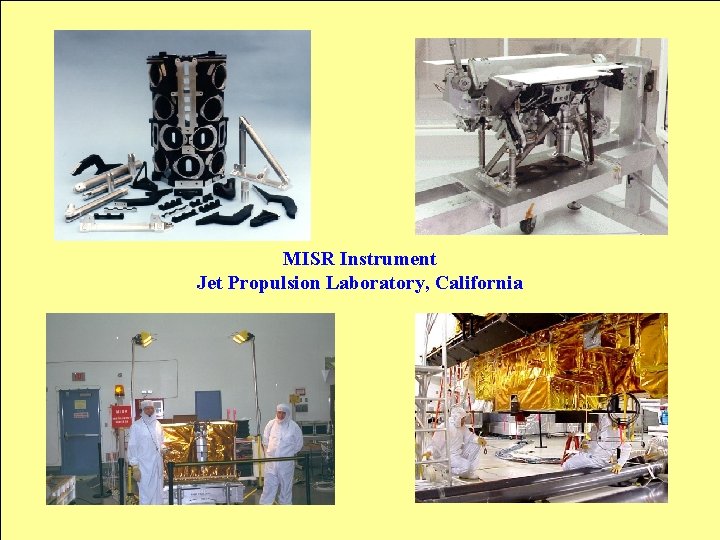
MISR Instrument Jet Propulsion Laboratory, California
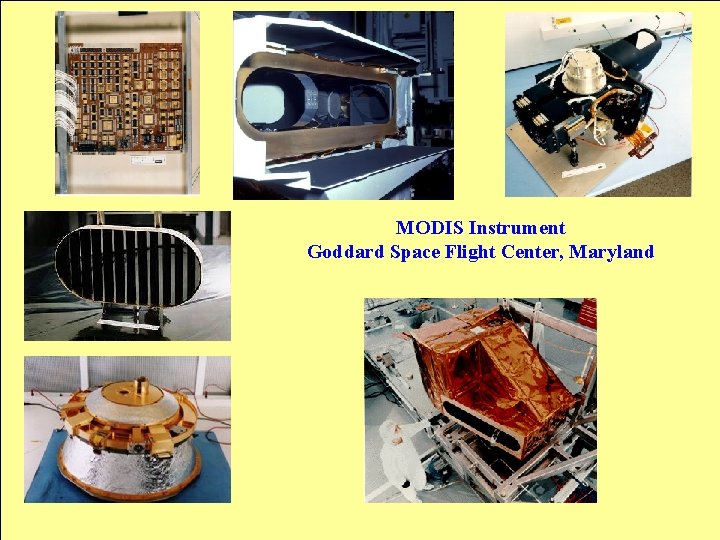
MODIS Instrument Goddard Space Flight Center, Maryland
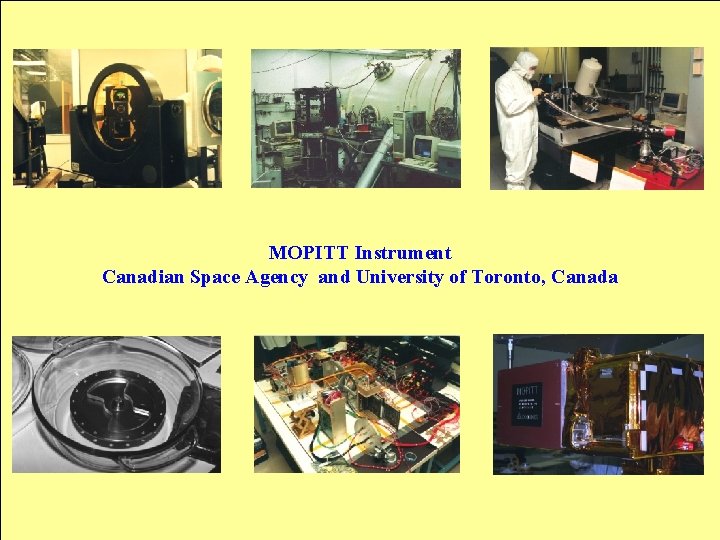
MOPITT Instrument Canadian Space Agency and University of Toronto, Canada
So what did it take to build Terra? A lot of dedication, technology and teamwork!!!
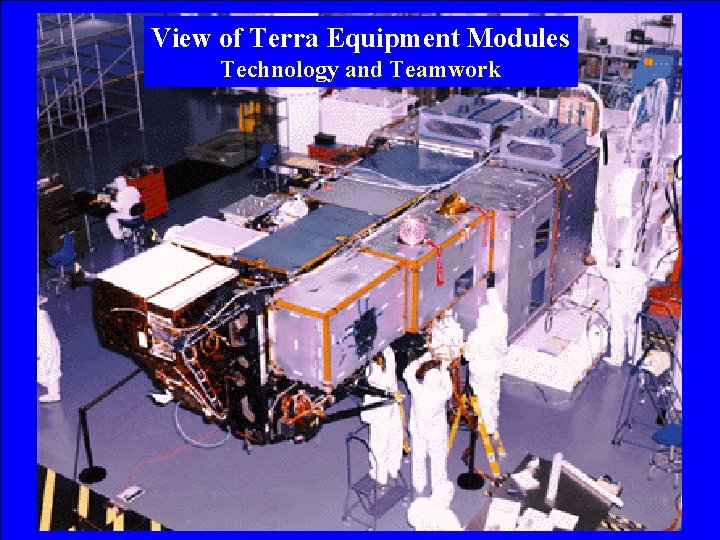
View of Terra Equipment Modules Technology and Teamwork
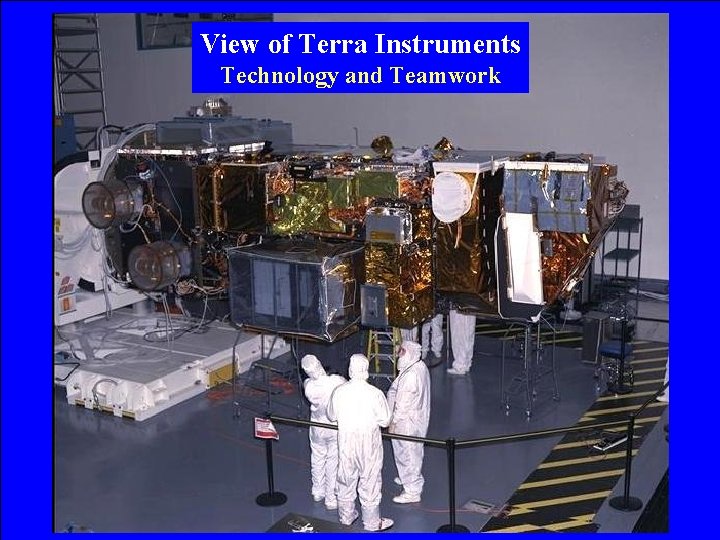
View of Terra Instruments Technology and Teamwork
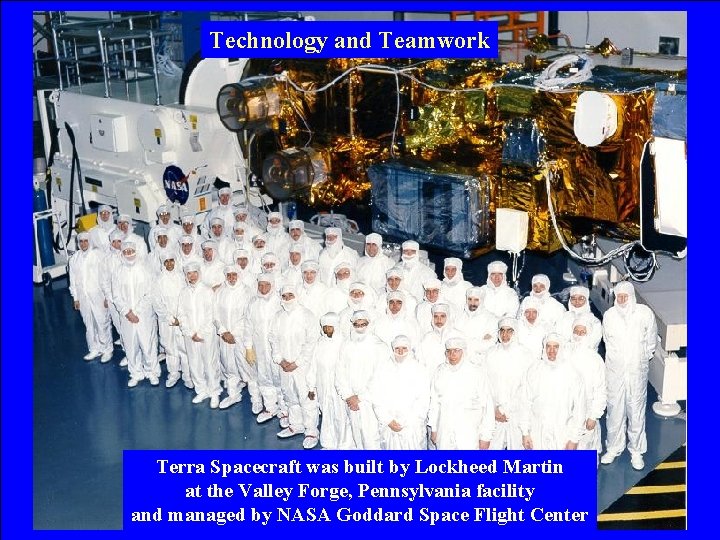
Technology and Teamwork Terra Spacecraft was built by Lockheed Martin at the Valley Forge, Pennsylvania facility and managed by NASA Goddard Space Flight Center
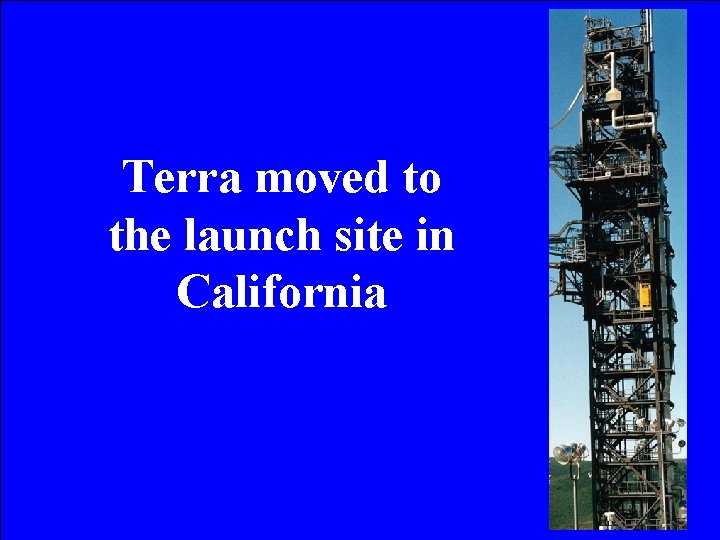
Terra moved to the launch site in California
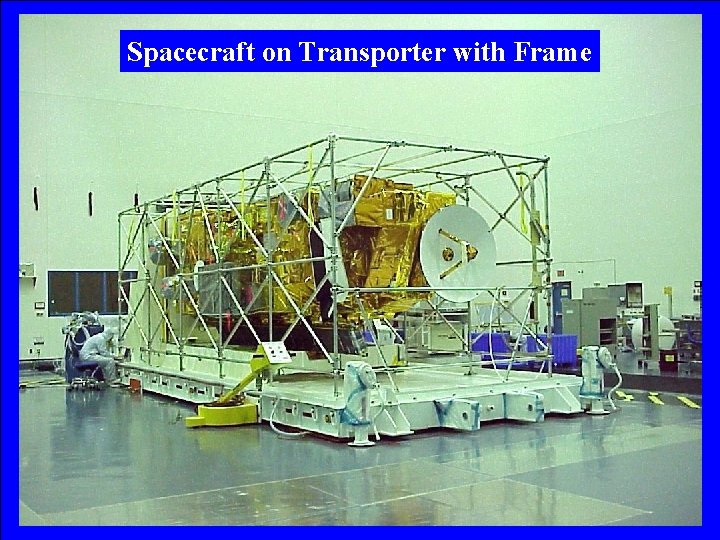
Spacecraft on Transporter with Frame
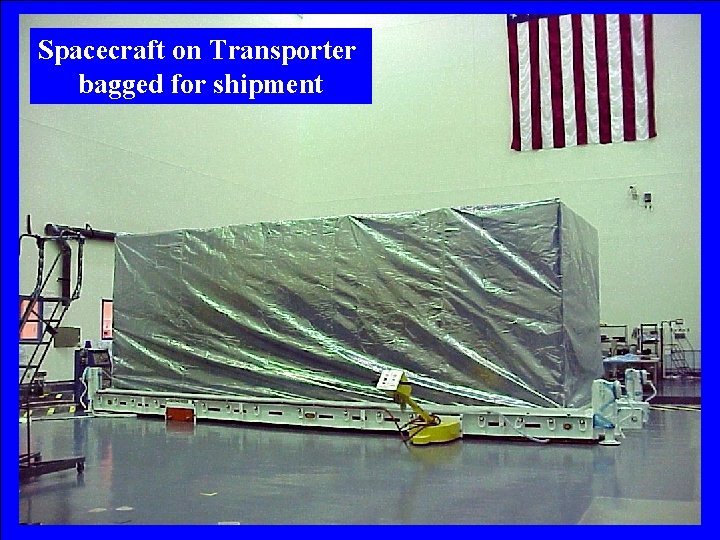
Spacecraft on Transporter bagged for shipment
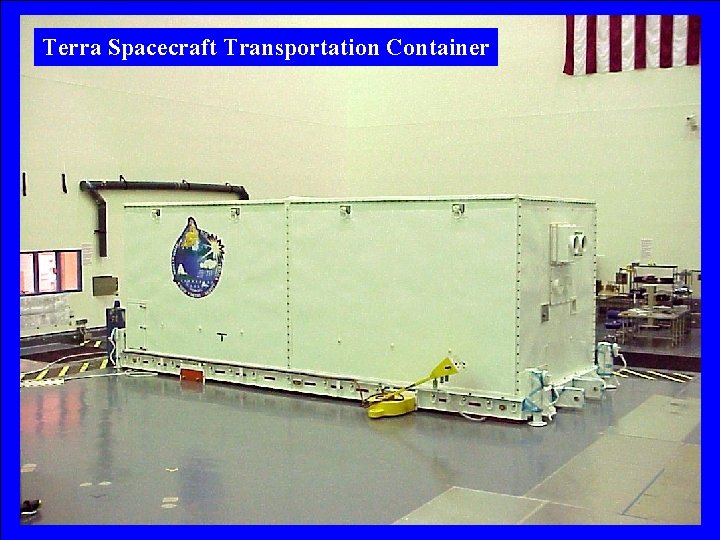
Terra Spacecraft Transportation Container
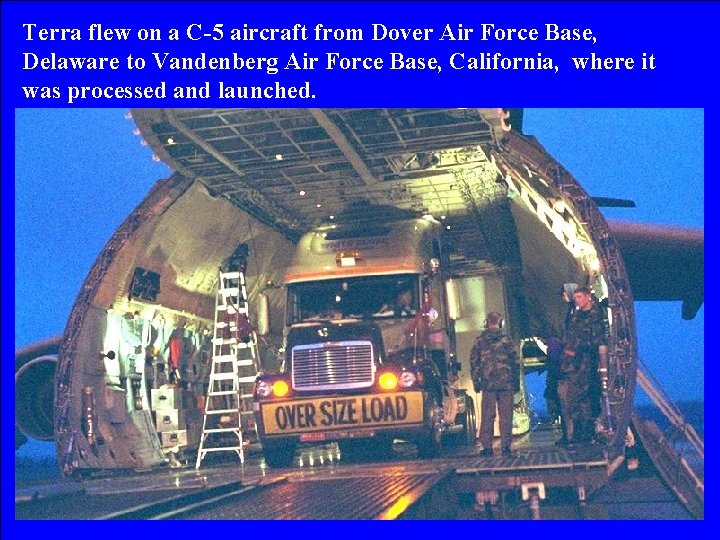
Terra flew on a C-5 aircraft from Dover Air Force Base, Delaware to Vandenberg Air Force Base, California, where it was processed and launched.
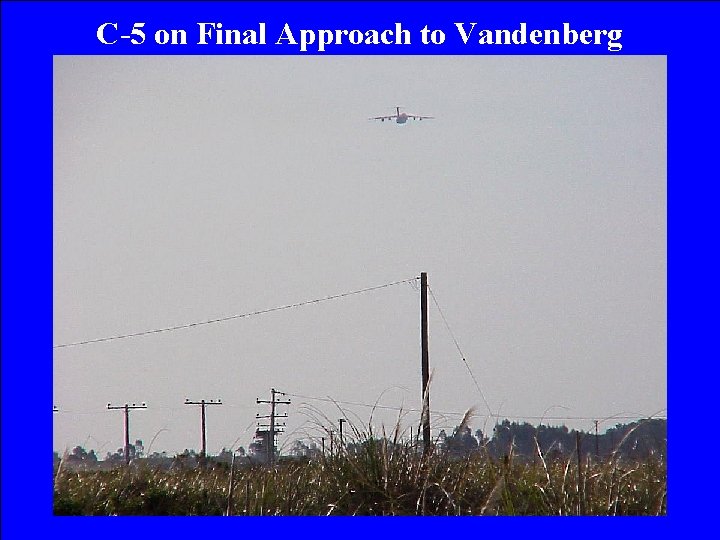
C-5 on Final Approach to Vandenberg
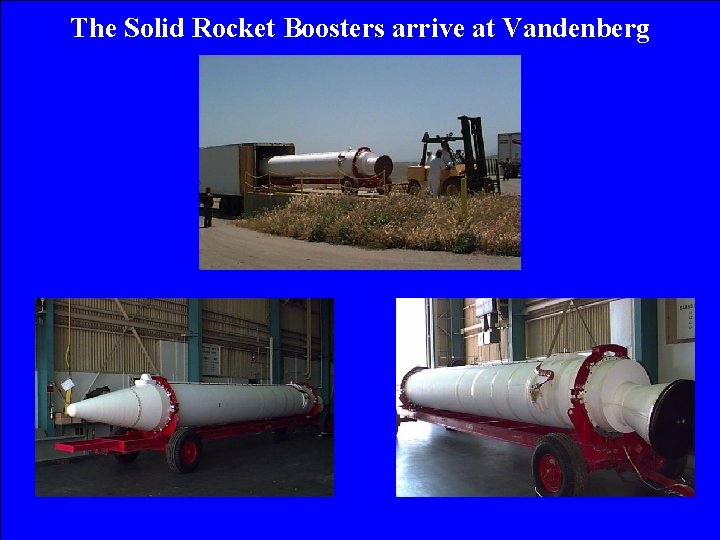
The Solid Rocket Boosters arrive at Vandenberg
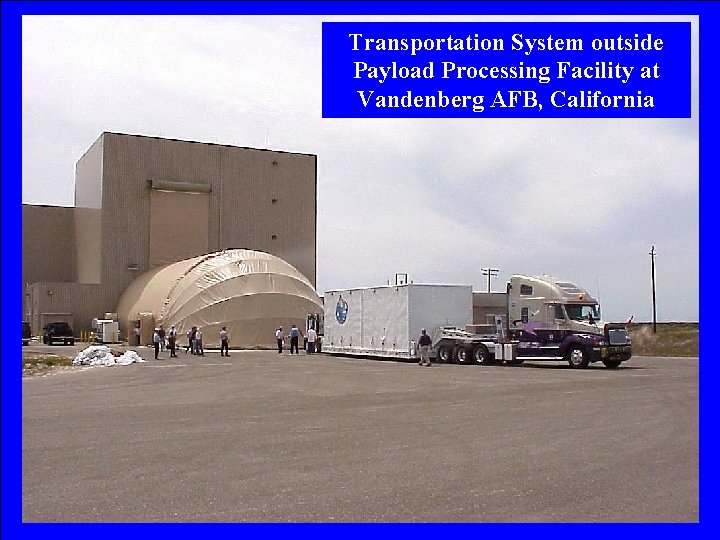
Transportation System outside Payload Processing Facility at Vandenberg AFB, California
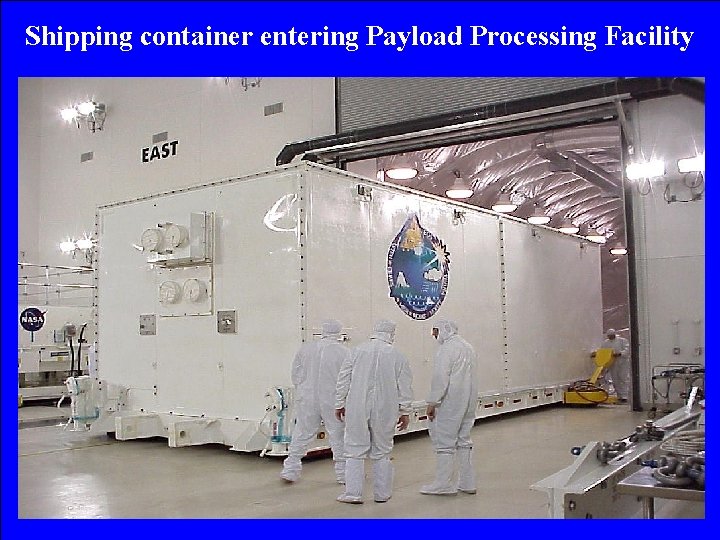
Shipping container entering Payload Processing Facility
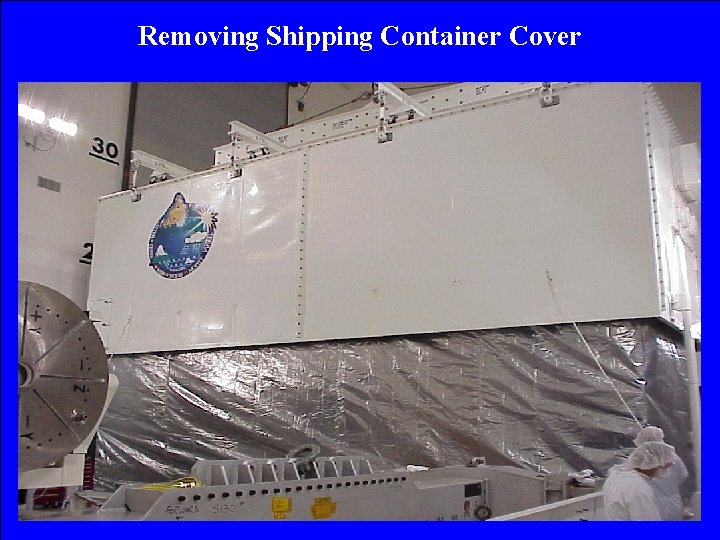
Removing Shipping Container Cover
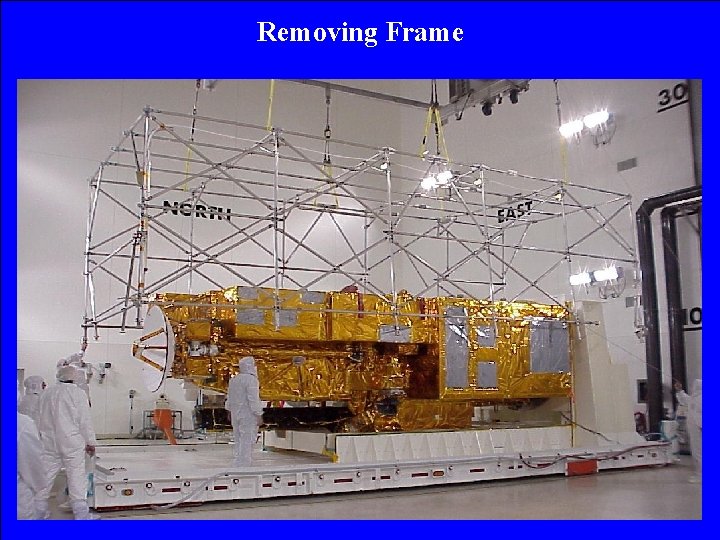
Removing Frame
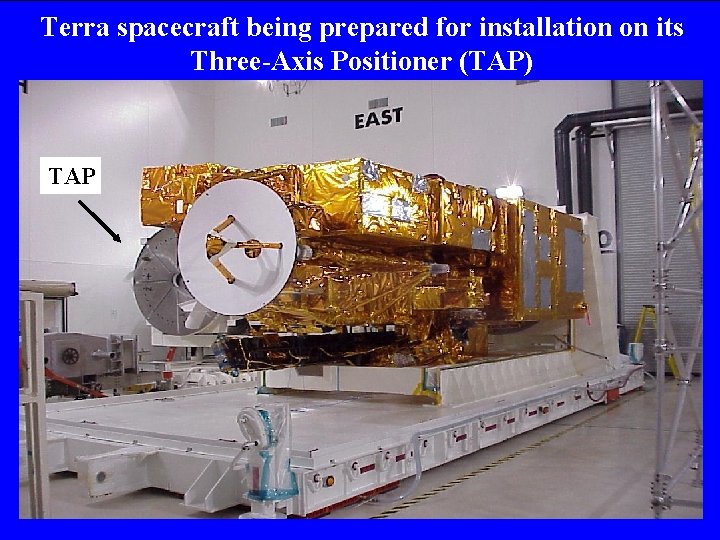
Terra spacecraft being prepared for installation on its Three-Axis Positioner (TAP) TAP
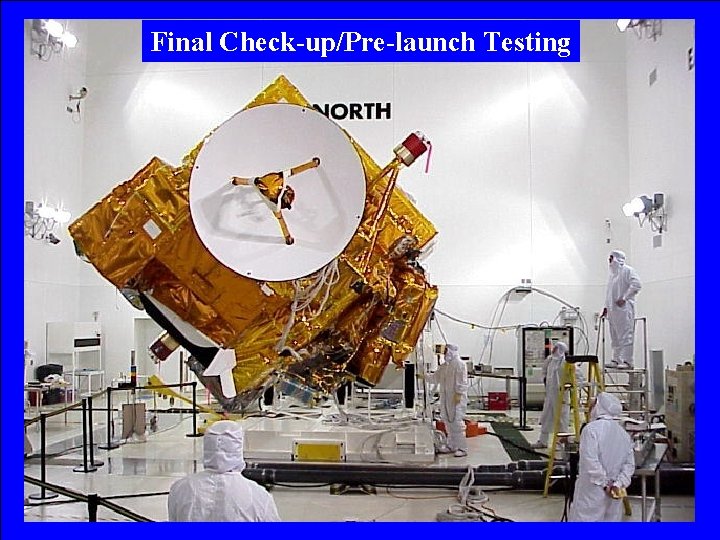
Final Check-up/Pre-launch Testing
Propulsion Leak Testing
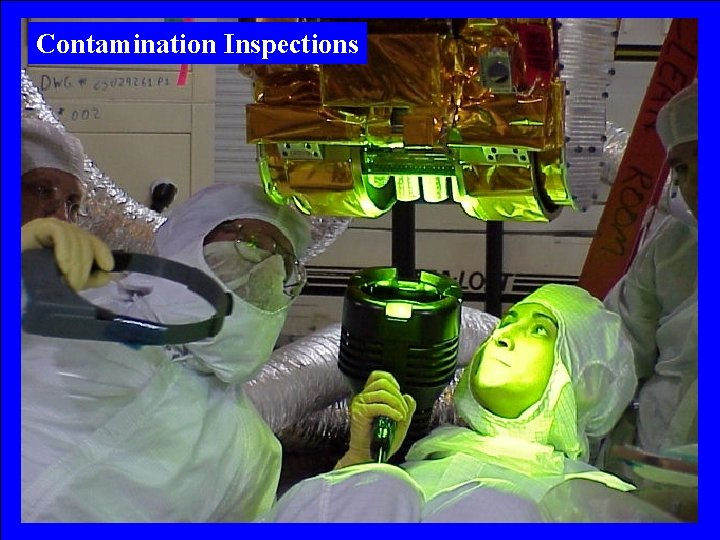
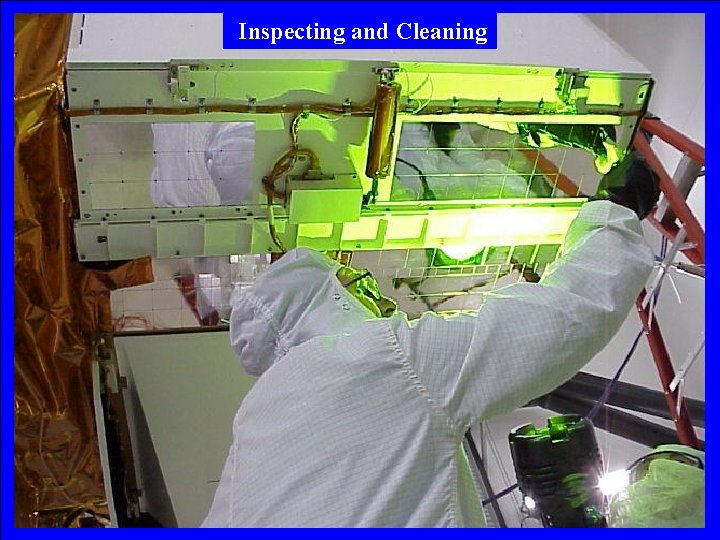
Contamination Inspections
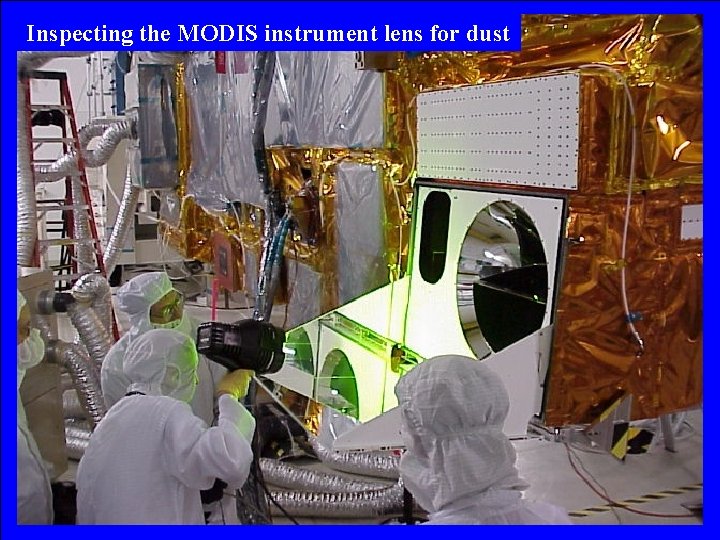
Inspecting the MODIS instrument lens for dust
Inspecting and Cleaning
After testing and inspections, Terra received a “GO FOR LAUNCH”!
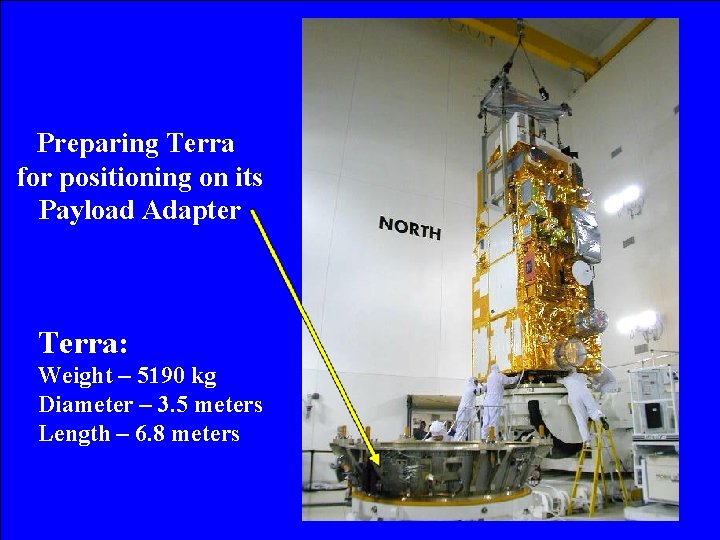
Preparing Terra for positioning on its Payload Adapter Terra: Weight – 5190 kg Diameter – 3. 5 meters Length – 6. 8 meters
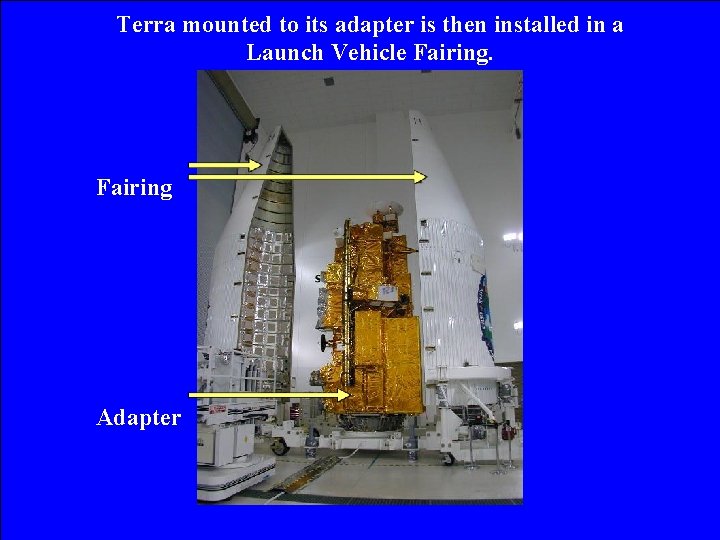
Terra mounted to its adapter is then installed in a Launch Vehicle Fairing Adapter
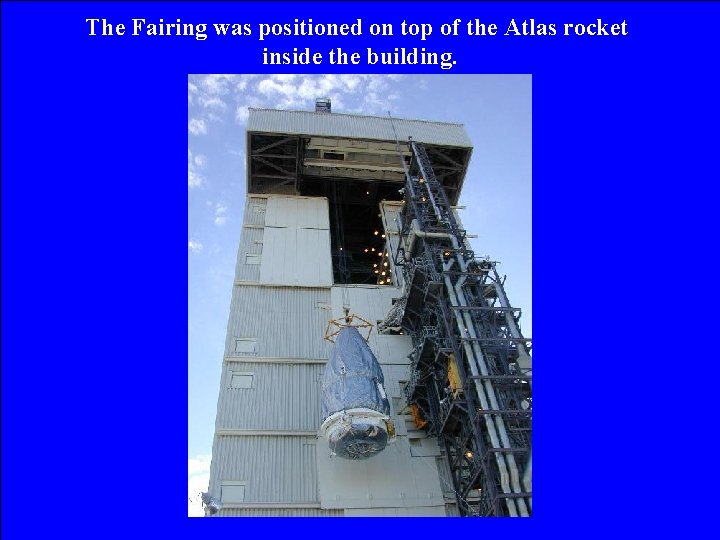
The Fairing was positioned on top of the Atlas rocket inside the building.
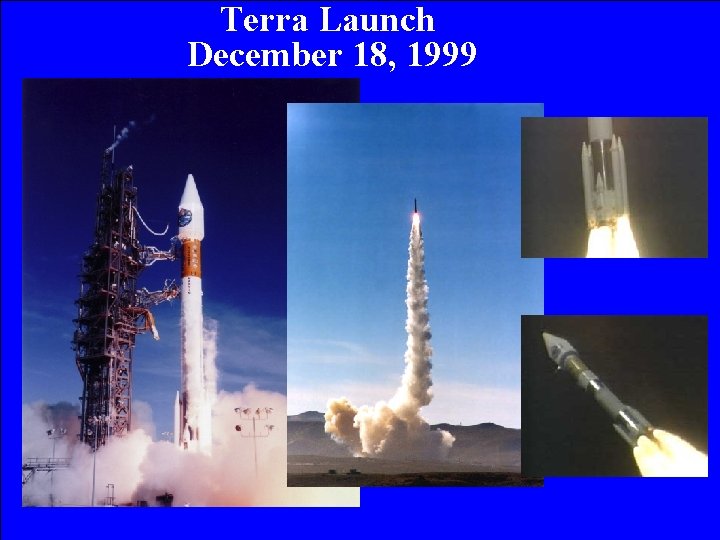
Terra Launch December 18, 1999
Terra’s systems and Instruments were checked successfully and declared operational.
Terra Today 2/23/2021 GSFC 48
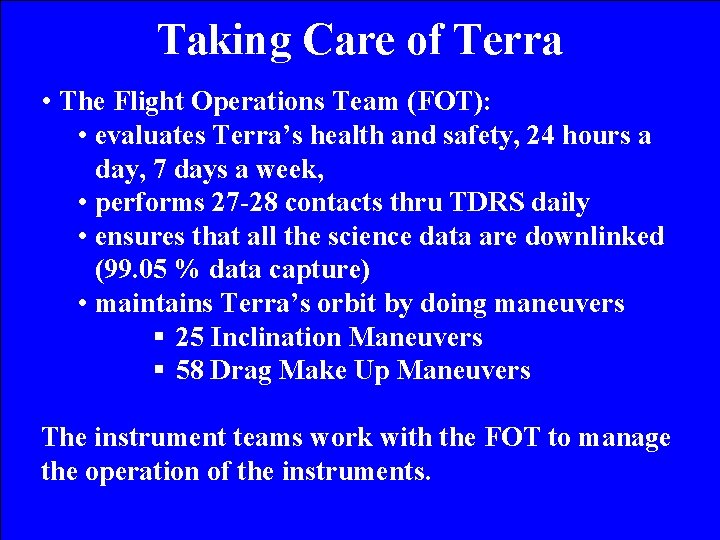
Taking Care of Terra • The Flight Operations Team (FOT): • evaluates Terra’s health and safety, 24 hours a day, 7 days a week, • performs 27 -28 contacts thru TDRS daily • ensures that all the science data are downlinked (99. 05 % data capture) • maintains Terra’s orbit by doing maneuvers § 25 Inclination Maneuvers § 58 Drag Make Up Maneuvers The instrument teams work with the FOT to manage the operation of the instruments. 2/23/2021 GSFC 50
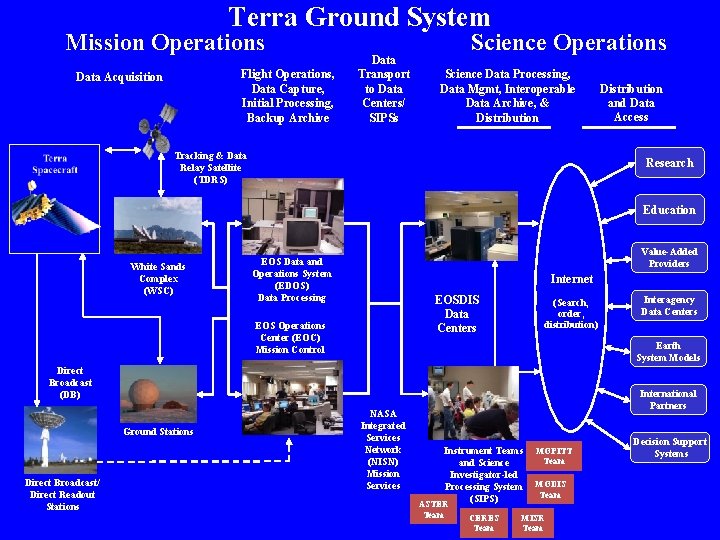
Terra Ground System Mission Operations Flight Operations, Data Capture, Initial Processing, Backup Archive Data Acquisition Data Transport to Data Centers/ SIPSs Science Operations Science Data Processing, Data Mgmt, Interoperable Data Archive, & Distribution Tracking & Data Relay Satellite (TDRS) Distribution and Data Access Research Education White Sands Complex (WSC) Value-Added Providers EOS Data and Operations System (EDOS) Data Processing Internet EOSDIS Data Centers EOS Operations Center (EOC) Mission Control (Search, order, distribution) Earth System Models Direct Broadcast (DB) Ground Stations Direct Broadcast/ Direct Readout Stations Interagency Data Centers NASA Integrated Services Network (NISN) Mission Services International Partners Instrument Teams and Science Investigator-led Processing System (SIPS) ASTER Team CERES Team MOPITT Team MODIS Team MISR Team Decision Support Systems
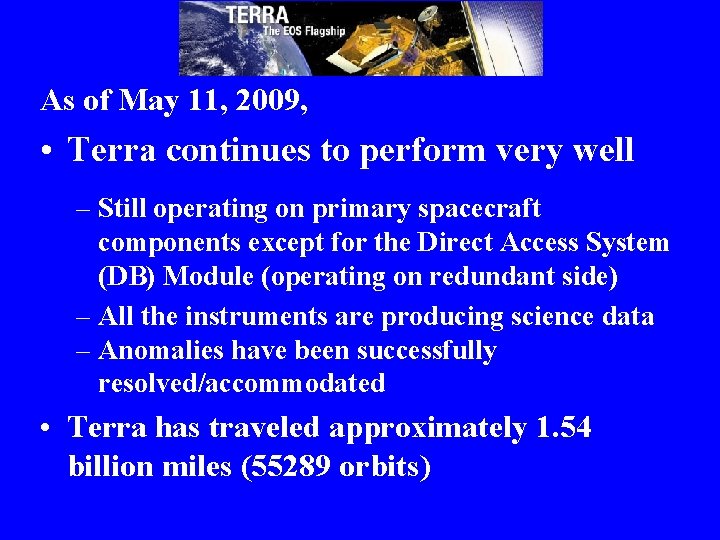
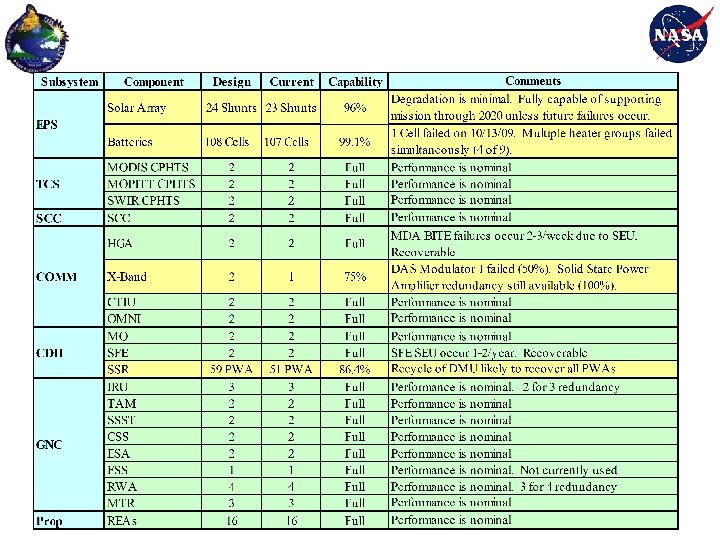
As of May 11, 2009, • Terra continues to perform very well – Still operating on primary spacecraft components except for the Direct Access System (DB) Module (operating on redundant side) – All the instruments are producing science data – Anomalies have been successfully resolved/accommodated • Terra has traveled approximately 1. 54 billion miles (55289 orbits) 2/23/2021 GSFC
Terra Data • Terra has generated 753 terabytes (TB) of data • 1. 35 million Level zero data products and 324, 000 near real time products Data Recovery is ~ 99. 05% • 5. 5 petabytes (PB) of Terra science data have been distributed to the world (public) • 2. 4 PB of Terra data are archived at geographically distributed data centers located in Colorado, Virginia, Tennessee, Maryland, South Dakota, and California 2/23/2021 GSFC 53
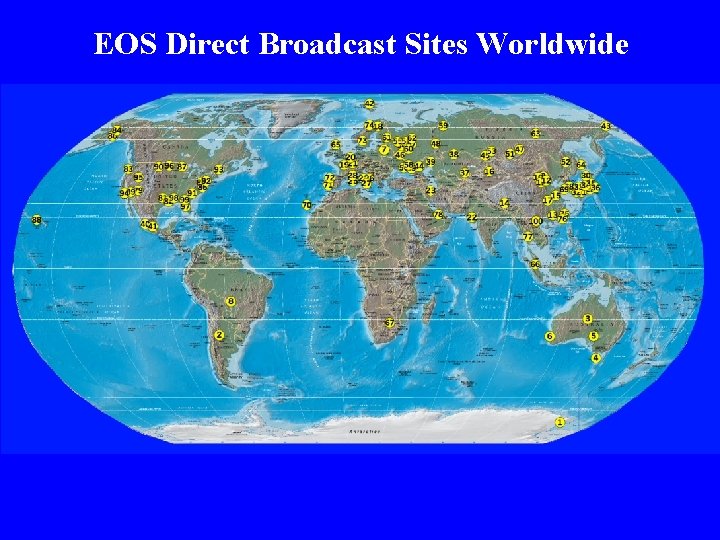
Terra Data Demand Distribution • Demand now exceeds 40 million files annually − From national/international scientists, US government, educational institutions, commercial interests • Direct Broadcast (Realtime MODIS data): – Over 1000 users at ~ 150 direct broadcast sites world-wide − Uses include − Forest fire detection and prevention − Coastal and fisheries studies and research − Disaster management − Natural resources and environmental research − Agricultural studies and research − Environmental hazard monitoring − Meteorological research and monitoring
EOS Direct Broadcast Sites Worldwide
Thank you for your attention. 2/23/2021 GSFC 57
Back-up slides 2/23/2021 GSFC 58
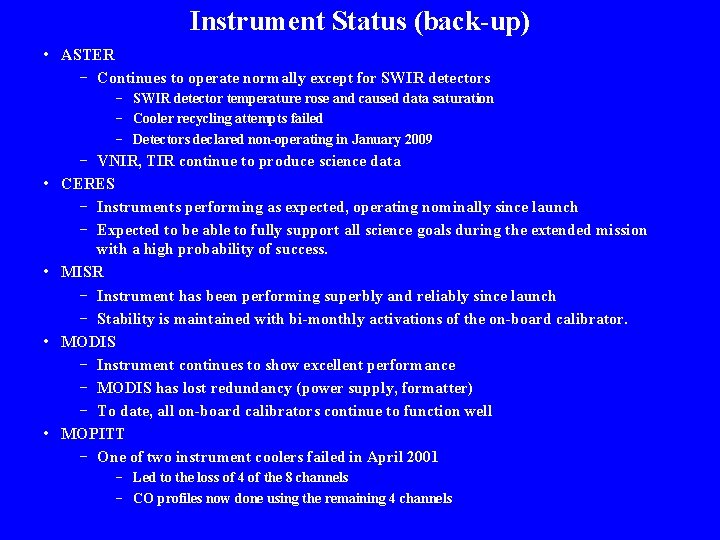
Instrument Status (back-up) • ASTER − Continues to operate normally except for SWIR detectors − SWIR detector temperature rose and caused data saturation − Cooler recycling attempts failed − Detectors declared non-operating in January 2009 • • − VNIR, TIR continue to produce science data CERES − Instruments performing as expected, operating nominally since launch − Expected to be able to fully support all science goals during the extended mission with a high probability of success. MISR − Instrument has been performing superbly and reliably since launch − Stability is maintained with bi-monthly activations of the on-board calibrator. MODIS − Instrument continues to show excellent performance − MODIS has lost redundancy (power supply, formatter) − To date, all on-board calibrators continue to function well MOPITT − One of two instrument coolers failed in April 2001 − Led to the loss of 4 of the 8 channels − CO profiles now done using the remaining 4 channels
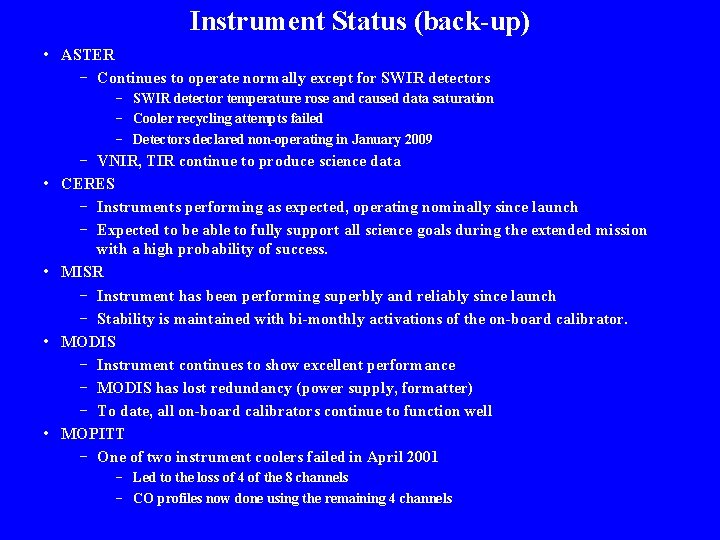
Instrument Status (back-up) • ASTER − Continues to operate normally except for SWIR detectors − SWIR detector temperature rose and caused data saturation − Cooler recycling attempts failed − Detectors declared non-operating in January 2009 • • − VNIR, TIR continue to produce science data CERES − Instruments performing as expected, operating nominally since launch − Expected to be able to fully support all science goals during the extended mission with a high probability of success. MISR − Instrument has been performing superbly and reliably since launch − Stability is maintained with bi-monthly activations of the on-board calibrator. MODIS − Instrument continues to show excellent performance − MODIS has lost redundancy (power supply, formatter) − To date, all on-board calibrators continue to function well MOPITT − One of two instrument coolers failed in April 2001 − Led to the loss of 4 of the 8 channels − CO profiles now done using the remaining 4 channels
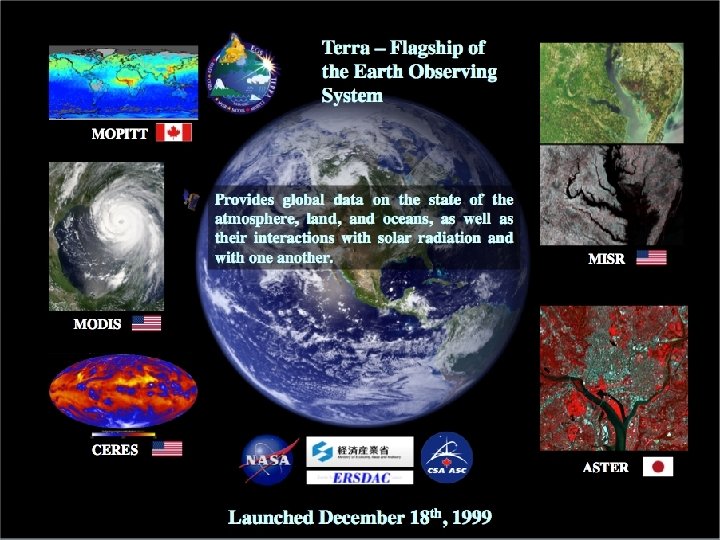
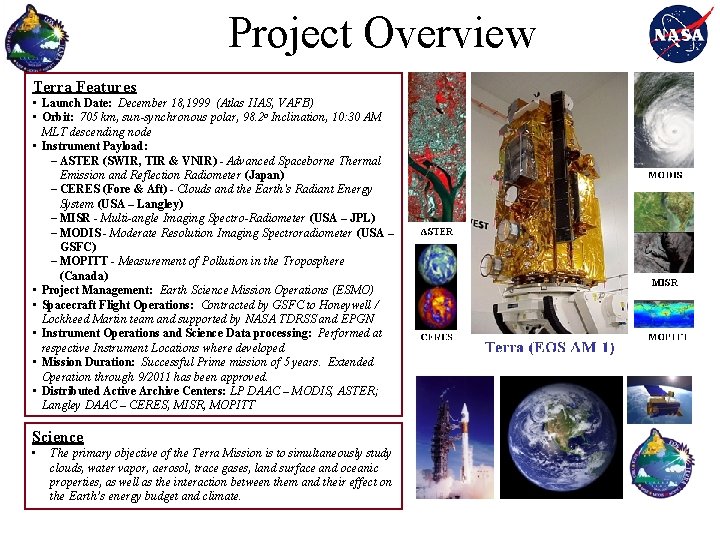
Project Overview Terra Features • Launch Date: December 18, 1999 (Atlas IIAS, VAFB) • Orbit: 705 km, sun-synchronous polar, 98. 2 o Inclination, 10: 30 AM MLT descending node • Instrument Payload: – ASTER (SWIR, TIR & VNIR) - Advanced Spaceborne Thermal Emission and Reflection Radiometer (Japan) – CERES (Fore & Aft) - Clouds and the Earth's Radiant Energy System (USA – Langley) – MISR - Multi-angle Imaging Spectro-Radiometer (USA – JPL) – MODIS - Moderate Resolution Imaging Spectroradiometer (USA – GSFC) – MOPITT - Measurement of Pollution in the Troposphere (Canada) • Project Management: Earth Science Mission Operations (ESMO) • Spacecraft Flight Operations: Contracted by GSFC to Honeywell / Lockheed Martin team and supported by NASA TDRSS and EPGN • Instrument Operations and Science Data processing: Performed at respective Instrument Locations where developed • Mission Duration: Successful Prime mission of 5 years. Extended Operation through 9/2011 has been approved. • Distributed Active Archive Centers: LP DAAC – MODIS, ASTER; Langley DAAC – CERES, MISR, MOPITT Science • The primary objective of the Terra Mission is to simultaneously study clouds, water vapor, aerosol, trace gases, land surface and oceanic properties, as well as the interaction between them and their effect on the Earth’s energy budget and climate.
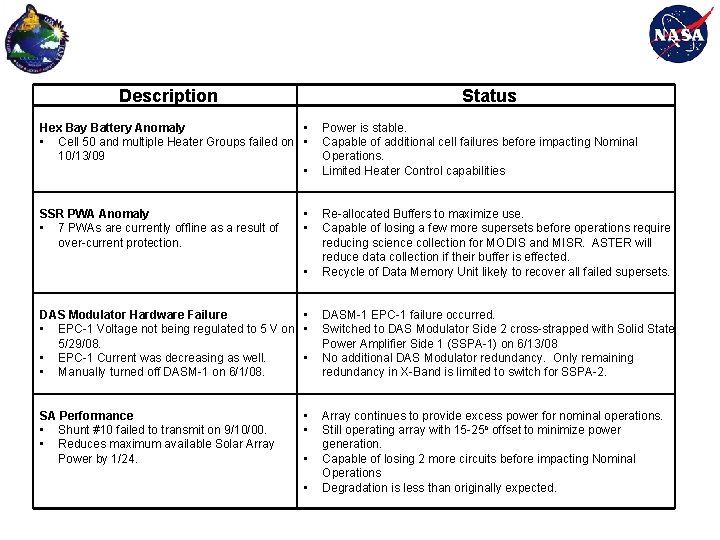
Description Status Hex Bay Battery Anomaly • • Cell 50 and multiple Heater Groups failed on • 10/13/09 • SSR PWA Anomaly • 7 PWAs are currently offline as a result of over-current protection. • • • DAS Modulator Hardware Failure • • EPC-1 Voltage not being regulated to 5 V on • 5/29/08. • EPC-1 Current was decreasing as well. • • Manually turned off DASM-1 on 6/1/08. SA Performance • Shunt #10 failed to transmit on 9/10/00. • Reduces maximum available Solar Array Power by 1/24. • • Power is stable. Capable of additional cell failures before impacting Nominal Operations. Limited Heater Control capabilities Re-allocated Buffers to maximize use. Capable of losing a few more supersets before operations require reducing science collection for MODIS and MISR. ASTER will reduce data collection if their buffer is effected. Recycle of Data Memory Unit likely to recover all failed supersets. DASM-1 EPC-1 failure occurred. Switched to DAS Modulator Side 2 cross-strapped with Solid State Power Amplifier Side 1 (SSPA-1) on 6/13/08 No additional DAS Modulator redundancy. Only remaining redundancy in X-Band is limited to switch for SSPA-2. Array continues to provide excess power for nominal operations. Still operating array with 15 -25 o offset to minimize power generation. Capable of losing 2 more circuits before impacting Nominal Operations Degradation is less than originally expected.
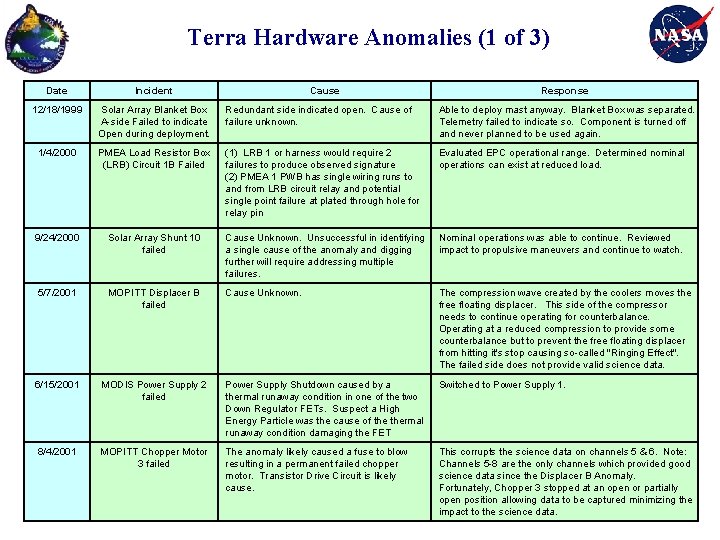
Terra Hardware Anomalies (1 of 3) Date Incident Cause Response 12/18/1999 Solar Array Blanket Box A-side Failed to indicate Open during deployment. Redundant side indicated open. Cause of failure unknown. Able to deploy mast anyway. Blanket Box was separated. Telemetry failed to indicate so. Component is turned off and never planned to be used again. 1/4/2000 PMEA Load Resistor Box (LRB) Circuit 1 B Failed (1) LRB 1 or harness would require 2 failures to produce observed signature (2) PMEA 1 PWB has single wiring runs to and from LRB circuit relay and potential single point failure at plated through hole for relay pin Evaluated EPC operational range. Determined nominal operations can exist at reduced load. 9/24/2000 Solar Array Shunt 10 failed Cause Unknown. Unsuccessful in identifying a single cause of the anomaly and digging further will require addressing multiple failures. Nominal operations was able to continue. Reviewed impact to propulsive maneuvers and continue to watch. 5/7/2001 MOPITT Displacer B failed Cause Unknown. The compression wave created by the coolers moves the free floating displacer. This side of the compressor needs to continue operating for counterbalance. Operating at a reduced compression to provide some counterbalance but to prevent the free floating displacer from hitting it's stop causing so-called "Ringing Effect". The failed side does not provide valid science data. 6/15/2001 MODIS Power Supply 2 failed Power Supply Shutdown caused by a thermal runaway condition in one of the two Down Regulator FETs. Suspect a High Energy Particle was the cause of thermal runaway condition damaging the FET Switched to Power Supply 1. 8/4/2001 MOPITT Chopper Motor 3 failed The anomaly likely caused a fuse to blow resulting in a permanent failed chopper motor. Transistor Drive Circuit is likely cause. This corrupts the science data on channels 5 & 6. Note: Channels 5 -8 are the only channels which provided good science data since the Displacer B Anomaly. Fortunately, Chopper 3 stopped at an open or partially open position allowing data to be captured minimizing the impact to the science data.
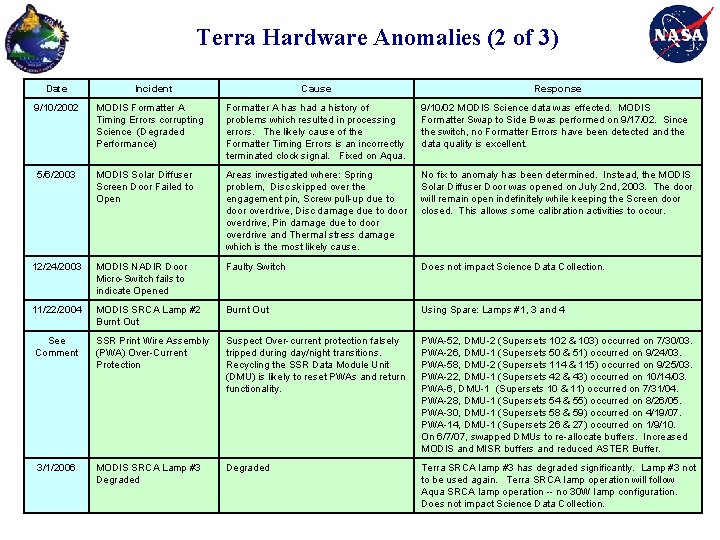
Terra Hardware Anomalies (2 of 3) Date Incident Cause Response 9/10/2002 MODIS Formatter A Timing Errors corrupting Science (Degraded Performance) Formatter A has had a history of problems which resulted in processing errors. The likely cause of the Formatter Timing Errors is an incorrectly terminated clock signal. Fixed on Aqua. 9/10/02 MODIS Science data was effected. MODIS Formatter Swap to Side B was performed on 9/17/02. Since the switch, no Formatter Errors have been detected and the data quality is excellent. 5/6/2003 MODIS Solar Diffuser Screen Door Failed to Open Areas investigated where: Spring problem, Disc skipped over the engagement pin, Screw pull-up due to door overdrive, Disc damage due to door overdrive, Pin damage due to door overdrive and Thermal stress damage which is the most likely cause. No fix to anomaly has been determined. Instead, the MODIS Solar Diffuser Door was opened on July 2 nd, 2003. The door will remain open indefinitely while keeping the Screen door closed. This allows some calibration activities to occur. 12/24/2003 MODIS NADIR Door Micro-Switch fails to indicate Opened Faulty Switch Does not impact Science Data Collection. 11/22/2004 MODIS SRCA Lamp #2 Burnt Out Using Spare: Lamps #1, 3 and 4 See Comment SSR Print Wire Assembly (PWA) Over-Current Protection Suspect Over-current protection falsely tripped during day/night transitions. Recycling the SSR Data Module Unit (DMU) is likely to reset PWAs and return functionality. PWA-52, DMU-2 (Supersets 102 & 103) occurred on 7/30/03. PWA-26, DMU-1 (Supersets 50 & 51) occurred on 9/24/03. PWA-58, DMU-2 (Supersets 114 & 115) occurred on 9/25/03. PWA-22, DMU-1 (Supersets 42 & 43) occurred on 10/14/03. PWA-6, DMU-1 (Supersets 10 & 11) occurred on 7/31/04. PWA-28, DMU-1 (Supersets 54 & 55) occurred on 8/26/05. PWA-30, DMU-1 (Supersets 58 & 59) occurred on 4/19/07. PWA-14, DMU-1 (Supersets 26 & 27) occurred on 1/9/10. On 6/7/07, swapped DMUs to re-allocate buffers. Increased MODIS and MISR buffers and reduced ASTER Buffer. 3/1/2006 MODIS SRCA Lamp #3 Degraded Terra SRCA lamp #3 has degraded significantly. Lamp #3 not to be used again. Terra SRCA lamp operation will follow Aqua SRCA lamp operation -- no 30 W lamp configuration. Does not impact Science Data Collection.
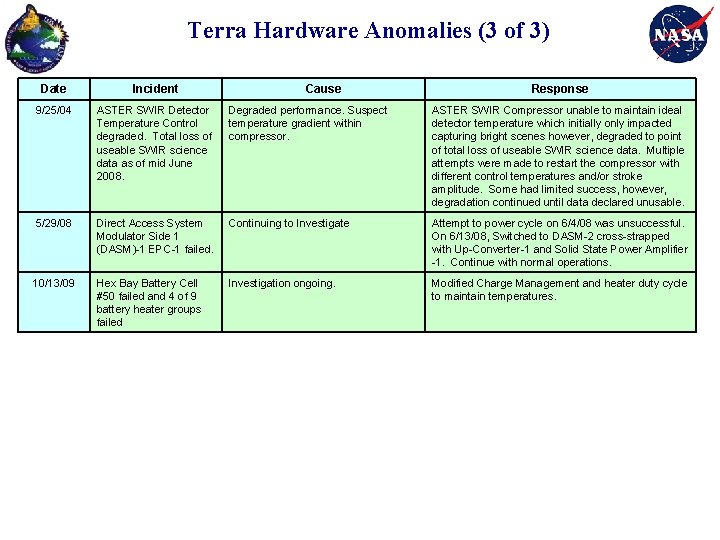
Terra Hardware Anomalies (3 of 3) Date Incident Cause Response 9/25/04 ASTER SWIR Detector Temperature Control degraded. Total loss of useable SWIR science data as of mid June 2008. Degraded performance. Suspect temperature gradient within compressor. ASTER SWIR Compressor unable to maintain ideal detector temperature which initially only impacted capturing bright scenes however, degraded to point of total loss of useable SWIR science data. Multiple attempts were made to restart the compressor with different control temperatures and/or stroke amplitude. Some had limited success, however, degradation continued until data declared unusable. 5/29/08 Direct Access System Modulator Side 1 (DASM)-1 EPC-1 failed. Continuing to Investigate Attempt to power cycle on 6/4/08 was unsuccessful. On 6/13/08, Switched to DASM-2 cross-strapped with Up-Converter-1 and Solid State Power Amplifier -1. Continue with normal operations. 10/13/09 Hex Bay Battery Cell #50 failed and 4 of 9 battery heater groups failed Investigation ongoing. Modified Charge Management and heater duty cycle to maintain temperatures.