
Terminology Management Maturity Model achieve semantic interoperability Updated
Terminology Management Maturity Model achieve semantic interoperability Updated Sept 2018
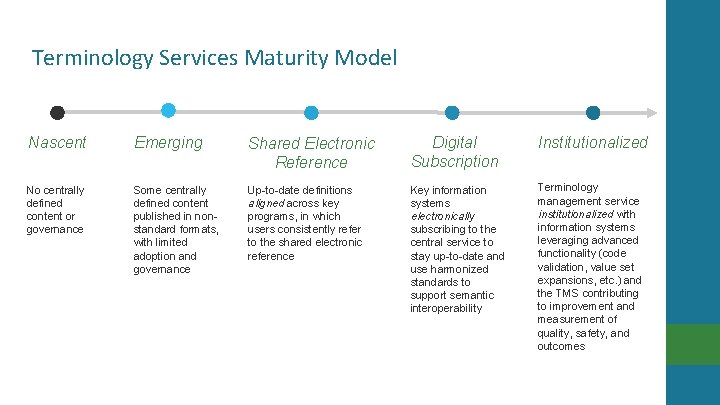
Terminology Services Maturity Model Nascent Emerging Shared Electronic Reference Digital Subscription Institutionalized No centrally defined content or governance Some centrally defined content published in nonstandard formats, with limited adoption and governance Up-to-date definitions aligned across key programs, in which users consistently refer to the shared electronic reference Key information systems electronically subscribing to the central service to stay up-to-date and use harmonized standards to support semantic interoperability Terminology management service institutionalized with information systems leveraging advanced functionality (code validation, value set expansions, etc. ) and the TMS contributing to improvement and measurement of quality, safety, and outcomes
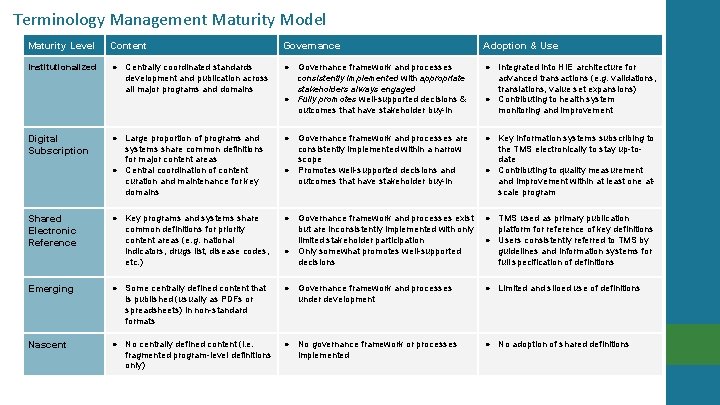
Terminology Management Maturity Model Maturity Level Content Governance Adoption & Use Institutionalized ● Centrally coordinated standards development and publication across all major programs and domains ● Governance framework and processes consistently implemented with appropriate stakeholders always engaged ● Fully promotes well-supported decisions & outcomes that have stakeholder buy-in ● Integrated into HIE architecture for advanced transactions (e. g. validations, translations, value set expansions) ● Contributing to health system monitoring and improvement Digital Subscription ● Large proportion of programs and systems share common definitions for major content areas ● Central coordination of content curation and maintenance for key domains ● Governance framework and processes are consistently implemented within a narrow scope ● Promotes well-supported decisions and outcomes that have stakeholder buy-in ● Key information systems subscribing to the TMS electronically to stay up-todate ● Contributing to quality measurement and improvement within at least one atscale program Shared Electronic Reference ● Key programs and systems share common definitions for priority content areas (e. g. national indicators, drugs list, disease codes, etc. ) ● Governance framework and processes exist but are inconsistently implemented with only limited stakeholder participation ● Only somewhat promotes well-supported decisions ● TMS used as primary publication platform for reference of key definitions ● Users consistently referred to TMS by guidelines and information systems for full specification of definitions Emerging ● Some centrally defined content that is published (usually as PDFs or spreadsheets) in non-standard formats ● Governance framework and processes under development ● Limited and siloed use of definitions Nascent ● No centrally defined content (i. e. fragmented program-level definitions only) ● No governance framework or processes implemented ● No adoption of shared definitions
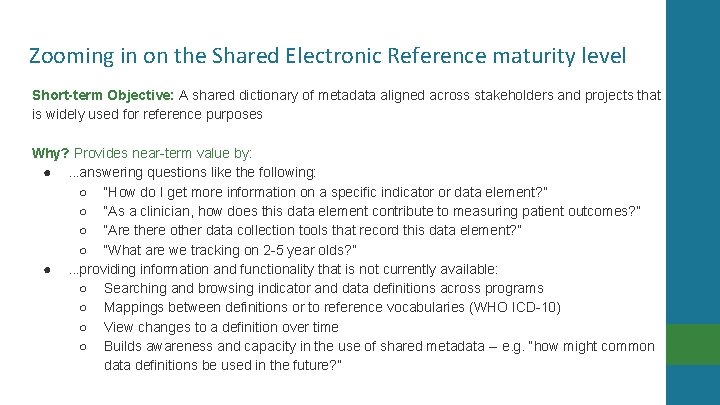
Zooming in on the Shared Electronic Reference maturity level Short-term Objective: A shared dictionary of metadata aligned across stakeholders and projects that is widely used for reference purposes Why? Provides near-term value by: ●. . . answering questions like the following: ○ “How do I get more information on a specific indicator or data element? ” ○ “As a clinician, how does this data element contribute to measuring patient outcomes? ” ○ “Are there other data collection tools that record this data element? ” ○ “What are we tracking on 2 -5 year olds? ” ●. . . providing information and functionality that is not currently available: ○ Searching and browsing indicator and data definitions across programs ○ Mappings between definitions or to reference vocabularies (WHO ICD-10) ○ View changes to a definition over time ○ Builds awareness and capacity in the use of shared metadata -- e. g. “how might common data definitions be used in the future? ”

Maturity Model - Get to the Next Level Nascent Emerging Shared Electronic Reference Digital Subscription Institutionalized Contains general analysis of information, but needs more structure and defined details. Information is a bit more specific, but not narrow enough. Needs to follow best practices and begin to be utilized/adopted by others. Has reached the level of containing clear, welldefined information and is being utilized by others, but has not been classified as a central service. Is used as a central service with highlevel vocabulary, but has not reached its maximum potential of advanced functionality. Has been established as a reliable system that has reached its maximum potential.
- Slides: 5