
Terminator Technology or how to create a problem
Terminator Technology or: how to create a problem Sandra Blessin BUKO Agrar Koordination Berlin, 22. 5. 2007
Overview u u Introduction What is Terminator Technology? u u u Definition How does it work Impacts and risks Short history The ban-terminator activities in Germany 2005/ 2006 The transcontainer project, COP 9 and possible activities
definition u Problems: u u u no official definition in the CBD text Different components and aims German campaign definition: Terminator Technology is a genetic modification of organisms which eliminates or reduces the germination capacity of the following seed generation. Usually the terminator gene sequence can be activated through a on or off mechanism.
definition u Our definition includes 4 components: u u u GMO Germination reduces or eliminated Sterile seeds inducible CBD: genetic use restriction technologies (GURTs) FAO: Biotechnology-based switch mechanism to restrict the unauthorized use of genetic material
how does it work? u u The Terminator Technology is basically a genetically engineered suicide mechanism that can be triggered on or off by aspecific outside stimulus (the inducer). The preferred inducer is Tetracycline (antibiotic). As the result the seeds of the next generation will self destruct by selfpoisoning. Usually there are 3 genes inserted. All can fail. The reliabilty of the hole construct is 80 % (estimated by R. Steinbrecher)

How Terminator works in theory (Overview from Dr. R. Steinbrecher) apply inducer R R molecular Scissors a elimination of repressor Scissors b for example Tetracycline, heat etc. toxin production from Ribonuclease Pro- toxin moter
impacts and risks Reliability for biosafety: enough for use restriction but as an affective measure to avoid GMO contamination not enough u Use restriction: u u u negation of farmers´rights undermining of food sovereignty danger food security biodiversity loss
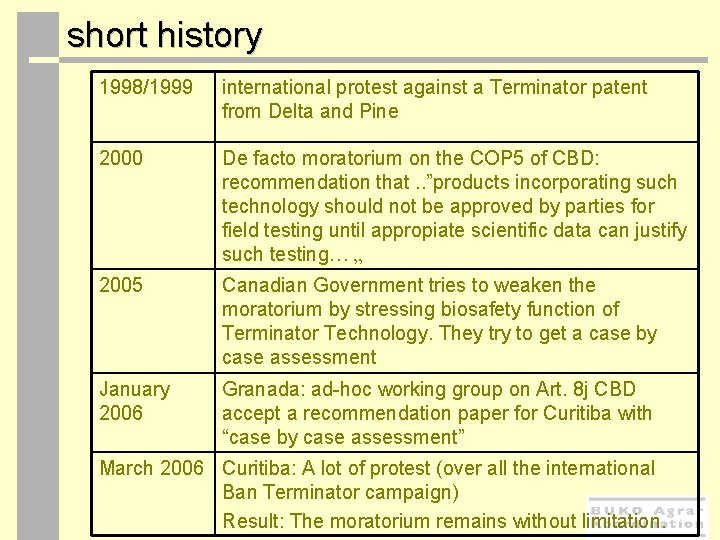
short history 1998/1999 international protest against a Terminator patent from Delta and Pine 2000 De facto moratorium on the COP 5 of CBD: recommendation that. . ”products incorporating such technology should not be approved by parties for field testing until appropiate scientific data can justify such testing… „ 2005 Canadian Government tries to weaken the moratorium by stressing biosafety function of Terminator Technology. They try to get a case by case assessment January 2006 Granada: ad-hoc working group on Art. 8 j CBD accept a recommendation paper for Curitiba with “case by case assessment” March 2006 Curitiba: A lot of protest (over all the international Ban Terminator campaign) Result: The moratorium remains without limitation.
german ban-terminator activities u u u www. freie-saat. de (in german) Initiated in october 2005 by the BUKO Agrar Koordination Activities: u position paper with 35 signing organizations u Press conference u Public work: Articles in german newspaper, TV u Participation in Granada demonstration u Handover from 2359 signatures to the German Parliament u Action in front of Canadian Embassy u Lettres to EU members of parliament u Meeting with the Federal Office of Consumer Protection and Food Safety (BVL), institution for GMO authorization because of “Transcontainer-project”
signing organizations (1) „Kein Patent auf Leben!“ u u u u Aktion 3. Welt Saar Arbeitsgemeinschaft bäuerliche Landwirtschaft (Ab. L. ) Arbeitsgemeinschaft der Umweltbeauftragten in der Ev. Kirche in Deutschland (AGU) ATTAC Ausschuss für den Dienst auf dem Lande in der EKD Bioland Bonner AK gegen Gentechnologie Brot für die Welt BUKO Agrar Koordination BUKO-Kampagne gegen Biopiraterie Bund für Umwelt und Naturschutz Deutschland (BUND) Bund Ökologischer Lebensmittelwirtschaft (BÖLW) Bundesarbeitsgemeinschaft Evangelische Jugend im ländlichen Raum (BAG ejl)
signing organizations (2) u u u u u Bündnis für die gentechnikfreie Landwirtschaft in Niedersachsen, Bremen und Hamburg Bürgerinitiative gentechnikfreies Schleswig-Holstein Coordination gegen Bayer-Gefahren Demeter Dreschflegel e. V. Evangelischer Entwicklungsdienst (EED) Evangelisches Bildungszentrum Hesselberg Gen-ethisches Netzwerk Gentechnikfreie Regionen in Deutschland Germanwatch NABU Naturland Ökologischer Ärztebund Ökomarkt PAN Germany (Pestizid Aktionsnetzwerk) Share e. V. Umweltinstitut München Verein zur Erhaltung der Nutzpflanzenvielfalt (VEN) Zukunftsstiftung Landwirtschaft
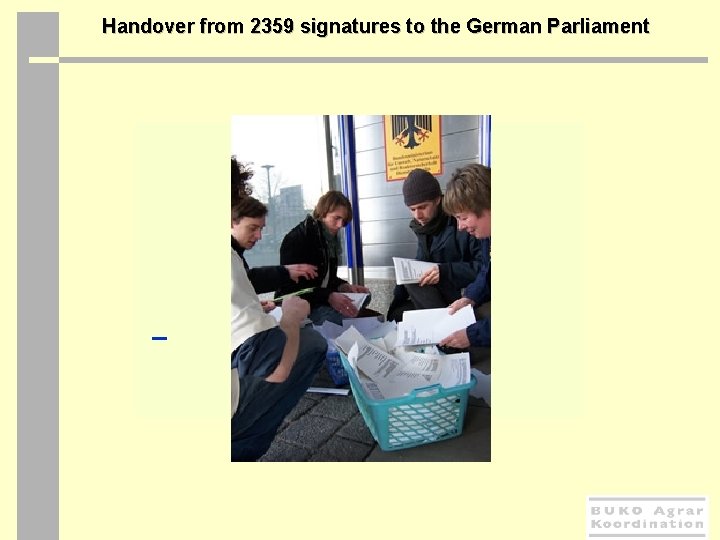
Handover from 2359 signatures to the German Parliament
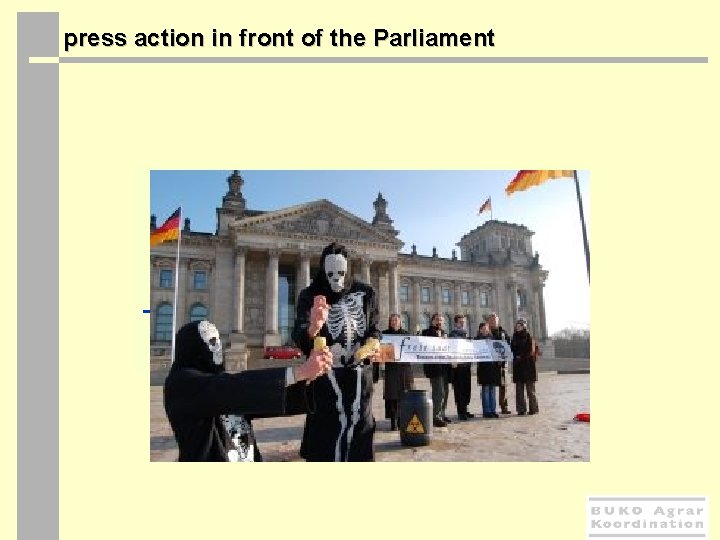
press action in front of the Parliament
Other ban-terminator campaigns u u u Ban terminator campaign: www. banterminator. org Spain : Ecologistas en Accion United Kingdom Canada Australia
Result of all campaigns u u The CBD moratorium remained in the COP 8 CBD in Curitiba Two problems: u Not legally binding u Call for new scientific research on Terminator Technology in decision V/5 Nr. 23 and 25.
„transcontainer“- project u u u a EU-wide official project executed by 8 European Member States Over all: scientific institutions and universities and two private companies: Swe. Tree Technologies AB in Sweden (researching with trees) and the DLF-Trifolium A/S in Denmark Destination crops: Canola, sugar beet, trees, aubergine and tomato Aim: To enhance the acceptance of GMO. Glasshouse-testing in Sweden an Denmark Transcontainer-workshop 2008 in Eastern Europe
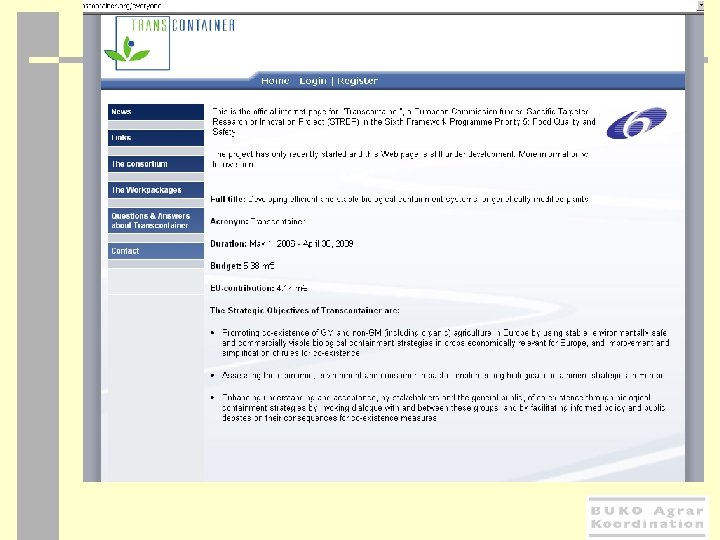
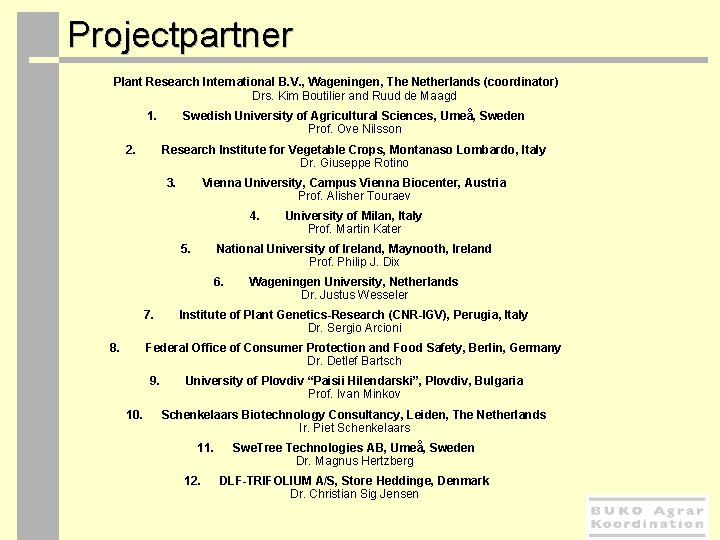
Projectpartner Plant Research International B. V. , Wageningen, The Netherlands (coordinator) Drs. Kim Boutilier and Ruud de Maagd 1. 2. Swedish University of Agricultural Sciences, Umeå, Sweden Prof. Ove Nilsson Research Institute for Vegetable Crops, Montanaso Lombardo, Italy Dr. Giuseppe Rotino 3. Vienna University, Campus Vienna Biocenter, Austria Prof. Alisher Touraev 4. 5. National University of Ireland, Maynooth, Ireland Prof. Philip J. Dix 6. 7. 8. University of Milan, Italy Prof. Martin Kater Wageningen University, Netherlands Dr. Justus Wesseler Institute of Plant Genetics-Research (CNR-IGV), Perugia, Italy Dr. Sergio Arcioni Federal Office of Consumer Protection and Food Safety, Berlin, Germany Dr. Detlef Bartsch 9. 10. University of Plovdiv “Paisii Hilendarski”, Plovdiv, Bulgaria Prof. Ivan Minkov Schenkelaars Biotechnology Consultancy, Leiden, The Netherlands Ir. Piet Schenkelaars 11. 12. Swe. Tree Technologies AB, Umeå, Sweden Dr. Magnus Hertzberg DLF-TRIFOLIUM A/S, Store Heddinge, Denmark Dr. Christian Sig Jensen
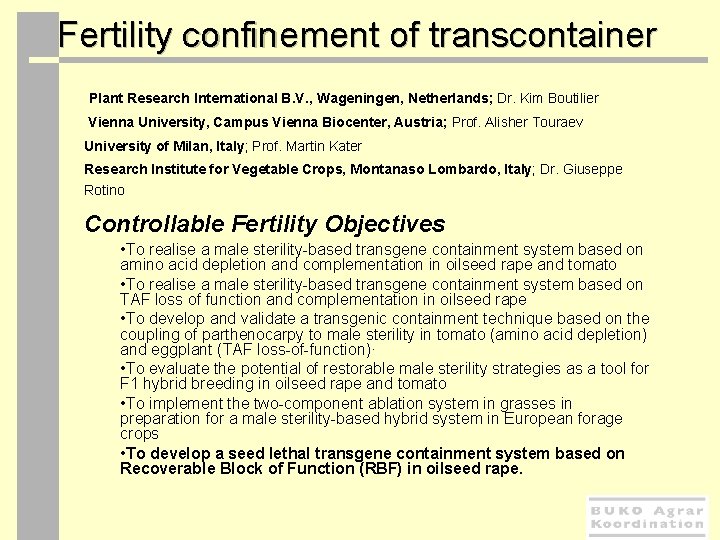
Fertility confinement of transcontainer Plant Research International B. V. , Wageningen, Netherlands; Dr. Kim Boutilier Vienna University, Campus Vienna Biocenter, Austria; Prof. Alisher Touraev University of Milan, Italy; Prof. Martin Kater Research Institute for Vegetable Crops, Montanaso Lombardo, Italy; Dr. Giuseppe Rotino Controllable Fertility Objectives • To realise a male sterility-based transgene containment system based on amino acid depletion and complementation in oilseed rape and tomato • To realise a male sterility-based transgene containment system based on TAF loss of function and complementation in oilseed rape • To develop and validate a transgenic containment technique based on the coupling of parthenocarpy to male sterility in tomato (amino acid depletion) and eggplant (TAF loss-of-function)· • To evaluate the potential of restorable male sterility strategies as a tool for F 1 hybrid breeding in oilseed rape and tomato • To implement the two-component ablation system in grasses in preparation for a male sterility-based hybrid system in European forage crops • To develop a seed lethal transgene containment system based on Recoverable Block of Function (RBF) in oilseed rape.
COP 9 and possible activities u u Untill now nothing on the Agenda; but new attack from Canada and Australia probable Possible activities: u u Take care on the Moratorium Maybe influence on the Moratorium excluding the call for scientific research Watch carefully the „transcontainer“project; side-event on COP 9. . .
- Slides: 20