
Termination of Translation Termination occurs when a stop
- Slides: 10
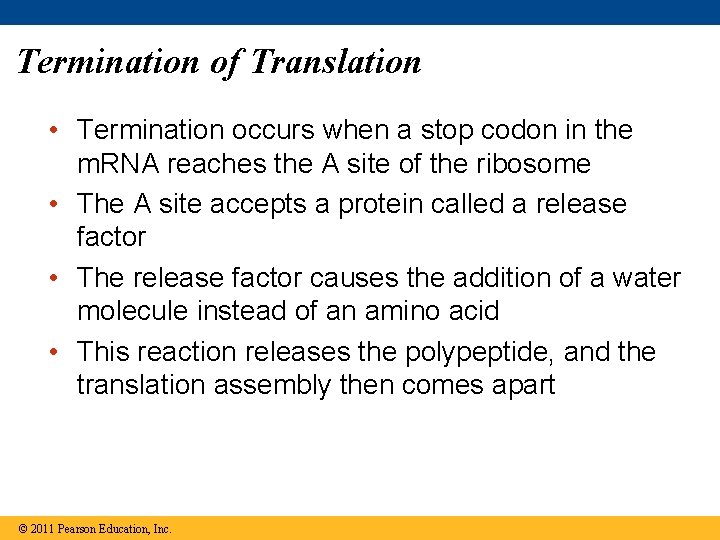
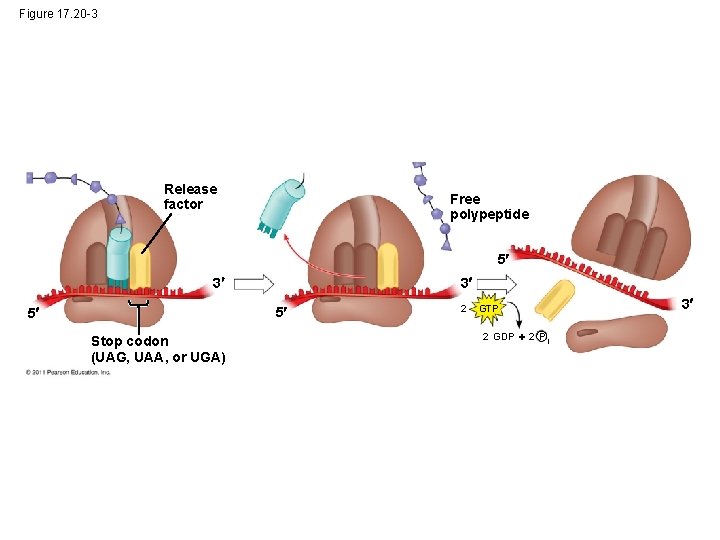
Termination of Translation • Termination occurs when a stop codon in the m. RNA reaches the A site of the ribosome • The A site accepts a protein called a release factor • The release factor causes the addition of a water molecule instead of an amino acid • This reaction releases the polypeptide, and the translation assembly then comes apart © 2011 Pearson Education, Inc.
Figure 17. 20 -3 Release factor Free polypeptide 5 3 3 5 5 Stop codon (UAG, UAA, or UGA) 2 GTP 2 GDP 2 P i 3
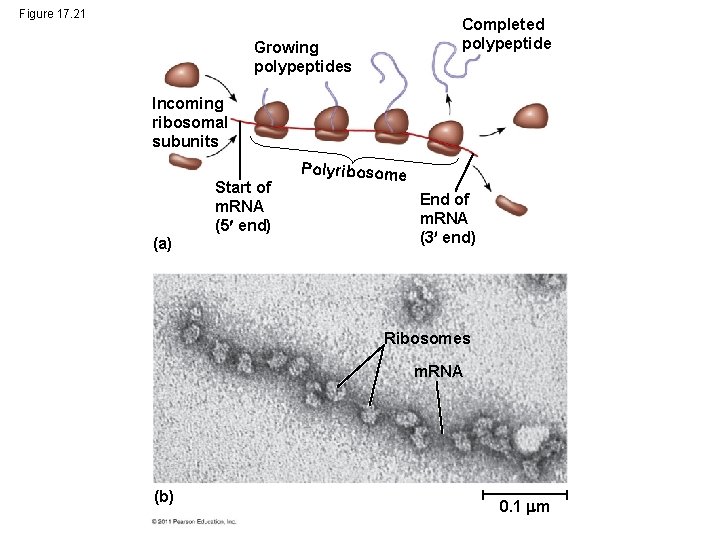
Polyribosomes • A number of ribosomes can translate a single m. RNA simultaneously, forming a polyribosome (or polysome) • Polyribosomes enable a cell to make many copies of a polypeptide very quickly © 2011 Pearson Education, Inc.
Figure 17. 21 Completed polypeptide Growing polypeptides Incoming ribosomal subunits (a) Start of m. RNA (5 end) Polyribosome End of m. RNA (3 end) Ribosomes m. RNA (b) 0. 1 m
Completing and Targeting the Functional Protein • Often translation is not sufficient to make a functional protein • Polypeptide chains are modified after translation or targeted to specific sites in the cell © 2011 Pearson Education, Inc.
Protein Folding and Post-Translational Modifications • During and after synthesis, a polypeptide chain spontaneously coils and folds into its threedimensional shape • Proteins may also require post-translational modifications before doing their job • Some polypeptides are activated by enzymes that cleave them • Other polypeptides come together to form the subunits of a protein © 2011 Pearson Education, Inc.
Targeting Polypeptides to Specific Locations • Two populations of ribosomes are evident in cells: free ribsomes (in the cytosol) and bound ribosomes (attached to the ER) • Free ribosomes mostly synthesize proteins that function in the cytosol • Bound ribosomes make proteins of the endomembrane system and proteins that are secreted from the cell • Ribosomes are identical and can switch from free to bound © 2011 Pearson Education, Inc.
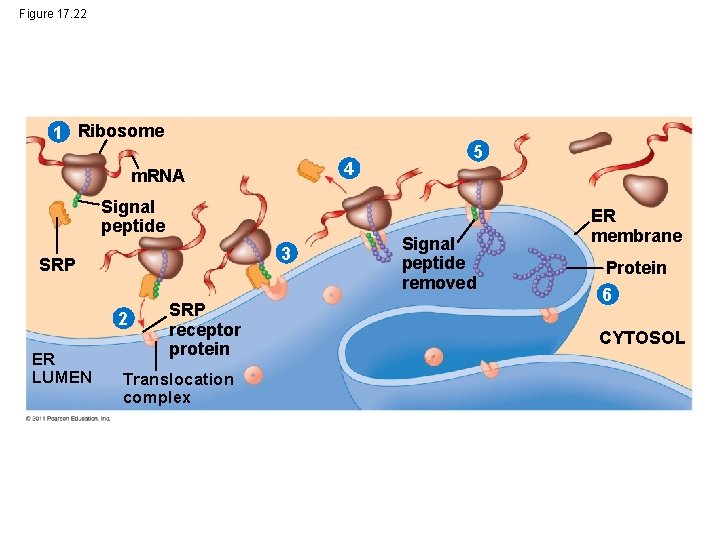
• Polypeptide synthesis always begins in the cytosol • Synthesis finishes in the cytosol unless the polypeptide signals the ribosome to attach to the ER • Polypeptides destined for the ER or for secretion are marked by a signal peptide © 2011 Pearson Education, Inc.
• A signal-recognition particle (SRP) binds to the signal peptide • The SRP brings the signal peptide and its ribosome to the ER © 2011 Pearson Education, Inc.
Figure 17. 22 1 Ribosome 4 m. RNA Signal peptide 3 SRP 2 ER LUMEN SRP receptor protein Translocation complex 5 Signal peptide removed ER membrane Protein 6 CYTOSOL