
Termination Analysis Math Foundations of Computer Science Topics
![General Induction Scheme To prove the following ic [ic Casei] For all ci’s that](https://slidetodoc.com/presentation_image_h/23d389ec2ae9f10e8eade63637140f8f/image-16.jpg "General Induction Scheme To prove the following ic [ic Casei] For all ci’s that")
![Boolean Expressions BExpr : = Constant: T|F [t | nil] Variable [symbol] Negation: BExpr](https://slidetodoc.com/presentation_image_h/23d389ec2ae9f10e8eade63637140f8f/image-23.jpg "Boolean Expressions BExpr : = Constant: T|F [t | nil] Variable [symbol] Negation: BExpr")
- Slides: 27
Termination Analysis Math Foundations of Computer Science
Topics Definitional principle Soundness and termination Proving termination and measure functions Well ordering and natural numbers Induction and termination Recursively defined data structures Undecidability of termination
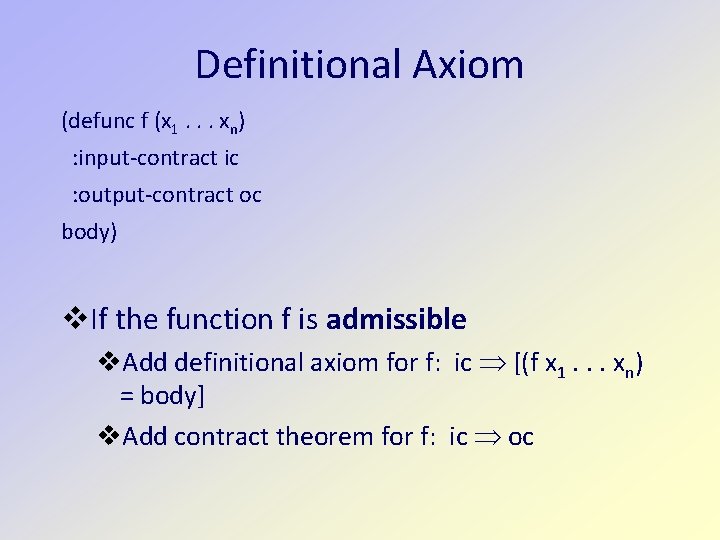
Definitional Axiom (defunc f (x 1. . . xn) : input-contract ic : output-contract oc body) If the function f is admissible Add definitional axiom for f: ic [(f x 1. . . xn) = body] Add contract theorem for f: ic oc
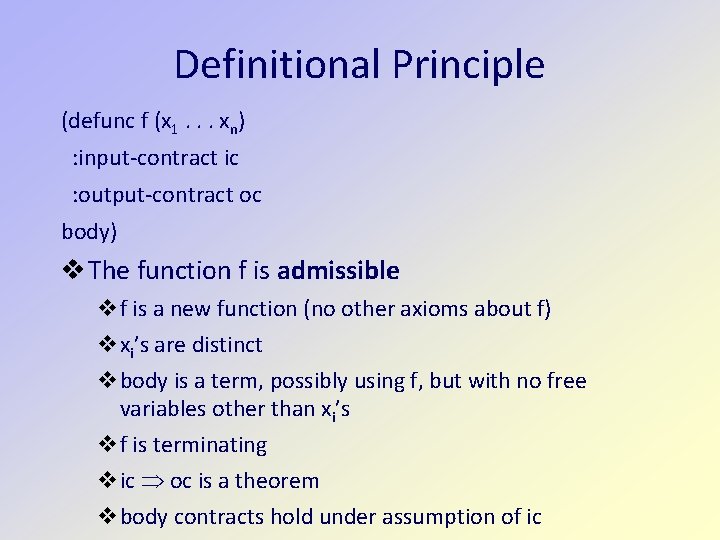
Definitional Principle (defunc f (x 1. . . xn) : input-contract ic : output-contract oc body) The function f is admissible f is a new function (no other axioms about f) xi’s are distinct body is a term, possibly using f, but with no free variables other than xi’s f is terminating ic oc is a theorem body contracts hold under assumption of ic
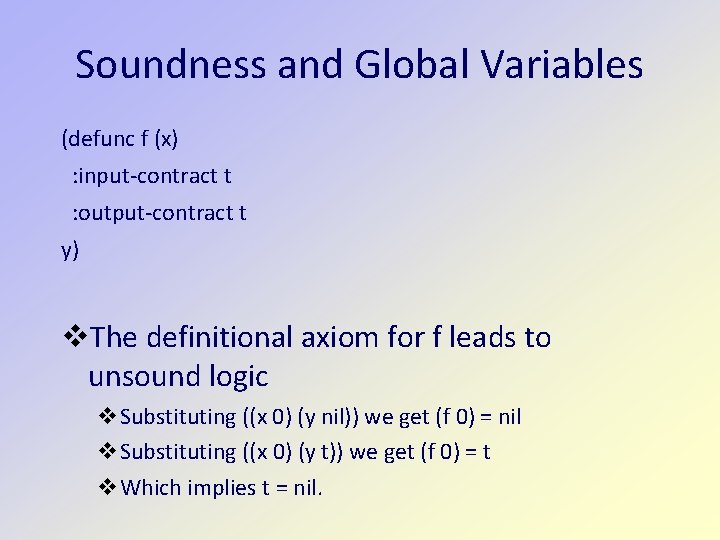
Soundness and Global Variables (defunc f (x) : input-contract t : output-contract t y) The definitional axiom for f leads to unsound logic Substituting ((x 0) (y nil)) we get (f 0) = nil Substituting ((x 0) (y t)) we get (f 0) = t Which implies t = nil.
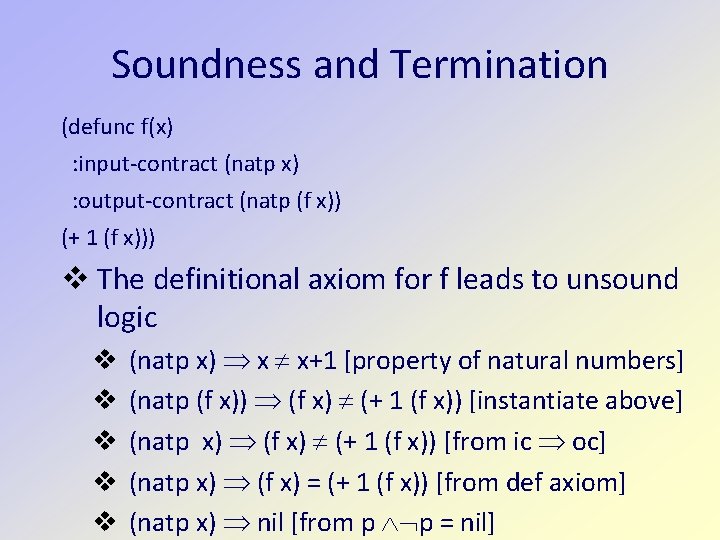
Soundness and Termination (defunc f(x) : input-contract (natp x) : output-contract (natp (f x)) (+ 1 (f x))) The definitional axiom for f leads to unsound logic (natp x) x x+1 [property of natural numbers] (natp (f x)) (f x) (+ 1 (f x)) [instantiate above] (natp x) (f x) (+ 1 (f x)) [from ic oc] (natp x) (f x) = (+ 1 (f x)) [from def axiom] (natp x) nil [from p p = nil]
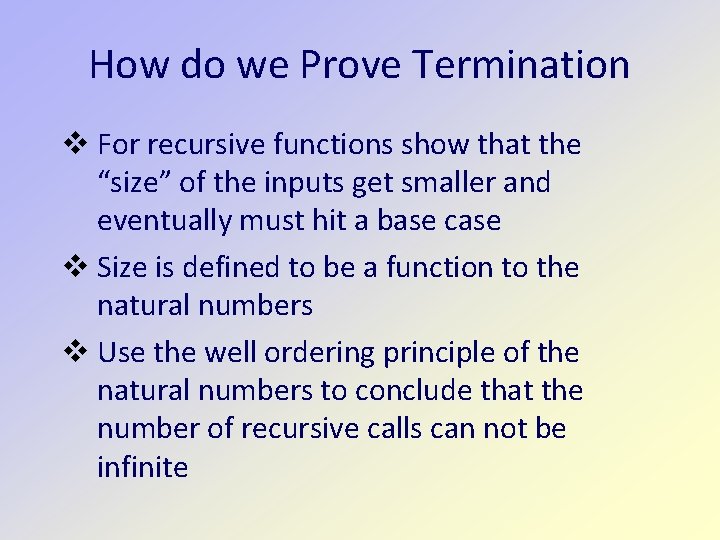
How do we Prove Termination For recursive functions show that the “size” of the inputs get smaller and eventually must hit a base case Size is defined to be a function to the natural numbers Use the well ordering principle of the natural numbers to conclude that the number of recursive calls can not be infinite
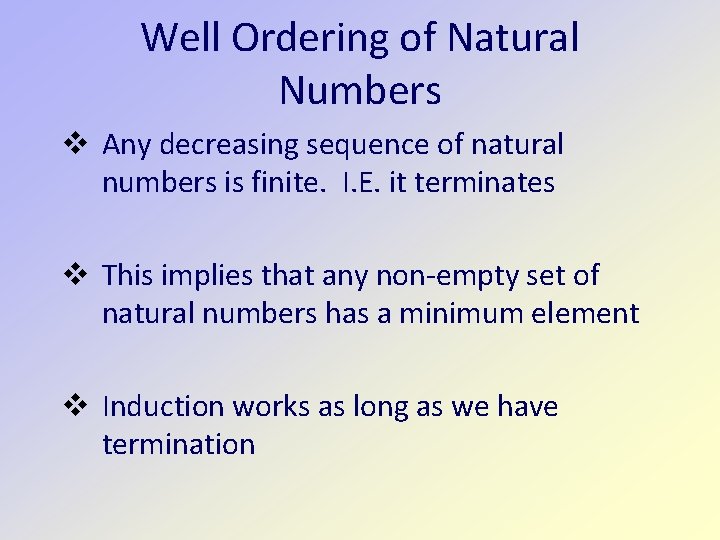
Well Ordering of Natural Numbers Any decreasing sequence of natural numbers is finite. I. E. it terminates This implies that any non-empty set of natural numbers has a minimum element Induction works as long as we have termination
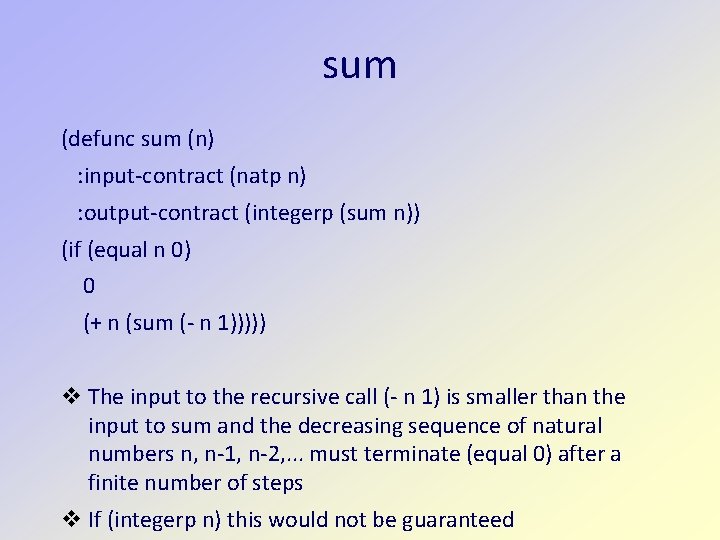
sum (defunc sum (n) : input-contract (natp n) : output-contract (integerp (sum n)) (if (equal n 0) 0 (+ n (sum (- n 1))))) The input to the recursive call (- n 1) is smaller than the input to sum and the decreasing sequence of natural numbers n, n-1, n-2, . . . must terminate (equal 0) after a finite number of steps If (integerp n) this would not be guaranteed
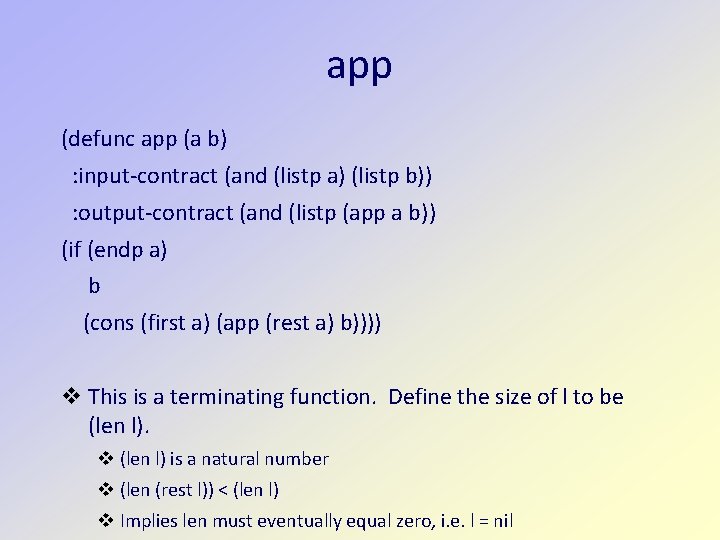
app (defunc app (a b) : input-contract (and (listp a) (listp b)) : output-contract (and (listp (app a b)) (if (endp a) b (cons (first a) (app (rest a) b)))) This is a terminating function. Define the size of l to be (len l) is a natural number (len (rest l)) < (len l) Implies len must eventually equal zero, i. e. l = nil
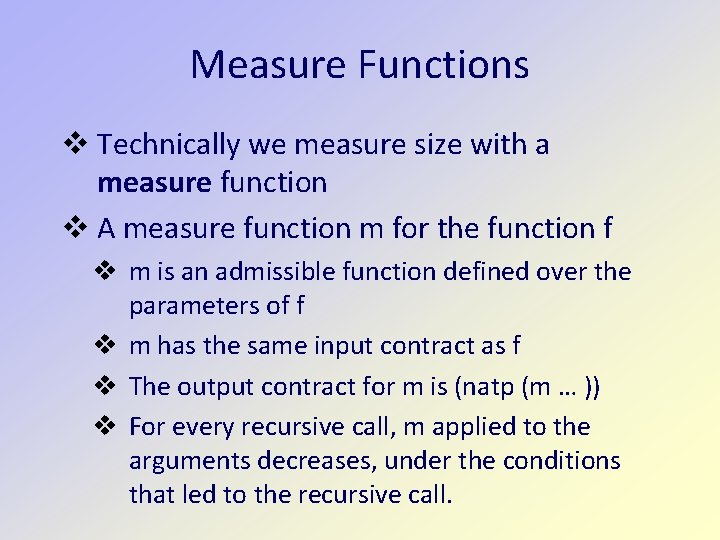
Measure Functions Technically we measure size with a measure function A measure function m for the function f m is an admissible function defined over the parameters of f m has the same input contract as f The output contract for m is (natp (m … )) For every recursive call, m applied to the arguments decreases, under the conditions that led to the recursive call.
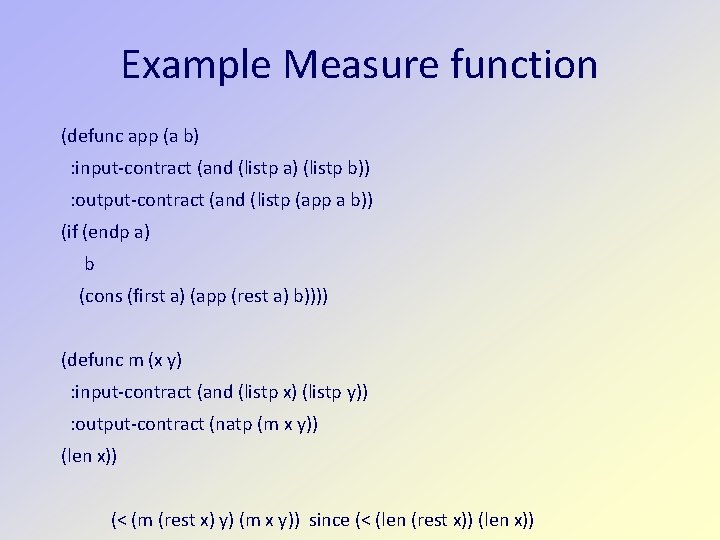
Example Measure function (defunc app (a b) : input-contract (and (listp a) (listp b)) : output-contract (and (listp (app a b)) (if (endp a) b (cons (first a) (app (rest a) b)))) (defunc m (x y) : input-contract (and (listp x) (listp y)) : output-contract (natp (m x y)) (len x)) (< (m (rest x) y) (m x y)) since (< (len (rest x)) (len x))
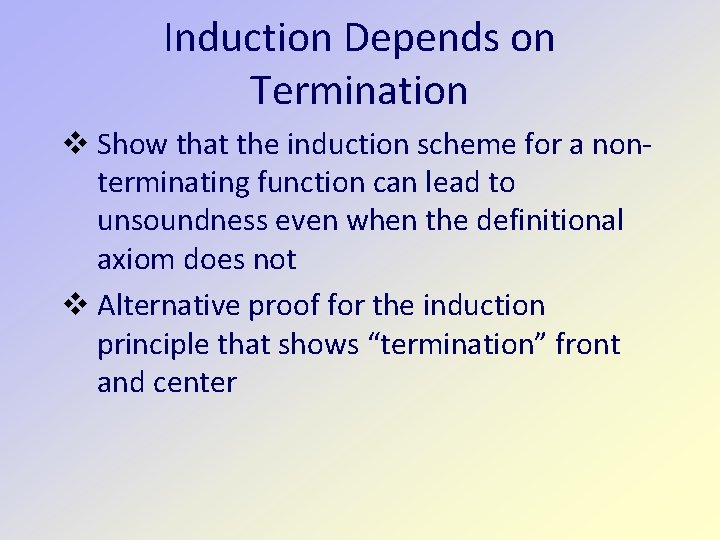
Induction Depends on Termination Show that the induction scheme for a nonterminating function can lead to unsoundness even when the definitional axiom does not Alternative proof for the induction principle that shows “termination” front and center
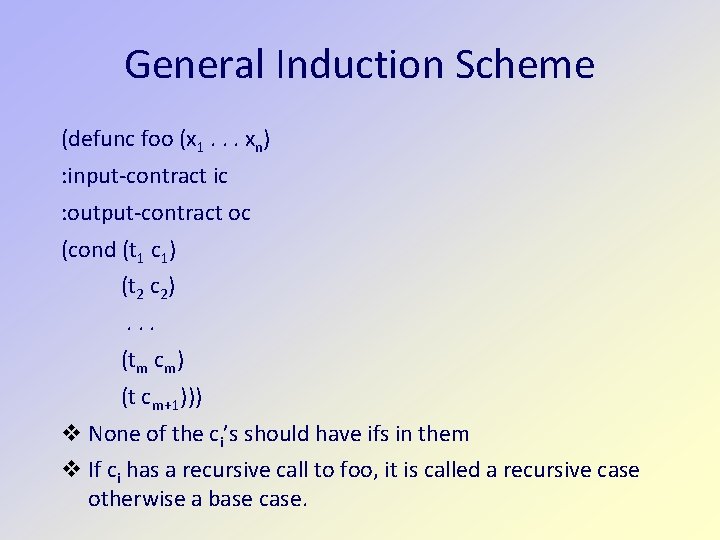
General Induction Scheme (defunc foo (x 1. . . xn) : input-contract ic : output-contract oc (cond (t 1 c 1) (t 2 c 2). . . (tm cm) (t cm+1))) None of the ci’s should have ifs in them If ci has a recursive call to foo, it is called a recursive case otherwise a base case.
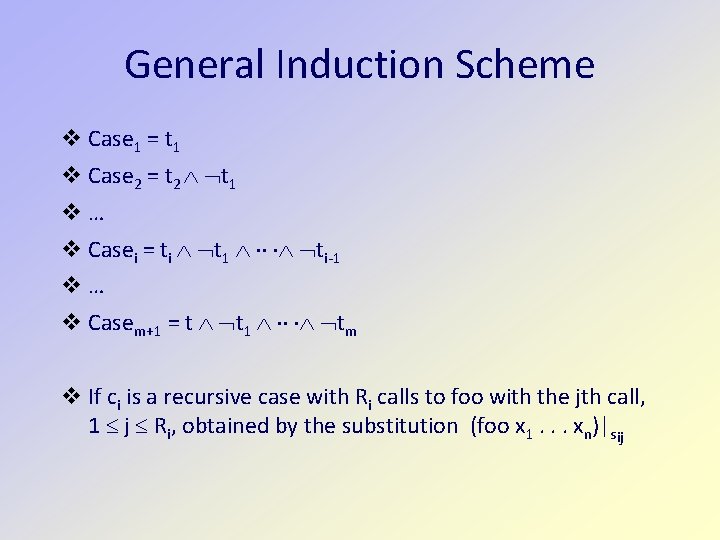
General Induction Scheme Case 1 = t 1 Case 2 = t 2 t 1 … Casei = ti t 1 ti-1 … Casem+1 = t t 1 tm If ci is a recursive case with Ri calls to foo with the jth call, 1 j Ri, obtained by the substitution (foo x 1. . . xn)|sij
General Induction Scheme To prove the following ic [ic Casei] For all ci’s that are base cases [ic Casei 1 i Ri |sij] For all ci’s that are recursive cases
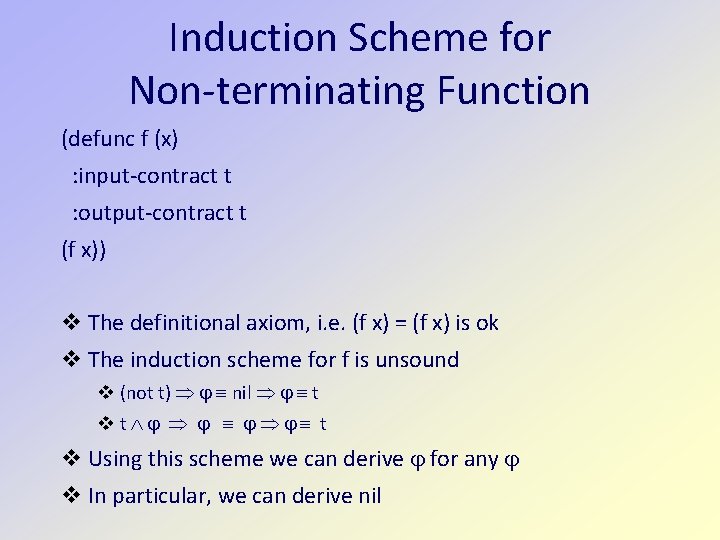
Induction Scheme for Non-terminating Function (defunc f (x) : input-contract t : output-contract t (f x)) The definitional axiom, i. e. (f x) = (f x) is ok The induction scheme for f is unsound (not t) nil t t Using this scheme we can derive for any In particular, we can derive nil
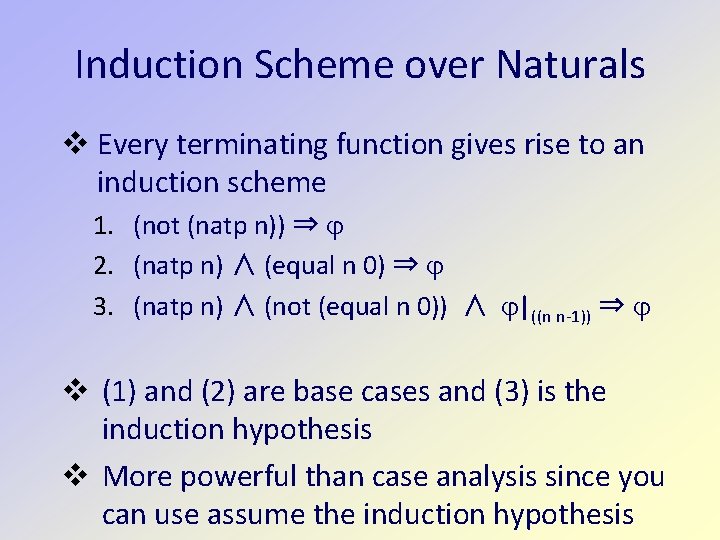
Induction Scheme over Naturals Every terminating function gives rise to an induction scheme 1. (not (natp n)) ⇒ 2. (natp n) ∧ (equal n 0) ⇒ 3. (natp n) ∧ (not (equal n 0)) ∧ |((n n-1)) ⇒ (1) and (2) are base cases and (3) is the induction hypothesis More powerful than case analysis since you can use assume the induction hypothesis
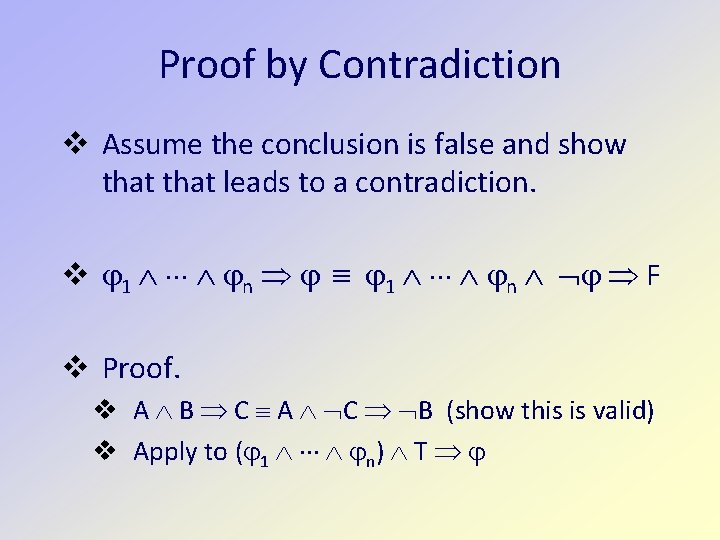
Proof by Contradiction Assume the conclusion is false and show that leads to a contradiction. 1 n F Proof. A B C A C B (show this is valid) Apply to ( 1 n) T
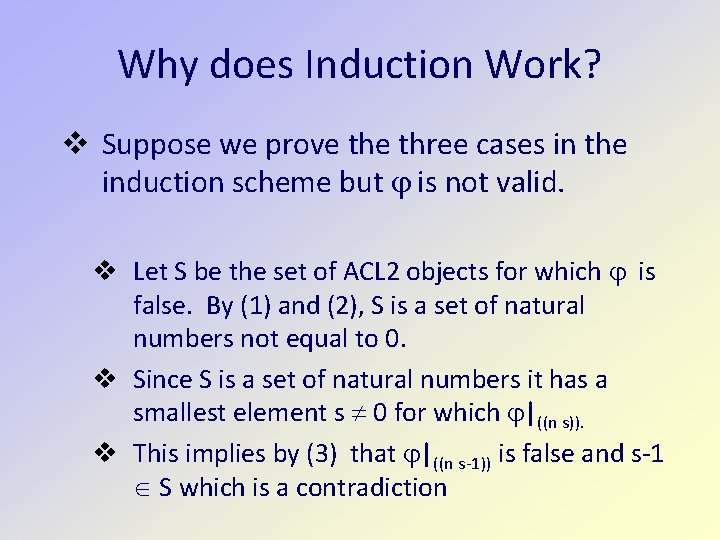
Why does Induction Work? Suppose we prove three cases in the induction scheme but is not valid. Let S be the set of ACL 2 objects for which is false. By (1) and (2), S is a set of natural numbers not equal to 0. Since S is a set of natural numbers it has a smallest element s 0 for which |((n s)). This implies by (3) that |((n s-1)) is false and s-1 S which is a contradiction
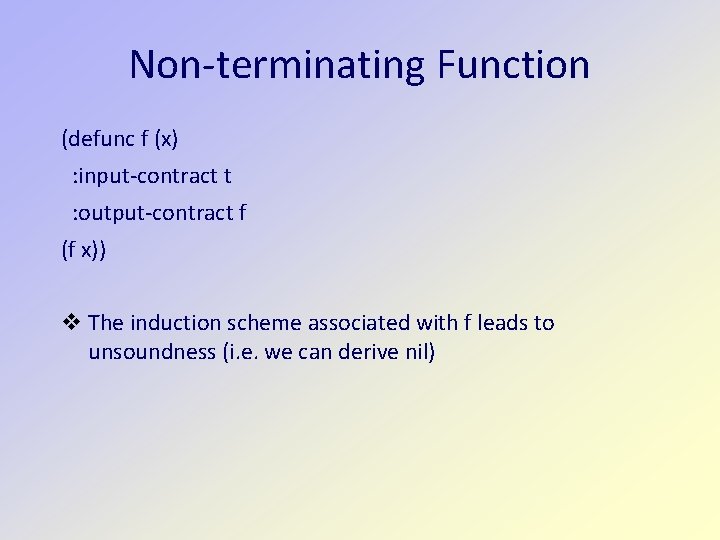
Non-terminating Function (defunc f (x) : input-contract t : output-contract f (f x)) The induction scheme associated with f leads to unsoundness (i. e. we can derive nil)
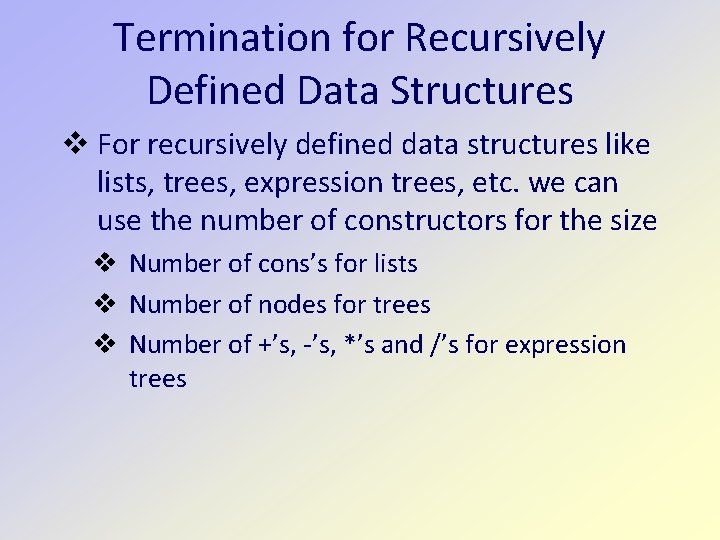
Termination for Recursively Defined Data Structures For recursively defined data structures like lists, trees, expression trees, etc. we can use the number of constructors for the size Number of cons’s for lists Number of nodes for trees Number of +’s, -’s, *’s and /’s for expression trees
Boolean Expressions BExpr : = Constant: T|F [t | nil] Variable [symbol] Negation: BExpr [(not BExpr)] And: BExpr [(and BExpr) Or: BExpr Bexpr [(or BExpr)] 23
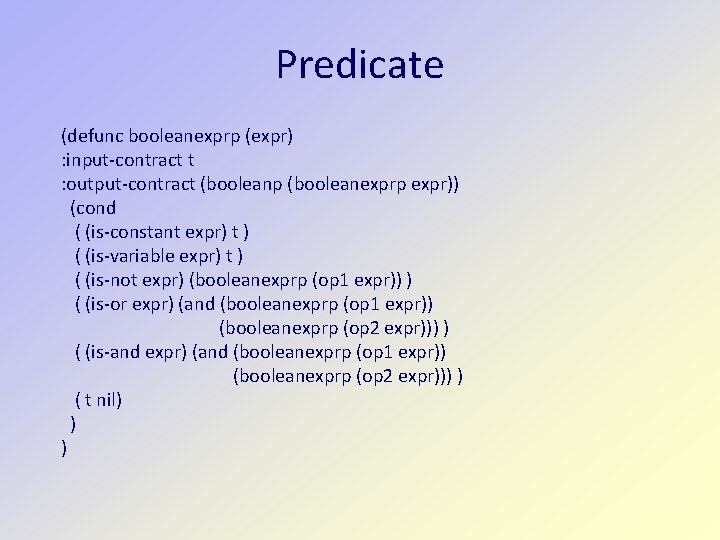
Predicate (defunc booleanexprp (expr) : input-contract t : output-contract (booleanp (booleanexprp expr)) (cond ( (is-constant expr) t ) ( (is-variable expr) t ) ( (is-not expr) (booleanexprp (op 1 expr)) ) ( (is-or expr) (and (booleanexprp (op 1 expr)) (booleanexprp (op 2 expr))) ) ( (is-and expr) (and (booleanexprp (op 1 expr)) (booleanexprp (op 2 expr))) ) ( t nil) ) )
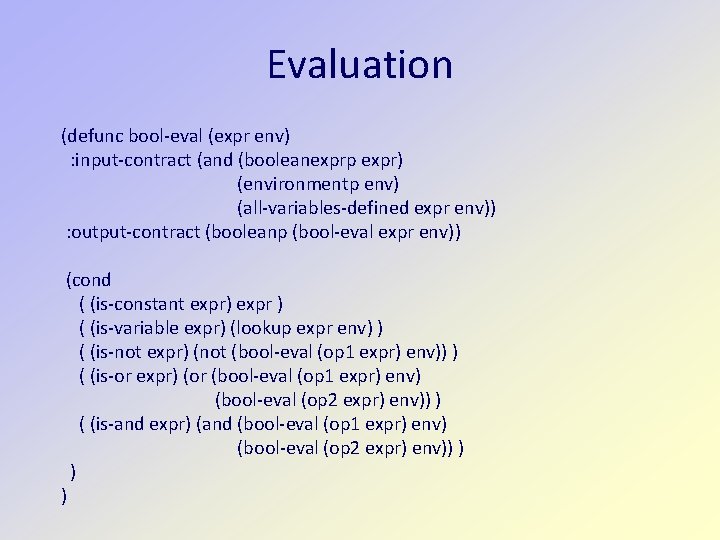
Evaluation (defunc bool-eval (expr env) : input-contract (and (booleanexprp expr) (environmentp env) (all-variables-defined expr env)) : output-contract (booleanp (bool-eval expr env)) (cond ( (is-constant expr) expr ) ( (is-variable expr) (lookup expr env) ) ( (is-not expr) (not (bool-eval (op 1 expr) env)) ) ( (is-or expr) (or (bool-eval (op 1 expr) env) (bool-eval (op 2 expr) env)) ) ( (is-and expr) (and (bool-eval (op 1 expr) env) (bool-eval (op 2 expr) env)) )
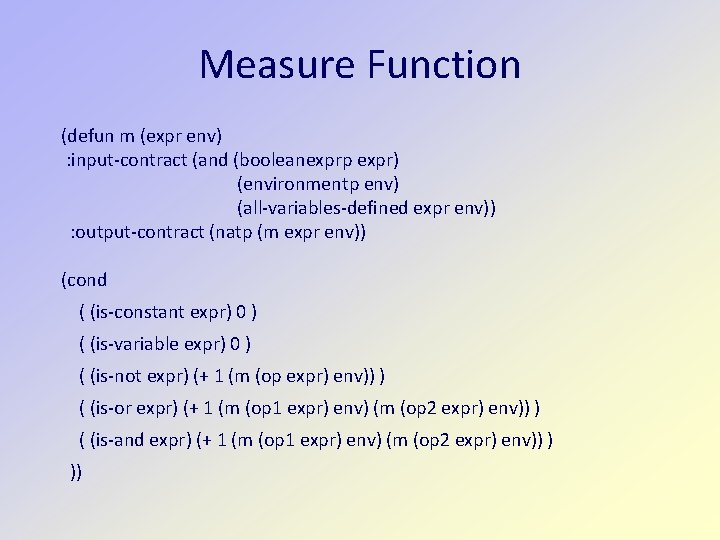
Measure Function (defun m (expr env) : input-contract (and (booleanexprp expr) (environmentp env) (all-variables-defined expr env)) : output-contract (natp (m expr env)) (cond ( (is-constant expr) 0 ) ( (is-variable expr) 0 ) ( (is-not expr) (+ 1 (m (op expr) env)) ) ( (is-or expr) (+ 1 (m (op 1 expr) env) (m (op 2 expr) env)) ) ( (is-and expr) (+ 1 (m (op 1 expr) env) (m (op 2 expr) env)) ) ))
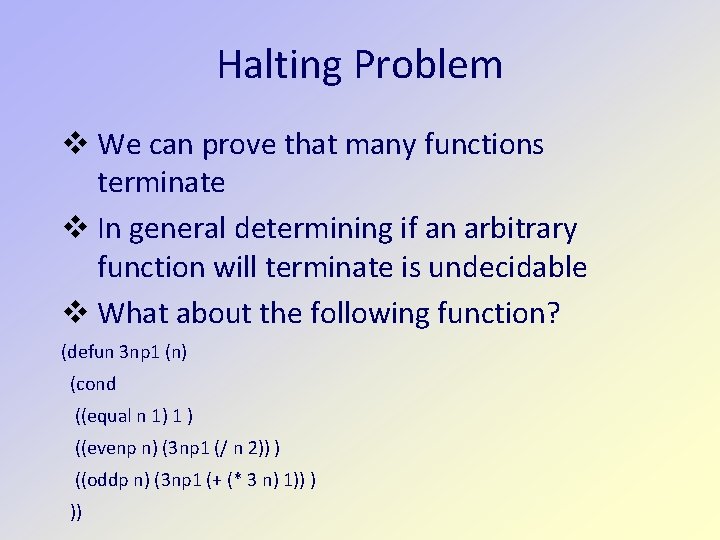
Halting Problem We can prove that many functions terminate In general determining if an arbitrary function will terminate is undecidable What about the following function? (defun 3 np 1 (n) (cond ((equal n 1) 1 ) ((evenp n) (3 np 1 (/ n 2)) ) ((oddp n) (3 np 1 (+ (* 3 n) 1)) ) ))