
Terminal bud Cabbage Evolution Chapter 22 Lateral buds
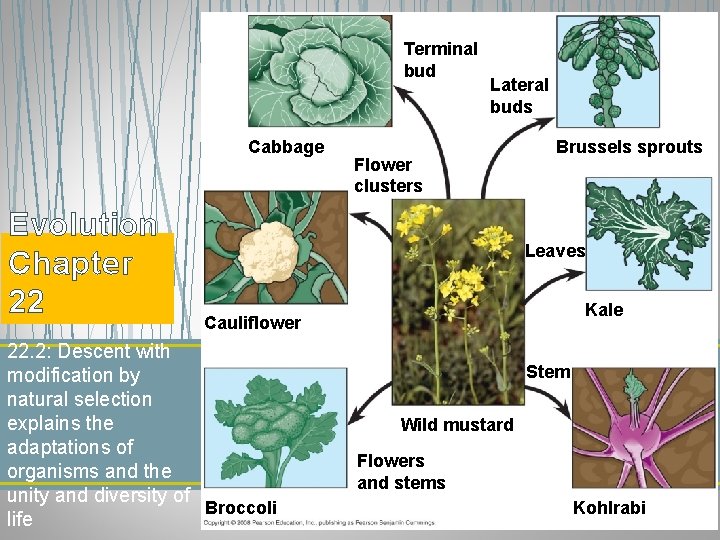
Terminal bud Cabbage Evolution Chapter 22 Lateral buds Flower clusters Brussels sprouts Leaves Kale Cauliflower 22. 2: Descent with modification by natural selection explains the adaptations of organisms and the unity and diversity of Broccoli life Stem Wild mustard Flowers and stems Kohlrabi
Overview: Endless Forms Most Beautiful • A new era of biology began in 1859 when Charles Darwin published The Origin of Species • The Origin of Species focused biologists’ attention on the great diversity of organisms Copyright © 2008 Pearson Education, Inc. , publishing as Pearson Benjamin Cummings

• Darwin noted that current species are descendants of ancestral species • Evolution can be defined by Darwin’s phrase descent with modification • Evolution can be viewed as both a pattern and a process Copyright © 2008 Pearson Education, Inc. , publishing as Pearson Benjamin Cummings

Fig. 22 -2 Linnaeus (classification) Hutton (gradual geologic change) Lamarck (species can change) Malthus (population limits) Cuvier (fossils, extinction) Lyell (modern geology) Darwin (evolution, natural selection) Wallace (evolution, natural selection) American Revolution French Revolution U. S. Civil War 1800 1900 1750 1850 1795 Hutton proposes his theory of gradualism. 1798 Malthus publishes “Essay on the Principle of Population. ” 1809 Lamarck publishes his hypothesis of evolution. 1830 Lyell publishes Principles of Geology. 1831– 1836 Darwin travels around the world on HMS Beagle. 1837 Darwin begins his notebooks. 1844 Darwin writes essay on descent with modification. 1858 Wallace sends his hypothesis to Darwin. 1859 The Origin of Species is published.
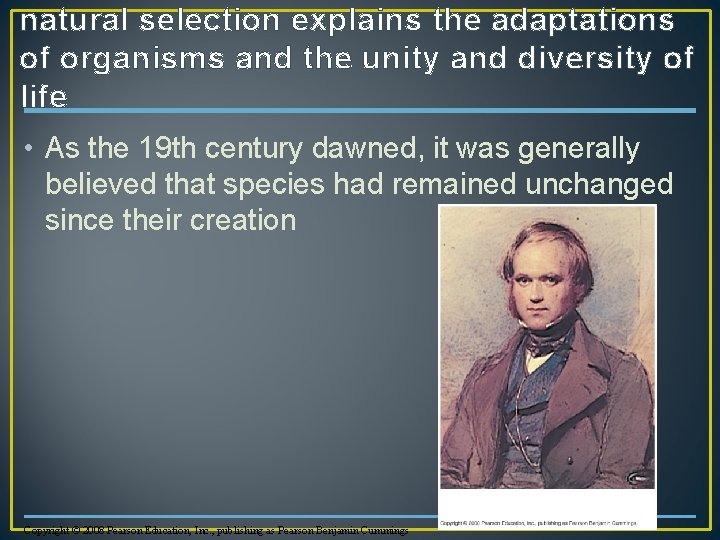
natural selection explains the adaptations of organisms and the unity and diversity of life • As the 19 th century dawned, it was generally believed that species had remained unchanged since their creation Copyright © 2008 Pearson Education, Inc. , publishing as Pearson Benjamin Cummings
The Voyage of the Beagle • During his travels on the Beagle, Darwin collected specimens of South American plants and animals • He observed adaptations of plants and animals that inhabited many diverse environments • Darwin was influenced by Lyell’s Principles of Geology and thought that the earth was more than 6000 years old Copyright © 2008 Pearson Education, Inc. , publishing as Pearson Benjamin Cummings
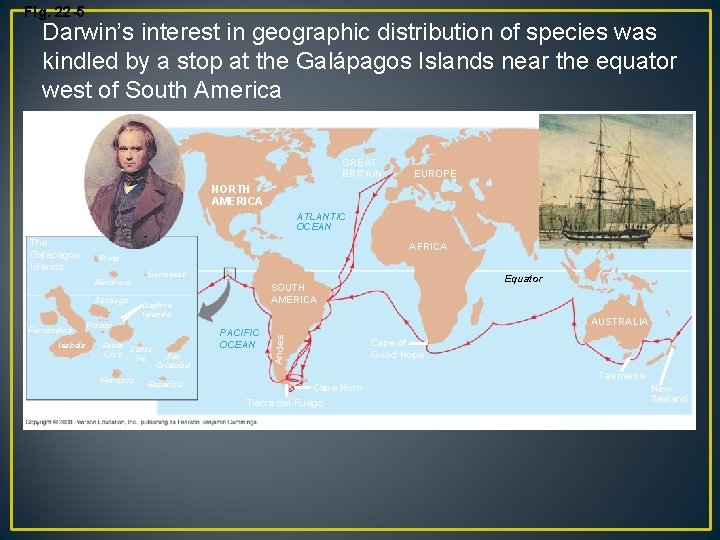
Fig. 22 -5 Darwin’s interest in geographic distribution of species was kindled by a stop at the Galápagos Islands near the equator west of South America GREAT BRITAIN EUROPE NORTH AMERICA ATLANTIC OCEAN AFRICA Pinta Marchena Santiago Fernandina Isabela Genovesa Daphne Islands Pinzón Santa Cruz Fe Florenza PACIFIC OCEAN San Cristobal Española Equator SOUTH AMERICA AUSTRALIA Andes The Galápagos Islands Cape of Good Hope Tasmania Cape Horn Tierra del Fuego New Zealand
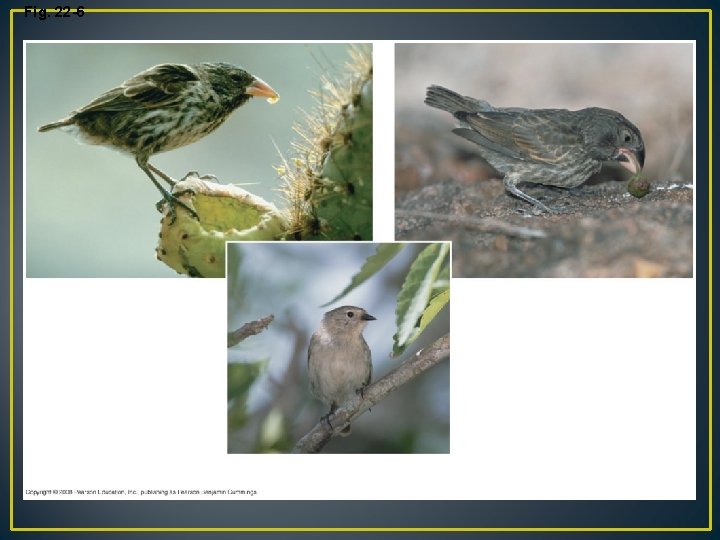
Fig. 22 -6 (a) Cactus-eater (c) Seed-eater In reassessing his observations, Darwin perceived adaptation to the environment and the origin of new species as closely related processes (b) Insect-eater
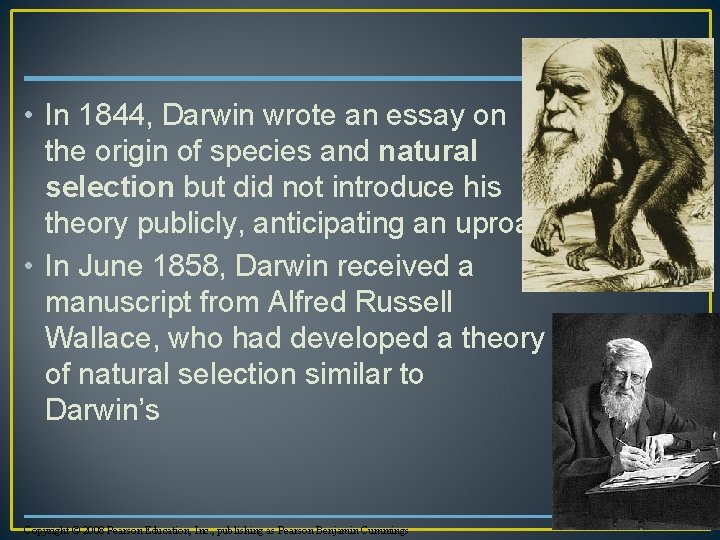
• In 1844, Darwin wrote an essay on the origin of species and natural selection but did not introduce his theory publicly, anticipating an uproar • In June 1858, Darwin received a manuscript from Alfred Russell Wallace, who had developed a theory of natural selection similar to Darwin’s Copyright © 2008 Pearson Education, Inc. , publishing as Pearson Benjamin Cummings
The Origin of Species • Darwin developed two main ideas: • Descent with modification explains life’s unity and diversity • Natural selection is a cause of adaptive evolution Copyright © 2008 Pearson Education, Inc. , publishing as Pearson Benjamin Cummings

Descent with Modification • Darwin never used the word evolution in the first edition of The Origin of Species • Instead he used the phrase “descent with modification”: all organisms are related through descent from an ancestor that lived in the remote past • In the Darwinian view, the history of life is like a tree with branches representing life’s diversity Copyright © 2008 Pearson Education, Inc. , publishing as Pearson Benjamin Cummings

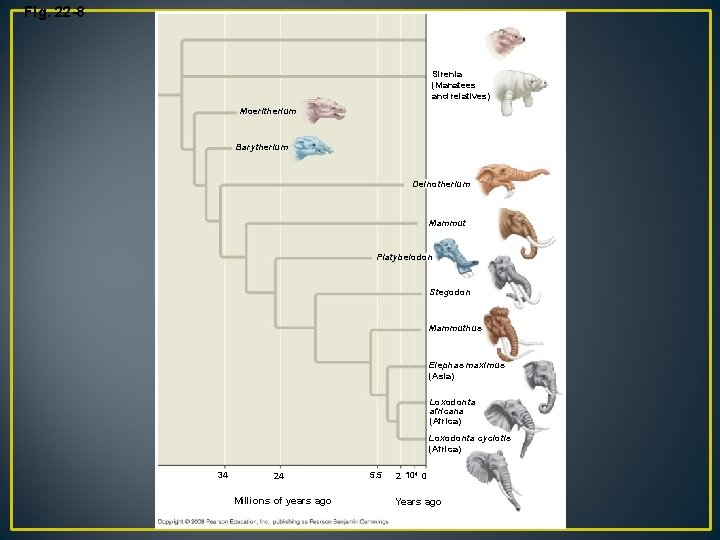
Fig. 22 -8 Hyracoidea (Hyraxes) Sirenia (Manatees and relatives) Moeritherium Barytherium Deinotherium Mammut Platybelodon Stegodon Mammuthus Elephas maximus (Asia) Loxodonta africana (Africa) Loxodonta cyclotis (Africa) 34 24 Millions of years ago 5. 5 2 104 0 Years ago
Artificial Selection, Natural Selection, and Adaptation • Darwin noted that humans have modified other species by selecting and breeding individuals with desired traits, a process called artificial selection • 4 Observations he made: 1. Members of a population often vary greatly in their traits 2. Traits are inherited from parents to offspring 3. All species are capable of producing more offspring than the environment can support 4. Owing to lack of food or other resources, many of these offspring do not survive Copyright © 2008 Pearson Education, Inc. , publishing as Pearson Benjamin Cummings
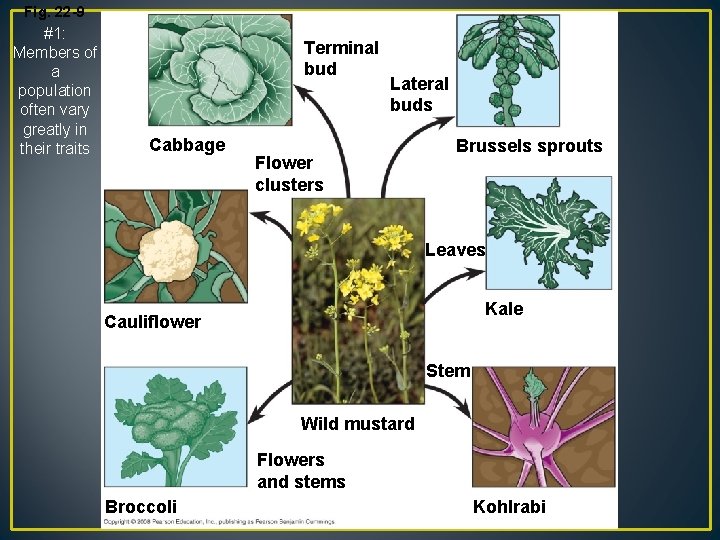
Fig. 22 -9 #1: Members of a population often vary greatly in their traits Terminal bud Cabbage Lateral buds Flower clusters Brussels sprouts Leaves Kale Cauliflower Stem Wild mustard Flowers and stems Broccoli Kohlrabi
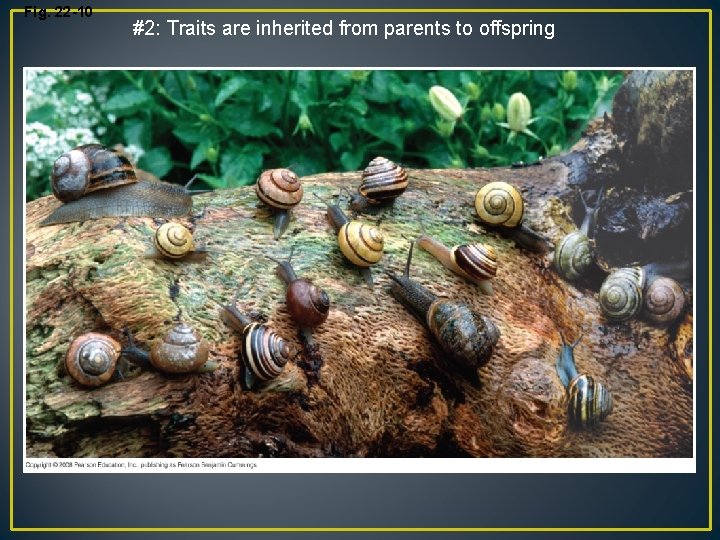
Fig. 22 -10 #2: Traits are inherited from parents to offspring
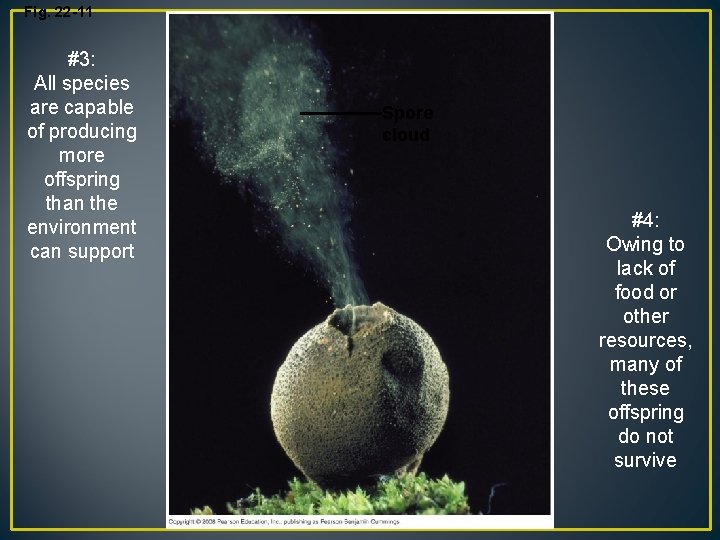
Fig. 22 -11 #3: All species are capable of producing more offspring than the environment can support Spore cloud #4: Owing to lack of food or other resources, many of these offspring do not survive
• Darwin made 2 inferences: • Individuals whose inherited traits give them a higher probability of surviving and reproducing in a given environment tend to leave more offspring than other individuals (differential reproductive success) • This unequal ability of individuals to survive and reproduce will lead to the accumulation of favorable traits in the population over generations Copyright © 2008 Pearson Education, Inc. , publishing as Pearson Benjamin Cummings
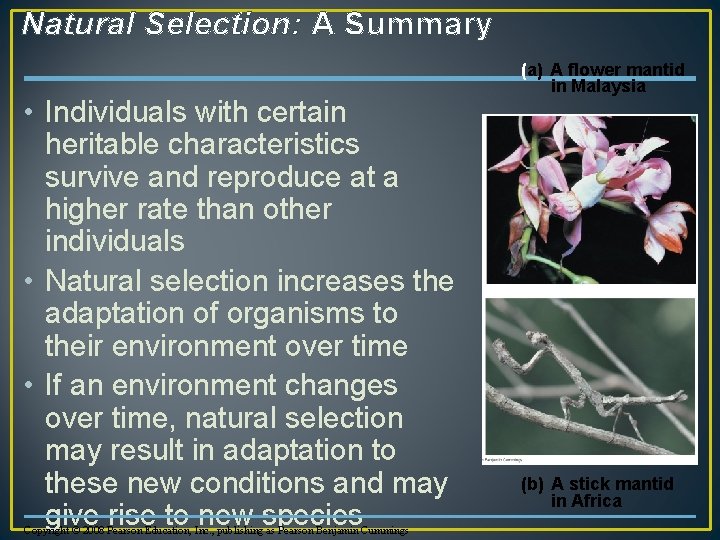
Natural Selection: A Summary • Individuals with certain heritable characteristics survive and reproduce at a higher rate than other individuals • Natural selection increases the adaptation of organisms to their environment over time • If an environment changes over time, natural selection may result in adaptation to these new conditions and may give rise to new species Copyright © 2008 Pearson Education, Inc. , publishing as Pearson Benjamin Cummings (a) A flower mantid in Malaysia (b) A stick mantid in Africa
• Individuals do not evolve; populations evolve over time • Natural selection can only increase or decrease heritable traits in a population • Adaptations vary with different environments Copyright © 2008 Pearson Education, Inc. , publishing as Pearson Benjamin Cummings

Evolution Chapter 22 22. 3: Evolution is supported by an overwhelming amount of scientific evidence
Evidence for evolution: A. Direct Observations of Evolutionary Change B. Biogeography C. Vestigial Organs D. Comparative Embyology E. Homologies F. Comparative Biochemistry G. Molecular Biology Copyright © 2008 Pearson Education, Inc. , publishing as Pearson Benjamin Cummings
Predation and Coloration in Guppies : Scientific Inquiry • John Endler has studied the effects of predators on wild guppy populations • Brightly colored males are more attractive to females • However, brightly colored males are more vulnerable to predation Copyright © 2008 Pearson Education, Inc. , publishing as Pearson Benjamin Cummings
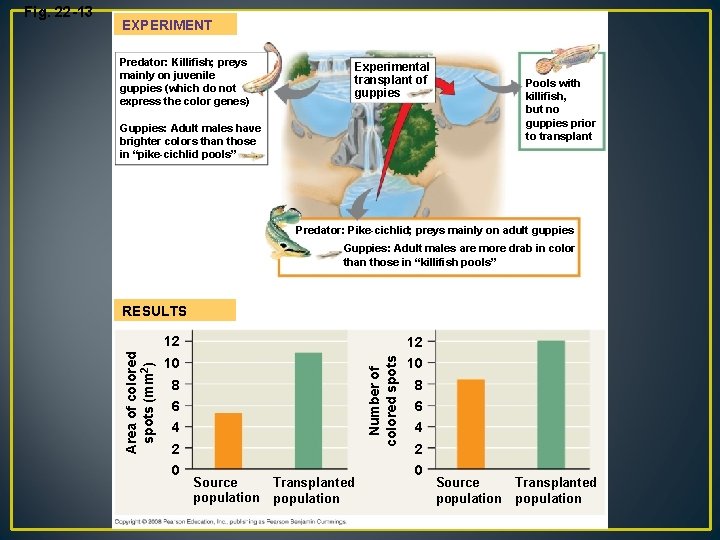
EXPERIMENT Predator: Killifish; preys mainly on juvenile guppies (which do not express the color genes) Experimental transplant of guppies Pools with killifish, but no guppies prior to transplant Guppies: Adult males have brighter colors than those in “pike-cichlid pools” Predator: Pike-cichlid; preys mainly on adult guppies Guppies: Adult males are more drab in color than those in “killifish pools” RESULTS 12 12 Number of colored spots Area of colored spots (mm 2) Fig. 22 -13 10 8 6 4 2 0 Source population Transplanted population
The Evolution of Drug-Resistant HIV • The use of drugs to combat HIV selects for viruses resistant to these drugs • HIV uses an enzyme to make a DNA version of its own RNA genome • The drug 3 TC is designed to interfere and cause errors in the manufacture of DNA from the virus • Some individual HIV viruses have a variation that allows them to produce DNA without errors • greater reproductive success • increase in number relative to the susceptible viruses • The population of HIV viruses has become resistance to 3 TC • Rapid evolution Copyright © 2008 Pearson Education, Inc. , publishing as Pearson Benjamin Cummings
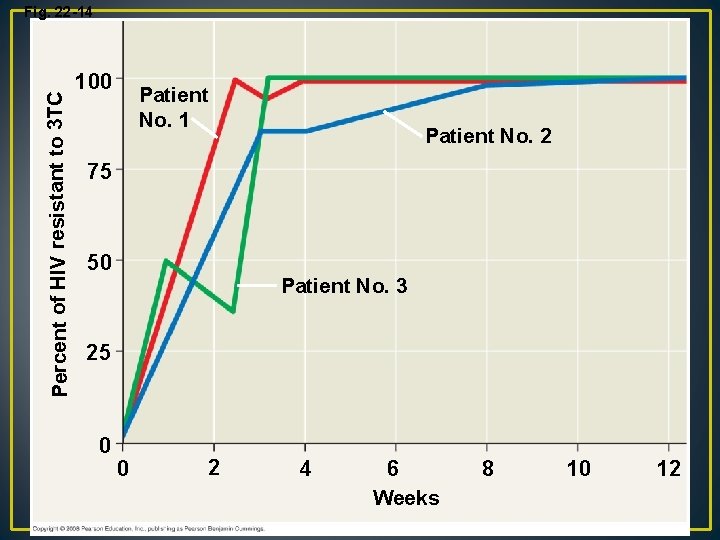
Percent of HIV resistant to 3 TC Fig. 22 -14 100 Patient No. 1 Patient No. 2 75 50 Patient No. 3 25 0 0 2 4 6 Weeks 8 10 12
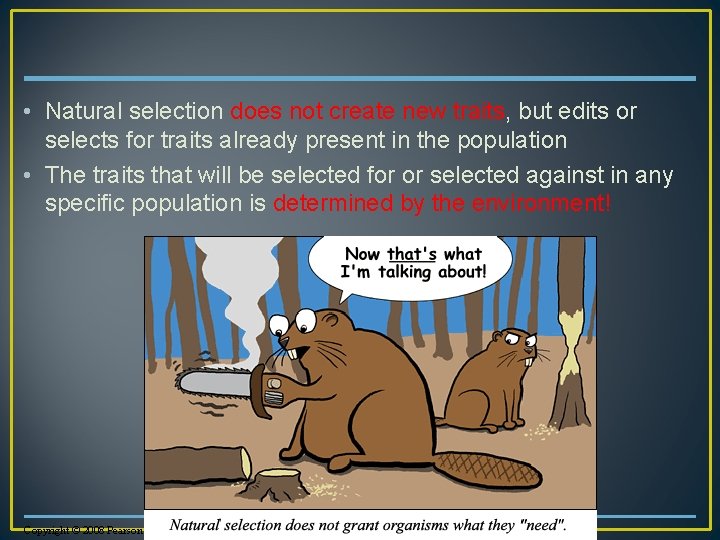
• Natural selection does not create new traits, but edits or selects for traits already present in the population • The traits that will be selected for or selected against in any specific population is determined by the environment! Copyright © 2008 Pearson Education, Inc. , publishing as Pearson Benjamin Cummings
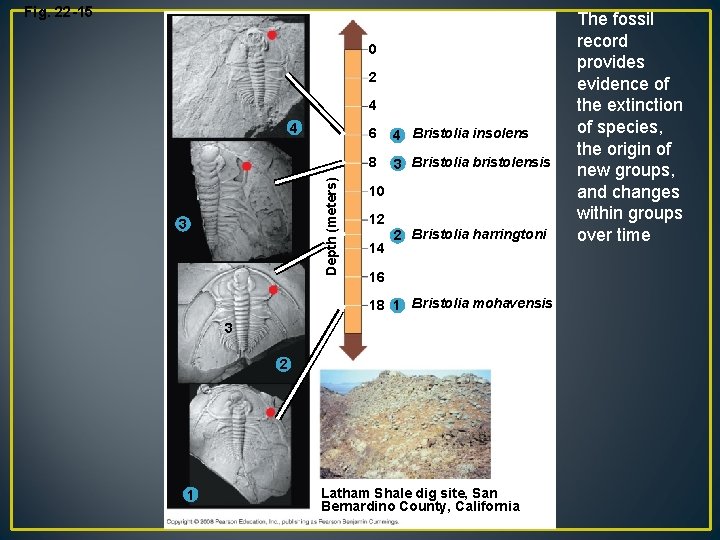
Fig. 22 -15 0 2 4 Depth (meters) 4 3 6 4 Bristolia insolens 8 3 Bristolia bristolensis 10 12 14 2 Bristolia harringtoni 16 18 1 Bristolia mohavensis 3 2 1 Latham Shale dig site, San Bernardino County, California The fossil record provides evidence of the extinction of species, the origin of new groups, and changes within groups over time
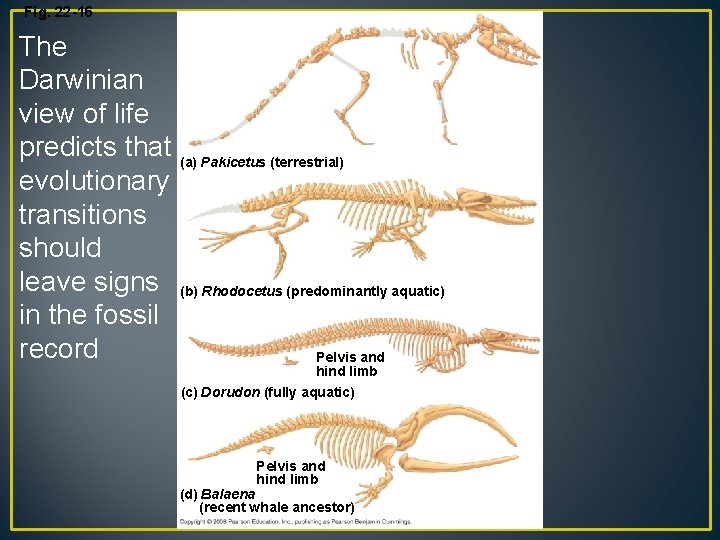
Fig. 22 -16 The Darwinian view of life predicts that (a) Pakicetus (terrestrial) evolutionary transitions should leave signs (b) Rhodocetus (predominantly aquatic) in the fossil record Pelvis and hind limb (c) Dorudon (fully aquatic) Pelvis and hind limb (d) Balaena (recent whale ancestor)
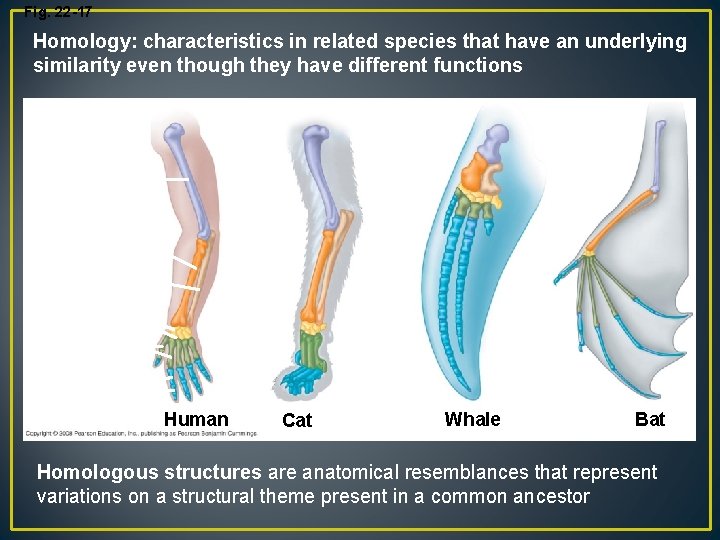
Fig. 22 -17 Homology: characteristics in related species that have an underlying similarity even though they have different functions Humerus Radius Ulna Carpals Metacarpals Phalanges Human Cat Whale Bat Homologous structures are anatomical resemblances that represent variations on a structural theme present in a common ancestor
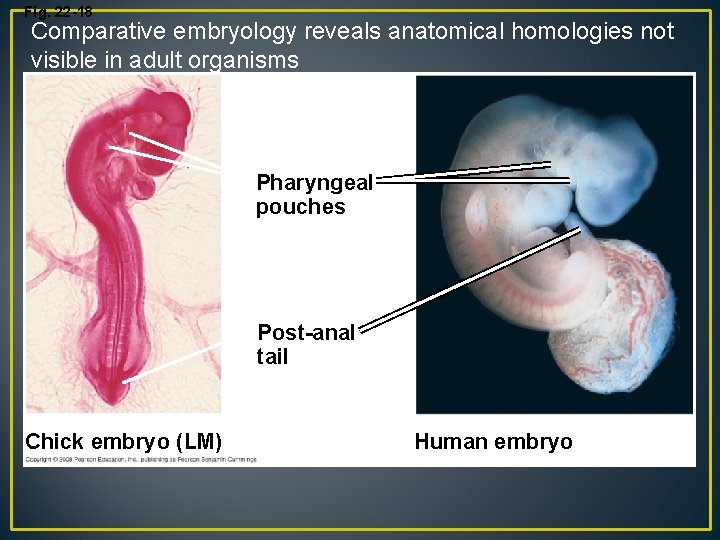
Fig. 22 -18 Comparative embryology reveals anatomical homologies not visible in adult organisms Pharyngeal pouches Post-anal tail Chick embryo (LM) Human embryo
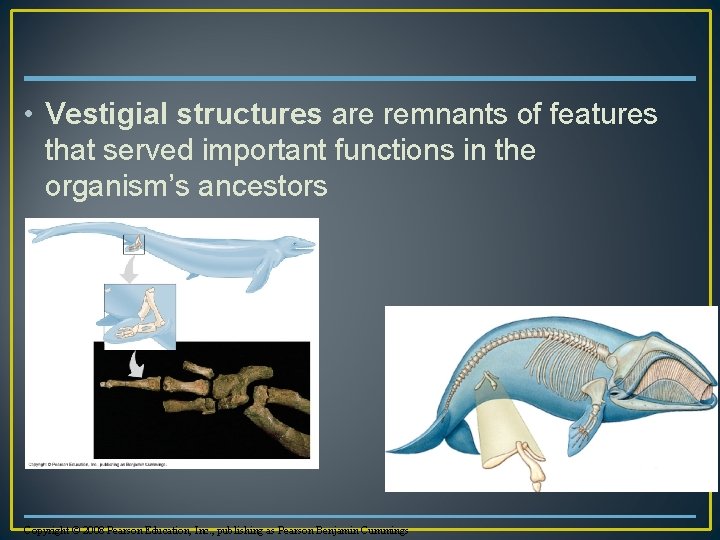
• Vestigial structures are remnants of features that served important functions in the organism’s ancestors Copyright © 2008 Pearson Education, Inc. , publishing as Pearson Benjamin Cummings
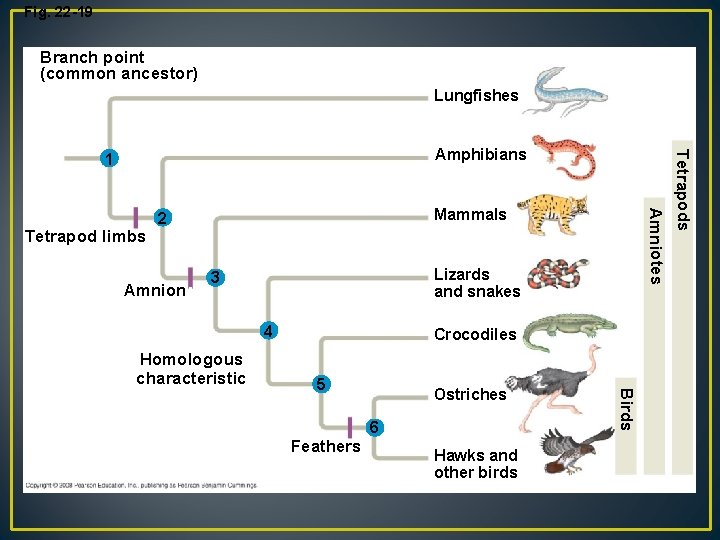
Fig. 22 -19 Branch point (common ancestor) Lungfishes Amnion Lizards and snakes 3 4 Homologous characteristic Amniotes Tetrapod limbs Mammals 2 Crocodiles Ostriches 6 Feathers Hawks and other birds Birds 5 Tetrapods Amphibians 1
Convergent Evolution • Convergent evolution is the evolution of similar/analogous, features in distantly related groups • Analogous traits arise when groups independently adapt to similar environments in similar ways • Convergent evolution does not provide information about ancestry Copyright © 2008 Pearson Education, Inc. , publishing as Pearson Benjamin Cummings
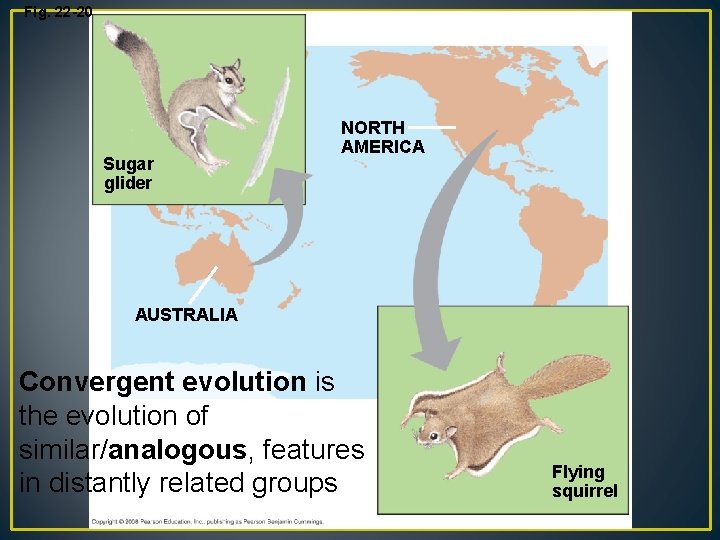
Fig. 22 -20 Sugar glider NORTH AMERICA AUSTRALIA Convergent evolution is the evolution of similar/analogous, features in distantly related groups Flying squirrel
Biogeography • Biogeography: the geographic distribution of species, formed an important part of his theory of evolution • Islands have many endemic species that are often closely related to species on the nearest mainland or island Copyright © 2008 Pearson Education, Inc. , publishing as Pearson Benjamin Cummings
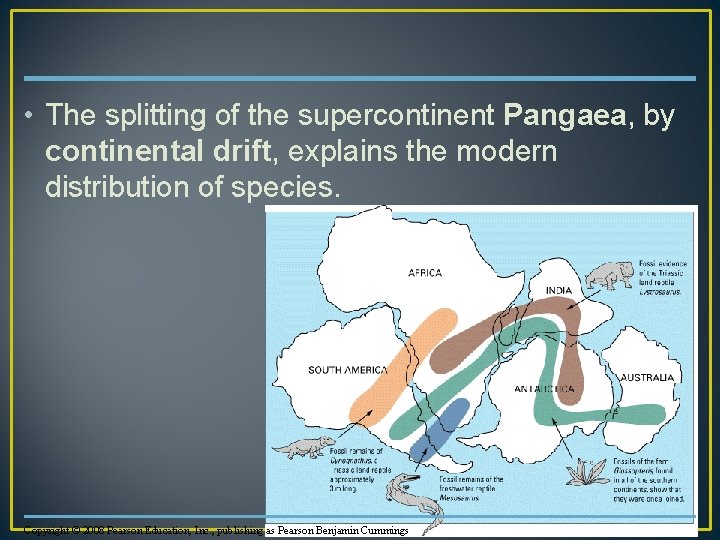
• The splitting of the supercontinent Pangaea, by continental drift, explains the modern distribution of species. Copyright © 2008 Pearson Education, Inc. , publishing as Pearson Benjamin Cummings
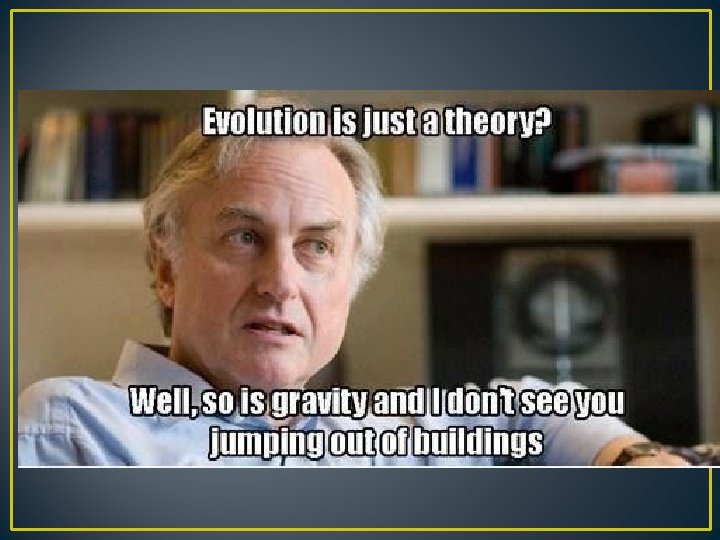
What Is Theoretical About Darwin’s View of Life? • In science, a theory accounts for many observations and data and attempts to explain and integrate a great variety of phenomena Copyright © 2008 Pearson Education, Inc. , publishing as Pearson Benjamin Cummings
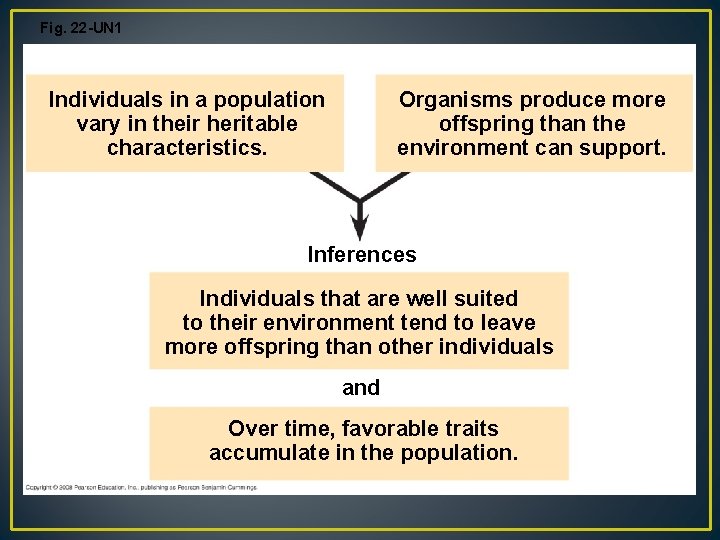
Fig. 22 -UN 1 Observations Individuals in a population vary in their heritable characteristics. Organisms produce more offspring than the environment can support. Inferences Individuals that are well suited to their environment tend to leave more offspring than other individuals and Over time, favorable traits accumulate in the population.
- Slides: 43