
TERM 2 PSEUDOSCIENTIFIC IDEAS OF RACE Prejudice a
- Slides: 22
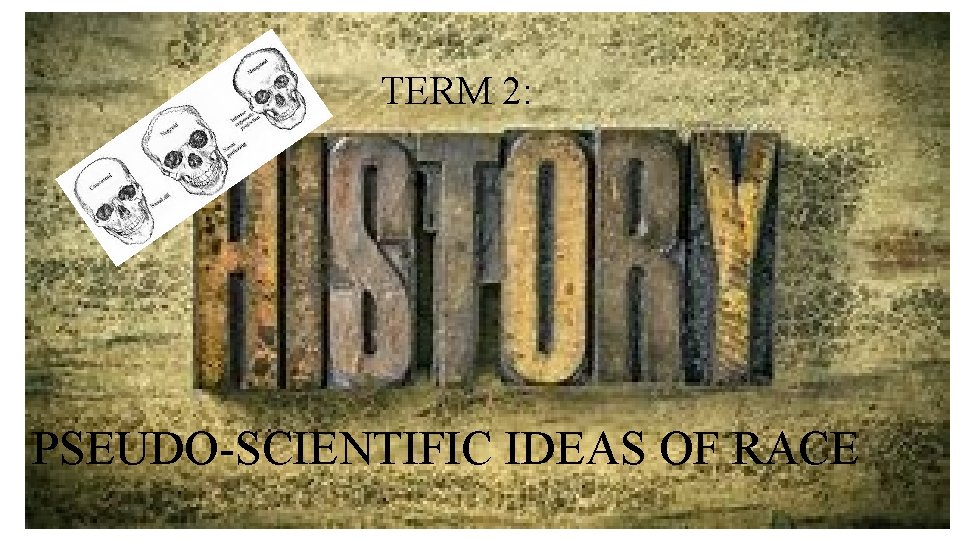
TERM 2: PSEUDO-SCIENTIFIC IDEAS OF RACE
Prejudice: a fixed opinion formed without knowing the facts. Racist: discriminating against people because of race. KEY WORDS: Scientific racism: theories about race which are supposedly baced on scientific research and which are meant to prove that some groups of people are superior to others. Hierarchy: ranking people or ideas from highest to lowest, from best to worst. Social Sciences: the study of human societies and behaviour.
Classified: ordered, sorted, organised into a category. Pseudo: false and misleading, not genuine. Evolution: the development of plants and animals from earlier, simpler form. Eugenics: a set of theories claiming that it is possible to improve a human or animal species by breeding from the better ones and not from the others. Genes: the parts of cells which controls the characteristics we inherit from our parents.
Theories about the hierarchies of race in the 19 th century: In the late 19 th century new ideas about race developed among Europeans. These ideas are called pseudoscientific because they were not based on proper science but on prejudices and faulty theories. Many people believed these ideas in the past. Governments developed racist policies and passed racest law’s, based on these pseudoscientific theories.
The pseudo-scientific theory of Johann Blumenbach: • In 1795 a German scientist called Johann Blumenbach divided humankind into five groups, based on the geographical areas in which they lived: • Negro – Africa • Mongolian – Asia • Malay – Southeast Asia • American Indian – the Americas • Caucasian – Europe.
• From the start. Blumenbach made judgements about these different groups, which he referred to as ‘races’. Blumenbach believed that the Caucasian(white) group was the ‘beautiful race’ and all the other were a “degeneration” from the original type. In fact, Blumenbach’s judgements about race were based on what he personally found beautiful, rather than on scientific facts. • Even though scientists such as Blumenbach made unscientific judgements, many people in western society accepted them as fact.
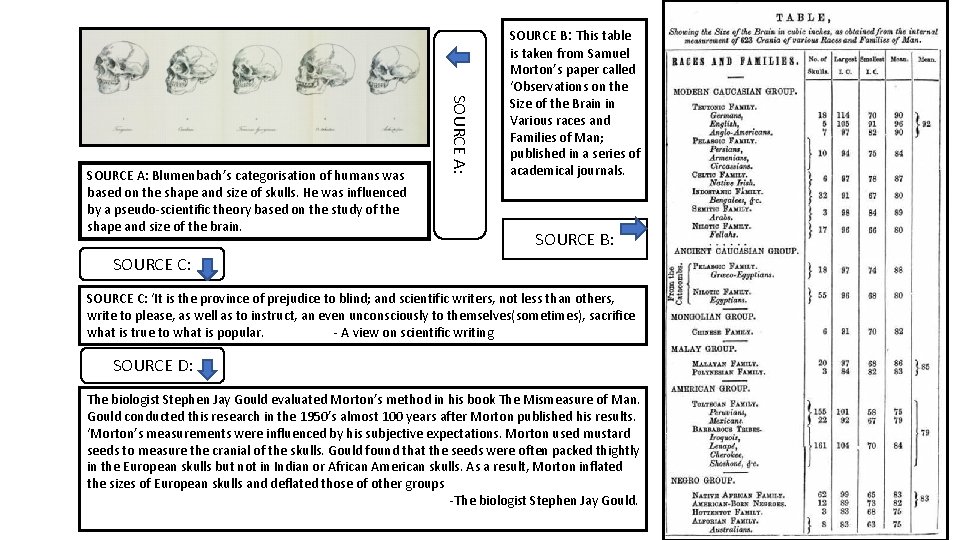
In the mid-19 th century, another scientist, the American Samual George Morton, further investigated the question of physical differences between human groups. He believed that each group was created separately and with different abilities. The pseudo scientific theory of Samuel Morton: In particular he believed that intelligence was linked to brain size. He measured a large number of human skulls from all around the world. He found that the size of the Caucasian skulls was bigger than others and this led him to conclude that Caucasians were intellectually superior to Native Americans and Americans.
• Morton’s scientific findings had a powerful impact when they became public. His work shaped the thinking of politicians, journalists and religious leaders of the time. He encouraged people to believe that racial differences exists and that some races were inferior to others. Because people were led to believe that his findings were bases on scientific methods, they accepted that they were true.
Scientific Racism: • In the late 19 th century, new areas of study – called the social science – were developing. Social scientists studies human societies and their behaviour and customs. They believed that social factors could be analysed and classified in the same way as data in the natural science. Zoologists an botanists had worked out a system to classify animals and plants which were based on their physical features. The new social scientists believed that humans could be studied in the same way. • They began to classify humans according to features such as size of their skulls, the shape of their lips and nose, the colour of their skin and the texture of their hair. They developed a theory that humankind was made up of separate types or races, which had distinct physical differences. They made links between these physical features and mental abilities, and reached unscientific conclusions about what were supposed to be the typical characteristics of each race.
Social Darwinism: The ideas of Scientific Racism were taken a step further in Social Darwinism. In 1859, the British scientist Charles Darwin published his theory of evolution. This showed that, in the animal world, species were continually evolving or changing. He proposed that this proses occurred because of the ability to better-adapt species to flourish at the expense of less well-adapted ones. A social scientist, Herbert Spencer, used the phrase ‘the survival of the fittest’ to describe the proses. Spencer and other social scientists applied Darwin’s theory to humans and called it Social Darwinism. They believed that the various human races were different stages in the process of evolution. It seemed to offer scientific explanation for the unequal levels of technology in different parts of the world.
Eugenics: • From Scientific Racism and Social Darwinism, a far more sinister ‘science’ developed. The word eugenics came from the Greek word for ‘good genes’. It was first developed by the British writer Francis Galton, who argued that it was wrong to protect the underprivileged and weak in society, since this went against the principals of evolution ant the survival of the fittest. Only those with ‘good genes’ should be supported.
Eugenics policies promoting health: Eugenicists believed that it was possible to produce better human beings by using the right kind of social policies. They thought that people who had the right physical an mental characteristics should be encouraged to have children. In this way they thought that the quality of the general population would improve. Many people even the democracies such as Britain, Sweden and the United States, accepted theory of eugenics. They supported positive policies to improve health, fitness and nutrition, hoping to prevent racial decline through better diet, fresh air and regular exercise. Many governments supported these ideals and build public swimming pools and sport grounds, promoting fitness as a national duty. They also encouraged woman who were considered healthy to have children. They set up maternity clinics and family planning programmes to give them support. There was also support for eugenics in countries like China, India and Brazil.
Negative eugenics: limiting fertility: • There was another, more disturbing side to eugenics. Some eugenicists believed that it was not enough to promote healthy populations. They believed that those who had bad genes should be prevented from having children. They were alarmed that social groups that in hier view were inferior, such as poor people, had high birth rates. They tried to encourage them to practise contraception and birth controle. In some cases they supported compolsary abortions or sterilization, or prohibited sexual relation amongst people they believed to be unfit to become parents, such as mental patience or criminals. In this way they believed the quality of the nations population would improve.
• So, for example, Britain passed a law in 1913 to lock away mentally ill people in a institution to prevent them from having children. Other countries tried a cheaper alternative: forced sterilisation. This was done in many states in the USA. Other countries, including Switzerland, Denmark and Norway, passed laws providing for voluntary sterilisation. • These ideas about eugenics were also applied to race. Scientific Racism and Social Darwinism led people to believe some races were fitter than others, when in fact human beings are all the same species, which continued to develop and adapt in different environments, for example, they acquired highly flexible fingers and hands in order to make tools to hunt, cut wood and meat. • Eugenics was used to encourage the breeding of superior races and to limit the inferior ones. Supporters of eugenics also believed that racial mixing led to the tainting of superior races by inferior ones. This led to laws prohibiting sexual contact across races, and ion extreme cases, to policies of genocide, such as the extermination of the Herero in Namibia and the Jews in Nazi Germany.
The modern understanding of race: • There is no scientific basis for using ‘race’ to differentiate between people: • Modern scientists tell us that the reason humans do not all look the same is because their ancestors lived and developed in different environments. So, for example, people living in parts of the world where it is hot developed darker skin to protect themselves from the rays of the sun. People living in colder climates have short stout bodies to retain heat and have pale skin, as there is less sunlight. • Most people take it for granted that humans can be divided into race. However the concept of human race is not scientific. Physical features like skin colour , hair type and facial shape do not relate in any way to how people think or behave.
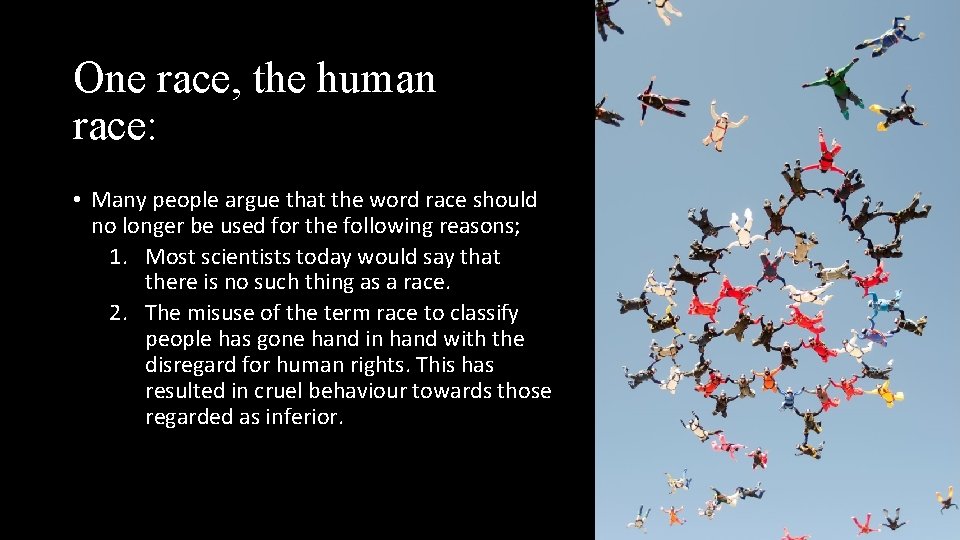
One race, the human race: • Many people argue that the word race should no longer be used for the following reasons; 1. Most scientists today would say that there is no such thing as a race. 2. The misuse of the term race to classify people has gone hand in hand with the disregard for human rights. This has resulted in cruel behaviour towards those regarded as inferior.
The Human Genome Project: • The Human Genome Project (HGP) began in October 1990 and was completed in 2003. It is an international scientific research project to find all the genes on every chromosome in the human body and to determine their biochemical nature. The findings of the HGP throw some useful light onto the issue of race. • Scientists have confirmed that most peoples idea of race are shaped by their culture and social traditions and not by the understanding of biology. Apartheid ideology, for example, simply used physical appearance as the basis for creating categories of people and classifying then into ‘population groups’.
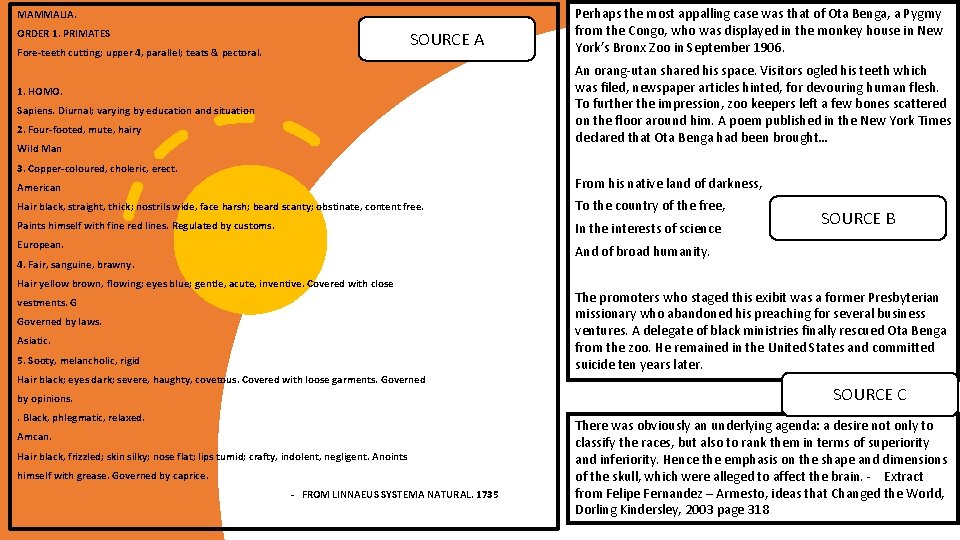
MAMMALIA. ORDER 1. PRIMATES SOURCE A Fore-teeth cutting; upper 4, parallel; teats & pectoral. Perhaps the most appalling case was that of Ota Benga, a Pygmy from the Congo, who was displayed in the monkey house in New York’s Bronx Zoo in September 1906. An orang-utan shared his space. Visitors ogled his teeth which was filed, newspaper articles hinted, for devouring human flesh. To further the impression, zoo keepers left a few bones scattered on the floor around him. A poem published in the New York Times declared that Ota Benga had been brought… 1. HOMO. Sapiens. Diurnal; varying by education and situation 2. Four-footed, mute, hairy Wild Man 3. Copper-coloured, choleric, erect. American From his native land of darkness, Hair black, straight, thick; nostrils wide, face harsh; beard scanty; obstinate, content free. To the country of the free, Paints himself with fine red lines. Regulated by customs. In the interests of science European. And of broad humanity. 4. Fair, sanguine, brawny. Hair yellow brown, flowing; eyes blue; gentle, acute, inventive. Covered with close vestments. G Governed by laws. Asiatic. 5. Sooty, melancholic, rigid Hair black; eyes dark; severe, haughty, covetous. Covered with loose garments. Governed by opinions. . Black, phlegmatic, relaxed. Amcan. Hair black, frizzled; skin silky; nose flat; lips tumid; crafty, indolent, negligent. Anoints himself with grease. Governed by caprice. - FROM LINNAEUS SYSTEMA NATURAL. 1735 SOURCE B The promoters who staged this exibit was a former Presbyterian missionary who abandoned his preaching for several business ventures. A delegate of black ministries finally rescued Ota Benga from the zoo. He remained in the United States and committed suicide ten years later. SOURCE C There was obviously an underlying agenda: a desire not only to classify the races, but also to rank them in terms of superiority and inferiority. Hence the emphasis on the shape and dimensions of the skull, which were alleged to affect the brain. - Extract from Felipe Fernandez – Armesto, ideas that Changed the World, Dorling Kindersley, 2003 page 318
1. Explain the following terms: a. Scientific Racism b. Social Darwinism Activity 1: 2. Study Source A and B then answer these questions: a. How is Scientific Racism illustrated in Source A? b. Explain why Fernandez-Armesto ( Source B) thinks that the findings of research like those shown in Source A are not neutral or scientific? 3. How was Social Darwinism used to justify colonialism and capitalism? 4. How would Darwin explain to the people who supported Social Darwinism that they had misinterpreted his theories? 5. Study Source C. a. What is ironic about the quotation given from the New York Times in this Source? b. The story of Ota Benga stresses the impact that these theories had on individuals. Why is it important to remember that theories are more than ideas in books – that they also affect people?
SOURCE A: Blumenbach’s categorisation of humans was based on the shape and size of skulls. He was influenced by a pseudo-scientific theory based on the study of the shape and size of the brain. SOURCE B: This table is taken from Samuel Morton’s paper called ‘Observations on the Size of the Brain in Various races and Families of Man; published in a series of academical journals. SOURCE B: SOURCE C: ‘It is the province of prejudice to blind; and scientific writers, not less than others, write to please, as well as to instruct, an even unconsciously to themselves(sometimes), sacrifice what is true to what is popular. - A view on scientific writing SOURCE D: The biologist Stephen Jay Gould evaluated Morton’s method in his book The Mismeasure of Man. Gould conducted this research in the 1950’s almost 100 years after Morton published his results. ‘Morton’s measurements were influenced by his subjective expectations. Morton used mustard seeds to measure the cranial of the skulls. Gould found that the seeds were often packed thightly in the European skulls but not in Indian or African American skulls. As a result, Morton inflated the sizes of European skulls and deflated those of other groups -The biologist Stephen Jay Gould.
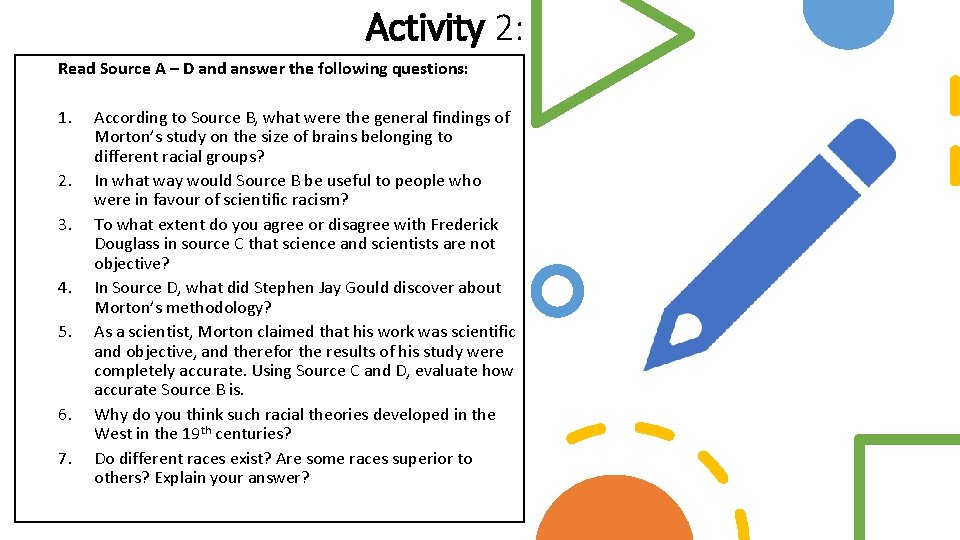
Activity 2: Read Source A – D and answer the following questions: 1. 2. 3. 4. 5. 6. 7. According to Source B, what were the general findings of Morton’s study on the size of brains belonging to different racial groups? In what way would Source B be useful to people who were in favour of scientific racism? To what extent do you agree or disagree with Frederick Douglass in source C that science and scientists are not objective? In Source D, what did Stephen Jay Gould discover about Morton’s methodology? As a scientist, Morton claimed that his work was scientific and objective, and therefor the results of his study were completely accurate. Using Source C and D, evaluate how accurate Source B is. Why do you think such racial theories developed in the West in the 19 th centuries? Do different races exist? Are some races superior to others? Explain your answer?
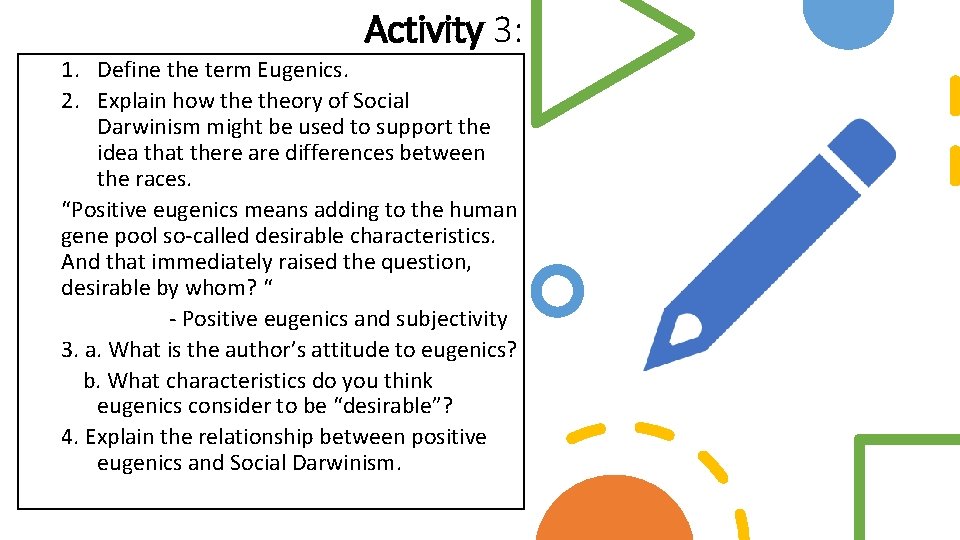
Activity 3: 1. Define the term Eugenics. 2. Explain how theory of Social Darwinism might be used to support the idea that there are differences between the races. “Positive eugenics means adding to the human gene pool so-called desirable characteristics. And that immediately raised the question, desirable by whom? “ - Positive eugenics and subjectivity 3. a. What is the author’s attitude to eugenics? b. What characteristics do you think eugenics consider to be “desirable”? 4. Explain the relationship between positive eugenics and Social Darwinism.