
Terapia della fibrosi polmonare idiopatica Paolo Spagnolo Clinica

Terapia della fibrosi polmonare idiopatica Paolo Spagnolo Clinica di Malattie dell’Apparato Respiratorio Università degli Studi di Padova


Idiopathic pulmonary fibrosis (IPF) IPF is an unpredictable and ultimately fatal age-related interstitial lung disease of unknown cause with a median survival of approximately 3 -5 years after diagnosis IPF occurs primarily in older adults, and is associated with the histopathologic and/or radiologic pattern of usual interstitial pneumonia (UIP) IPF: idiopathic UIP Raghu G et al. Am J Respir Crit Care Med 2011; 183: 788 -824
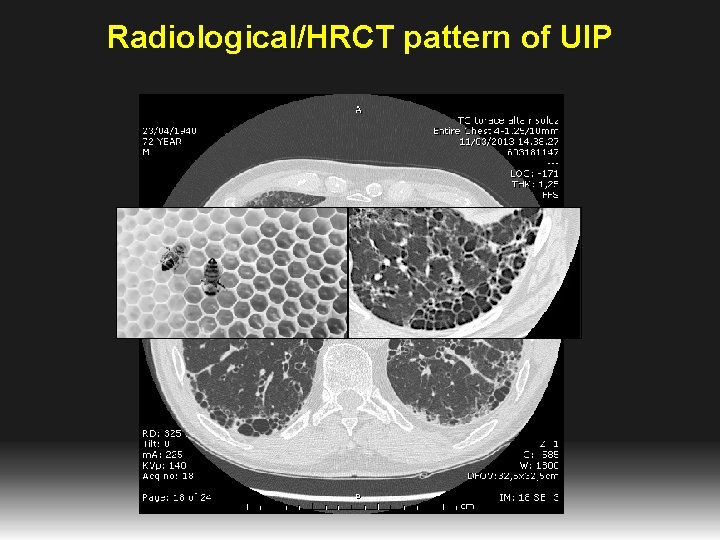
Radiological/HRCT pattern of UIP


Patients with IPF exhibit a poor prognosis Expected Patients with IPF 100 Survival (%) 80 60 40 20 0 0 2 4 6 8 10 12 Time after diagnosis (years) Bjoraker JA et al. Am J Respir Crit Care Med 1998; 157: 199 -203 14 16 18

“Mister IPF” 65 year old man Former smoker Dyspnea on exertion Chronic dry cough 93% room air saturation BMI = 33 Bibasilar “velcro-type” crackles CXR: nonspecific/normal PFTs: Mixed restriction/obstruction with a low DLCO • Often previously diagnosed with a different lung disease • • • Slide courtesy of Hal Collard (modified)

Risk factors and possible etiologies for IPF Old age • • • Environmental factors Other Cigarette smoking Infection A large number of studies have examined this, but findings are not conclusive Strongly associated with IPF Environmental pollutants Associated with an increased risk of IPF Exposure to metal and wood dusts, farming, raising birds, hairdressing, stone cutting/polishing, and exposure to livestock, vegetables or animal dust • Gastroesophageal reflux disease • Proposed cause of repeated micro-injury Genetic factors • Familial pulmonary fibrosis accounts for around 10% of total population with IPF

Recommendations by 2000 guidelines ATS/ERS. Am J Respir Crit Care Med 2000

Azathioprine • 27 patients with IPF; • prednisone (n=13) ± azathioprine (n=14); • Primary endpoints: survival and PFTs after 1 year • FVC, DLCO, Pa. O 2: non significant • Survival: non significant but in favor of azathioprine if corrected by age • More side effects in the prednisone arm, azathioprine well tolerated

NAC: Aim and Study Design • Does N-acetylcysteine (NAC) 600 mg tid over one year slow functional deterioration in IPF? – when administered in addition to prednisone plus azathioprine • Double-blind, placebo-controlled, parallel-group trial with randomization by country and stratified by VC (≤ or >60% predicted) Demedts M et al. N Engl J Med 2005; 353: 2229 -42

High-dose N-Acetylcysteine in IPF: Effects on Vital Capacity and DLCO NAC Placebo 0. 1 0. 0 Vital capacity (liters) -0. 1 -0. 2 -0. 3 No. of patients: NAC 80 63 Placebo 75 Baseline 55 60 6 mo 12 mo 80 75 51 0. 5 DLCo (mmol/min/k. Pa) 0. 0 -0. 5 -1. 0 No. of patients: NAC 79 58 Placebo 74 Baseline 48 59 2 0 -2 (% of predicted) -4 -6 -8 -10 6 mo 12 mo 47 Demedts M et al. N Engl J Med 2005; 353: 2229 -42 63 60 2 0 -2 (% of predicted) -4 -6 -8 -10 79 74 58 59 Baseline 6 mo 12 mo 55 51 Baseline 48 47

N-acetylcysteine/prednisone/azathioprine IPF Clinical Research Network. N Engl J Med 2012; 366: 1968 -77

Epithelial cell injury and activation INJURY Selman M, et al Ann Int Med 2002

Epithelial cell injury and activation INJURY Wound clot Fibroblast Migration and Proliferation Basement Membrane Disruption Selman M, et al Ann Int Med 2002

Epithelial cell injury and activation INJURY Wound clot Fibroblast Migration and Proliferation Basement Membrane Disruption Myofibroblast Accumulation Selman M, et al Ann Int Med 2002

Epithelial cell injury and activation INJURY Wound clot Angiogenesis Fibroblast Migration and Proliferation Basement Membrane Disruption Myofibroblast Accumulation Selman M, et al Ann Int Med 2002

Fibrosis and Impaired Reepithelialization Epithelial cell injury and activation INJURY Epithelial Apoptosis Wound clot Angiogenesis Fibroblast Migration and Proliferation Basement Membrane Disruption Myofibroblast Accumulation Selman M, et al Ann Int Med 2002


Recommendations in the 2015 IPF guidelines Agent 2015 guidelines Anticoagulant Strong recommendation against use Combination prednisone/azathioprine/NAC Strong recommendation against use Ambrisentan Strong recommendation against use Imatinib Strong recommendation against use Nintedanib Conditional recommendation for use Pirfenidone Conditional recommendation for use Macitentan, bosentan Conditional recommendation against use Sildenafil Conditional recommendation against use Antiacid therapy Conditional recommendation for use NAC monotherapy Conditional recommendation against use Modified from Raghu G et al. Am J Respir Crit Care Med 2015; 192: e 3 -e 19

Pirfenidone • Pirfenidone is an orally available, synthetic, pyridone compound with anti-inflammatory, anti-oxidant and antifibrotic properties • The mechanism of action is not fully understood • The drug is believed to act on multiple pathways, with in vitro cell-based studies and in vivo studies in animal models of pulmonary fibrosis providing insight into its anti-fibrotic activity Oku H et al. Eur J Pharmacol 2008: 590: 400 -8; Kim ES, Keating GM. Drugs 2015; 75: 219 -30

CAPACITY Studies 004 and 006: study design Study 004 Pirfenidone 2403 mg/day* vs. placebo vs. pirfenidone 1197 mg/day* n = 435 Open-label pirfenidone (2403 mg/day) 72 Weeks Study 006 Pirfenidone 2403 mg/day* vs. placebo n = 344 Primary endpoint • Study completion – Primary endpoint for both studies was change in percent predicted forced vital capacity (FVC) from baseline to week 72 – Patients remained in the double-blind treatment allocation until the last patient completed 72 weeks Thereafter, patients were offered a transition to an open-label extension study *267 mg capsule formulation Noble PW et al, Lancet 2011; 377: 1760 -9

Mean change from baseline (% predicted FVC) CAPACITY Study 004: main results Pirfenidone 2403 mg/day (n = 174) 0 Pirfenidone 1197 mg/day (n = 87) Placebo (n = 174) -5 -10 -15 0 Absolute difference, % Relative difference, % p value 12 24 36 Time (weeks) 48 Pirfenidone 2403 mg/day vs. placebo 1. 4 2. 5 4. 6 4. 8 53. 5 65. 2 63. 7 52. 3 0. 061 0. 014 <0. 001 Noble PW et al, Lancet 2011; 377: 1760 -9 60 72 Endpoint 4. 1 38. 3 <0. 001 4. 4 35. 3 0. 001

Mean change from baseline (% predicted FVC) CAPACITY Study 006: main results Pirfenidone 2403 mg/day (n = 171) 0 Placebo (n = 173) -5 -10 -15 0 Absolute difference, % Relative difference, % p value 12 24 36 Time (weeks) 48 Pirfenidone 2403 mg/day vs. placebo -0. 4 2. 8 2. 4 1. 9 -31. 5 62. 1 48. 2 27. 3 0. 021 <0. 001 0. 011 0. 005 Noble PW et al, Lancet 2011; 377: 1760 -9 60 72 Endpoint 0. 6 7. 6 0. 172 0. 6 6. 5 0. 501

ASCEND: study design and primary outcome Day 1: Randomization 1: 1 to pirfenidone 2403 mg/d or matched placebo 52 weeks Treatment duration Titration (2 weeks) 28 days Followup 50 weeks Primary endpoint: change in percent predicted FVC from baseline through week 52 calculated by using a ranked analysis of covariance (ANCOVA). Magnitude of effect: categorical analysis of two clinically important thresholds of change (≥ 10% decline in FVC or death, and no FVC decline) King TE Jr et al. N Engl J Med 2014; 370: 2083 -92

Primary efficacy analysis: proportion of patients with %FVC decline ≥ 10% or death 35 Patients (%) 30 Pirfenidone (N=278) Placebo (N=277) 25 20 15 10 5 0 13 26 39 52 Absolute Difference (%) 2. 5 7. 9 12. 3 15. 3 Relative Difference (%) 54. 0 58. 0 57. 8 47. 9 Rank ANCOVA p-value p<0. 000001 p=0. 000002 p<0. 000001 King TE Jr et al. N Engl J Med 2014; 370: 2083 -92 Week

All-cause and IPF-related mortality sensitivity analysis over 120 weeks All-cause mortality Pooled analysis IPF-related mortality Random-effects metaanalysis (all trials) Pooled analysis Pirfenidone (n=623) Placebo (n=624) Pirfenidone (n=804) Placebo (n=764) Pirfenidone (n=623) Placebo (n=624) 22 (3. 5%) 42 (6. 7%) 25 (3. 1%) 47 (6. 2%) 10 (1. 6%) 28 (4. 5%) 0. 52 (0. 31 -0. 87) - 0. 53 (0. 32 -0. 85) - 0. 35 (0. 17 -0. 72) - 0. 0107 - 0. 0092 - 0. 0029 - 32 (5. 1%) 50 (8. 0%) 35 (4. 4%) 55 (7. 2%) 17 (2. 7%) 35 (5. 6%) 0. 63 (0. 41 -0. 98) - 0. 63 (0. 41 -0. 96) - 0. 48 (0. 27 -0. 85) - 0. 0404 - 0. 0305 - 0. 0107 - 38 (6. 1%) 54 (8. 7%) 41 (5. 1%) 59 (7. 7%) 22 (3. 5%) 39 (6. 3%) 0. 69 (0. 46 -1. 05) - 0. 68 (0. 46 -1. 01) - 0. 55 (0. 33 -0. 93) - 0. 0789 - 0. 0585 - 0. 0237 - Week 52 Deaths , n (%) HR (95% CI) p value Week 72 Deaths , n (%) HR (95% CI) p value End of study Deaths , n (%) HR (95% CI) p value Adapted from Nathan SD et al. Lancet Respir Med 2017; 5; 33 -41

Power calculations and sample size estimates for mortality trials in IPF (placebo controlled) King TE Jr et al. Am J Respir Crit Care Med 2014; 189: 825 -831

Nintedanib • Nintedanib is an orally available, small molecule, tyrosine kinase inhibitor originally developed for cancer • It acts primarily, but not exclusively, downstream of FGF, PDGF and VEGF, all of which are major growth factors involved in the pathogenesis of IPF • Nintedanib blocks the intracellular signaling needed for the proliferation, migration and differentiation of lung fibroblasts to myofibroblast, thus reducing extracellular matrix deposition FGF: fibroblast growth factor; PDGF: platelet-derived growth factor; VEGF: vascular endothelial growth factor Wollin L et al. Eur Respir J 2015; 45: 1434 -45

INPULSIS: study design and primary outcome Two identical phase III RCTs that enrolled 1, 066 patients with IPF/likely IPF Randomized (3: 2 ratio) to nintedanib/placebo for 52 weeks nintedanib n = 638 IPF n = 1, 066 placebo n = 423 Primary endpoint: annual rate of decline in FVC (m. L per year) Richeldi L et al. N Engl J Med 2014; 370: 2071 -82


Richeldi L et al. N Engl J Med 2014; 370: 2071 -82; Colladr HR et al. Eur Resir J 2017; May 19; 49(5). pii: 1601339

Annual rate of decline in FVC (m. L/year) by subgroup Kolb M et al. Thorax doi: 10. 1136/thoraxjnl-2016 -208710

Unanswered questions Which drug should be used as first line treatment? How long should we treat IPF patients for? Should we combine pirfenidone and nintedanib? How do we treat more severe patients? How do we treat patients with comorbid disease (particularly PH)? • Does the effective of anti-fibrotic therapy last beyond the 52 to 72 -week duration of clinical trials? • • • Spagnolo P et al. Lancet Respir Med 2015; 3: e 31 -e 32

The holistic approach Nutrition Adherence to medication Vaccinations Psychosocial assistance • Patients • Family Medical treatment Management of nfections Lung transplantation Palliation of symptoms Long-term oxygen therapy Physiotherapy • Individually 5– 6 times weekly • Training Spagnolo P et al. Frontiers in Medicine (in press) Non-invasive ventilation

Conclusions • The approval of pirfenidone and nintedanib has dramatically changed the landscape of pharmacological treatment of IPF • The future – combination therapy vs. personalized therapy (or both? ) • Better understanding of disease pathophysiology remains crucial
- Slides: 37