
Terahertz wireless networks applications challenges and early solutions


![Results [1/3] f=0. 3 THz, B=50 GHz, PA=23 d. Bm, δ=5μs](https://slidetodoc.com/presentation_image_h2/96b6aa6746d6b5e1f8ad44044972a84b/image-42.jpg "Results [1/3] f=0. 3 THz, B=50 GHz, PA=23 d. Bm, δ=5μs")
![Results [2/3] f=0. 3 THz, B=50 GHz, PA=23 d. Bm, δ=5μs](https://slidetodoc.com/presentation_image_h2/96b6aa6746d6b5e1f8ad44044972a84b/image-43.jpg "Results [2/3] f=0. 3 THz, B=50 GHz, PA=23 d. Bm, δ=5μs")
![Results [3/3] f=0. 3 THz, B=50 GHz, PA=23 d. Bm, δ=5μs](https://slidetodoc.com/presentation_image_h2/96b6aa6746d6b5e1f8ad44044972a84b/image-44.jpg "Results [3/3] f=0. 3 THz, B=50 GHz, PA=23 d. Bm, δ=5μs")
- Slides: 52
Terahertz wireless networks: applications, challenges, and early solutions Dr. D. Moltchanov Tampere University dmitri. moltchanov@gmail. com
Outline THz band capabilities and promises Challenges and limitations Applications and use-cases o Macro world use-cases o Micro-scale applications Earlier solutions o Addressing micromobility challenges o Physical layer security and eavesdropping
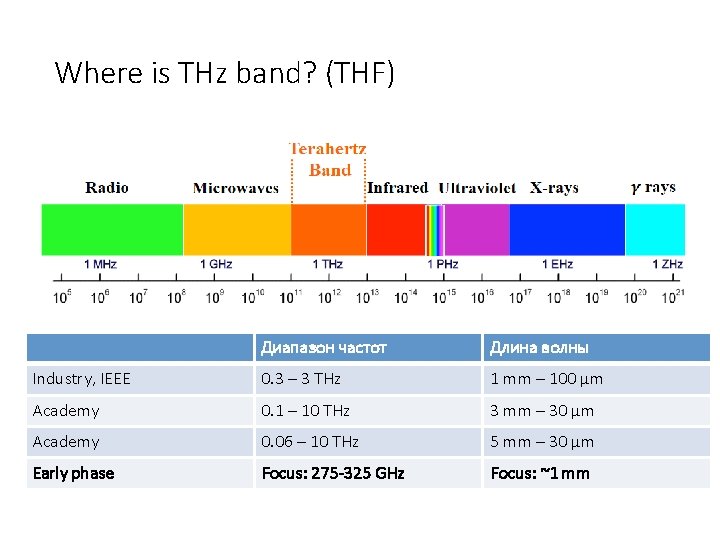
Where is THz band? (THF) Диапазон частот Длина волны Industry, IEEE 0. 3 – 3 THz 1 mm – 100 µm Academy 0. 1 – 10 THz 3 mm – 30 µm Academy 0. 06 – 10 THz 5 mm – 30 µm Early phase Focus: 275 -325 GHz Focus: ~1 mm
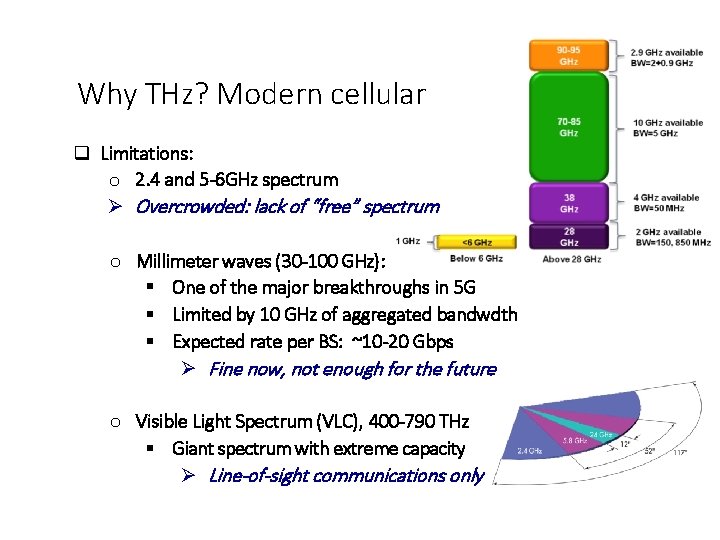
Why THz? Modern cellular Limitations: o 2. 4 and 5 -6 GHz spectrum Overcrowded: lack of “free” spectrum o Millimeter waves (30 -100 GHz): One of the major breakthroughs in 5 G Limited by 10 GHz of aggregated bandwdth Expected rate per BS: ~10 -20 Gbps Fine now, not enough for the future o Visible Light Spectrum (VLC), 400 -790 THz Giant spectrum with extreme capacity Line-of-sight communications only
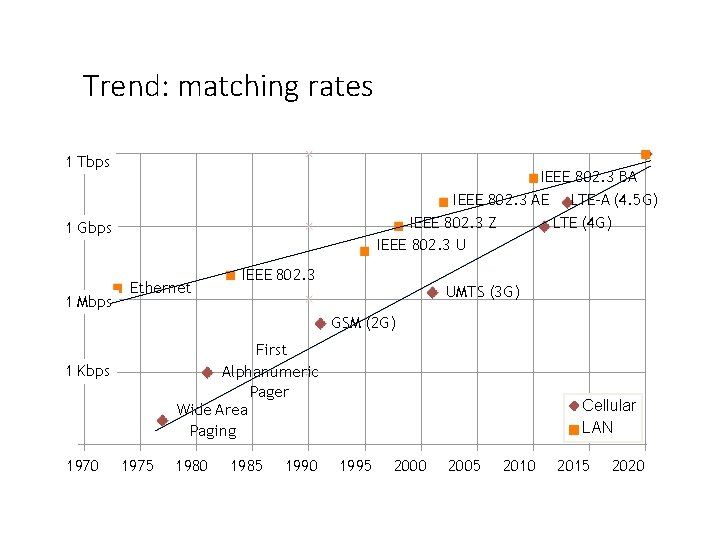
Trend: matching rates 1 Tbps IEEE 802. 3 BA IEEE 802. 3 AE LTE-A (4. 5 G) IEEE 802. 3 Z LTE (4 G) IEEE 802. 3 U 1 Gbps 1 Mbps Ethernet IEEE 802. 3 UMTS (3 G) GSM (2 G) First Alphanumeric Pager Wide Area Paging 1 Kbps 1970 1975 1980 1985 1990 Cellular LAN 1995 2000 2005 2010 2015 2020
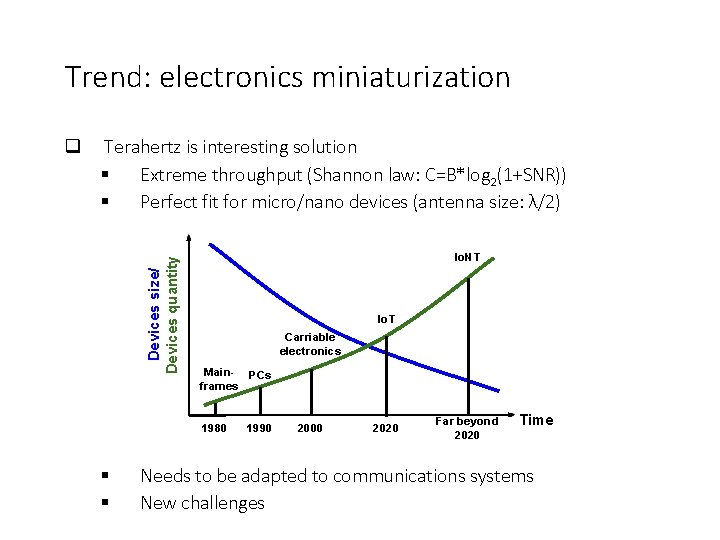
Trend: electronics miniaturization Terahertz is interesting solution Extreme throughput (Shannon law: C=B*log 2(1+SNR)) Perfect fit for micro/nano devices (antenna size: λ/2) Devices size/ Devices quantity Io. NT Io. T Carriable electronics Main- PCs frames 1980 1990 2000 2020 Far beyond 2020 Time Needs to be adapted to communications systems New challenges
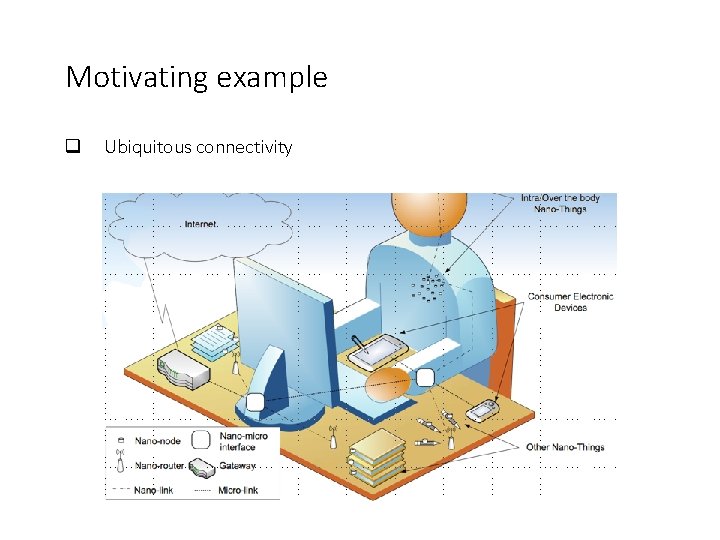
Motivating example Ubiquitous connectivity
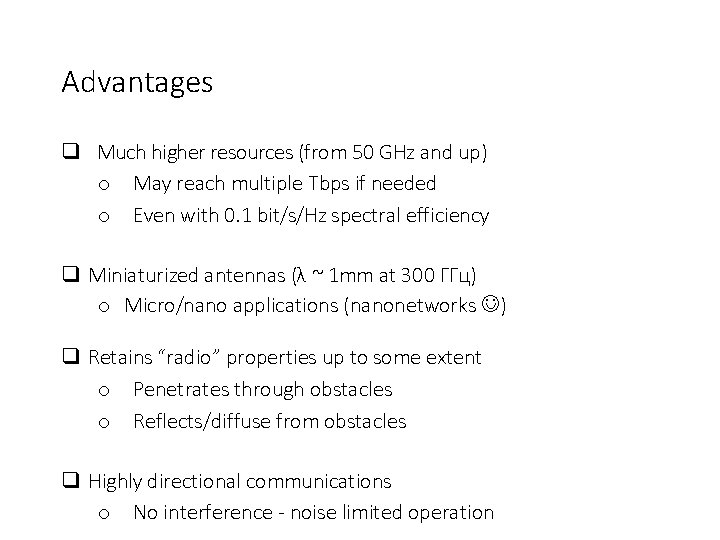
Advantages Much higher resources (from 50 GHz and up) o May reach multiple Tbps if needed o Even with 0. 1 bit/s/Hz spectral efficiency Miniaturized antennas (λ ~ 1 mm at 300 ГГц) o Micro/nano applications (nanonetworks ) Retains “radio” properties up to some extent o Penetrates through obstacles o Reflects/diffuse from obstacles Highly directional communications o No interference - noise limited operation
Challenges
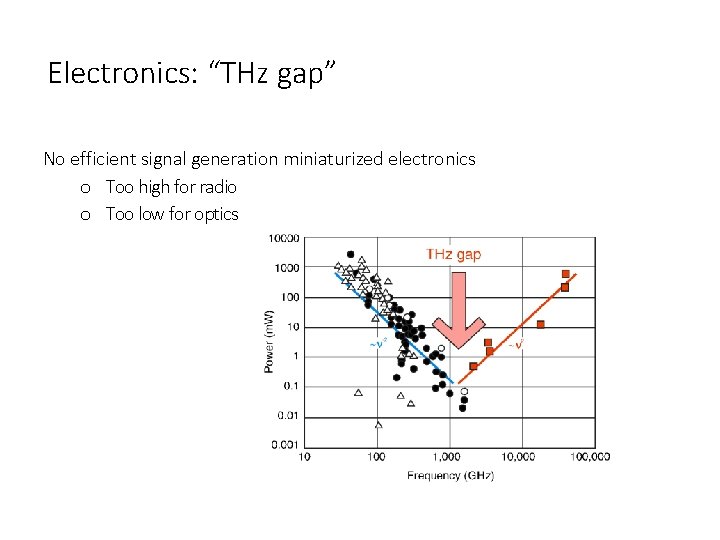
Electronics: “THz gap” No efficient signal generation miniaturized electronics o Too high for radio o Too low for optics
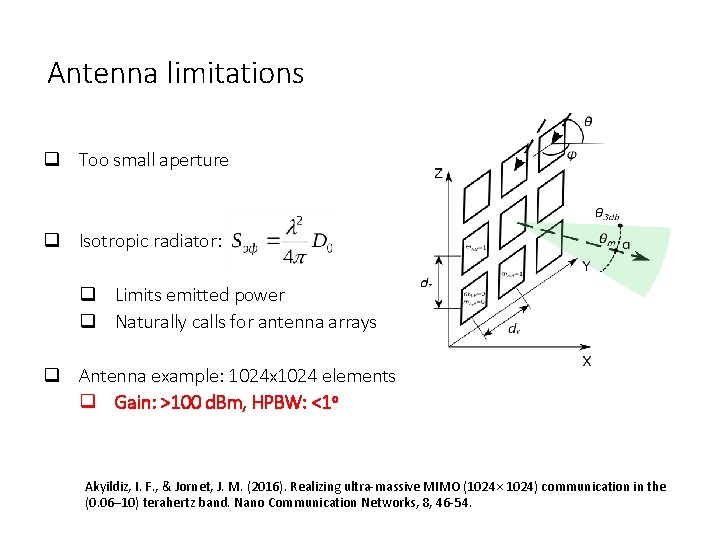
Limitations of THz band (2) Antenna limitations Small antenna aperture Too small aperture Isotropic radiator: Limits emitted power Naturally calls for antenna arrays Antenna example: 1024 x 1024 elements Gain: >100 d. Bm, HPBW: <1 o Akyildiz, I. F. , & Jornet, J. M. (2016). Realizing ultra-massive MIMO (1024× 1024) communication in the (0. 06– 10) terahertz band. Nano Communication Networks, 8, 46 -54.
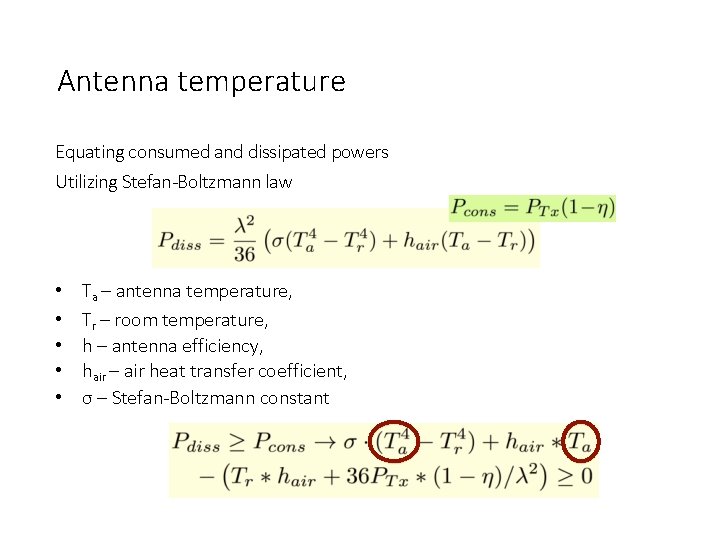
Antenna temperature Equating consumed and dissipated powers Utilizing Stefan-Boltzmann law • • • Ta – antenna temperature, Tr – room temperature, h – antenna efficiency, hair – air heat transfer coefficient, σ – Stefan-Boltzmann constant
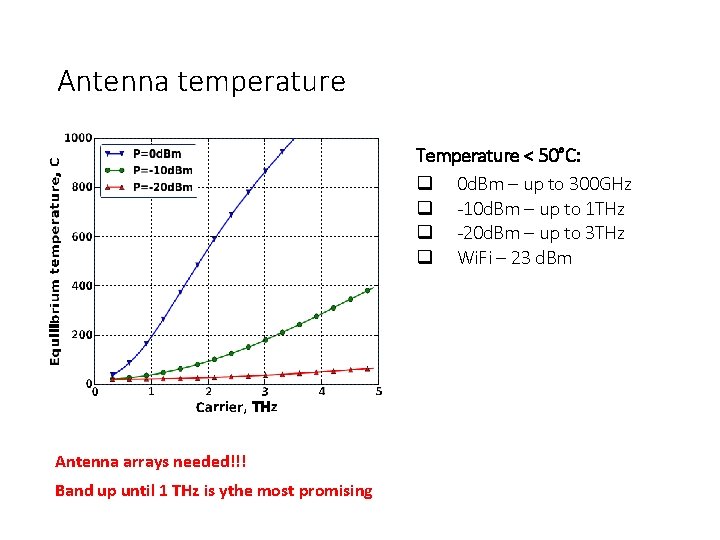
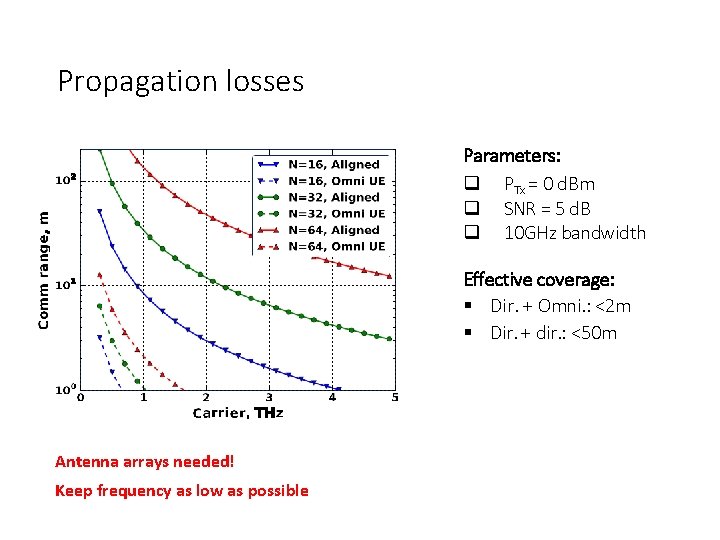
Antenna temperature Temperature < 50°C: 0 d. Bm – up to 300 GHz -10 d. Bm – up to 1 THz -20 d. Bm – up to 3 THz Wi. Fi – 23 d. Bm Antenna arrays needed!!! Band up until 1 THz is ythe most promising
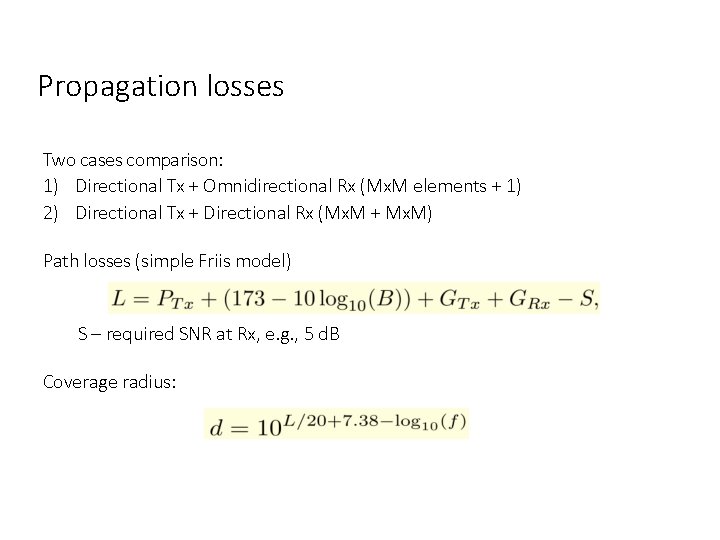
Propagation losses Two cases comparison: 1) Directional Tx + Omnidirectional Rx (Mx. M elements + 1) 2) Directional Tx + Directional Rx (Mx. M + Mx. M) Path losses (simple Friis model) S – required SNR at Rx, e. g. , 5 d. B Coverage radius:
Propagation losses Parameters: PTx = 0 d. Bm SNR = 5 d. B 10 GHz bandwidth Effective coverage: Dir. + Omni. : <2 m Dir. + dir. : <50 m Antenna arrays needed! Keep frequency as low as possible
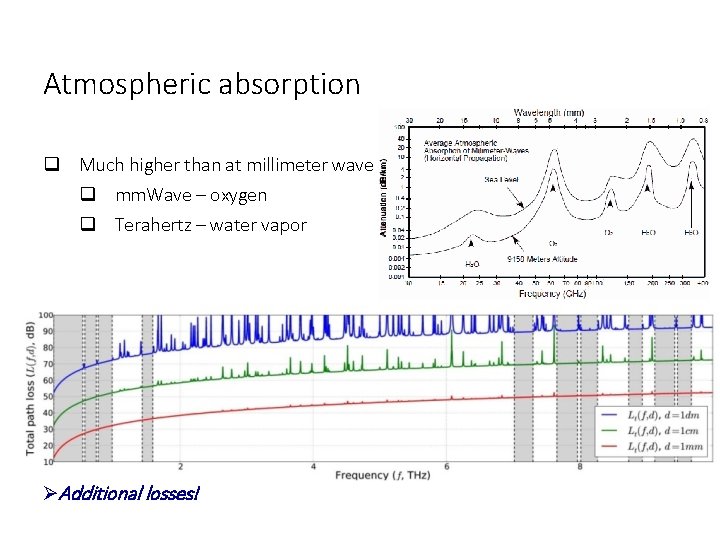
Atmospheric absorption Much higher than at millimeter wave mm. Wave – oxygen Terahertz – water vapor Additional losses!
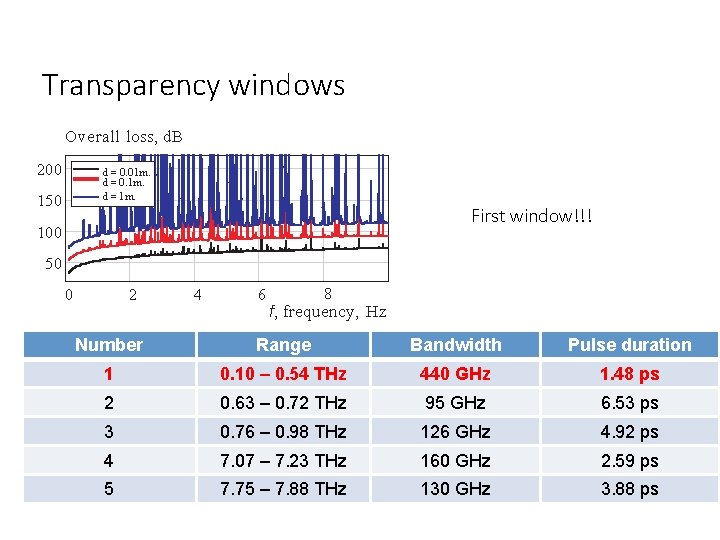
Transparency windows Overall loss, d. B 200 d = 0. 01 m. d = 0. 1 m. d = 1 m. 150 First window!!! 100 50 0 2 4 6 8 f, frequency, Hz Number Range Bandwidth Pulse duration 1 0. 10 – 0. 54 THz 440 GHz 1. 48 ps 2 0. 63 – 0. 72 THz 95 GHz 6. 53 ps 3 0. 76 – 0. 98 THz 126 GHz 4. 92 ps 4 7. 07 – 7. 23 THz 160 GHz 2. 59 ps 5 7. 75 – 7. 88 THz 130 GHz 3. 88 ps
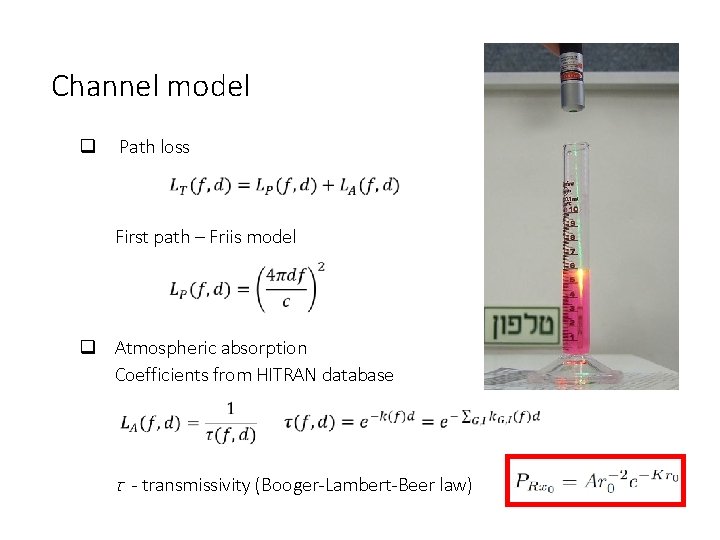
Propagation and path loss Channel model Path loss First path – Friis model Atmospheric absorption Coefficients from HITRAN database τ - transmissivity (Booger-Lambert-Beer law)
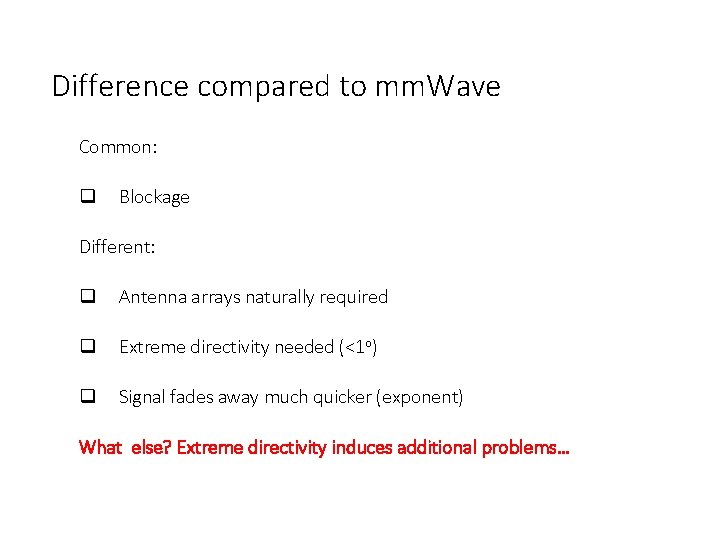
Propagation and path loss Difference compared to mm. Wave Common: Blockage Different: Antenna arrays naturally required Extreme directivity needed (<1 o) Signal fades away much quicker (exponent) What else? Extreme directivity induces additional problems…
Applications
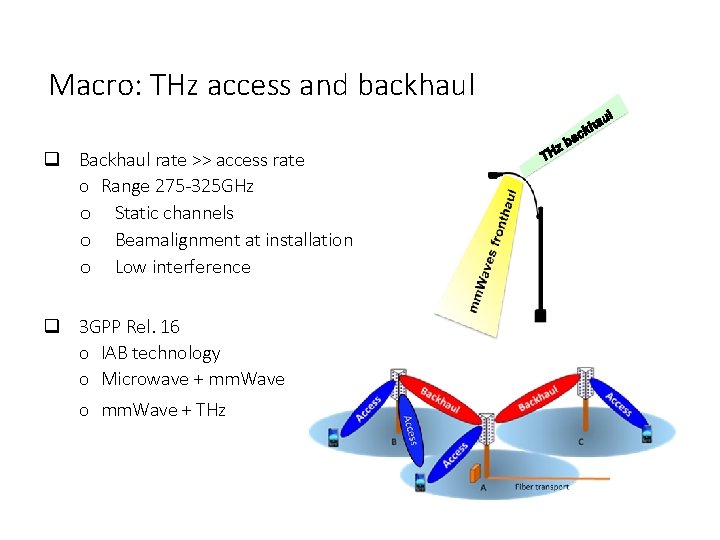
Macro: THz access and backhaul Backhaul rate >> access rate o Range 275 -325 GHz o Static channels o Beamalignment at installation o Low interference 3 GPP Rel. 16 o IAB technology o Microwave + mm. Wave o mm. Wave + THz
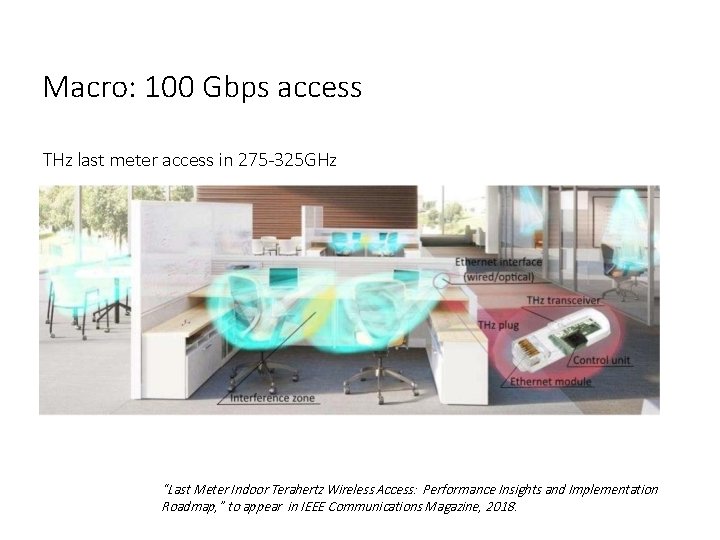
Macro: 100 Gbps access THz last meter access in 275 -325 GHz “Last Meter Indoor Terahertz Wireless Access: Performance Insights and Implementation Roadmap, ” to appear in IEEE Communications Magazine, 2018.
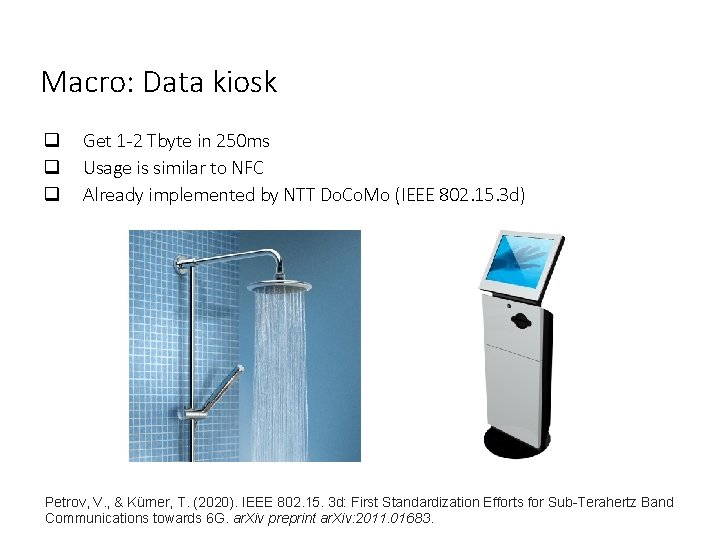
Macro: Data kiosk Get 1 -2 Тbyte in 250 ms Usage is similar to NFC Already implemented by NTT Do. Co. Mo (IEEE 802. 15. 3 d) Petrov, V. , & Kürner, T. (2020). IEEE 802. 15. 3 d: First Standardization Efforts for Sub-Terahertz Band Communications towards 6 G. ar. Xiv preprint ar. Xiv: 2011. 01683.
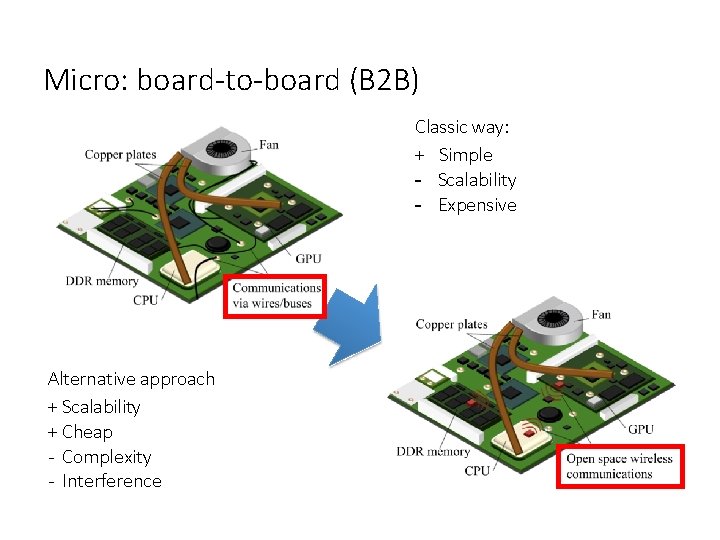
Micro: board-to-board (B 2 B) Classic way: + Simple - Scalability - Expensive Alternative approach + Scalability + Cheap - Complexity - Interference
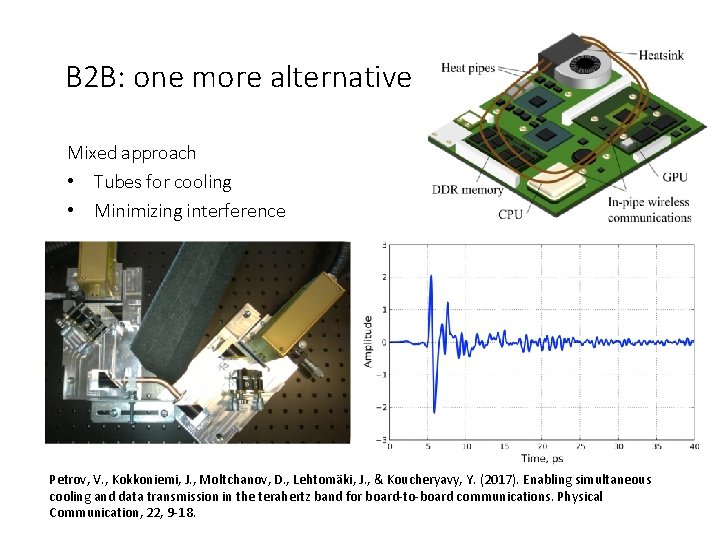
B 2 B: one more alternative Mixed approach • Tubes for cooling • Minimizing interference Petrov, V. , Kokkoniemi, J. , Moltchanov, D. , Lehtomäki, J. , & Koucheryavy, Y. (2017). Enabling simultaneous cooling and data transmission in the terahertz band for board-to-board communications. Physical Communication, 22, 9 -18.
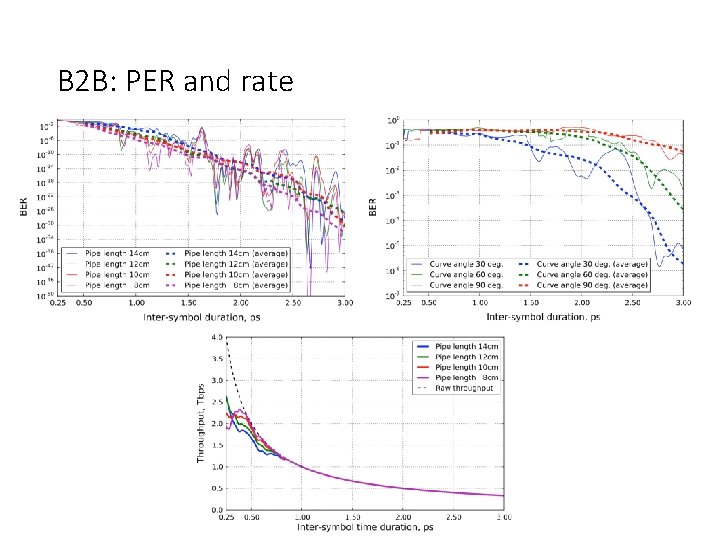
B 2 B: PER and rate
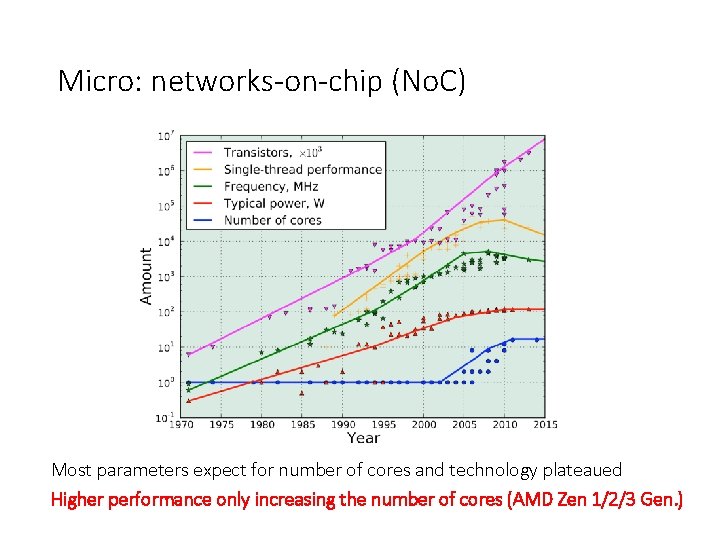
Micro: networks-on-chip (No. C) Most parameters expect for number of cores and technology plateaued Higher performance only increasing the number of cores (AMD Zen 1/2/3 Gen. )
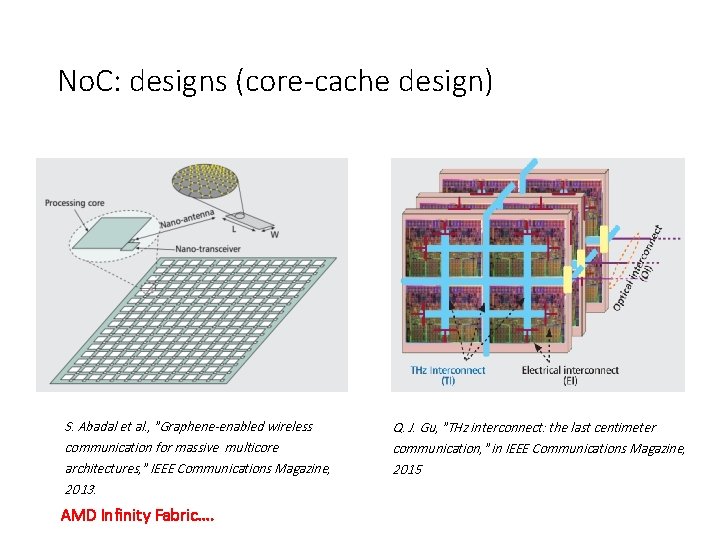
No. C: designs (core-cache design) S. Abadal et al. , "Graphene-enabled wireless communication for massive multicore architectures, " IEEE Communications Magazine, 2013. AMD Infinity Fabric…. Q. J. Gu, "THz interconnect: the last centimeter communication, " in IEEE Communications Magazine, 2015
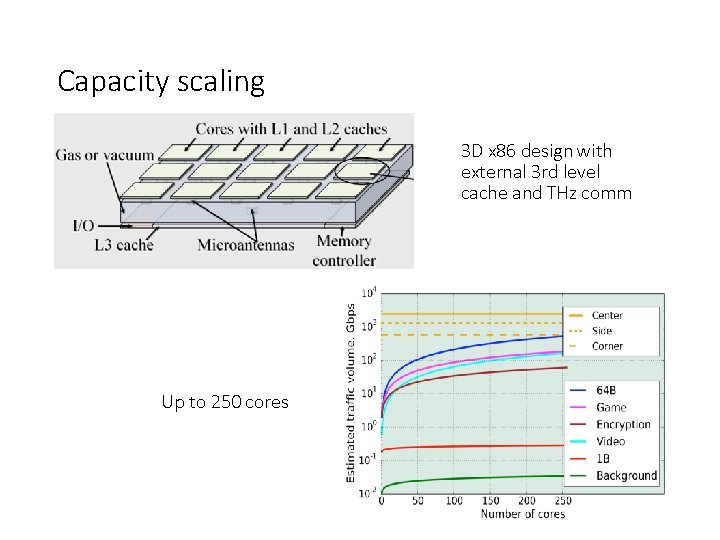
Capacity scaling 3 D x 86 design with external 3 rd level cache and THz comm Up to 250 cores
Addressing challenges: micromobility
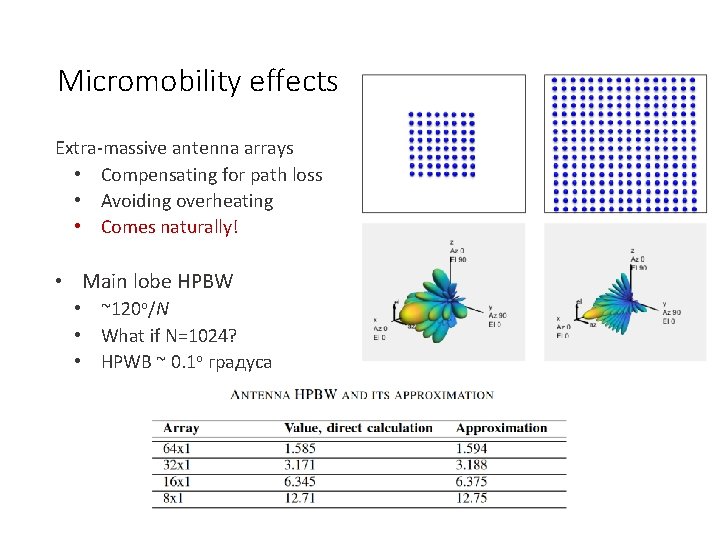
Micromobility effects Extra-massive antenna arrays • Compensating for path loss • Avoiding overheating • Comes naturally! • Main lobe HPBW • ~120 o/N • What if N=1024? • HPWB ~ 0. 1 o градуса
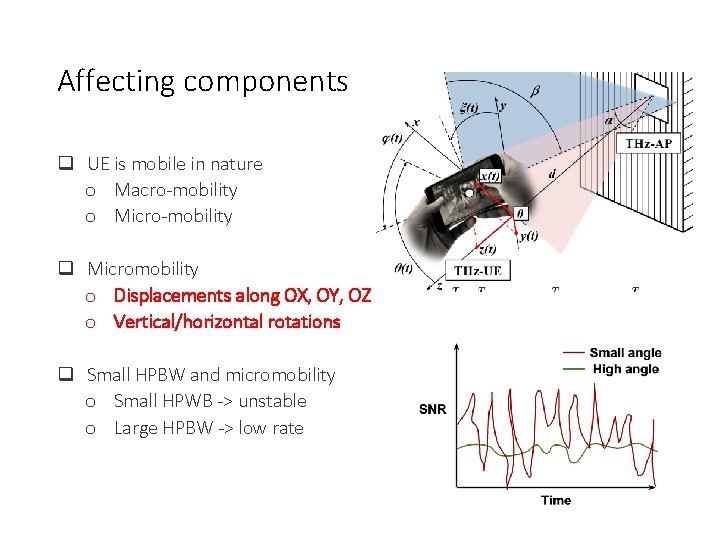
Affecting components UE is mobile in nature o Macro-mobility o Micro-mobility Micromobility o Displacements along OX, OY, OZ o Vertical/horizontal rotations Small HPBW and micromobility o Small HPWB -> unstable o Large HPBW -> low rate
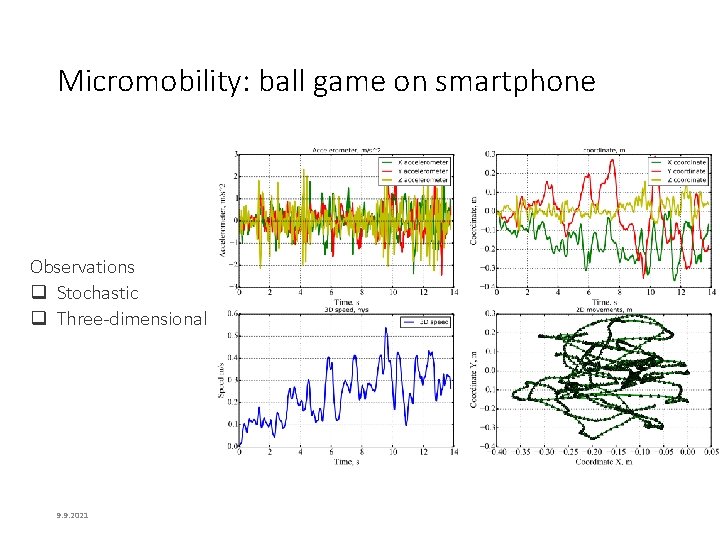
Micromobility: ball game on smartphone Observations Stochastic Three-dimensional 9. 9. 2021
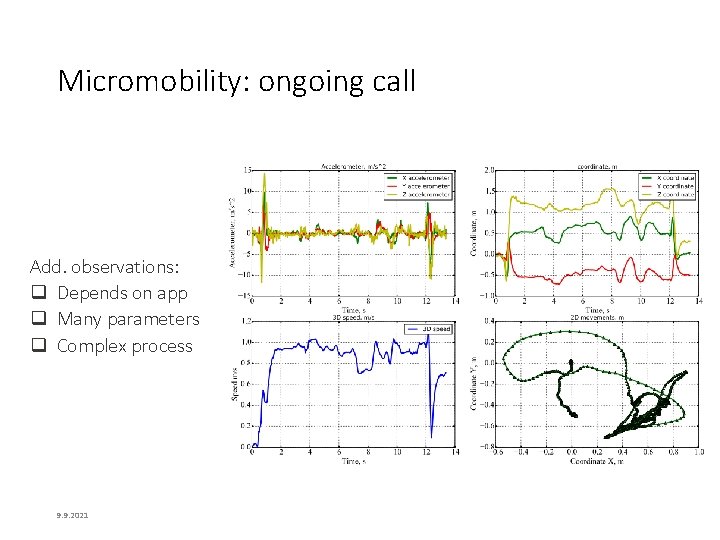
Micromobility: ongoing call Add. observations: Depends on app Many parameters Complex process 9. 9. 2021
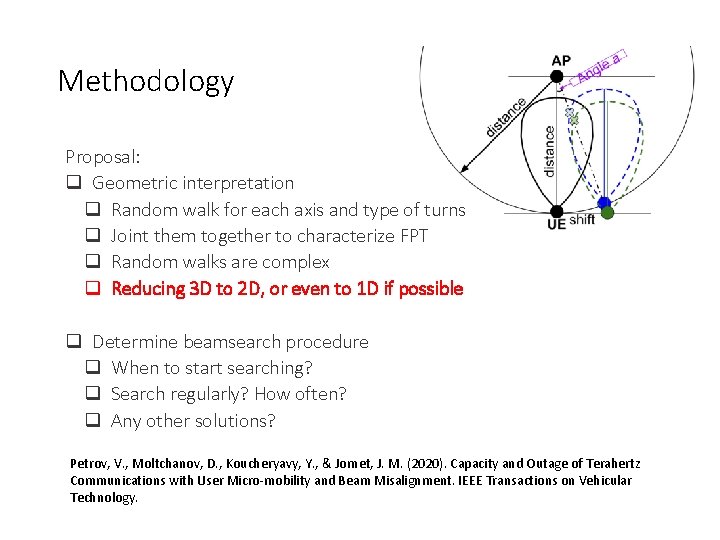
Methodology Proposal: Geometric interpretation Random walk for each axis and type of turns Joint them together to characterize FPT Random walks are complex Reducing 3 D to 2 D, or even to 1 D if possible Determine beamsearch procedure When to start searching? Search regularly? How often? Any other solutions? Petrov, V. , Moltchanov, D. , Koucheryavy, Y. , & Jornet, J. M. (2020). Capacity and Outage of Terahertz Communications with User Micro-mobility and Beam Misalignment. IEEE Transactions on Vehicular Technology.
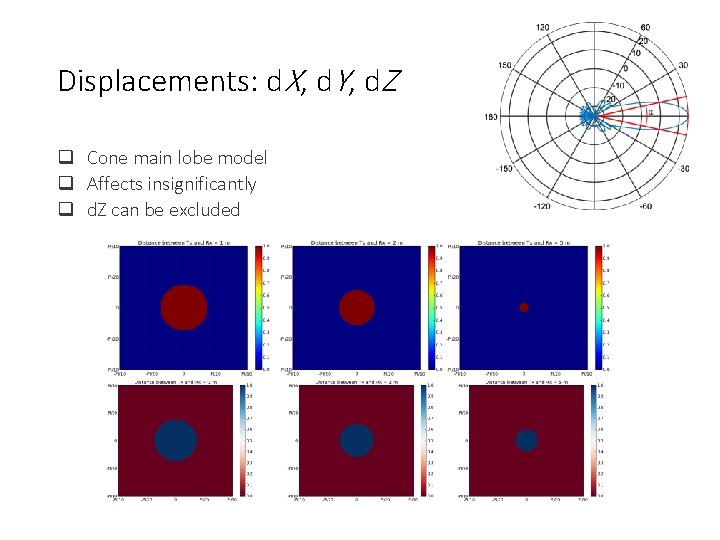
Displacements: d. X, d. Y, d. Z Cone main lobe model Affects insignificantly d. Z can be excluded
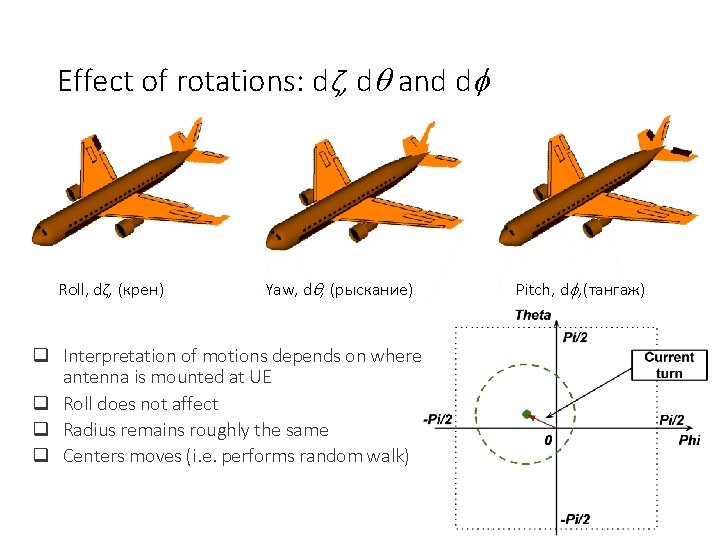
Effect of rotations: dζ, d and d Roll, dζ, (крен) Yaw, d , (рыскание) Interpretation of motions depends on where antenna is mounted at UE Roll does not affect Radius remains roughly the same Centers moves (i. e. performs random walk) Pitch, d , (тангаж)
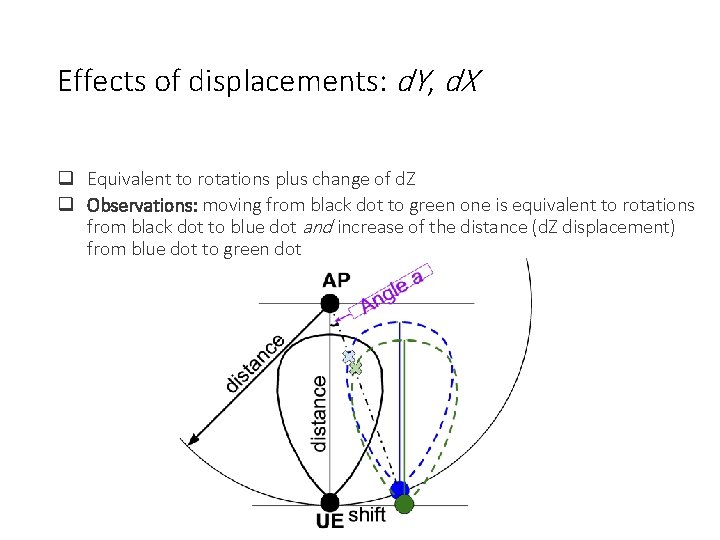
Effects of displacements: d. Y, d. X Equivalent to rotations plus change of d. Z Observations: moving from black dot to green one is equivalent to rotations from black dot to blue dot and increase of the distance (d. Z displacement) from blue dot to green dot
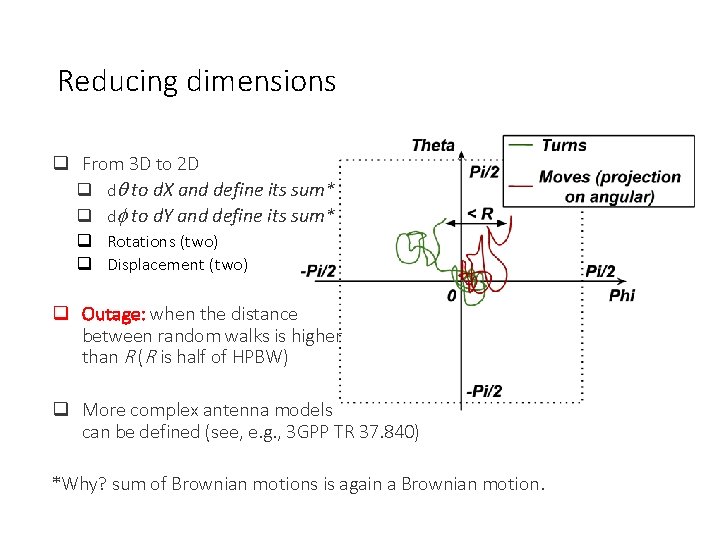
Reducing dimensions From 3 D to 2 D d to d. X and define its sum* d to d. Y and define its sum* Rotations (two) Displacement (two) Outage: when the distance between random walks is higher than R (R is half of HPBW) More complex antenna models can be defined (see, e. g. , 3 GPP TR 37. 840) *Why? sum of Brownian motions is again a Brownian motion.
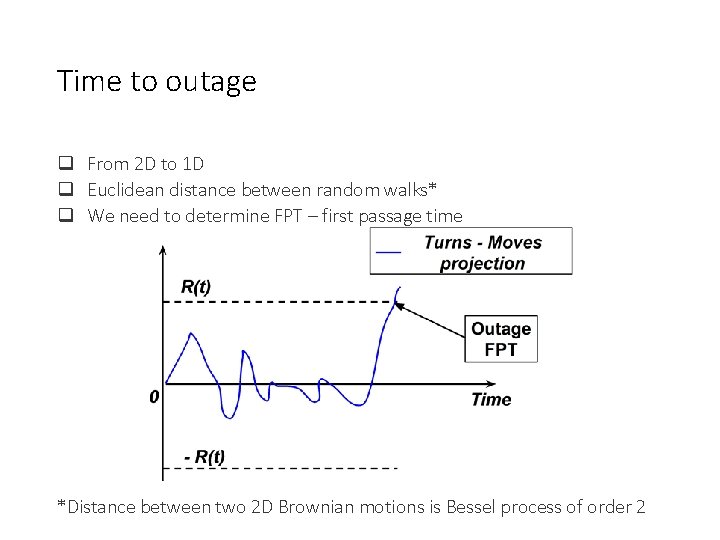
Time to outage From 2 D to 1 D Euclidean distance between random walks* We need to determine FPT – first passage time *Distance between two 2 D Brownian motions is Bessel process of order 2
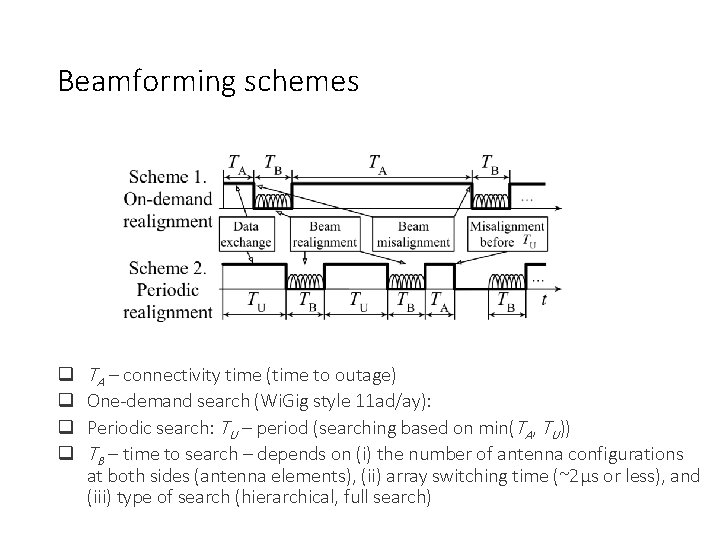
Beamforming schemes TA – connectivity time (time to outage) One-demand search (Wi. Gig style 11 ad/ay): Periodic search: TU – period (searching based on min(TA, TU)) TB – time to search – depends on (i) the number of antenna configurations at both sides (antenna elements), (ii) array switching time (~2μs or less), and (iii) type of search (hierarchical, full search)
Results [1/3] f=0. 3 THz, B=50 GHz, PA=23 d. Bm, δ=5μs
Results [2/3] f=0. 3 THz, B=50 GHz, PA=23 d. Bm, δ=5μs
Results [3/3] f=0. 3 THz, B=50 GHz, PA=23 d. Bm, δ=5μs
Addressing challenges: eavesdropping
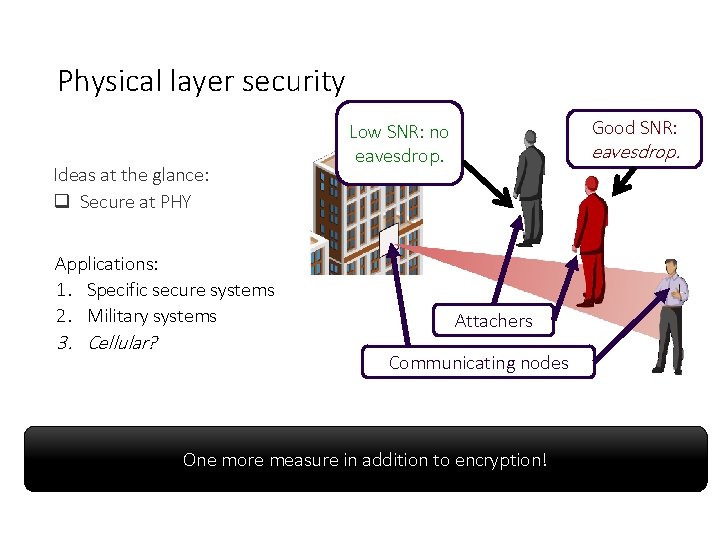
Physical layer security Ideas at the glance: Secure at PHY Applications: 1. Specific secure systems 2. Military systems 3. Cellular? Good SNR: Low SNR: no eavesdrop. Attachers Communicating nodes One more measure in addition to encryption!
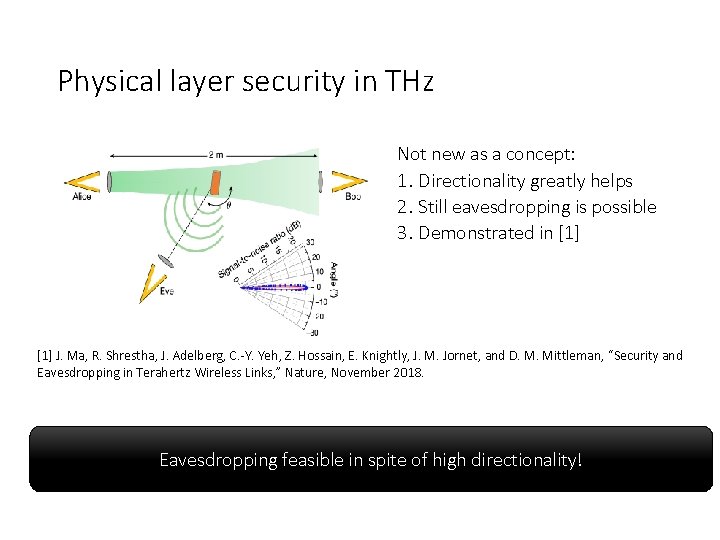
Physical layer security in THz Not new as a concept: 1. Directionality greatly helps 2. Still eavesdropping is possible 3. Demonstrated in [1] J. Ma, R. Shrestha, J. Adelberg, C. -Y. Yeh, Z. Hossain, E. Knightly, J. M. Jornet, and D. M. Mittleman, “Security and Eavesdropping in Terahertz Wireless Links, ” Nature, November 2018. Eavesdropping feasible in spite of high directionality!
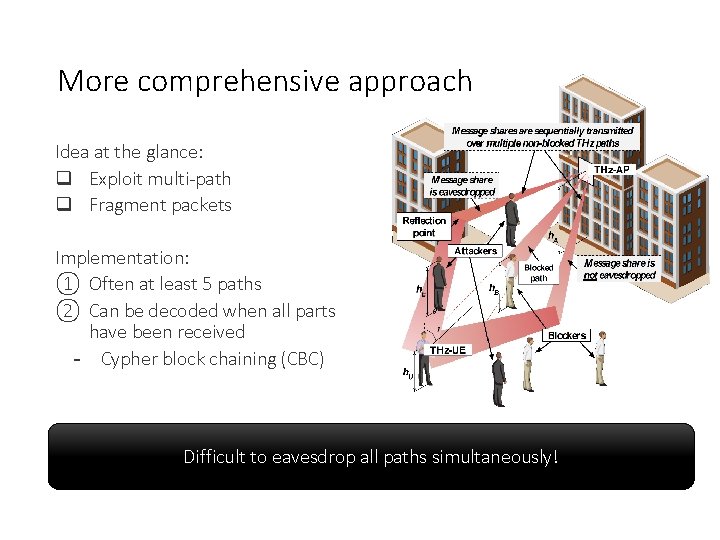
More comprehensive approach Idea at the glance: Exploit multi-path Fragment packets Implementation: ① Often at least 5 paths ② Can be decoded when all parts have been received - Cypher block chaining (CBC) Difficult to eavesdrop all paths simultaneously!
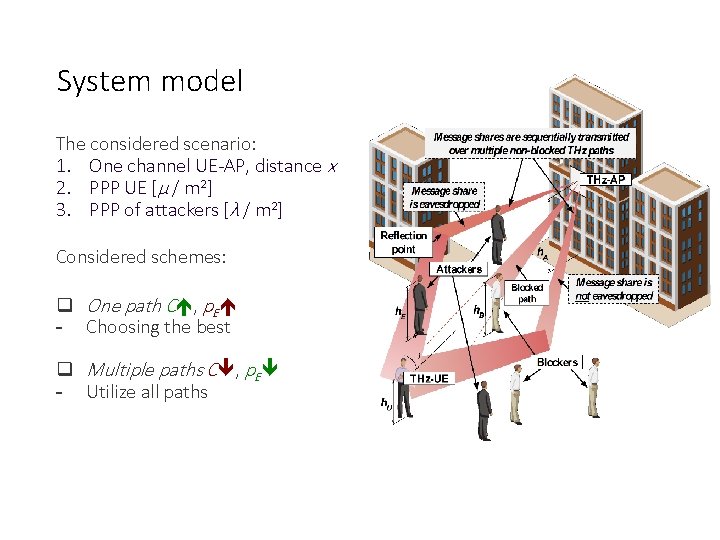
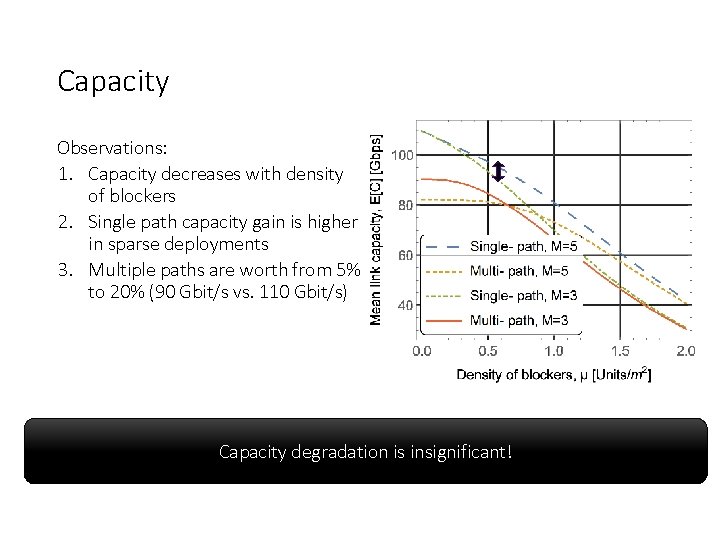
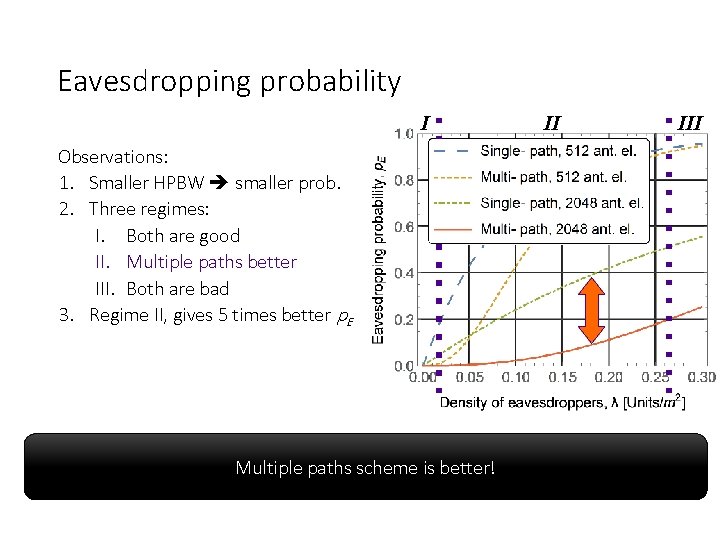
System model The considered scenario: 1. One channel UE-AP, distance x 2. PPP UE [μ / m 2] 3. PPP of attackers [λ / m 2] Considered schemes: One path C , p. E - Choosing the best Multiple paths C , p. E - Utilize all paths
Capacity Observations: 1. Capacity decreases with density of blockers 2. Single path capacity gain is higher in sparse deployments 3. Multiple paths are worth from 5% to 20% (90 Gbit/s vs. 110 Gbit/s) Capacity degradation is insignificant!
Eavesdropping probability I Observations: 1. Smaller HPBW smaller prob. 2. Three regimes: I. Both are good II. Multiple paths better III. Both are bad 3. Regime II, gives 5 times better p. E Multiple paths scheme is better! II III
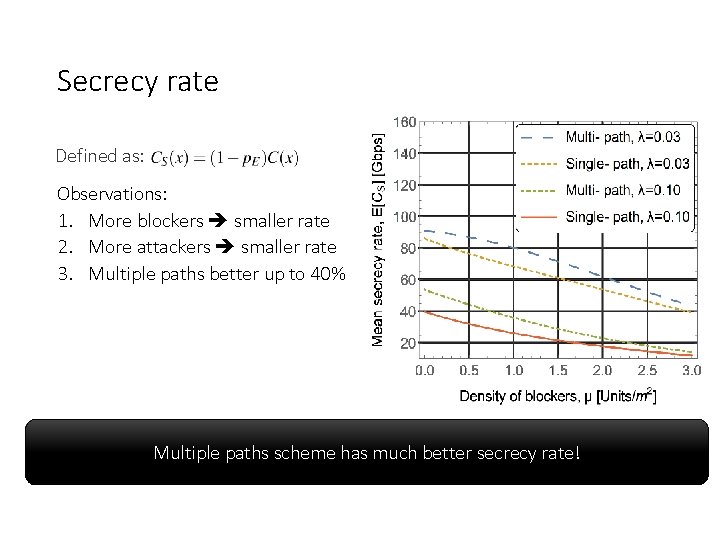
Secrecy rate Defined as: Observations: 1. More blockers smaller rate 2. More attackers smaller rate 3. Multiple paths better up to 40% Multiple paths scheme has much better secrecy rate!