
Terabit Applications What Are They What is Needed
“Terabit Applications: What Are They, What is Needed to Enable Them? " 3 rd Annual ON*VECTOR Terabit LAN Workshop Calit 2@UCSD La Jolla, CA February 28, 2007 Dr. Larry Smarr Director, California Institute for Telecommunications and Information Technology; Harry E. Gruber Professor, Dept. of Computer Science and Engineering Jacobs School of Engineering, UCSD
Toward Terabit Applications: Four Drivers • Data Flow – Global Particle Physics • Giga. Pixel Images – Terabit Web • Supercomputer Simulation Visualization – Cosmology Analysis • Parallel Video Flows – Terabit LAN Opt. IPuter Cine. Grid
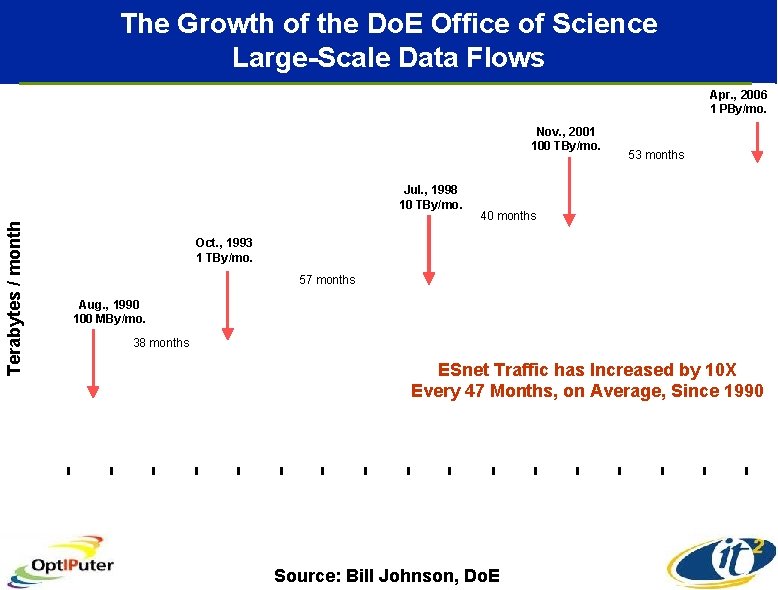
The Growth of the Do. E Office of Science Large-Scale Data Flows Apr. , 2006 1 PBy/mo. Nov. , 2001 100 TBy/mo. Terabytes / month Jul. , 1998 10 TBy/mo. 53 months 40 months Oct. , 1993 1 TBy/mo. 57 months Aug. , 1990 100 MBy/mo. 38 months ESnet Traffic has Increased by 10 X Every 47 Months, on Average, Since 1990 Source: Bill Johnson, Do. E
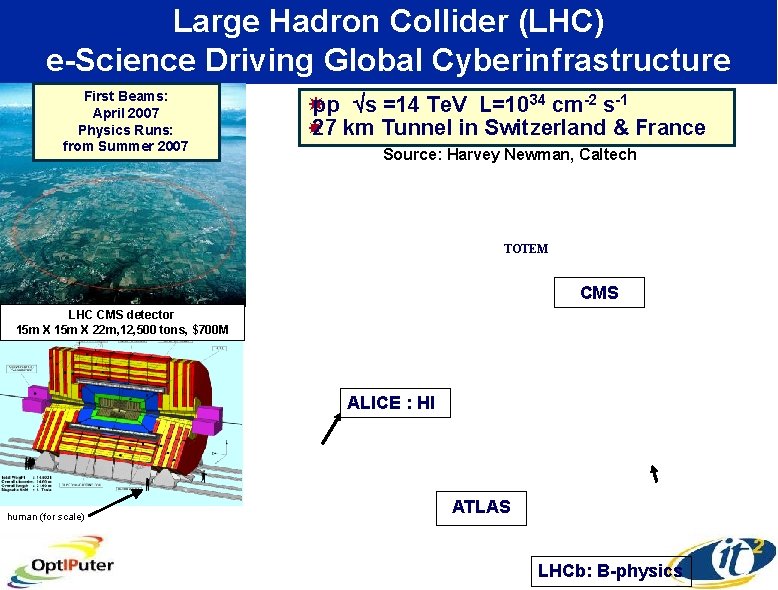
Large Hadron Collider (LHC) e-Science Driving Global Cyberinfrastructure First Beams: April 2007 Physics Runs: from Summer 2007 pp s =14 Te. V L=1034 cm-2 s-1 27 km Tunnel in Switzerland & France Source: Harvey Newman, Caltech TOTEM CMS LHC CMS detector 15 m X 22 m, 12, 500 tons, $700 M ALICE : HI human (for scale) ATLAS LHCb: B-physics

High Energy and Nuclear Physics A Terabit/s WAN by 2013! Source: Harvey Newman, Caltech
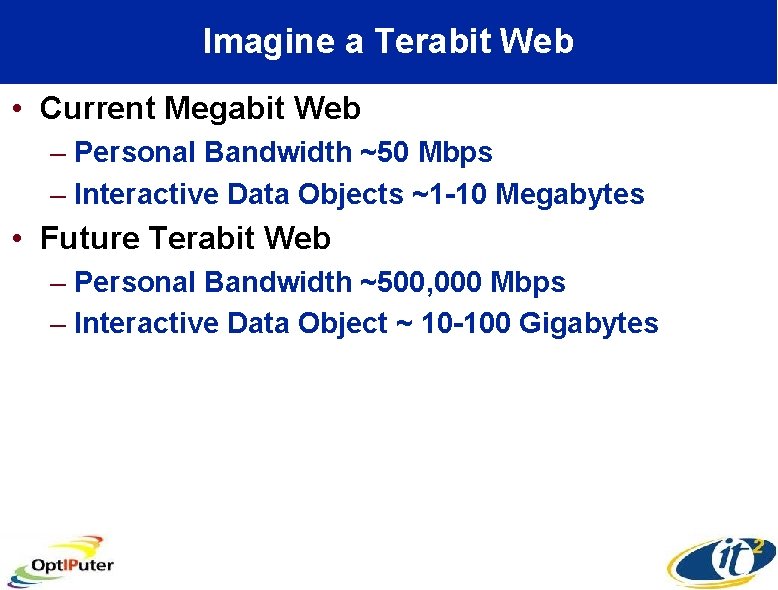
Imagine a Terabit Web • Current Megabit Web – Personal Bandwidth ~50 Mbps – Interactive Data Objects ~1 -10 Megabytes • Future Terabit Web – Personal Bandwidth ~500, 000 Mbps – Interactive Data Object ~ 10 -100 Gigabytes
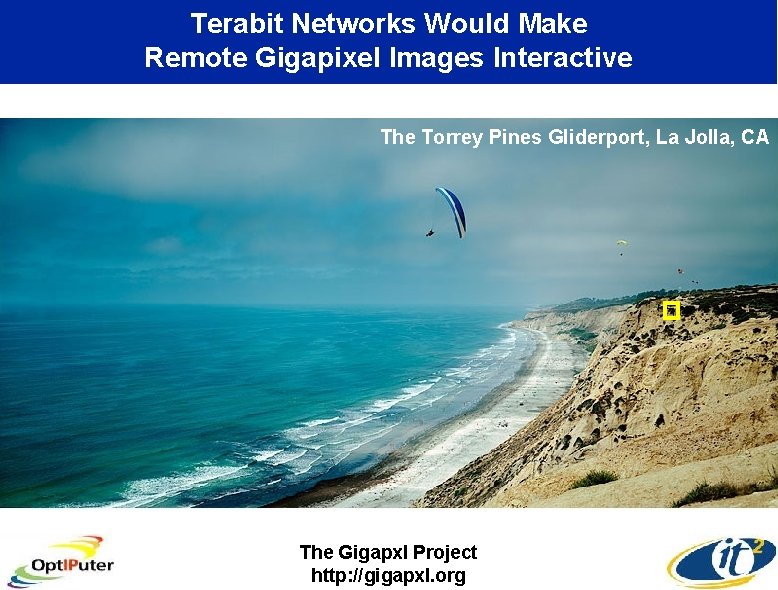
Terabit Networks Would Make Remote Gigapixel Images Interactive The Torrey Pines Gliderport, La Jolla, CA The Gigapxl Project http: //gigapxl. org
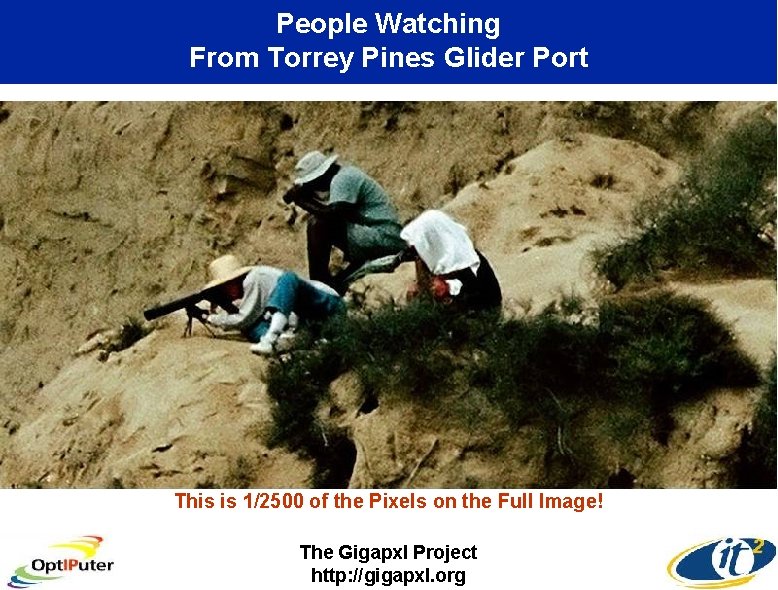
People Watching From Torrey Pines Glider Port This is 1/2500 of the Pixels on the Full Image! The Gigapxl Project http: //gigapxl. org
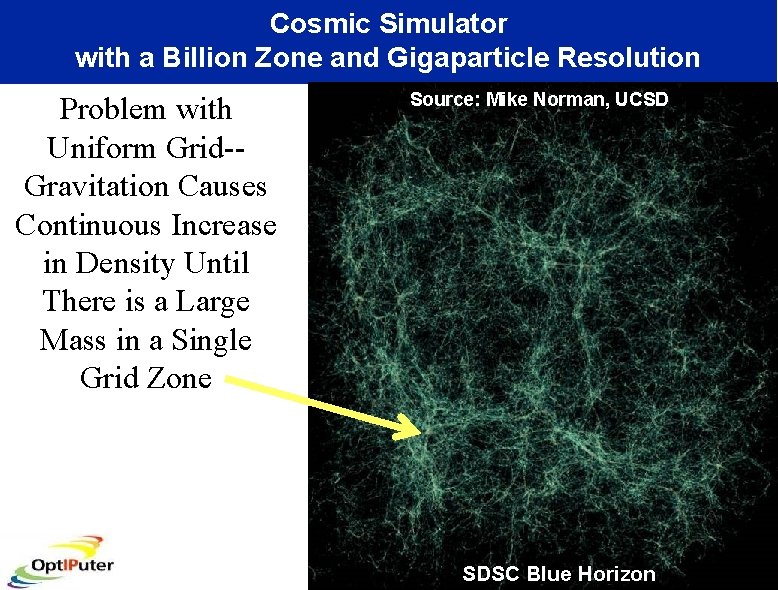
Cosmic Simulator with a Billion Zone and Gigaparticle Resolution Problem with Uniform Grid-Gravitation Causes Continuous Increase in Density Until There is a Large Mass in a Single Grid Zone Source: Mike Norman, UCSD SDSC Blue Horizon
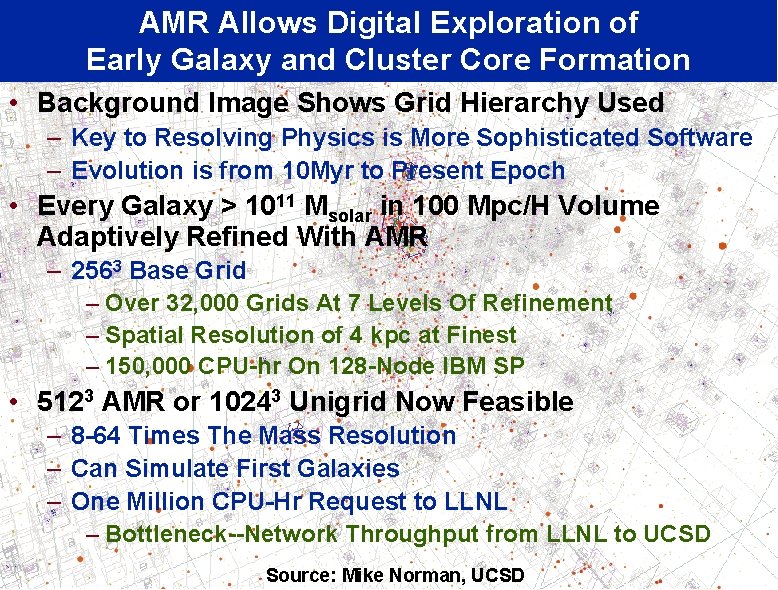
AMR Allows Digital Exploration of Early Galaxy and Cluster Core Formation • Background Image Shows Grid Hierarchy Used – Key to Resolving Physics is More Sophisticated Software – Evolution is from 10 Myr to Present Epoch • Every Galaxy > 1011 Msolar in 100 Mpc/H Volume Adaptively Refined With AMR – 2563 Base Grid – Over 32, 000 Grids At 7 Levels Of Refinement – Spatial Resolution of 4 kpc at Finest – 150, 000 CPU-hr On 128 -Node IBM SP • 5123 AMR or 10243 Unigrid Now Feasible – 8 -64 Times The Mass Resolution – Can Simulate First Galaxies – One Million CPU-Hr Request to LLNL – Bottleneck--Network Throughput from LLNL to UCSD Source: Mike Norman, UCSD
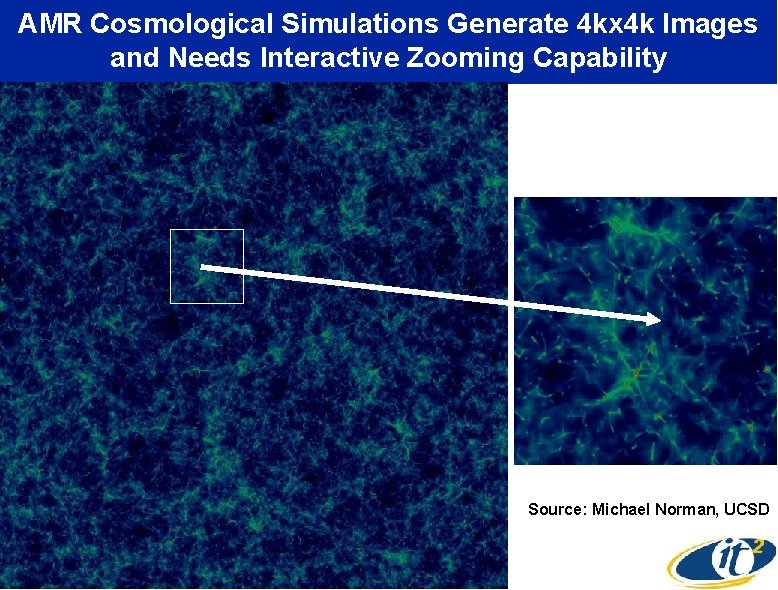
AMR Cosmological Simulations Generate 4 kx 4 k Images and Needs Interactive Zooming Capability Source: Michael Norman, UCSD
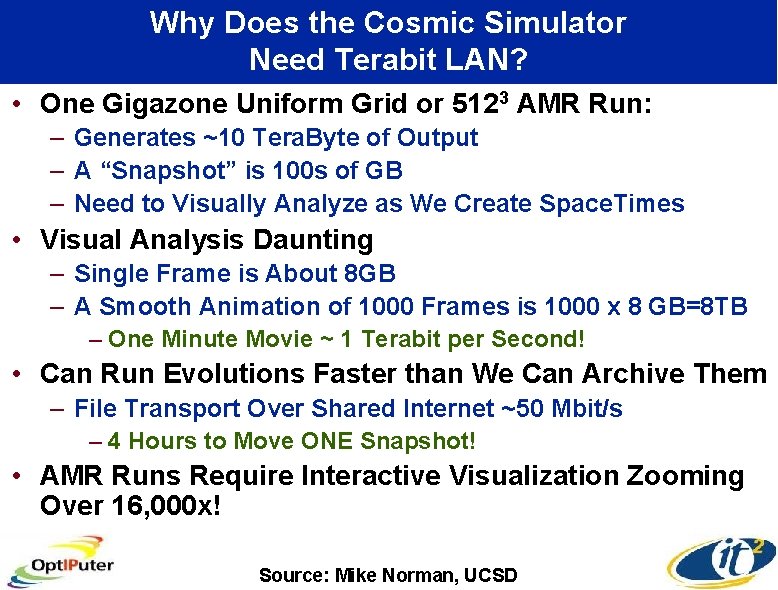
Why Does the Cosmic Simulator Need Terabit LAN? • One Gigazone Uniform Grid or 5123 AMR Run: – Generates ~10 Tera. Byte of Output – A “Snapshot” is 100 s of GB – Need to Visually Analyze as We Create Space. Times • Visual Analysis Daunting – Single Frame is About 8 GB – A Smooth Animation of 1000 Frames is 1000 x 8 GB=8 TB – One Minute Movie ~ 1 Terabit per Second! • Can Run Evolutions Faster than We Can Archive Them – File Transport Over Shared Internet ~50 Mbit/s – 4 Hours to Move ONE Snapshot! • AMR Runs Require Interactive Visualization Zooming Over 16, 000 x! Source: Mike Norman, UCSD
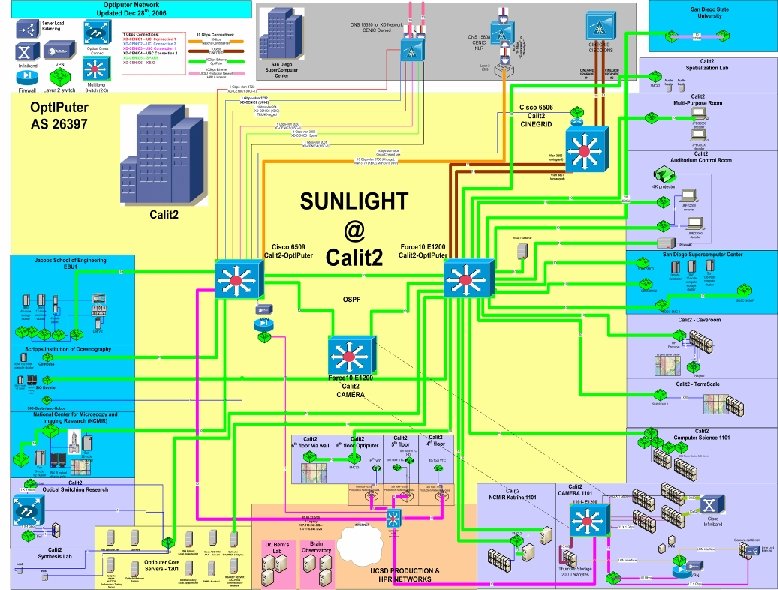
Building a Terabit LAN at Calit 2
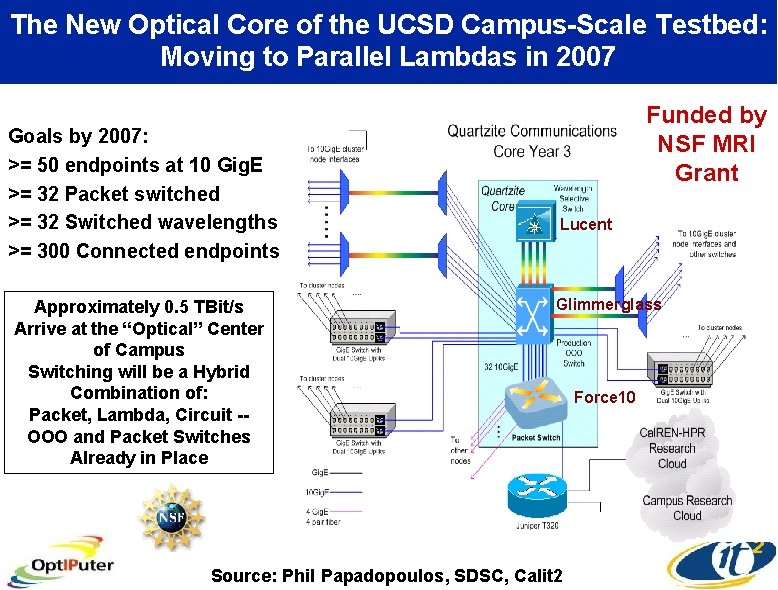
The New Optical Core of the UCSD Campus-Scale Testbed: Moving to Parallel Lambdas in 2007 Goals by 2007: >= 50 endpoints at 10 Gig. E >= 32 Packet switched >= 32 Switched wavelengths >= 300 Connected endpoints Approximately 0. 5 TBit/s Arrive at the “Optical” Center of Campus Switching will be a Hybrid Combination of: Packet, Lambda, Circuit -OOO and Packet Switches Already in Place Funded by NSF MRI Grant Lucent Glimmerglass Source: Phil Papadopoulos, SDSC, Calit 2 Force 10
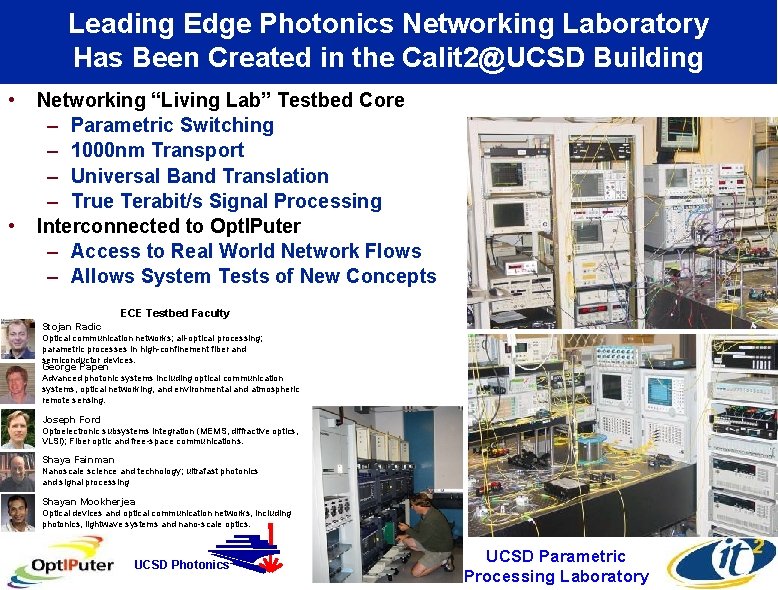
Leading Edge Photonics Networking Laboratory Has Been Created in the Calit 2@UCSD Building • • Networking “Living Lab” Testbed Core – Parametric Switching – 1000 nm Transport – Universal Band Translation – True Terabit/s Signal Processing Interconnected to Opt. IPuter – Access to Real World Network Flows – Allows System Tests of New Concepts ECE Testbed Faculty Stojan Radic Optical communication networks; all-optical processing; parametric processes in high-confinement fiber and semiconductor devices. George Papen Advanced photonic systems including optical communication systems, optical networking, and environmental and atmospheric remote sensing. Joseph Ford Optoelectronic subsystems integration (MEMS, diffractive optics, VLSI); Fiber optic and free-space communications. Shaya Fainman Nanoscale science and technology; ultrafast photonics and signal processing Shayan Mookherjea Optical devices and optical communication networks, including photonics, lightwave systems and nano-scale optics. UCSD Photonics UCSD Parametric Processing Laboratory
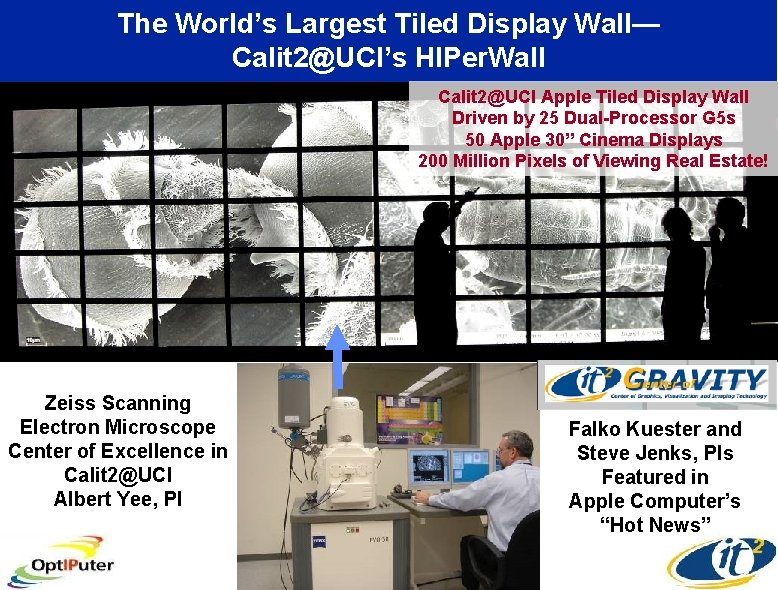
The World’s Largest Tiled Display Wall— Calit 2@UCI’s HIPer. Wall Calit 2@UCI Apple Tiled Display Wall Driven by 25 Dual-Processor G 5 s 50 Apple 30” Cinema Displays 200 Million Pixels of Viewing Real Estate! Zeiss Scanning Electron Microscope Center of Excellence in Calit 2@UCI Albert Yee, PI Falko Kuester and Steve Jenks, PIs Featured in Apple Computer’s “Hot News”
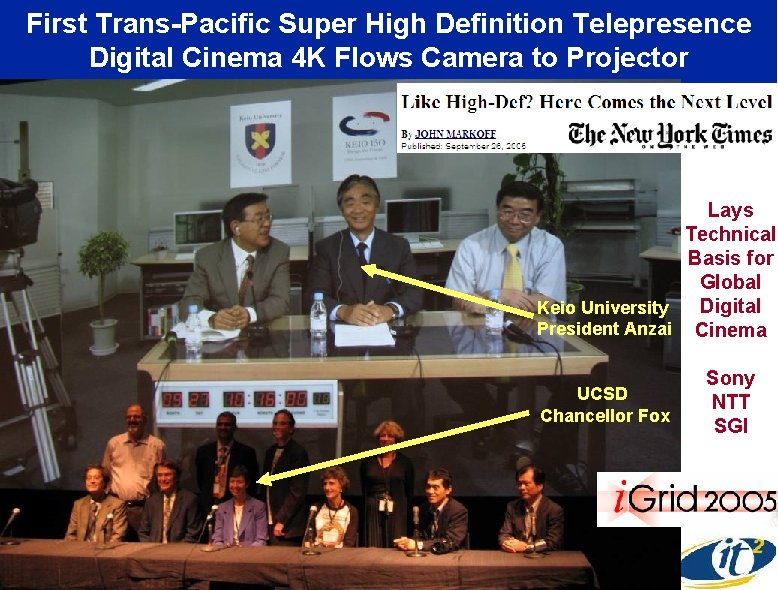
First Trans-Pacific Super High Definition Telepresence Digital Cinema 4 K Flows Camera to Projector Lays Technical Basis for Global Digital Keio University President Anzai Cinema UCSD Chancellor Fox Sony NTT SGI
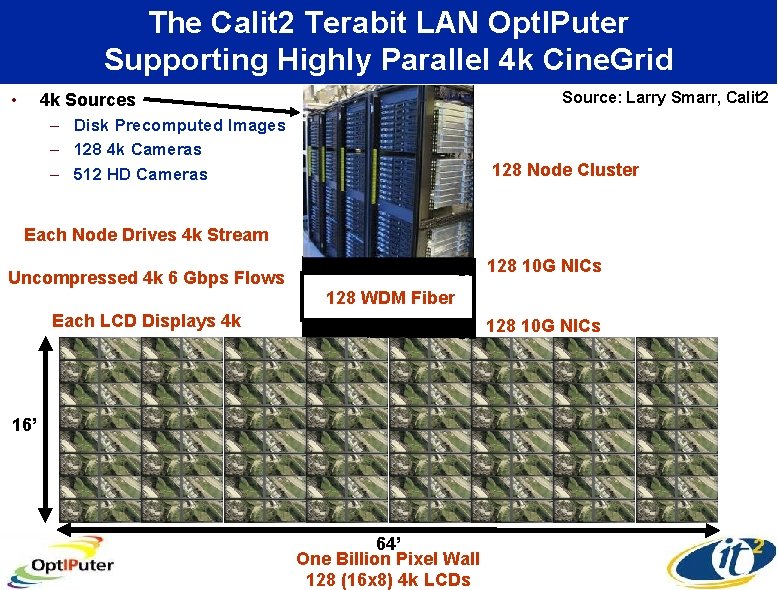
The Calit 2 Terabit LAN Opt. IPuter Supporting Highly Parallel 4 k Cine. Grid • Source: Larry Smarr, Calit 2 4 k Sources – Disk Precomputed Images – 128 4 k Cameras – 512 HD Cameras 128 Node Cluster Each Node Drives 4 k Stream Uncompressed 4 k 6 Gbps Flows 128 10 G NICs 128 WDM Fiber Each LCD Displays 4 k 128 10 G NICs 16’ 64’ One Billion Pixel Wall 128 (16 x 8) 4 k LCDs
- Slides: 19