
TEPs Guide To A Successful Interview Introduction TEP
- Slides: 28
TEP’s Guide To A Successful Interview
Introduction � � � TEP has defined twelve “core competencies” employees are expected to utilize on the job. A core competency is a behavior, or a group of behaviors necessary to accomplish a specific work task or goal, or the most basic level of competency required for successful job performance. A list and definition of these are included in this power point. Each job posting will include a list of competencies needed for that particular job and interview questions will be based on that list.
Introduction (contd. ) � � � TEP uses a behavioral interview approach. Behavioral interviewing is based on the belief that the single best predictor of future behavior is a person’s past behavior. Meaning in a similar or same circumstance, people are likely to react and/or behave in the same or a consistent manner. Applicants may be assessed on two different types of competencies during any job interview: technical competencies and interpersonal competencies.
Introduction (contd. ) � � � Technical competencies are the specific skills, knowledge and abilities required to work in a job. For example, driving a forklift, computer programming, using a welding torch, etc. , are examples of technical competency. Interpersonal competencies are a person’s demonstrated past behaviors and how they have dealt with situations in the past.
Introduction (contd. ) � Interview answers should be based on how those past behaviors specifically relate to the TEP core competencies listed on the job posting. � In some interviews, a role play demonstrating customer service skills may be required. You will find information and practice scenarios for role play at the next class.
Introduction (contd. ) � Applicants are strongly encouraged to bring the completed worksheets with them to an interview to use as an aide or notes to keep them on track.
TEP Core Competencies � � � TEP has chosen 12 core competencies that every employee is expected to demonstrate on the job, throughout their career. Interviews can be focused on any number of these competencies. Review the following core competency definitions and on the worksheets and write specific examples of how you have applied the competencies in your past work, school or life experiences.
TEP Core Competencies 1. Customer Focus ◦ Is dedicated to meeting the expectations and requirements of internal and external customers; ◦ Gets first-hand customer information uses it for improvements in products and services ◦ Talks and acts with customers in mind ◦ Establishes and maintains effective relationships with customers and gains their trust and respect.
TEP Core Competencies 2. Creativity ◦ Comes up with a lot of new and unique ideas ◦ Easily makes connections among previously unrelated notions ◦ Tends to be seen as original and good in brainstorming settings.
TEP Core Competencies 3. Command Skills ◦ Is not afraid to take charge when trouble comes ◦ Does whatever it takes to get the job ◦ Done despite resistance ◦ Takes unpopular stands if necessary ◦ Faces difficult situations
TEP Core Competencies 3. Command Skills (contd. ) ◦ With guts and tenacity ◦ Encourages direct and tough debate but isn’t afraid to end it and move on ◦ Is looked to for direction in a crisis; relishes leading.
TEP Core Competencies 4. Dealing with Ambiguity ◦ Can effectively cope with change ◦ Can shift gears comfortably ◦ Can decide and act without having the total picture ◦ Isn’t upset when things are up in the air, doesn’t have to finish things before moving on can comfortably handle risk and uncertainty.
TEP Core Competencies 5. Develops People and Self ◦ Views people, their knowledge, and capabilities as the organization’s core assets. ◦ Supports the structures and policies that encourage employees to continuously seek improvement. ◦ Creates development possibilities for self and others.
TEP Core Competencies 6. Effectively Manages Change ◦ Accepts and successfully adapts to change. Helps others adapt and remain effective.
TEP Core Competencies 7. Financial Intelligence ◦ Possesses financial understanding and demonstrates the ability to foster and lead cost efficient initiatives without sacrificing quality or core values.
TEP Core Competencies 8. Informing ◦ Provides the information people need to know to do their jobs and to feel good about being a member of the team, unit, and/or the organization ◦ Provides direct feedback and information to individuals so that they can make accurate decisions ◦ Is timely with information
TEP Core Competencies 9. Process Management ◦ Good at figuring out the processes necessary to get things done ◦ Knows how to organize people and activities ◦ Understands how to separate and combine tasks into efficient work flow ◦ Knows what to measure and how to measure it ◦ Can see opportunities for synergy and integration where others can’t ◦ Can simplify complex processes gets more out of fewer resources
TEP Core Competencies 10. Planning ◦ Accurately scopes out length and difficulty of tasks and projects; sets objectives and goals ◦ Breaks down work into the process steps ◦ Develops schedules and task/people assignments ◦ Anticipates and adjusts for
TEP Core Competencies 11. Results Oriented ◦ Is willing and able to be competitive and take risks in growing the organization’s profitability, while holding self and others accountable. ◦ Seeks to accomplish critical tasks with measurable results. ◦ Personally strives for excellence in performance by surpassing established standards. “Under promises and over delivers. ”
TEP Core Competencies 12. Technical Learning ◦ Picks up on technical things quickly ◦ Can learn new skills and knowledge ◦ Is good at learning new industry, company, product, or technical knowledge as well as business skills ◦ Does well in technical courses and business seminars.
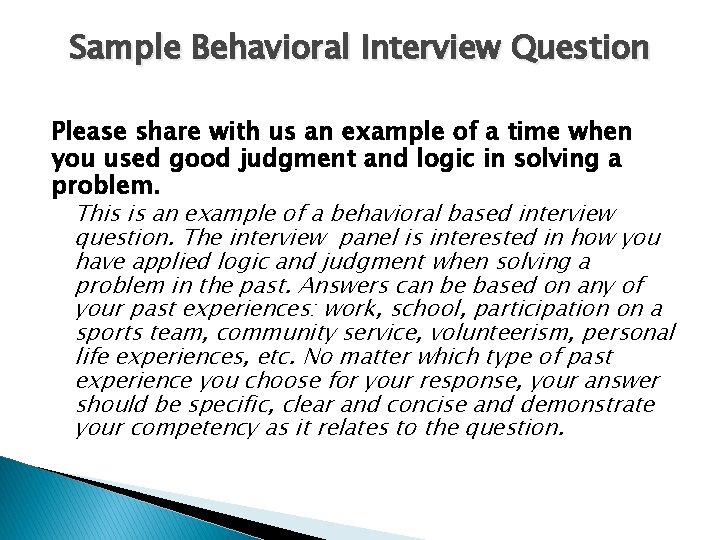
Sample Behavioral Interview Question Please share with us an example of a time when you used good judgment and logic in solving a problem. This is an example of a behavioral based interview question. The interview panel is interested in how you have applied logic and judgment when solving a problem in the past. Answers can be based on any of your past experiences: work, school, participation on a sports team, community service, volunteerism, personal life experiences, etc. No matter which type of past experience you choose for your response, your answer should be specific, clear and concise and demonstrate your competency as it relates to the question.
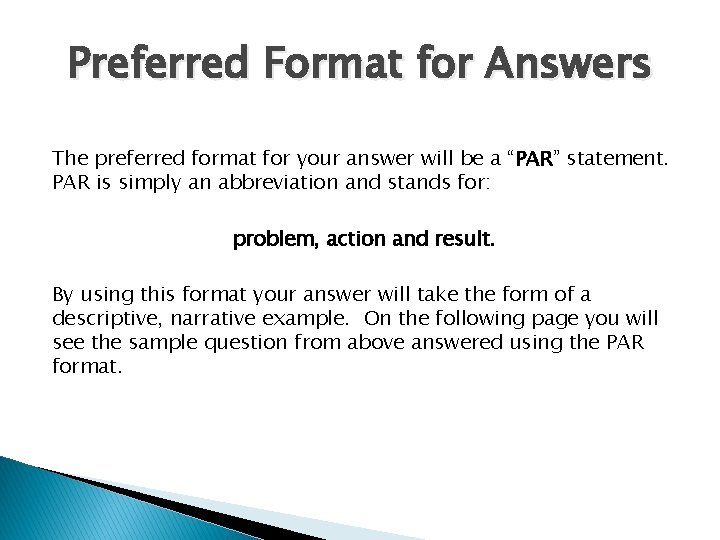
Preferred Format for Answers The preferred format for your answer will be a “PAR” statement. PAR is simply an abbreviation and stands for: problem, action and result. By using this format your answer will take the form of a descriptive, narrative example. On the following page you will see the sample question from above answered using the PAR format.
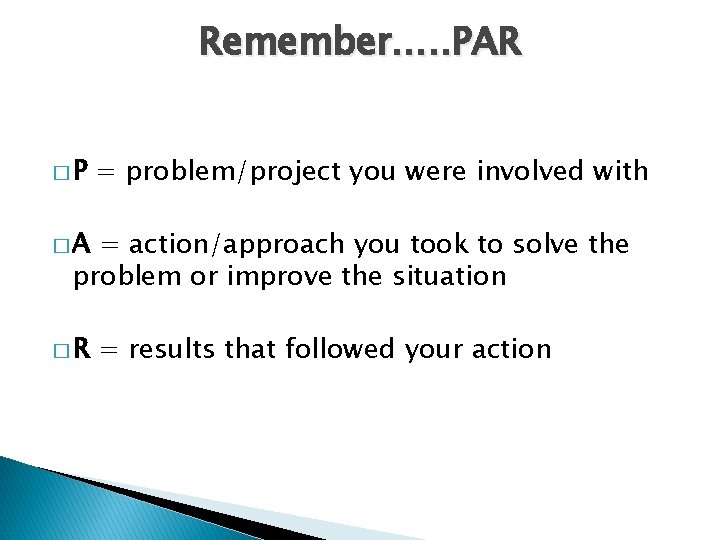
Remember…. . PAR �P = problem/project you were involved with �A = action/approach you took to solve the problem or improve the situation �R = results that followed your action
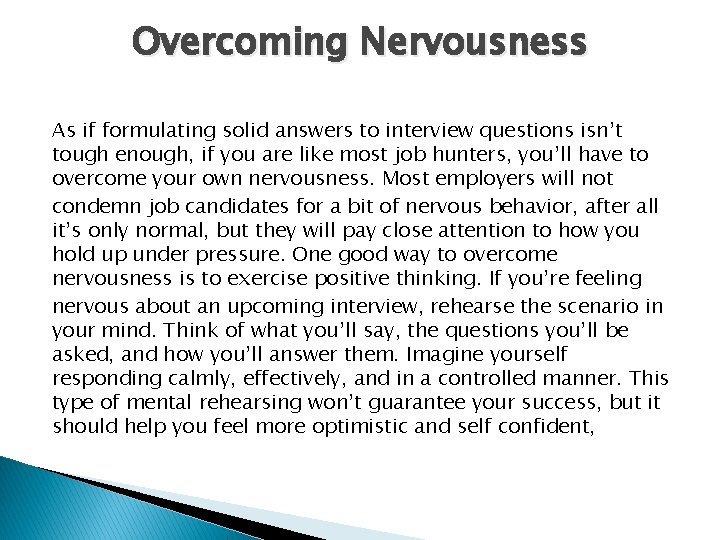
Overcoming Nervousness As if formulating solid answers to interview questions isn’t tough enough, if you are like most job hunters, you’ll have to overcome your own nervousness. Most employers will not condemn job candidates for a bit of nervous behavior, after all it’s only normal, but they will pay close attention to how you hold up under pressure. One good way to overcome nervousness is to exercise positive thinking. If you’re feeling nervous about an upcoming interview, rehearse the scenario in your mind. Think of what you’ll say, the questions you’ll be asked, and how you’ll answer them. Imagine yourself responding calmly, effectively, and in a controlled manner. This type of mental rehearsing won’t guarantee your success, but it should help you feel more optimistic and self confident,
Overcoming Nervousness (contd. ) This type of mental rehearsing won’t guarantee your success, but it should help you feel more optimistic and self confident, which will in fact influence your final presentation in a positive way. Also, you should practice interviewing as much as you can, especially practicing out loud with another person. You will become more confident and your answers will become more polished with each interview you have.
Key Points to Remember � � � Listen to the question. Understand exactly what is being asked. If you are unsure, ask for clarification or use the restatement technique. (”If I understand you correctly, you are asking me to tell you about a time that I ……? ”) Take time to think through the question and make sure to use facts and details that pertain to the question being asked before you start to answer. Take your time, there is no rush. If there is silence in the room while you prepare your thoughts, it is both normal and acceptable.
Key Points to Remember (contd. ) � � Use the PAR model to answer the question. Focus on your strengths and accomplishments, emphasize how they can be applied in the position you are interviewing for. Sell yourself to the interview panel! Remember that the basic question on the interviewer’s mind is: “What can this person do for us? ”
Key Points to Remember (contd. ) YEAH-BUT Is it really worth my time to do all this preparation? If I’m too prepared, my answers will sound canned. COACH’S COMEBACK Wrong! Preparing specific interview answers will take you only two hours or so – time that will make you a stronger competitor in your interviews. And it’s not preparation that makes you sound “canned, ” its incomplete preparation. In order to be really good in your interview, practice giving specific examples of your skills aloud until you feel comfortable doing it. Paul C. Green Get Hired!