
Tenth Edition Vector Mechanics for Engineers Statics Introduction

- Slides: 8
Tenth Edition Vector Mechanics for Engineers: Statics Introduction • Treatment of a body as a single particle is not always possible. In general, the size of the body and the specific points of application of the forces must be considered. • Current chapter describes the effect of forces exerted on a rigid body and how to replace a given system of forces with a simpler equivalent system. • First, we need to learn some new statics concepts, including: • moment of a force about a point • moment of a force about an axis • moment due to a couple • Any system of forces acting on a rigid body can be replaced by an equivalent system consisting of one force acting at a given point and one couple. © 2013 The Mc. Graw-Hill Companies, Inc. All rights reserved. 3 -1
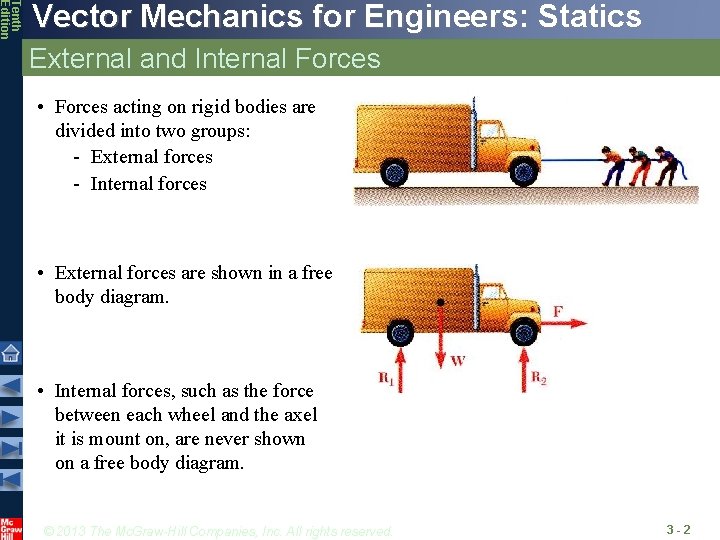
Tenth Edition Vector Mechanics for Engineers: Statics External and Internal Forces • Forces acting on rigid bodies are divided into two groups: - External forces - Internal forces • External forces are shown in a free body diagram. • Internal forces, such as the force between each wheel and the axel it is mount on, are never shown on a free body diagram. © 2013 The Mc. Graw-Hill Companies, Inc. All rights reserved. 3 -2
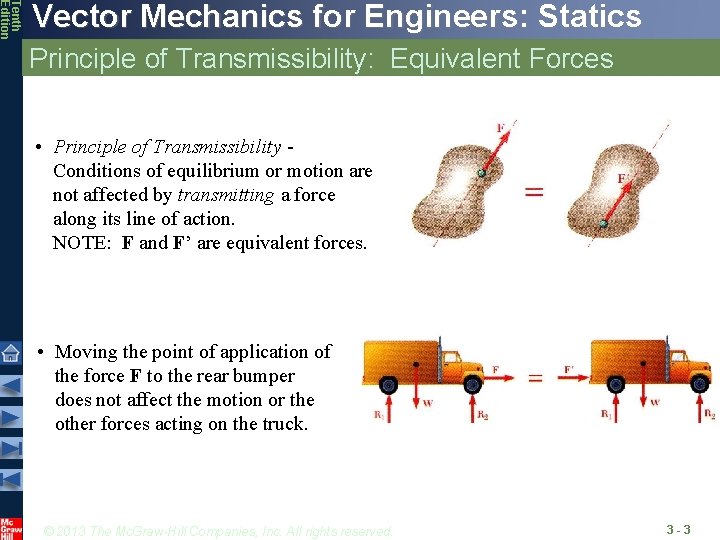
Tenth Edition Vector Mechanics for Engineers: Statics Principle of Transmissibility: Equivalent Forces • Principle of Transmissibility Conditions of equilibrium or motion are not affected by transmitting a force along its line of action. NOTE: F and F’ are equivalent forces. • Moving the point of application of the force F to the rear bumper does not affect the motion or the other forces acting on the truck. © 2013 The Mc. Graw-Hill Companies, Inc. All rights reserved. 3 -3
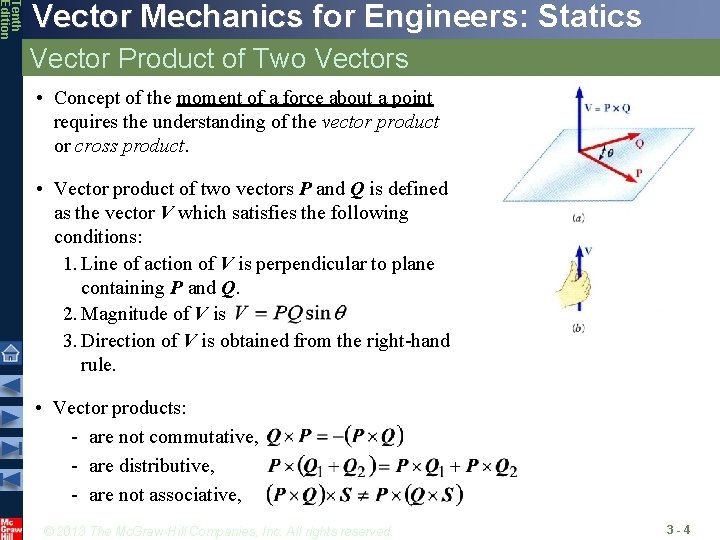
Tenth Edition Vector Mechanics for Engineers: Statics Vector Product of Two Vectors • Concept of the moment of a force about a point requires the understanding of the vector product or cross product. • Vector product of two vectors P and Q is defined as the vector V which satisfies the following conditions: 1. Line of action of V is perpendicular to plane containing P and Q. 2. Magnitude of V is 3. Direction of V is obtained from the right-hand rule. • Vector products: - are not commutative, - are distributive, - are not associative, © 2013 The Mc. Graw-Hill Companies, Inc. All rights reserved. 3 -4
Tenth Edition Vector Mechanics for Engineers: Statics Vector Products: Rectangular Components • Vector products of Cartesian unit vectors, • Vector products in terms of rectangular coordinates © 2013 The Mc. Graw-Hill Companies, Inc. All rights reserved. 3 -5
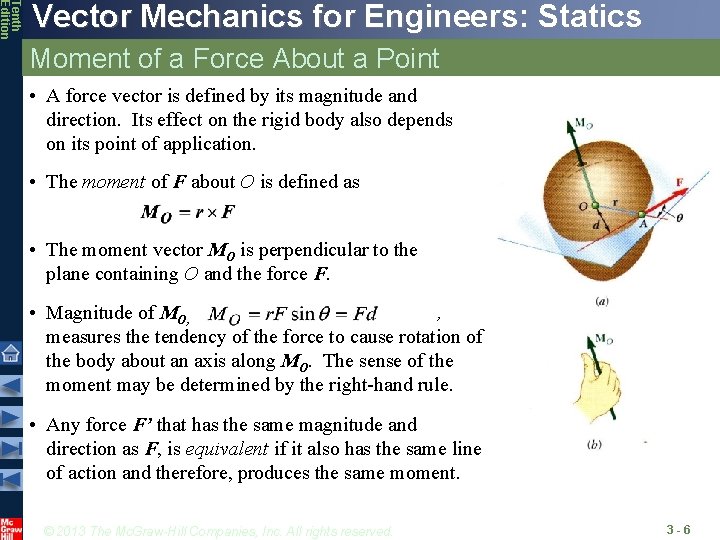
Tenth Edition Vector Mechanics for Engineers: Statics Moment of a Force About a Point • A force vector is defined by its magnitude and direction. Its effect on the rigid body also depends on its point of application. • The moment of F about O is defined as • The moment vector MO is perpendicular to the plane containing O and the force F. • Magnitude of MO, , measures the tendency of the force to cause rotation of the body about an axis along MO. The sense of the moment may be determined by the right-hand rule. • Any force F’ that has the same magnitude and direction as F, is equivalent if it also has the same line of action and therefore, produces the same moment. © 2013 The Mc. Graw-Hill Companies, Inc. All rights reserved. 3 -6
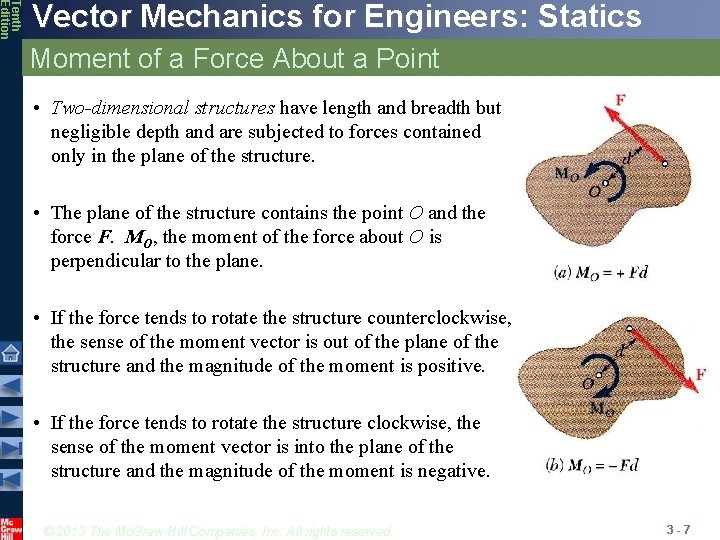
Tenth Edition Vector Mechanics for Engineers: Statics Moment of a Force About a Point • Two-dimensional structures have length and breadth but negligible depth and are subjected to forces contained only in the plane of the structure. • The plane of the structure contains the point O and the force F. MO, the moment of the force about O is perpendicular to the plane. • If the force tends to rotate the structure counterclockwise, the sense of the moment vector is out of the plane of the structure and the magnitude of the moment is positive. • If the force tends to rotate the structure clockwise, the sense of the moment vector is into the plane of the structure and the magnitude of the moment is negative. © 2013 The Mc. Graw-Hill Companies, Inc. All rights reserved. 3 -7
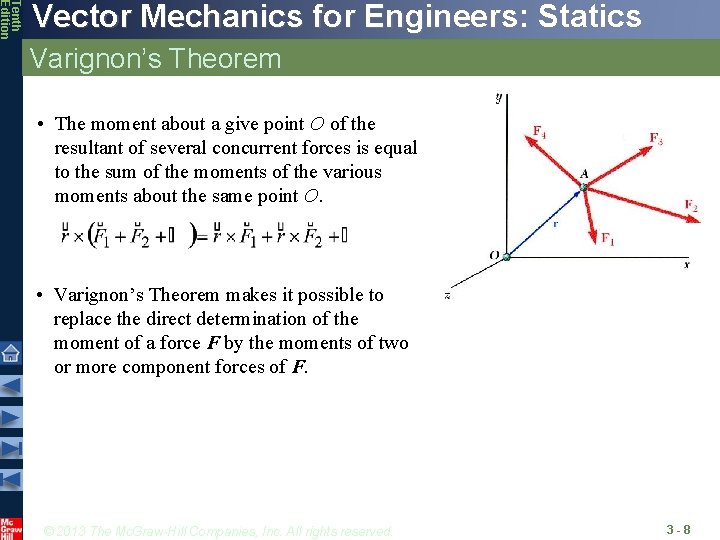
Tenth Edition Vector Mechanics for Engineers: Statics Varignon’s Theorem • The moment about a give point O of the resultant of several concurrent forces is equal to the sum of the moments of the various moments about the same point O. • Varignon’s Theorem makes it possible to replace the direct determination of the moment of a force F by the moments of two or more component forces of F. © 2013 The Mc. Graw-Hill Companies, Inc. All rights reserved. 3 -8