
Tenth Edition CHAPTER 1 1 VECTOR MECHANICS FOR
- Slides: 61
Tenth Edition CHAPTER 1 1 VECTOR MECHANICS FOR ENGINEERS: DYNAMICS Ferdinand P. Beer E. Russell Johnston, Jr. Phillip J. Cornwell Kinematics of Particles Lecture Notes: Brian P. Self California Polytechnic State University © 2013 The Mc. Graw-Hill Companies, Inc. All rights reserved.
Tenth Edition Vector Mechanics for Engineers: Dynamics Contents Introduction Rectilinear Motion: Position, Velocity & Acceleration Determination of the Motion of a Particle Uniform Rectilinear-Motion Uniformly Accelerated Rectilinear. Motion of Several Particles: Relative Motion Sample Problem 11. 4 Motion of Several Particles: Dependent Motion Graphical Solution of Rectilinear. Motion Problems Other Graphical Methods Curvilinear Motion: Position, Velocity & Acceleration Derivatives of Vector Functions Rectangular Components of Velocity and Acceleration Motion Relative to a Frame in Translation Tangential and Normal Components Radial and Transverse Components © 2013 The Mc. Graw-Hill Companies, Inc. All rights reserved. 11 - 2
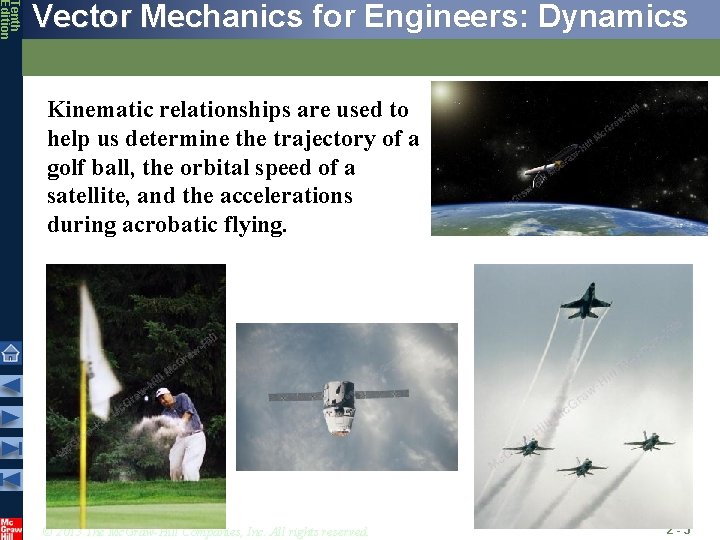
Tenth Edition Vector Mechanics for Engineers: Dynamics Kinematic relationships are used to help us determine the trajectory of a golf ball, the orbital speed of a satellite, and the accelerations during acrobatic flying. © 2013 The Mc. Graw-Hill Companies, Inc. All rights reserved. 2 -3
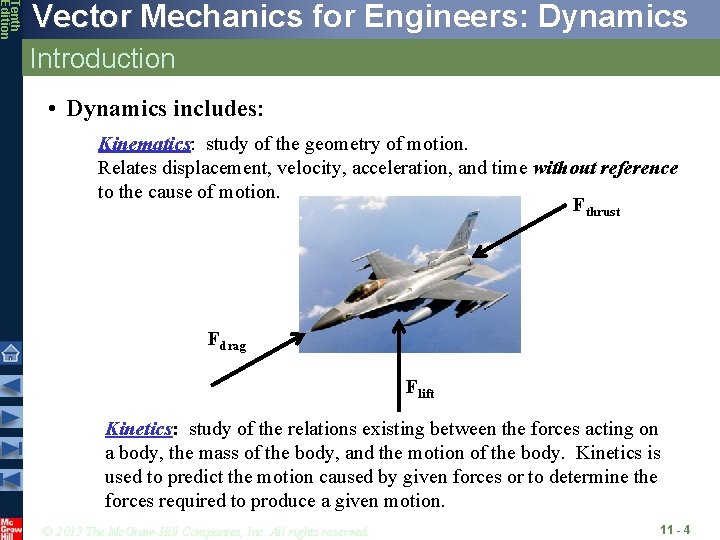
Tenth Edition Vector Mechanics for Engineers: Dynamics Introduction • Dynamics includes: Kinematics: study of the geometry of motion. Relates displacement, velocity, acceleration, and time without reference to the cause of motion. Fthrust Fdrag Flift Kinetics: study of the relations existing between the forces acting on a body, the mass of the body, and the motion of the body. Kinetics is used to predict the motion caused by given forces or to determine the forces required to produce a given motion. © 2013 The Mc. Graw-Hill Companies, Inc. All rights reserved. 11 - 4
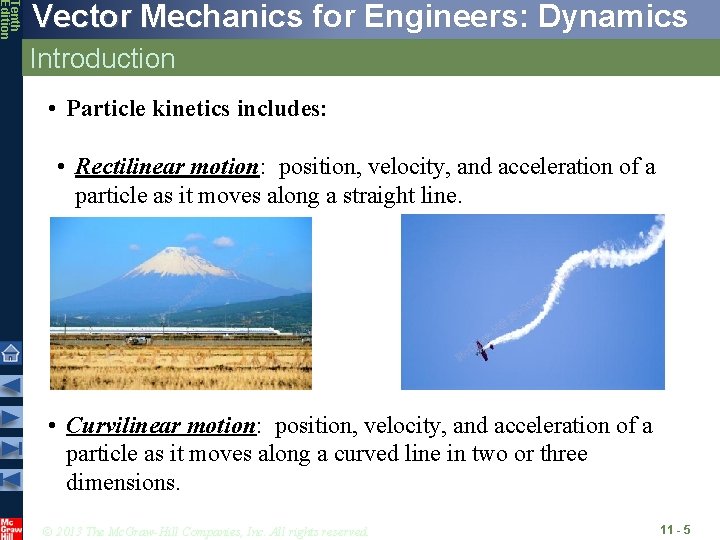
Tenth Edition Vector Mechanics for Engineers: Dynamics Introduction • Particle kinetics includes: • Rectilinear motion: position, velocity, and acceleration of a particle as it moves along a straight line. • Curvilinear motion: position, velocity, and acceleration of a particle as it moves along a curved line in two or three dimensions. © 2013 The Mc. Graw-Hill Companies, Inc. All rights reserved. 11 - 5
Tenth Edition Vector Mechanics for Engineers: Dynamics Helpful Videos Newton’s three laws of motion: https: //youtu. be/mn 34 mnn. Dn. KU Position, velocity, acceleration: https: //youtu. be/4 d. Crkp 8 qg. LU Horizontal motion: https: //youtu. be/hp. Wu. Zh 6 o. Tew Vertical motion: https: //youtu. be/K 8 i. Iu 2 OW 7_E © 2013 The Mc. Graw-Hill Companies, Inc. All rights reserved. 2 -6
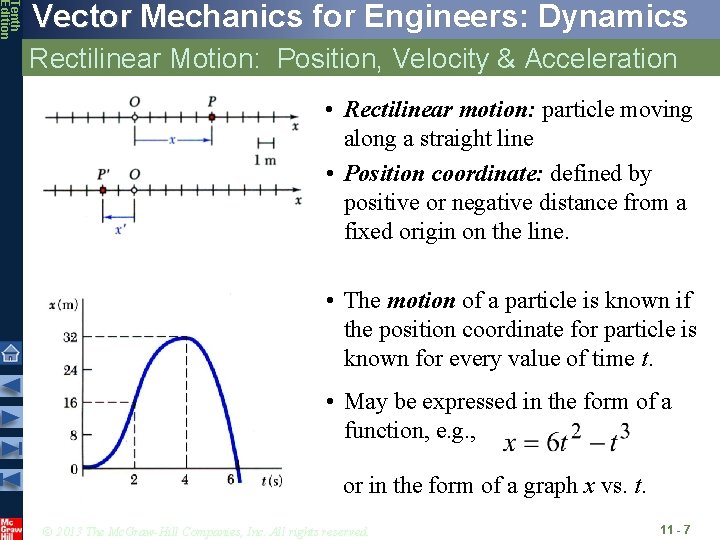
Tenth Edition Vector Mechanics for Engineers: Dynamics Rectilinear Motion: Position, Velocity & Acceleration • Rectilinear motion: particle moving along a straight line • Position coordinate: defined by positive or negative distance from a fixed origin on the line. • The motion of a particle is known if the position coordinate for particle is known for every value of time t. • May be expressed in the form of a function, e. g. , or in the form of a graph x vs. t. © 2013 The Mc. Graw-Hill Companies, Inc. All rights reserved. 11 - 7
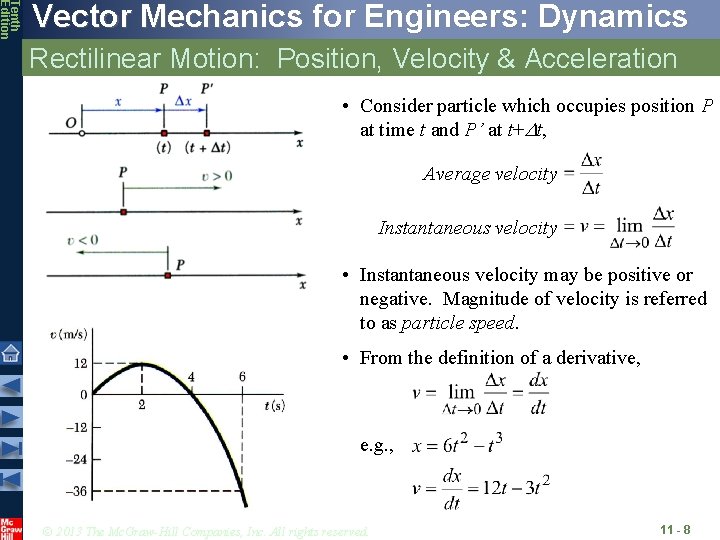
Tenth Edition Vector Mechanics for Engineers: Dynamics Rectilinear Motion: Position, Velocity & Acceleration • Consider particle which occupies position P at time t and P’ at t+Dt, Average velocity Instantaneous velocity • Instantaneous velocity may be positive or negative. Magnitude of velocity is referred to as particle speed. • From the definition of a derivative, e. g. , © 2013 The Mc. Graw-Hill Companies, Inc. All rights reserved. 11 - 8
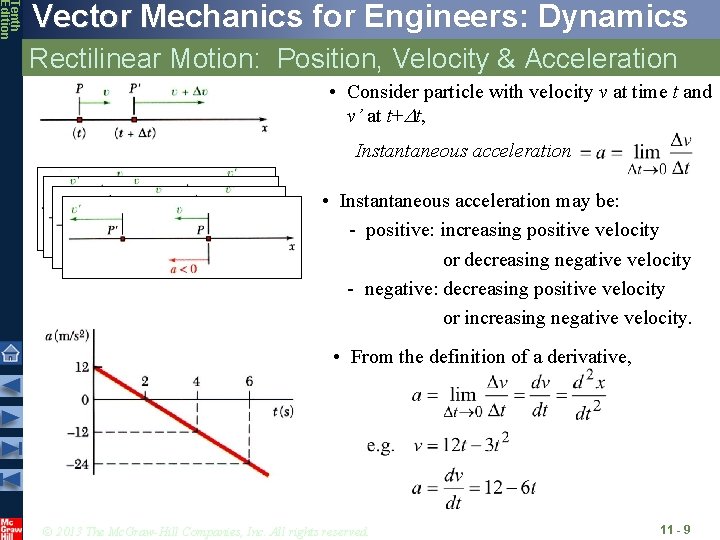
Tenth Edition Vector Mechanics for Engineers: Dynamics Rectilinear Motion: Position, Velocity & Acceleration • Consider particle with velocity v at time t and v’ at t+Dt, Instantaneous acceleration • Instantaneous acceleration may be: - positive: increasing positive velocity or decreasing negative velocity - negative: decreasing positive velocity or increasing negative velocity. • From the definition of a derivative, © 2013 The Mc. Graw-Hill Companies, Inc. All rights reserved. 11 - 9
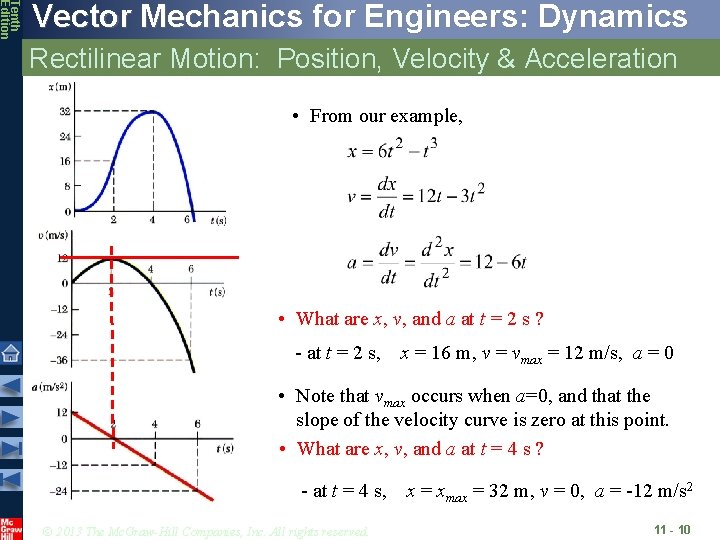
Tenth Edition Vector Mechanics for Engineers: Dynamics Rectilinear Motion: Position, Velocity & Acceleration • From our example, • What are x, v, and a at t = 2 s ? - at t = 2 s, x = 16 m, v = vmax = 12 m/s, a = 0 • Note that vmax occurs when a=0, and that the slope of the velocity curve is zero at this point. • What are x, v, and a at t = 4 s ? - at t = 4 s, © 2013 The Mc. Graw-Hill Companies, Inc. All rights reserved. x = xmax = 32 m, v = 0, a = -12 m/s 2 11 - 10
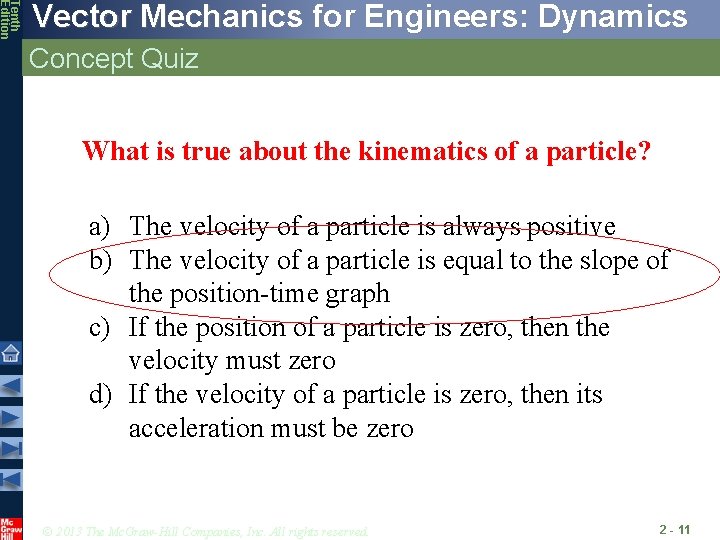
Tenth Edition Vector Mechanics for Engineers: Dynamics Concept Quiz What is true about the kinematics of a particle? a) The velocity of a particle is always positive b) The velocity of a particle is equal to the slope of the position-time graph c) If the position of a particle is zero, then the velocity must zero d) If the velocity of a particle is zero, then its acceleration must be zero © 2013 The Mc. Graw-Hill Companies, Inc. All rights reserved. 2 - 11
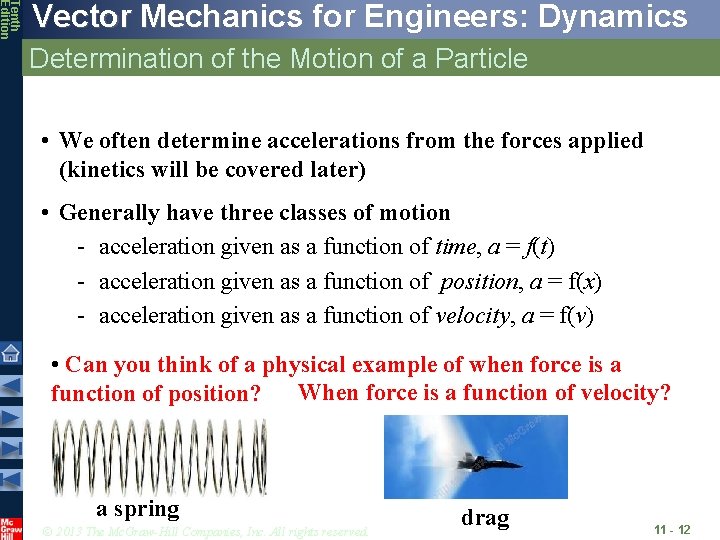
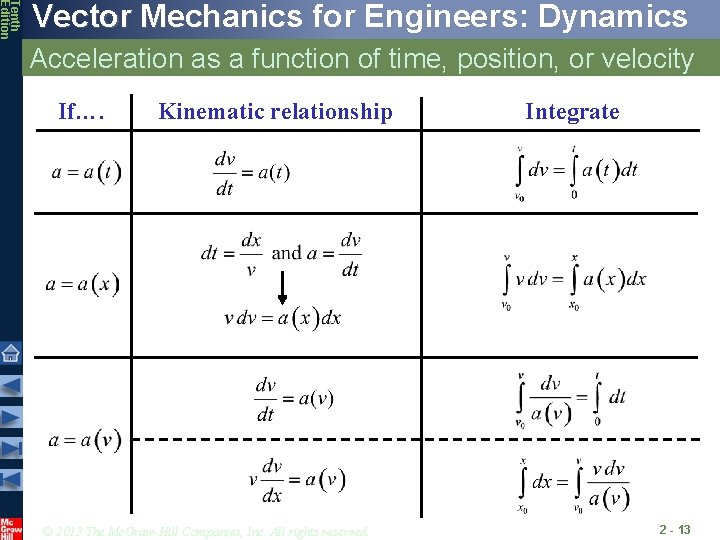
Tenth Edition Vector Mechanics for Engineers: Dynamics Determination of the Motion of a Particle • We often determine accelerations from the forces applied (kinetics will be covered later) • Generally have three classes of motion - acceleration given as a function of time, a = f(t) - acceleration given as a function of position, a = f(x) - acceleration given as a function of velocity, a = f(v) • Can you think of a physical example of when force is a When force is a function of velocity? function of position? a spring © 2013 The Mc. Graw-Hill Companies, Inc. All rights reserved. drag 11 - 12
Tenth Edition Vector Mechanics for Engineers: Dynamics Acceleration as a function of time, position, or velocity If…. Kinematic relationship © 2013 The Mc. Graw-Hill Companies, Inc. All rights reserved. Integrate 2 - 13
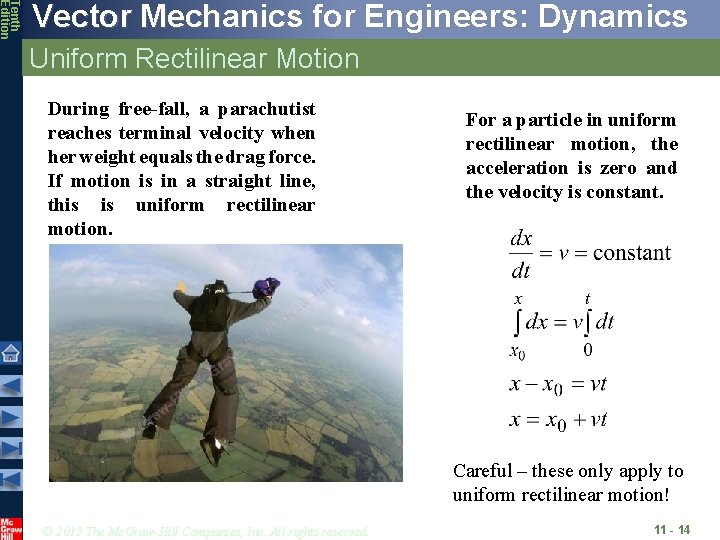
Tenth Edition Vector Mechanics for Engineers: Dynamics Uniform Rectilinear Motion During free-fall, a parachutist reaches terminal velocity when her weight equals the drag force. If motion is in a straight line, this is uniform rectilinear motion. For a particle in uniform rectilinear motion, the acceleration is zero and the velocity is constant. Careful – these only apply to uniform rectilinear motion! © 2013 The Mc. Graw-Hill Companies, Inc. All rights reserved. 11 - 14
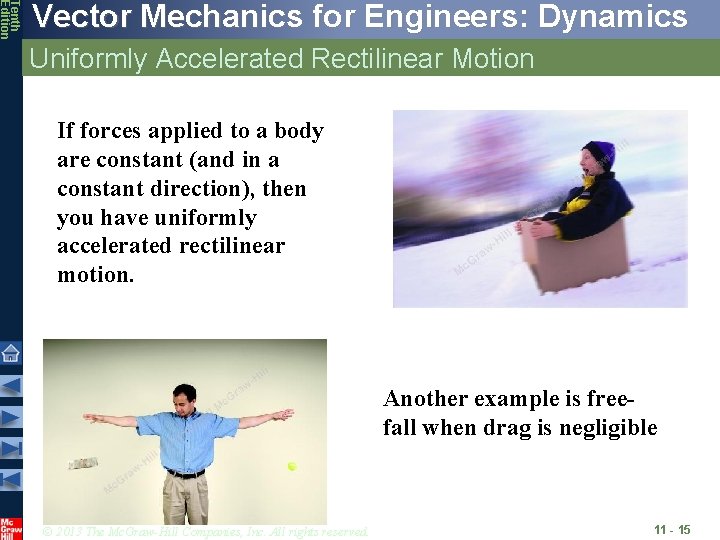
Tenth Edition Vector Mechanics for Engineers: Dynamics Uniformly Accelerated Rectilinear Motion If forces applied to a body are constant (and in a constant direction), then you have uniformly accelerated rectilinear motion. Another example is freefall when drag is negligible © 2013 The Mc. Graw-Hill Companies, Inc. All rights reserved. 11 - 15
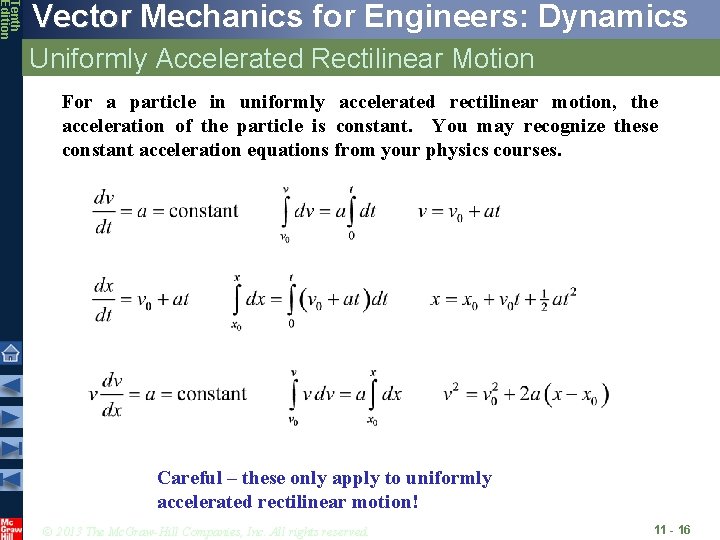
Tenth Edition Vector Mechanics for Engineers: Dynamics Uniformly Accelerated Rectilinear Motion For a particle in uniformly accelerated rectilinear motion, the acceleration of the particle is constant. You may recognize these constant acceleration equations from your physics courses. Careful – these only apply to uniformly accelerated rectilinear motion! © 2013 The Mc. Graw-Hill Companies, Inc. All rights reserved. 11 - 16
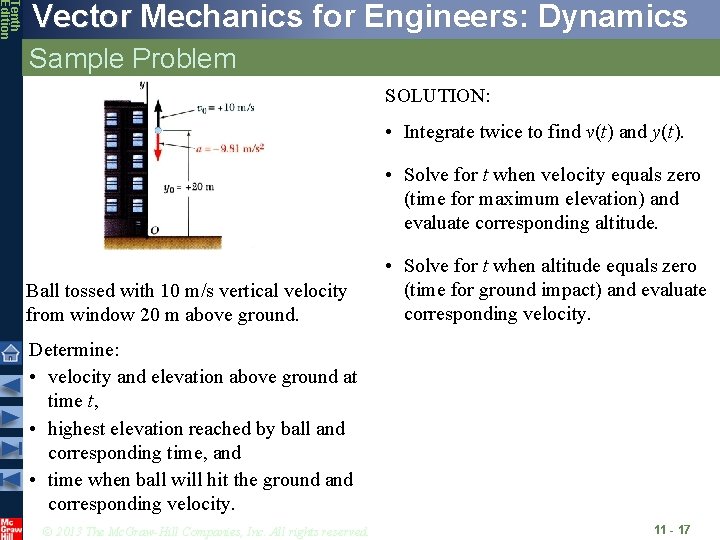
Tenth Edition Vector Mechanics for Engineers: Dynamics Sample Problem SOLUTION: • Integrate twice to find v(t) and y(t). • Solve for t when velocity equals zero (time for maximum elevation) and evaluate corresponding altitude. Ball tossed with 10 m/s vertical velocity from window 20 m above ground. • Solve for t when altitude equals zero (time for ground impact) and evaluate corresponding velocity. Determine: • velocity and elevation above ground at time t, • highest elevation reached by ball and corresponding time, and • time when ball will hit the ground and corresponding velocity. © 2013 The Mc. Graw-Hill Companies, Inc. All rights reserved. 11 - 17
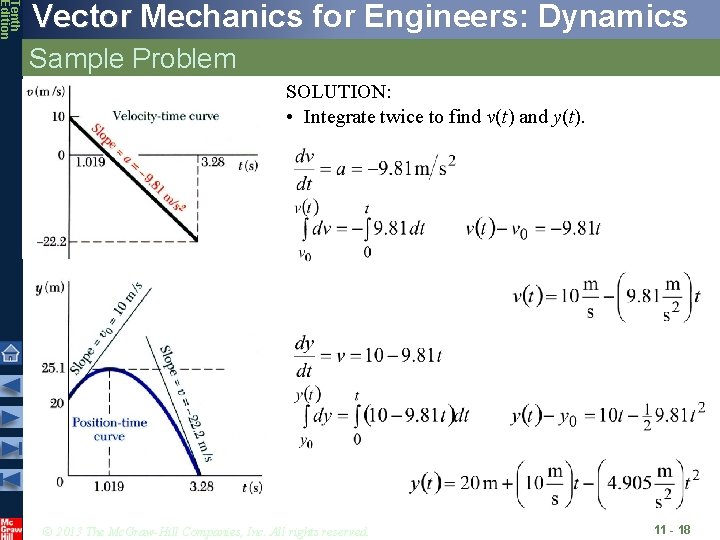
Tenth Edition Vector Mechanics for Engineers: Dynamics Sample Problem SOLUTION: • Integrate twice to find v(t) and y(t). © 2013 The Mc. Graw-Hill Companies, Inc. All rights reserved. 11 - 18
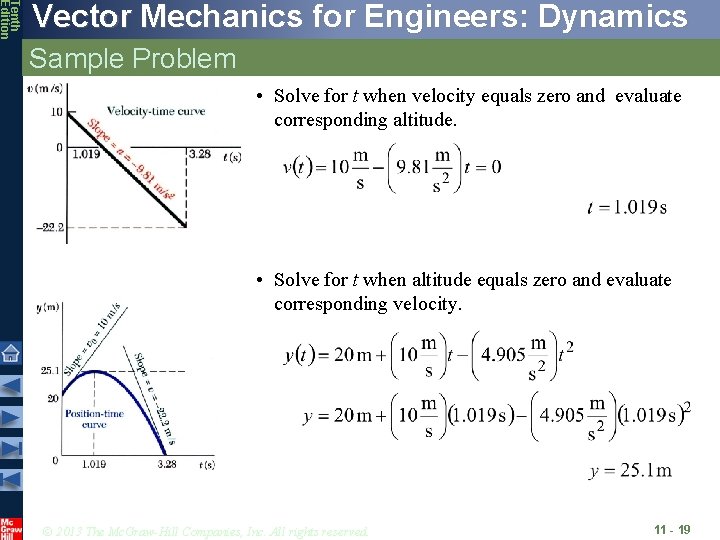
Tenth Edition Vector Mechanics for Engineers: Dynamics Sample Problem • Solve for t when velocity equals zero and evaluate corresponding altitude. • Solve for t when altitude equals zero and evaluate corresponding velocity. © 2013 The Mc. Graw-Hill Companies, Inc. All rights reserved. 11 - 19
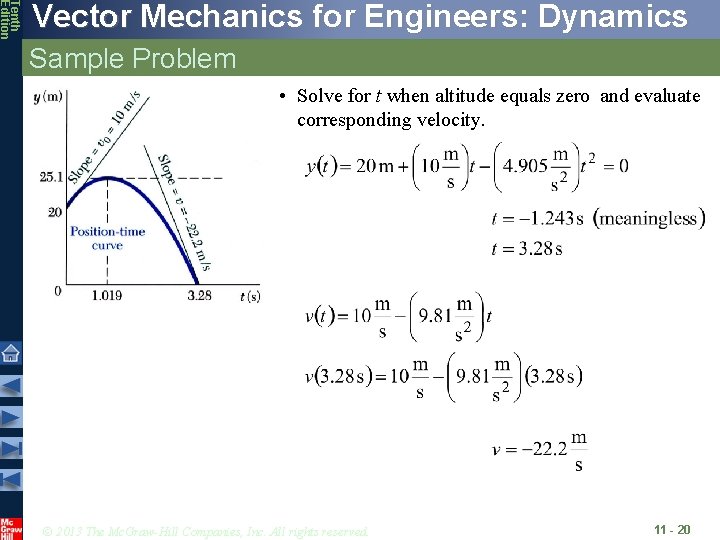
Tenth Edition Vector Mechanics for Engineers: Dynamics Sample Problem • Solve for t when altitude equals zero and evaluate corresponding velocity. © 2013 The Mc. Graw-Hill Companies, Inc. All rights reserved. 11 - 20
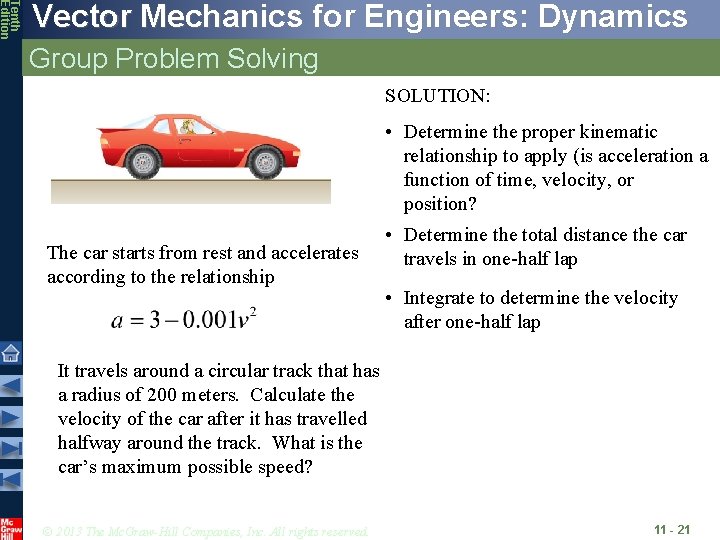
Tenth Edition Vector Mechanics for Engineers: Dynamics Group Problem Solving SOLUTION: • Determine the proper kinematic relationship to apply (is acceleration a function of time, velocity, or position? The car starts from rest and accelerates according to the relationship • Determine the total distance the car travels in one-half lap • Integrate to determine the velocity after one-half lap It travels around a circular track that has a radius of 200 meters. Calculate the velocity of the car after it has travelled halfway around the track. What is the car’s maximum possible speed? © 2013 The Mc. Graw-Hill Companies, Inc. All rights reserved. 11 - 21
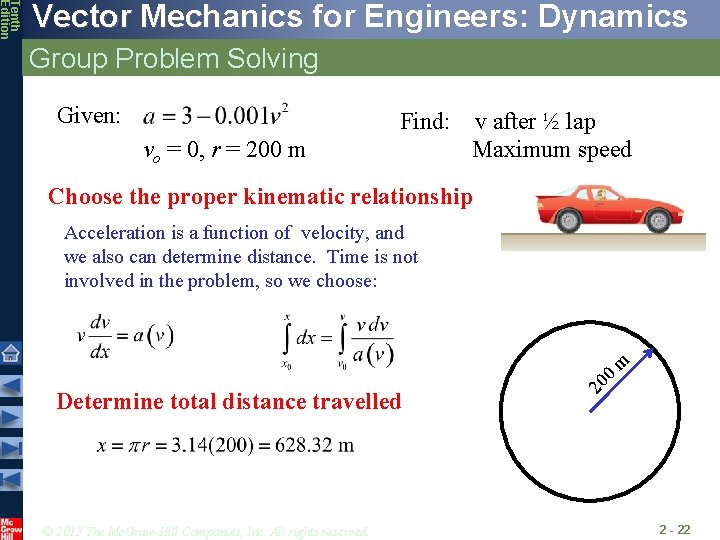
Group Problem Solving Given: vo = 0, r = 200 m Find: v after ½ lap Maximum speed Choose the proper kinematic relationship m Acceleration is a function of velocity, and we also can determine distance. Time is not involved in the problem, so we choose: Determine total distance travelled © 2013 The Mc. Graw-Hill Companies, Inc. All rights reserved. 20 0 Tenth Edition Vector Mechanics for Engineers: Dynamics 2 - 22
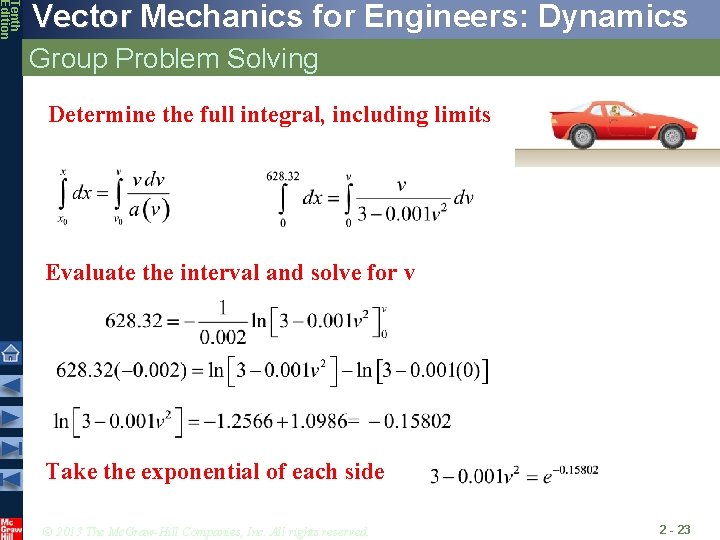
Tenth Edition Vector Mechanics for Engineers: Dynamics Group Problem Solving Determine the full integral, including limits Evaluate the interval and solve for v Take the exponential of each side © 2013 The Mc. Graw-Hill Companies, Inc. All rights reserved. 2 - 23
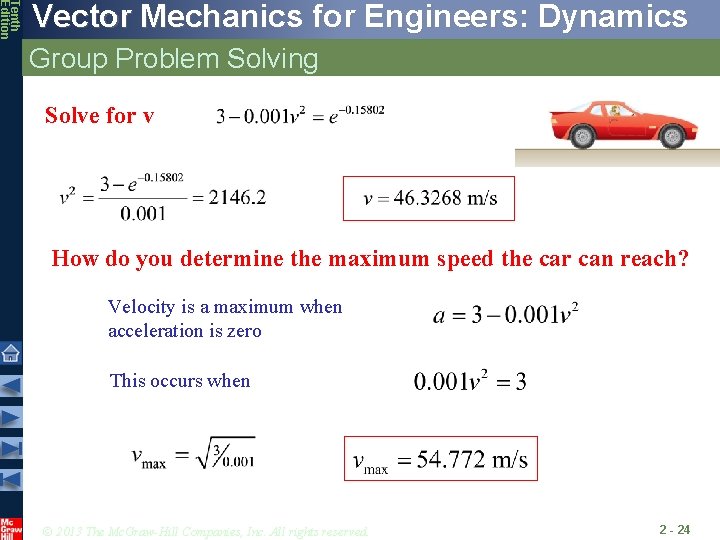
Tenth Edition Vector Mechanics for Engineers: Dynamics Group Problem Solving Solve for v How do you determine the maximum speed the car can reach? Velocity is a maximum when acceleration is zero This occurs when © 2013 The Mc. Graw-Hill Companies, Inc. All rights reserved. 2 - 24
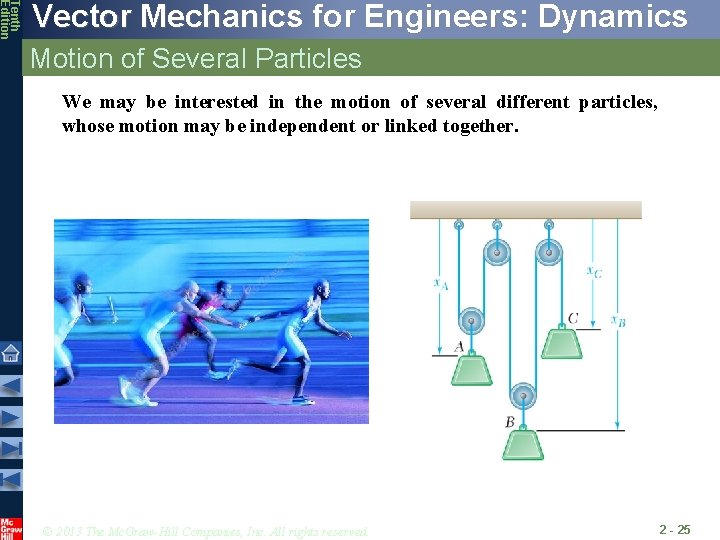
Tenth Edition Vector Mechanics for Engineers: Dynamics Motion of Several Particles We may be interested in the motion of several different particles, whose motion may be independent or linked together. © 2013 The Mc. Graw-Hill Companies, Inc. All rights reserved. 2 - 25
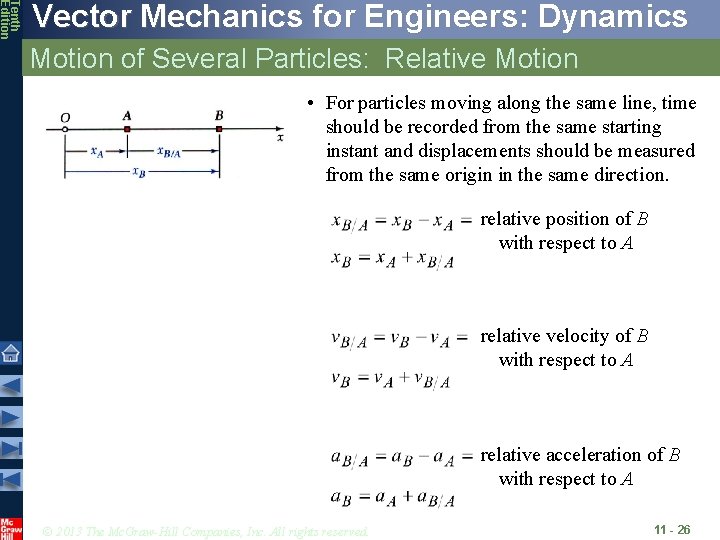
Tenth Edition Vector Mechanics for Engineers: Dynamics Motion of Several Particles: Relative Motion • For particles moving along the same line, time should be recorded from the same starting instant and displacements should be measured from the same origin in the same direction. relative position of B with respect to A relative velocity of B with respect to A relative acceleration of B with respect to A © 2013 The Mc. Graw-Hill Companies, Inc. All rights reserved. 11 - 26
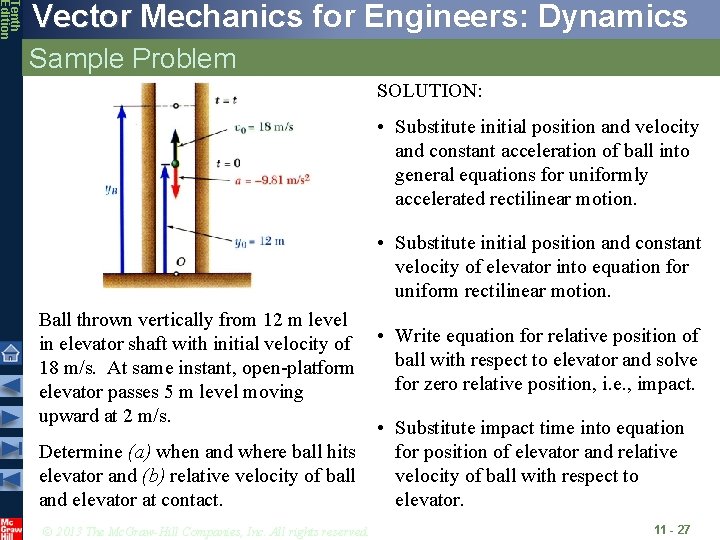
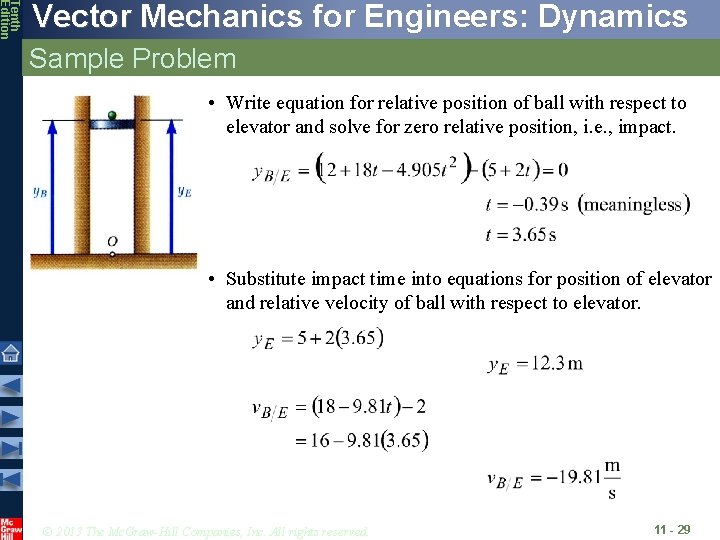
Tenth Edition Vector Mechanics for Engineers: Dynamics Sample Problem SOLUTION: • Substitute initial position and velocity and constant acceleration of ball into general equations for uniformly accelerated rectilinear motion. • Substitute initial position and constant velocity of elevator into equation for uniform rectilinear motion. Ball thrown vertically from 12 m level in elevator shaft with initial velocity of 18 m/s. At same instant, open-platform elevator passes 5 m level moving upward at 2 m/s. Determine (a) when and where ball hits elevator and (b) relative velocity of ball and elevator at contact. © 2013 The Mc. Graw-Hill Companies, Inc. All rights reserved. • Write equation for relative position of ball with respect to elevator and solve for zero relative position, i. e. , impact. • Substitute impact time into equation for position of elevator and relative velocity of ball with respect to elevator. 11 - 27
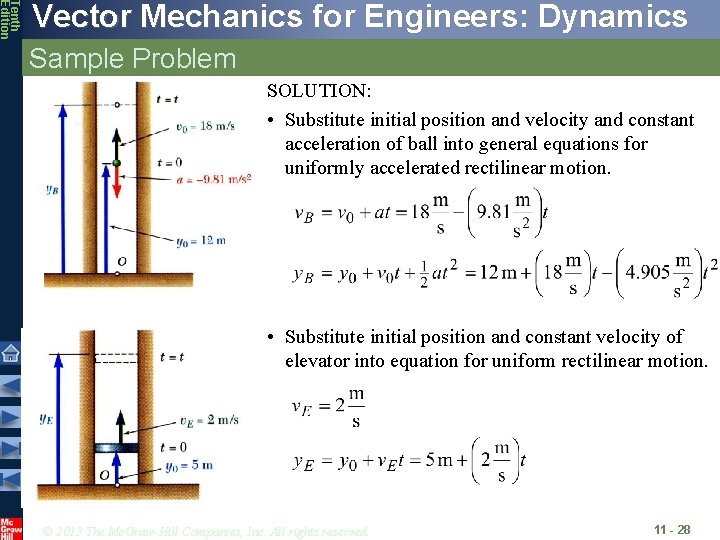
Tenth Edition Vector Mechanics for Engineers: Dynamics Sample Problem SOLUTION: • Substitute initial position and velocity and constant acceleration of ball into general equations for uniformly accelerated rectilinear motion. • Substitute initial position and constant velocity of elevator into equation for uniform rectilinear motion. © 2013 The Mc. Graw-Hill Companies, Inc. All rights reserved. 11 - 28
Tenth Edition Vector Mechanics for Engineers: Dynamics Sample Problem • Write equation for relative position of ball with respect to elevator and solve for zero relative position, i. e. , impact. • Substitute impact time into equations for position of elevator and relative velocity of ball with respect to elevator. © 2013 The Mc. Graw-Hill Companies, Inc. All rights reserved. 11 - 29
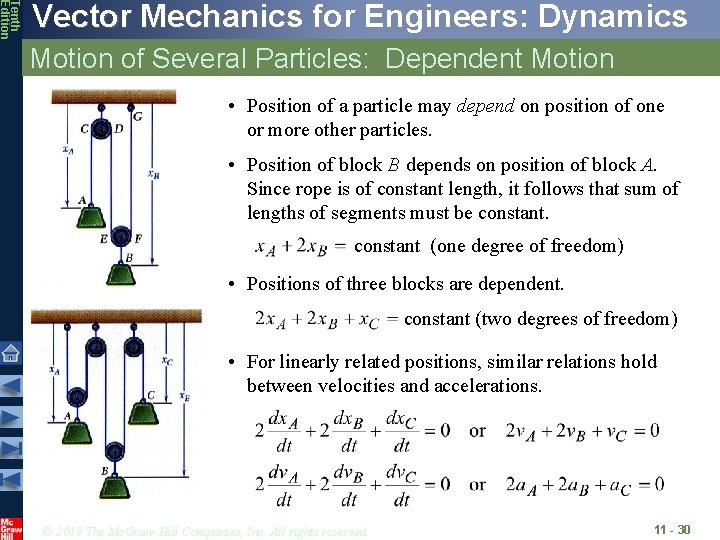
Tenth Edition Vector Mechanics for Engineers: Dynamics Motion of Several Particles: Dependent Motion • Position of a particle may depend on position of one or more other particles. • Position of block B depends on position of block A. Since rope is of constant length, it follows that sum of lengths of segments must be constant (one degree of freedom) • Positions of three blocks are dependent. constant (two degrees of freedom) • For linearly related positions, similar relations hold between velocities and accelerations. © 2013 The Mc. Graw-Hill Companies, Inc. All rights reserved. 11 - 30
Tenth Edition Vector Mechanics for Engineers: Dynamics Helpful Video Dependent motion (Pulley system): https: //youtu. be/yea 9 z. NCTQGQ © 2013 The Mc. Graw-Hill Companies, Inc. All rights reserved. 2 - 31
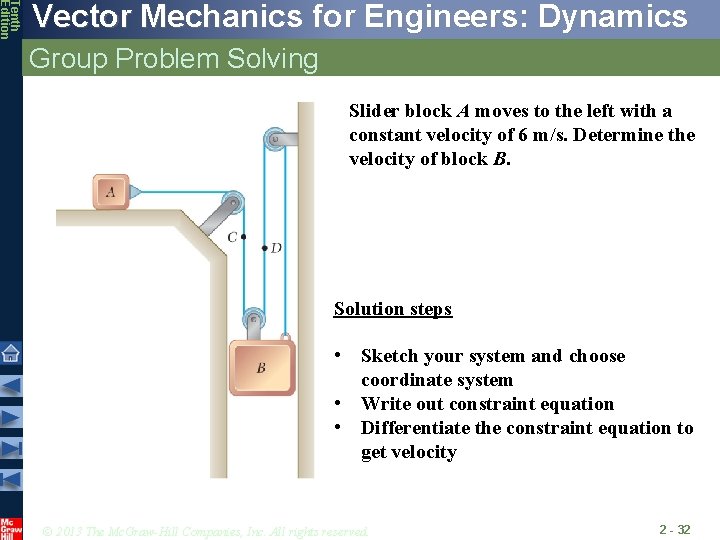
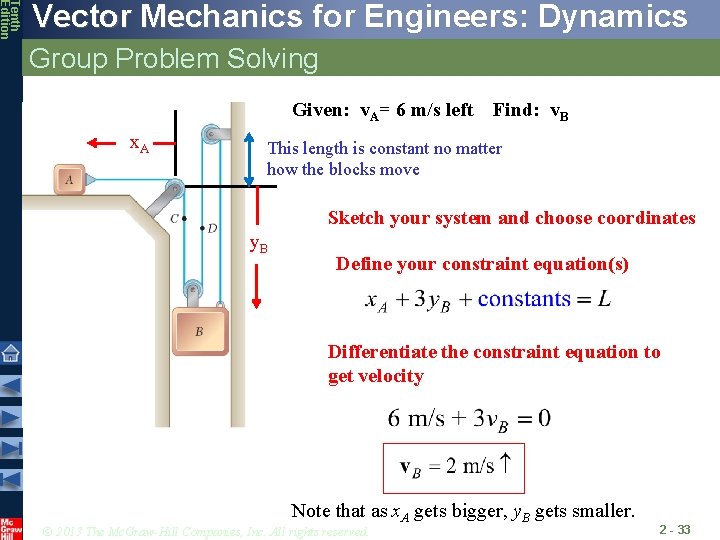
Tenth Edition Vector Mechanics for Engineers: Dynamics Group Problem Solving Slider block A moves to the left with a constant velocity of 6 m/s. Determine the velocity of block B. Solution steps • Sketch your system and choose coordinate system • Write out constraint equation • Differentiate the constraint equation to get velocity © 2013 The Mc. Graw-Hill Companies, Inc. All rights reserved. 2 - 32
Tenth Edition Vector Mechanics for Engineers: Dynamics Group Problem Solving Given: v. A= 6 m/s left x. A Find: v. B This length is constant no matter how the blocks move Sketch your system and choose coordinates y. B Define your constraint equation(s) Differentiate the constraint equation to get velocity Note that as x. A gets bigger, y. B gets smaller. © 2013 The Mc. Graw-Hill Companies, Inc. All rights reserved. 2 - 33
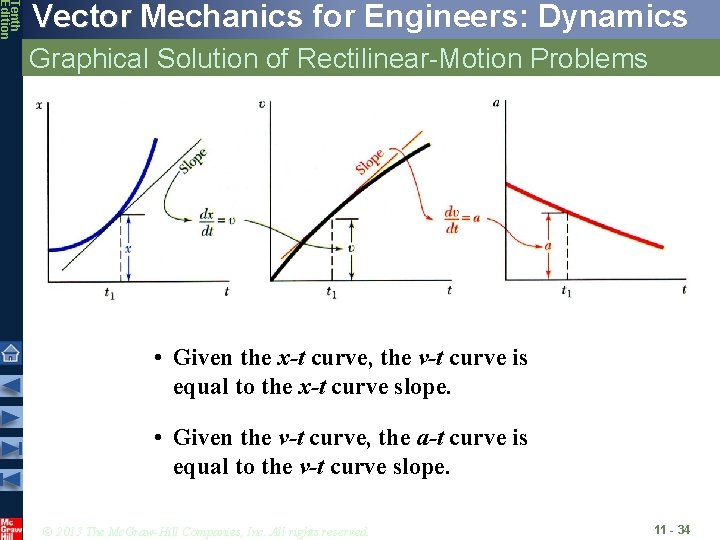
Tenth Edition Vector Mechanics for Engineers: Dynamics Graphical Solution of Rectilinear-Motion Problems • Given the x-t curve, the v-t curve is equal to the x-t curve slope. • Given the v-t curve, the a-t curve is equal to the v-t curve slope. © 2013 The Mc. Graw-Hill Companies, Inc. All rights reserved. 11 - 34
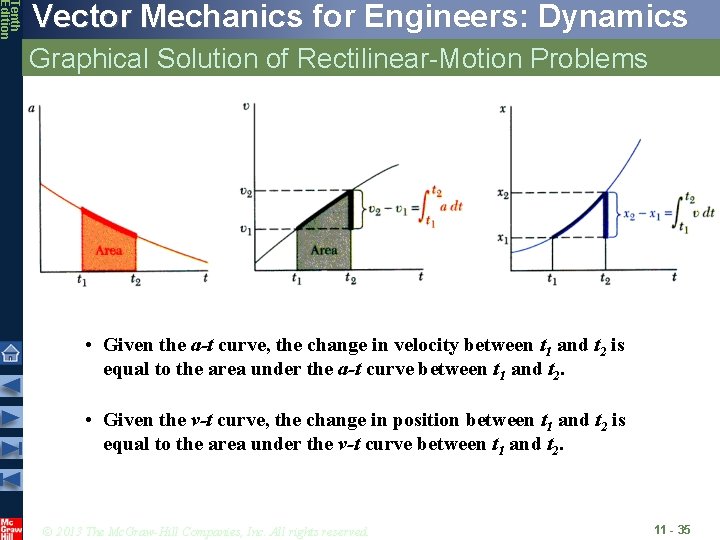
Tenth Edition Vector Mechanics for Engineers: Dynamics Graphical Solution of Rectilinear-Motion Problems • Given the a-t curve, the change in velocity between t 1 and t 2 is equal to the area under the a-t curve between t 1 and t 2. • Given the v-t curve, the change in position between t 1 and t 2 is equal to the area under the v-t curve between t 1 and t 2. © 2013 The Mc. Graw-Hill Companies, Inc. All rights reserved. 11 - 35
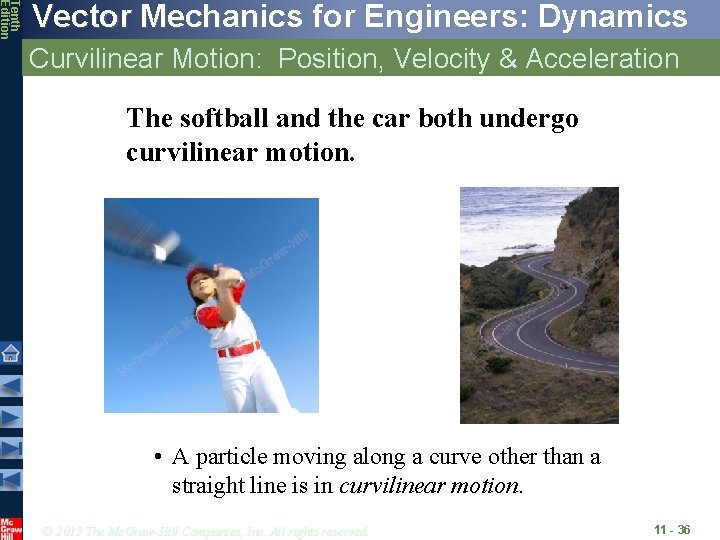
Tenth Edition Vector Mechanics for Engineers: Dynamics Curvilinear Motion: Position, Velocity & Acceleration The softball and the car both undergo curvilinear motion. • A particle moving along a curve other than a straight line is in curvilinear motion. © 2013 The Mc. Graw-Hill Companies, Inc. All rights reserved. 11 - 36
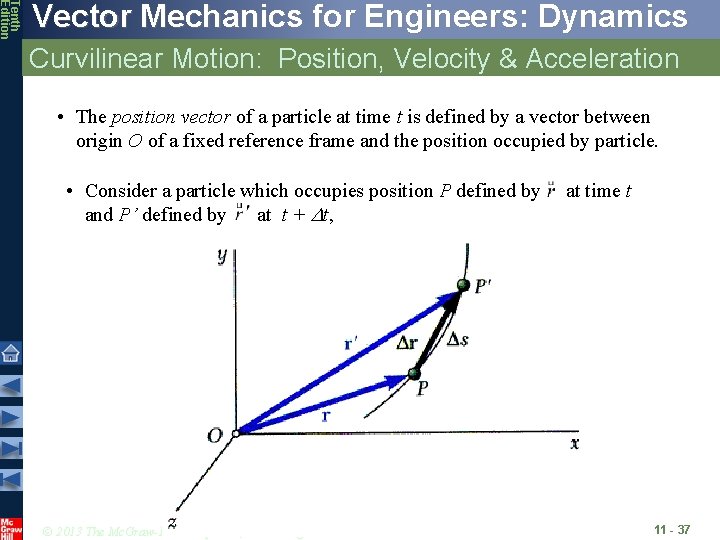
Tenth Edition Vector Mechanics for Engineers: Dynamics Curvilinear Motion: Position, Velocity & Acceleration • The position vector of a particle at time t is defined by a vector between origin O of a fixed reference frame and the position occupied by particle. • Consider a particle which occupies position P defined by and P’ defined by at t + Dt, © 2013 The Mc. Graw-Hill Companies, Inc. All rights reserved. at time t 11 - 37
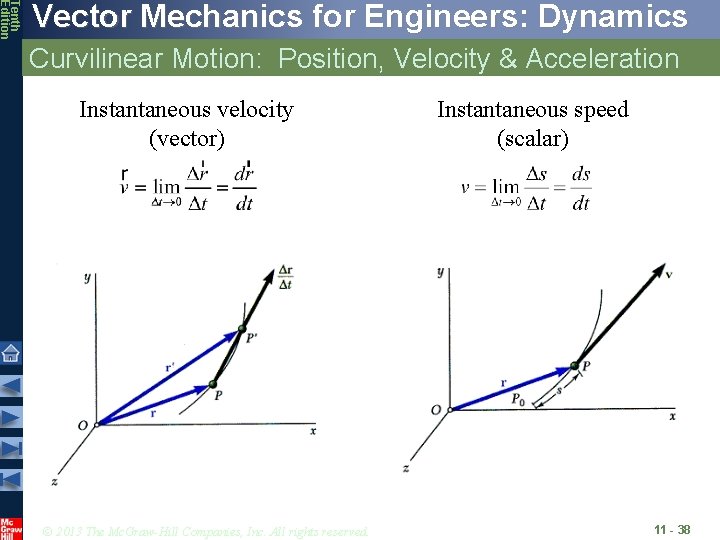
Tenth Edition Vector Mechanics for Engineers: Dynamics Curvilinear Motion: Position, Velocity & Acceleration Instantaneous velocity (vector) © 2013 The Mc. Graw-Hill Companies, Inc. All rights reserved. Instantaneous speed (scalar) 11 - 38
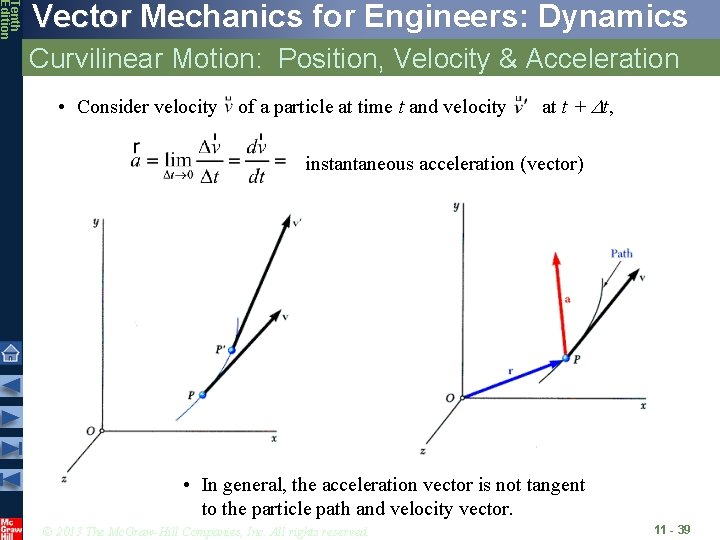
Tenth Edition Vector Mechanics for Engineers: Dynamics Curvilinear Motion: Position, Velocity & Acceleration • Consider velocity of a particle at time t and velocity at t + Dt, instantaneous acceleration (vector) • In general, the acceleration vector is not tangent to the particle path and velocity vector. © 2013 The Mc. Graw-Hill Companies, Inc. All rights reserved. 11 - 39
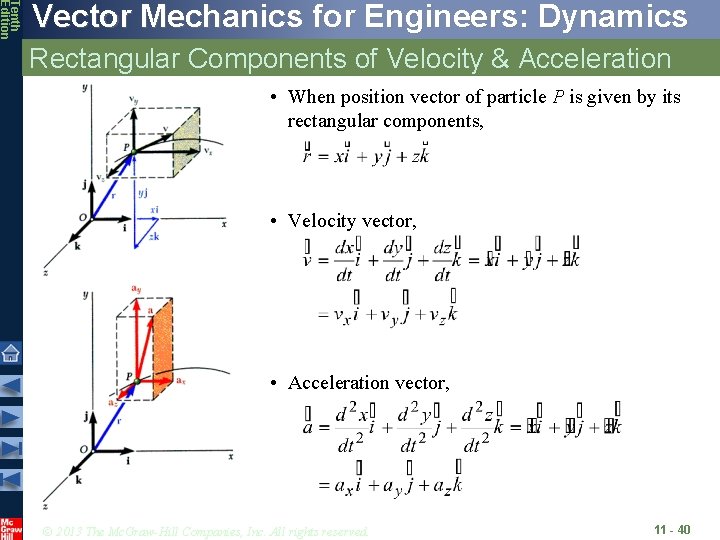
Tenth Edition Vector Mechanics for Engineers: Dynamics Rectangular Components of Velocity & Acceleration • When position vector of particle P is given by its rectangular components, • Velocity vector, • Acceleration vector, © 2013 The Mc. Graw-Hill Companies, Inc. All rights reserved. 11 - 40
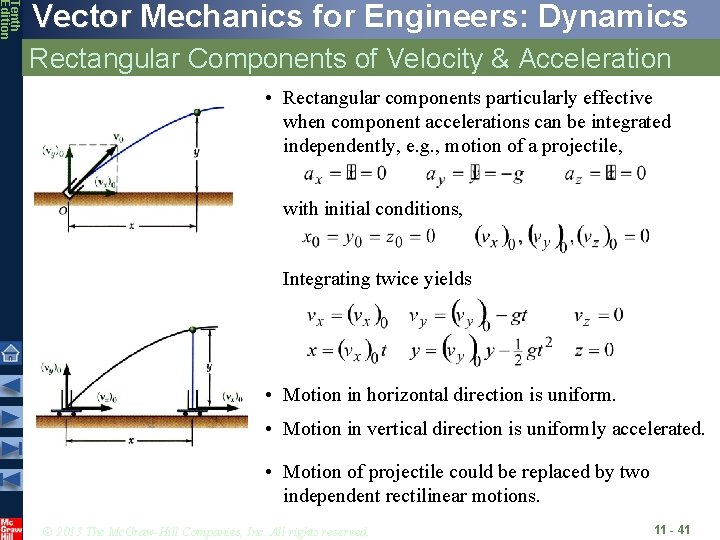
Tenth Edition Vector Mechanics for Engineers: Dynamics Rectangular Components of Velocity & Acceleration • Rectangular components particularly effective when component accelerations can be integrated independently, e. g. , motion of a projectile, with initial conditions, Integrating twice yields • Motion in horizontal direction is uniform. • Motion in vertical direction is uniformly accelerated. • Motion of projectile could be replaced by two independent rectilinear motions. © 2013 The Mc. Graw-Hill Companies, Inc. All rights reserved. 11 - 41
Tenth Edition Vector Mechanics for Engineers: Dynamics Helpful video Projectile Motion: https: //youtu. be/a. Y 8 z 2 q. O 44 WA Example: https: //youtu. be/Dc 34 e. Sc 8 k. PA © 2013 The Mc. Graw-Hill Companies, Inc. All rights reserved. 2 - 42
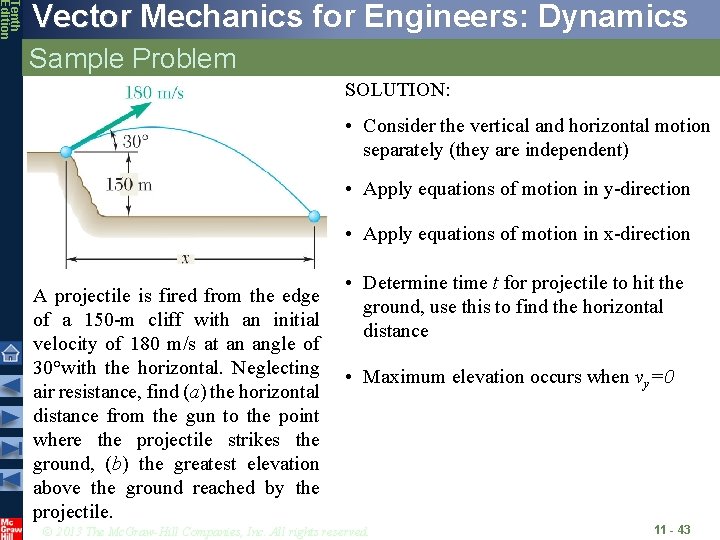
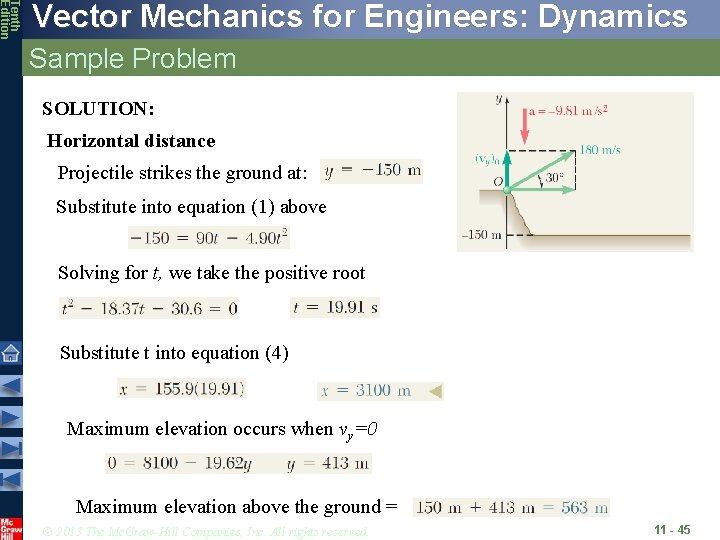
Tenth Edition Vector Mechanics for Engineers: Dynamics Sample Problem SOLUTION: • Consider the vertical and horizontal motion separately (they are independent) • Apply equations of motion in y-direction • Apply equations of motion in x-direction A projectile is fired from the edge of a 150 -m cliff with an initial velocity of 180 m/s at an angle of 30°with the horizontal. Neglecting air resistance, find (a) the horizontal distance from the gun to the point where the projectile strikes the ground, (b) the greatest elevation above the ground reached by the projectile. • Determine time t for projectile to hit the ground, use this to find the horizontal distance • Maximum elevation occurs when vy=0 © 2013 The Mc. Graw-Hill Companies, Inc. All rights reserved. 11 - 43
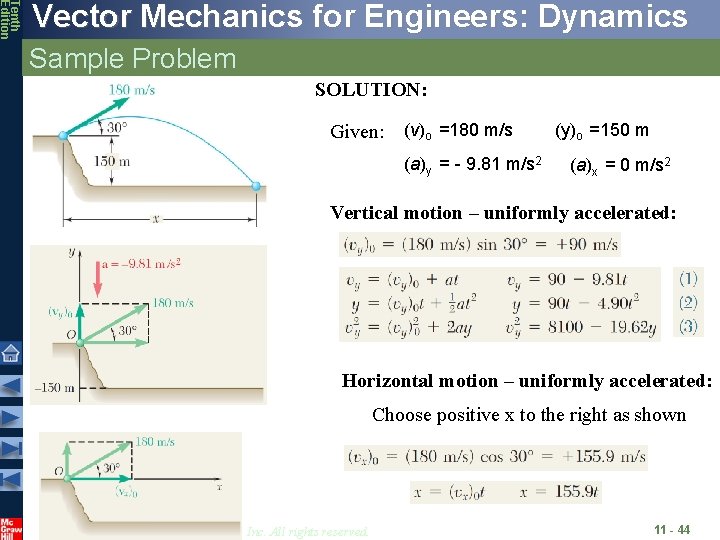
Tenth Edition Vector Mechanics for Engineers: Dynamics Sample Problem SOLUTION: Given: (v)o =180 m/s (a)y = - 9. 81 m/s 2 (y)o =150 m (a)x = 0 m/s 2 Vertical motion – uniformly accelerated: Horizontal motion – uniformly accelerated: Choose positive x to the right as shown © 2013 The Mc. Graw-Hill Companies, Inc. All rights reserved. 11 - 44
Tenth Edition Vector Mechanics for Engineers: Dynamics Sample Problem SOLUTION: Horizontal distance Projectile strikes the ground at: Substitute into equation (1) above Solving for t, we take the positive root Substitute t into equation (4) Maximum elevation occurs when vy=0 Maximum elevation above the ground = © 2013 The Mc. Graw-Hill Companies, Inc. All rights reserved. 11 - 45
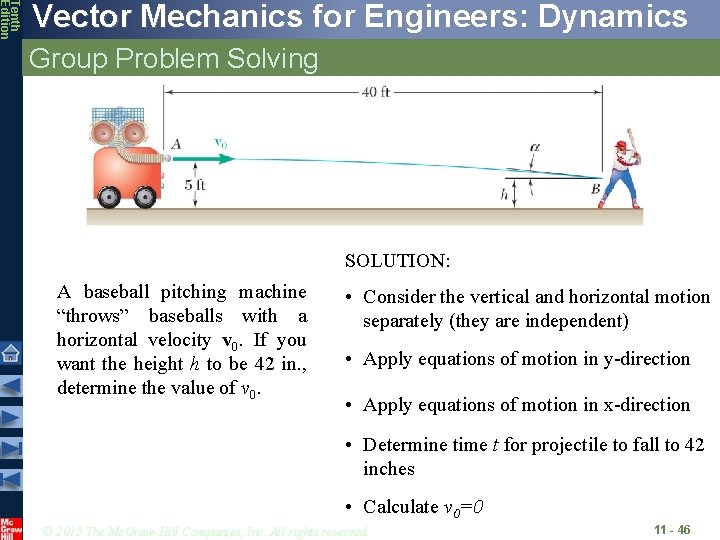
Tenth Edition Vector Mechanics for Engineers: Dynamics Group Problem Solving SOLUTION: A baseball pitching machine “throws” baseballs with a horizontal velocity v 0. If you want the height h to be 42 in. , determine the value of v 0. • Consider the vertical and horizontal motion separately (they are independent) • Apply equations of motion in y-direction • Apply equations of motion in x-direction • Determine time t for projectile to fall to 42 inches • Calculate v 0=0 © 2013 The Mc. Graw-Hill Companies, Inc. All rights reserved. 11 - 46
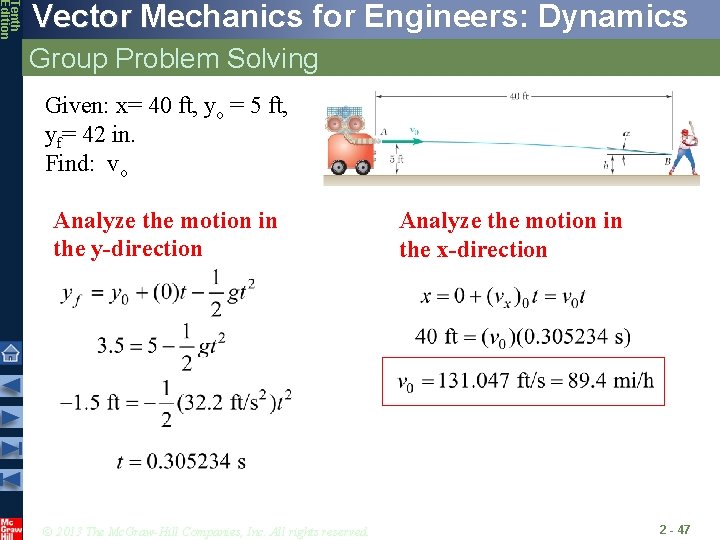
Tenth Edition Vector Mechanics for Engineers: Dynamics Group Problem Solving Given: x= 40 ft, yo = 5 ft, yf= 42 in. Find: vo Analyze the motion in the y-direction © 2013 The Mc. Graw-Hill Companies, Inc. All rights reserved. Analyze the motion in the x-direction 2 - 47
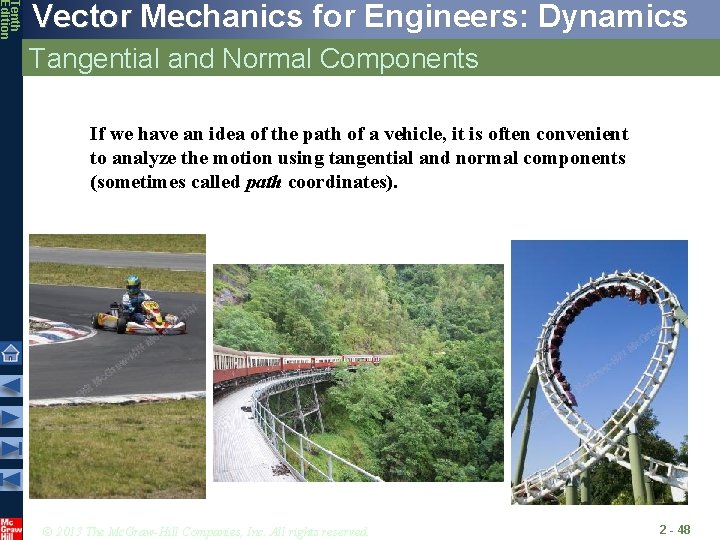
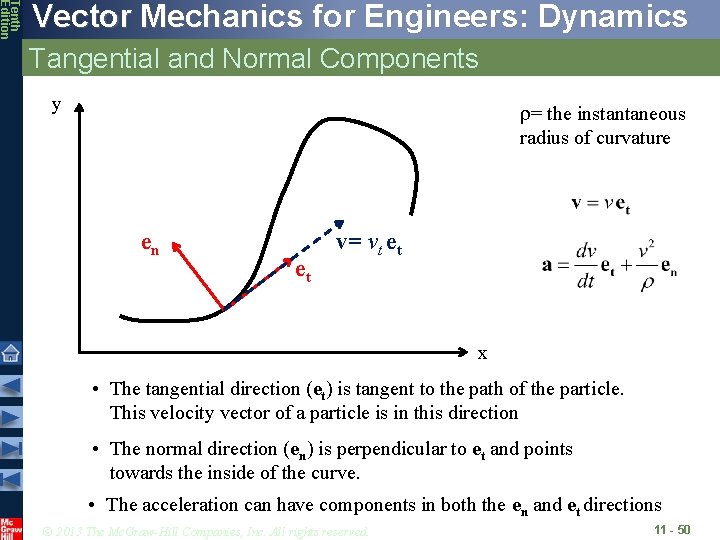
Tenth Edition Vector Mechanics for Engineers: Dynamics Tangential and Normal Components If we have an idea of the path of a vehicle, it is often convenient to analyze the motion using tangential and normal components (sometimes called path coordinates). © 2013 The Mc. Graw-Hill Companies, Inc. All rights reserved. 2 - 48
Tenth Edition Vector Mechanics for Engineers: Dynamics Helpful Videos Normal acceleration: https: //www. youtube. com/watch? v=a. J 6 P 9 be. Sg. Dc https: //www. youtube. com/watch? v=z. W 3 KCKOXe 0 k © 2013 The Mc. Graw-Hill Companies, Inc. All rights reserved. 2 - 49
Tenth Edition Vector Mechanics for Engineers: Dynamics Tangential and Normal Components y r= the instantaneous radius of curvature en et v= vt et x • The tangential direction (et) is tangent to the path of the particle. This velocity vector of a particle is in this direction • The normal direction (en) is perpendicular to et and points towards the inside of the curve. • The acceleration can have components in both the en and et directions © 2013 The Mc. Graw-Hill Companies, Inc. All rights reserved. 11 - 50
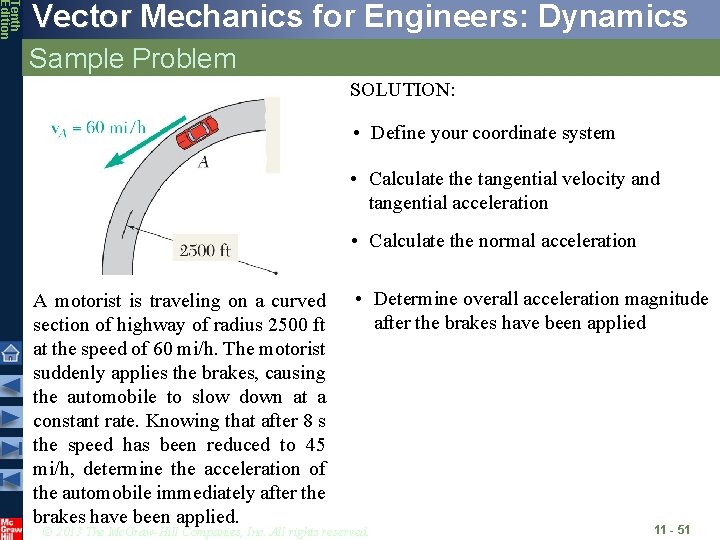
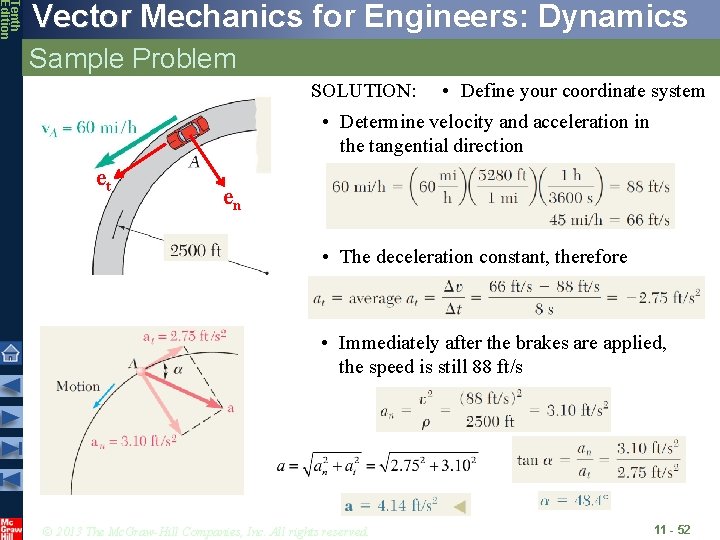
Tenth Edition Vector Mechanics for Engineers: Dynamics Sample Problem SOLUTION: • Define your coordinate system • Calculate the tangential velocity and tangential acceleration • Calculate the normal acceleration A motorist is traveling on a curved section of highway of radius 2500 ft at the speed of 60 mi/h. The motorist suddenly applies the brakes, causing the automobile to slow down at a constant rate. Knowing that after 8 s the speed has been reduced to 45 mi/h, determine the acceleration of the automobile immediately after the brakes have been applied. • Determine overall acceleration magnitude after the brakes have been applied © 2013 The Mc. Graw-Hill Companies, Inc. All rights reserved. 11 - 51
Tenth Edition Vector Mechanics for Engineers: Dynamics Sample Problem • Define your coordinate system • Determine velocity and acceleration in the tangential direction SOLUTION: et en • The deceleration constant, therefore • Immediately after the brakes are applied, the speed is still 88 ft/s © 2013 The Mc. Graw-Hill Companies, Inc. All rights reserved. 11 - 52
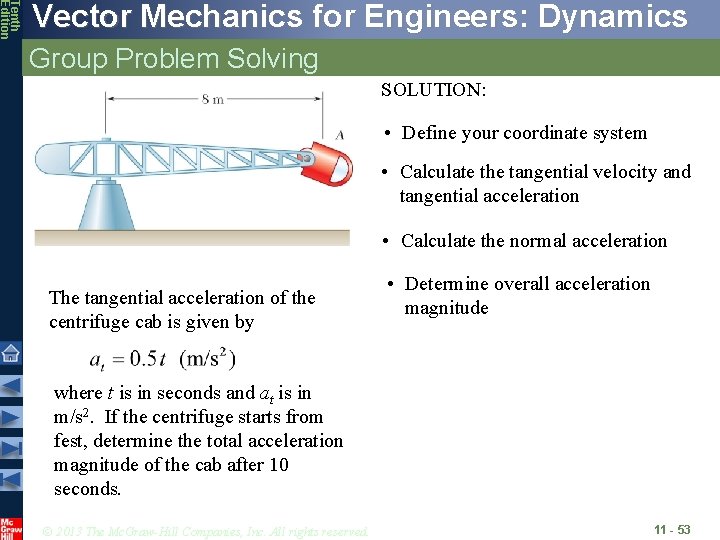
Tenth Edition Vector Mechanics for Engineers: Dynamics Group Problem Solving SOLUTION: • Define your coordinate system • Calculate the tangential velocity and tangential acceleration • Calculate the normal acceleration The tangential acceleration of the centrifuge cab is given by • Determine overall acceleration magnitude where t is in seconds and at is in m/s 2. If the centrifuge starts from fest, determine the total acceleration magnitude of the cab after 10 seconds. © 2013 The Mc. Graw-Hill Companies, Inc. All rights reserved. 11 - 53
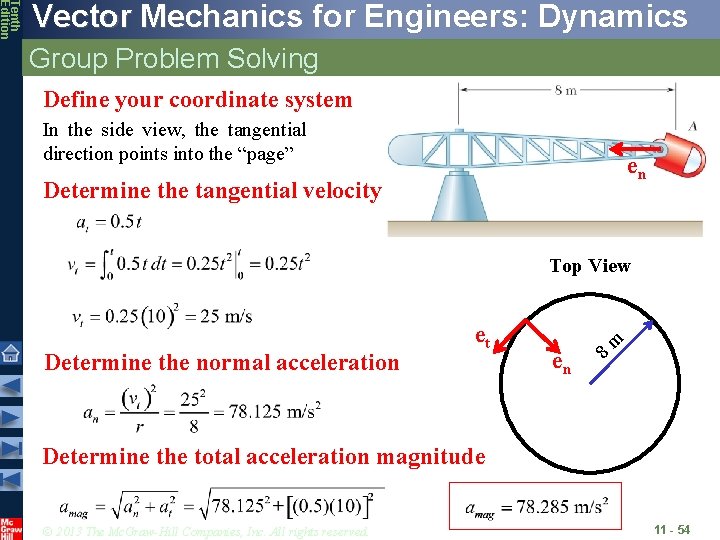
Group Problem Solving Define your coordinate system In the side view, the tangential direction points into the “page” en Determine the tangential velocity Determine the normal acceleration et en m Top View 8 Tenth Edition Vector Mechanics for Engineers: Dynamics Determine the total acceleration magnitude © 2013 The Mc. Graw-Hill Companies, Inc. All rights reserved. 11 - 54
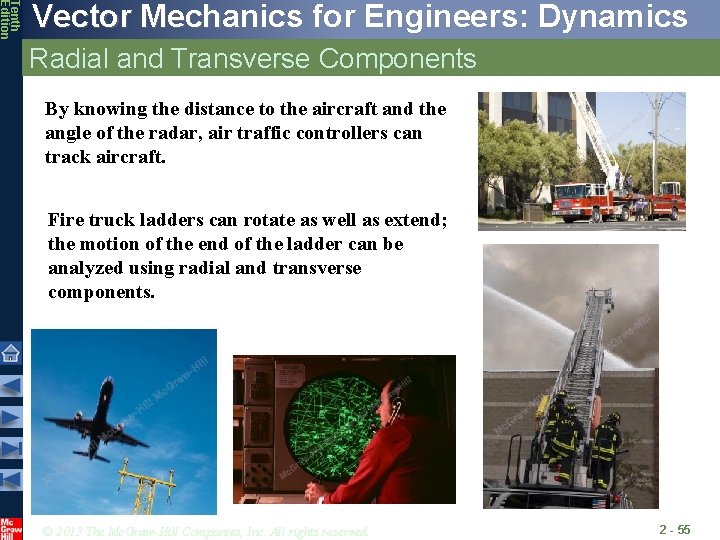
Tenth Edition Vector Mechanics for Engineers: Dynamics Radial and Transverse Components By knowing the distance to the aircraft and the angle of the radar, air traffic controllers can track aircraft. Fire truck ladders can rotate as well as extend; the motion of the end of the ladder can be analyzed using radial and transverse components. © 2013 The Mc. Graw-Hill Companies, Inc. All rights reserved. 2 - 55
Tenth Edition Vector Mechanics for Engineers: Dynamics Helpful videos Radial and Transverse Components: https: //www. youtube. com/watch? v=iwtfcy. RZZRY https: //www. youtube. com/watch? v=Ad 7 V 6 MFPQc. M © 2013 The Mc. Graw-Hill Companies, Inc. All rights reserved. 2 - 56
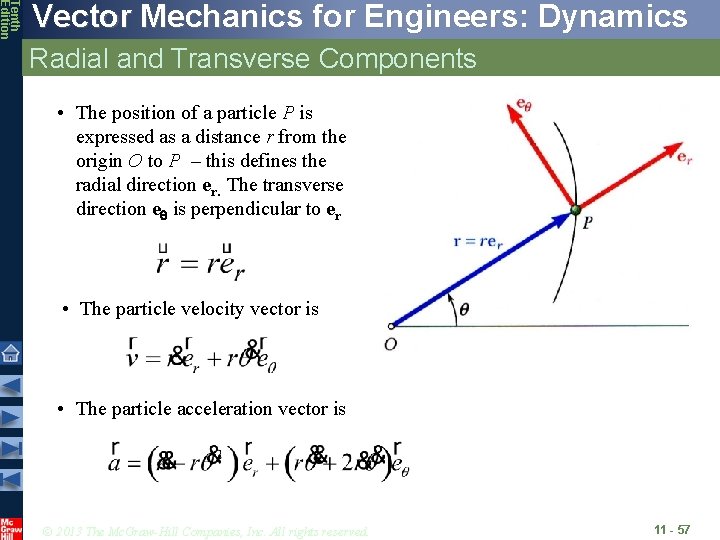
Tenth Edition Vector Mechanics for Engineers: Dynamics Radial and Transverse Components • The position of a particle P is expressed as a distance r from the origin O to P – this defines the radial direction er. The transverse direction eq is perpendicular to er • The particle velocity vector is • The particle acceleration vector is © 2013 The Mc. Graw-Hill Companies, Inc. All rights reserved. 11 - 57
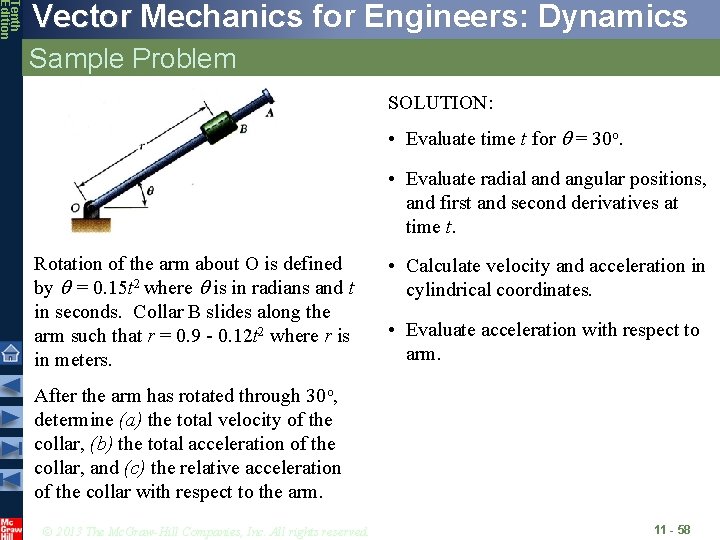
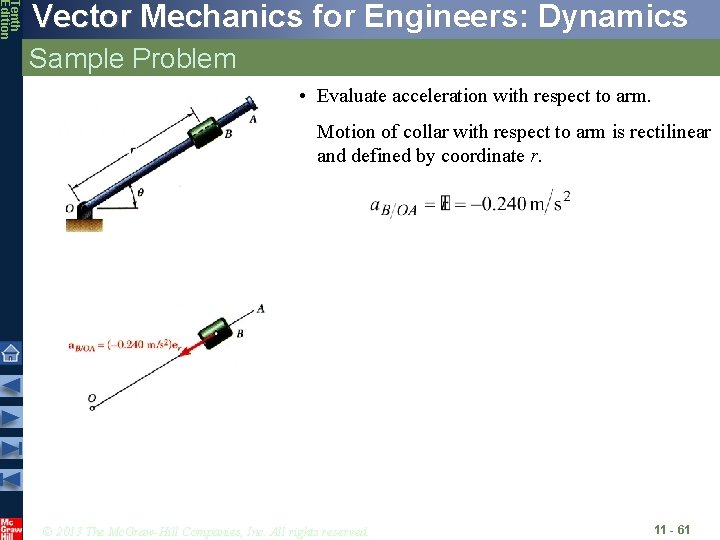
Tenth Edition Vector Mechanics for Engineers: Dynamics Sample Problem SOLUTION: • Evaluate time t for q = 30 o. • Evaluate radial and angular positions, and first and second derivatives at time t. Rotation of the arm about O is defined by q = 0. 15 t 2 where q is in radians and t in seconds. Collar B slides along the arm such that r = 0. 9 - 0. 12 t 2 where r is in meters. • Calculate velocity and acceleration in cylindrical coordinates. • Evaluate acceleration with respect to arm. After the arm has rotated through 30 o, determine (a) the total velocity of the collar, (b) the total acceleration of the collar, and (c) the relative acceleration of the collar with respect to the arm. © 2013 The Mc. Graw-Hill Companies, Inc. All rights reserved. 11 - 58
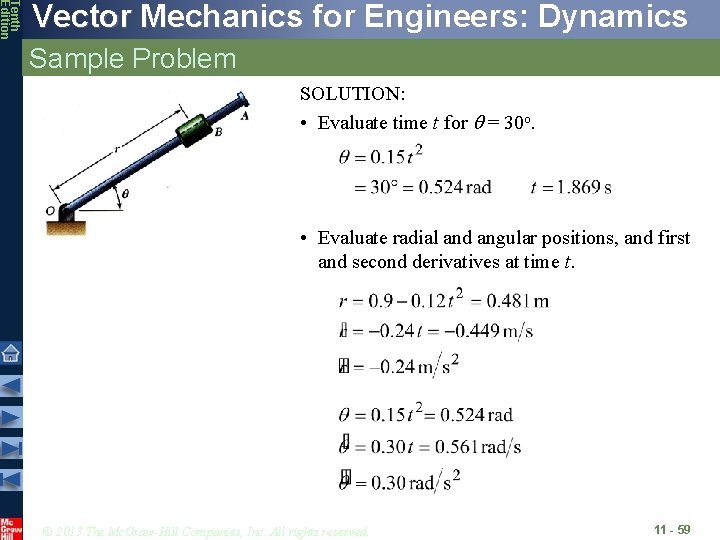
Tenth Edition Vector Mechanics for Engineers: Dynamics Sample Problem SOLUTION: • Evaluate time t for q = 30 o. • Evaluate radial and angular positions, and first and second derivatives at time t. © 2013 The Mc. Graw-Hill Companies, Inc. All rights reserved. 11 - 59
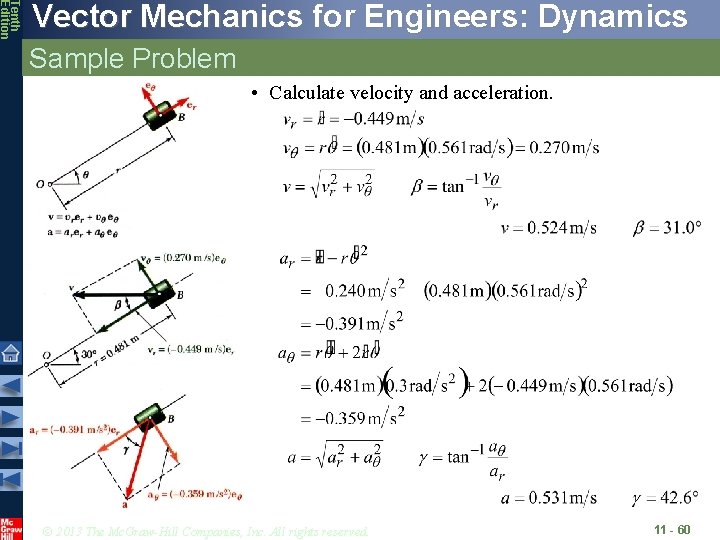
Tenth Edition Vector Mechanics for Engineers: Dynamics Sample Problem • Calculate velocity and acceleration. © 2013 The Mc. Graw-Hill Companies, Inc. All rights reserved. 11 - 60
Tenth Edition Vector Mechanics for Engineers: Dynamics Sample Problem • Evaluate acceleration with respect to arm. Motion of collar with respect to arm is rectilinear and defined by coordinate r. © 2013 The Mc. Graw-Hill Companies, Inc. All rights reserved. 11 - 61