
Tentative flow chart of CMS MultiMuon analysis 1
- Slides: 10
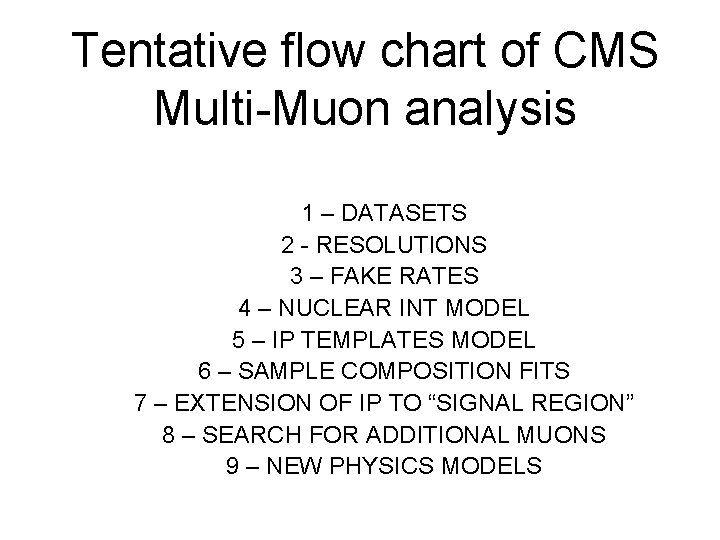
Tentative flow chart of CMS Multi-Muon analysis 1 – DATASETS 2 - RESOLUTIONS 3 – FAKE RATES 4 – NUCLEAR INT MODEL 5 – IP TEMPLATES MODEL 6 – SAMPLE COMPOSITION FITS 7 – EXTENSION OF IP TO “SIGNAL REGION” 8 – SEARCH FOR ADDITIONAL MUONS 9 – NEW PHYSICS MODELS
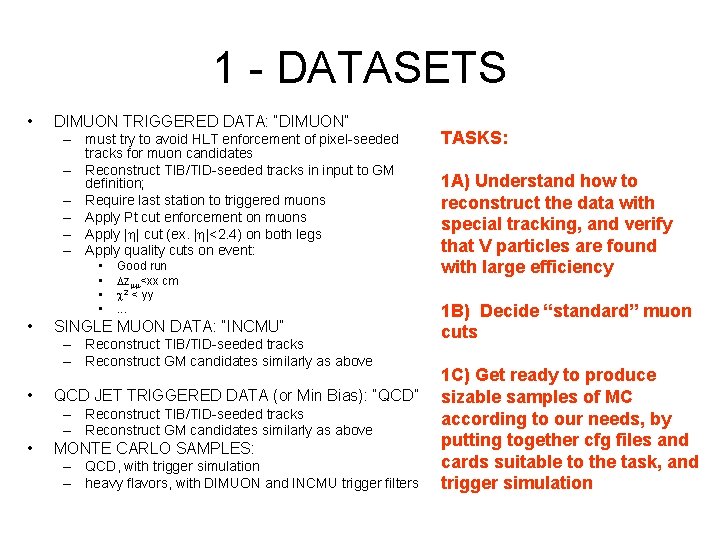
1 - DATASETS • DIMUON TRIGGERED DATA: “DIMUON” – must try to avoid HLT enforcement of pixel-seeded tracks for muon candidates – Reconstruct TIB/TID-seeded tracks in input to GM definition; – Require last station to triggered muons – Apply Pt cut enforcement on muons – Apply |h| cut (ex. |h|<2. 4) on both legs – Apply quality cuts on event: • • • Good run Dzmm<xx cm c 2 < yy. . . SINGLE MUON DATA: “INCMU” – Reconstruct TIB/TID-seeded tracks – Reconstruct GM candidates similarly as above • QCD JET TRIGGERED DATA (or Min Bias): “QCD” – Reconstruct TIB/TID-seeded tracks – Reconstruct GM candidates similarly as above • MONTE CARLO SAMPLES: – QCD, with trigger simulation – heavy flavors, with DIMUON and INCMU trigger filters TASKS: 1 A) Understand how to reconstruct the data with special tracking, and verify that V particles are found with large efficiency 1 B) Decide “standard” muon cuts 1 C) Get ready to produce sizable samples of MC according to our needs, by putting together cfg files and cards suitable to the task, and trigger simulation
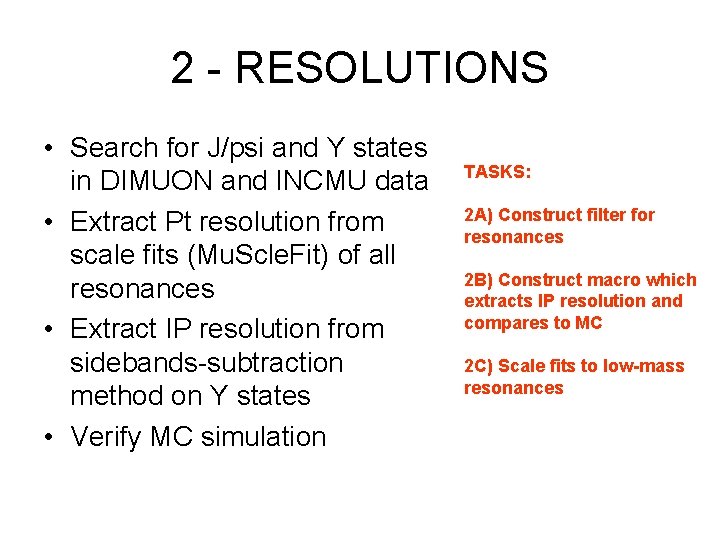
2 - RESOLUTIONS • Search for J/psi and Y states in DIMUON and INCMU data • Extract Pt resolution from scale fits (Mu. Scle. Fit) of all resonances • Extract IP resolution from sidebands-subtraction method on Y states • Verify MC simulation TASKS: 2 A) Construct filter for resonances 2 B) Construct macro which extracts IP resolution and compares to MC 2 C) Scale fits to low-mass resonances
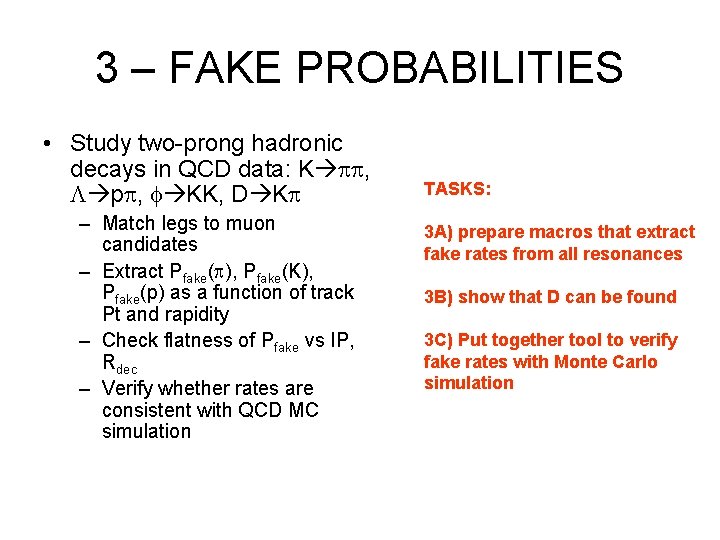
3 – FAKE PROBABILITIES • Study two-prong hadronic decays in QCD data: K pp, L pp, f KK, D Kp – Match legs to muon candidates – Extract Pfake(p), Pfake(K), Pfake(p) as a function of track Pt and rapidity – Check flatness of Pfake vs IP, Rdec – Verify whether rates are consistent with QCD MC simulation TASKS: 3 A) prepare macros that extract fake rates from all resonances 3 B) show that D can be found 3 C) Put together tool to verify fake rates with Monte Carlo simulation
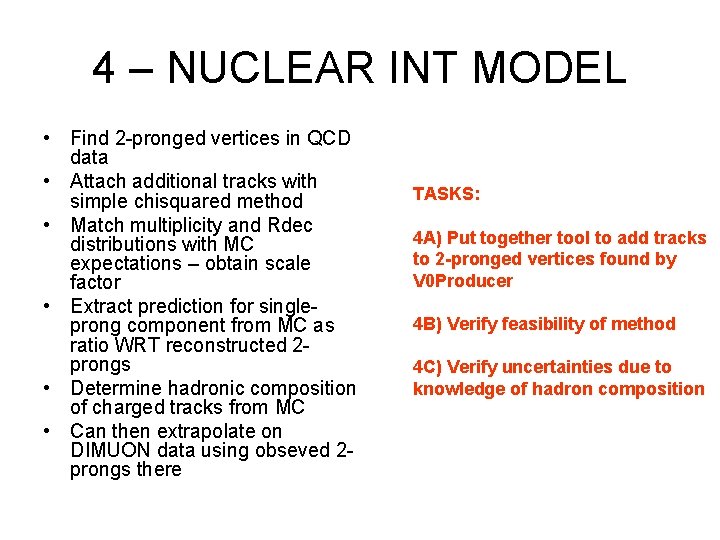
4 – NUCLEAR INT MODEL • Find 2 -pronged vertices in QCD data • Attach additional tracks with simple chisquared method • Match multiplicity and Rdec distributions with MC expectations – obtain scale factor • Extract prediction for singleprong component from MC as ratio WRT reconstructed 2 prongs • Determine hadronic composition of charged tracks from MC • Can then extrapolate on DIMUON data using obseved 2 prongs there TASKS: 4 A) Put together tool to add tracks to 2 -pronged vertices found by V 0 Producer 4 B) Verify feasibility of method 4 C) Verify uncertainties due to knowledge of hadron composition
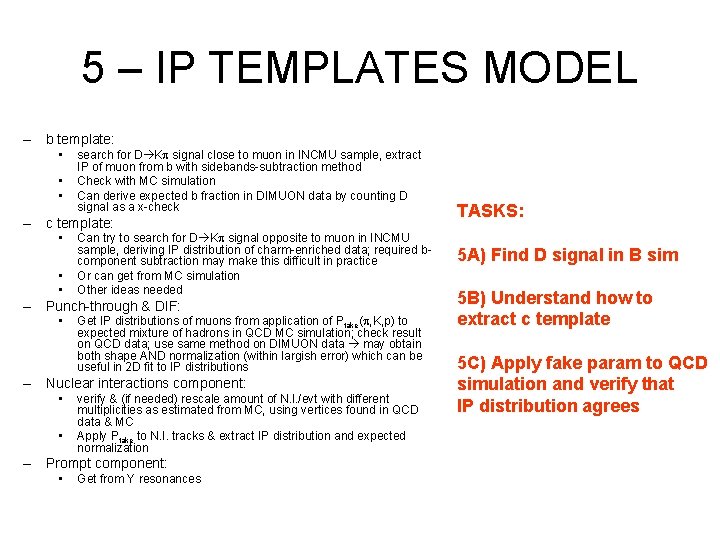
5 – IP TEMPLATES MODEL – b template: • • • search for D Kp signal close to muon in INCMU sample, extract IP of muon from b with sidebands-subtraction method Check with MC simulation Can derive expected b fraction in DIMUON data by counting D signal as a x-check – c template: • • • Can try to search for D Kp signal opposite to muon in INCMU sample, deriving IP distribution of charm-enriched data; required bcomponent subtraction may make this difficult in practice Or can get from MC simulation Other ideas needed – Punch-through & DIF: • Get IP distributions of muons from application of Pfake(p, K, p) to expected mixture of hadrons in QCD MC simulation; check result on QCD data; use same method on DIMUON data may obtain both shape AND normalization (within largish error) which can be useful in 2 D fit to IP distributions – Nuclear interactions component: • • verify & (if needed) rescale amount of N. I. /evt with different multiplicities as estimated from MC, using vertices found in QCD data & MC Apply Pfake to N. I. tracks & extract IP distribution and expected normalization – Prompt component: • Get from Y resonances TASKS: 5 A) Find D signal in B sim 5 B) Understand how to extract c template 5 C) Apply fake param to QCD simulation and verify that IP distribution agrees
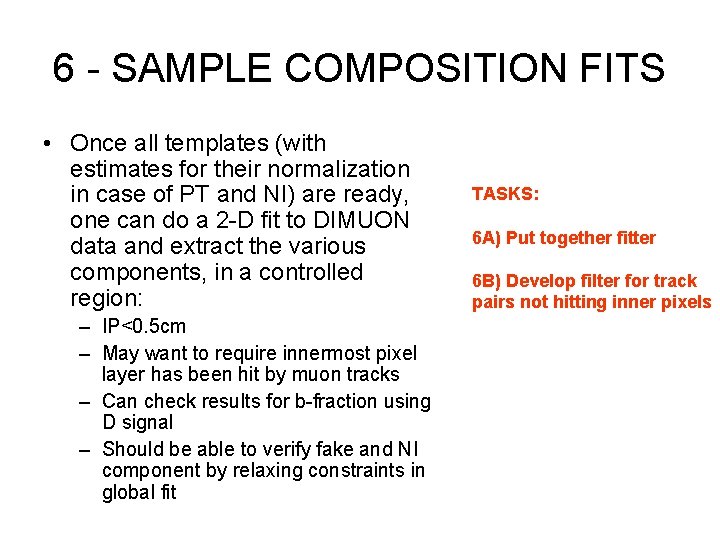
6 - SAMPLE COMPOSITION FITS • Once all templates (with estimates for their normalization in case of PT and NI) are ready, one can do a 2 -D fit to DIMUON data and extract the various components, in a controlled region: – IP<0. 5 cm – May want to require innermost pixel layer has been hit by muon tracks – Can check results for b-fraction using D signal – Should be able to verify fake and NI component by relaxing constraints in global fit TASKS: 6 A) Put together fitter 6 B) Develop filter for track pairs not hitting inner pixels
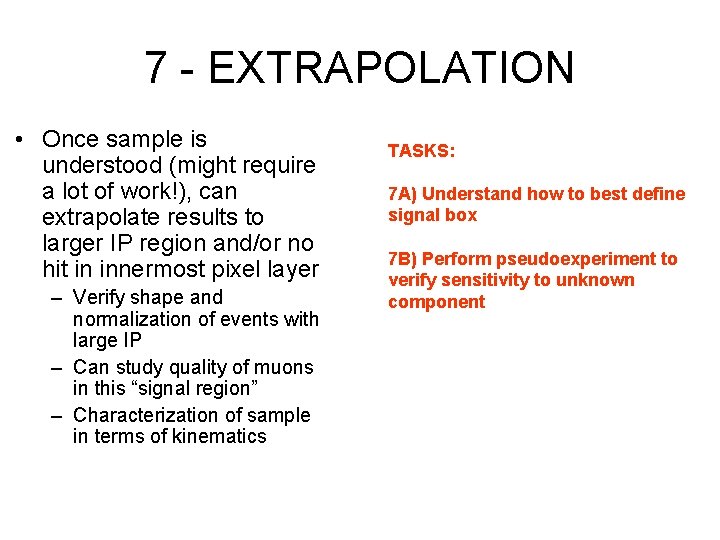
7 - EXTRAPOLATION • Once sample is understood (might require a lot of work!), can extrapolate results to larger IP region and/or no hit in innermost pixel layer – Verify shape and normalization of events with large IP – Can study quality of muons in this “signal region” – Characterization of sample in terms of kinematics TASKS: 7 A) Understand how to best define signal box 7 B) Perform pseudoexperiment to verify sensitivity to unknown component
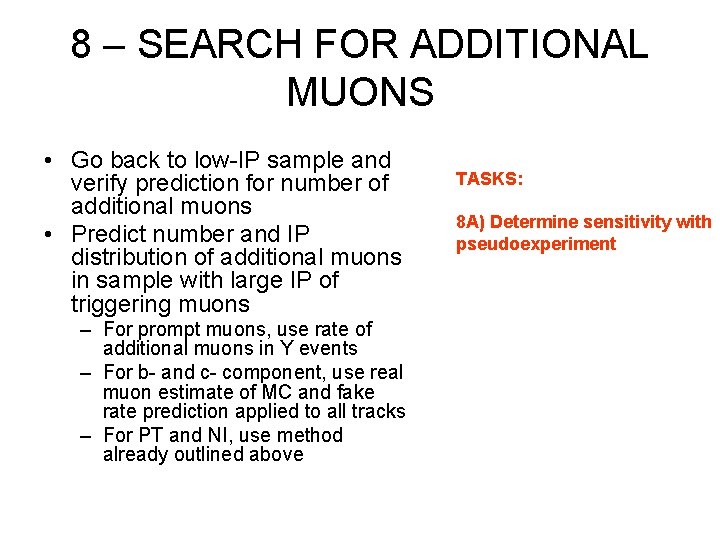
8 – SEARCH FOR ADDITIONAL MUONS • Go back to low-IP sample and verify prediction for number of additional muons • Predict number and IP distribution of additional muons in sample with large IP of triggering muons – For prompt muons, use rate of additional muons in Y events – For b- and c- component, use real muon estimate of MC and fake rate prediction applied to all tracks – For PT and NI, use method already outlined above TASKS: 8 A) Determine sensitivity with pseudoexperiment
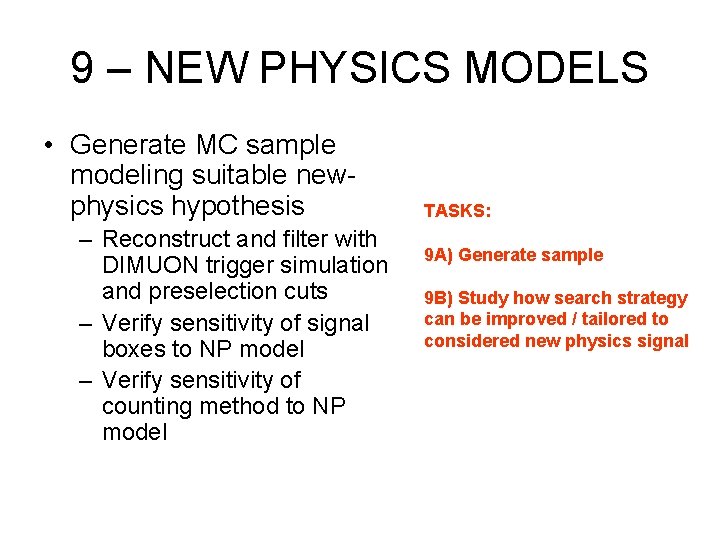
9 – NEW PHYSICS MODELS • Generate MC sample modeling suitable newphysics hypothesis – Reconstruct and filter with DIMUON trigger simulation and preselection cuts – Verify sensitivity of signal boxes to NP model – Verify sensitivity of counting method to NP model TASKS: 9 A) Generate sample 9 B) Study how search strategy can be improved / tailored to considered new physics signal