
Tensor Processing Unit ISCA 2017 First two slides
- Slides: 32
Tensor Processing Unit ISCA 2017 • First two slides text from: – https: //www. slideshare. net/Antonios. Katsarakis/tensorprocessing-unit-tpu – Andreas Moshovos, Advanced Computer Architecture, Winter 2018, U. of Toronto
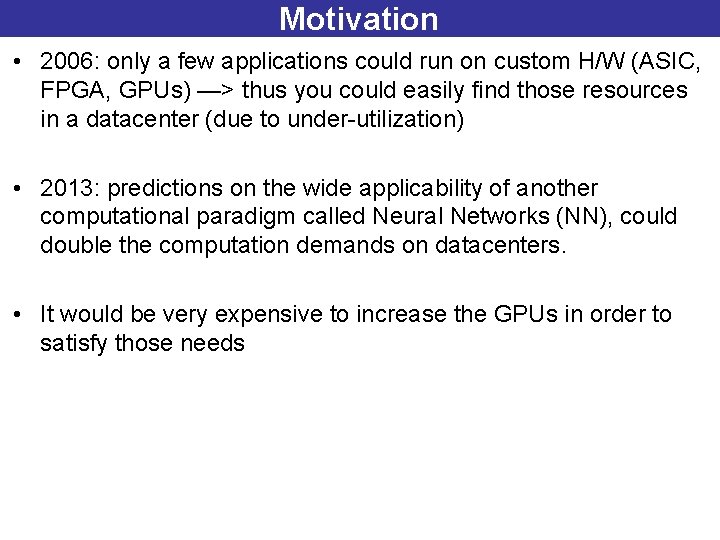
Motivation • 2006: only a few applications could run on custom H/W (ASIC, FPGA, GPUs) —> thus you could easily find those resources in a datacenter (due to under-utilization) • 2013: predictions on the wide applicability of another computational paradigm called Neural Networks (NN), could double the computation demands on datacenters. • It would be very expensive to increase the GPUs in order to satisfy those needs
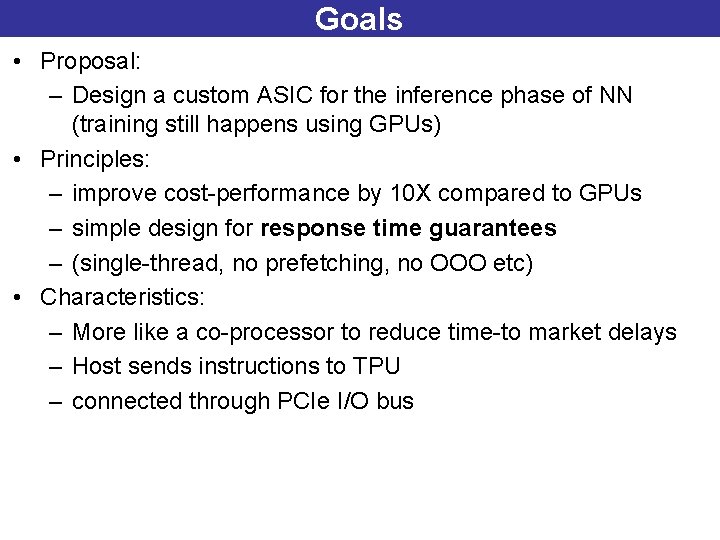
Goals • Proposal: – Design a custom ASIC for the inference phase of NN (training still happens using GPUs) • Principles: – improve cost-performance by 10 X compared to GPUs – simple design for response time guarantees – (single-thread, no prefetching, no OOO etc) • Characteristics: – More like a co-processor to reduce time-to market delays – Host sends instructions to TPU – connected through PCIe I/O bus
This Paper • Overview of the TPU architectufre • Compare to CPU + GPU in a datacenter setting • Not the latest designs but the designs contemporary at the time
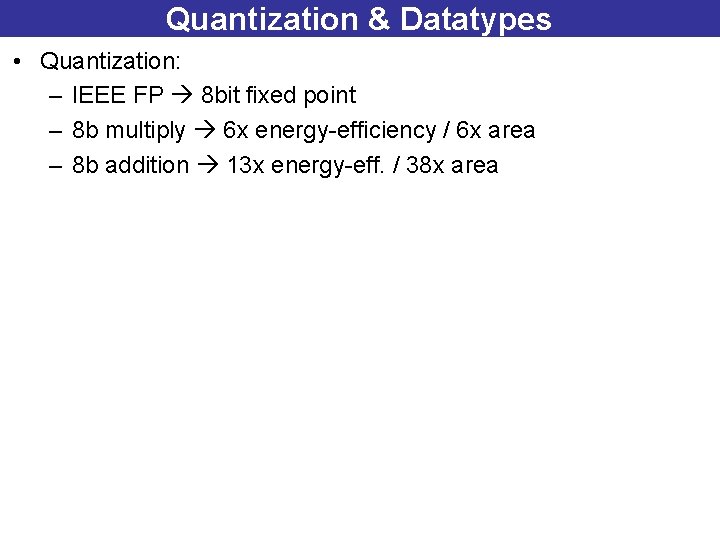
Quantization & Datatypes • Quantization: – IEEE FP 8 bit fixed point – 8 b multiply 6 x energy-efficiency / 6 x area – 8 b addition 13 x energy-eff. / 38 x area
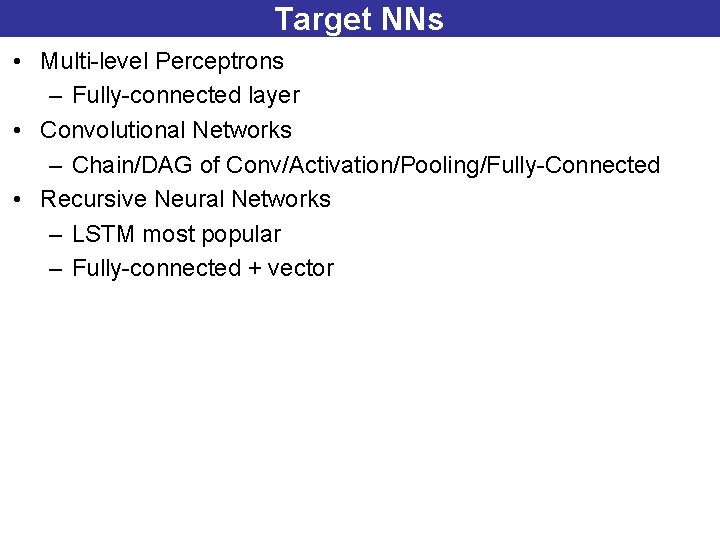
Target NNs • Multi-level Perceptrons – Fully-connected layer • Convolutional Networks – Chain/DAG of Conv/Activation/Pooling/Fully-Connected • Recursive Neural Networks – LSTM most popular – Fully-connected + vector
Models
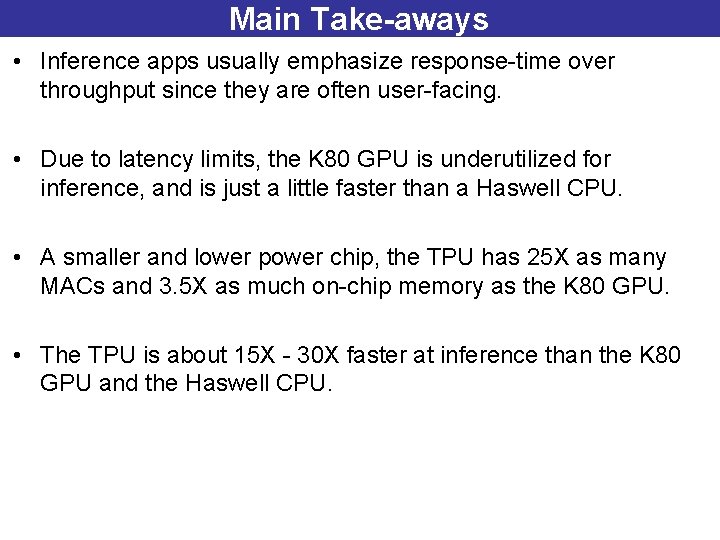
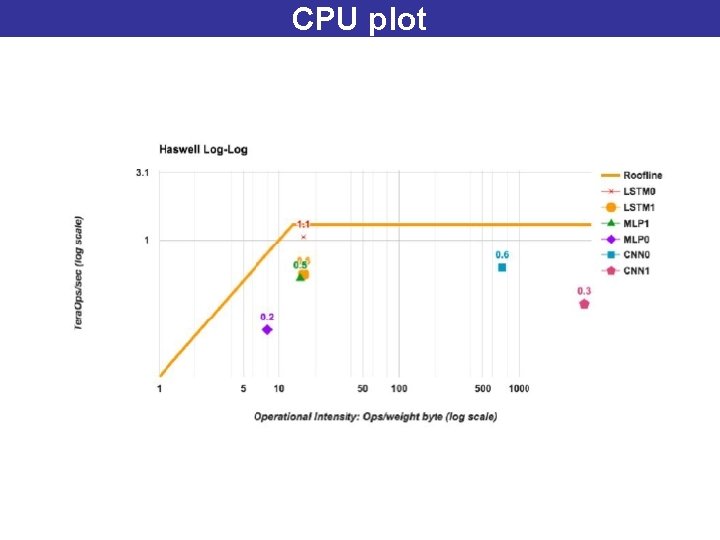
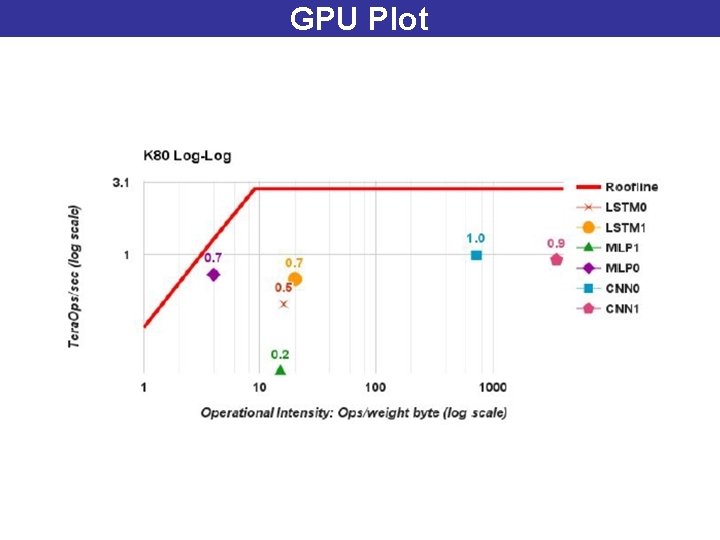
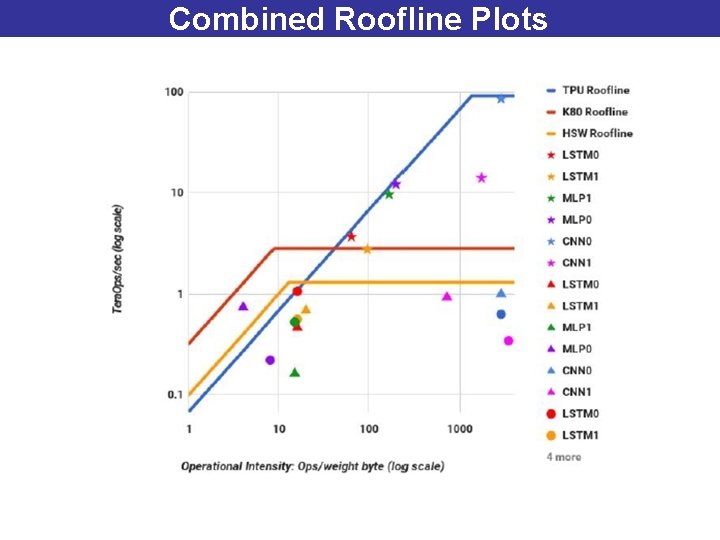
Main Take-aways • Inference apps usually emphasize response-time over throughput since they are often user-facing. • Due to latency limits, the K 80 GPU is underutilized for inference, and is just a little faster than a Haswell CPU. • A smaller and lower power chip, the TPU has 25 X as many MACs and 3. 5 X as much on-chip memory as the K 80 GPU. • The TPU is about 15 X - 30 X faster at inference than the K 80 GPU and the Haswell CPU.
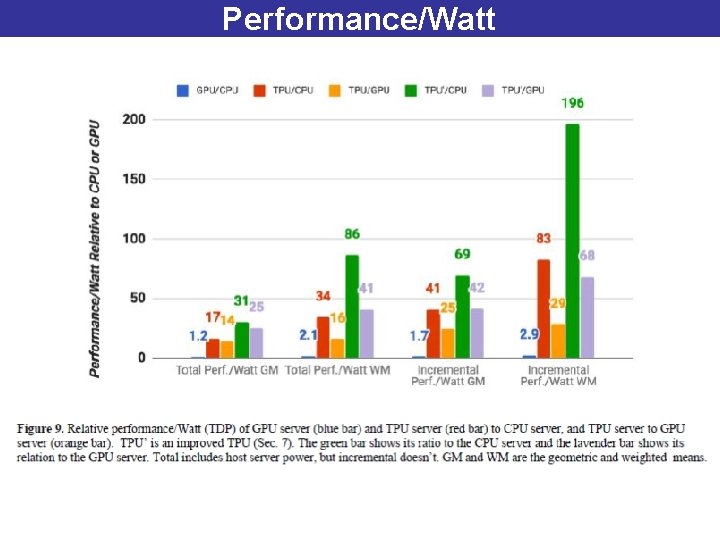
Main Take-aways #2 • Four of the six NN apps are memory-bandwidth limited on the TPU; – if the TPU were revised to have the same memory system as the K 80 GPU, it would be about 30 X - 50 X faster than the GPU and CPU. • The performance/Watt of the TPU is 30 X - 80 X that of contemporary products; – the revised TPU with K 80 memory would be 70 X - 200 X better. • While most architects have been accelerating CNNs, they represent just 5% of our datacenter workload.
TPU Architecture All internal buses are 256 B wide
TPU Architecture Main Block: MMU 256 x 256 MACs, 8 b signed or unsigned ints. 256 partial sums per cycle
TPU Architecture 16 bit products accumulated in the Accumulators
TPU Architecture 4 Mi. B: 4 K x 256 x 32 b accumulators (vectors)
Why 4 K vectors in the Accumulators • Calculated for Peak performance; – Need ~1350 – Rounded that up to 2048 – Double that so that we can have double buffering: • Reading past results while calculating the next set
TPU Architecture MMU: can do mix of 8 b, or 16 b ½ speed for 8 b x 16 b, ¼ speed for 16 b x 16 b
MMU contd. • Contains 64 Ki. B weights x 2 • One tile is the active the other is for double buffering – Loading the next while calculating with the current one – Needs 256 cycles to load next one • Can do Matrix Multiply or Convolution • Can read or write 256 values per cycle • Targets Dense networks, Sparse later revisions
Loading Weights 8 Gi. B off-chip DRAM, Weight FIFO 64 Ki. B x 4
Activations/Intermediate Results Unified Buffer: 24 Mi. B, data from/to host CPU Connects on 16 x PCIE 3. 0 through Sata interface
Other Layers Specialized Units for; Activation Functions, Normalization and Pooling
Layout
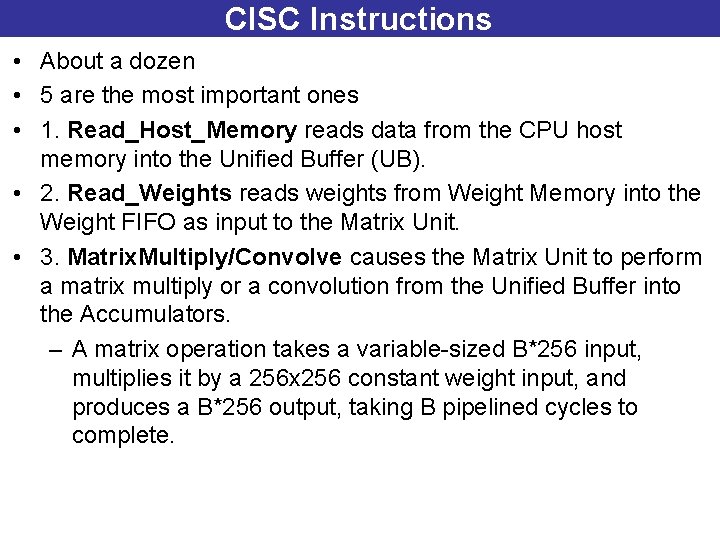
CISC Instructions • About a dozen • 5 are the most important ones • 1. Read_Host_Memory reads data from the CPU host memory into the Unified Buffer (UB). • 2. Read_Weights reads weights from Weight Memory into the Weight FIFO as input to the Matrix Unit. • 3. Matrix. Multiply/Convolve causes the Matrix Unit to perform a matrix multiply or a convolution from the Unified Buffer into the Accumulators. – A matrix operation takes a variable-sized B*256 input, multiplies it by a 256 x 256 constant weight input, and produces a B*256 output, taking B pipelined cycles to complete.
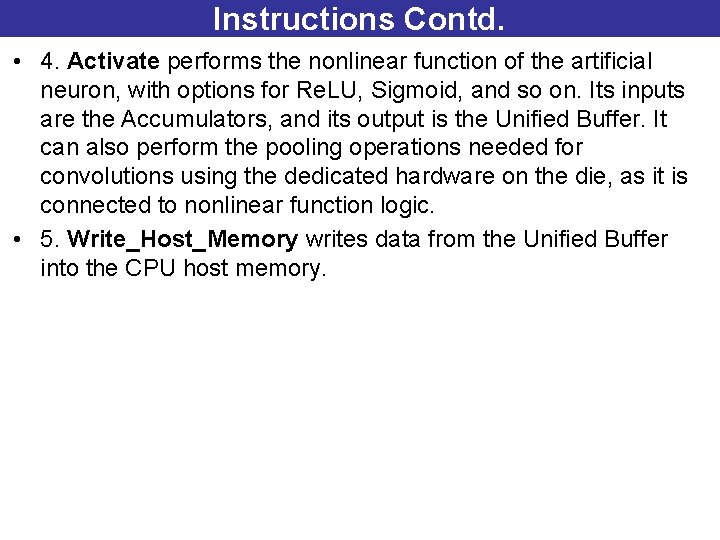
Instructions Contd. • 4. Activate performs the nonlinear function of the artificial neuron, with options for Re. LU, Sigmoid, and so on. Its inputs are the Accumulators, and its output is the Unified Buffer. It can also perform the pooling operations needed for convolutions using the dedicated hardware on the die, as it is connected to nonlinear function logic. • 5. Write_Host_Memory writes data from the Unified Buffer into the CPU host memory.
Design Philosophy • Keep the Matrix Unit busy • 4 -stage pipeline – Instructions can occupy pipeline “stages” for thousands of cycles • Overlap instructions with Matrix. Multiply • Read_weights uses access/decoupling
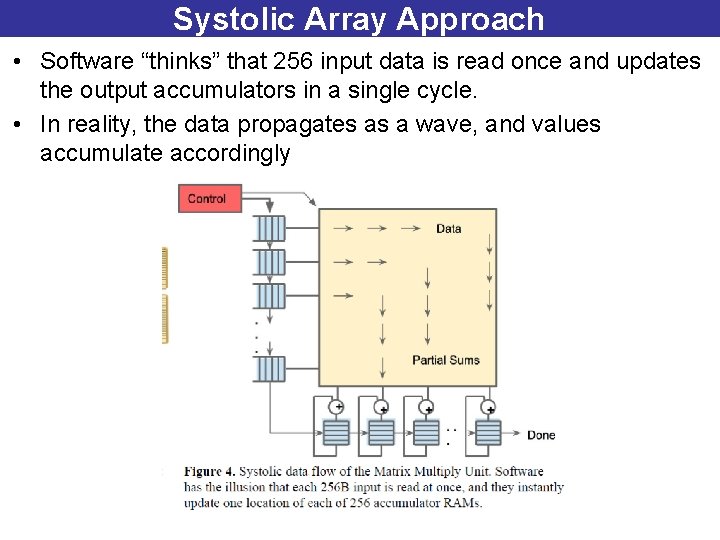
Systolic Array Approach • Software “thinks” that 256 input data is read once and updates the output accumulators in a single cycle. • In reality, the data propagates as a wave, and values accumulate accordingly
Hardware Being Compared
Roofline Model The closer we are to the roofline the better the machine is utilized
What’s going on with CNN 1? Half of the cycles doing MACs Only half of those are active due to shallow feature depths 35% of cycles waiting for weights to load from off-chip
CPU plot
GPU Plot
Combined Roofline Plots
Performance/Watt
Scaling