
Tensor Network States Algorithms and Applications December 1
Tensor Network States: Algorithms and Applications December 1 -5, 2014 Beijing, China The multi-scale Entanglement Renormalization Ansatz MERA -- a pedagogical introduction-- Guifre Vidal
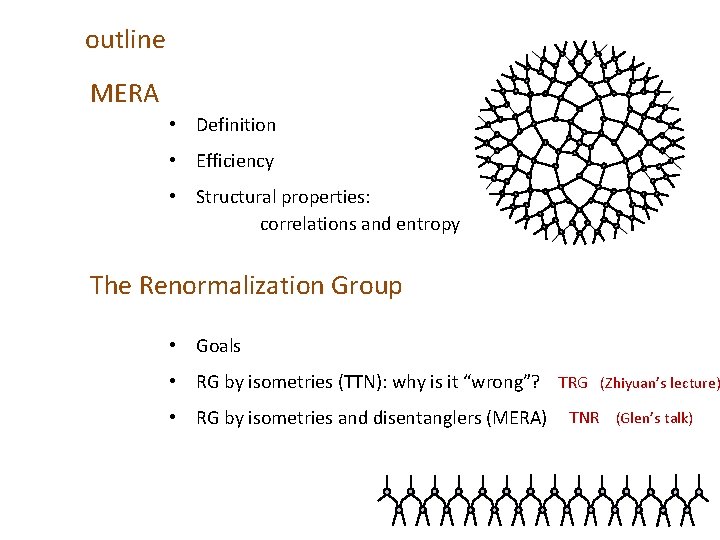
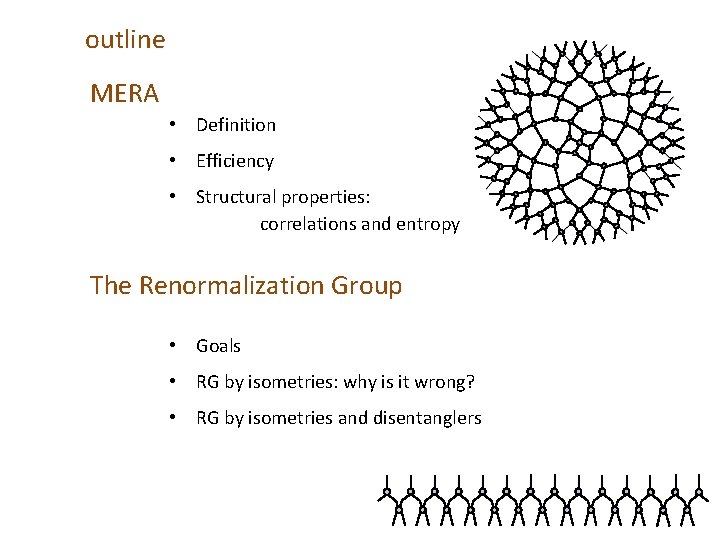
outline MERA • Definition • Efficiency • Structural properties: correlations and entropy The Renormalization Group • Goals • RG by isometries (TTN): why is it “wrong”? TRG (Zhiyuan’s lecture) • RG by isometries and disentanglers (MERA) TNR (Glen’s talk)
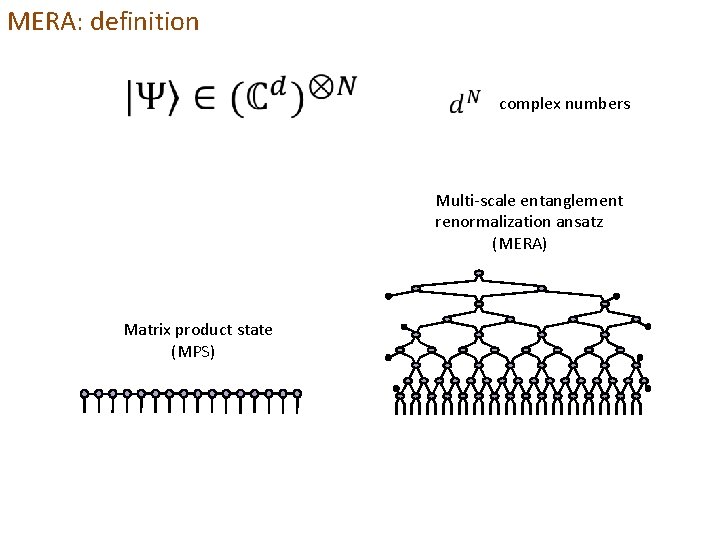
MERA: definition complex numbers Multi-scale entanglement renormalization ansatz (MERA) Matrix product state (MPS)
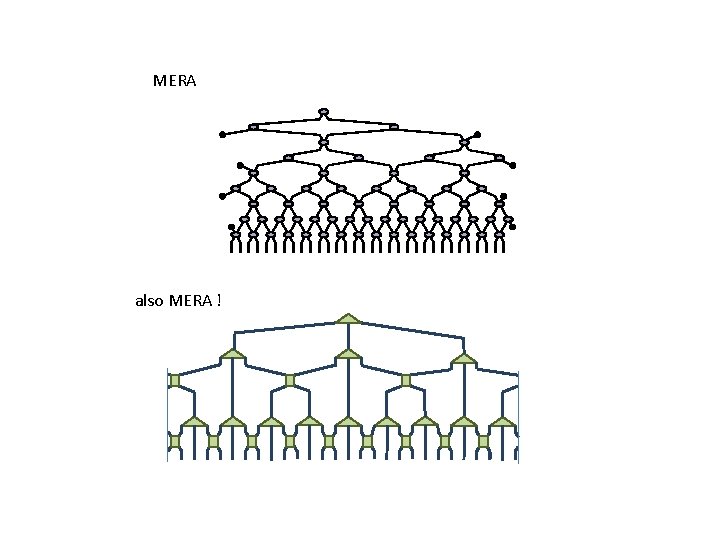
MERA also MERA !
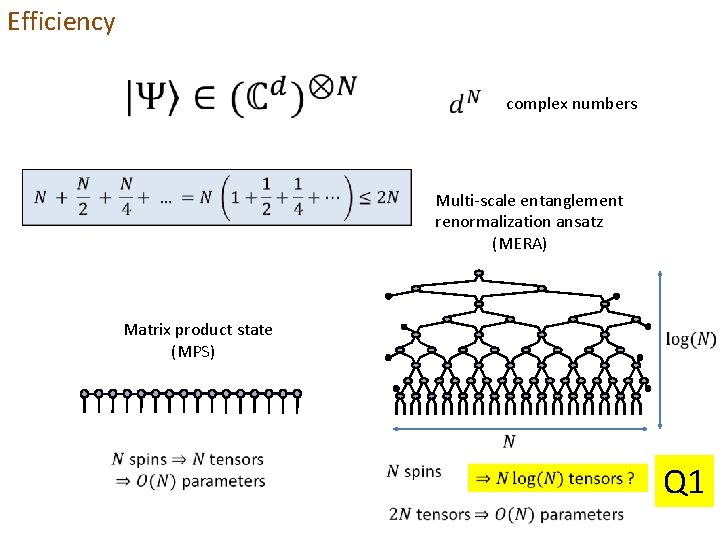
Efficiency complex numbers Multi-scale entanglement renormalization ansatz (MERA) Matrix product state (MPS) Q 1
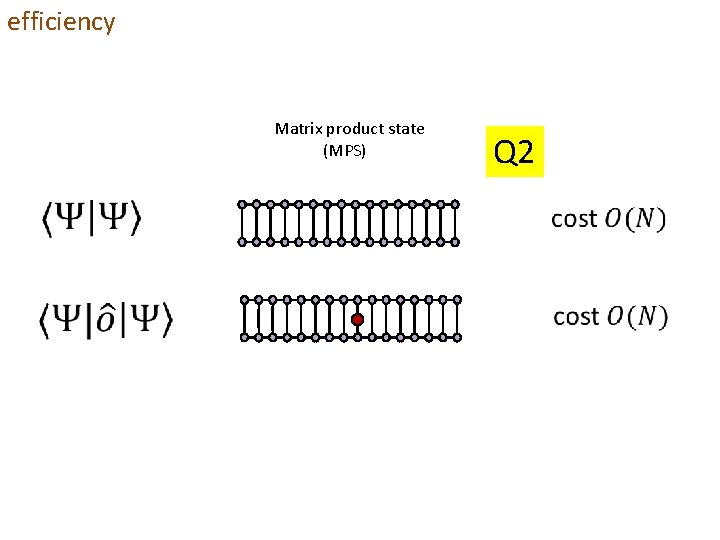
efficiency Matrix product state (MPS) Q 2
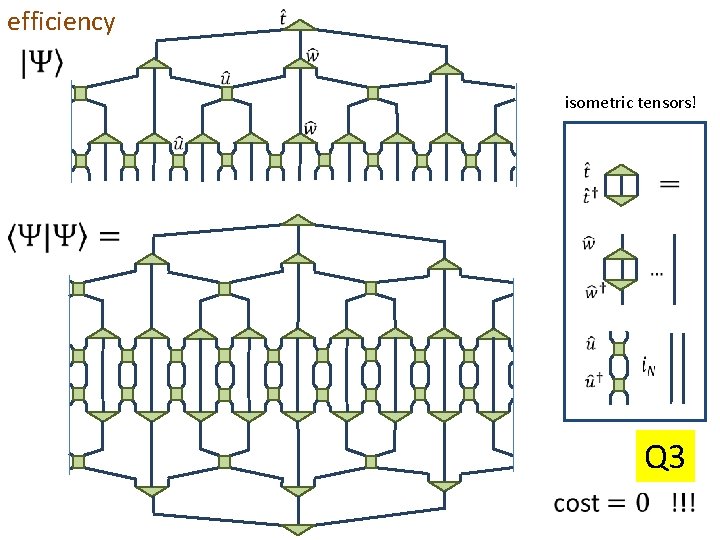
efficiency isometric tensors! Q 3
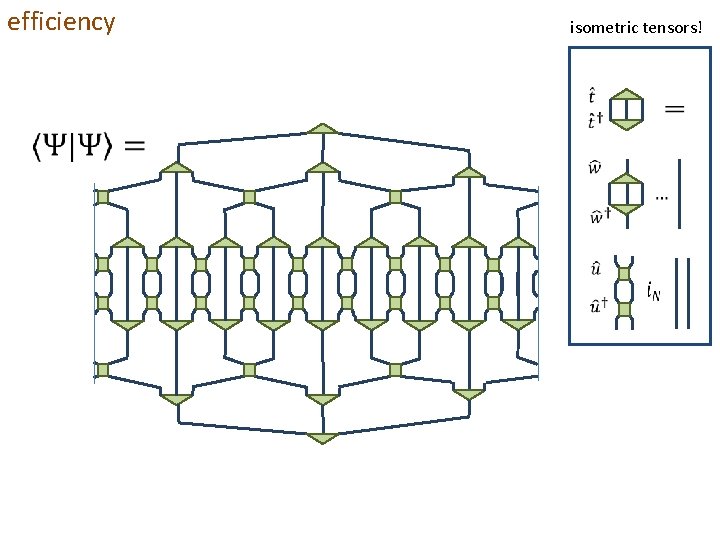
efficiency isometric tensors!
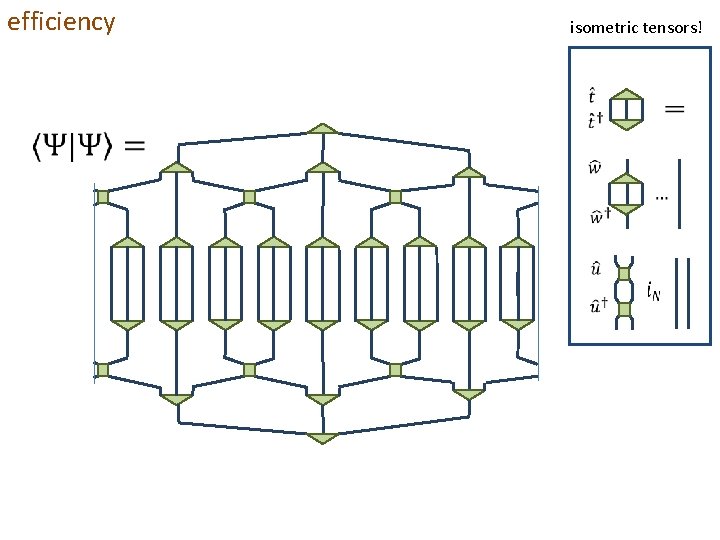
efficiency isometric tensors!
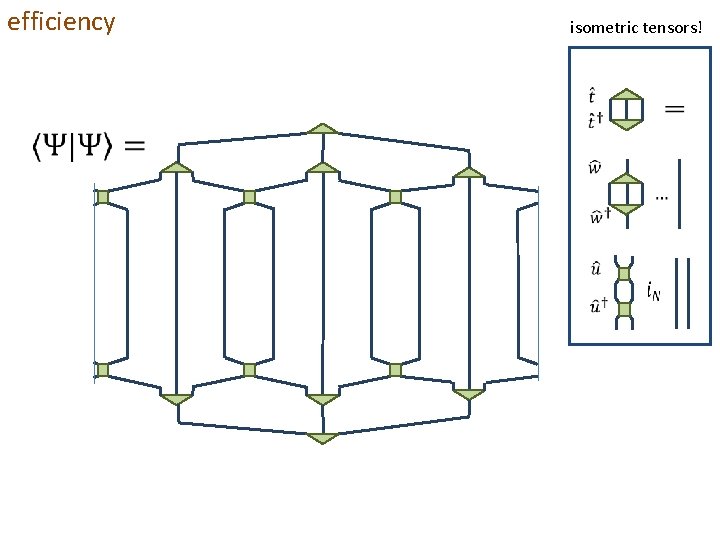
efficiency isometric tensors!
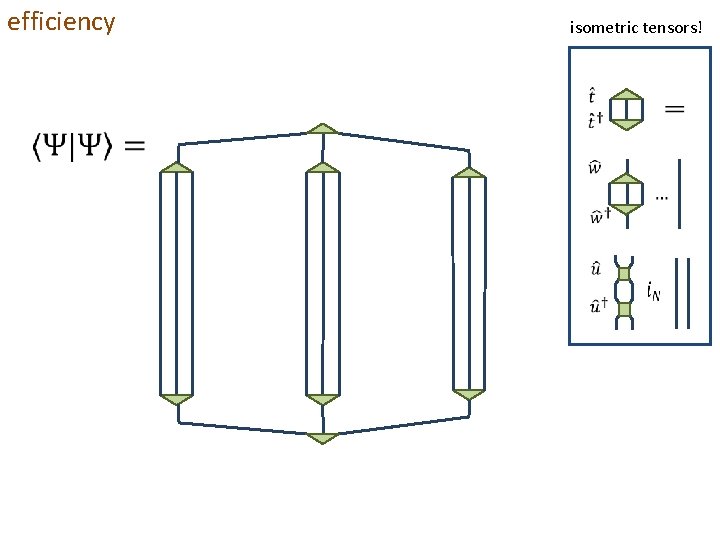
efficiency isometric tensors!
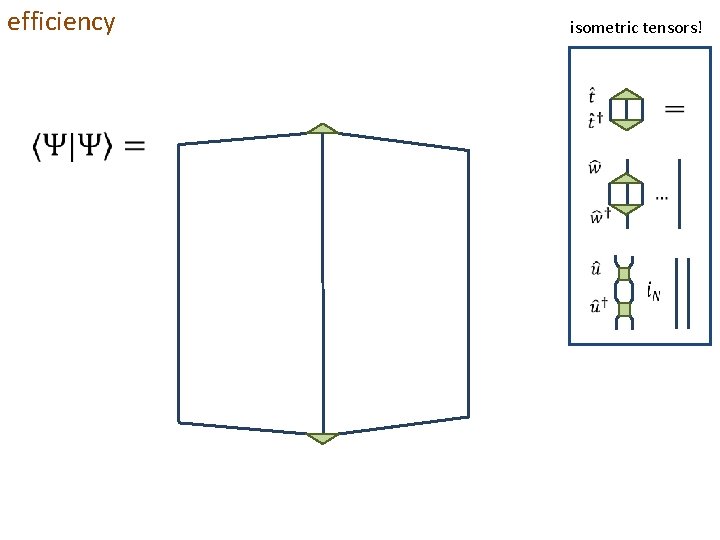
efficiency isometric tensors!
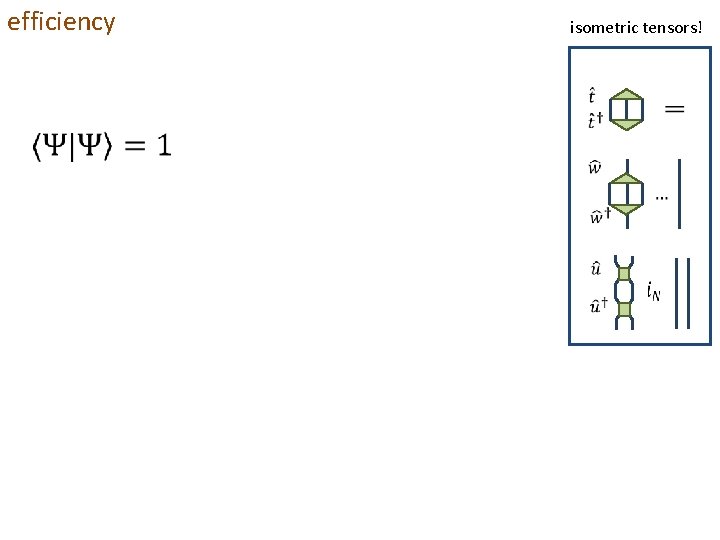
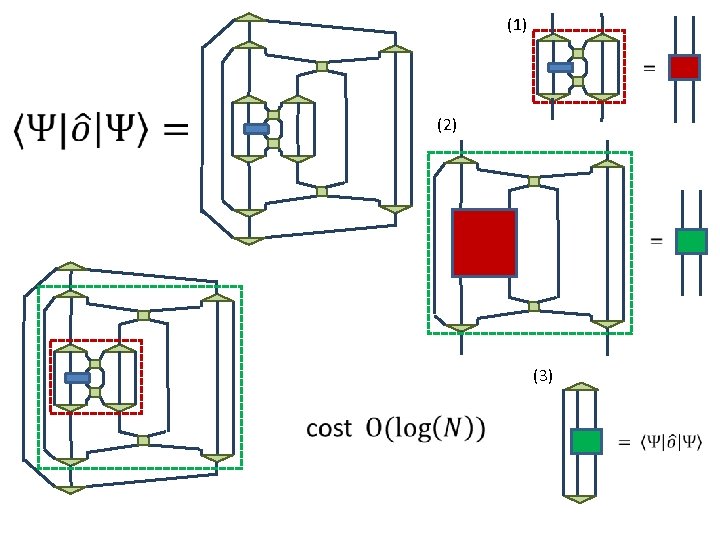
efficiency isometric tensors!

isometric tensors!
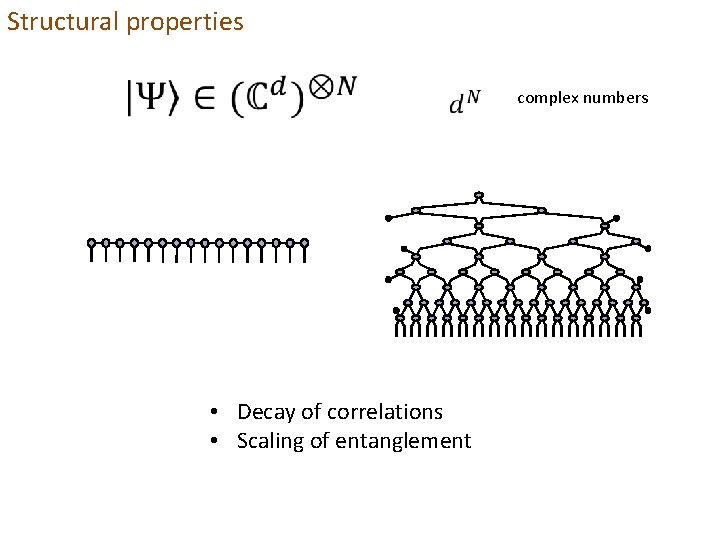
Structural properties • Decay of correlations • Scaling of entanglement complex numbers
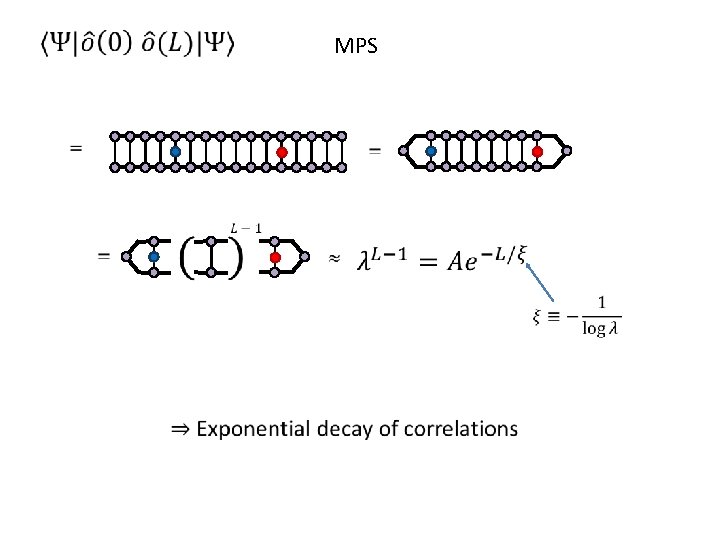
MPS
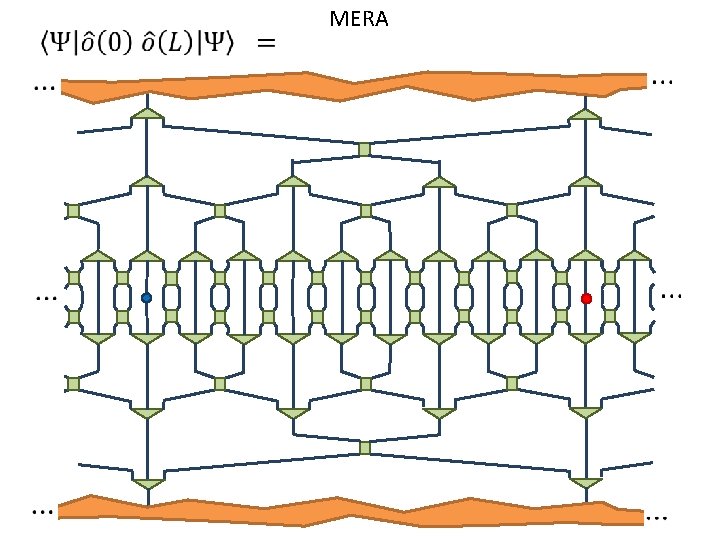
MERA
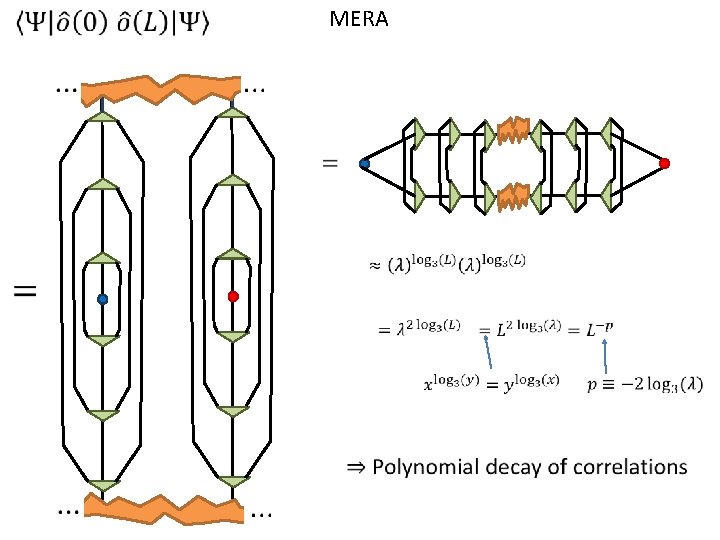
MERA
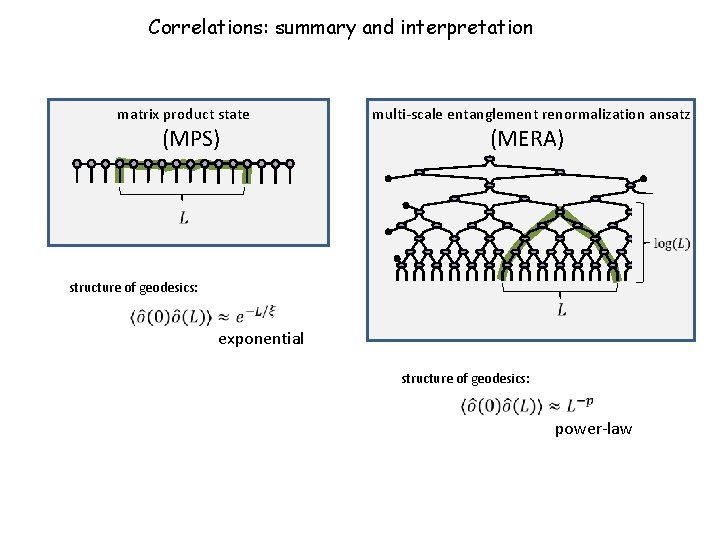
Correlations: summary and interpretation matrix product state (MPS) multi-scale entanglement renormalization ansatz (MERA) structure of geodesics: exponential structure of geodesics: power-law
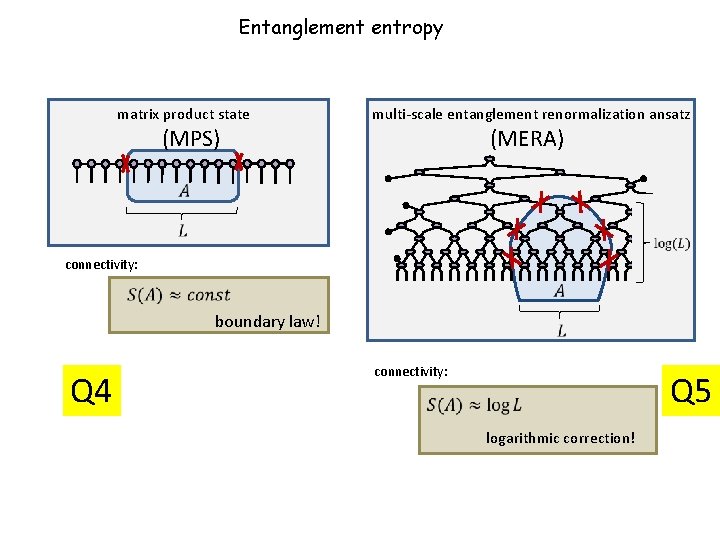
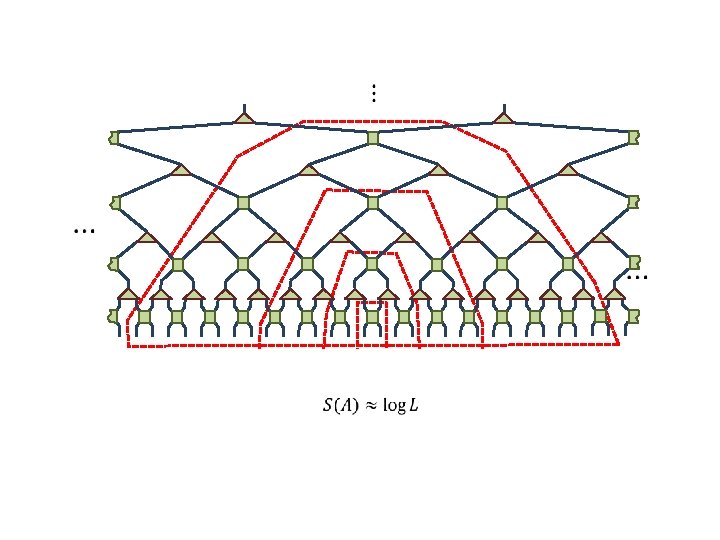
Entanglement entropy matrix product state (MPS) multi-scale entanglement renormalization ansatz (MERA) connectivity: boundary law! Q 4 connectivity: Q 5 logarithmic correction!
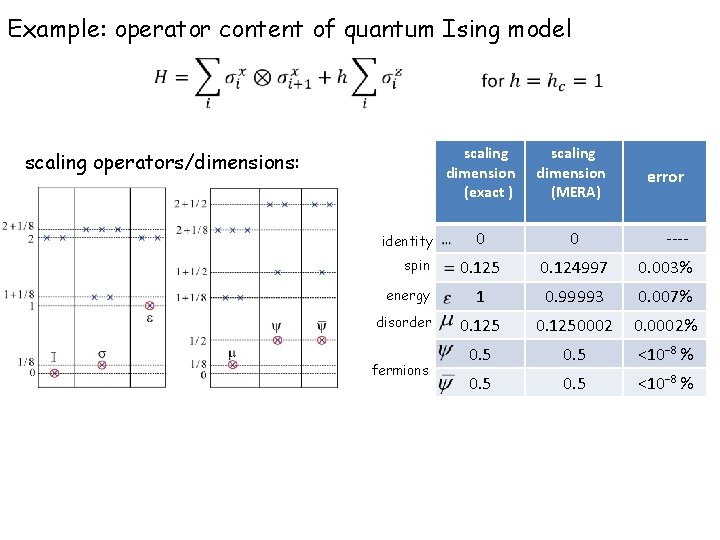
Example: operator content of quantum Ising model scaling dimension (exact ) scaling operators/dimensions: identity spin energy disorder fermions scaling dimension (MERA) error 0 ---- 0. 124997 0. 003% 1 0. 99993 0. 007% 0. 1250002 0. 0002% 0. 5 <10− 8 % 0 0. 125
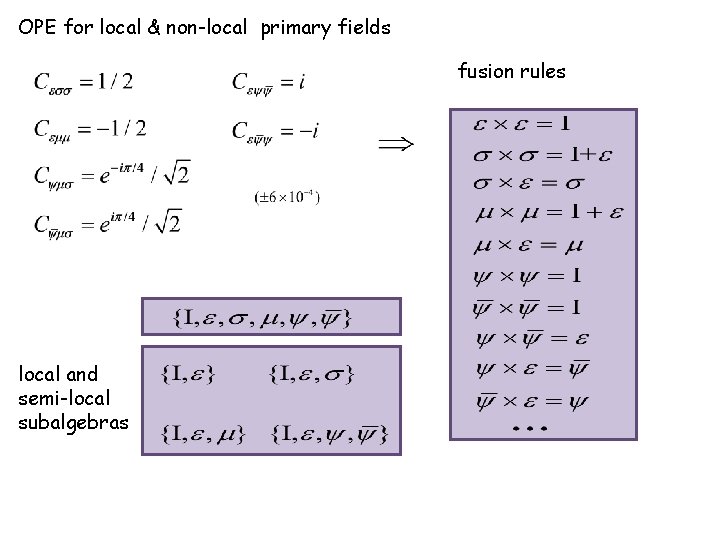
OPE for local & non-local primary fields fusion rules local and semi-local subalgebras
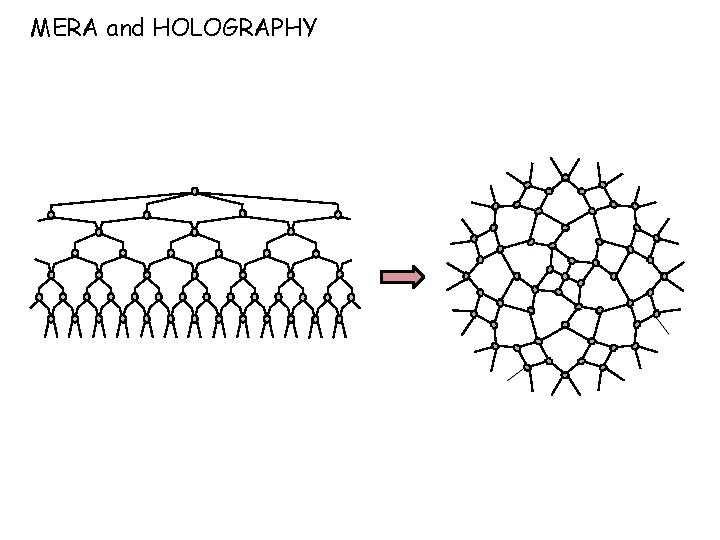
MERA and HOLOGRAPHY
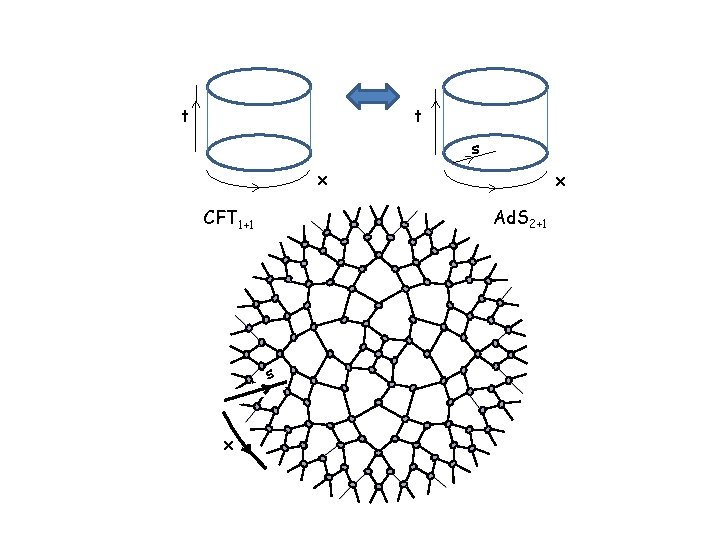
t t s x Ad. S 2+1 CFT 1+1 s x x
outline MERA • Definition • Efficiency • Structural properties: correlations and entropy The Renormalization Group • Goals • RG by isometries: why is it wrong? • RG by isometries and disentanglers
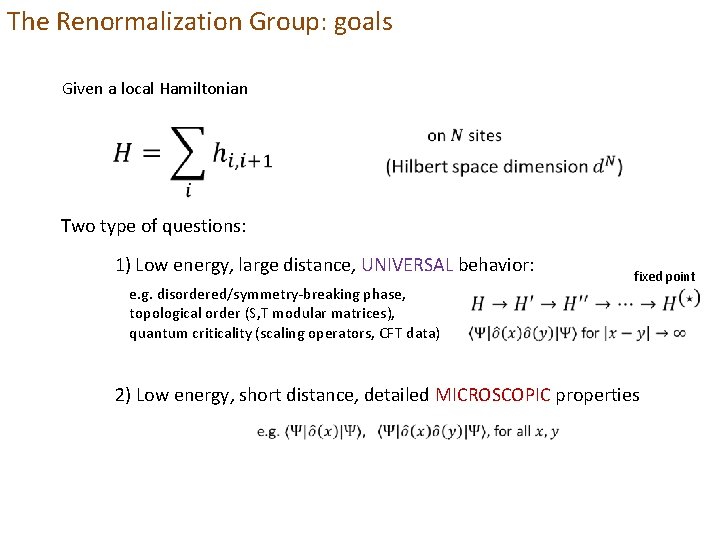
The Renormalization Group: goals Given a local Hamiltonian Two type of questions: 1) Low energy, large distance, UNIVERSAL behavior: e. g. disordered/symmetry-breaking phase, topological order (S, T modular matrices), quantum criticality (scaling operators, CFT data) fixed point 2) Low energy, short distance, detailed MICROSCOPIC properties
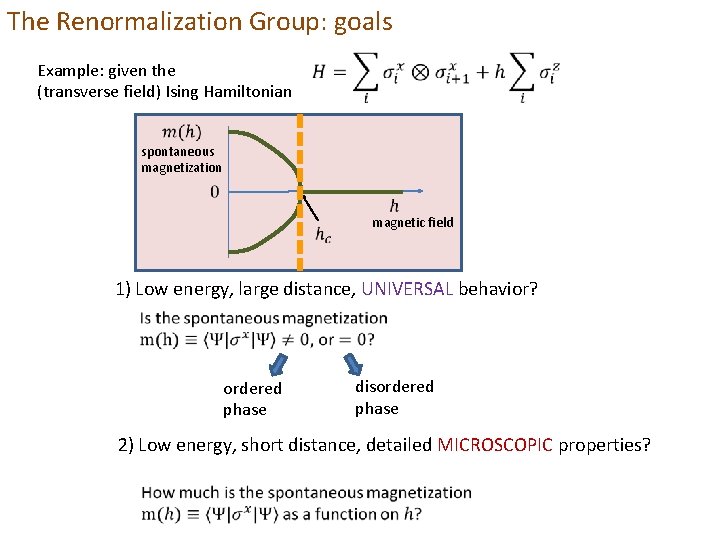
The Renormalization Group: goals Example: given the (transverse field) Ising Hamiltonian spontaneous magnetization magnetic field 1) Low energy, large distance, UNIVERSAL behavior? ordered phase disordered phase 2) Low energy, short distance, detailed MICROSCOPIC properties?
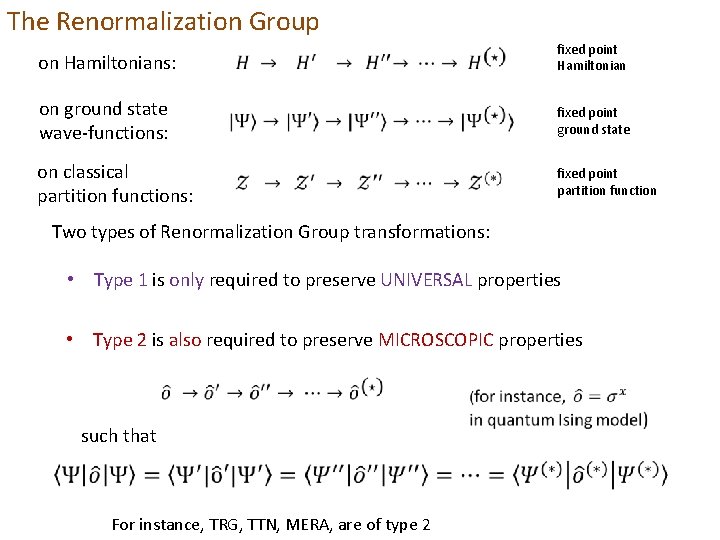
The Renormalization Group on Hamiltonians: on ground state wave-functions: on classical partition functions: fixed point Hamiltonian fixed point ground state fixed point partition function Two types of Renormalization Group transformations: • Type 1 is only required to preserve UNIVERSAL properties • Type 2 is also required to preserve MICROSCOPIC properties such that For instance, TRG, TTN, MERA, are of type 2
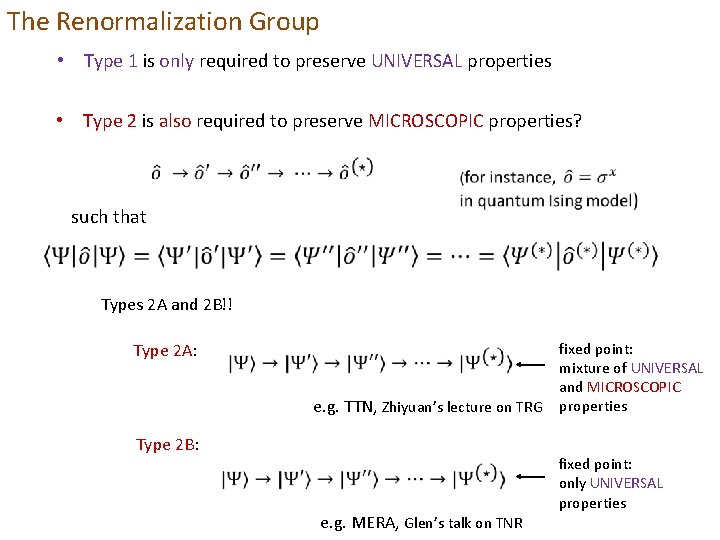
The Renormalization Group • Type 1 is only required to preserve UNIVERSAL properties • Type 2 is also required to preserve MICROSCOPIC properties? such that Types 2 A and 2 B!! Type 2 A: e. g. TTN, Zhiyuan’s lecture on TRG Type 2 B: e. g. MERA, Glen’s talk on TNR fixed point: mixture of UNIVERSAL and MICROSCOPIC properties fixed point: only UNIVERSAL properties
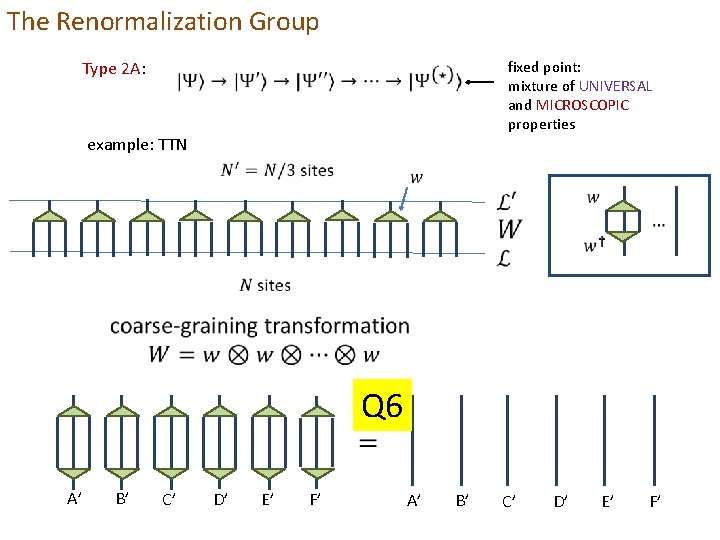
The Renormalization Group Type 2 A: fixed point: mixture of UNIVERSAL and MICROSCOPIC properties example: TTN A’ B’ C’ D’ E’ F’ Q 6 A’ B’ C’ D’ E’ F’
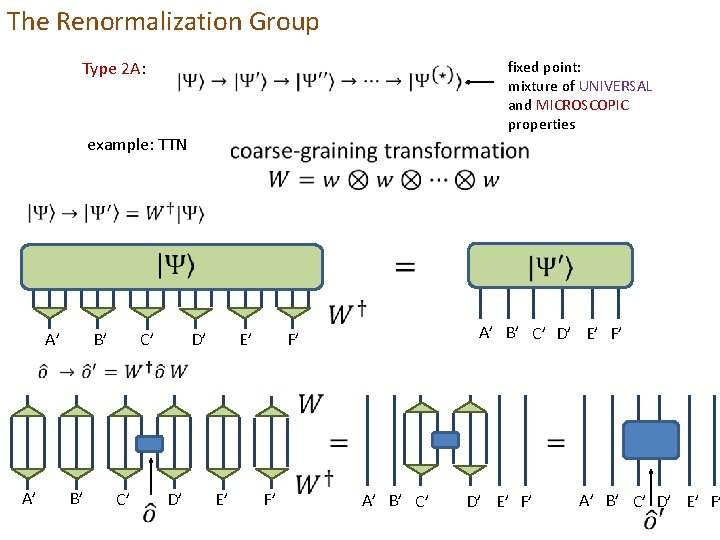
The Renormalization Group Type 2 A: fixed point: mixture of UNIVERSAL and MICROSCOPIC properties example: TTN A’ B’ D’ C’ A’ B’ C’ D’ E’ F’ F’ E’ A’ B’ C’ D’ E’ F’ A’ B’ C’ D’ E’ F’
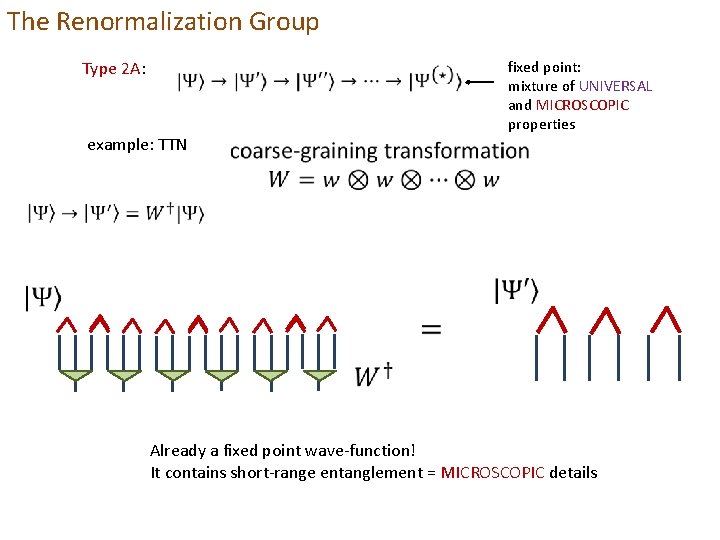
The Renormalization Group Type 2 A: fixed point: mixture of UNIVERSAL and MICROSCOPIC properties example: TTN Already a fixed point wave-function! It contains short-range entanglement = MICROSCOPIC details
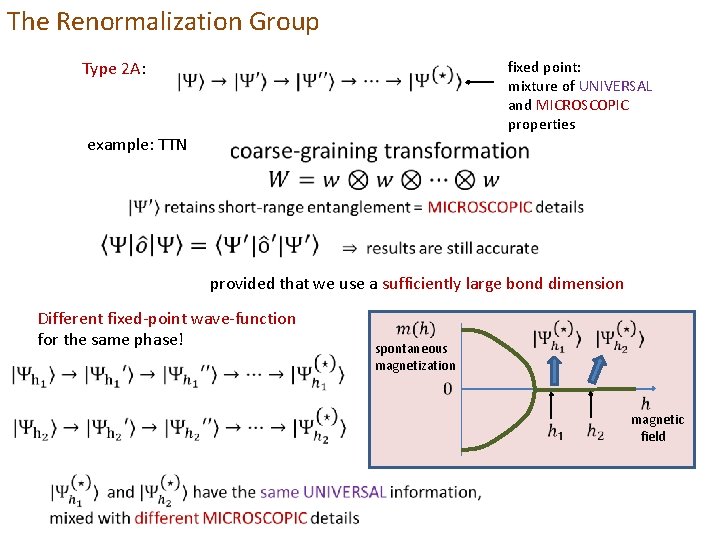
The Renormalization Group Type 2 A: fixed point: mixture of UNIVERSAL and MICROSCOPIC properties example: TTN provided that we use a sufficiently large bond dimension Different fixed-point wave-function for the same phase! spontaneous magnetization magnetic field
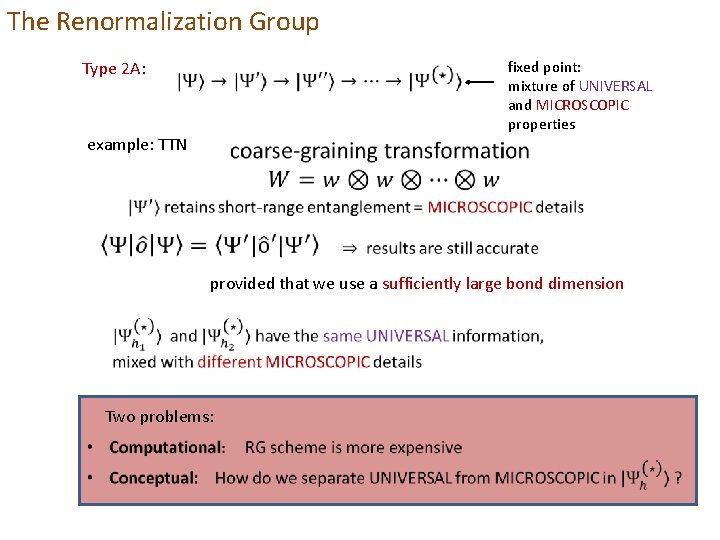
The Renormalization Group Type 2 A: fixed point: mixture of UNIVERSAL and MICROSCOPIC properties example: TTN provided that we use a sufficiently large bond dimension Two problems:
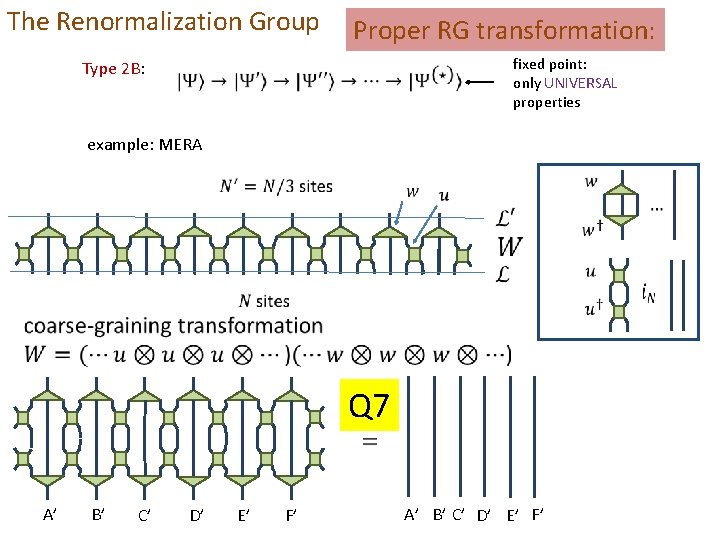
The Renormalization Group Type 2 B: Proper RG transformation: fixed point: only UNIVERSAL properties example: MERA Q 7 A’ B’ C’ D’ E’ F’
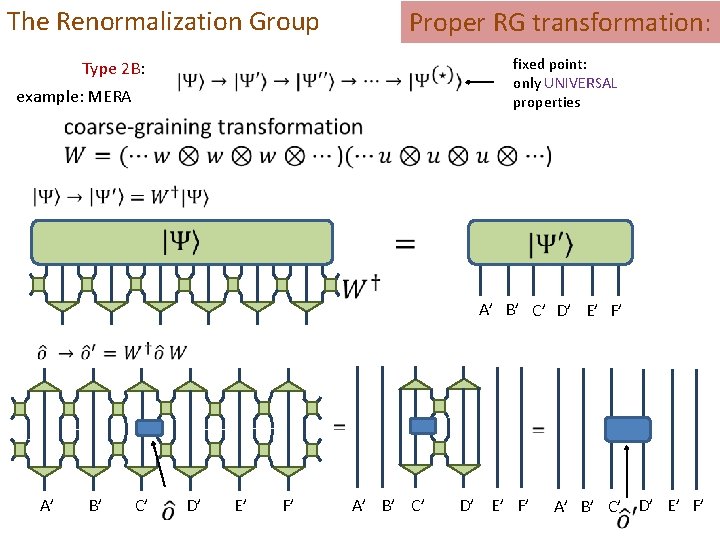
The Renormalization Group Type 2 B: Proper RG transformation: fixed point: only UNIVERSAL properties example: MERA A’ B’ C’ D’ E’ F’ A’ B’ C’ D’ E’ F’
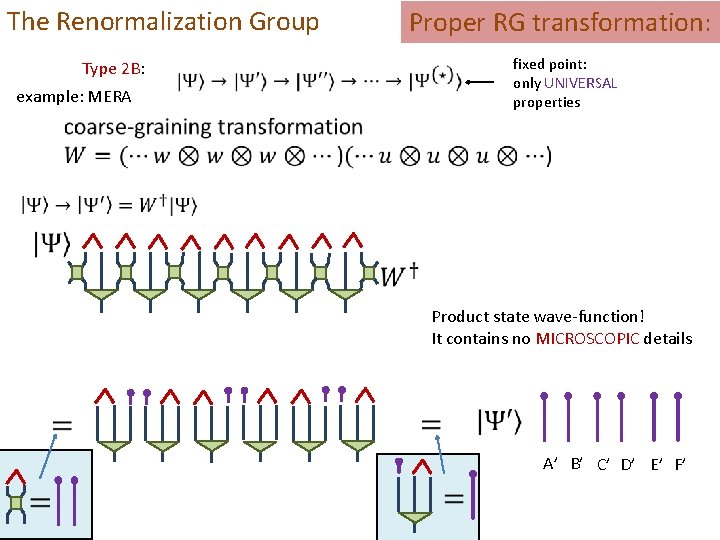
The Renormalization Group Type 2 B: example: MERA Proper RG transformation: fixed point: only UNIVERSAL properties Product state wave-function! It contains no MICROSCOPIC details A’ B’ C’ D’ E’ F’
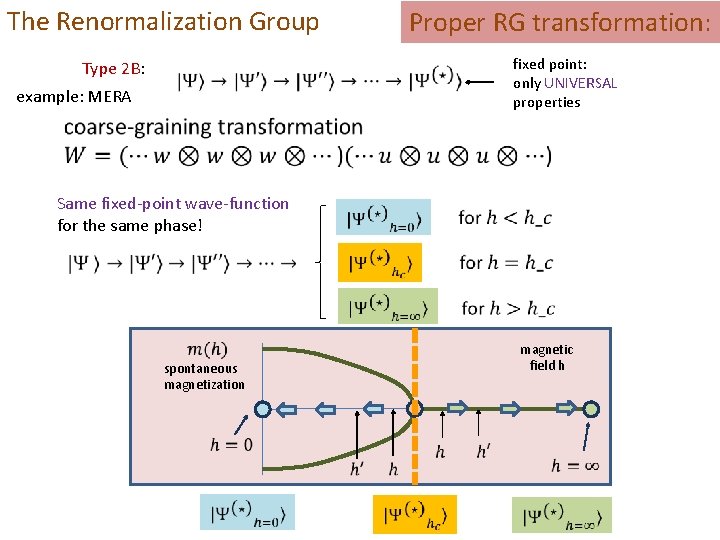
The Renormalization Group Type 2 B: example: MERA Proper RG transformation: fixed point: only UNIVERSAL properties Same fixed-point wave-function for the same phase! magnetic field h spontaneous magnetization
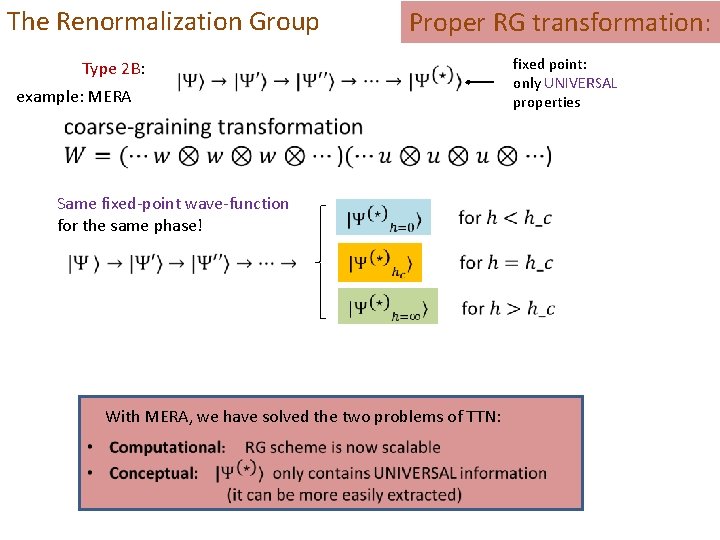
The Renormalization Group Type 2 B: example: MERA fixed point: only UNIVERSAL properties Same fixed-point wave-function for the same phase! Proper RG transformation: With MERA, we have solved the two problems of TTN:
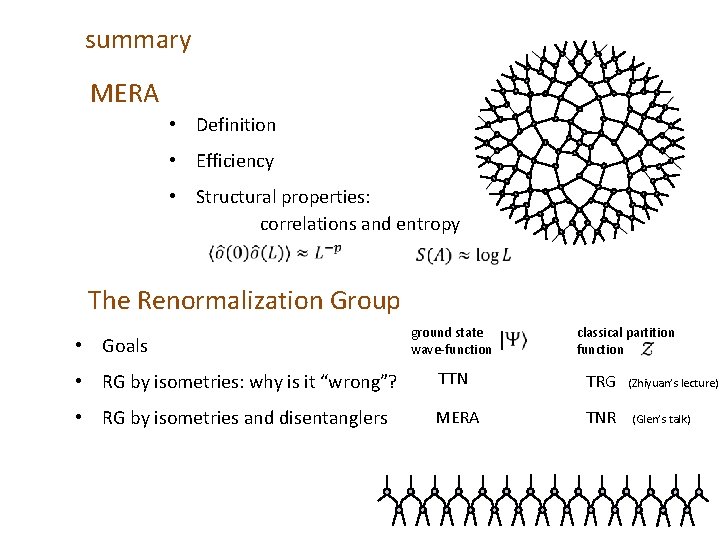
summary MERA • Definition • Efficiency • Structural properties: correlations and entropy The Renormalization Group • Goals ground state wave-function classical partition function • RG by isometries: why is it “wrong”? TTN TRG (Zhiyuan’s lecture) • RG by isometries and disentanglers MERA TNR (Glen’s talk)
- Slides: 42