
Tensor Network Simulations of QFT in Curved Spacetime

- Slides: 43
Tensor Network Simulations of QFT in Curved Spacetime ADAM GM LEWIS, QI HU, GUIFRE VIDAL PERIMETER INSTITUTE FOR THEORETICAL PHYSICS , WATERLOO, ON, CA
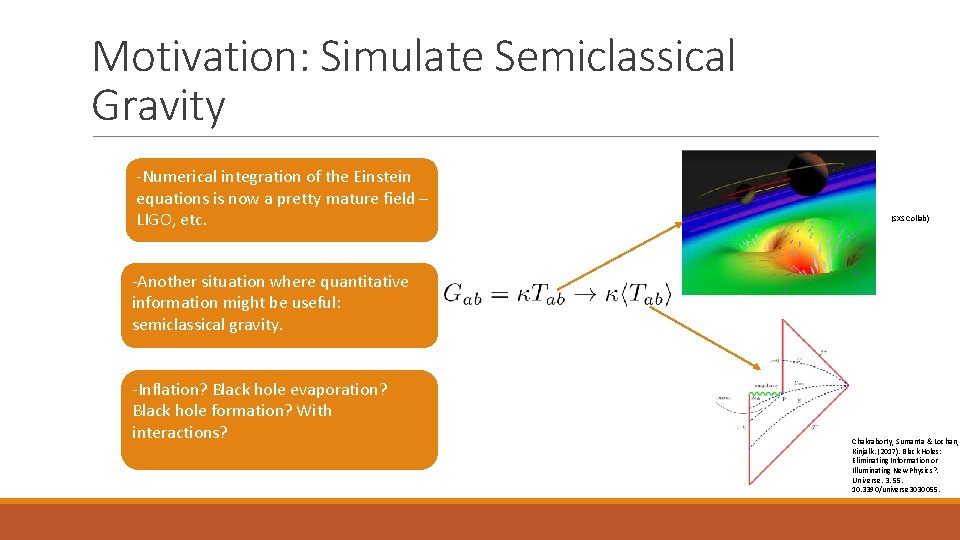
Motivation: Simulate Semiclassical Gravity -Numerical integration of the Einstein equations is now a pretty mature field – LIGO, etc. (SXS Collab) -Another situation where quantitative information might be useful: semiclassical gravity. -Inflation? Black hole evaporation? Black hole formation? With interactions? Chakraborty, Sumanta & Lochan, Kinjalk. (2017). Black Holes: Eliminating Information or Illuminating New Physics? . Universe. 3. 55. 10. 3390/universe 3030055.
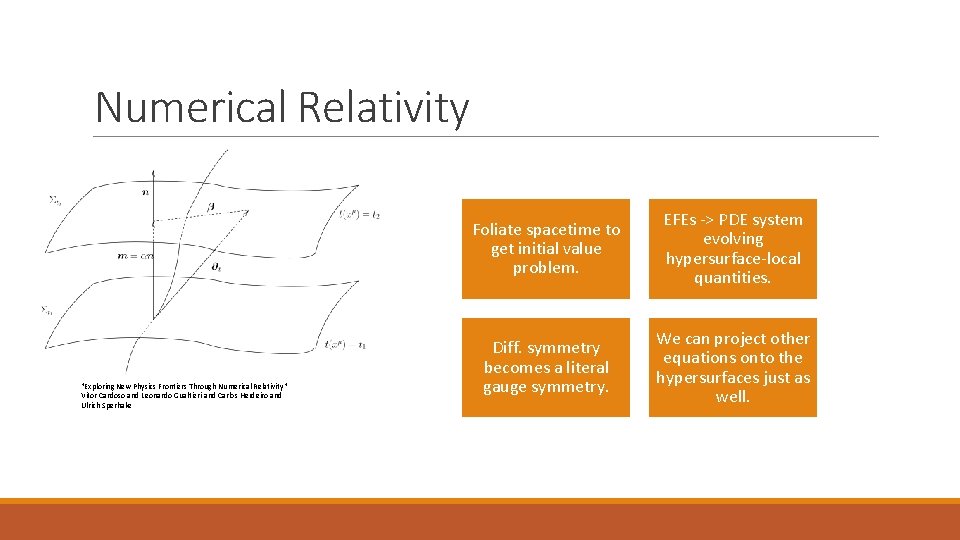
Numerical Relativity "Exploring New Physics Frontiers Through Numerical Relativity" Vitor Cardoso and Leonardo Gualtieri and Carlos Herdeiro and Ulrich Sperhake Foliate spacetime to get initial value problem. EFEs -> PDE system evolving hypersurface-local quantities. Diff. symmetry becomes a literal gauge symmetry. We can project other equations onto the hypersurfaces just as well.
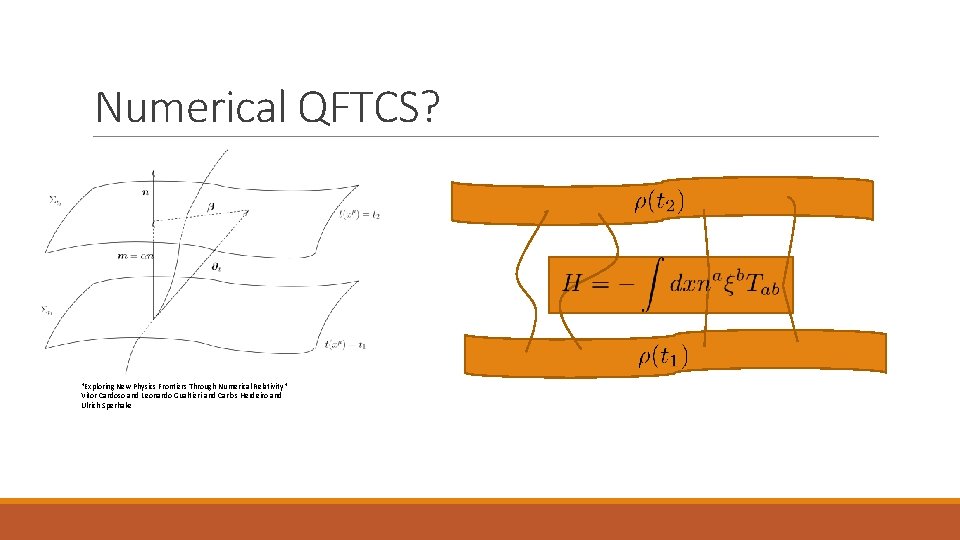
Numerical QFTCS? "Exploring New Physics Frontiers Through Numerical Relativity" Vitor Cardoso and Leonardo Gualtieri and Carlos Herdeiro and Ulrich Sperhake
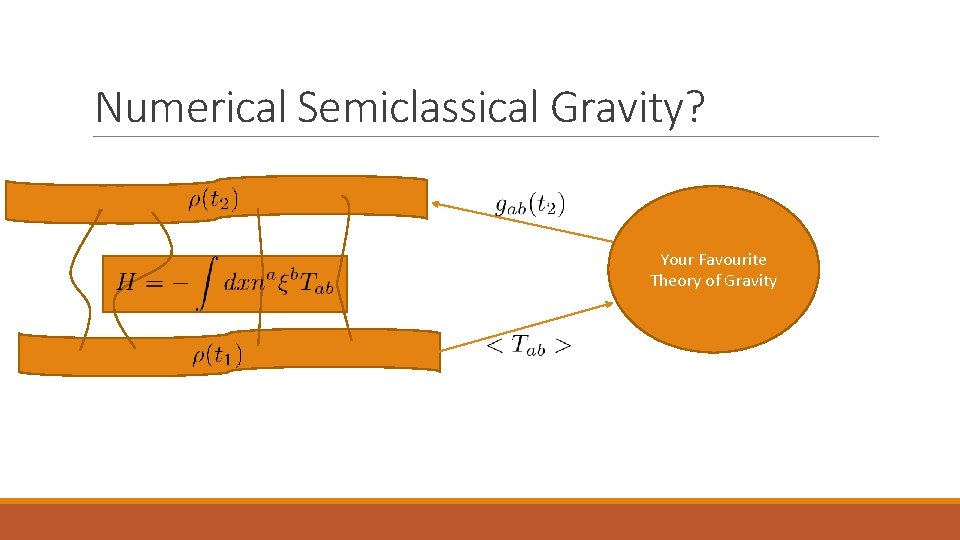
Numerical Semiclassical Gravity? Your Favourite Theory of Gravity
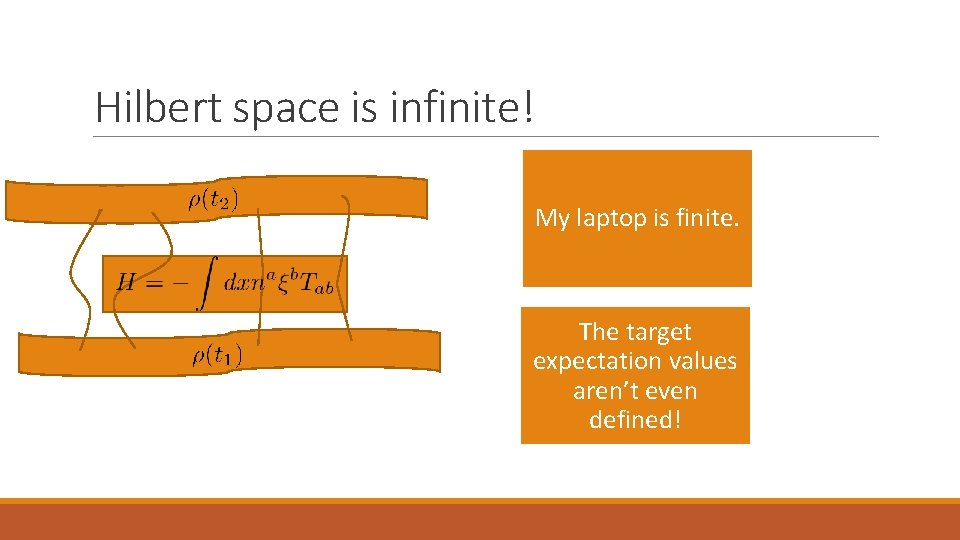
Hilbert space is infinite! My laptop is finite. The target expectation values aren’t even defined!
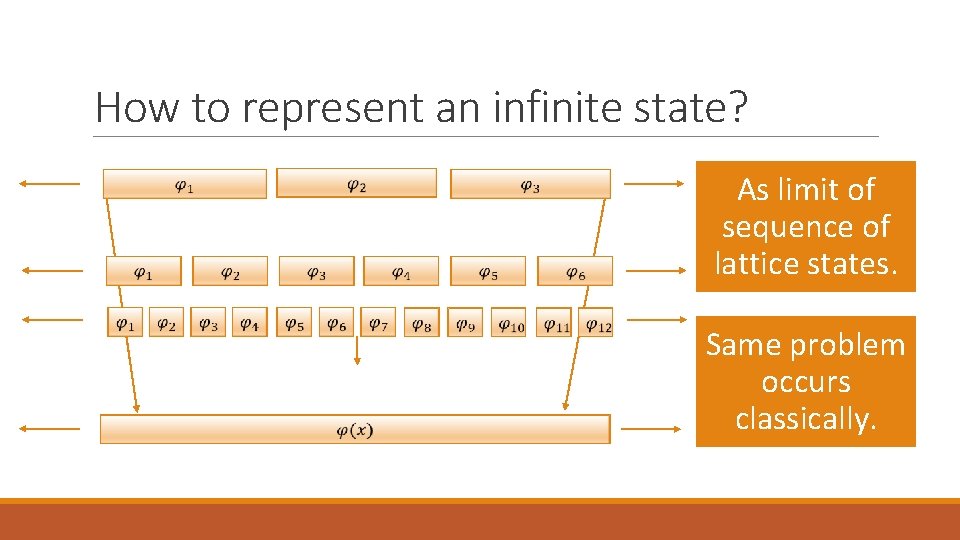
How to represent an infinite state? As limit of sequence of lattice states. Same problem occurs classically.
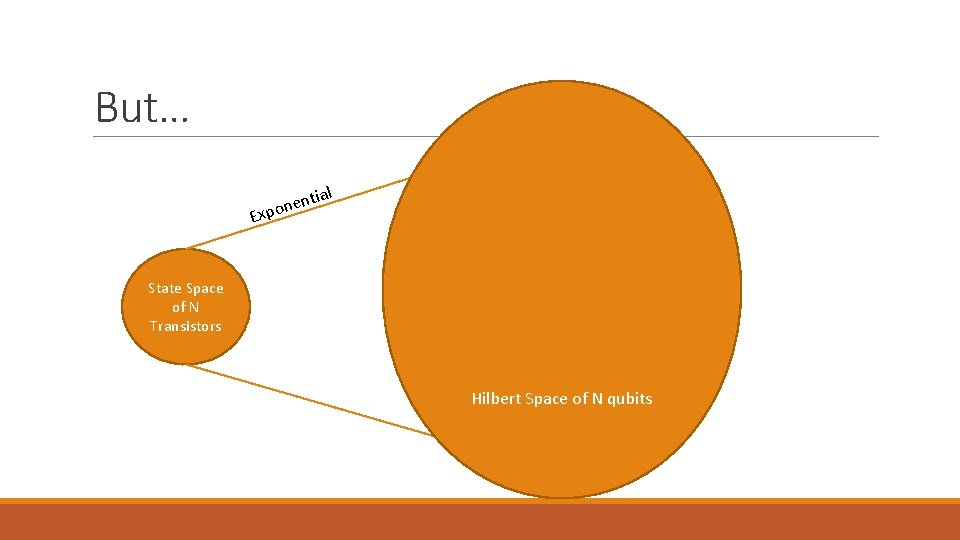
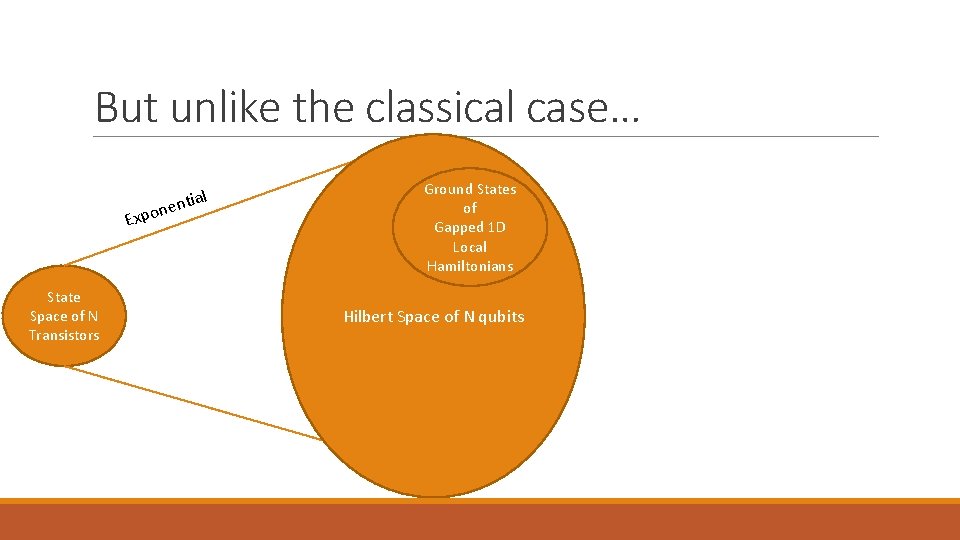
But… l ntia e n o p Ex State Space of N Transistors Hilbert Space of N qubits
But unlike the classical case… ial nent Expo State Space of N Transistors Ground States of Gapped 1 D Local Hamiltonians Hilbert Space of N qubits
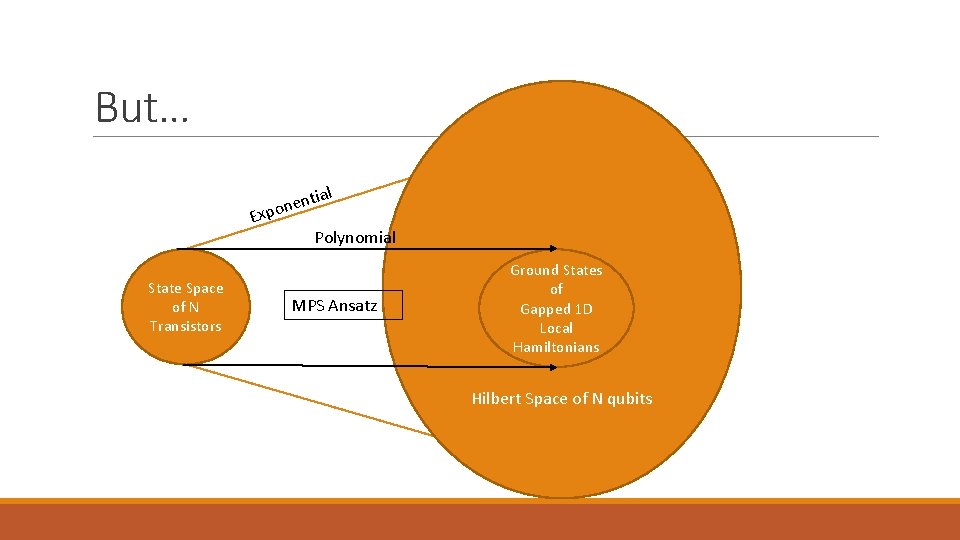
But… l ntia e n o p Ex State Space of N Transistors Polynomial MPS Ansatz Ground States of Gapped 1 D Local Hamiltonians Hilbert Space of N qubits
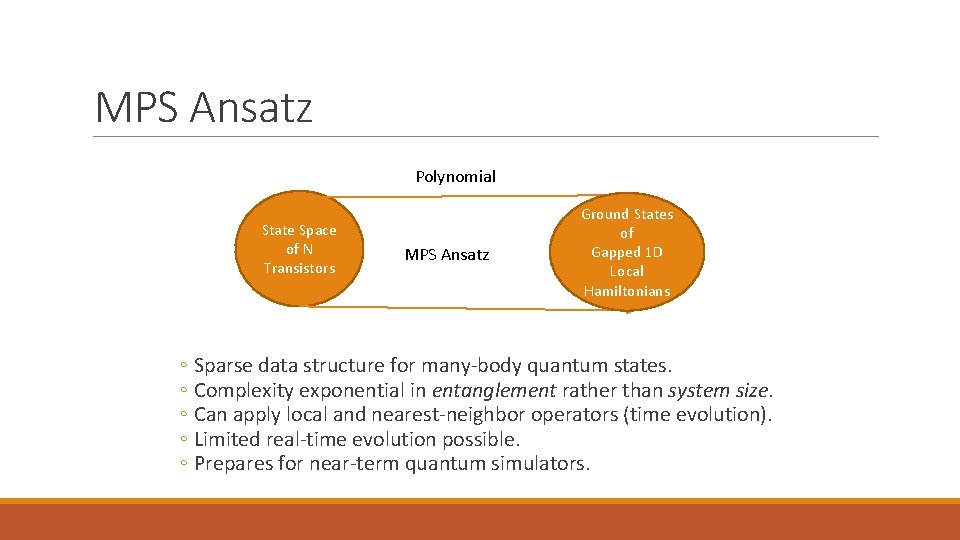
MPS Ansatz Polynomial State Space of N Transistors MPS Ansatz Ground States of Gapped 1 D Local Hamiltonians ◦ Sparse data structure for many-body quantum states. ◦ Complexity exponential in entanglement rather than system size. ◦ Can apply local and nearest-neighbor operators (time evolution). ◦ Limited real-time evolution possible. ◦ Prepares for near-term quantum simulators.
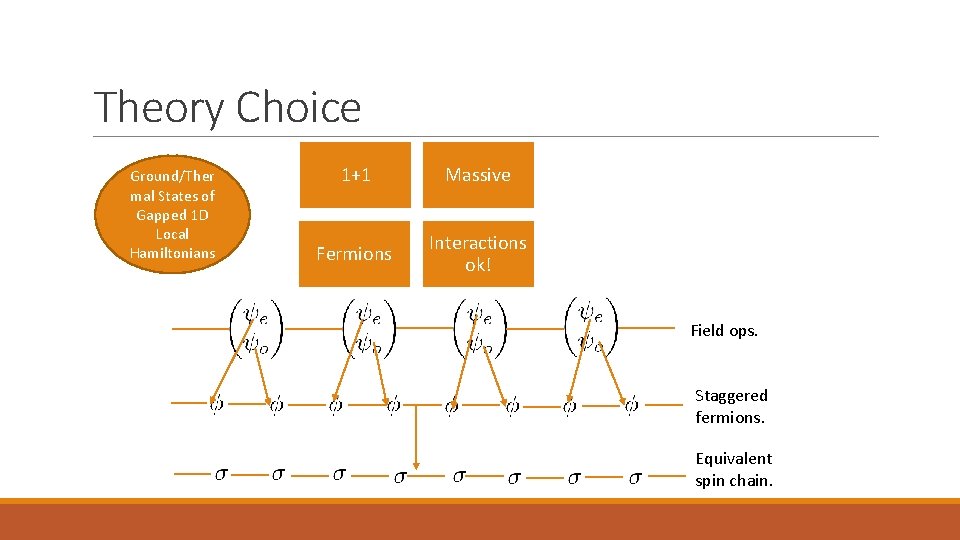
Theory Choice Ground/Ther mal States of Gapped 1 D Local Hamiltonians 1+1 Massive Fermions Interactions ok! Field ops. Staggered fermions. Equivalent spin chain.
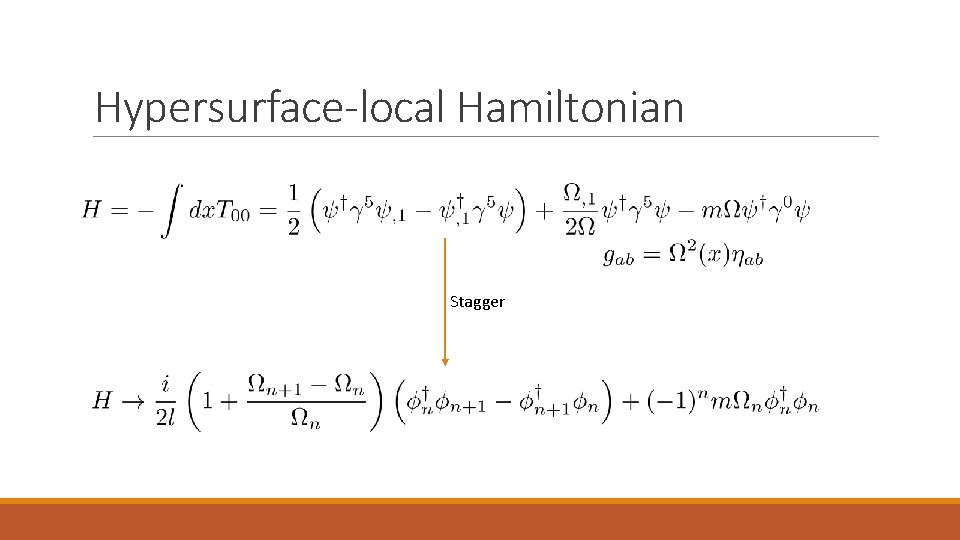
Hypersurface-local Hamiltonian Stagger
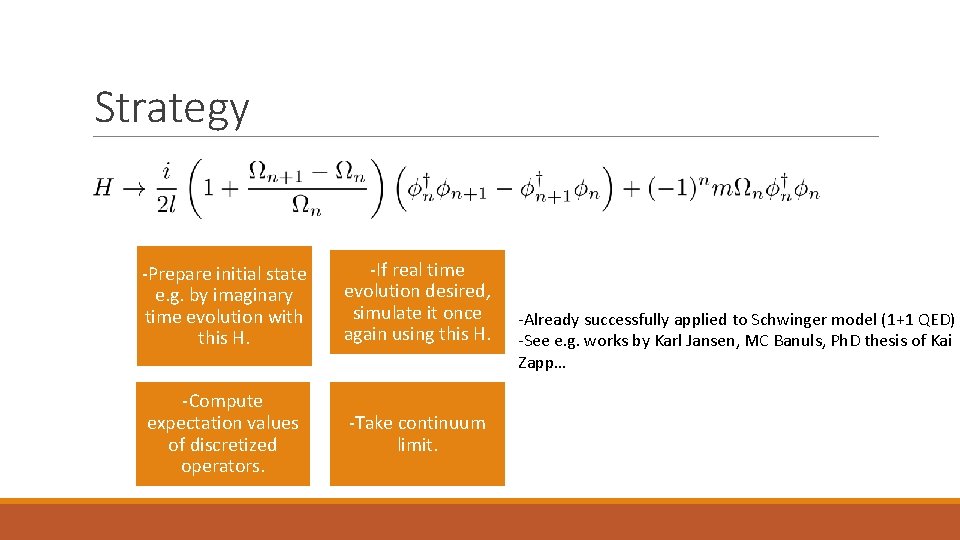
Strategy -Prepare initial state e. g. by imaginary time evolution with this H. -If real time evolution desired, simulate it once again using this H. -Compute expectation values of discretized operators. -Take continuum limit. -Already successfully applied to Schwinger model (1+1 QED) -See e. g. works by Karl Jansen, MC Banuls, Ph. D thesis of Kai Zapp…
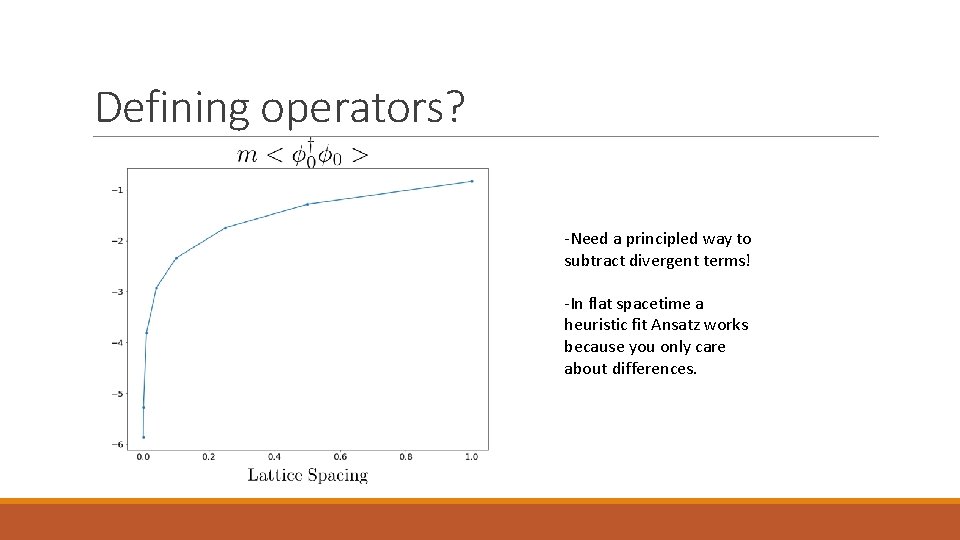
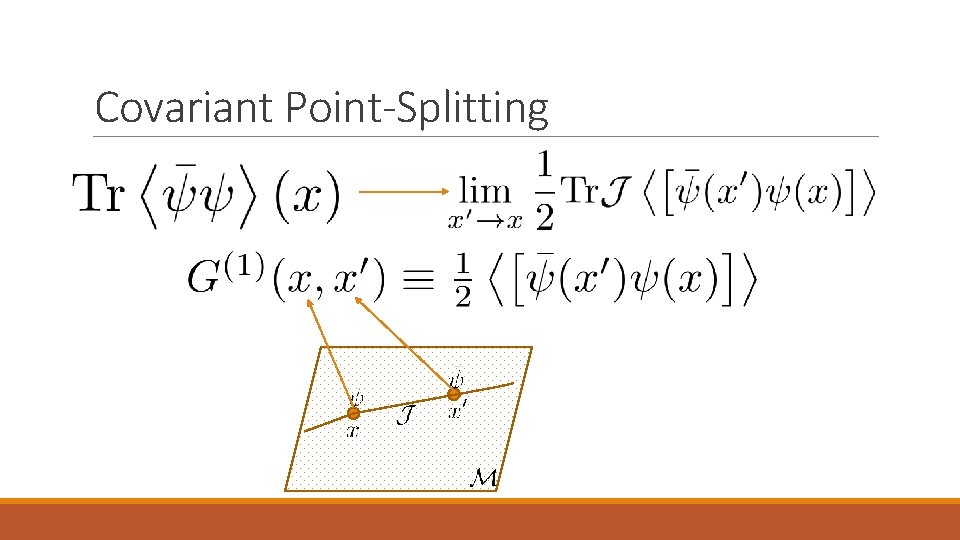
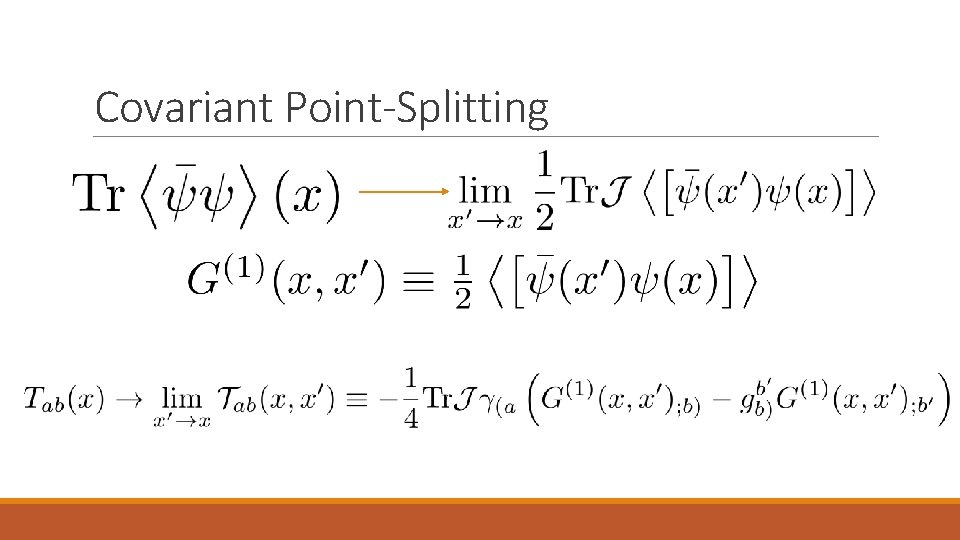
Defining operators? -Need a principled way to subtract divergent terms! -In flat spacetime a heuristic fit Ansatz works because you only care about differences.
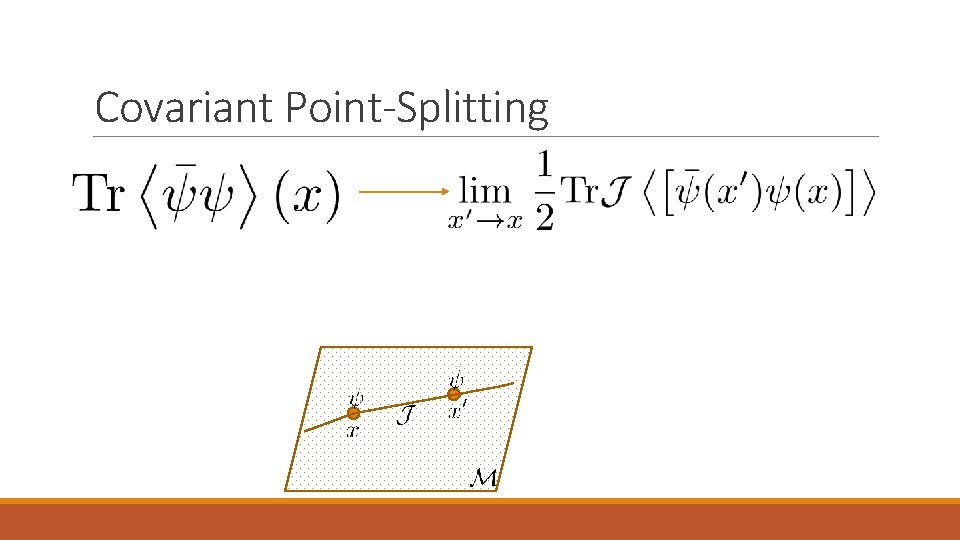
Covariant Point-Splitting
Covariant Point-Splitting
Covariant Point-Splitting
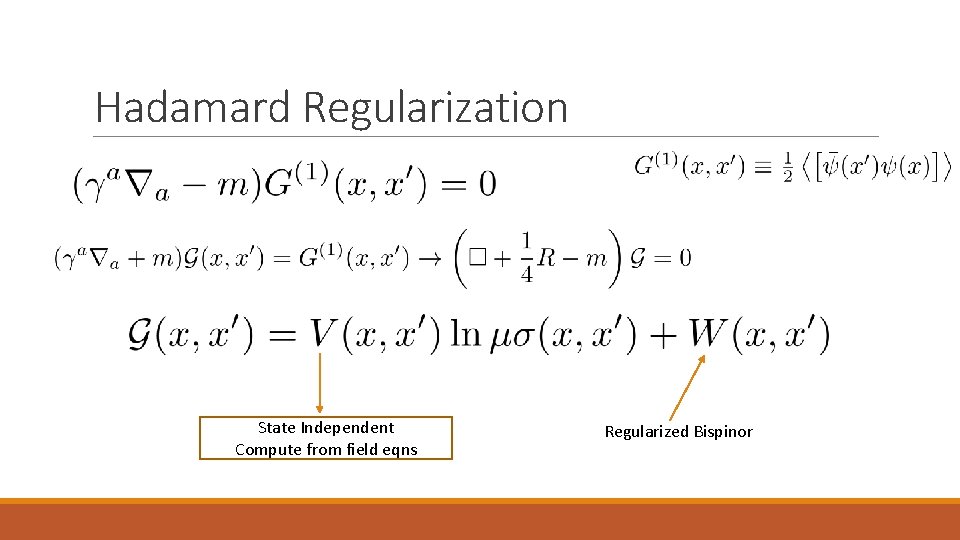
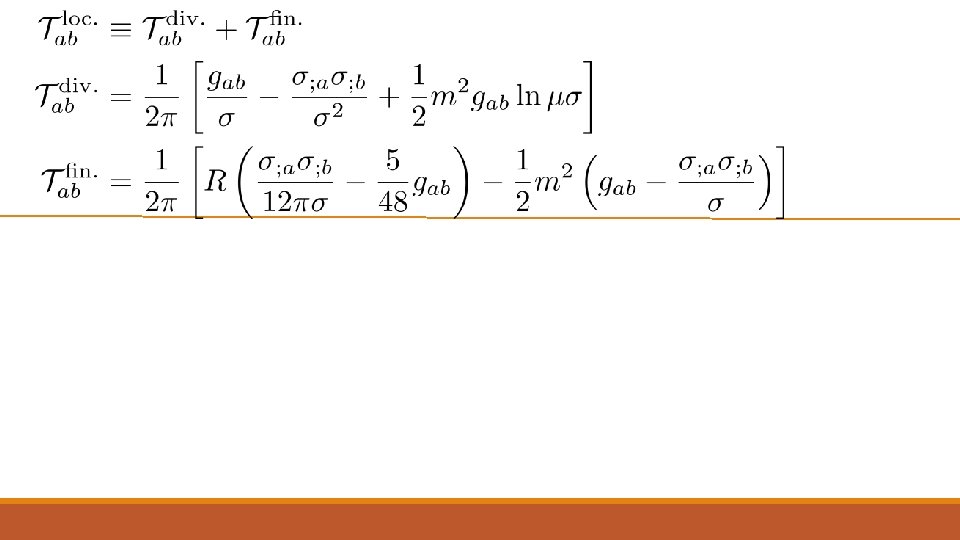
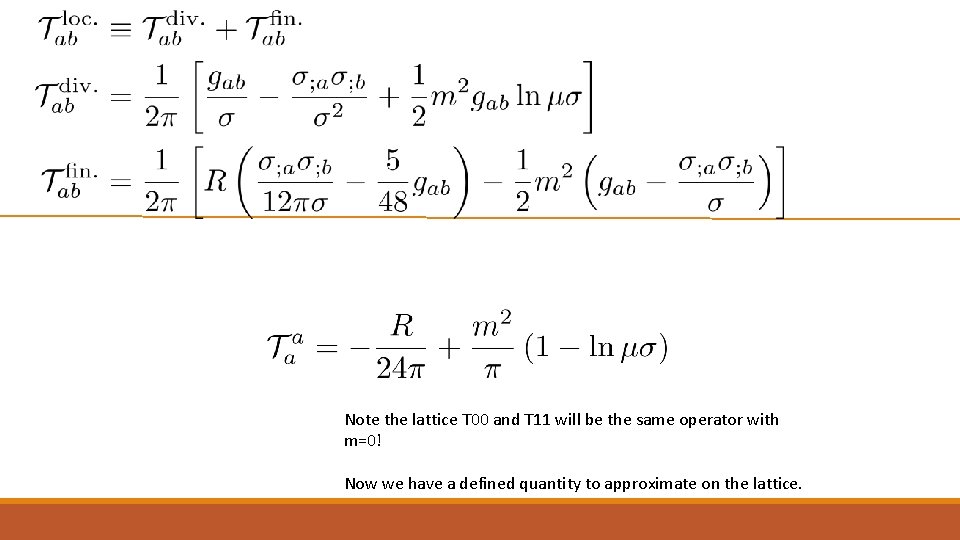
Hadamard Regularization State Independent Compute from field eqns Regularized Bispinor
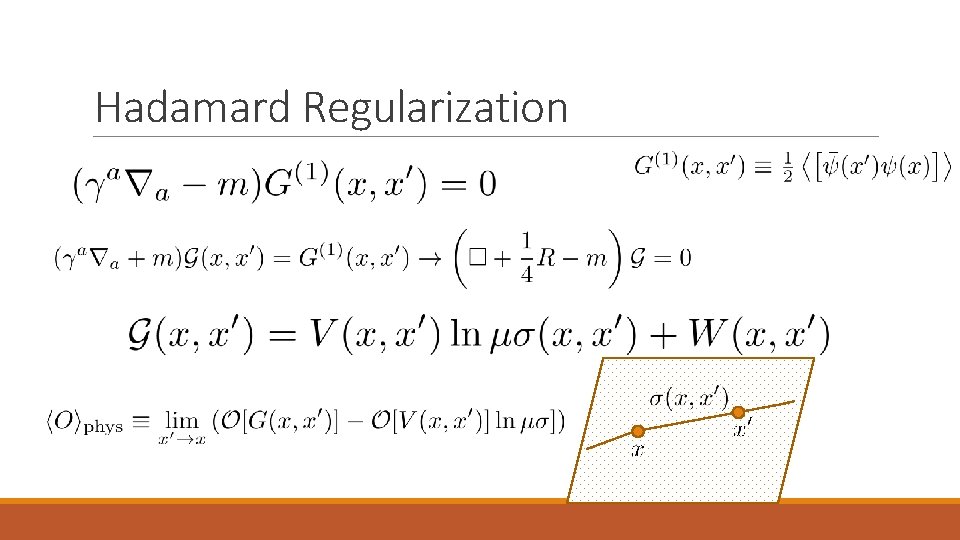
Hadamard Regularization
Note the lattice T 00 and T 11 will be the same operator with m=0! Now we have a defined quantity to approximate on the lattice.
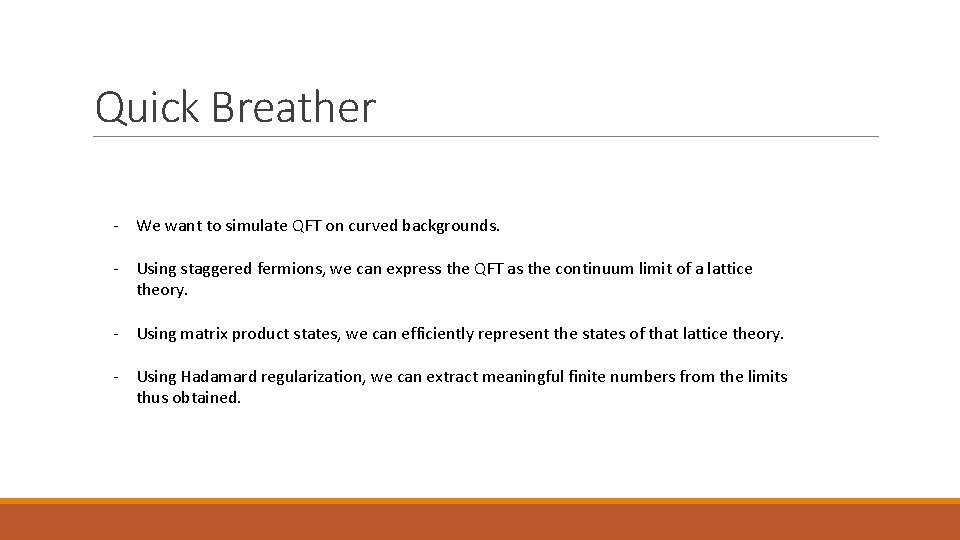
Quick Breather - We want to simulate QFT on curved backgrounds. - Using staggered fermions, we can express the QFT as the continuum limit of a lattice theory. - Using matrix product states, we can efficiently represent the states of that lattice theory. - Using Hadamard regularization, we can extract meaningful finite numbers from the limits thus obtained.
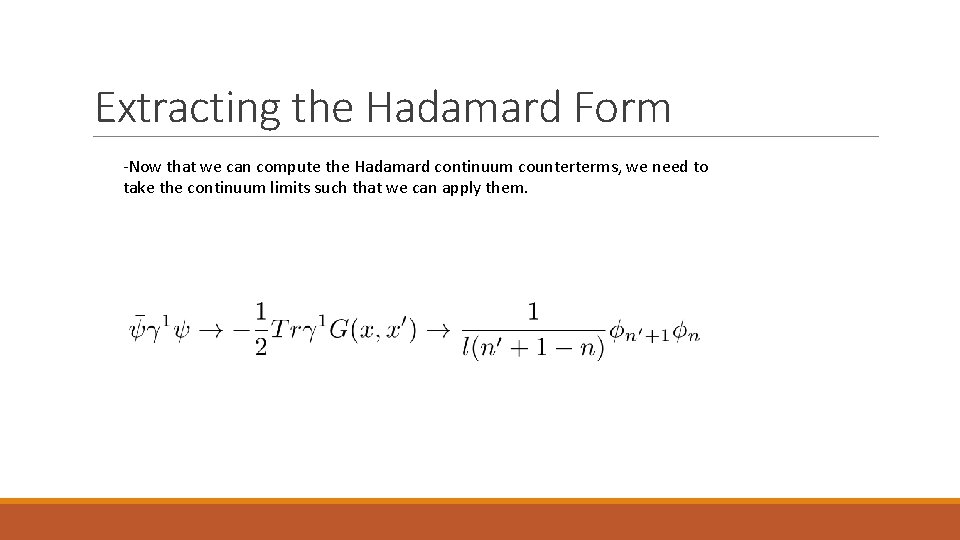
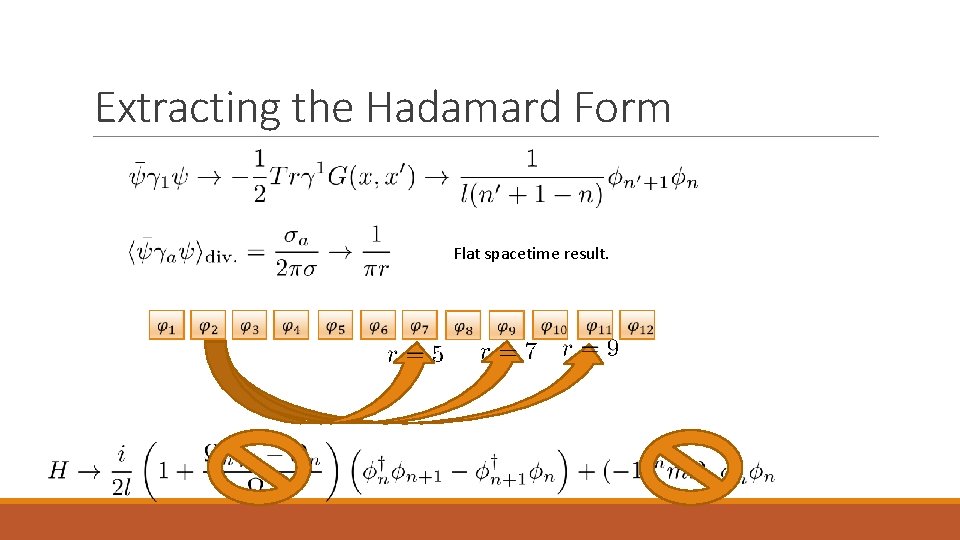
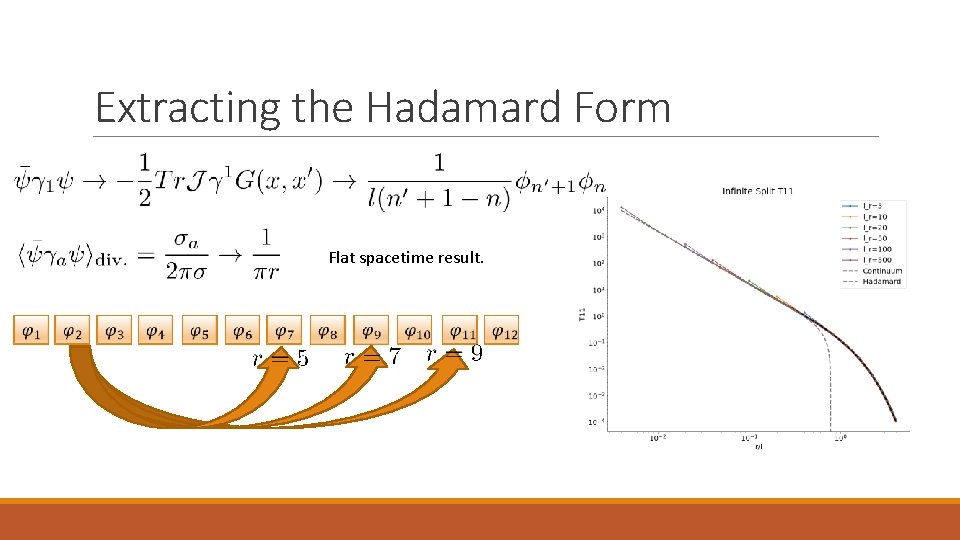
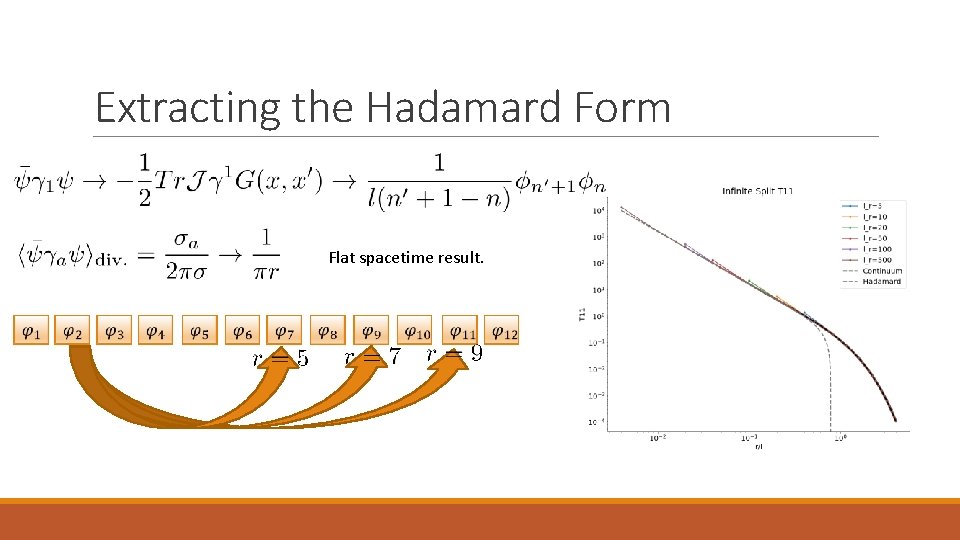
Extracting the Hadamard Form -Now that we can compute the Hadamard continuum counterterms, we need to take the continuum limits such that we can apply them.
Extracting the Hadamard Form Flat spacetime result.
Extracting the Hadamard Form Flat spacetime result.
Extracting the Hadamard Form Flat spacetime result.
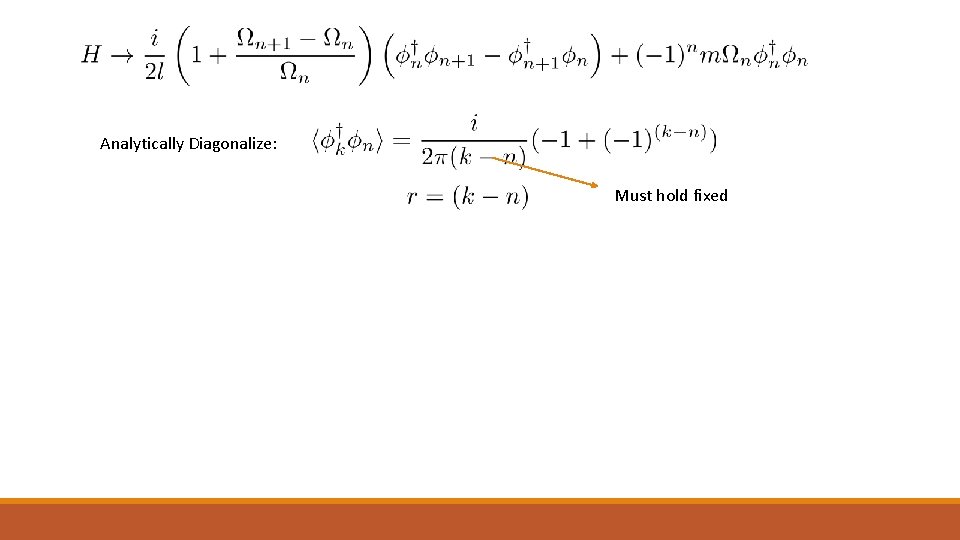
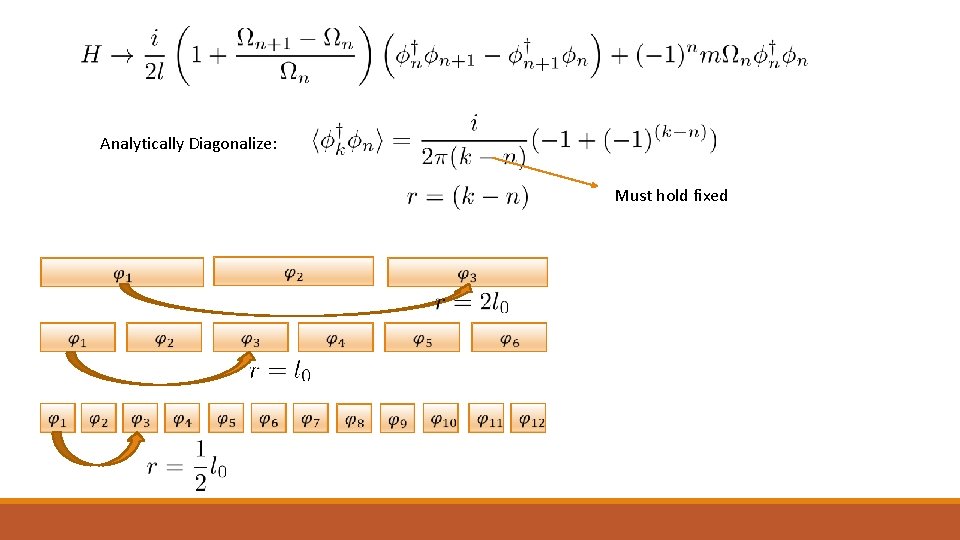
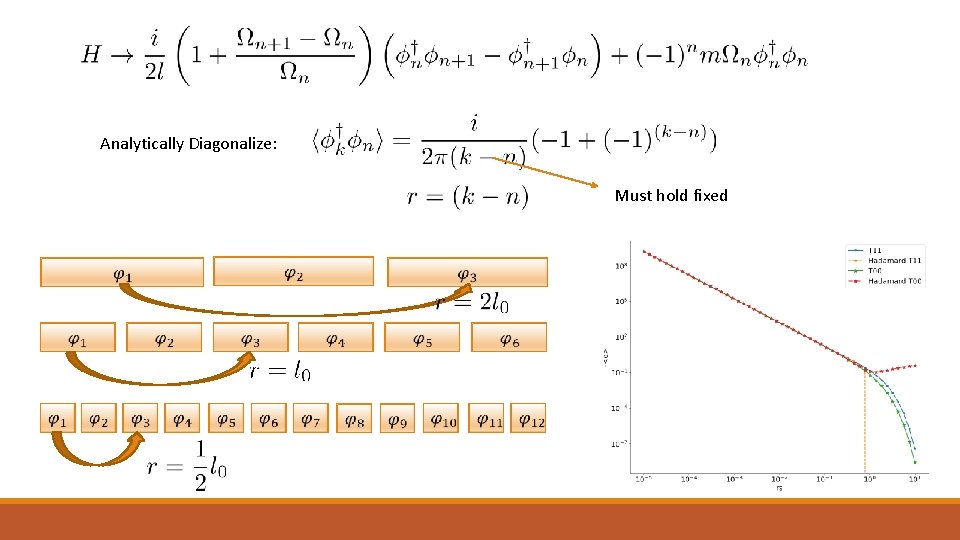
Analytically Diagonalize: Must hold fixed
Analytically Diagonalize: Must hold fixed
Analytically Diagonalize: Must hold fixed
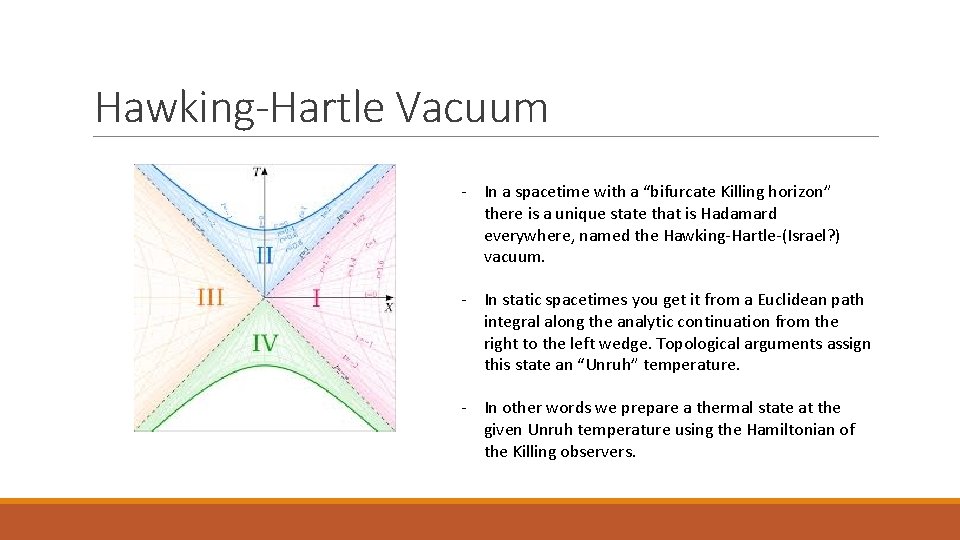
Hawking-Hartle Vacuum - In a spacetime with a “bifurcate Killing horizon” there is a unique state that is Hadamard everywhere, named the Hawking-Hartle-(Israel? ) vacuum. - In static spacetimes you get it from a Euclidean path integral along the analytic continuation from the right to the left wedge. Topological arguments assign this state an “Unruh” temperature. - In other words we prepare a thermal state at the given Unruh temperature using the Hamiltonian of the Killing observers.
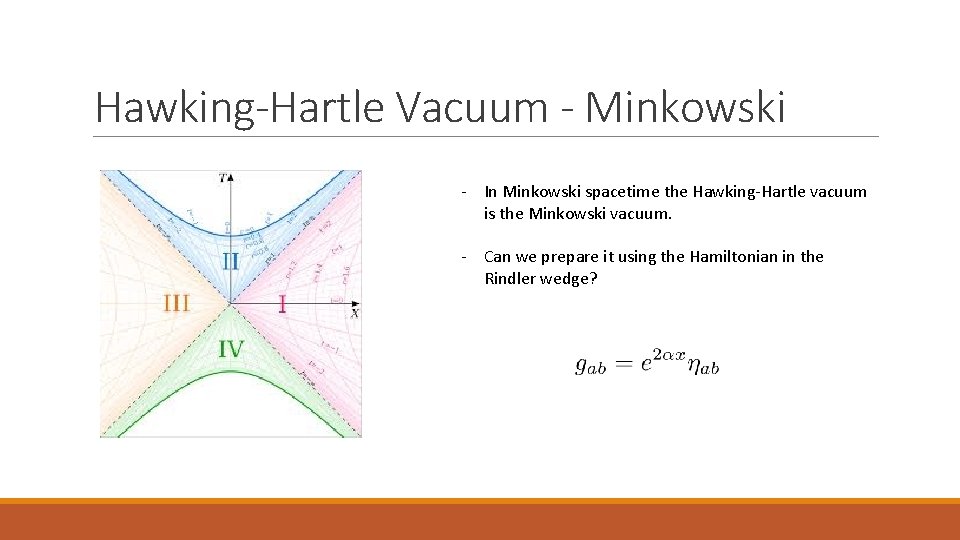
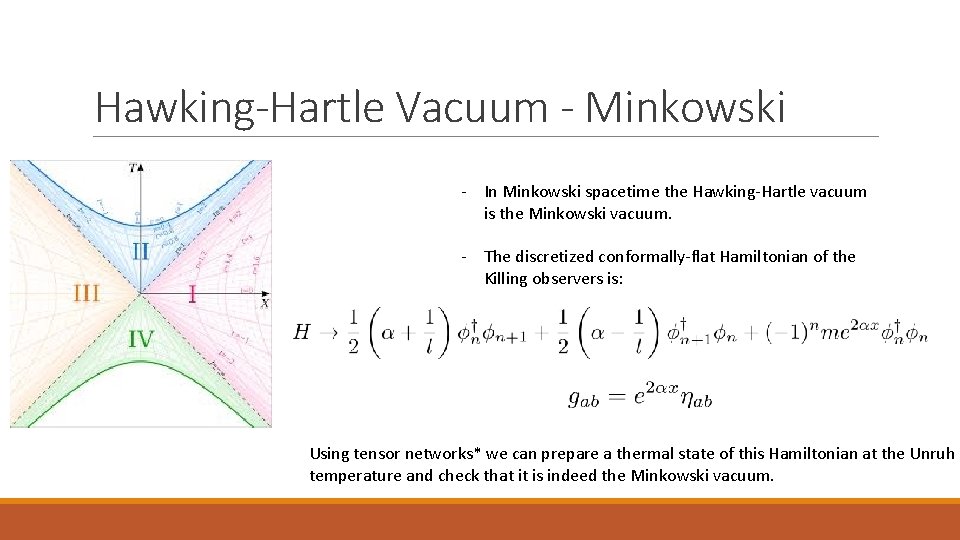
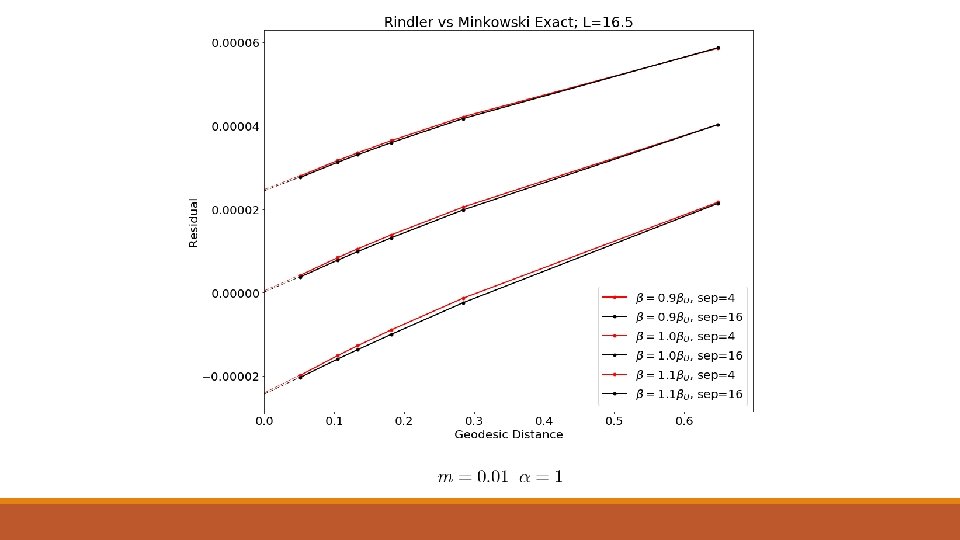
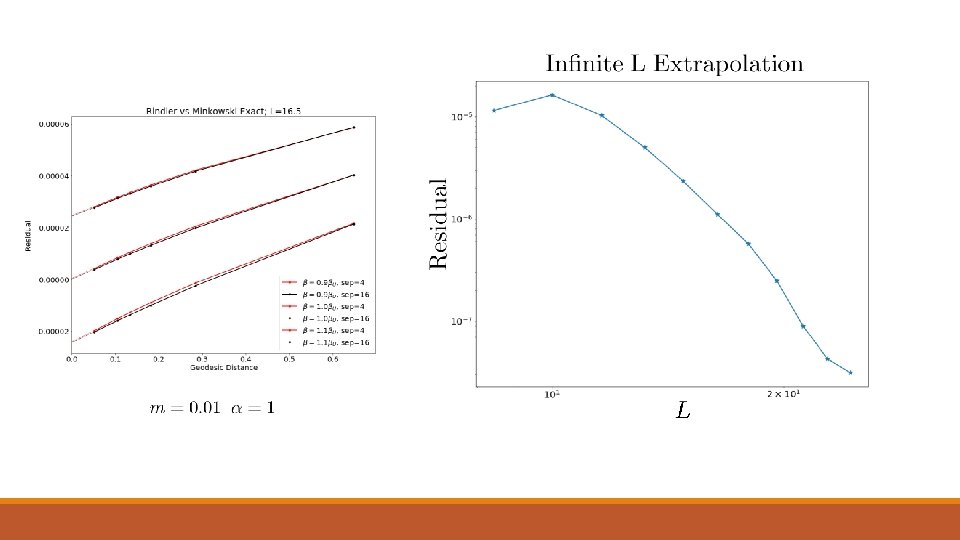
Hawking-Hartle Vacuum - Minkowski - In Minkowski spacetime the Hawking-Hartle vacuum is the Minkowski vacuum. - Can we prepare it using the Hamiltonian in the Rindler wedge?
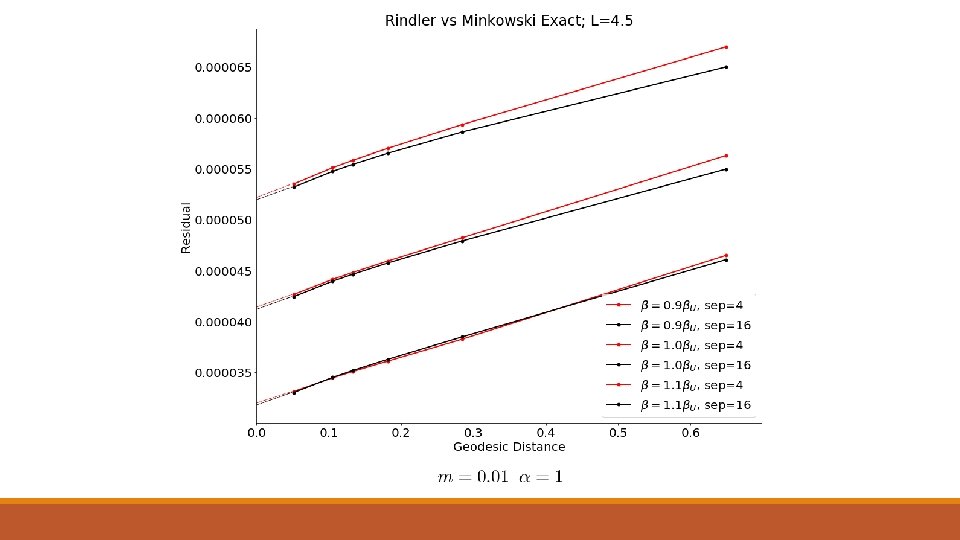
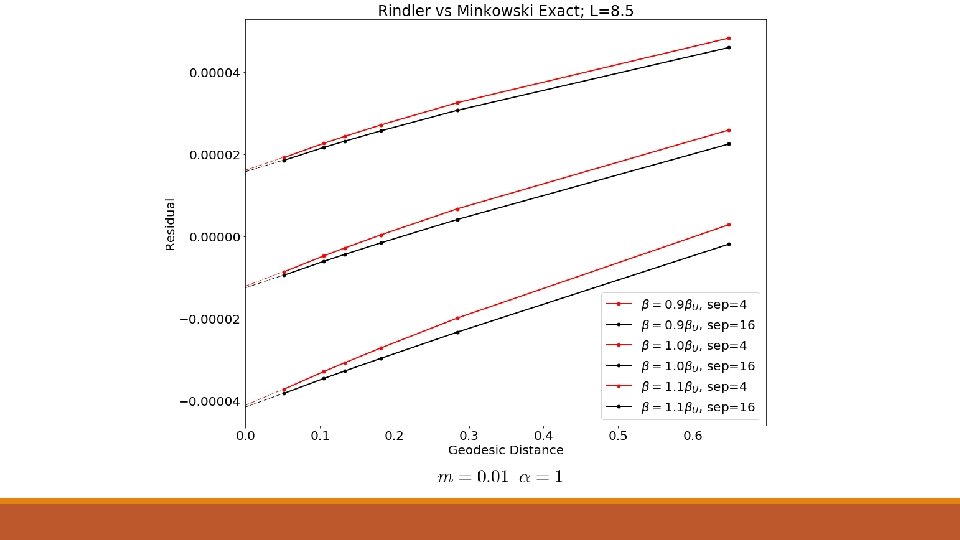
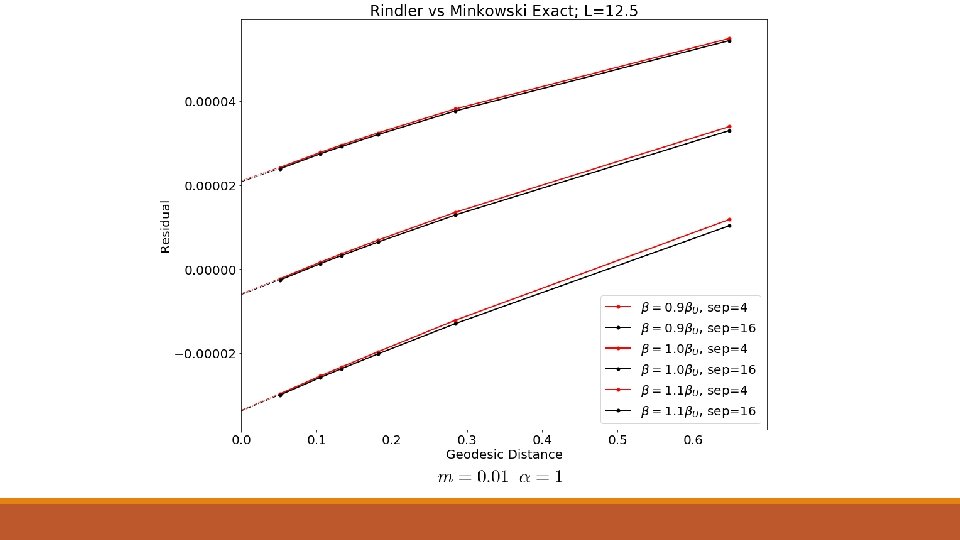
Hawking-Hartle Vacuum - Minkowski - In Minkowski spacetime the Hawking-Hartle vacuum is the Minkowski vacuum. - The discretized conformally-flat Hamiltonian of the Killing observers is: Using tensor networks* we can prepare a thermal state of this Hamiltonian at the Unruh temperature and check that it is indeed the Minkowski vacuum.
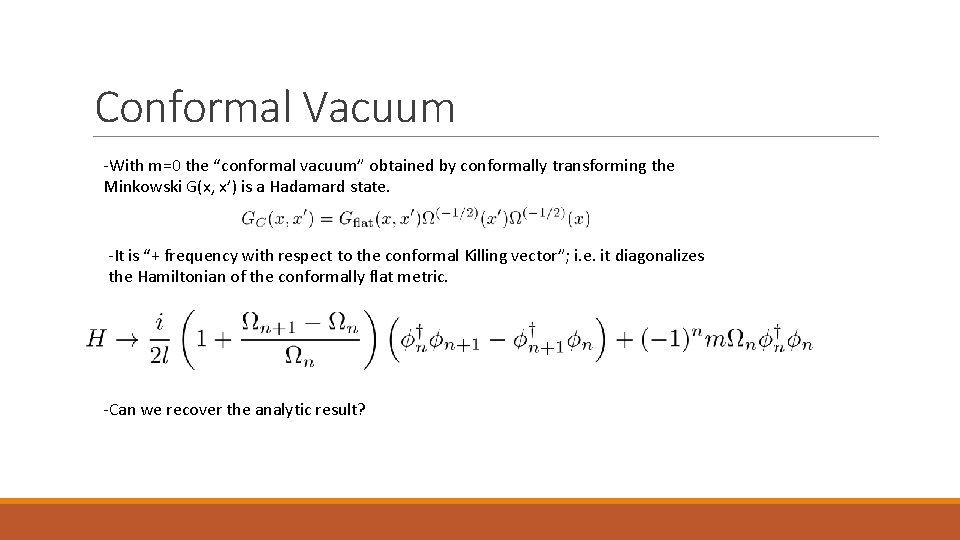
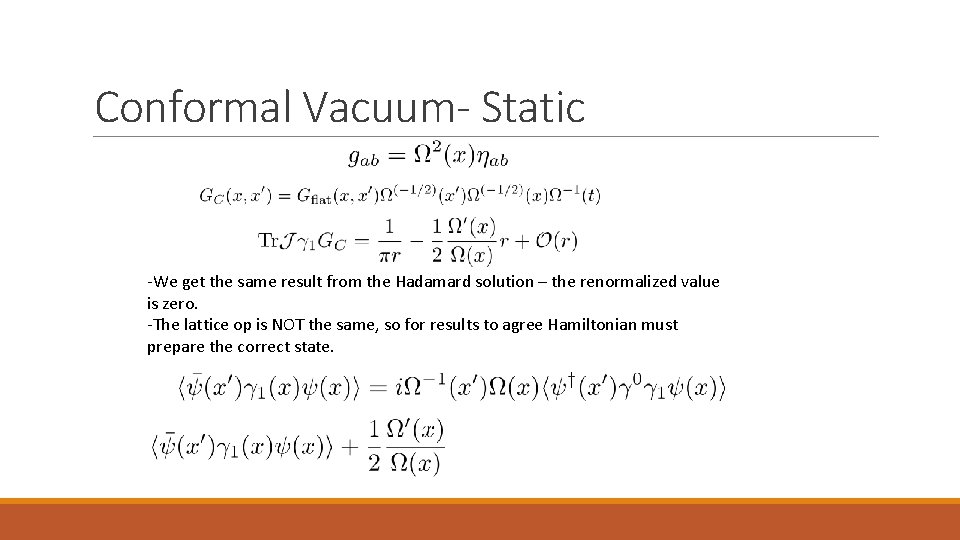
Conformal Vacuum -With m=0 the “conformal vacuum” obtained by conformally transforming the Minkowski G(x, x’) is a Hadamard state. -It is “+ frequency with respect to the conformal Killing vector”; i. e. it diagonalizes the Hamiltonian of the conformally flat metric. -Can we recover the analytic result?
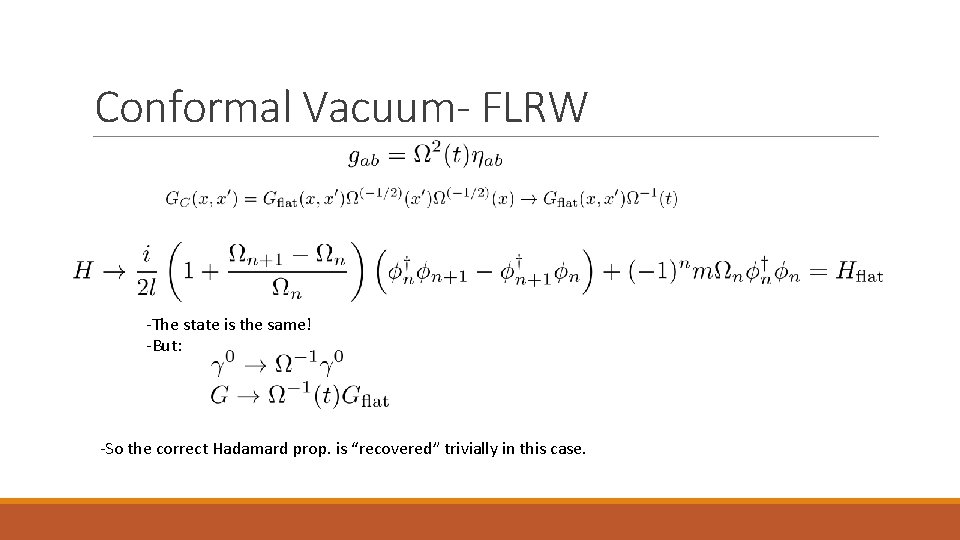
Conformal Vacuum- FLRW -The state is the same! -But: -So the correct Hadamard prop. is “recovered” trivially in this case.
Conformal Vacuum- Static -We get the same result from the Hadamard solution – the renormalized value is zero. -The lattice op is NOT the same, so for results to agree Hamiltonian must prepare the correct state.
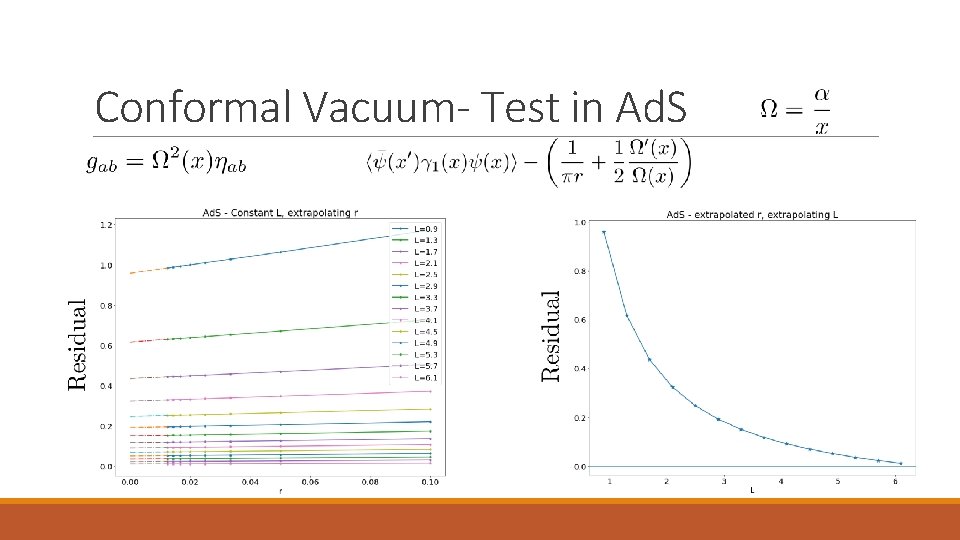
Conformal Vacuum- Test in Ad. S
Thanks! (hire me)