
Tenses in Writing and Speaking There are only
- Slides: 20
Tenses in Writing and Speaking There are only three main tenses in English: 1. Past 2. Present 3. Future All these can be seen through cultures around the world.
Tenses in Writing and Speaking However, they tenses can be more complex in each culture or language. In this lesson, I would like to discuss with you these tenses in English, which you might not experience in our language (in this case, Vietnamese) As seen in Vietnamese, tenses appear with adverbs of time and certain words like đã, rồi and sẽ to show people the time of the action.
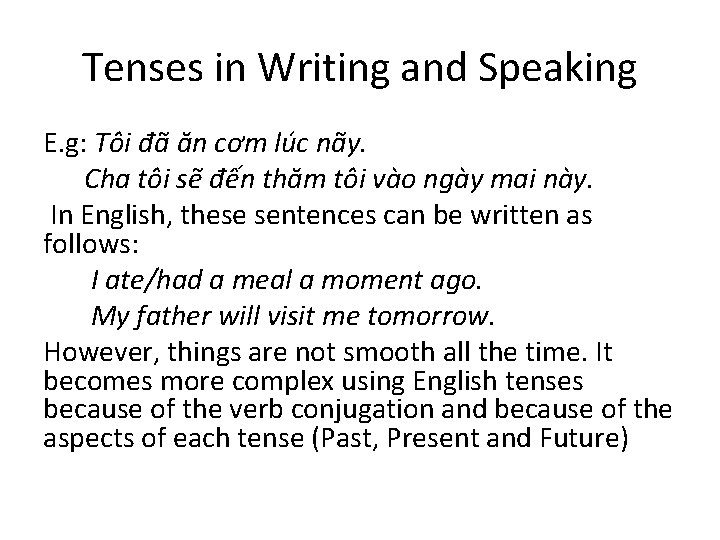
Tenses in Writing and Speaking E. g: Tôi đã ăn cơm lúc nãy. Cha tôi sẽ đến thăm tôi vào ngày mai này. In English, these sentences can be written as follows: I ate/had a meal a moment ago. My father will visit me tomorrow. However, things are not smooth all the time. It becomes more complex using English tenses because of the verb conjugation and because of the aspects of each tense (Past, Present and Future)
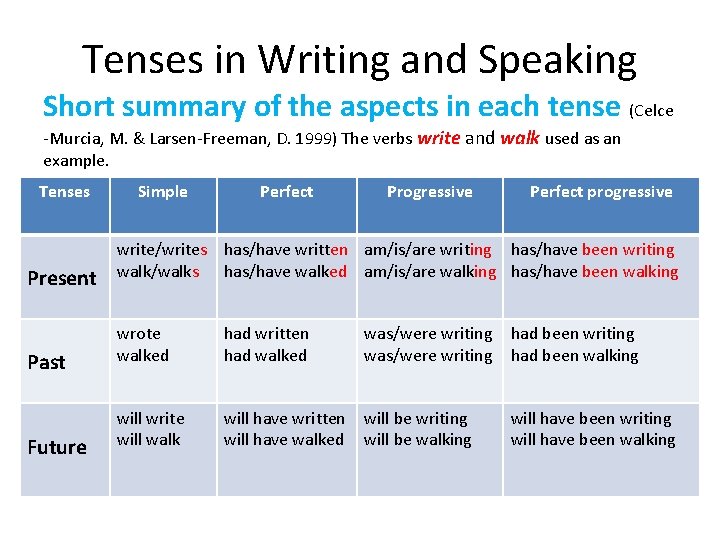
Tenses in Writing and Speaking Short summary of the aspects in each tense (Celce -Murcia, M. & Larsen-Freeman, D. 1999) The verbs write and walk used as an example. Tenses Present Past Future Simple Perfect Progressive Perfect progressive write/writes has/have written am/is/are writing has/have been writing walk/walks has/have walked am/is/are walking has/have been walking wrote walked had written had walked was/were writing had been walking will write will walk will have written will have walked will be writing will be walking will have been writing will have been walking
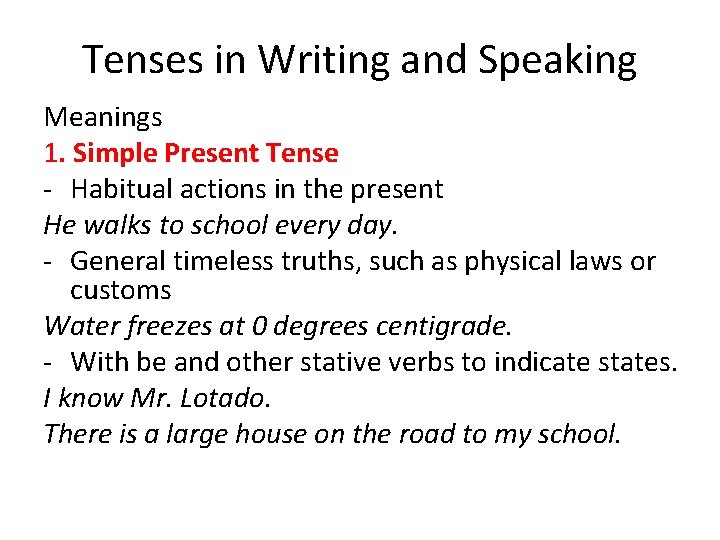
Tenses in Writing and Speaking Meanings 1. Simple Present Tense - Habitual actions in the present He walks to school every day. - General timeless truths, such as physical laws or customs Water freezes at 0 degrees centigrade. - With be and other stative verbs to indicate states. I know Mr. Lotado. There is a large house on the road to my school.
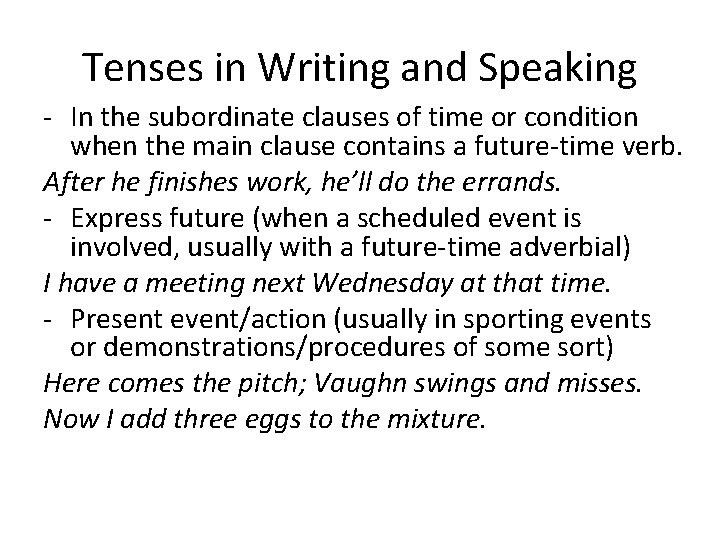
Tenses in Writing and Speaking - In the subordinate clauses of time or condition when the main clause contains a future-time verb. After he finishes work, he’ll do the errands. - Express future (when a scheduled event is involved, usually with a future-time adverbial) I have a meeting next Wednesday at that time. - Present event/action (usually in sporting events or demonstrations/procedures of some sort) Here comes the pitch; Vaughn swings and misses. Now I add three eggs to the mixture.
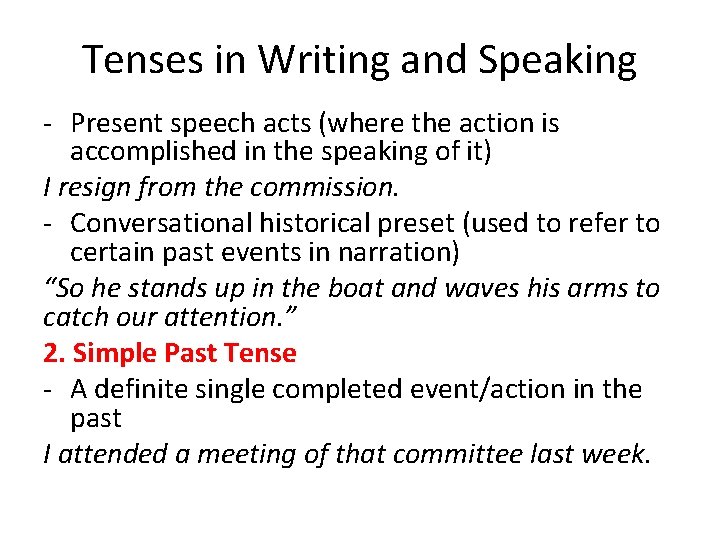
Tenses in Writing and Speaking - Present speech acts (where the action is accomplished in the speaking of it) I resign from the commission. - Conversational historical preset (used to refer to certain past events in narration) “So he stands up in the boat and waves his arms to catch our attention. ” 2. Simple Past Tense - A definite single completed event/action in the past I attended a meeting of that committee last week.
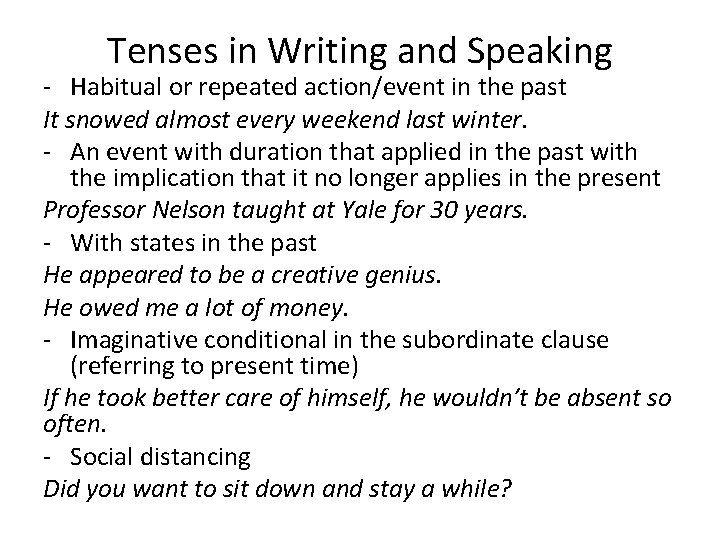
Tenses in Writing and Speaking - Habitual or repeated action/event in the past It snowed almost every weekend last winter. - An event with duration that applied in the past with the implication that it no longer applies in the present Professor Nelson taught at Yale for 30 years. - With states in the past He appeared to be a creative genius. He owed me a lot of money. - Imaginative conditional in the subordinate clause (referring to present time) If he took better care of himself, he wouldn’t be absent so often. - Social distancing Did you want to sit down and stay a while?
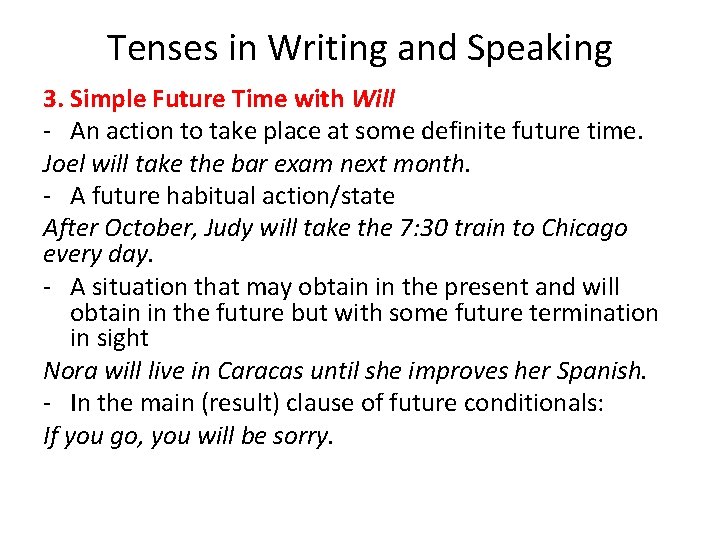
Tenses in Writing and Speaking 3. Simple Future Time with Will - An action to take place at some definite future time. Joel will take the bar exam next month. - A future habitual action/state After October, Judy will take the 7: 30 train to Chicago every day. - A situation that may obtain in the present and will obtain in the future but with some future termination in sight Nora will live in Caracas until she improves her Spanish. - In the main (result) clause of future conditionals: If you go, you will be sorry.
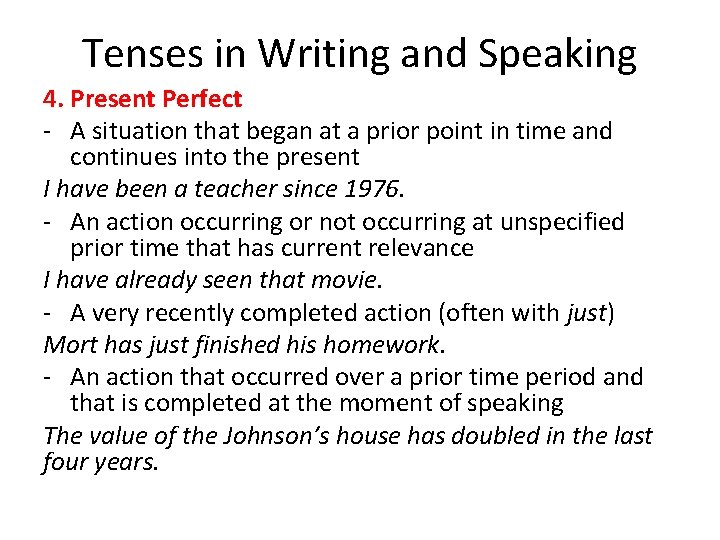
Tenses in Writing and Speaking 4. Present Perfect - A situation that began at a prior point in time and continues into the present I have been a teacher since 1976. - An action occurring or not occurring at unspecified prior time that has current relevance I have already seen that movie. - A very recently completed action (often with just) Mort has just finished his homework. - An action that occurred over a prior time period and that is completed at the moment of speaking The value of the Johnson’s house has doubled in the last four years.
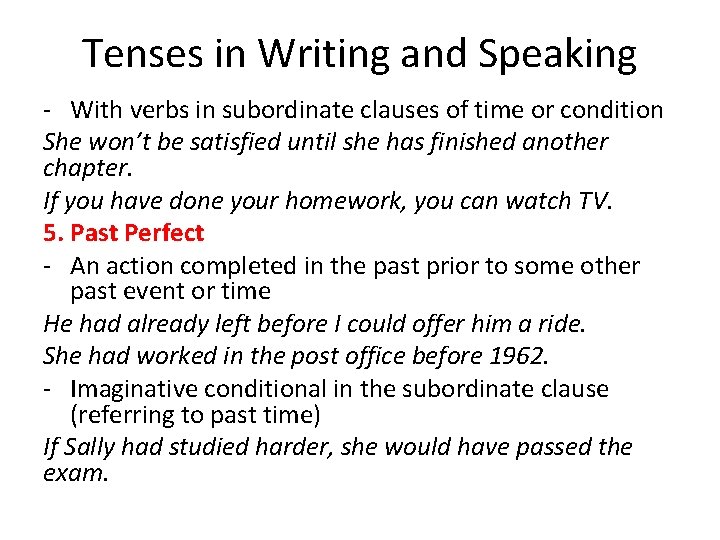
Tenses in Writing and Speaking - With verbs in subordinate clauses of time or condition She won’t be satisfied until she has finished another chapter. If you have done your homework, you can watch TV. 5. Past Perfect - An action completed in the past prior to some other past event or time He had already left before I could offer him a ride. She had worked in the post office before 1962. - Imaginative conditional in the subordinate clause (referring to past time) If Sally had studied harder, she would have passed the exam.
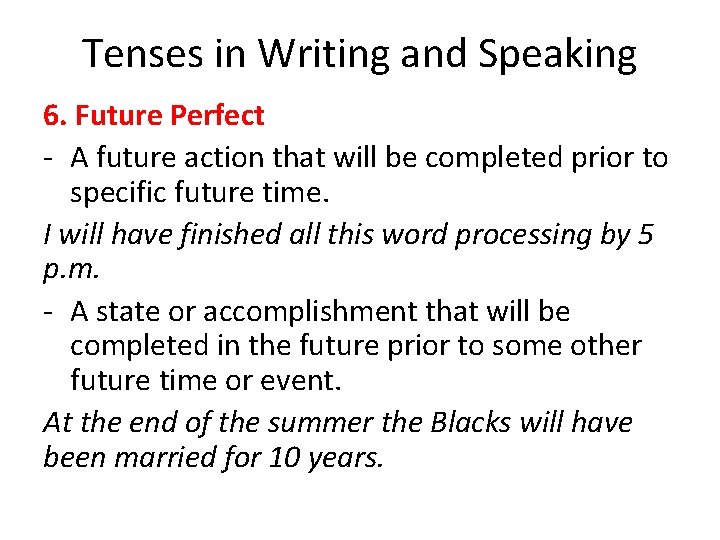
Tenses in Writing and Speaking 6. Future Perfect - A future action that will be completed prior to specific future time. I will have finished all this word processing by 5 p. m. - A state or accomplishment that will be completed in the future prior to some other future time or event. At the end of the summer the Blacks will have been married for 10 years.
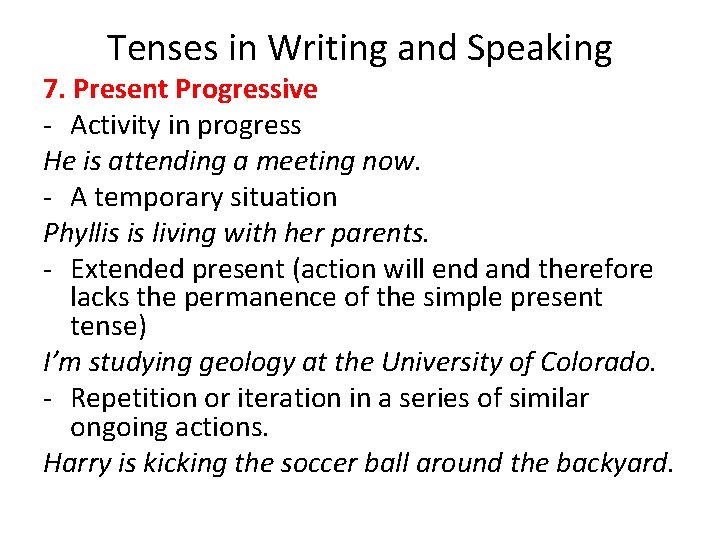
Tenses in Writing and Speaking 7. Present Progressive - Activity in progress He is attending a meeting now. - A temporary situation Phyllis is living with her parents. - Extended present (action will end and therefore lacks the permanence of the simple present tense) I’m studying geology at the University of Colorado. - Repetition or iteration in a series of similar ongoing actions. Harry is kicking the soccer ball around the backyard.
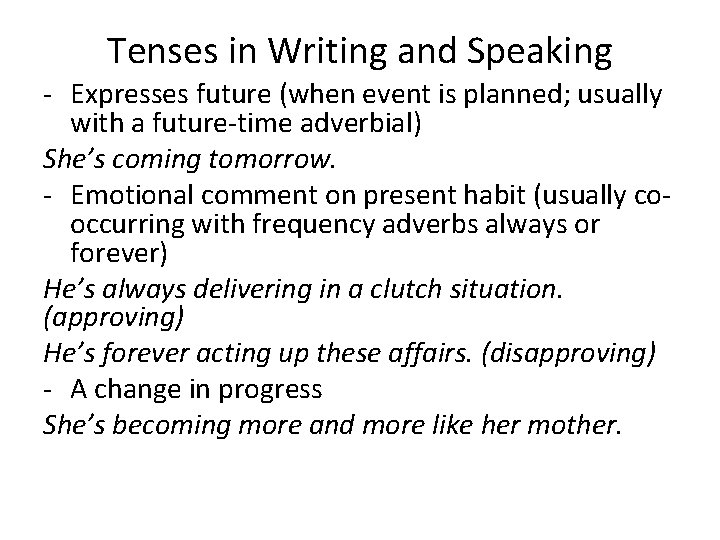
Tenses in Writing and Speaking - Expresses future (when event is planned; usually with a future-time adverbial) She’s coming tomorrow. - Emotional comment on present habit (usually cooccurring with frequency adverbs always or forever) He’s always delivering in a clutch situation. (approving) He’s forever acting up these affairs. (disapproving) - A change in progress She’s becoming more and more like her mother.
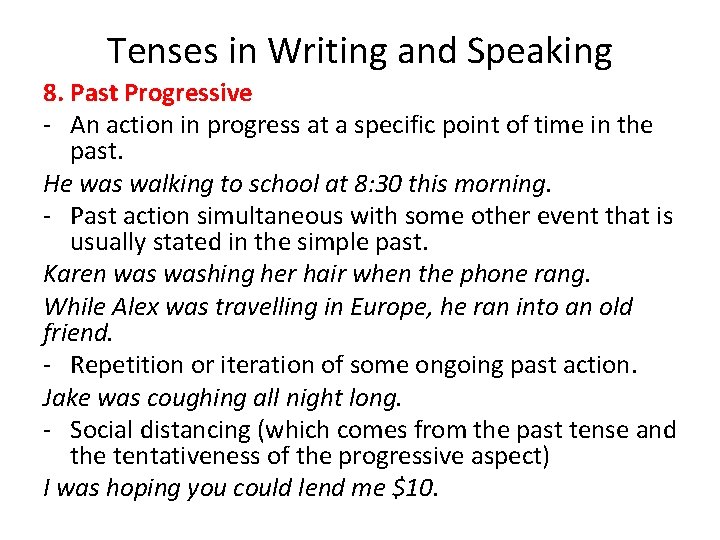
Tenses in Writing and Speaking 8. Past Progressive - An action in progress at a specific point of time in the past. He was walking to school at 8: 30 this morning. - Past action simultaneous with some other event that is usually stated in the simple past. Karen washing her hair when the phone rang. While Alex was travelling in Europe, he ran into an old friend. - Repetition or iteration of some ongoing past action. Jake was coughing all night long. - Social distancing (which comes from the past tense and the tentativeness of the progressive aspect) I was hoping you could lend me $10.
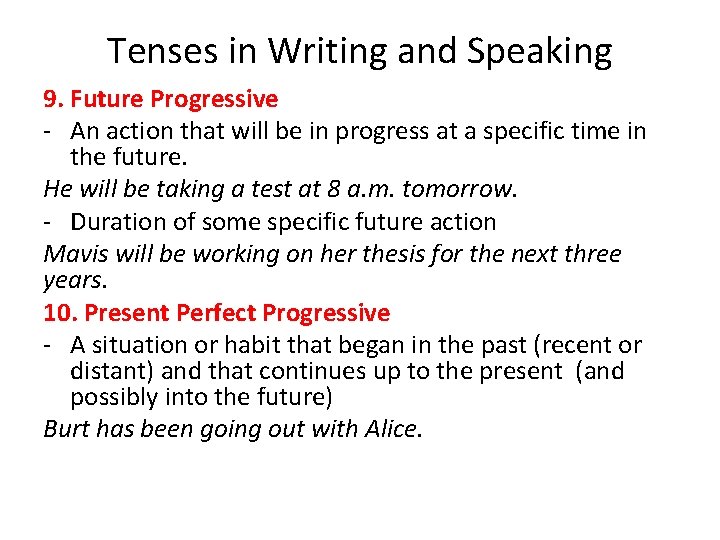
Tenses in Writing and Speaking 9. Future Progressive - An action that will be in progress at a specific time in the future. He will be taking a test at 8 a. m. tomorrow. - Duration of some specific future action Mavis will be working on her thesis for the next three years. 10. Present Perfect Progressive - A situation or habit that began in the past (recent or distant) and that continues up to the present (and possibly into the future) Burt has been going out with Alice.
Tenses in Writing and Speaking - An action in progress that is not yet completed I have been reading that book. - A state that changes over time The students have been getting better and better. - An evaluative comment on something observed over time triggered by current evidence. You’ve been drinking again.
Tenses in Writing and Speaking 11. Past Perfect Progressive - An action or habit taking place over a period of time in the past prior to some other past event or time. Carol had been working hard, so her doctor told her to take a vacation. She had been trying to finish her degree that year. - A past action in progress that was interrupted by a more recent past action. We had been planning to vacation in Maine, but changed our minds after receiving the brochure on Nova Scotia. - An ongoing past action or state that becomes satisfied by some other event I had been wanting to see that play, so I was pleased when I won the tickets.
Tenses in Writing and Speaking 12. Future Perfect Progressive - Durative or habitual action that is taking place in the present and that will continue into the future up until or through a specific future time. On Christmas Eve we will have been living in the same house for 20 years. He will have been keeping a journal for 10 years next month.
Tenses in Writing and Speaking Activities 1. Give your opinions about these tenses. Which one you like or usually use most and which one do you dislike or least used most? 2. Write your own sentences to describe your own situation using all the tenses discussed in this lesson. Good luck!