
TENSE PRESENT PAST FUTURE Simple I write letters

- Slides: 18
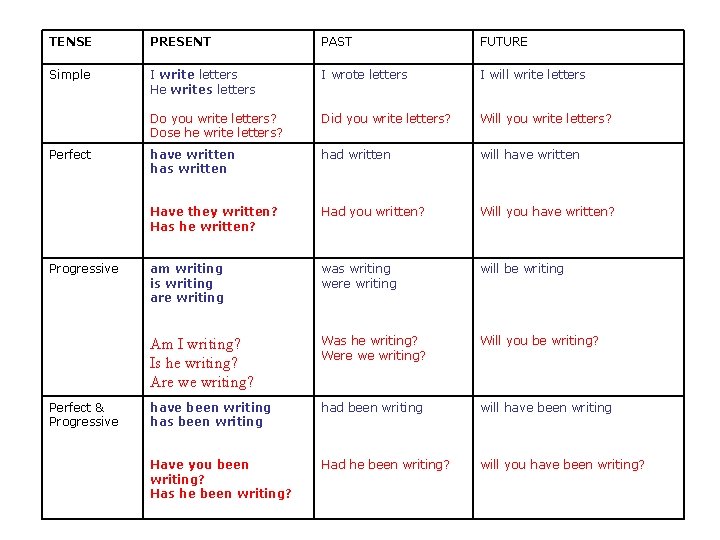
TENSE PRESENT PAST FUTURE Simple I write letters He writes letters I wrote letters I will write letters Do you write letters? Dose he write letters? Did you write letters? Will you write letters? have written has written had written will have written Have they written? Has he written? Had you written? Will you have written? am writing is writing are writing was writing were writing will be writing Am I writing? Is he writing? Are we writing? Was he writing? Were we writing? Will you be writing? have been writing has been writing had been writing will have been writing Have you been writing? Has he been writing? Had he been writing? will you have been writing? Perfect Progressive Perfect & Progressive
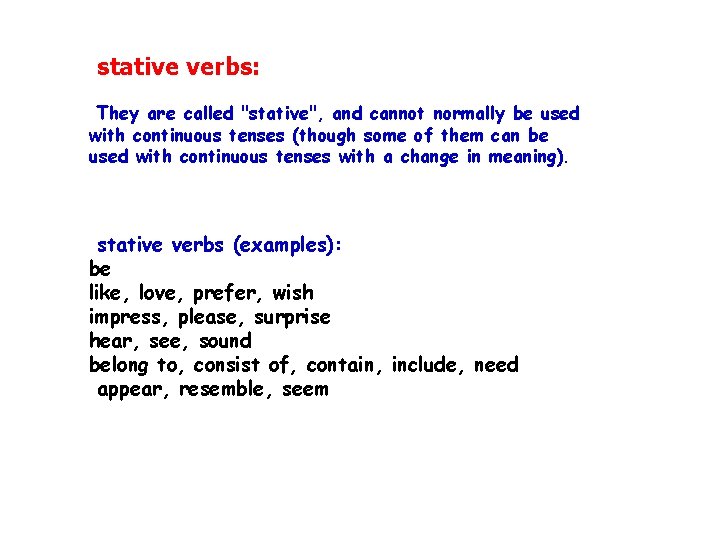
stative verbs: They are called "stative", and cannot normally be used with continuous tenses (though some of them can be used with continuous tenses with a change in meaning). stative verbs (examples): be like, love, prefer, wish impress, please, surprise hear, see, sound belong to, consist of, contain, include, need appear, resemble, seem
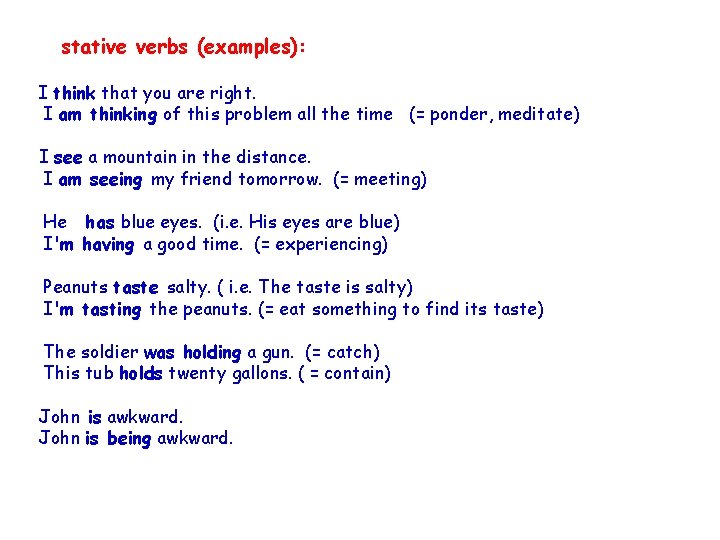
stative verbs (examples): I think that you are right. I am thinking of this problem all the time (= ponder, meditate) I see a mountain in the distance. I am seeing my friend tomorrow. (= meeting) He has blue eyes. (i. e. His eyes are blue) I'm having a good time. (= experiencing) Peanuts taste salty. ( i. e. The taste is salty) I'm tasting the peanuts. (= eat something to find its taste) The soldier was holding a gun. (= catch) This tub holds twenty gallons. ( = contain) John is awkward. John is being awkward.
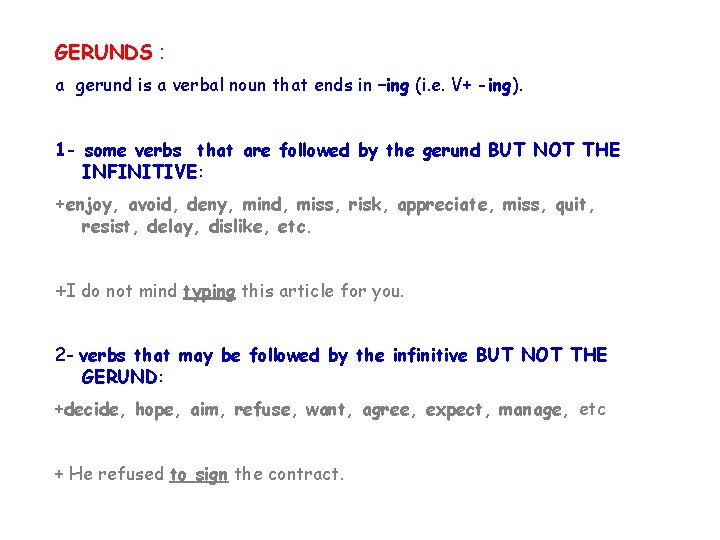
GERUNDS : a gerund is a verbal noun that ends in –ing (i. e. V+ -ing). 1 - some verbs that are followed by the gerund BUT NOT THE INFINITIVE: +enjoy, avoid, deny, mind, miss, risk, appreciate, miss, quit, resist, delay, dislike, etc. +I do not mind typing this article for you. 2 - verbs that may be followed by the infinitive BUT NOT THE GERUND: +decide, hope, aim, refuse, want, agree, expect, manage, etc + He refused to sign the contract.
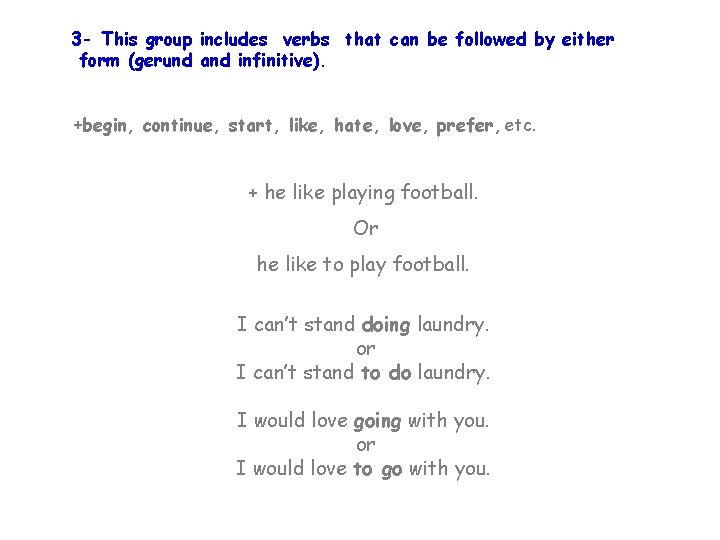
3 - This group includes verbs that can be followed by either form (gerund and infinitive). +begin, continue, start, like, hate, love, prefer, etc. + he like playing football. Or he like to play football. I can’t stand doing laundry. or I can’t stand to do laundry. I would love going with you. or I would love to go with you.
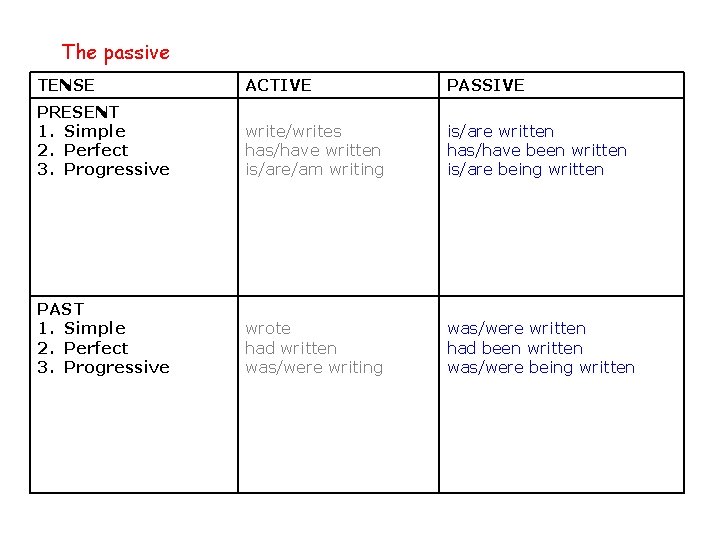
The passive TENSE ACTIVE PASSIVE PRESENT 1. Simple 2. Perfect 3. Progressive write/writes has/have written is/are/am writing is/are written has/have been written is/are being written PAST 1. Simple 2. Perfect 3. Progressive wrote had written was/were writing was/were written had been written was/were being written
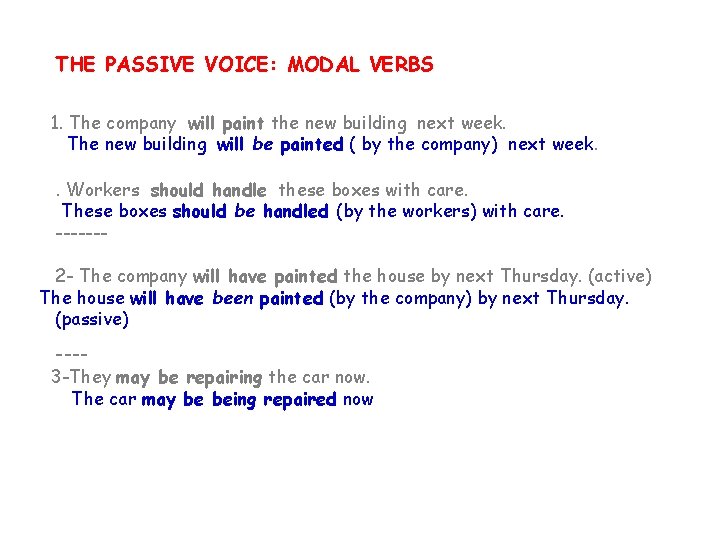
THE PASSIVE VOICE: MODAL VERBS 1. The company will paint the new building next week. The new building will be painted ( by the company) next week. . Workers should handle these boxes with care. These boxes should be handled (by the workers) with care. ------2 - The company will have painted the house by next Thursday. (active) The house will have been painted (by the company) by next Thursday. (passive) ---- 3 -They may be repairing the car now. The car may be being repaired now
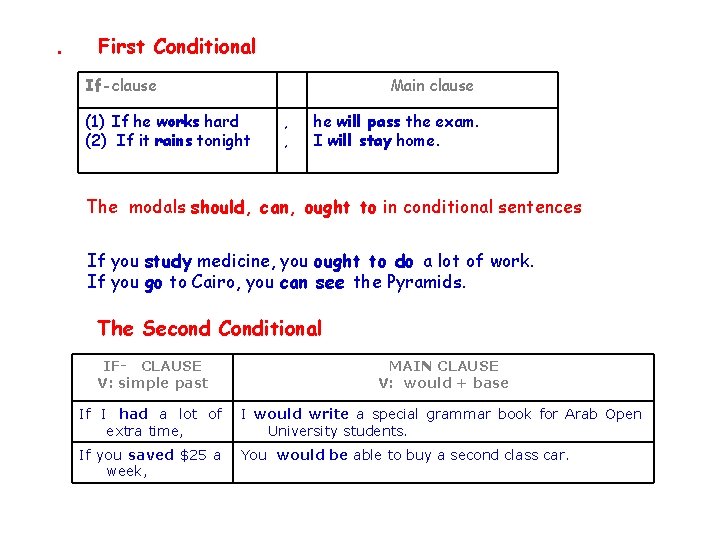
. First Conditional If-clause Main clause (1) If he works hard (2) If it rains tonight , , he will pass the exam. I will stay home. The modals should, can, ought to in conditional sentences If you study medicine, you ought to do a lot of work. If you go to Cairo, you can see the Pyramids. The Second Conditional IF- CLAUSE V: simple past MAIN CLAUSE V: would + base If I had a lot of extra time, I would write a special grammar book for Arab Open University students. If you saved $25 a week, You would be able to buy a second class car.
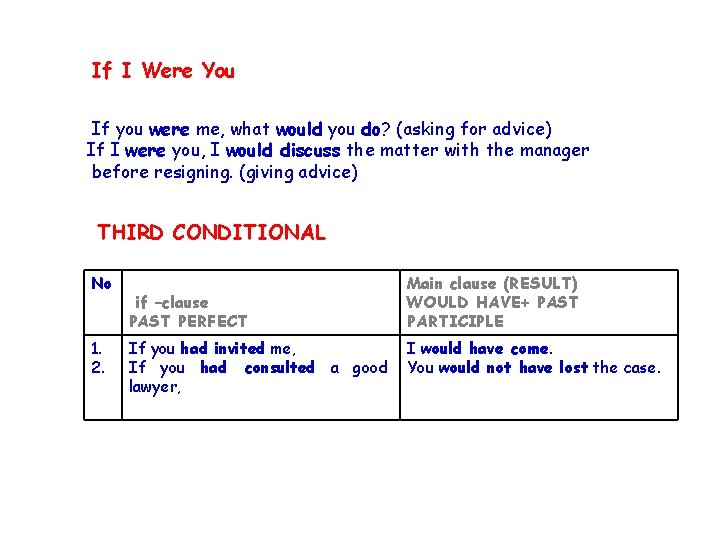
If I Were You If you were me, what would you do? (asking for advice) If I were you, I would discuss the matter with the manager before resigning. (giving advice) THIRD CONDITIONAL No 1. 2. if –clause PAST PERFECT If you had invited me, If you had consulted a good lawyer, Main clause (RESULT) WOULD HAVE+ PAST PARTICIPLE I would have come. You would not have lost the case.
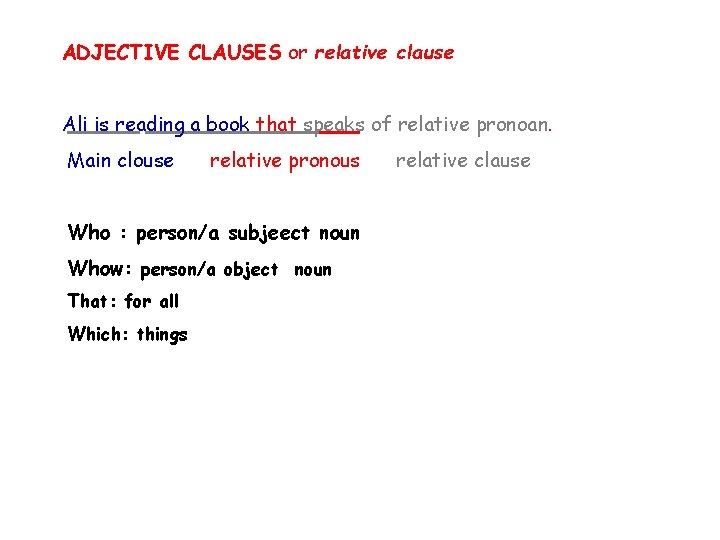
ADJECTIVE CLAUSES or relative clause Ali is reading a book that speaks of relative pronoan. Main clouse relative pronous Who : person/a subjeect noun Whow: person/a object noun That: for all Which: things relative clause
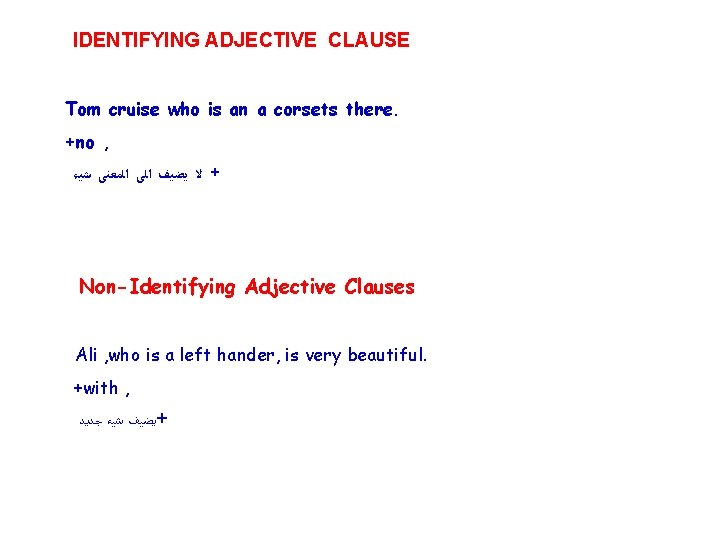
IDENTIFYING ADJECTIVE CLAUSE Tom cruise who is an a corsets there. +no , ﻻ ﻳﻀﻴﻒ ﺍﻟﻰ ﺍﻟﻤﻌﻨﻰ ﺷﻴﺀ + Non-Identifying Adjective Clauses Ali , who is a left hander, is very beautiful. +with , ﻳﻀﻴﻒ ﺷﻴﺀ ﺟﺪﻳﺪ +
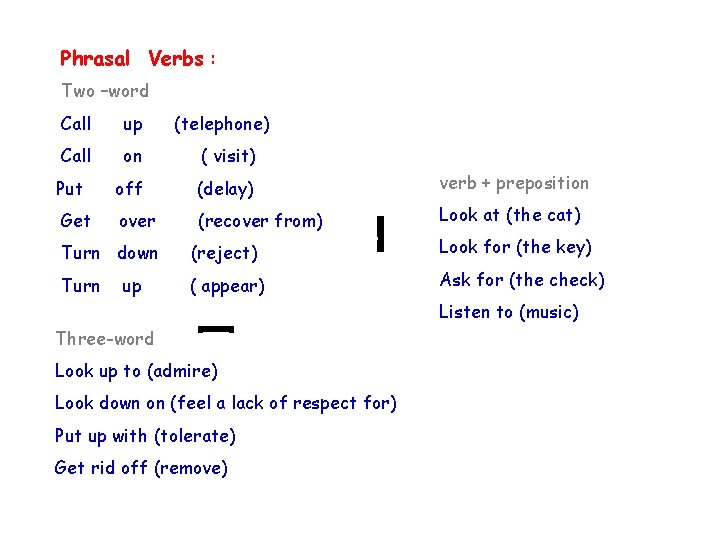
Phrasal Verbs : Two –word Call up (telephone) Call on ( visit) Put off (delay) verb + preposition Get over (recover from) Look at (the cat) Turn down (reject) Look for (the key) Turn ( appear) Ask for (the check) up Listen to (music) Three-word Look up to (admire) Look down on (feel a lack of respect for) Put up with (tolerate) Get rid off (remove)
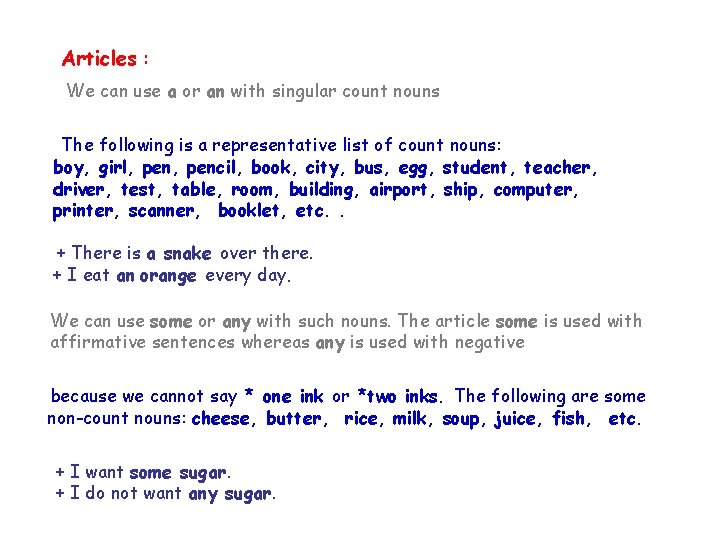
Articles : We can use a or an with singular count nouns The following is a representative list of count nouns: boy, girl, pencil, book, city, bus, egg, student, teacher, driver, test, table, room, building, airport, ship, computer, printer, scanner, booklet, etc. . + There is a snake over there. + I eat an orange every day. We can use some or any with such nouns. The article some is used with affirmative sentences whereas any is used with negative because we cannot say * one ink or *two inks. The following are some non-count nouns: cheese, butter, rice, milk, soup, juice, fish, etc. + I want some sugar. + I do not want any sugar.
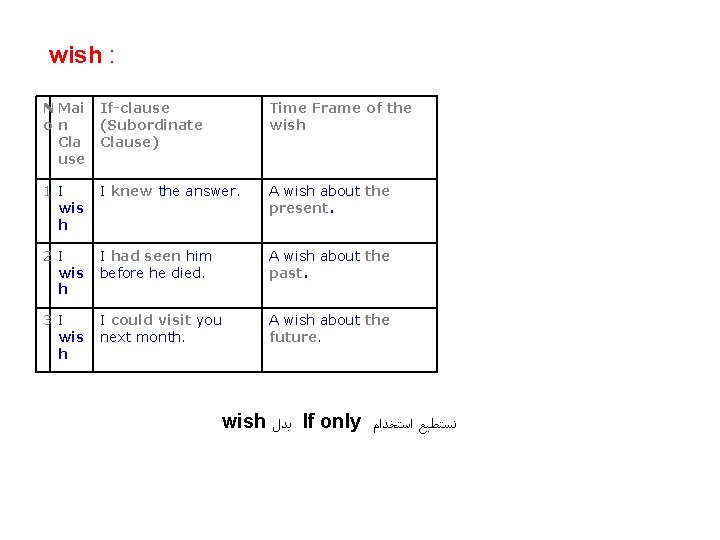
wish : N Mai on Cla use If-clause (Subordinate Clause) Time Frame of the wish 1 I wis h I knew the answer. A wish about the present. 2 I wis h I had seen him before he died. A wish about the past. 3 I wis h I could visit you next month. A wish about the future. wish ﺑﺪﻝ If only ﻧﺴﺘﻄﻴﻊ ﺍﺳﺘﺨﺪﺍﻡ
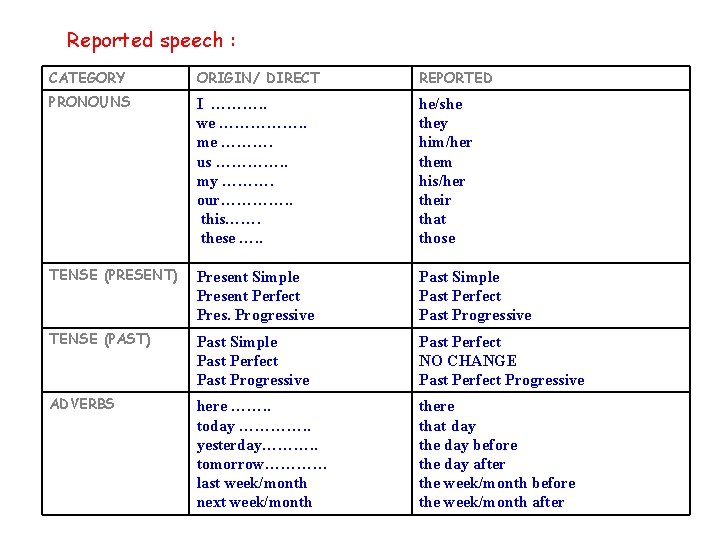
Reported speech : CATEGORY ORIGIN/ DIRECT REPORTED PRONOUNS I ………. . we ……………. . me ………. us …………. . my ………. our…………. . this……. these …. . he/she they him/her them his/her their that those TENSE (PRESENT) Present Simple Present Perfect Pres. Progressive Past Simple Past Perfect Past Progressive TENSE (PAST) Past Simple Past Perfect Past Progressive Past Perfect NO CHANGE Past Perfect Progressive ADVERBS here ……. . today …………. . yesterday………. . tomorrow………… last week/month next week/month there that day the day before the day after the week/month before the week/month after
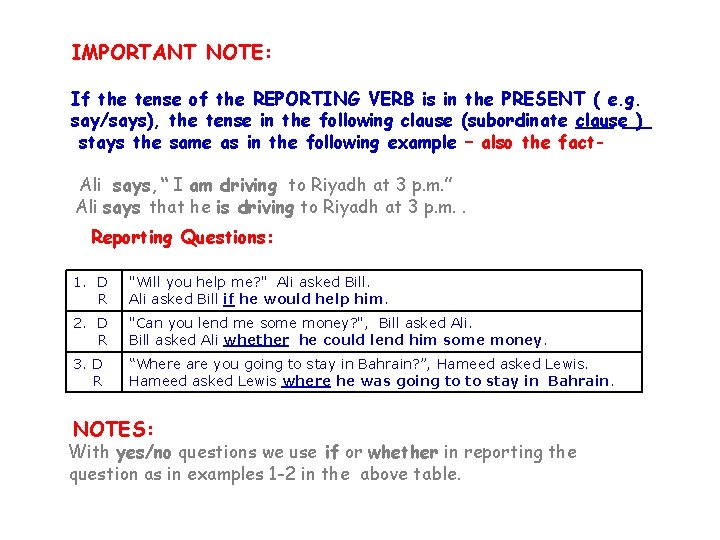
IMPORTANT NOTE: If the tense of the REPORTING VERB is in the PRESENT ( e. g. say/says), the tense in the following clause (subordinate clause ) stays the same as in the following example – also the fact. Ali says, “ I am driving to Riyadh at 3 p. m. ” Ali says that he is driving to Riyadh at 3 p. m. . Reporting Questions: 1. D R "Will you help me? " Ali asked Bill if he would help him. 2. D R "Can you lend me some money? ", Bill asked Ali whether he could lend him some money. 3. D R “Where are you going to stay in Bahrain? ”, Hameed asked Lewis where he was going to to stay in Bahrain. NOTES: With yes/no questions we use if or whether in reporting the question as in examples 1 -2 in the above table.