
Tense Aspect and Modality in Xhosa Stefan Savi
- Slides: 42
Tense, Aspect and Modality in Xhosa Stefan Savić Rhodes University
Outline 1. Xhosa 2. Verbal paradigm 3. Corpus data 4. Remoteness in the past tenses 5. Aspect 6. Modality in the future tenses
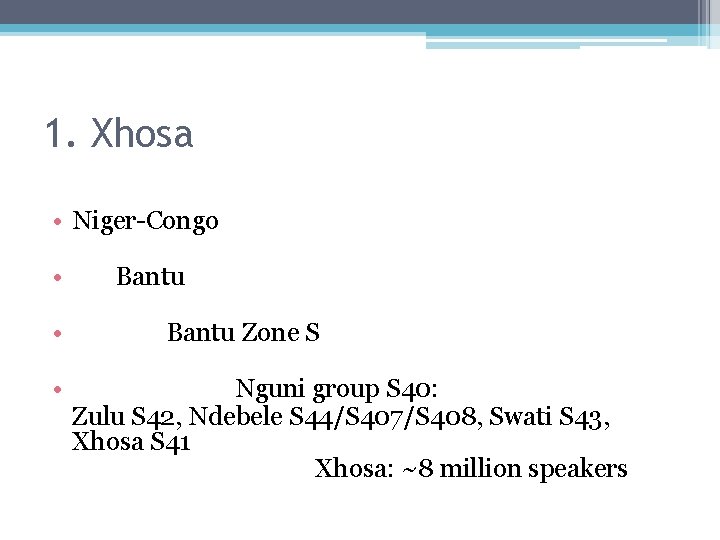
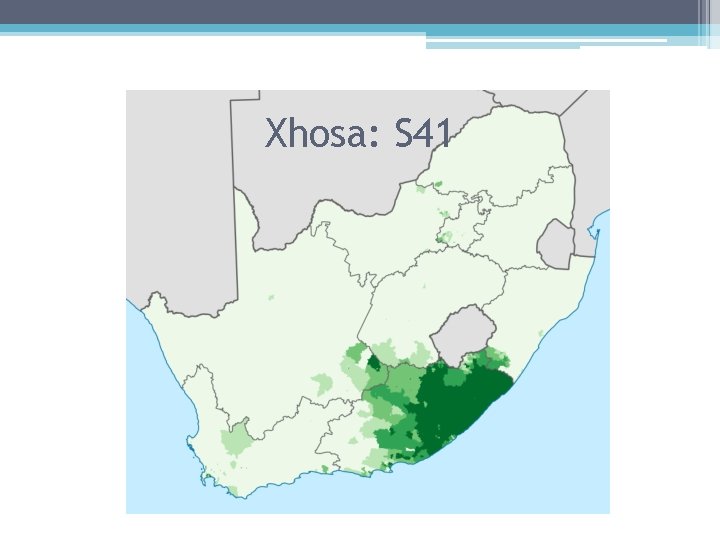
1. Xhosa • Niger-Congo • Bantu • Bantu Zone S • Nguni group S 40: Zulu S 42, Ndebele S 44/S 407/S 408, Swati S 43, Xhosa S 41 Xhosa: ~8 million speakers
Xhosa: S 41
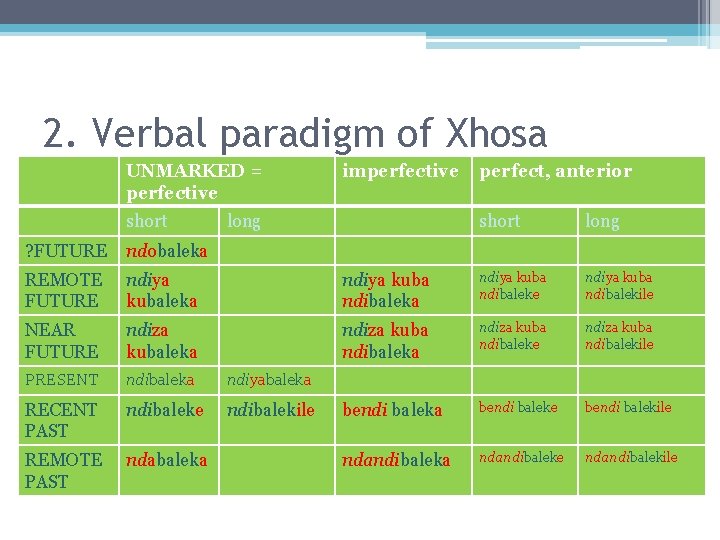
2. Verbal paradigm of Xhosa UNMARKED = perfective short imperfective long perfect, anterior short long ? FUTURE ndobaleka REMOTE FUTURE ndiya kubaleka ndiya kuba ndibaleke ndiya kuba ndibalekile NEAR FUTURE ndiza kubaleka ndiza kuba ndibaleke ndiza kuba ndibalekile PRESENT ndibaleka ndiyabaleka RECENT PAST ndibaleke ndibalekile bendi baleka bendi baleke bendi balekile REMOTE PAST ndabaleka ndandibaleke ndandibalekile
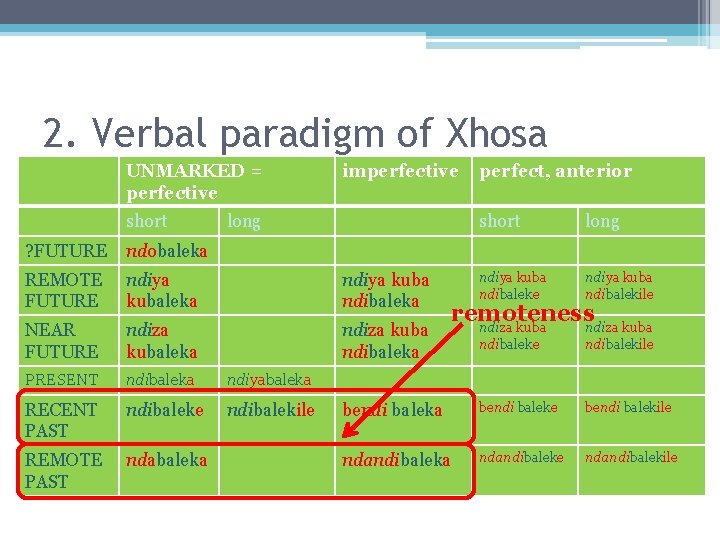
2. Verbal paradigm of Xhosa UNMARKED = perfective short imperfective long perfect, anterior short long ndiya kuba ndibaleke ndiya kuba ndibalekile bendi baleka bendi baleke bendi balekile ndandibaleka ndandibaleke ndandibalekile ? FUTURE ndobaleka REMOTE FUTURE ndiya kubaleka ndiya kuba ndibaleka NEAR FUTURE ndiza kubaleka ndiza kuba ndibaleka PRESENT ndibaleka ndiyabaleka RECENT PAST ndibaleke ndibalekile REMOTE PAST ndabaleka remoteness ndiza kuba
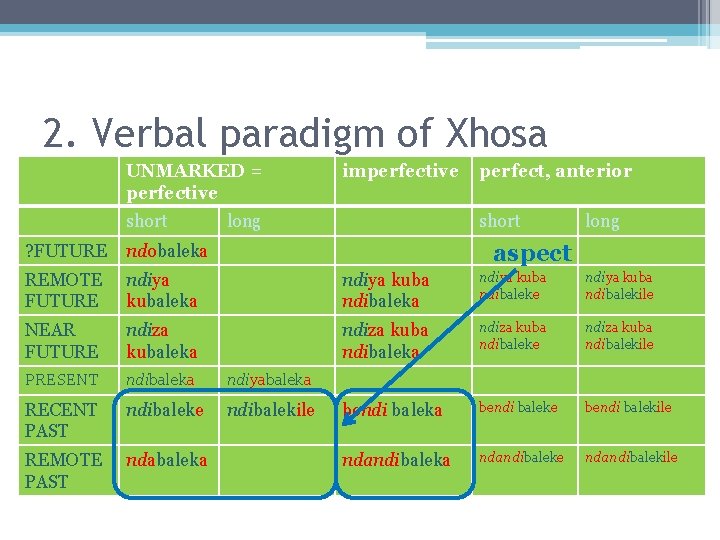
2. Verbal paradigm of Xhosa UNMARKED = perfective short imperfective long perfect, anterior short long aspect ? FUTURE ndobaleka REMOTE FUTURE ndiya kubaleka ndiya kuba ndibaleke ndiya kuba ndibalekile NEAR FUTURE ndiza kubaleka ndiza kuba ndibaleke ndiza kuba ndibalekile PRESENT ndibaleka ndiyabaleka RECENT PAST ndibaleke ndibalekile bendi baleka bendi baleke bendi balekile REMOTE PAST ndabaleka ndandibaleke ndandibalekile
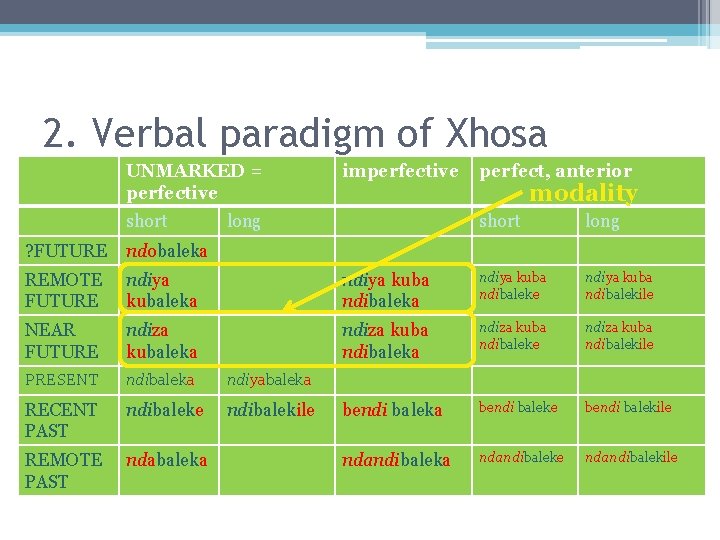
2. Verbal paradigm of Xhosa UNMARKED = perfective short imperfective long perfect, anterior modality short long ? FUTURE ndobaleka REMOTE FUTURE ndiya kubaleka ndiya kuba ndibaleke ndiya kuba ndibalekile NEAR FUTURE ndiza kubaleka ndiza kuba ndibaleke ndiza kuba ndibalekile PRESENT ndibaleka ndiyabaleka RECENT PAST ndibaleke ndibalekile bendi baleka bendi baleke bendi balekile REMOTE PAST ndabaleka ndandibaleke ndandibalekile
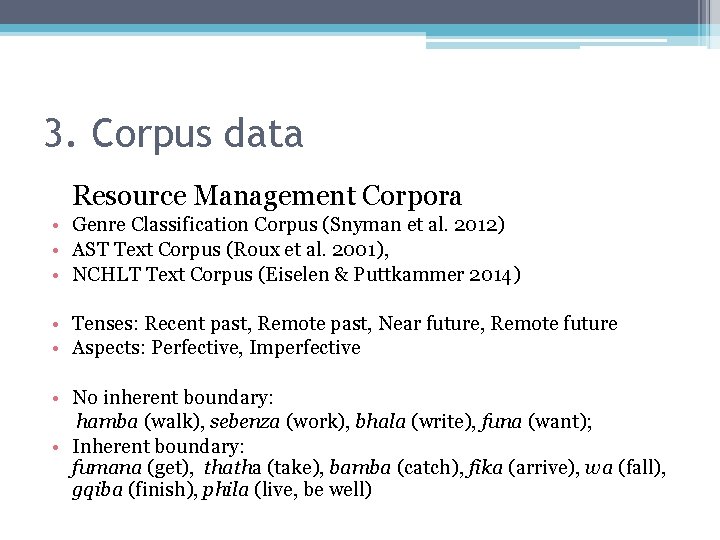
3. Corpus data Resource Management Corpora • Genre Classification Corpus (Snyman et al. 2012) • AST Text Corpus (Roux et al. 2001), • NCHLT Text Corpus (Eiselen & Puttkammer 2014) • Tenses: Recent past, Remote past, Near future, Remote future • Aspects: Perfective, Imperfective • No inherent boundary: hamba (walk), sebenza (work), bhala (write), funa (want); • Inherent boundary: fumana (get), thatha (take), bamba (catch), fika (arrive), wa (fall), gqiba (finish), phila (live, be well)
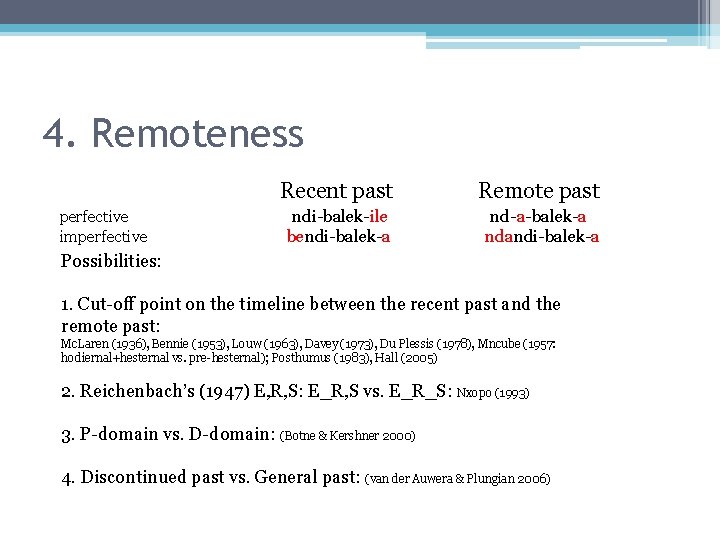
4. Remoteness Recent past Remote past perfective ndi-balek-ile nd-a-balek-a imperfective bendi-balek-a ndandi-balek-a Possibilities: 1. Cut-off point on the timeline between the recent past and the remote past: Mc. Laren (1936), Bennie (1953), Louw (1963), Davey (1973), Du Plessis (1978), Mncube (1957: hodiernal+hesternal vs. pre-hesternal); Posthumus (1983), Hall (2005) 2. Reichenbach’s (1947) E, R, S: E_R, S vs. E_R_S: Nxopo (1993) 3. P-domain vs. D-domain: (Botne & Kershner 2000) 4. Discontinued past vs. General past: (van der Auwera & Plungian 2006)
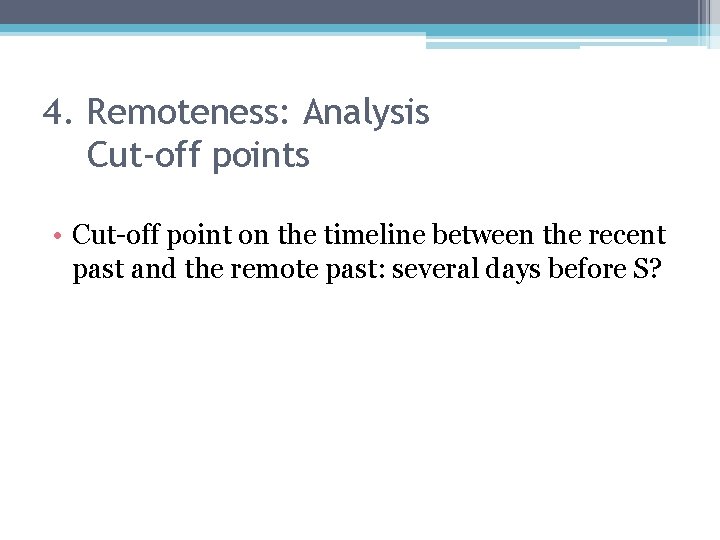
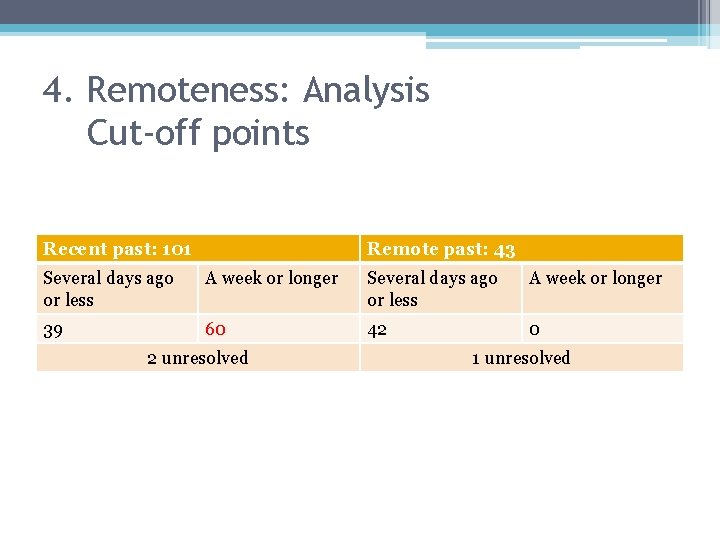
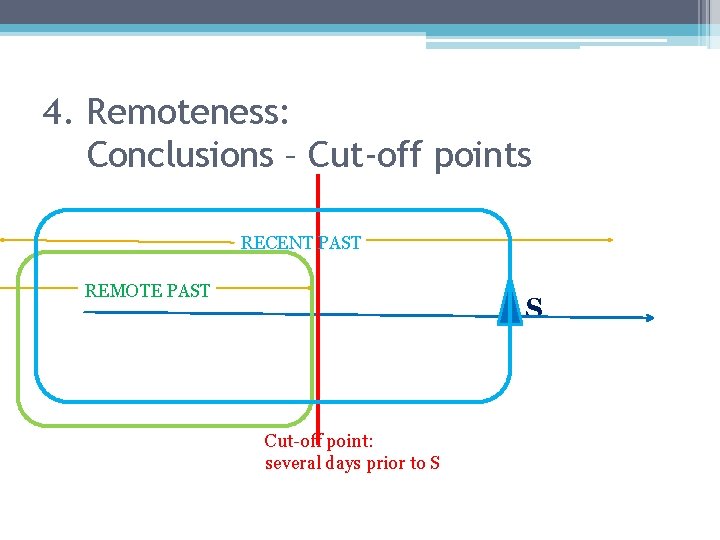
4. Remoteness: Analysis Cut-off points • Cut-off point on the timeline between the recent past and the remote past: several days before S?
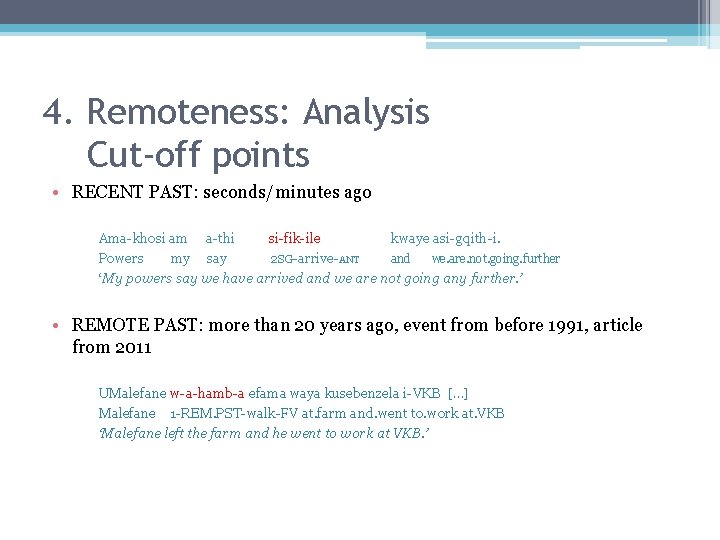
4. Remoteness: Analysis Cut-off points • RECENT PAST: seconds/minutes ago Ama-khosi am a-thi si-fik-ile kwaye asi-gqith-i. Powers my say 2 SG-arrive-ANT and we. are. not. going. further ‘My powers say we have arrived and we are not going any further. ’ • REMOTE PAST: more than 20 years ago, event from before 1991, article from 2011 UMalefane w-a-hamb-a efama waya kusebenzela i-VKB […] Malefane 1 -REM. PST-walk-FV at. farm and. went to. work at. VKB ‘Malefane left the farm and he went to work at VKB. ’
4. Remoteness: Analysis Cut-off points Recent past: 101 Remote past: 43 Several days ago or less A week or longer 39 60 42 0 2 unresolved 1 unresolved
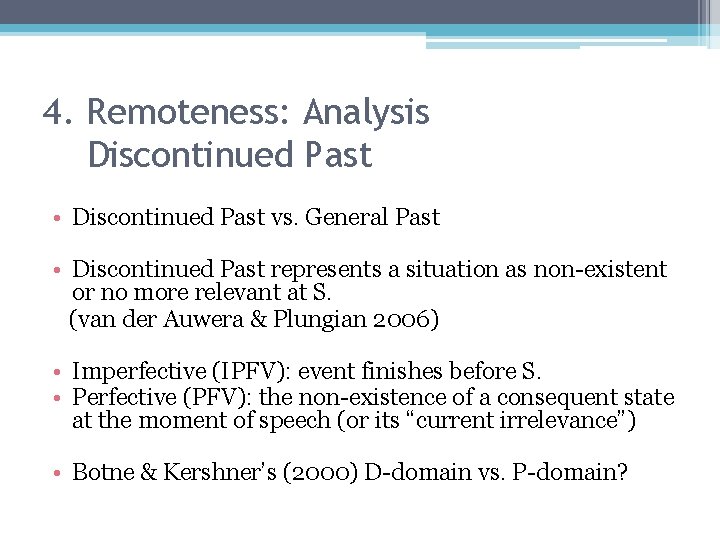
4. Remoteness: Analysis Discontinued Past • Discontinued Past vs. General Past • Discontinued Past represents a situation as non-existent or no more relevant at S. (van der Auwera & Plungian 2006) • Imperfective (IPFV): event finishes before S. • Perfective (PFV): the non-existence of a consequent state at the moment of speech (or its “current irrelevance”) • Botne & Kershner’s (2000) D-domain vs. P-domain?
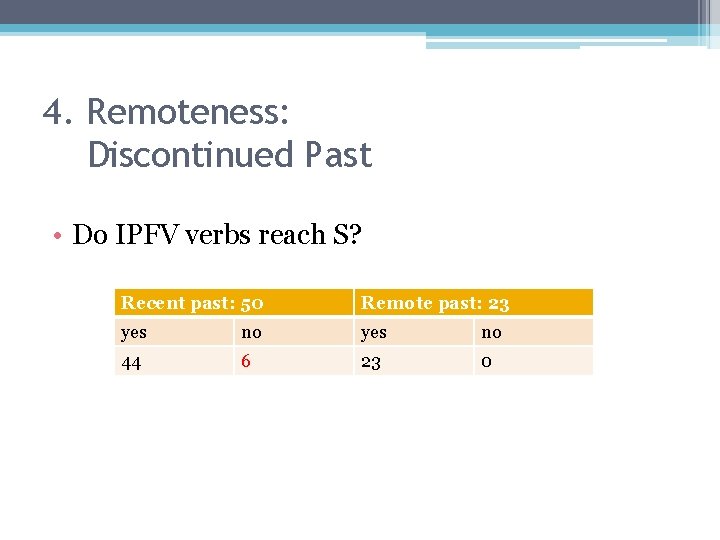
4. Remoteness: Discontinued Past • Do IPFV verbs reach S? Recent past: 50 Remote past: 23 yes no 44 6 23 0
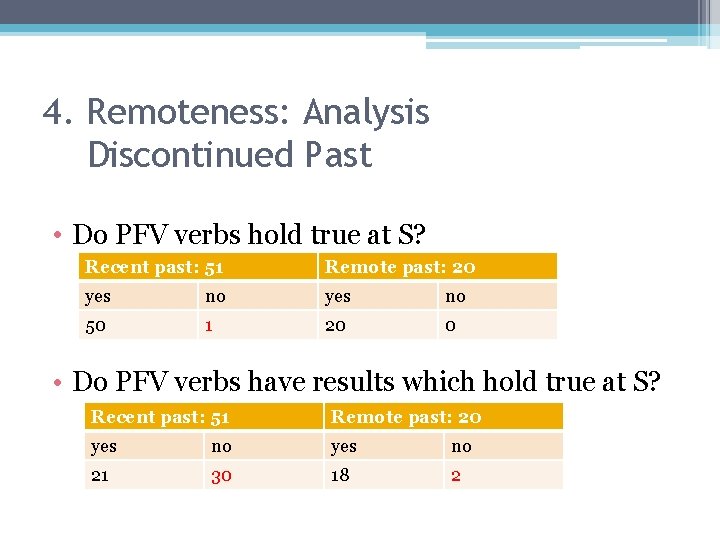
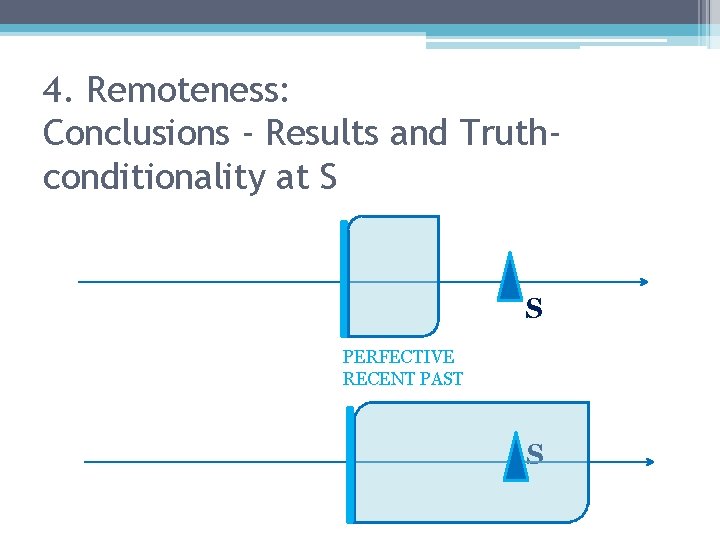
4. Remoteness: Analysis Discontinued Past • Do PFV verbs hold true at S? Recent past: 51 Remote past: 20 yes no 50 1 20 0 • Do PFV verbs have results which hold true at S? Recent past: 51 Remote past: 20 yes no 21 30 18 2
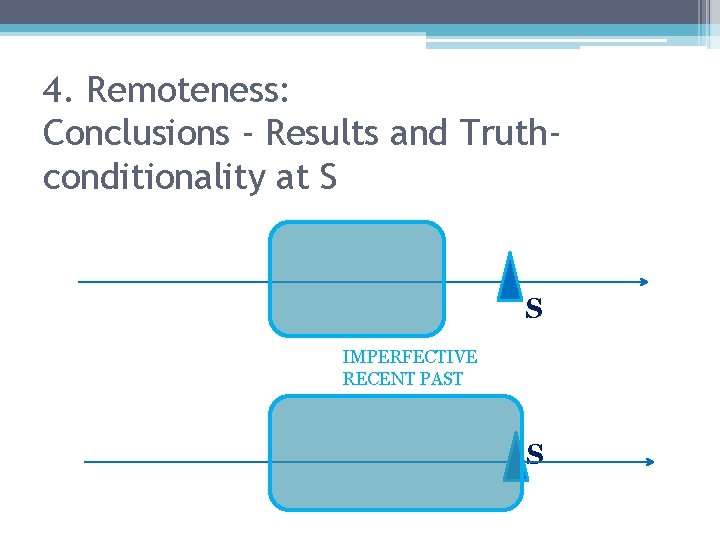
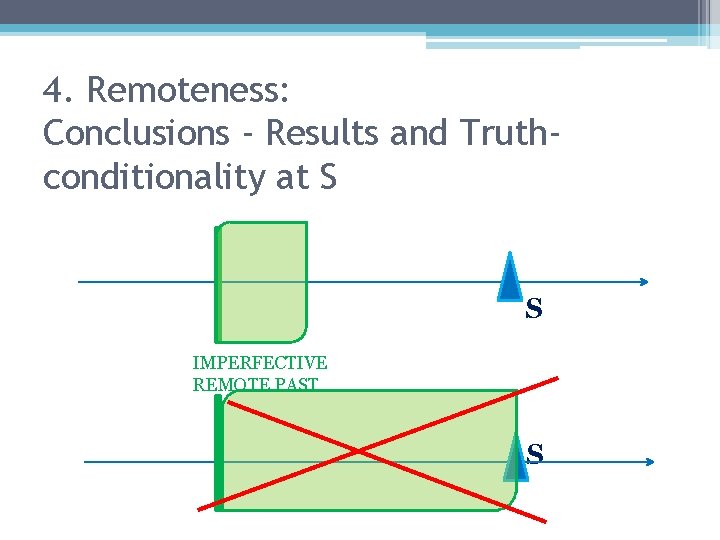
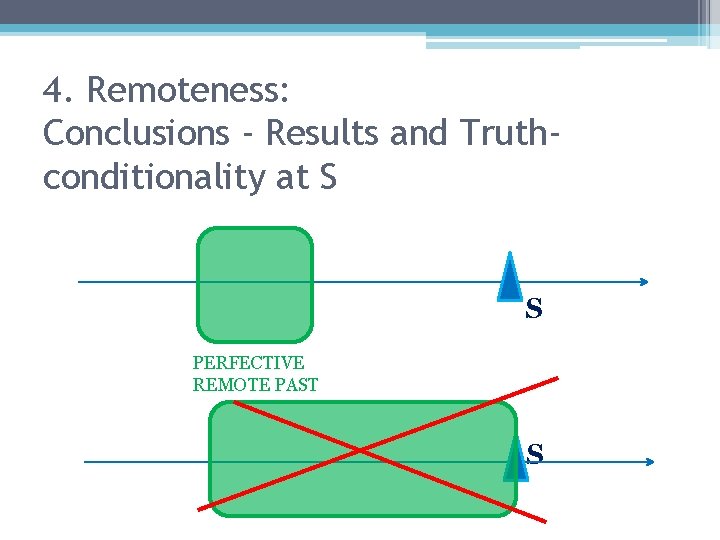
4. Remoteness: Conclusions • The imperfective verbs of the general past do not specify whether the event holds true at S (van der Auwera & Plungian 2006); • Recent past perfective: does not have to have a result which still holds true at S; • Remote past perfective: may or may not have a result which still holds true at S; • Remote past imperfective: may not last until S.
4. Remoteness: Conclusions • Recent past: covers all time references; Often used in narrations with the remote past to indicate events that are expected; • Remote past: only those time references which are several days prior to S.
4. Remoteness: Conclusions – Cut-off points RECENT PAST REMOTE PAST S Cut-off point: several days prior to S
4. Remoteness: Conclusions - Results and Truthconditionality at S S PERFECTIVE RECENT PAST S
4. Remoteness: Conclusions - Results and Truthconditionality at S S IMPERFECTIVE RECENT PAST S
4. Remoteness: Conclusions - Results and Truthconditionality at S S IMPERFECTIVE REMOTE PAST S
4. Remoteness: Conclusions - Results and Truthconditionality at S S PERFECTIVE REMOTE PAST S
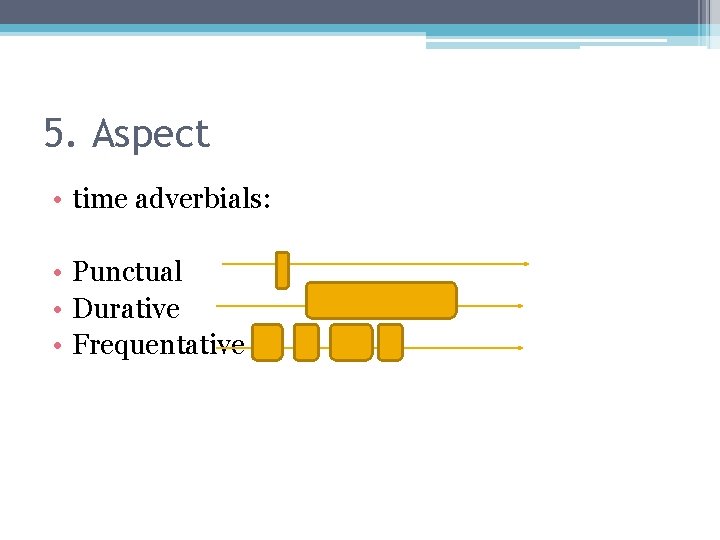
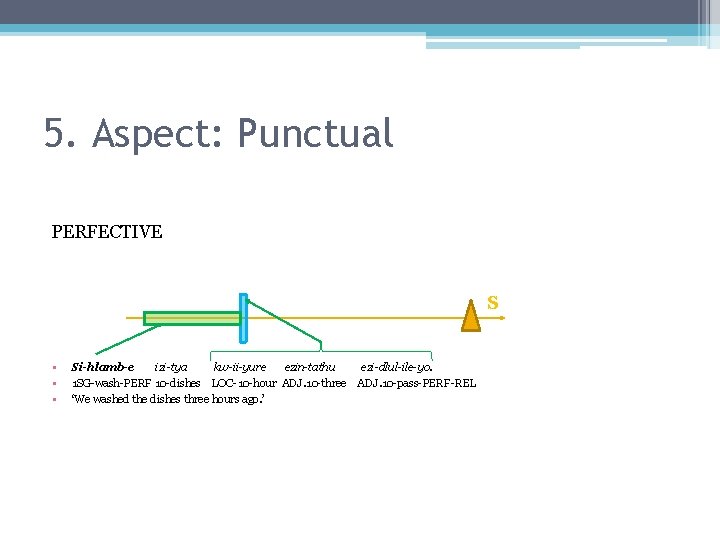
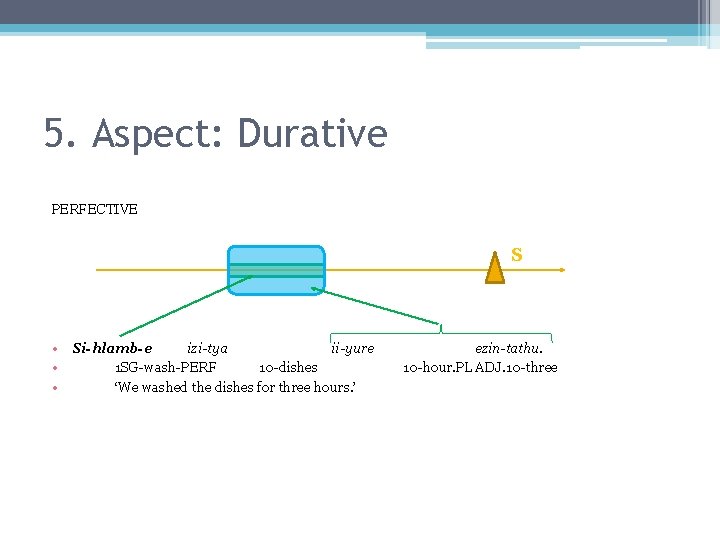
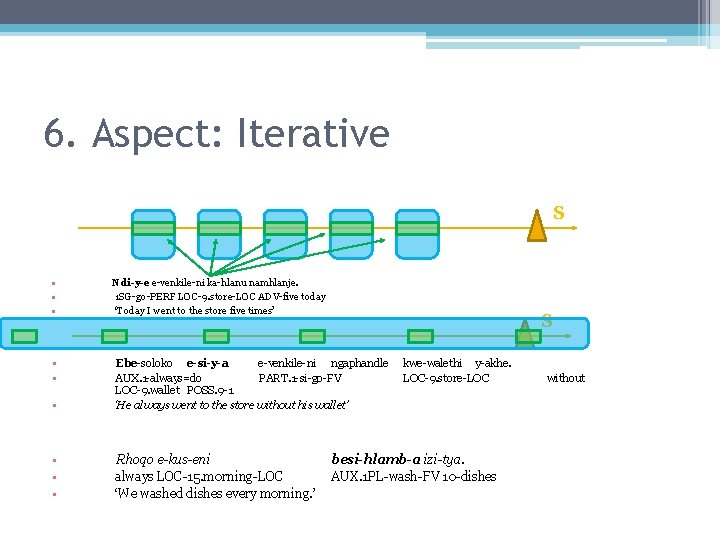
5. Aspect • time adverbials: • Punctual • Durative • Frequentative
5. Aspect: Punctual PERFECTIVE S • • • Si-hlamb-e izi-tya kw-ii-yure ezin-tathu ezi-dlul-ile-yo. 1 SG-wash-PERF 10 -dishes LOC-10 -hour ADJ. 10 -three ADJ. 10 -pass-PERF-REL ‘We washed the dishes three hours ago. ’
5. Aspect: Durative PERFECTIVE S • Si-hlamb-e izi-tya ii-yure • 1 SG-wash-PERF 10 -dishes • ‘We washed the dishes for three hours. ’ ezin-tathu. 10 -hour. PL ADJ. 10 -three
6. Aspect: Iterative S • • • Ndi-y-e e-venkile-ni ka-hlanu namhlanje. 1 SG-go-PERF LOC-9. store-LOC ADV-five today ‘Today I went to the store five times’ • • • Ebe-soloko e-si-y-a e-venkile-ni ngaphandle AUX. 1 -always=do PART. 1 -si-go-FV LOC-9. wallet POSS. 9 -1 ‘He always went to the store without his wallet’ • • • Rhoqo e-kus-eni always LOC-15. morning-LOC ‘We washed dishes every morning. ’ S kwe-walethi y-akhe. LOC-9. store-LOC besi-hlamb-a izi-tya. AUX. 1 PL-wash-FV 10 -dishes without
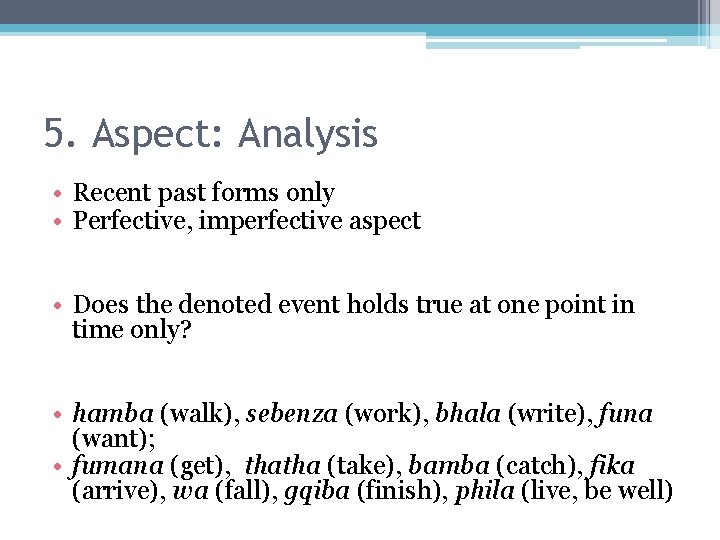
5. Aspect: Analysis • Recent past forms only • Perfective, imperfective aspect • Does the denoted event holds true at one point in time only? • hamba (walk), sebenza (work), bhala (write), funa (want); • fumana (get), thatha (take), bamba (catch), fika (arrive), wa (fall), gqiba (finish), phila (live, be well)
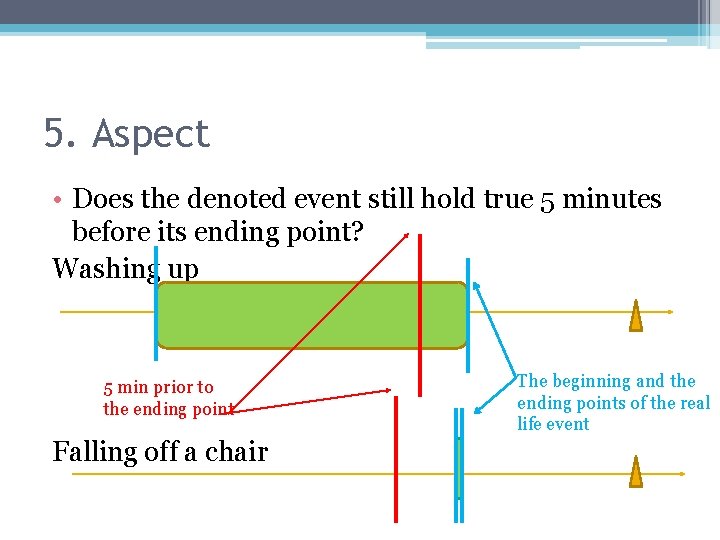
5. Aspect • Does the denoted event still hold true 5 minutes before its ending point? Washing up 5 min prior to the ending point Falling off a chair The beginning and the ending points of the real life event
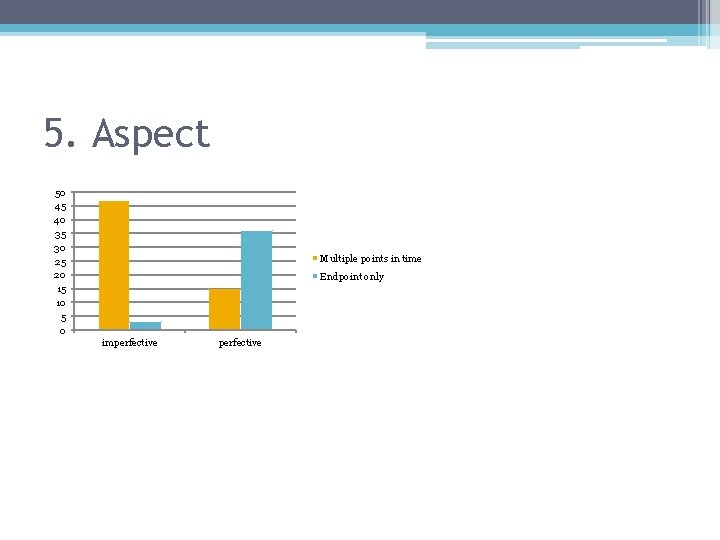
5. Aspect 50 45 40 35 30 25 20 15 10 5 0 Multiple points in time Endpoint only imperfective
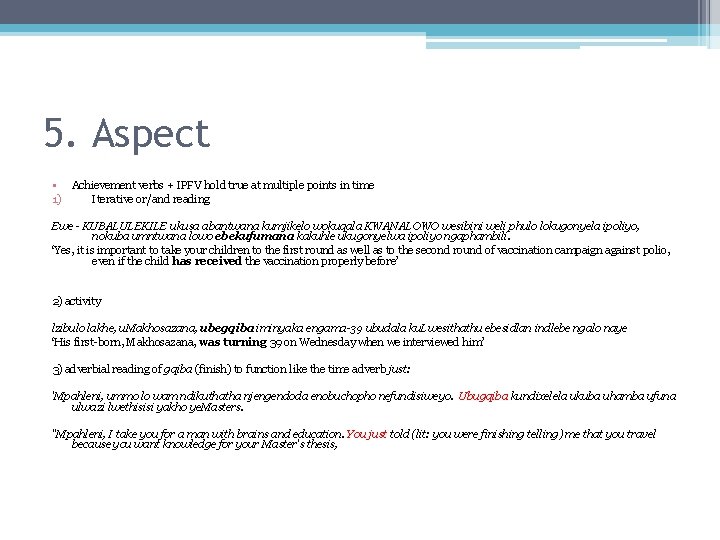
5. Aspect • Achievement verbs + IPFV hold true at multiple points in time 1) Iterative or/and reading Ewe - KUBALULEKILE ukusa abantwana kumjikelo wokuqala KWANALOWO wesibini weli phulo lokugonyela ipoliyo, nokuba umntwana lowo ebekufumana kakuhle ukugonyelwa ipoliyo ngaphambili. ‘Yes, it is important to take your children to the first round as well as to the second round of vaccination campaign against polio, even if the child has received the vaccination properly before’ 2) activity lzibulo lakhe, u. Makhosazana, ubegqiba iminyaka engama-39 ubudala ku. Lwesithathu ebesidlan indlebe ngalo naye ‘His first-born, Makhosazana, was turning 39 on Wednesday when we interviewed him’ 3) adverbial reading of gqiba (finish) to function like the time adverb just: 'Mpahleni, ummo lo wam ndikuthatha njengendoda enobuchopho nefundisiweyo. Ubugqiba kundixelela ukuba uhamba ufuna ulwazi lwethisisi yakho ye. Masters. "Mpahleni, I take you for a man with brains and education. You just told (lit: you were finishing telling) me that you travel because you want knowledge for your Master's thesis,
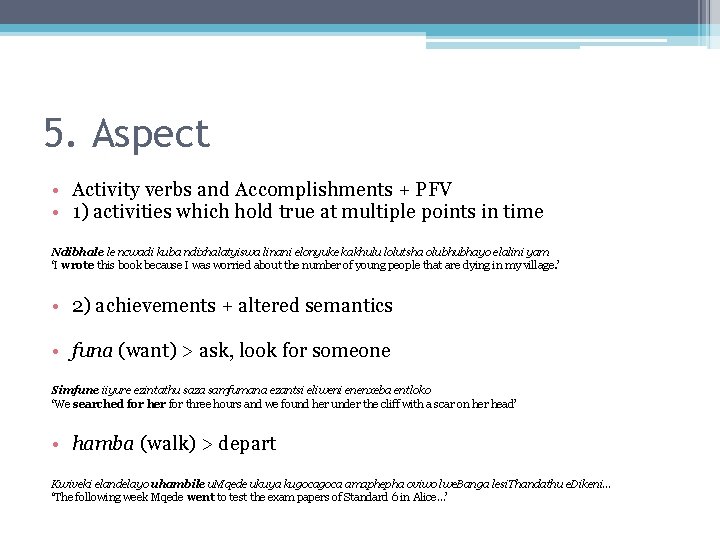
5. Aspect • Activity verbs and Accomplishments + PFV • 1) activities which hold true at multiple points in time Ndibhale le ncwadi kuba ndixhalatyiswa linani elonyuke kakhulu lolutsha olubhubhayo elalini yam ‘I wrote this book because I was worried about the number of young people that are dying in my village. ’ • 2) achievements + altered semantics • funa (want) > ask, look for someone Simfune iiyure ezintathu saza samfumana ezantsi eliweni enenxeba entloko ‘We searched for her for three hours and we found her under the cliff with a scar on her head’ • hamba (walk) > depart Kwiveki elandelayo uhambile u. Mqede ukuya kugoca amaphepha oviwo lwe. Banga lesi. Thandathu e. Dikeni… ‘The following week Mqede went to test the exam papers of Standard 6 in Alice…’
5. Aspect: Boundaries • Perfective – adds a boundary to an event (inchoative, holistic etc. ) • Imperfective – does not have a boundary • Grammatical aspect alters the lexical aspect of the verb phrase
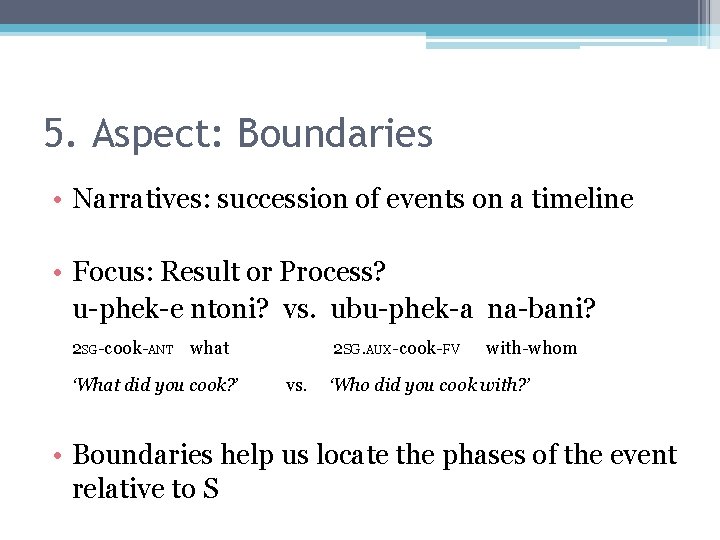
5. Aspect: Boundaries • Narratives: succession of events on a timeline • Focus: Result or Process? u-phek-e ntoni? vs. ubu-phek-a na-bani? 2 SG-cook-ANT what 2 SG. AUX-cook-FV with-whom ‘What did you cook? ’ vs. ‘Who did you cook with? ’ • Boundaries help us locate the phases of the event relative to S
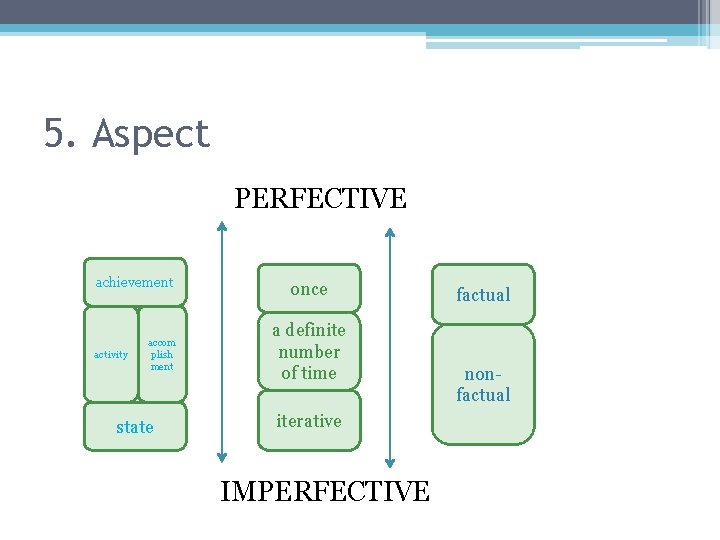
5. Aspect PERFECTIVE achievement activity accom plish ment state once a definite number of time iterative IMPERFECTIVE factual nonfactual
6. Modality • Modality: status of the proposition (Palmer 1986) • -za ku- (‘come to’) and -ya ku- (‘go to’) express different degrees of epistemic modality or conditional mood?
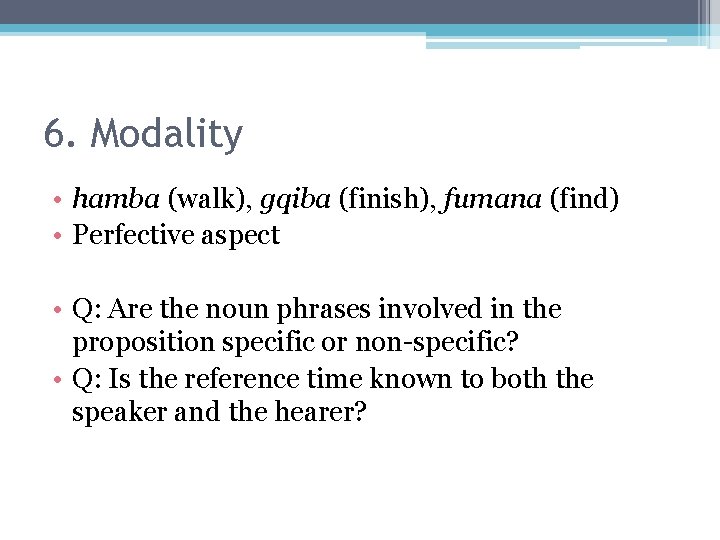
6. Modality • hamba (walk), gqiba (finish), fumana (find) • Perfective aspect • Q: Are the noun phrases involved in the proposition specific or non-specific? • Q: Is the reference time known to both the speaker and the hearer?
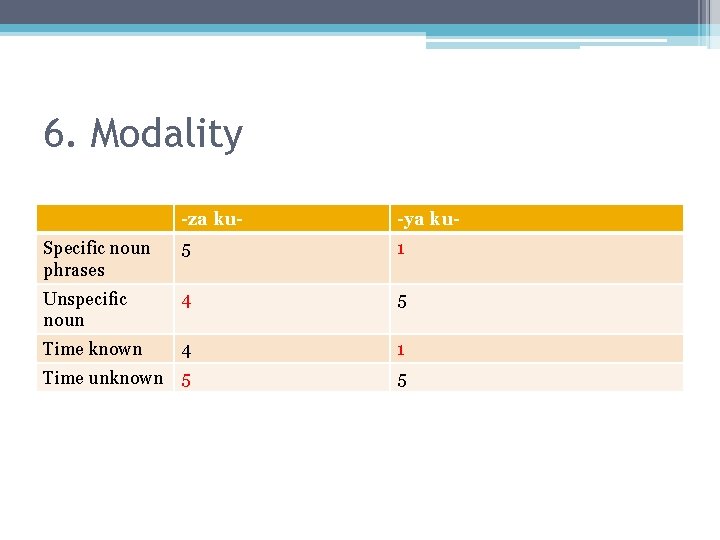
6. Modality -za ku- -ya ku- Specific noun phrases 5 1 Unspecific noun 4 5 Time known 4 1 Time unknown 5 5
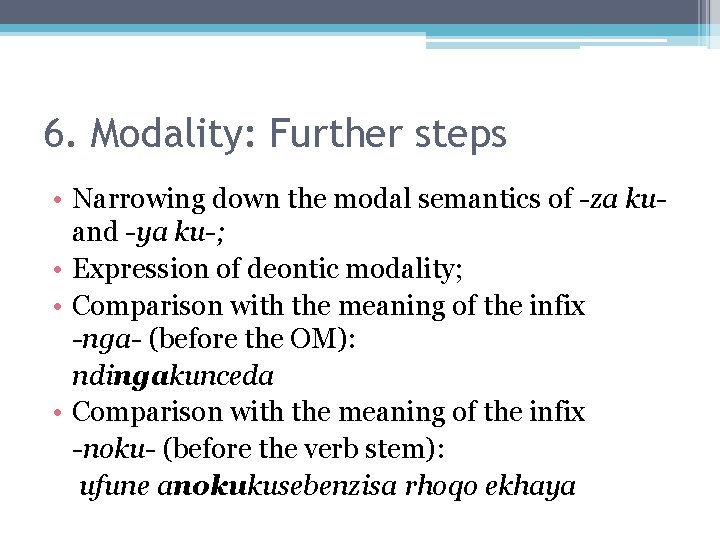
6. Modality: Further steps • Narrowing down the modal semantics of -za kuand -ya ku-; • Expression of deontic modality; • Comparison with the meaning of the infix -nga- (before the OM): ndingakunceda • Comparison with the meaning of the infix -noku- (before the verb stem): ufune anokukusebenzisa rhoqo ekhaya
References • • • • • • Bennie, W. G. 1953. A Grammar of Xhosa for the Xhosa-speaking. Lovedale: Lovedale Press. Botne, R. , Kershner, T. L. 2000. Time, Tense, and the Perfect in Zulu. Afrika und Übersee 83: 161 -181. Comrie, B. 1976. Aspect. Cambridge: Cambridge University Press. Comrie, B. 1985. Tense. Cambridge: Cambridge University Press. Davey, A. S. 1973. Moods and Tenses of the Verb in Xhosa. University of South Africa, Pretoria, unpublished M. A. dissertation. Du Plessis, J. A. 1978. Isi. Xhosa 4. Cape Town : Oudiovista Produksies. Eiselen, E. R. , Puttkammer, M. J. 2014. Developing text resources for ten South African languages. Proceedings of the 9 th International Conference on Language Resources and Evaluation, Reykjavik, Iceland: 3698 -3703. ISLRN: 848 -955 -511 -452 -0. Hall, L. 2005. The be- relative tenses of Zulu. University of Pretoria, Master dissertation. Louw, J. A. 1963. Handboek van Xhosa. Johannesburg: Bonapers Beperk. Mc. Laren, J. 1936. A Xhosa Grammar. London: Longmans. Mncube, F. S. M. 1957. Xhosa Manual. Johannesburg: Juta & Co. Limited. Nxopo, M. C. 1993. The Meaning of the four basic tenses in Xhosa. University of Stellenbosch, Master dissertation. Posthumus, L. C. 1983. Werkwoordkategorieë in Zulu. University of Orange Free State, unpublished Ph. D dissertation. Posthumus, L. C. 1988. Basis for tense analysis in African languages. South African Journal for African Languages 8(4): 139 -143. Posthumus, L. C. 1990. Time reference in Zulu. South African Journal for African Languages 10(1): 22 -28. Posthumus, L. C. 1999. Can the deictic centre be shifted? South African Journal for African Languages 19(3): 188 -195. Reichenbach, H. 1947. Elements of Symbolic Logic. London: Macmillan. Nurse, D. 2008. Tense and Aspect in Bantu. Oxford: Oxford University Press. Roux, J. C. , Louw, P. H. , Botha, E. C. 2001. African Speech Technology telephone speech databases. Proceedings of the 12 th Annual Symposium of the Pattern Recognition Association of South Africa (PRASA), University of Pretoria: 115 -119. ISLRN: 818 -393 -622 -097 -4. Snyman, D. , van Huyssteen, G. B. , Daelemans, W. 2012. Cross-Lingual Genre Classification for Closely Related Languages. Proceedings of the 22 nd Annual Symposium of the Pattern Recognition Association of South Africa: 132 -137. ISLRN: 418 -998 -894 -930 -1. Van der Auwera , J, Plungian , V. . A. 2006. Towards a typology of discontinuous past. Sprachtypologische Universitätsforschung. Berlin 59. 51 -89.
Thank you • • • Sibusiso Klaas Hlumela Mkabile Zukisani Dyasi Dr Mark de Vos Dr Silvester Ron Simango Sandisa Imbewu Fund
Thank you! Enkosi!