
Tensar geogrid foundation solutions in earthquakesusceptible locations Background
Tensar geogrid foundation solutions in earthquake-susceptible locations
Background § Benefits of geogrid reinforced structures in seismic zones proven § Kobe 1996 § Chi-Chi 1999 § Geogrid stabilised mattresses in New Zealand have been effective to mitigate soil liquefaction and associated damage to houses § These applications are not accidental! § Over 30 years of testing and application of a Tensar MSL in foundations in shallow footings – see earlier § Milligan & Love – load spread angle § Guido – increased bearing capacity § BRE (UK) – confirmation of load spread and reduced stress on foundation soils

Seismic performance Integrity of the Tensar MSL under vertical accelerations § When vertical acceleration exceeds 1 g, a foundation raft can become temporarily “weightless” § The foundation raft will benefit from the composite nature of the Tensar MSL – particle confinement and built in residual stress § Shaking table research shows that initial stiffness of the MSL is important in reducing settlement in the foundation § “Triaxial” cell testing shows the Tensar geogrid creates an effective increase in confining pressure

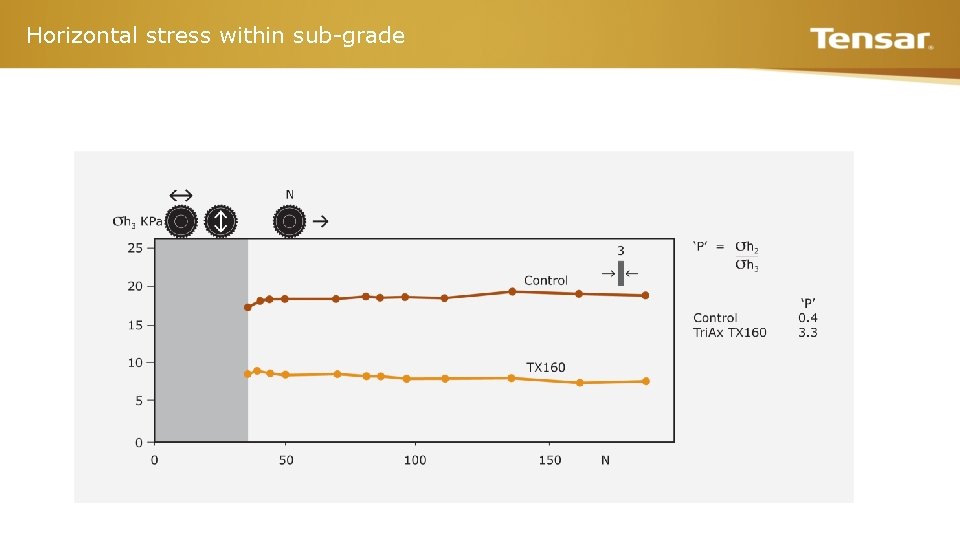
Full scale supporting data § Full scale testing to confirm the ability of the Tensar MSL to increase “built-in” stresses § Instrumentation placed near the base of a compacted road base material to measure horizontal stress

Horizontal stress within granular base § Higher stress “locked in” to the Tensar MSL § Stress is relieved during trafficking § The confinement effect can offer additional integrity to the foundation raft during an earthquake event
Horizontal stress within sub-grade
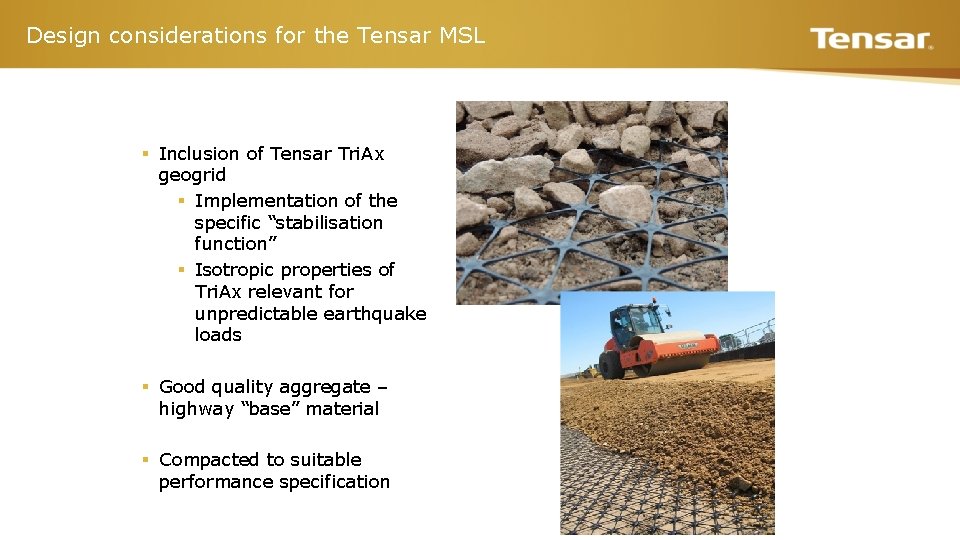
Design considerations for the Tensar MSL § Inclusion of Tensar Tri. Ax geogrid § Implementation of the specific “stabilisation function” § Isotropic properties of Tri. Ax relevant for unpredictable earthquake loads § Good quality aggregate – highway “base” material § Compacted to suitable performance specification
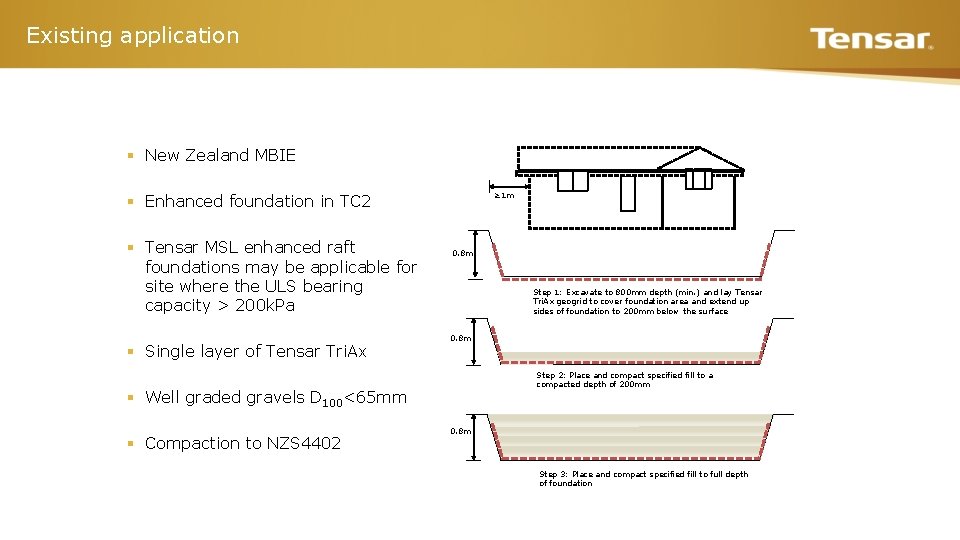
Existing application § New Zealand MBIE ≥ 1 m § Enhanced foundation in TC 2 § Tensar MSL enhanced raft foundations may be applicable for site where the ULS bearing capacity > 200 k. Pa § Single layer of Tensar Tri. Ax 0. 8 m Step 1: Excavate to 800 mm depth (min. ) and lay Tensar Tri. Ax geogrid to cover foundation area and extend up sides of foundation to 200 mm below the surface 0. 8 m Step 2: Place and compact specified fill to a compacted depth of 200 mm § Well graded gravels D 100<65 mm § Compaction to NZS 4402 0. 8 m Step 3: Place and compact specified fill to full depth of foundation
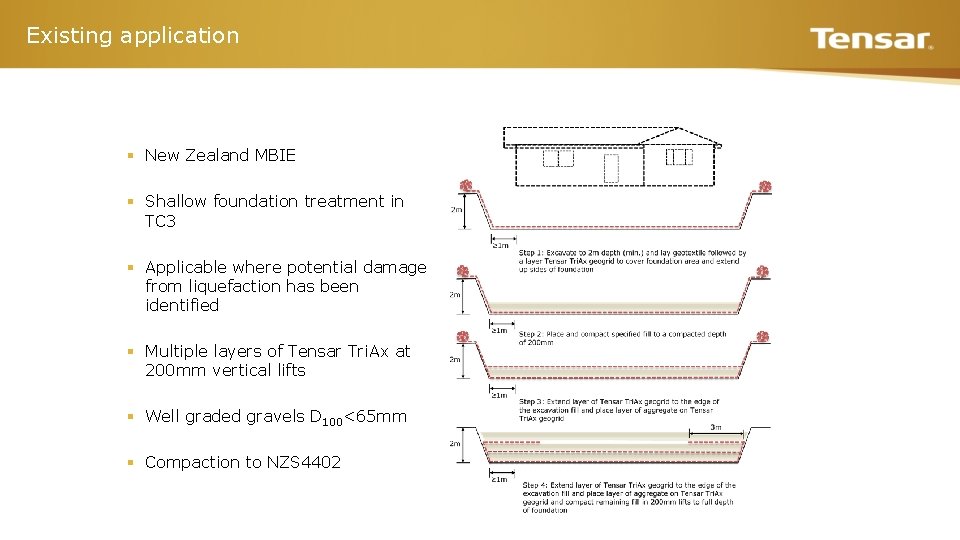
Existing application § New Zealand MBIE § Shallow foundation treatment in TC 3 § Applicable where potential damage from liquefaction has been identified § Multiple layers of Tensar Tri. Ax at 200 mm vertical lifts § Well graded gravels D 100<65 mm § Compaction to NZS 4402
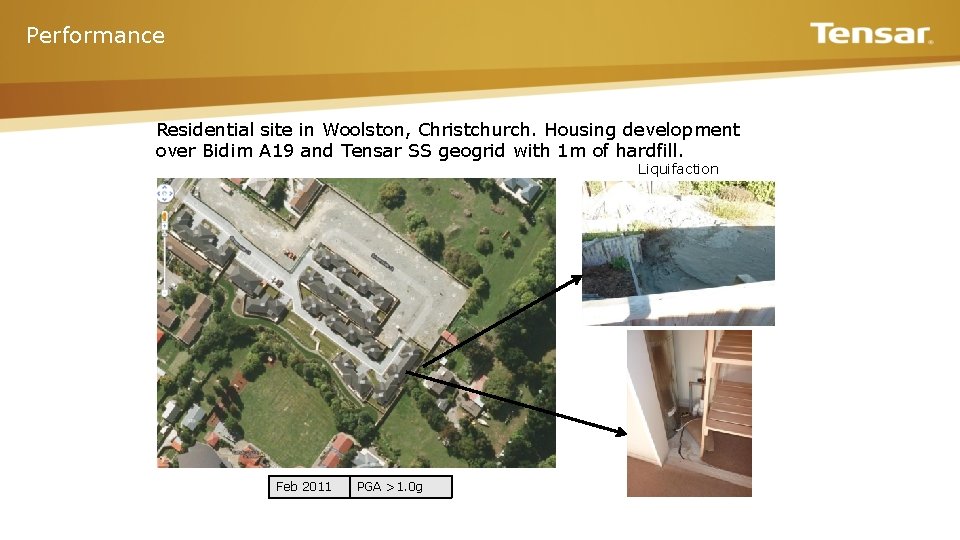
Performance Residential site in Woolston, Christchurch. Housing development over Bidim A 19 and Tensar SS geogrid with 1 m of hardfill. Liquifaction Feb 2011 PGA >1. 0 g
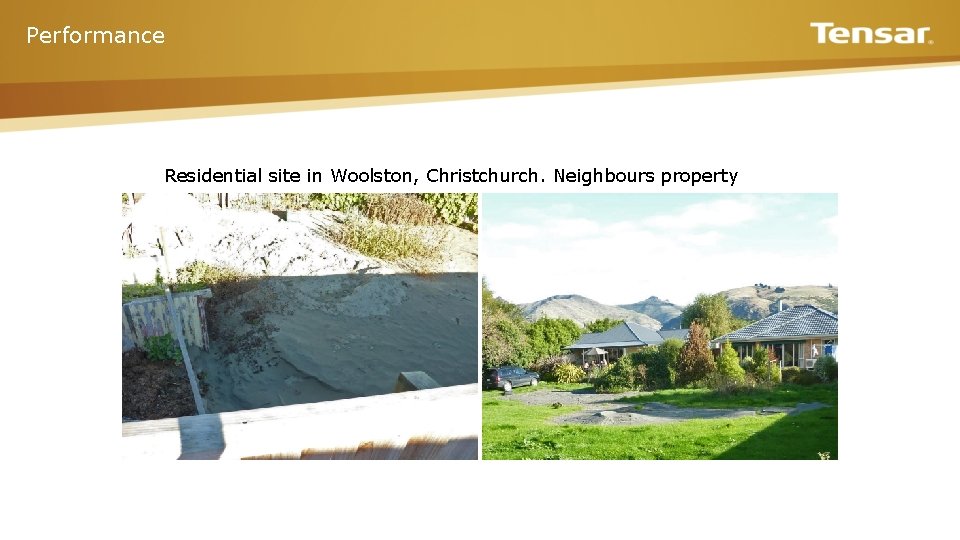
Performance Residential site in Woolston, Christchurch. Neighbours property
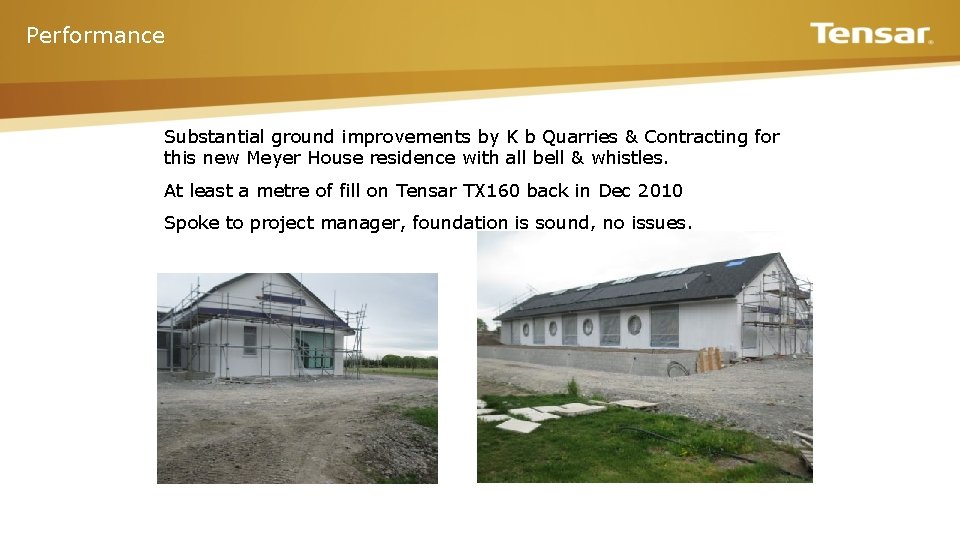
Performance Substantial ground improvements by K b Quarries & Contracting for this new Meyer House residence with all bell & whistles. At least a metre of fill on Tensar TX 160 back in Dec 2010 Spoke to project manager, foundation is sound, no issues.
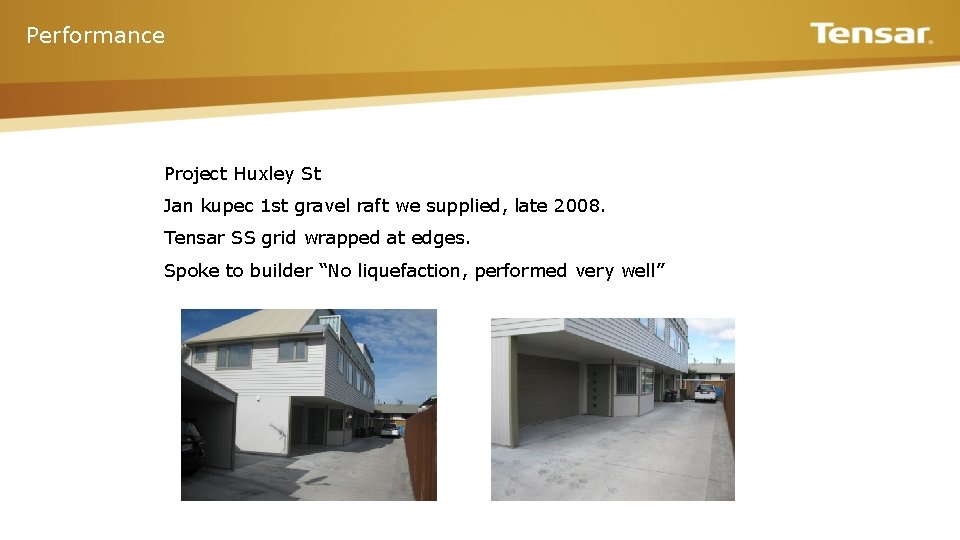
Performance Project Huxley St Jan kupec 1 st gravel raft we supplied, late 2008. Tensar SS grid wrapped at edges. Spoke to builder “No liquefaction, performed very well”
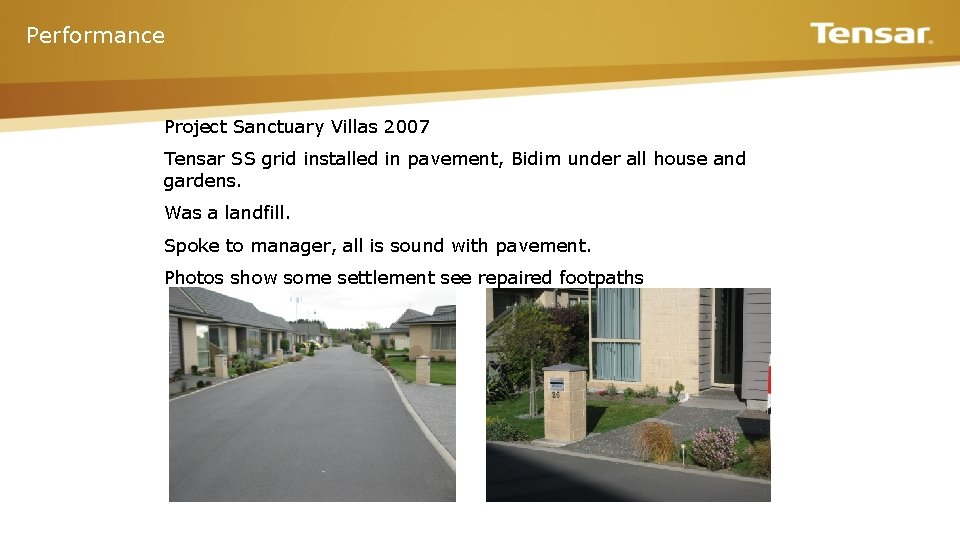
Performance Project Sanctuary Villas 2007 Tensar SS grid installed in pavement, Bidim under all house and gardens. Was a landfill. Spoke to manager, all is sound with pavement. Photos show some settlement see repaired footpaths
Performance in Recent New Zealand Earthquake § Several foundations which had been constructed on a Tensar MSL geogrid stabilised granular mattress following the 09/2010 event § These were investigated after the 2011 EQ and showed no sign of failure § Nearby buildings showed up to 700 mm settlement and up to 500 mm horizontal movement § The buildings resting on the Tensar MSL foundations however, showed § only 40 -50 mm of movement § no failures or cracks in the superstructure § only minor refurbishment was required for the buildings to be fully usable.
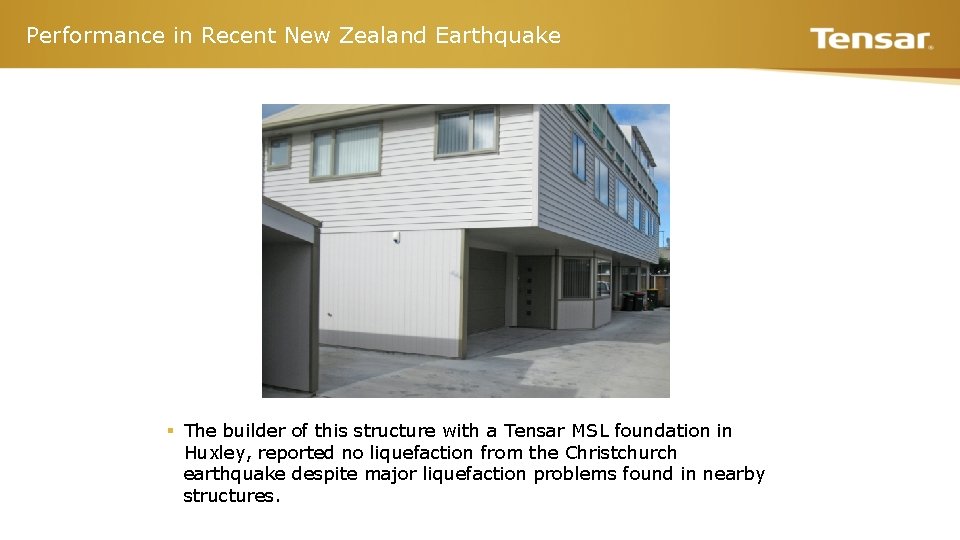
Performance in Recent New Zealand Earthquake § The builder of this structure with a Tensar MSL foundation in Huxley, reported no liquefaction from the Christchurch earthquake despite major liquefaction problems found in nearby structures.

Questions?
- Slides: 17