
TENORM in Municipal Solid Waste Landfills Assessing the

- Slides: 18
TENORM in Municipal Solid Waste Landfills: Assessing the Risk Jim Grice, Radioactive Materials Unit Leader James. Grice@state. co. us
TENORM Defined …naturally occurring radioactive material whose radionuclide concentrations are increased by or as a result of past or present human practices. TENORM does not include background radiation or the natural radioactivity of rocks or soils. TENORM does not include "source material" and "byproduct material" …
TENORM Defined Bottom Line Naturally Occurring Radioactive Material Concentrated Human Activity *Two Caveats* • Some would include materials not concentrated but rather relocated • Source Material, i. e. Uranium and Thorium are not included
TENORM Generation Water Treatment: v Drinking Water v IX Media v Green Sand v HMO v Soils from discharge area/impoundment v Wastewater (if there is a discharge to the system from another water treatment activity) v Biosolids v Drying beds v Industrial (any treatments that would likely concentrate metals) v Any Filter media v Soils from discharge area/impoundment
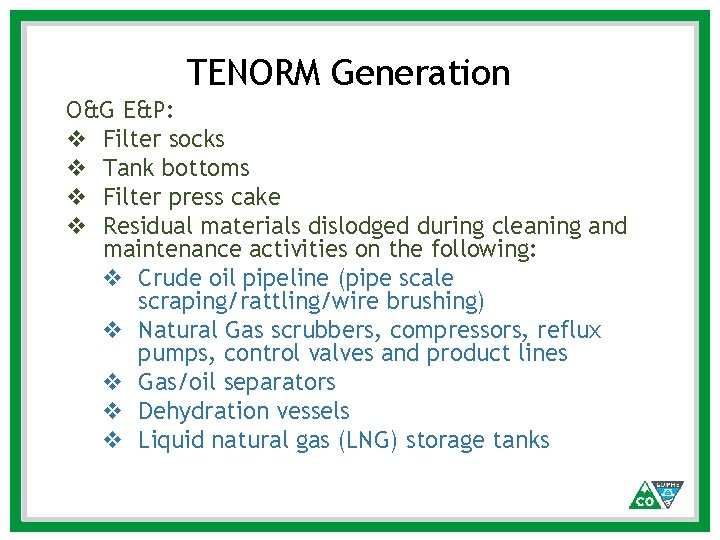
TENORM Generation O&G E&P: v Filter socks v Tank bottoms v Filter press cake v Residual materials dislodged during cleaning and maintenance activities on the following: v Crude oil pipeline (pipe scale scraping/rattling/wire brushing) v Natural Gas scrubbers, compressors, reflux pumps, control valves and product lines v Gas/oil separators v Dehydration vessels v Liquid natural gas (LNG) storage tanks
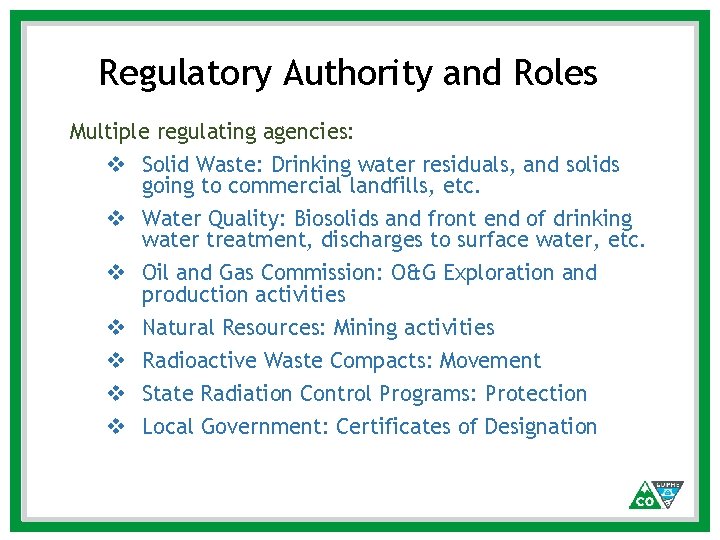
Regulatory Authority and Roles Multiple regulating agencies: v Solid Waste: Drinking water residuals, and solids going to commercial landfills, etc. v Water Quality: Biosolids and front end of drinking water treatment, discharges to surface water, etc. v Oil and Gas Commission: O&G Exploration and production activities v Natural Resources: Mining activities v Radioactive Waste Compacts: Movement v State Radiation Control Programs: Protection v Local Government: Certificates of Designation
TENORM Disposal Typical approaches: v Concentration/Focus on safe long term disposal v Treated as Solid Waste v Radiological Dose And Risk Assessments for Municipal Solid Waste Landfill Disposal
Risk Analysis / Radiological Dose Assessments Begins with identifying: v The design and operational attributes of a facility v The environmental conditions at the facility v The radiological characteristics of the TENORM that is desired to be received v The operational aspects of the facility: potential exposure routes
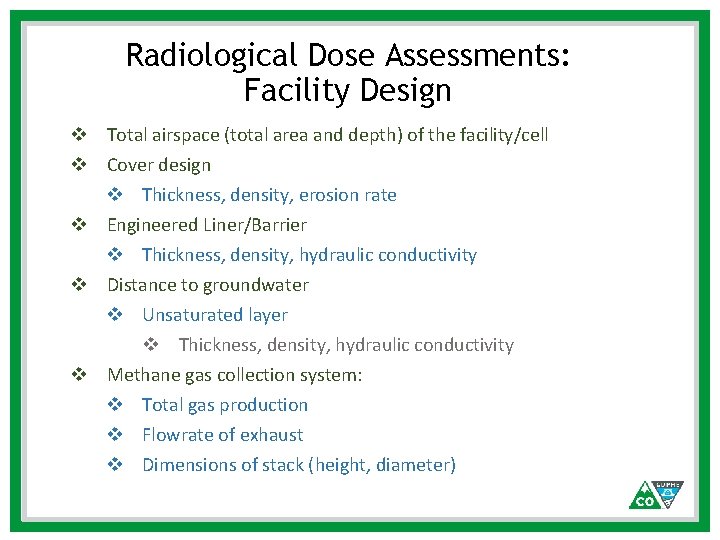
Radiological Dose Assessments: Facility Design v Total airspace (total area and depth) of the facility/cell v Cover design v Thickness, density, erosion rate v Engineered Liner/Barrier v Thickness, density, hydraulic conductivity v Distance to groundwater v Unsaturated layer v Thickness, density, hydraulic conductivity v Methane gas collection system: v Total gas production v Flowrate of exhaust v Dimensions of stack (height, diameter)
Radiological Dose Assessments: Facility Environment v Climate/Weather Data: v STAR data files v Wind and precipitation data
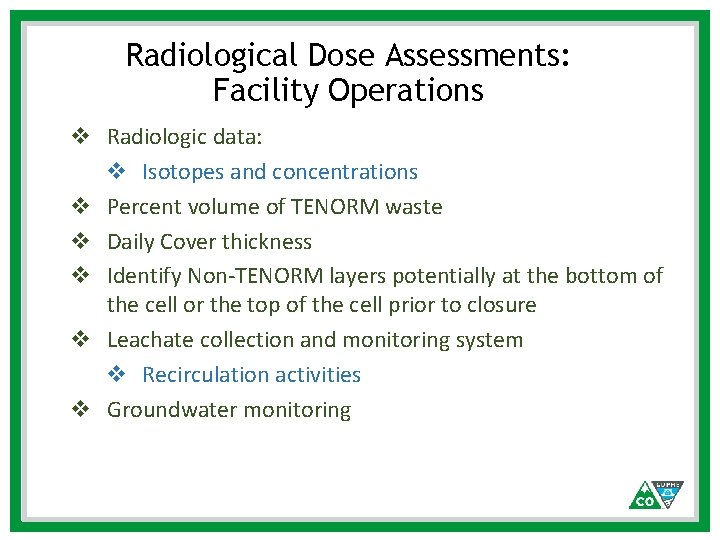
Radiological Dose Assessments: Facility Operations v Radiologic data: v Isotopes and concentrations v Percent volume of TENORM waste v Daily Cover thickness v Identify Non-TENORM layers potentially at the bottom of the cell or the top of the cell prior to closure v Leachate collection and monitoring system v Recirculation activities v Groundwater monitoring
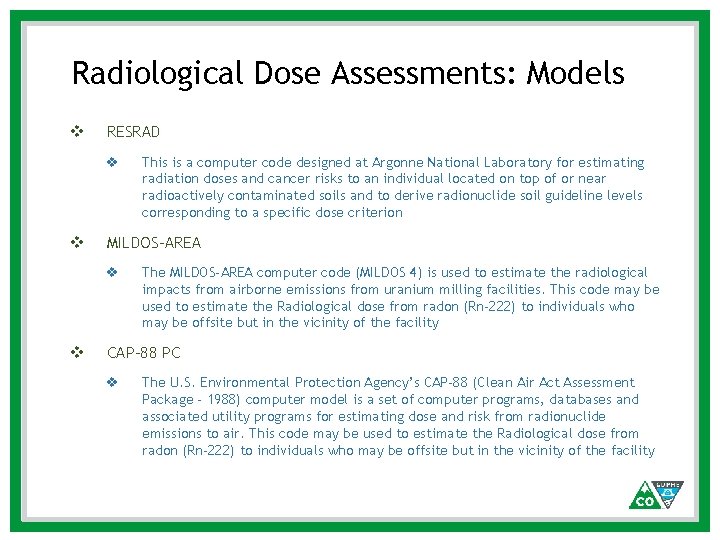
Radiological Dose Assessments: Models v RESRAD v v MILDOS-AREA v v This is a computer code designed at Argonne National Laboratory for estimating radiation doses and cancer risks to an individual located on top of or near radioactively contaminated soils and to derive radionuclide soil guideline levels corresponding to a specific dose criterion The MILDOS-AREA computer code (MILDOS 4) is used to estimate the radiological impacts from airborne emissions from uranium milling facilities. This code may be used to estimate the Radiological dose from radon (Rn-222) to individuals who may be offsite but in the vicinity of the facility CAP-88 PC v The U. S. Environmental Protection Agency’s CAP-88 (Clean Air Act Assessment Package - 1988) computer model is a set of computer programs, databases and associated utility programs for estimating dose and risk from radionuclide emissions to air. This code may be used to estimate the Radiological dose from radon (Rn-222) to individuals who may be offsite but in the vicinity of the facility
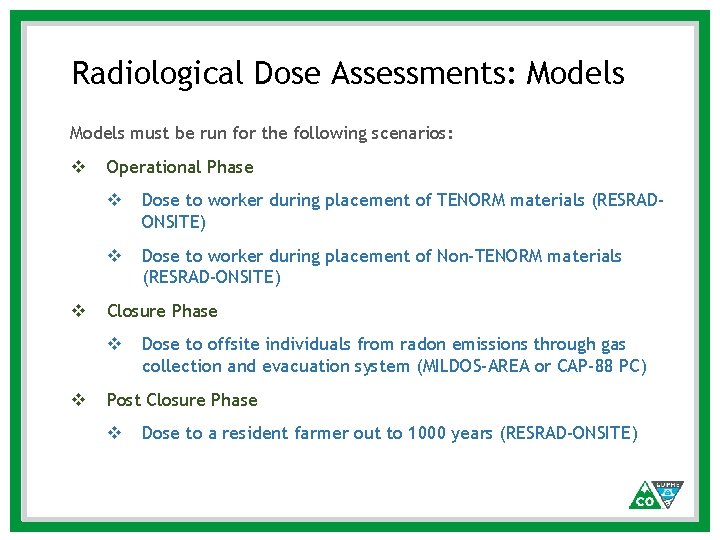
Radiological Dose Assessments: Models must be run for the following scenarios: v v Operational Phase v Dose to worker during placement of TENORM materials (RESRADONSITE) v Dose to worker during placement of Non-TENORM materials (RESRAD-ONSITE) Closure Phase v v Dose to offsite individuals from radon emissions through gas collection and evacuation system (MILDOS-AREA or CAP-88 PC) Post Closure Phase v Dose to a resident farmer out to 1000 years (RESRAD-ONSITE)
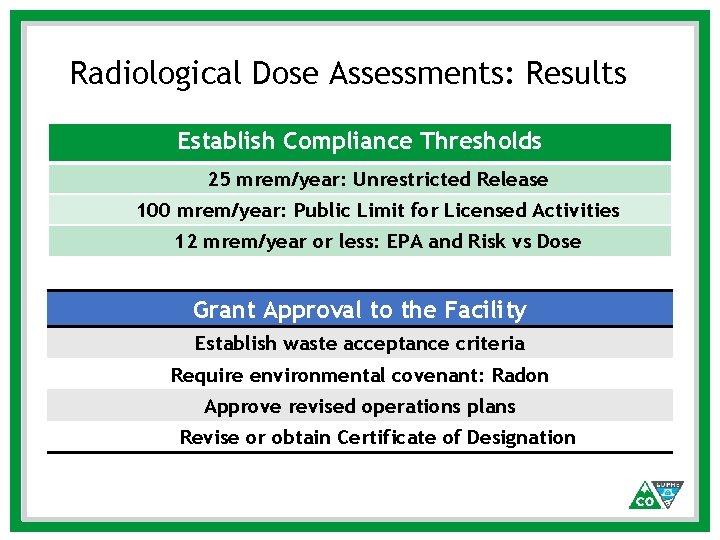
Radiological Dose Assessments: Results Establish Compliance Thresholds 25 mrem/year: Unrestricted Release 100 mrem/year: Public Limit for Licensed Activities 12 mrem/year or less: EPA and Risk vs Dose Grant Approval to the Facility Establish waste acceptance criteria Require environmental covenant: Radon Approve revised operations plans Revise or obtain Certificate of Designation
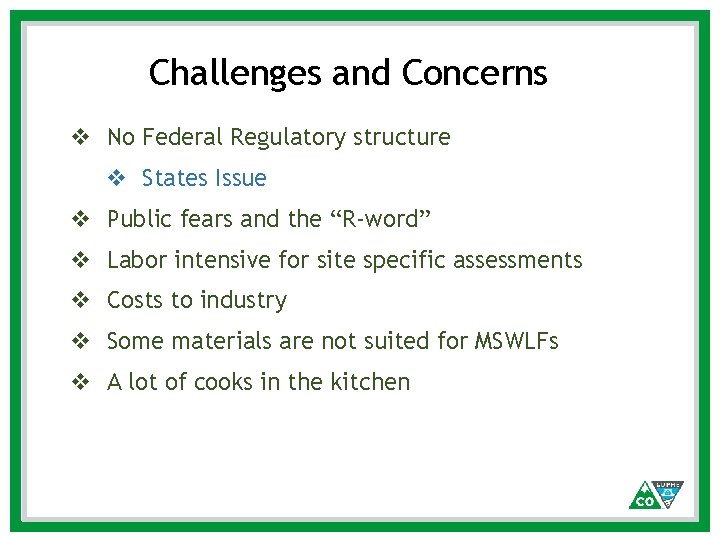
Challenges and Concerns v No Federal Regulatory structure v States Issue v Public fears and the “R-word” v Labor intensive for site specific assessments v Costs to industry v Some materials are not suited for MSWLFs v A lot of cooks in the kitchen
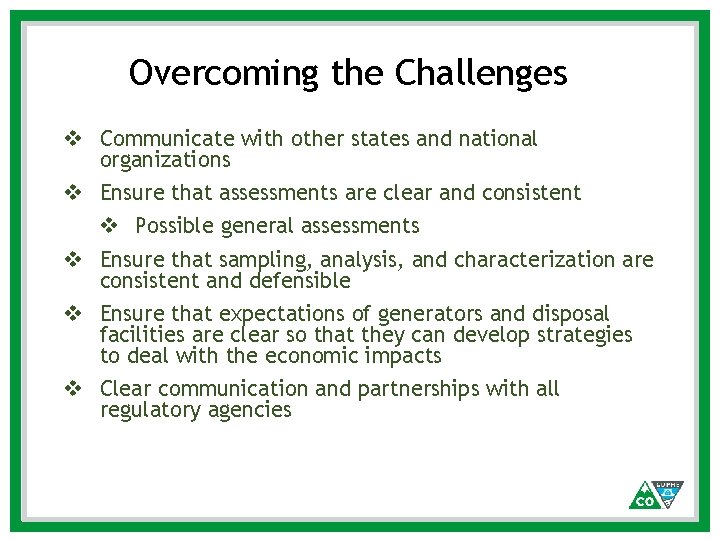
Overcoming the Challenges v Communicate with other states and national organizations v Ensure that assessments are clear and consistent v Possible general assessments v Ensure that sampling, analysis, and characterization are consistent and defensible v Ensure that expectations of generators and disposal facilities are clear so that they can develop strategies to deal with the economic impacts v Clear communication and partnerships with all regulatory agencies
Conclusions v TENORM is out there and it needs a home v Disposal options have to be established to avoid improper disposal v Well designed engineered Municipal Solid Waste Landfills can be a safe and protective disposal option
Thank You For Your Time and Attention Questions? http: //www. colorado. gov/cdphe/ Jim Grice at james. grice@state. co. us or (303) 692 -3371