
Ten Things You Need to Know About Selecting
Ten Things You Need to Know About Selecting a Voting System Columbia, South Carolina May 13, 2015
The Future of Voting Columbia, South Carolina Merle S. King Executive Director Center for Election Systems Kennesaw State University Kennesaw, Georgia
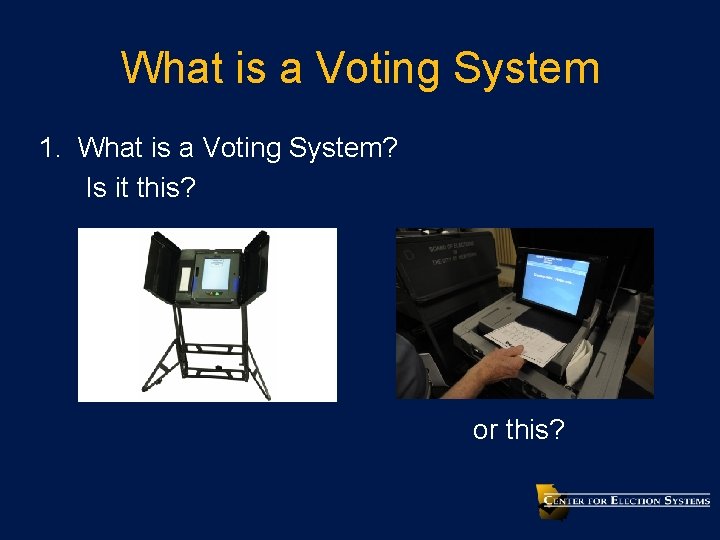
What is a Voting System 1. What is a Voting System? Is it this? or this?
What is a Voting System? Is it a vote capture/vote tabulation system as defined by HAVA (301)? • (1) the total combination of mechanical, electromechanical, or electronic equipment (including the software, firmware, and documentation required to program, control, and support the equipment) that is used— – (A) to define ballots; – (B) to cast and count votes; – (C) to report or display election results; and – (D) to maintain and produce any audit trail information
What is a Voting System? Or a system as defined in SC statute? SC Code § 7 -13 -1655 (2013) A voting system is…” the total combination of mechanical, electromechanical, or electronic equipment, including the software, firmware, and documentation required to program, control, and support the equipment that is used to: (a) define ballots; (b) cast and count votes; (c) report or display election results; and (d) maintain and produce audit trail information; ”
What is a Voting System? … or is it this?
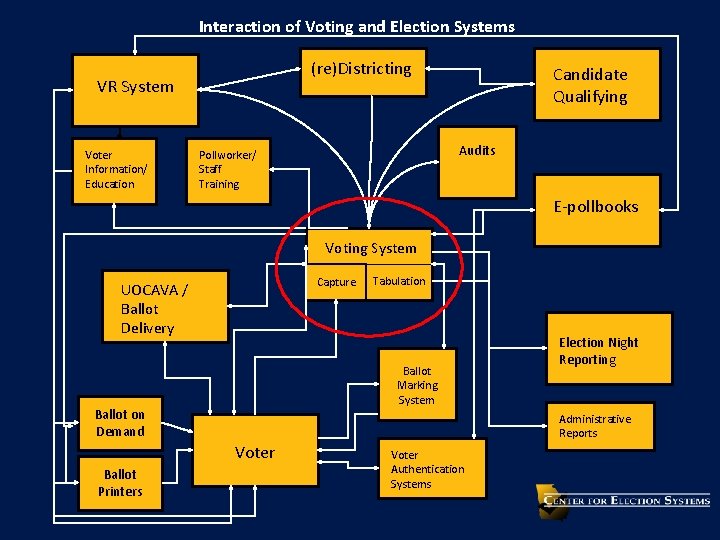
Interaction of Voting and Election Systems (re)Districting VR System Voter Information/ Education Candidate Qualifying Audits Pollworker/ Staff Training E-pollbooks Voting System Capture UOCAVA / Ballot Delivery Ballot Marking System Ballot on Demand Election Night Reporting Administrative Reports Voter Ballot Printers Tabulation Voter Authentication Systems
What is a Voting System? A voting system is the core technology that drives and integrates the election system. It is the most visible component of the election system – It’s the part the voter touches – It’s the part that produces results and determines outcomes of elections – It’s the part that gets tested and audited – It’s the least understood part of the system
What is a Voting System? Your voting system may be more, may become more, than a vote capture/vote tabulation system • Have a consensus understanding of what constitutes the system: scope and depth • Know the envelope of the system, its interfaces, and its dependencies on other systems • Your voting system will become the flagship of your election system
Roles and Responsibilities Evaluating, selecting, purchasing, deploying, maintaining, using, auditing, and retiring a voting system, requires scores of individuals and organizations working together. • State Election Commission • State elections office • State Procurement • State Attorney General • Legislature • County election officials • Muni election officials • Voter advocacy groups • Vendor(s) • Political parties • Academic researchers • Citizens • Testing Authority/Lab • Other stakeholders
Roles and Responsibilities Without clearly defined roles and responsibilities, problems will occur: – – – – Confusion Gaps in effort Duplication of effort Turf wars without methods of resolution Missed deadlines Ineffective systems Lost momentum and damaged credibility
Roles and Responsibilities Make sure all appropriate stakeholders are identified Map and validate the roles and responsibilities of each stakeholder group Identify how efforts will be coordinated and corrected (if need be) – Look for gaps – Look for unintended consequences
True Cost of Ownership Determining the cost of ownership of a voting system is not easy…the True Cost of Ownership is the cost to purchase, operate and maintain a voting system over its life span. • Probably more than you think • Pricing structure may shift costs around – Time (front-loaded, back-loaded, leases) – Organizationally • Know how the vendor intends to be profitable on this contract
True Cost of Ownership There are explicit and implicit costs associated with the voting system. • Explicit costs will have $ outlay • Implicit costs include – Social and political costs – Modification of existing systems to conform to the voting system • Evaluate the cost of the system over its life span – not by initial purchase – not by budget cycle or even election cycle
RFPs The Request for Proposal (and related RFIs) is your first and last, best chance to get the system requirements right Systems are rarely (never) better than the RFPs used to define the requirements for that system Put in the time – get it right Don’t be afraid to start over if you have to RFPs are widely available – ask other states
Transitioning Changing a voting system is like changing tires on the bus… without stopping South Carolina has an election every Tuesday A transition plan will may allow the seamless migration from the old system to the new system, with minimum disruption Vendor role may change once their system is no longer in use
Transitioning Planning for the transition: • Unfreeze – Freeze – Look for opportunities! • Evaluation of space, security requirement, operating requirements of new system • Delivery, acceptance testing • Disposal of equipment, media, consumables – Archived election data – Salvage value (if any) – Concurrent storage of the systems • Skill sets – especially PM
Training and Education Training and education - May cost more than the purchase price of the system when you factor in voter education, poll workers, election officials, etc. Consider requisite: • Attitude – mindset of each stakeholder • Knowledge – what they need to be aware of • Skill – demonstrated abilities
Training and Education Identify: • Needed learning outcomes and skills for all stakeholders • Strategy for attaining those outcomes • Budget • Plan • Evaluation process and feedback loop
Life Span of System The selection process should reveal how long the system is expected to last Is this reasonable? Desirable? Will the use of Common Off-The-Shelf (COTS) components extend the life? Identify circumstances that can shorten the life of the system • Changes in statute and rule • Supply chain issues • Under capitalized vendor; inexperienced vendor • Poorly structured contract • Rigid architecture
All Systems are Multi-Modal All modern voting system are multi modal - that is they will have to function as VBM, central count, precinct count, accessible-voting, and online ballot return, etc. , over their lifetime Require that flexibility in the architecture so you don't have to retro-fit Evaluate the candidate system against existing and potential applications
Vendor Management Have a Vendor Management Strategy - Either you manage them, or they manage you Vendors have a financial and ethical obligation to their stockholders/owners – they have a contractual obligation to the jurisdiction Evaluate the extent to which the architecture and related services make the jurisdiction captive to the vendor(s) What role should the vendor play in the context of the new system?
The Known Unknowns There is a body of knowledge regarding the uncertainty and risks associated with voting systems We don’t know the answers to all existing risks, and certainly don’t know the answers to emerging risks and threats In many cases the risks are identified without mention of corresponding methods of mitigation
The Known Unknowns Know the issues, know their relevance, set your priorities – – – – Security Accessibility Auditability Usability Voter convenience Transparency of process Testing and Certification
Summary “No sensible decision can be made any longer without taking into account not only the world as it is, but the world as it will be. ” ~ Isaac Asimov Decide if you are “replacing” a system or acquiring a “new” system.
Conclusion • • • Know your history Know your future Know your priorities Know your options Get help if you need it Merle S. King mking@kennesaw. edu
- Slides: 26