
Ten Techniques for Teaching Culture in the Classroom

















- Slides: 73
Ten Techniques for Teaching Culture in the Classroom Joe Mc. Veigh CATESOL 2012 Oakland, CA
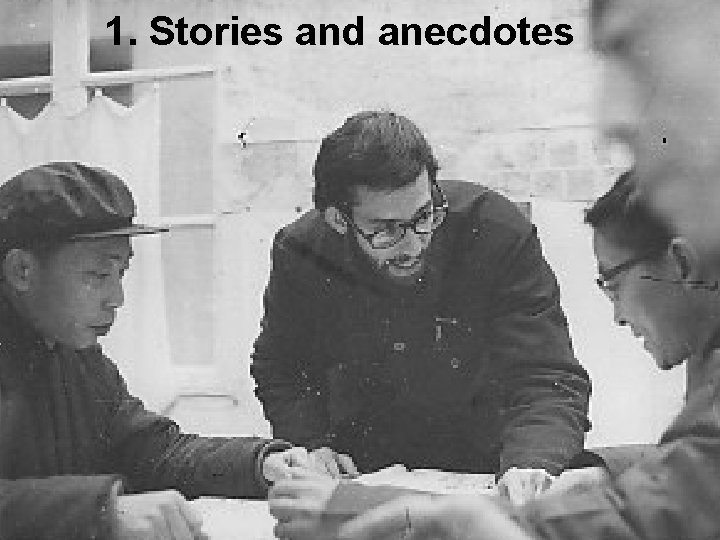
1. Stories and anecdotes
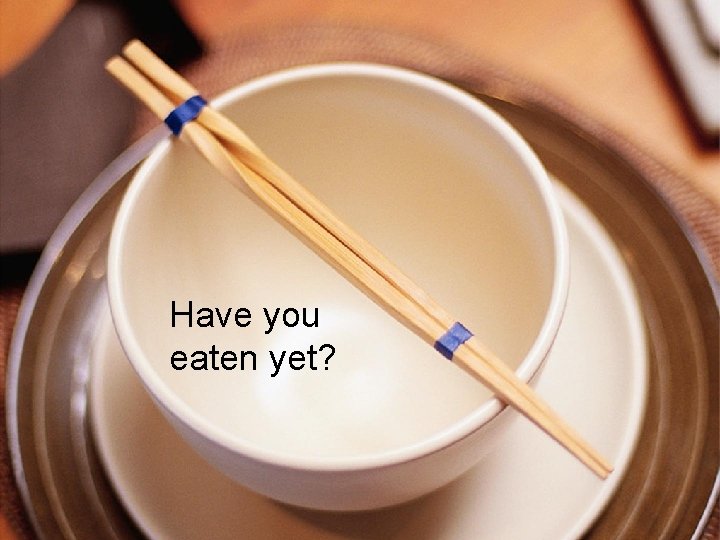
Have you eaten yet?
“Hazigone? ”
Hazigone? How’s it going?
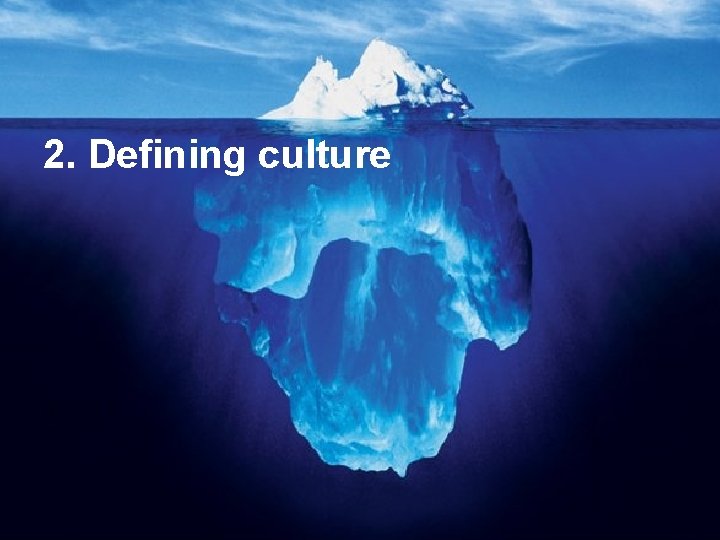
2. Defining culture
Culture is. . . Take a minute to write down your own definition of culture. Complete this sentence: Culture is ____________.
Culture is. . . Take two minutes to discuss your responses with the person next to you.
What is culture? Is culture a question of “content” such as holidays, films, literature, and food? Or is culture a set of values, attitudes, and behaviors?
What is culture? Culture = an integrated system of learned behavior patterns that are characteristic of the members of any given society. Culture refers to the total way of life of particular groups of people. It includes everything that a group of people thinks, says, does and makes— its systems of attitudes and feelings. Culture is learned and transmitted from generation to generation (Kohls 1996)
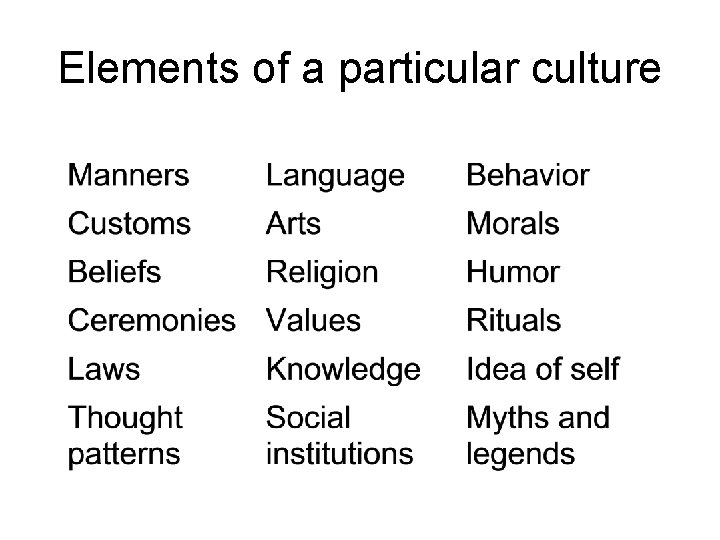
So, then, what does culture consist of? What might be some elements of a particular culture?
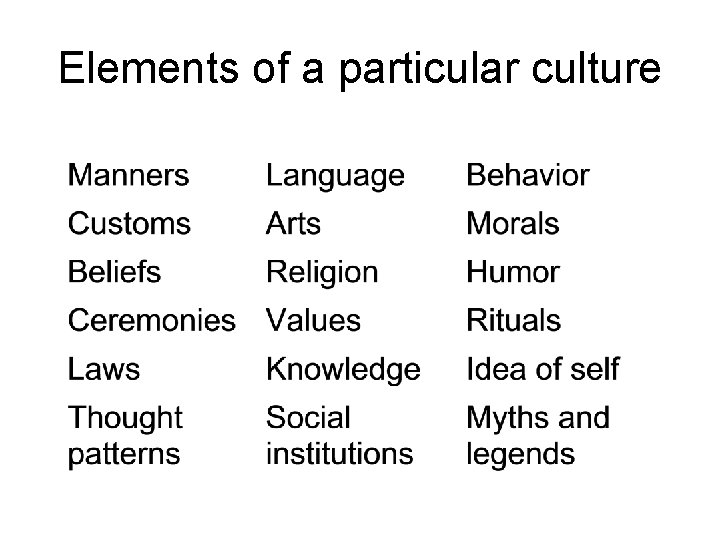
Elements of a particular culture
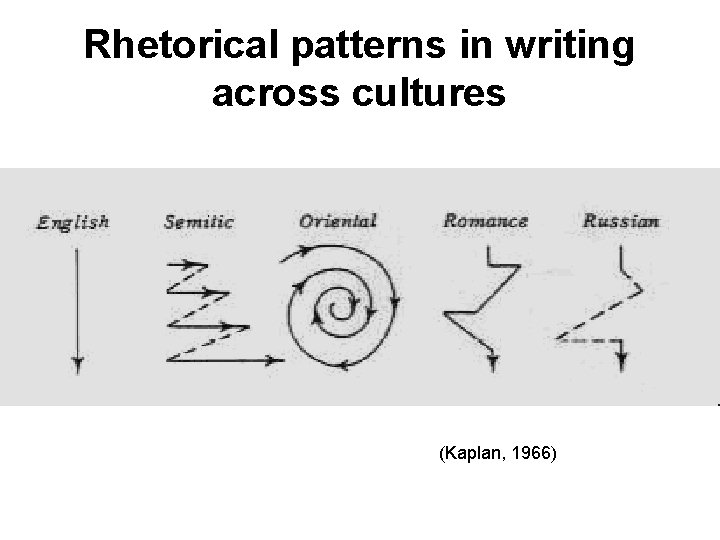
Rhetorical patterns in writing across cultures (Kaplan, 1966)
Elements of a particular culture
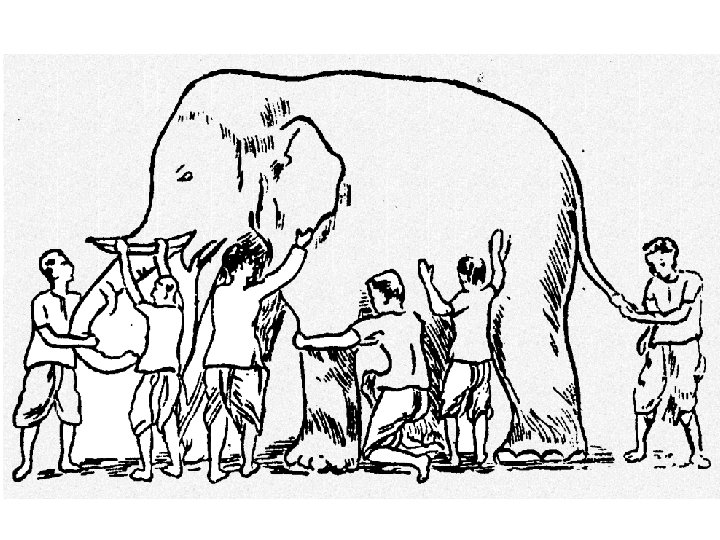
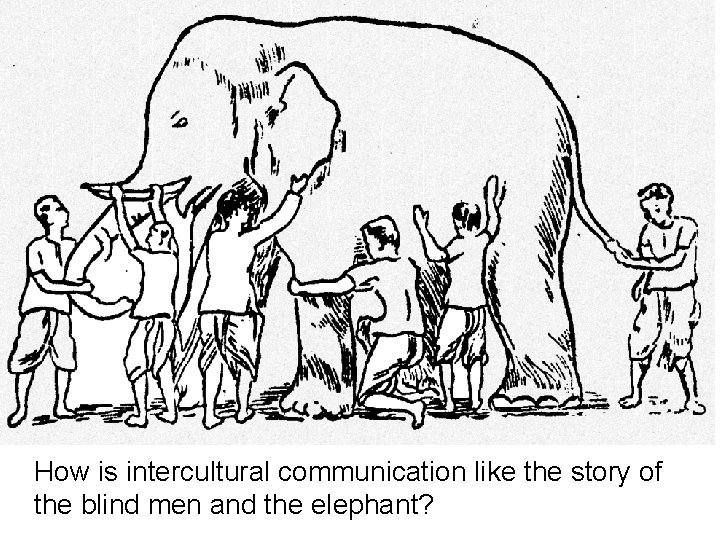
3. Literature & Story The Blind Men and the Elephant A Hindoo Fable by John Godfrey Saxe (1816 -1887)
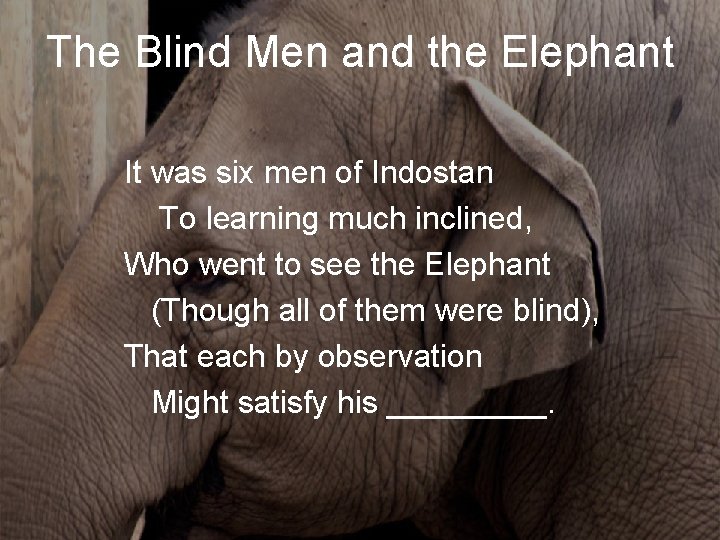
The Blind Men and the Elephant It was six men of Indostan To learning much inclined, Who went to see the Elephant (Though all of them were blind), That each by observation Might satisfy his _____.
The Blind Men and the Elephant The first approached the Elephant, And happening to fall Against his broad and sturdy side, At once began to bawl: “God bless me! But the Elephant Is very like a ______!”
The Blind Men and the Elephant The second feeling of the tusk, Cried, “Ho! What have we here So very round and smooth and sharp? To me ‘tis mighty clear The wonder of an Elephant Is very like a _______!”
The Blind Men and the Elephant The third approached the animal, And happening to take The squirming trunk within his hands, Thus boldly up and spake: “I see, ” quoth he, “the Elephant Is very like a ____”
The Blind Men and the Elephant The fourth reached out an eager hand, And felt about the knee, “What most this wondrous beast is like Is mighty plain, ” quoth he; “ ‘Tis clear enough the Elephant Is very like a _____”
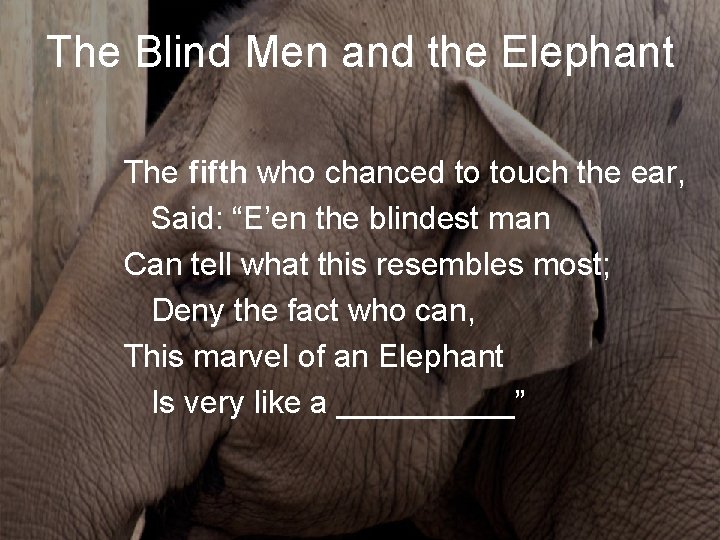
The Blind Men and the Elephant The fifth who chanced to touch the ear, Said: “E’en the blindest man Can tell what this resembles most; Deny the fact who can, This marvel of an Elephant Is very like a _____”
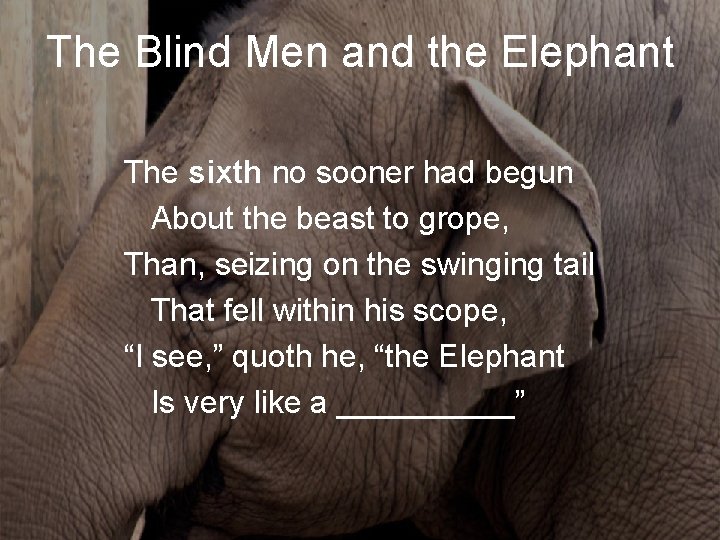
The Blind Men and the Elephant The sixth no sooner had begun About the beast to grope, Than, seizing on the swinging tail That fell within his scope, “I see, ” quoth he, “the Elephant Is very like a _____”
The Blind Men and the Elephant And so these men of Indostan Disputed loud and long, Each in his own opinion Exceeding stiff and strong, Though each was partly in the right, And all were in the _______ !
How is intercultural communication like the story of the blind men and the elephant?
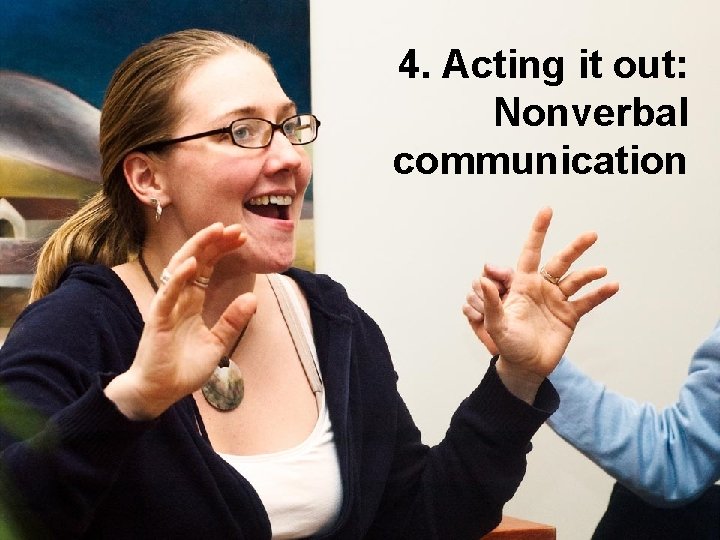
4. Acting it out: Nonverbal communication
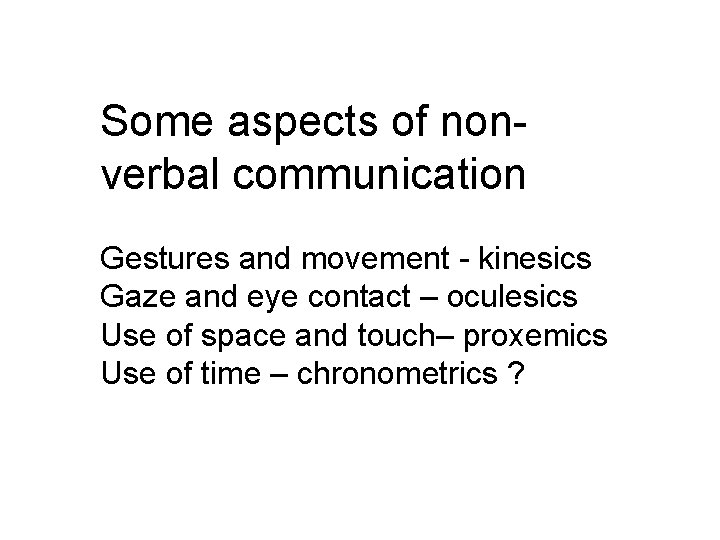
Some aspects of nonverbal communication Gestures and movement - kinesics Gaze and eye contact – oculesics Use of space and touch– proxemics Use of time – chronometrics ?
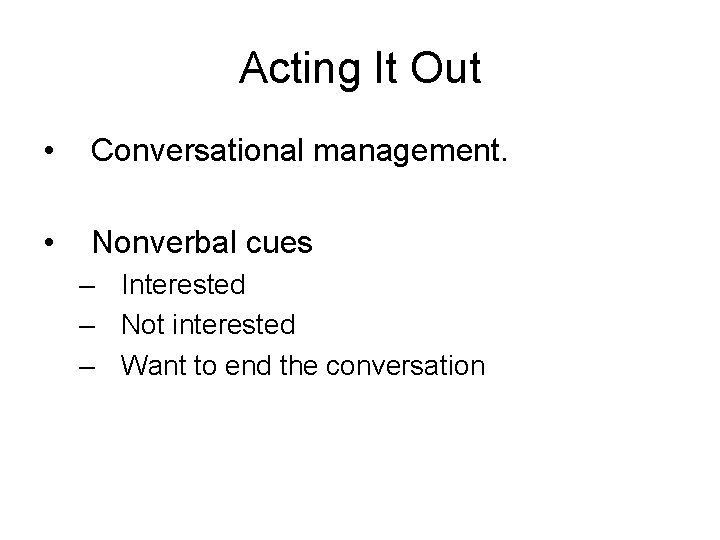
Acting It Out • Conversational management. • Nonverbal cues – Interested – Not interested – Want to end the conversation
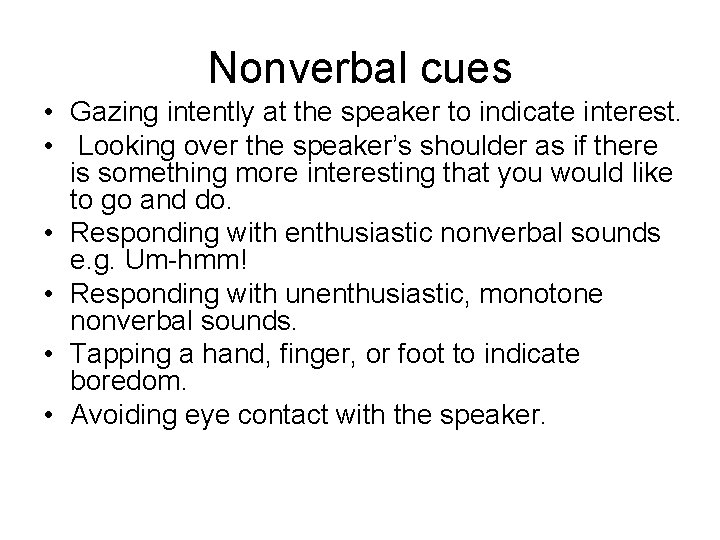
Nonverbal cues • Gazing intently at the speaker to indicate interest. • Looking over the speaker’s shoulder as if there is something more interesting that you would like to go and do. • Responding with enthusiastic nonverbal sounds e. g. Um-hmm! • Responding with unenthusiastic, monotone nonverbal sounds. • Tapping a hand, finger, or foot to indicate boredom. • Avoiding eye contact with the speaker.
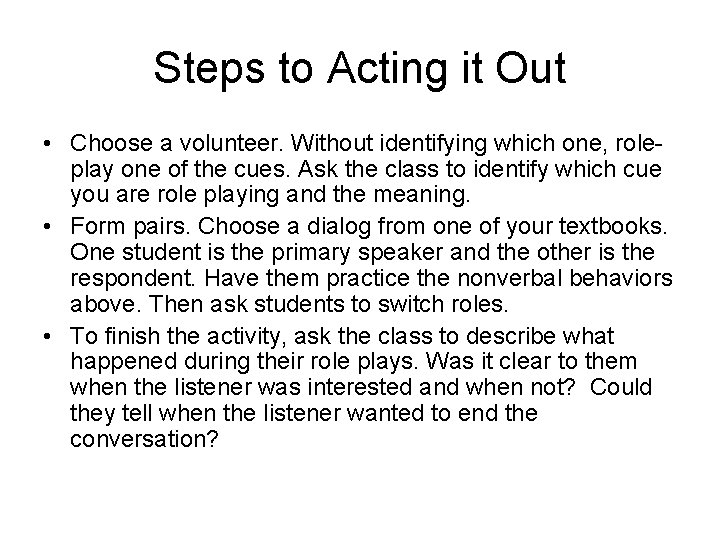
Steps to Acting it Out • Choose a volunteer. Without identifying which one, roleplay one of the cues. Ask the class to identify which cue you are role playing and the meaning. • Form pairs. Choose a dialog from one of your textbooks. One student is the primary speaker and the other is the respondent. Have them practice the nonverbal behaviors above. Then ask students to switch roles. • To finish the activity, ask the class to describe what happened during their role plays. Was it clear to them when the listener was interested and when not? Could they tell when the listener wanted to end the conversation?
5: Self Awareness & Feedback
Preparation • • Write on the board: feeling tired, eating more or less, tight muscles (especially in shoulders and jaw), difficulty concentrating, difficulty sleeping, irritability, headaches, worrying, and unhappiness. Introduce the topic of culture shock
Symptoms and strategies • Ask students to think about other causes and symptoms of stress. Write their ideas on the board. • Ask students about any ideas they have or strategies they use for dealing with stress. Write their ideas on the board.
Stress-busters • If students haven't mentioned the following, add them to the list on the board: – deep breathing – progressive muscle relaxation – meditation (mindfulness, guided imagery, repetitive prayer) – exercise (yoga, tai-chi, walking) – massage therapy (by others, by self)
Follow-up • Share information with your students about how to explore these and other techniques at your institution’s health center, by doing research online, or by checking their local library or community center. • Have students think about a personal plan that could help them reduce stress.
6. Agreement & completion: Gender and language
Gender and language • How men and women view interaction • For women, “communication is primarily a way to establish and maintain relationships with others” (Tannen 1990) • “The primary purpose of communication for men is to exert control, preserve independence, and enhance status” (Tannen 1990)
Gender and language • When talking with each other, women give and receive equal turns • They show support and sympathy for each other • They use questions to probe for greater understanding of feelings • They work hard to keep the conversation going • They are responsive to the comments of others • They speak in concrete and personal terms • They are sometimes tentative or apologetic • Men focus more on gathering data or solving problems. • They tend to express superiority and maintain control, dominating the conversation. • They are not very responsive, may assert themselves, and may speak in abstract terms removed from personal experience. (Wood 1994)
Agreement / Completion Ask students to what extent they agree with the four statements below: Women talk more than men. Women talk more for the purpose of maintaining relationships. Men talk more to get things done. I feel comfortable talking to members of the opposite sex. Then ask them to complete the following sentences: I think that in communication, women are too. . . I think that in communication, men are too. . .
7. Culture Assimilator
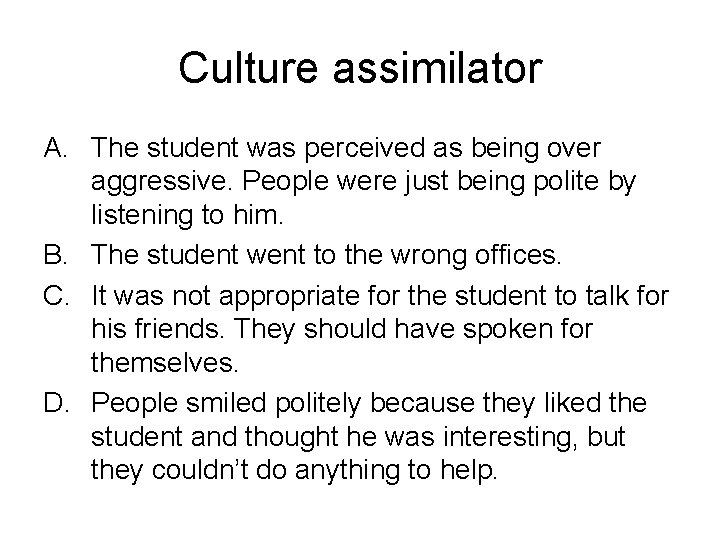
Culture assimilators • Describe an incident in which an international visitor is faced with a dilemma, problem, or situation that has a cultural basis. • Suggest four multiple choice explanations for why things happened the way they did. • Prepare answers to explain.
Culture assimilator A student from the Middle East is attending a university in the mid-western part of the United States. He has many friends that he hopes to have admitted to the university, so he often visits the offices of different departments to talk to the secretaries, talking about his friends and what good students they would be.
He makes many visits, and each time he is received with smiles and polite listening. However, no action is ever taken to admit his friends. Later he discovers that his actions were perceived as annoying by the secretaries. What went wrong?
Culture assimilator A. The student was perceived as being over aggressive. People were just being polite by listening to him. B. The student went to the wrong offices. C. It was not appropriate for the student to talk for his friends. They should have spoken for themselves. D. People smiled politely because they liked the student and thought he was interesting, but they couldn’t do anything to help.
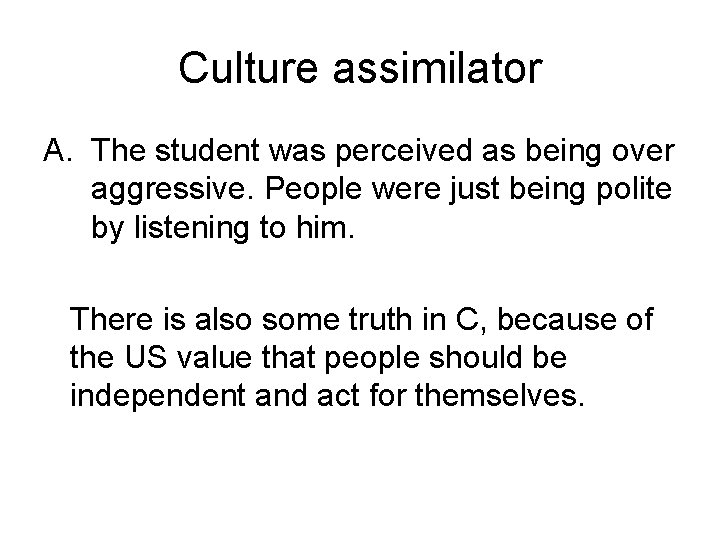
Culture assimilator A. The student was perceived as being over aggressive. People were just being polite by listening to him. There is also some truth in C, because of the US value that people should be independent and act for themselves.
8. True/false activities: Testing across cultures
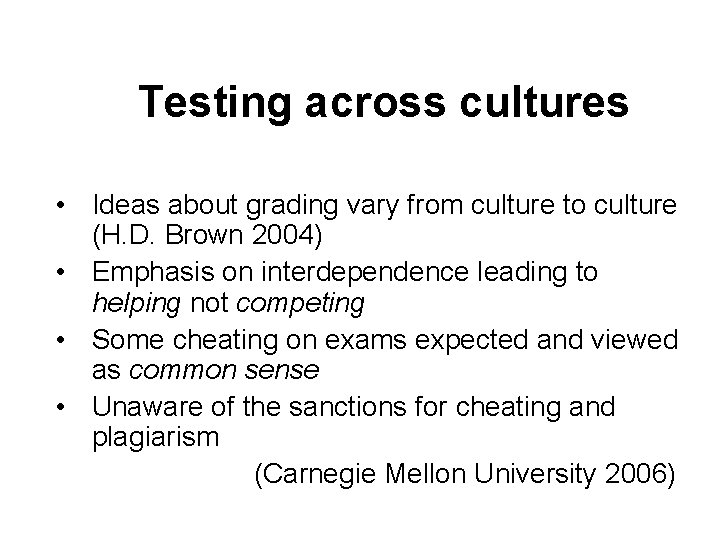
Testing across cultures • Ideas about grading vary from culture to culture (H. D. Brown 2004) • Emphasis on interdependence leading to helping not competing • Some cheating on exams expected and viewed as common sense • Unaware of the sanctions for cheating and plagiarism (Carnegie Mellon University 2006)
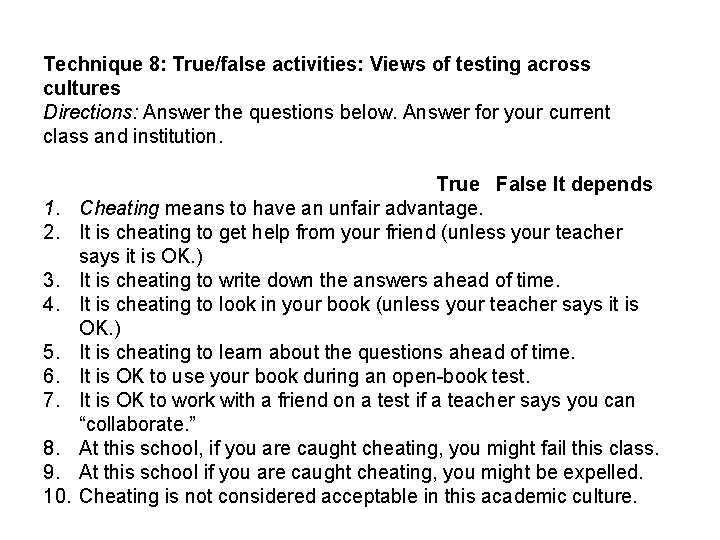
Technique 8: True/false activities: Views of testing across cultures Directions: Answer the questions below. Answer for your current class and institution. True False It depends 1. Cheating means to have an unfair advantage. 2. It is cheating to get help from your friend (unless your teacher says it is OK. ) 3. It is cheating to write down the answers ahead of time. 4. It is cheating to look in your book (unless your teacher says it is OK. ) 5. It is cheating to learn about the questions ahead of time. 6. It is OK to use your book during an open-book test. 7. It is OK to work with a friend on a test if a teacher says you can “collaborate. ” 8. At this school, if you are caught cheating, you might fail this class. 9. At this school if you are caught cheating, you might be expelled. 10. Cheating is not considered acceptable in this academic culture.
True / false activities Students need to commit to an answer before it gets discussed.
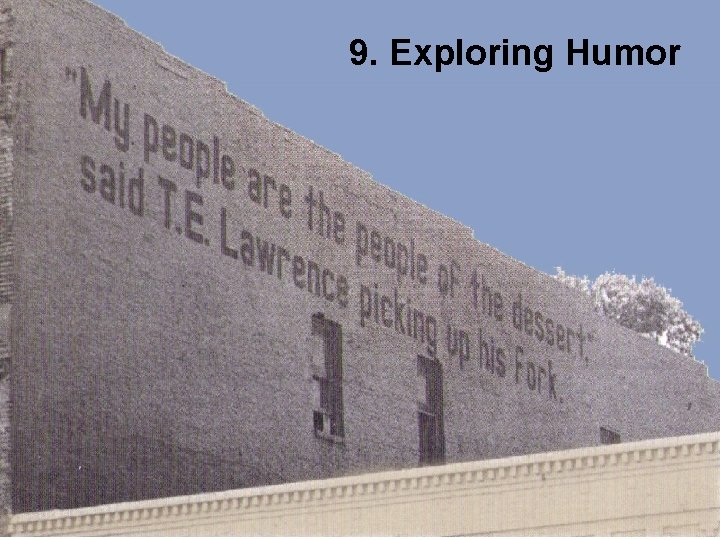
9. Exploring Humor
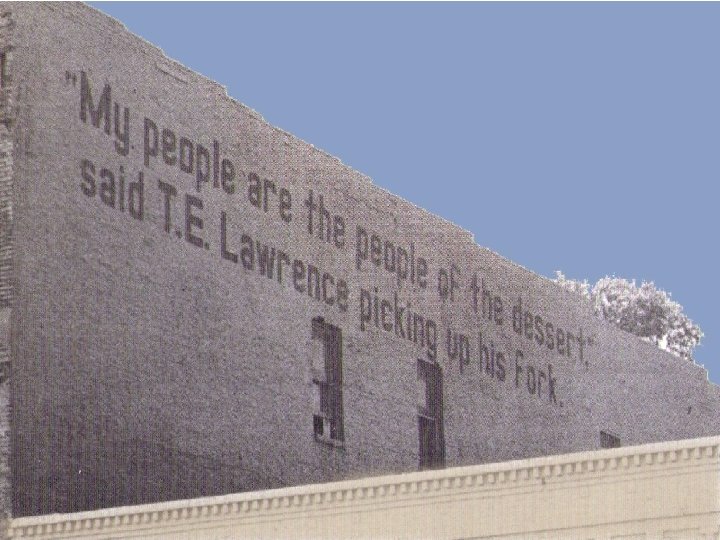
“My people are the people of the dessert, ” said T. E. Lawrence picking up his fork.
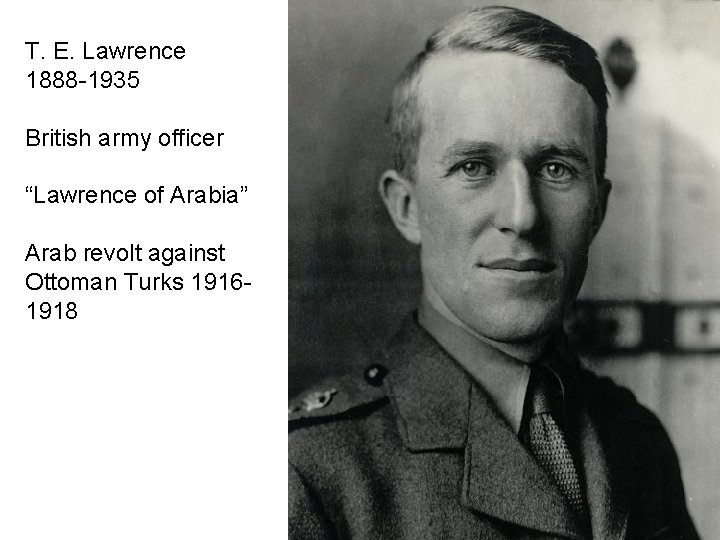
T. E. Lawrence 1888 -1935 British army officer “Lawrence of Arabia” Arab revolt against Ottoman Turks 19161918
“My people are the people of the desert. ” “My people are the people of the dessert, ” said T. E. Lawrence, picking up his fork.
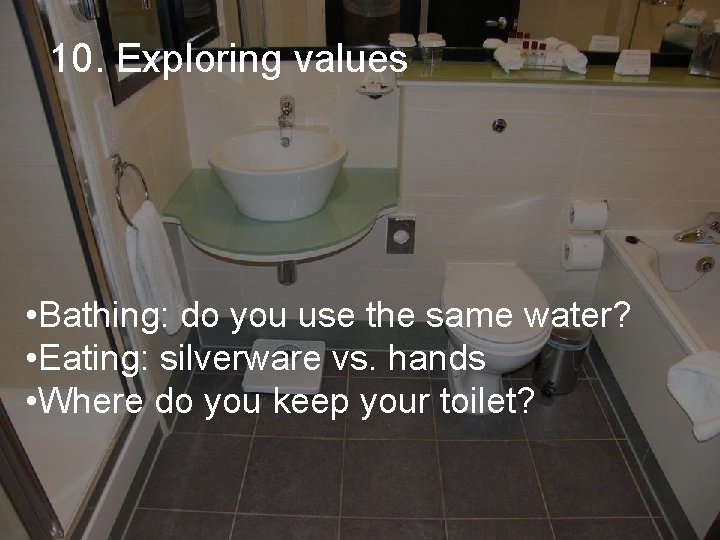
10. Exploring values • Bathing: do you use the same water? • Eating: silverware vs. hands • Where do you keep your toilet?
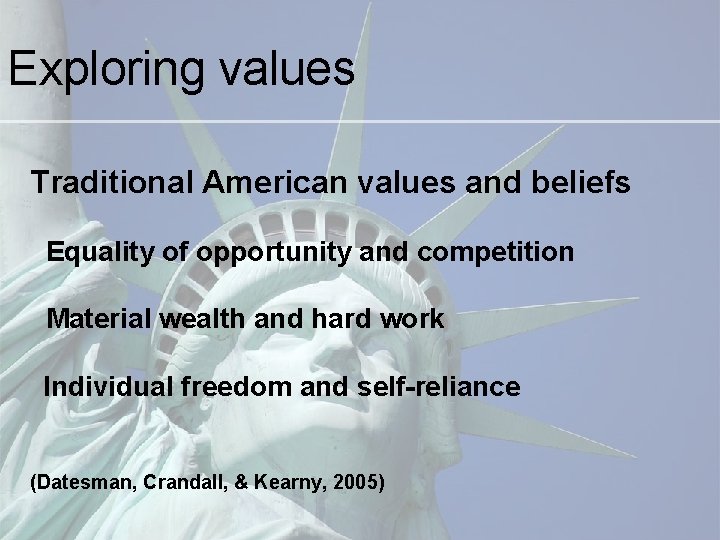
Exploring values Traditional American values and beliefs Equality of opportunity and competition Material wealth and hard work Individual freedom and self-reliance (Datesman, Crandall, & Kearny, 2005)
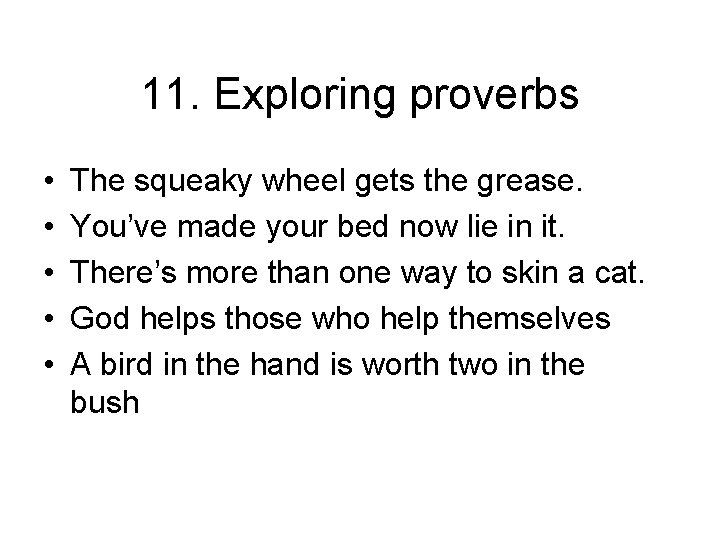
11. Exploring proverbs • • • The squeaky wheel gets the grease. You’ve made your bed now lie in it. There’s more than one way to skin a cat. God helps those who help themselves A bird in the hand is worth two in the bush
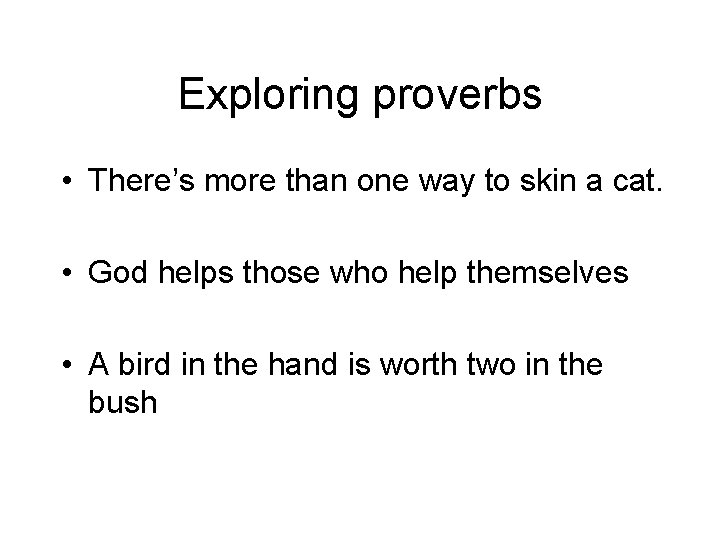
Exploring proverbs • There’s more than one way to skin a cat. • God helps those who help themselves • A bird in the hand is worth two in the bush
12. Explore idioms and expressions
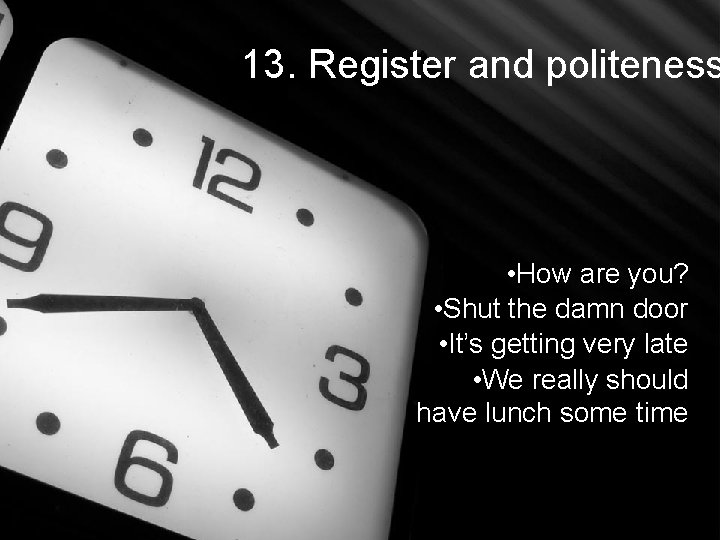
13. Register and politeness • How are you? • Shut the damn door • It’s getting very late • We really should have lunch some time
14. Culture a question of perspective
Questions & Discussion
Many of the activities in this presentation are taken from Tips for Teaching Culture: Practical Approaches to Intercultural Communication by Ann C. Wintergerst & Joe Mc. Veigh © 2010 Pearson Longman. Permission granted to copy for classroom use.
Photo Credits The following photos used under a Creative Commons Attribution license and found on flickr Tibetan mandala Blueprints Taking the plunge Woman gesturing Test Culture shock Woman and man People at a party Time Women talking Question mark Thank you flower “Wonderlane” Todd Ehlers Mark Donoher David Goehring “hyperscholar” “jovike” Michele Sandberg See-ming Lee David Goehring ryanne “laihui” Ethan Lofton Joanne Q. Escober
I do not want my house to be walled in on all sides and my windows to be stuffed. I want the cultures of all lands to be blown about my house as freely as possible. But I refuse to be blown off my feet by any. —— Mahatma Gandhi
Thank you ! www. joemcveigh. org