
Temporary Storage of Poultry Broiler Litter C C
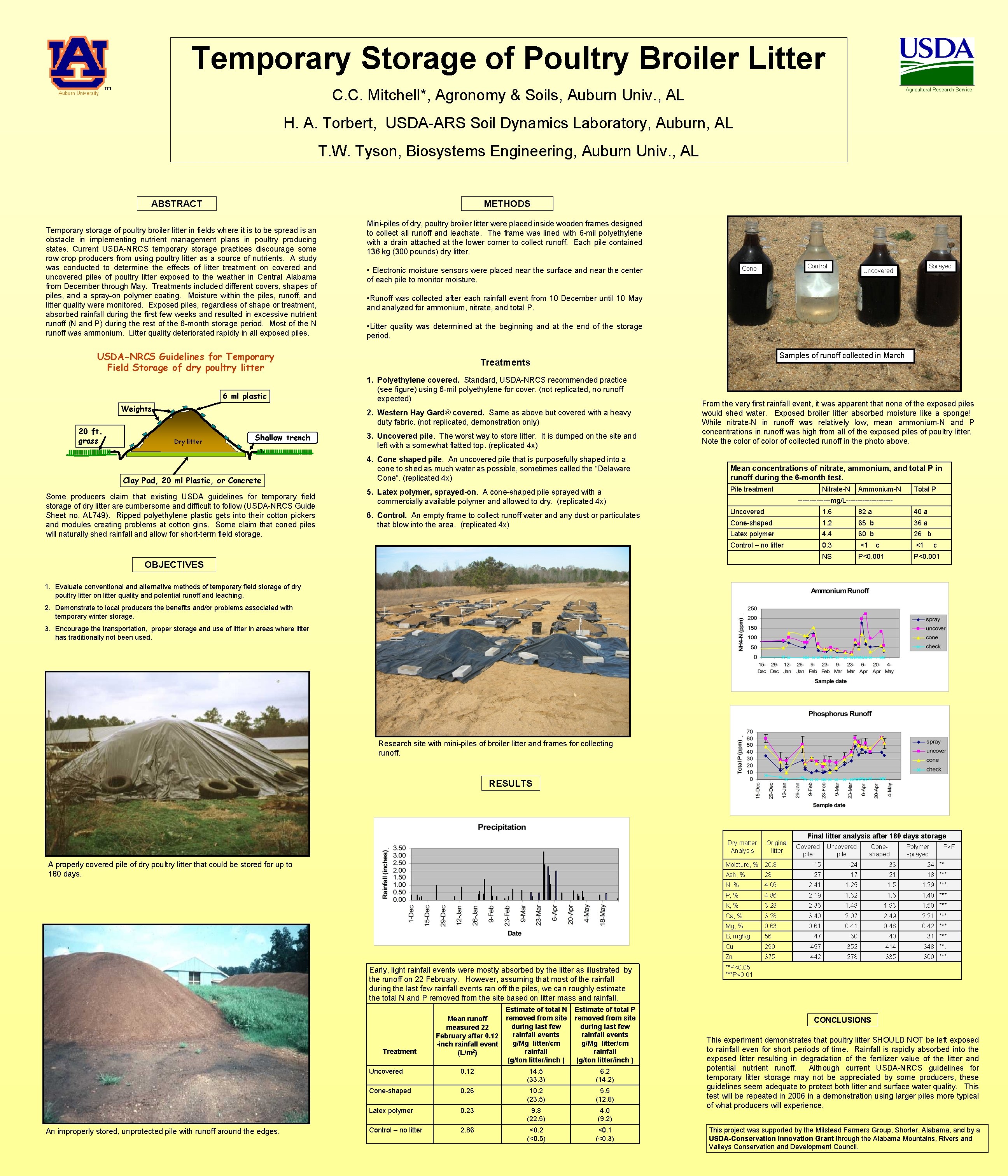
Temporary Storage of Poultry Broiler Litter C. C. Mitchell*, Agronomy & Soils, Auburn Univ. , AL Auburn University Agricultural Research Service H. A. Torbert, USDA-ARS Soil Dynamics Laboratory, Auburn, AL T. W. Tyson, Biosystems Engineering, Auburn Univ. , AL ABSTRACT METHODS Temporary storage of poultry broiler litter in fields where it is to be spread is an obstacle in implementing nutrient management plans in poultry producing states. Current USDA-NRCS temporary storage practices discourage some row crop producers from using poultry litter as a source of nutrients. A study was conducted to determine the effects of litter treatment on covered and uncovered piles of poultry litter exposed to the weather in Central Alabama from December through May. Treatments included different covers, shapes of piles, and a spray-on polymer coating. Moisture within the piles, runoff, and litter quality were monitored. Exposed piles, regardless of shape or treatment, absorbed rainfall during the first few weeks and resulted in excessive nutrient runoff (N and P) during the rest of the 6 -month storage period. Most of the N runoff was ammonium. Litter quality deteriorated rapidly in all exposed piles. Mini-piles of dry, poultry broiler litter were placed inside wooden frames designed to collect all runoff and leachate. The frame was lined with 6 -mil polyethylene with a drain attached at the lower corner to collect runoff. Each pile contained 136 kg (300 pounds) dry litter. Weights 20 ft. grass • Litter quality was determined at the beginning and at the end of the storage period. Samples of runoff collected in March Treatments 1. Polyethylene covered. Standard, USDA-NRCS recommended practice (see figure) using 6 -mil polyethylene for cover. (not replicated, no runoff expected) 2. Western Hay Gard® covered. Same as above but covered with a heavy duty fabric. (not replicated, demonstration only) Dry litter Shallow trench Clay Pad, 20 ml Plastic, or Concrete Some producers claim that existing USDA guidelines for temporary field storage of dry litter are cumbersome and difficult to follow (USDA-NRCS Guide Sheet no. AL 749). Ripped polyethylene plastic gets into their cotton pickers and modules creating problems at cotton gins. Some claim that coned piles will naturally shed rainfall and allow for short-term field storage. Sprayed Uncovered • Runoff was collected after each rainfall event from 10 December until 10 May and analyzed for ammonium, nitrate, and total P. USDA-NRCS Guidelines for Temporary Field Storage of dry poultry litter 6 ml plastic Control Cone • Electronic moisture sensors were placed near the surface and near the center of each pile to monitor moisture. 3. Uncovered pile. The worst way to store litter. It is dumped on the site and left with a somewhat flatted top. (replicated 4 x) 4. Cone shaped pile. An uncovered pile that is purposefully shaped into a cone to shed as much water as possible, sometimes called the “Delaware Cone”. (replicated 4 x) From the very first rainfall event, it was apparent that none of the exposed piles would shed water. Exposed broiler litter absorbed moisture like a sponge! While nitrate-N in runoff was relatively low, mean ammonium-N and P concentrations in runoff was high from all of the exposed piles of poultry litter. Note the color of collected runoff in the photo above. Mean concentrations of nitrate, ammonium, and total P in runoff during the 6 -month test. 5. Latex polymer, sprayed-on. A cone-shaped pile sprayed with a commercially available polymer and allowed to dry. (replicated 4 x) Pile treatment Nitrate-N Ammonium-N Total P 6. Control. An empty frame to collect runoff water and any dust or particulates that blow into the area. (replicated 4 x) Uncovered 1. 6 82 a 40 a Cone-shaped 1. 2 65 b 36 a Latex polymer 4. 4 60 b 26 b Control – no litter 0. 3 <1 NS P<0. 001 -------mg/L---------- OBJECTIVES c <1 c P<0. 001 1. Evaluate conventional and alternative methods of temporary field storage of dry poultry litter on litter quality and potential runoff and leaching. 2. Demonstrate to local producers the benefits and/or problems associated with temporary winter storage. 3. Encourage the transportation, proper storage and use of litter in areas where litter has traditionally not been used. Research site with mini-piles of broiler litter and frames for collecting runoff. RESULTS Dry matter Analysis A properly covered pile of dry poultry litter that could be stored for up to 180 days. Early, light rainfall events were mostly absorbed by the litter as illustrated by the runoff on 22 February. However, assuming that most of the rainfall during the last few rainfall events ran off the piles, we can roughly estimate the total N and P removed from the site based on litter mass and rainfall. Treatment An improperly stored, unprotected pile with runoff around the edges. Estimate of total N removed from site Mean runoff during last few measured 22 rainfall events February after 0. 12 g/Mg litter/cm -inch rainfall event rainfall (L/m 2) (g/ton litter/inch ) Estimate of total P removed from site during last few rainfall events g/Mg litter/cm rainfall (g/ton litter/inch ) Uncovered 0. 12 14. 5 (33. 3) 6. 2 (14. 2) Cone-shaped 0. 26 10. 2 (23. 5) 5. 5 (12. 8) Latex polymer 0. 23 9. 8 (22. 5) 4. 0 (9. 2) Control – no litter 2. 86 <0. 2 (<0. 5) <0. 1 (<0. 3) Original litter Final litter analysis after 180 days storage Covered pile Uncovered pile Coneshaped Polymer sprayed P>F Moisture, % 20. 8 15 24 33 24 ** Ash, % 28 27 17 21 18 *** N, % 4. 06 2. 41 1. 25 1. 29 *** P, % 4. 86 2. 19 1. 32 1. 6 1. 40 *** K, % 3. 28 2. 36 1. 48 1. 93 1. 50 *** Ca, % 3. 28 3. 40 2. 07 2. 49 2. 21 *** Mg, % 0. 63 0. 61 0. 48 0. 42 *** B, mg/kg 56 47 30 40 31 *** Cu 290 457 352 414 348 **. Zn 375 442 278 335 300 *** **P<0. 05 ***P<0. 01 CONCLUSIONS This experiment demonstrates that poultry litter SHOULD NOT be left exposed to rainfall even for short periods of time. Rainfall is rapidly absorbed into the exposed litter resulting in degradation of the fertilizer value of the litter and potential nutrient runoff. Although current USDA-NRCS guidelines for temporary litter storage may not be appreciated by some producers, these guidelines seem adequate to protect both litter and surface water quality. This test will be repeated in 2006 in a demonstration using larger piles more typical of what producers will experience. This project was supported by the Milstead Farmers Group, Shorter, Alabama, and by a USDA-Conservation Innovation Grant through the Alabama Mountains, Rivers and Valleys Conservation and Development Council.
- Slides: 1