
Temporal separation of turbulent time series Measurements and
Temporal separation of turbulent time series: Measurements and simulations Nils P. Basse 1, 2, S. Zoletnik, M. Saffman, G. Antar, P. K. Michelsen and the W 7 -AS Team 1 Association EURATOM – Risø National Laboratory, Denmark 2Ørsted Laboratory, Niels Bohr Institute for Astronomy, Physics and Geophysics, Denmark 1. 2. 3. W 7 -AS and the density fluctuation diagnostic Phase separation Discharge analysis 9 th European Fusion Theory Conference, 17 -19 October 2001, Helsingør, Denmark
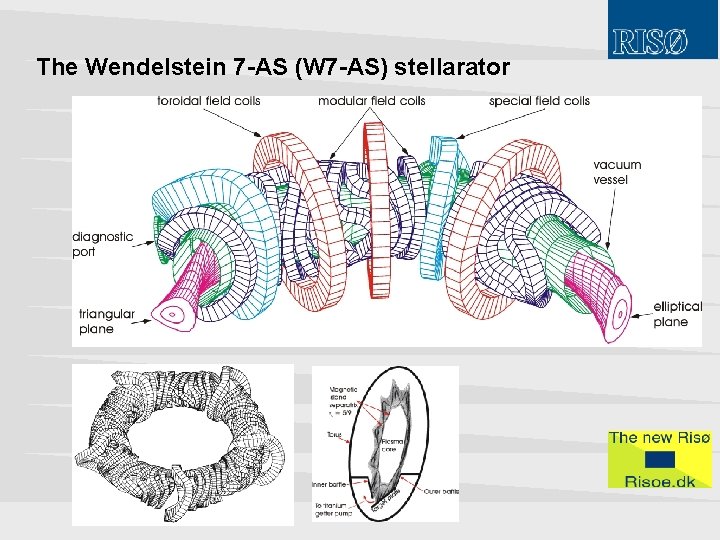
The Wendelstein 7 -AS (W 7 -AS) stellarator
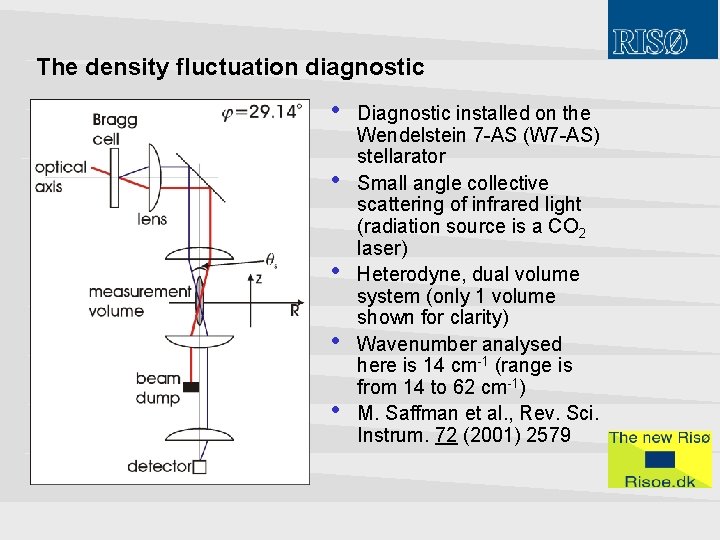
The density fluctuation diagnostic • • • Diagnostic installed on the Wendelstein 7 -AS (W 7 -AS) stellarator Small angle collective scattering of infrared light (radiation source is a CO 2 laser) Heterodyne, dual volume system (only 1 volume shown for clarity) Wavenumber analysed here is 14 cm-1 (range is from 14 to 62 cm-1) M. Saffman et al. , Rev. Sci. Instrum. 72 (2001) 2579

The density fluctuation diagnostic • • • Diagnostic installed on the Wendelstein 7 -AS (W 7 -AS) stellarator Small angle collective scattering of infrared light (radiation source is a CO 2 laser) Heterodyne, dual volume system (only 1 volume shown for clarity) Wavenumber analysed here is 14 cm-1 (range is from 14 to 62 cm-1) M. Saffman et al. , Rev. Sci. Instrum. 72 (2001) 2579
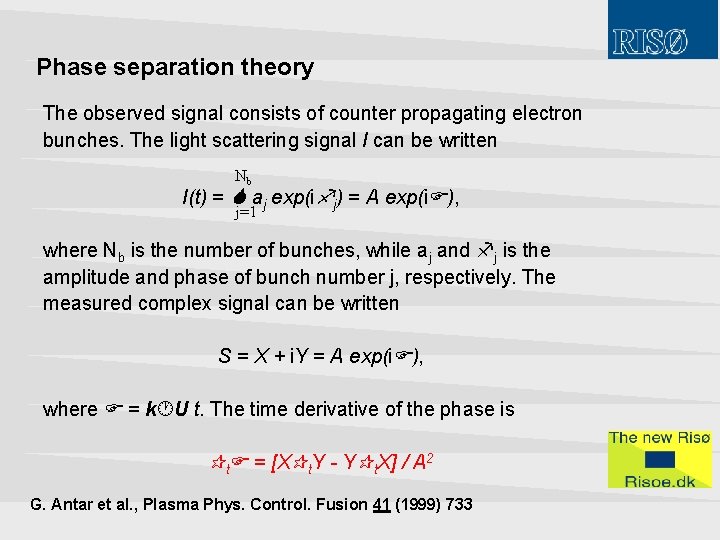
Phase separation theory The observed signal consists of counter propagating electron bunches. The light scattering signal I can be written Nb I(t) = aj exp(i j) = A exp(i ), j=1 where Nb is the number of bunches, while aj and j is the amplitude and phase of bunch number j, respectively. The measured complex signal can be written S = X + i. Y = A exp(i ), where = k U t. The time derivative of the phase is t = [X t. Y - Y t. X] / A 2 G. Antar et al. , Plasma Phys. Control. Fusion 41 (1999) 733
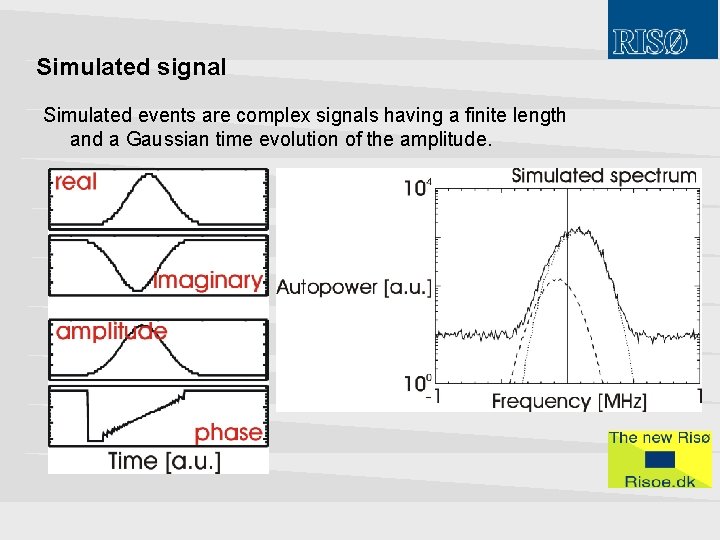
Simulated signal Simulated events are complex signals having a finite length and a Gaussian time evolution of the amplitude.

Phase separation tests The quality of the phase separation technique is gauged by cross correlating the simulated and separated amplitudes. A variety of parameters can be adjusted: • Phase velocity • Noise level • Number/lifetime/amplitude of events

Discharge overview Right-hand figure: Autopower spectra from a W 7 -AS shot displaying three distinct phases: 1. L-mode 100 -400 ms 2. Dithering H-mode 400 -550 ms 3. ELM-free H-mode 550 -600 ms Left-hand figure: Autopower spectra from a DIII-D discharge. C. L. Rettig et al. , Phys. Plasmas 4 (1997) 4009
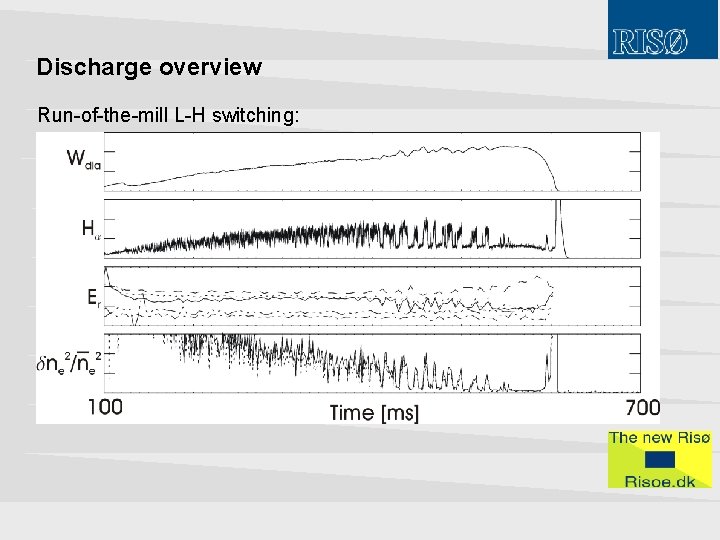
Discharge overview Run-of-the-mill L-H switching:

Events in L- and H-mode The 3 figures below show the amplitude (top) and phase derivative (bottom) for time windows of 100 s. H-mode Background L-mode The raw data has been bandpass filtered between 1 k. Hz and 1 MHz before the amplitude and phase derivative was calculated.

Average derivative Averaging the absolute value of the phase derivative over 100 s time windows, a clear correlation is seen with the dithering in other plasma parameters such as the H -light. This is not the case for the standard average – work is in progress.

Conclusions and outlook We have in this presentation outlined an investigation dealing with time derivatives of the phase of our signal: • The procedure as first used by G. Antar et al. on Tore Supra data is applicable to W 7 -AS discharges • Simulations creating autopower spectra similar to those measured have shown that phase separation of events in counter propagating directions is a valid approach • Events in L- and H-mode time windows have distinguishable phase derivatives Outlook: • Continue search for quantities differing in L- and H-mode (e. g. tt , PDF’s), work on bandpass filtering and physics interpretation • Use the technique for calculating phase separated autopower spectra in L- and H-modes Completed work and ongoing studies: www. npb. dk

MAY 2001: Detachment in W 7 -AS divertor plasmas • • First modular stellarator divertor (10 discrete toroidal sections) is operating in W 7 -AS 2 MW NBI power, a = 0. 556 Two density plateaus (we have obtained densities of 4 1020 m-3) Strictly speaking the discharge was partially detached, strike points still visible (thermography, H ) Observed wavenumber 20 cm-1 Spectra broaden at detachment Frequency integrated fluctuations increase at detachment
- Slides: 13