
Temporal Rainfall A Risk Based Approach Water New
Temporal Rainfall: A Risk Based Approach Water New Zealand’s 2019 Stormwater Conference Andrew Boldero Work Group Manager - Water Resources WSP Opus Hamilton, New Zealand Zaki Matar Water Resources Engineer WSP Melbourne , Australia
Agenda • Australian Rainfall and Runoff Prediction methodology • New Zealand Rainfall and Runoff Prediction methodologies • New Zealand’s HIRDS (version 4 update) • Test case and results • Comparison of methodologies (Australia and New Zealand) • Discussion/Next stage/Collaboration • Questions
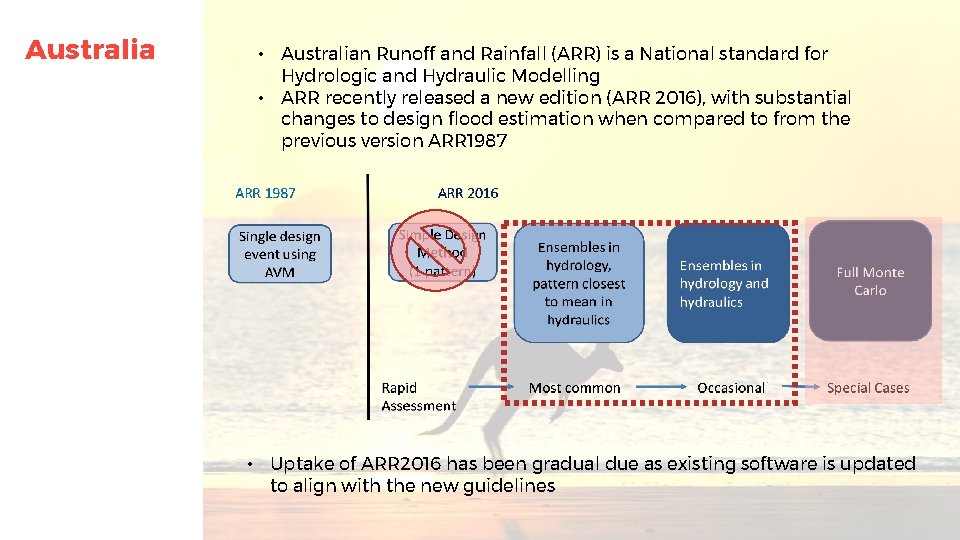
Australia • Australian Runoff and Rainfall (ARR) is a National standard for Hydrologic and Hydraulic Modelling • ARR recently released a new edition (ARR 2016), with substantial changes to design flood estimation when compared to from the previous version ARR 1987 • Uptake of ARR 2016 has been gradual due as existing software is updated to align with the new guidelines
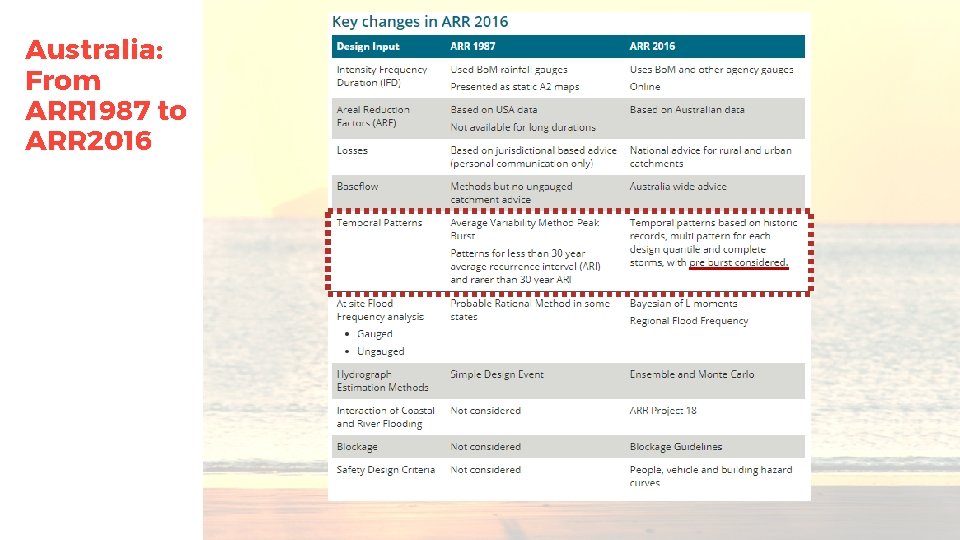
Australia: From ARR 1987 to ARR 2016
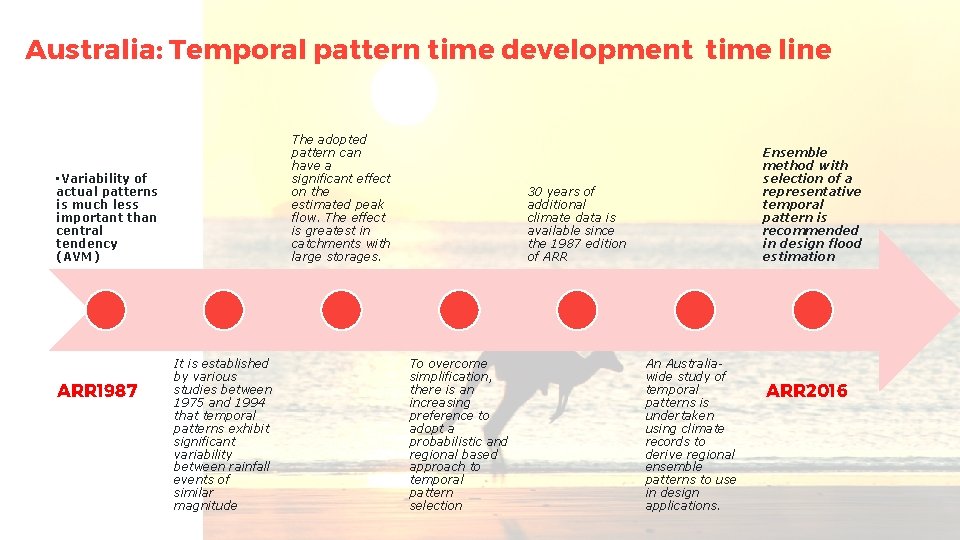
Australia: Temporal pattern time development time line The adopted pattern can have a significant effect on the estimated peak flow. The effect is greatest in catchments with large storages. • Variability of actual patterns is much less important than central tendency (AVM) ARR 1987 It is established by various studies between 1975 and 1994 that temporal patterns exhibit significant variability between rainfall events of similar magnitude Ensemble method with selection of a representative temporal pattern is recommended in design flood estimation 30 years of additional climate data is available since the 1987 edition of ARR To overcome simplification, there is an increasing preference to adopt a probabilistic and regional based approach to temporal pattern selection An Australiawide study of temporal patterns is undertaken using climate records to derive regional ensemble patterns to use in design applications. ARR 2016
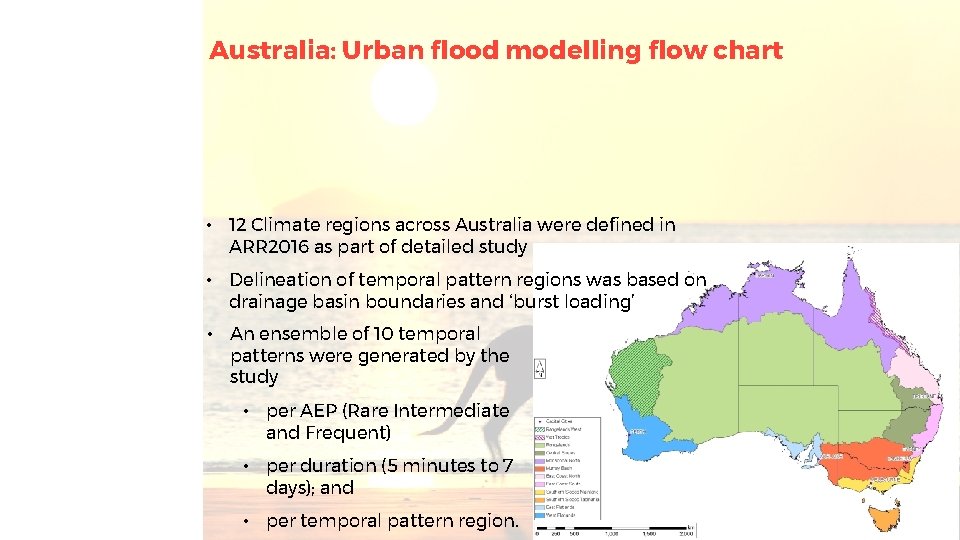
Australia: Urban flood modelling flow chart • 12 Climate regions across Australia were defined in ARR 2016 as part of detailed study • Delineation of temporal pattern regions was based on drainage basin boundaries and ‘burst loading’ • An ensemble of 10 temporal patterns were generated by the study • per AEP (Rare Intermediate and Frequent) • per duration (5 minutes to 7 days); and • per temporal pattern region.
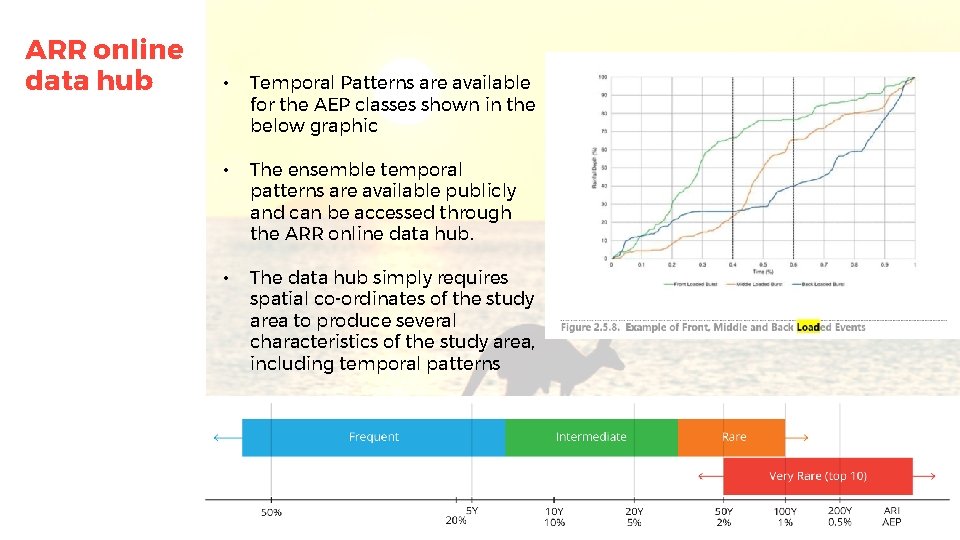
ARR online data hub • Temporal Patterns are available for the AEP classes shown in the below graphic • The ensemble temporal patterns are available publicly and can be accessed through the ARR online data hub. • The data hub simply requires spatial co-ordinates of the study area to produce several characteristics of the study area, including temporal patterns
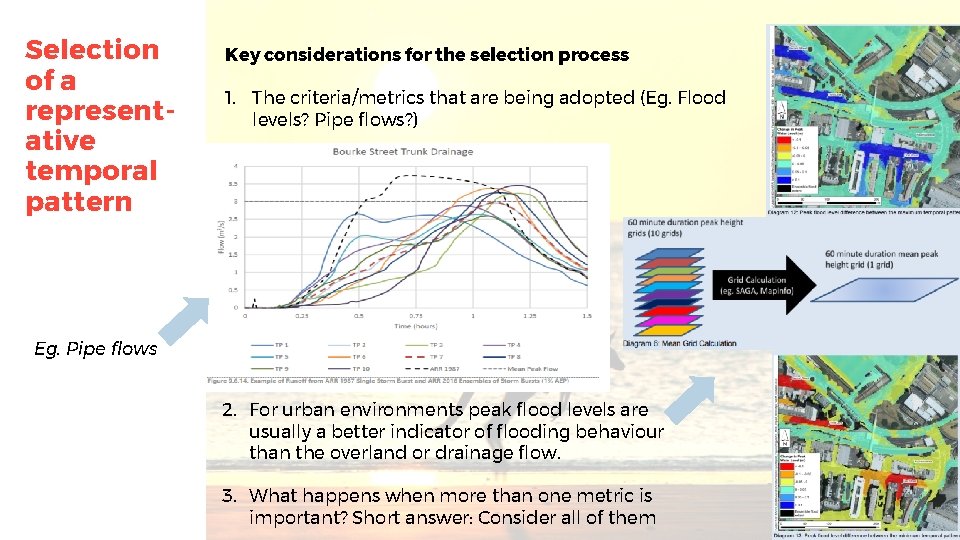
Selection of a representative temporal pattern Key considerations for the selection process 1. The criteria/metrics that are being adopted (Eg. Flood levels? Pipe flows? ) Eg. Pipe flows 2. For urban environments peak flood levels are usually a better indicator of flooding behaviour than the overland or drainage flow. 3. What happens when more than one metric is important? Short answer: Consider all of them
New Zealand Common New Zealand Runoff Estimation Methodologies: • Technical Publication (TP) 108: Guidelines for stormwater runoff modelling in the Auckland Region (April 1999) • Rational Method (Kuichling (1889) – peak flow only • Hydrological and hydraulic simulation modelling
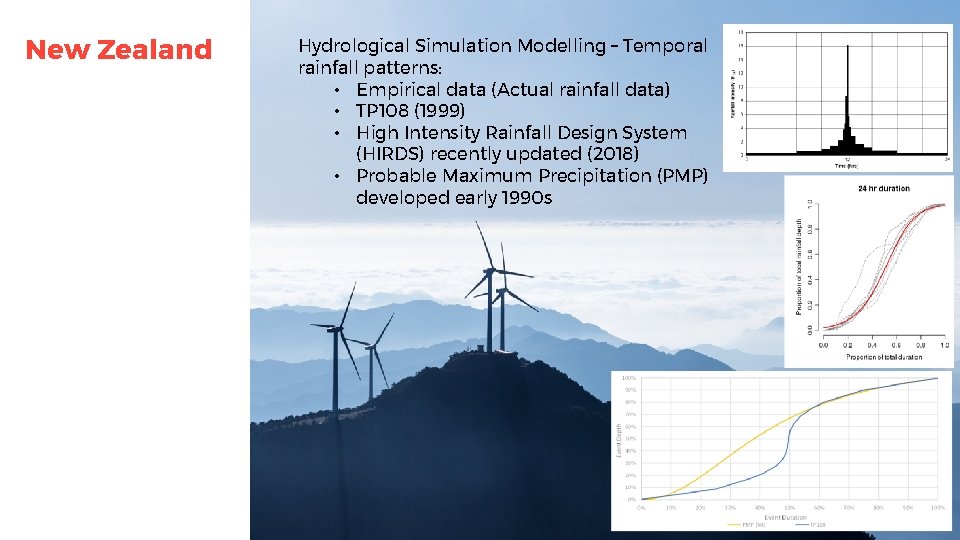
New Zealand Hydrological Simulation Modelling – Temporal rainfall patterns: • Empirical data (Actual rainfall data) • TP 108 (1999) • High Intensity Rainfall Design System (HIRDS) recently updated (2018) • Probable Maximum Precipitation (PMP) developed early 1990 s
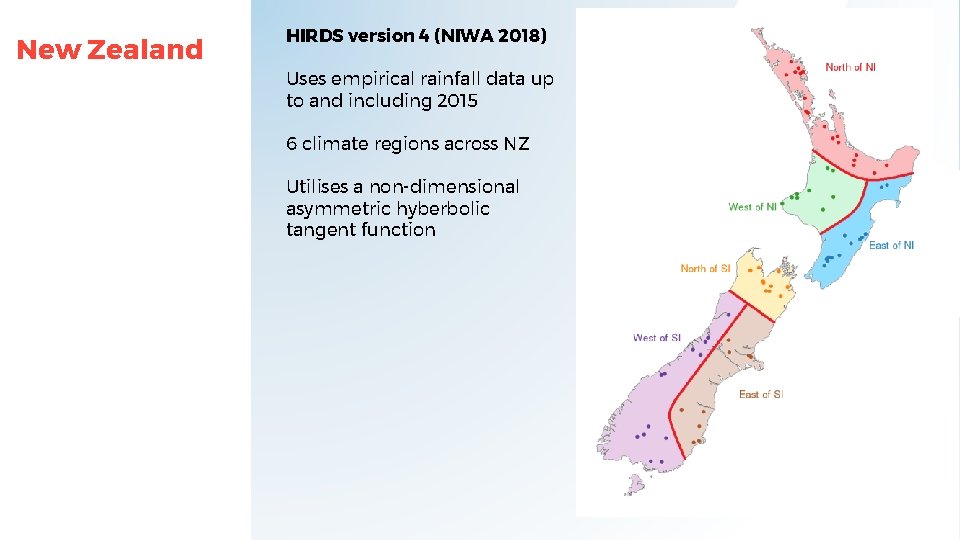
New Zealand HIRDS version 4 (NIWA 2018) Uses empirical rainfall data up to and including 2015 6 climate regions across NZ Utilises a non-dimensional asymmetric hyberbolic tangent function
New Zealand HIRDS version 4 (2018) Example (6 hour duration) graph - Front and rear loading is removed - Steep intensities are averaged/reduced - Multi-peaked events are distributed across a singular peak/not represented
New Zealand TEST CASE A New Zealand Sample site with calibrated model (downstream measured flow data) was selected with a catchment size of 18 km 2 Selection of various temporal rainfall patterns across Australia (Hobart, Melbourne and Sydney) were applied to the test site. An additional run was also completed for the Melbourne data where the temporal rainfall pattern was averaged to see what effect this could have on the results.
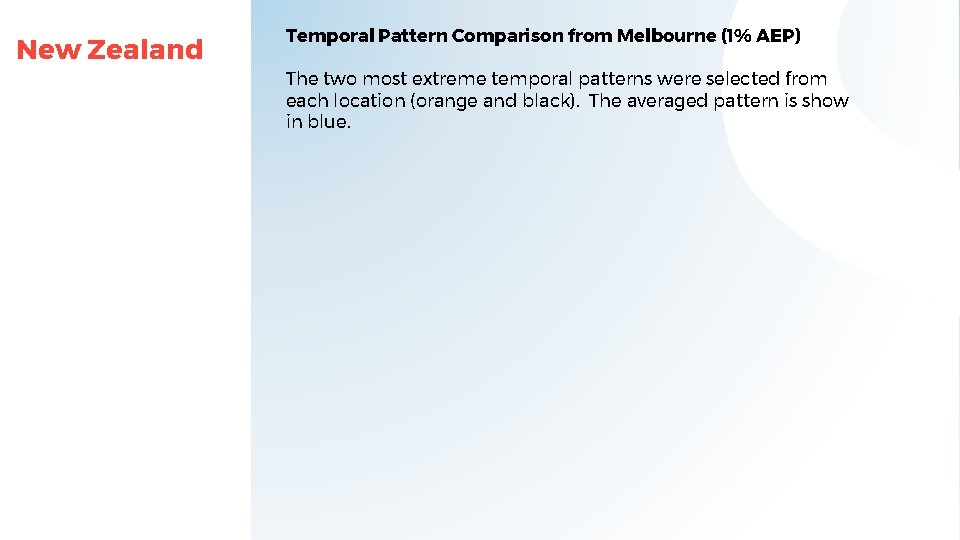
New Zealand Temporal Pattern Comparison from Melbourne (1% AEP) The two most extreme temporal patterns were selected from each location (orange and black). The averaged pattern is show in blue.
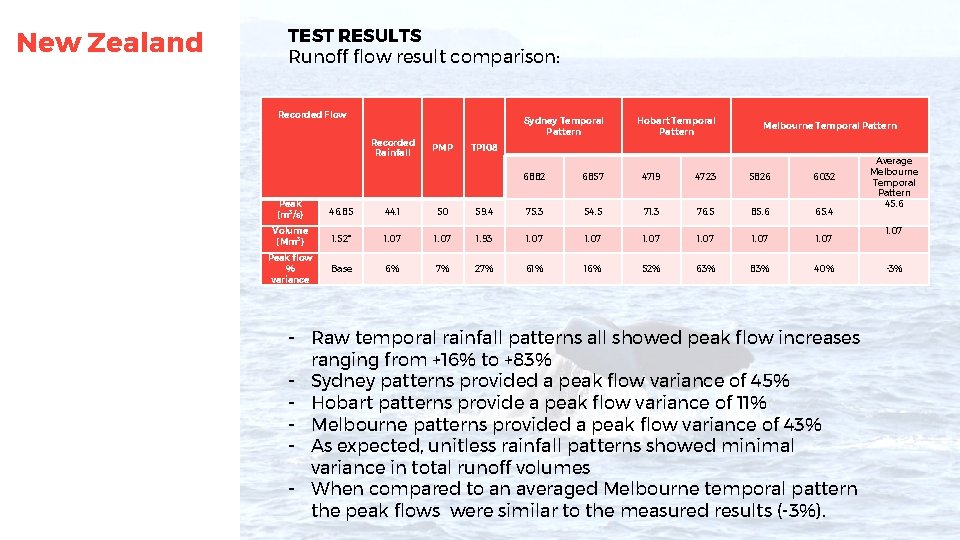
New Zealand TEST RESULTS Runoff flow result comparison: Recorded Flow Recorded Rainfall Sydney Temporal Pattern PMP Hobart Temporal Pattern Melbourne Temporal Pattern TP 108 6882 6857 4719 4723 5826 6032 Peak (m³/s) 46. 85 44. 1 50 59. 4 75. 3 54. 5 71. 3 76. 5 85. 6 65. 4 Volume (Mm³) 1. 52* 1. 07 1. 93 1. 07 Peak flow % variance Base 6% 7% 27% 61% 16% 52% 63% 83% 40% - Raw temporal rainfall patterns all showed peak flow increases ranging from +16% to +83% - Sydney patterns provided a peak flow variance of 45% - Hobart patterns provide a peak flow variance of 11% - Melbourne patterns provided a peak flow variance of 43% - As expected, unitless rainfall patterns showed minimal variance in total runoff volumes - When compared to an averaged Melbourne temporal pattern the peak flows were similar to the measured results (-3%). Average Melbourne Temporal Pattern 45. 6 1. 07 -3%
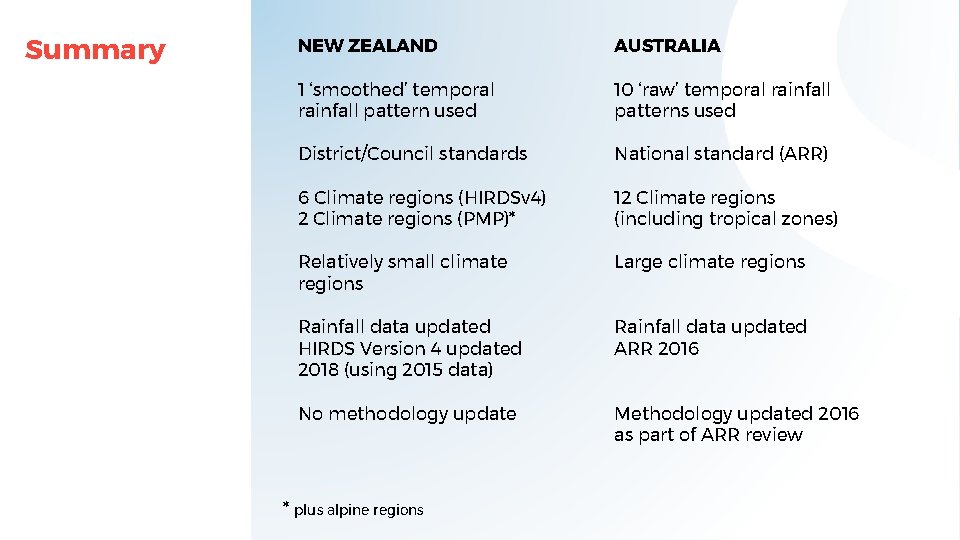
Summary NEW ZEALAND AUSTRALIA 1 ‘smoothed’ temporal rainfall pattern used 10 ‘raw’ temporal rainfall patterns used District/Council standards National standard (ARR) 6 Climate regions (HIRDSv 4) 2 Climate regions (PMP)* 12 Climate regions (including tropical zones) Relatively small climate regions Large climate regions Rainfall data updated HIRDS Version 4 updated 2018 (using 2015 data) Rainfall data updated ARR 2016 No methodology update Methodology updated 2016 as part of ARR review * plus alpine regions
What is Next? To answer the question ‘is a risk based approach suitable for New Zealand? ’ More data is needed to enable a detailed analyse of the alternative methodology in the New Zealand Climate Next Steps: • Industry Collaboration • Undertake simplified ARR 2016 methodology utilising NIWA’s raw temporal data. • Collate and analyse results • Share results with Industry Contact: andrew. boldero@wsp. com

Questions Contact: andrew. boldero@wsp. com
- Slides: 18