
Temporal Planning with Temporal and Concurrent Actions Temporal
![Properties of Composition l l l transitive • if [i 1 r i 2]](https://slidetodoc.com/presentation_image_h/1f25fa8656a4564a07775babdd6b3260/image-29.jpg "Properties of Composition l l l transitive • if [i 1 r i 2]")
![Example: Quantitative Temporal Constraint Network [1, 2] AUranus now [3, 4] or [6, ∞]](https://slidetodoc.com/presentation_image_h/1f25fa8656a4564a07775babdd6b3260/image-34.jpg "Example: Quantitative Temporal Constraint Network [1, 2] AUranus now [3, 4] or [6, ∞]")
- Slides: 59
Temporal Planning with Temporal and Concurrent Actions Temporal Planning
Literature l Malik Ghallab, Dana Nau, and Paolo Traverso. Automated Planning – Theory and Practice, chapter 13 -14. Elsevier/Morgan Kaufmann, 2004. Temporal Planning 2
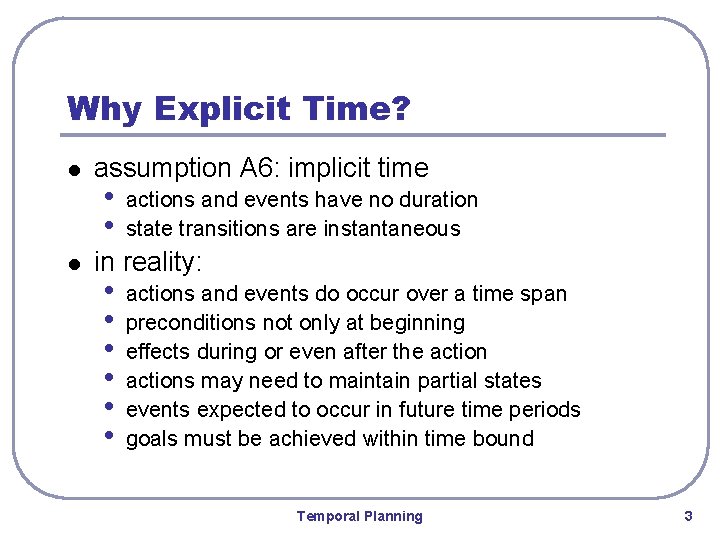
Why Explicit Time? l l assumption A 6: implicit time • • actions and events have no duration state transitions are instantaneous in reality: • • • actions and events do occur over a time span preconditions not only at beginning effects during or even after the actions may need to maintain partial states events expected to occur in future time periods goals must be achieved within time bound Temporal Planning 3
Overview l l Actions and Time Points Interval Algebra and Quantitative Time Planning with Temporal Operators Temporal Planning 4
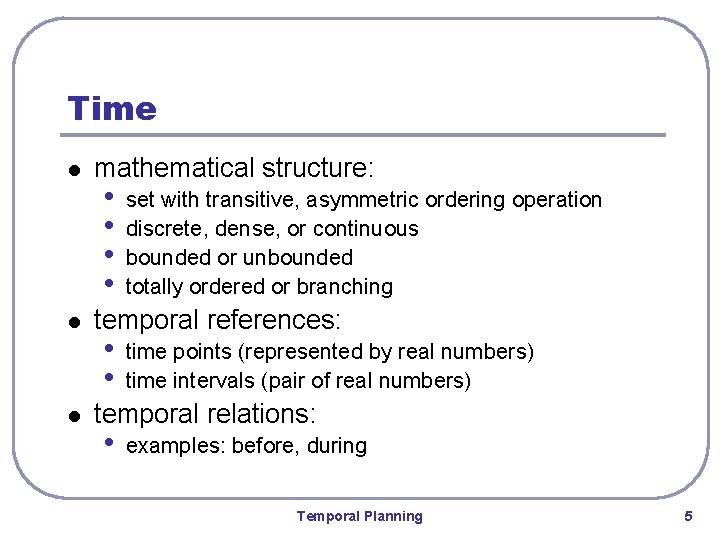
Time l l l mathematical structure: • • set with transitive, asymmetric ordering operation discrete, dense, or continuous bounded or unbounded totally ordered or branching temporal references: • • time points (represented by real numbers) time intervals (pair of real numbers) temporal relations: • examples: before, during Temporal Planning 5
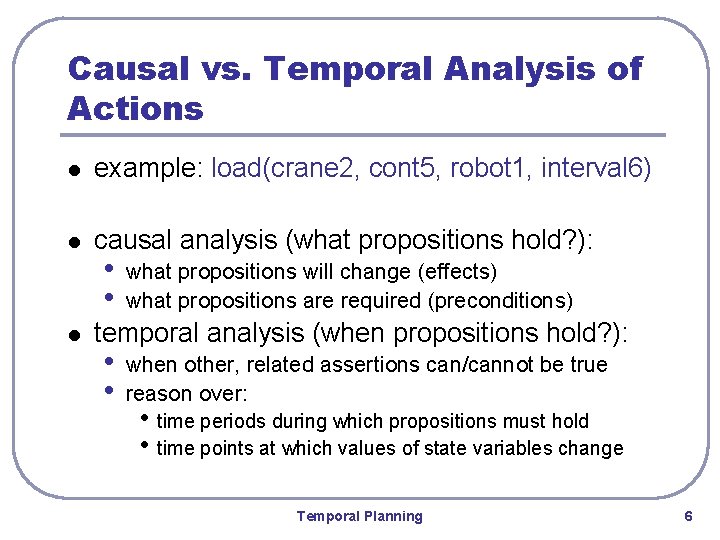
Causal vs. Temporal Analysis of Actions l example: load(crane 2, cont 5, robot 1, interval 6) l causal analysis (what propositions hold? ): l • • what propositions will change (effects) what propositions are required (preconditions) temporal analysis (when propositions hold? ): • • when other, related assertions can/cannot be true reason over: • time periods during which propositions must hold • time points at which values of state variables change Temporal Planning 6
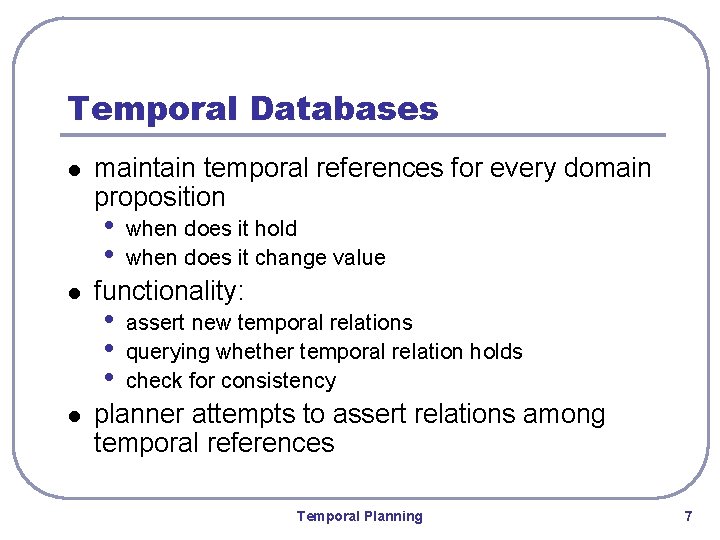
Temporal Databases l maintain temporal references for every domain proposition • • l l when does it hold when does it change value functionality: • • • assert new temporal relations querying whether temporal relation holds check for consistency planner attempts to assert relations among temporal references Temporal Planning 7
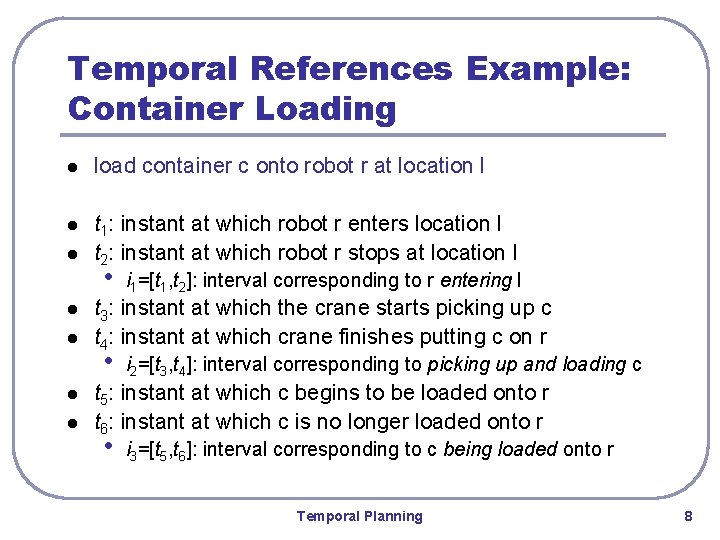
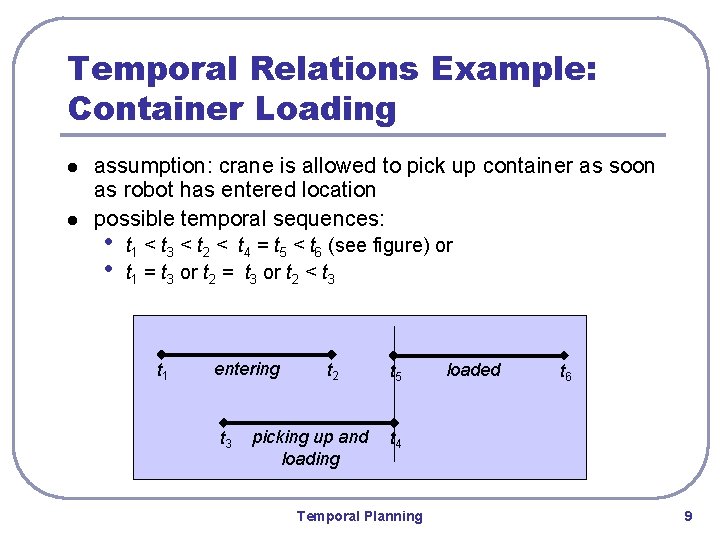
Temporal References Example: Container Loading l load container c onto robot r at location l l t 1: instant at which robot r enters location l t 2: instant at which robot r stops at location l l l • i 1=[t 1, t 2]: interval corresponding to r entering l t 3: instant at which the crane starts picking up c t 4: instant at which crane finishes putting c on r • i 2=[t 3, t 4]: interval corresponding to picking up and loading c t 5: instant at which c begins to be loaded onto r t 6: instant at which c is no longer loaded onto r • i 3=[t 5, t 6]: interval corresponding to c being loaded onto r Temporal Planning 8
Temporal Relations Example: Container Loading l l assumption: crane is allowed to pick up container as soon as robot has entered location possible temporal sequences: • • t 1 < t 3 < t 2 < t 4 = t 5 < t 6 (see figure) or t 1 = t 3 or t 2 < t 3 t 1 entering t 3 t 2 picking up and loading t 5 loaded t 6 t 4 Temporal Planning 9
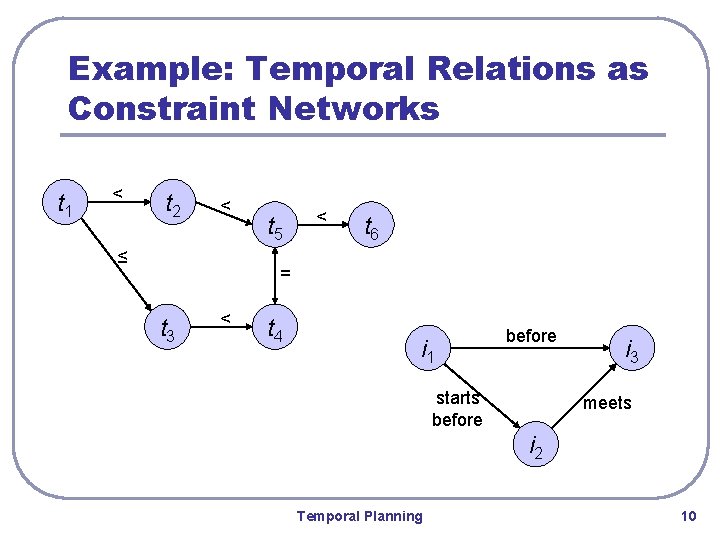
Example: Temporal Relations as Constraint Networks t 1 < t 2 < ≤ t 5 < t 6 = t 3 < t 4 i 1 before starts before i 3 meets i 2 Temporal Planning 10
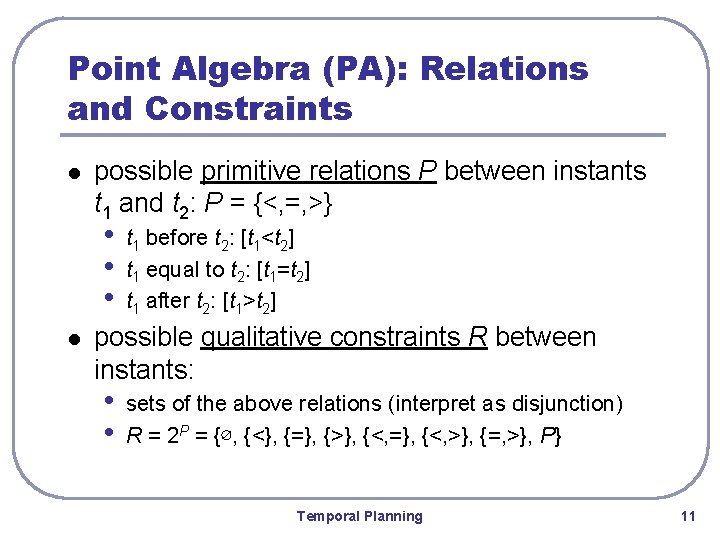
Point Algebra (PA): Relations and Constraints l possible primitive relations P between instants t 1 and t 2: P = {<, =, >} • • • l t 1 before t 2: [t 1<t 2] t 1 equal to t 2: [t 1=t 2] t 1 after t 2: [t 1>t 2] possible qualitative constraints R between instants: • • sets of the above relations (interpret as disjunction) R = 2 P = {∅, {<}, {=}, {>}, {<, =}, {<, >}, {=, >}, P} Temporal Planning 11
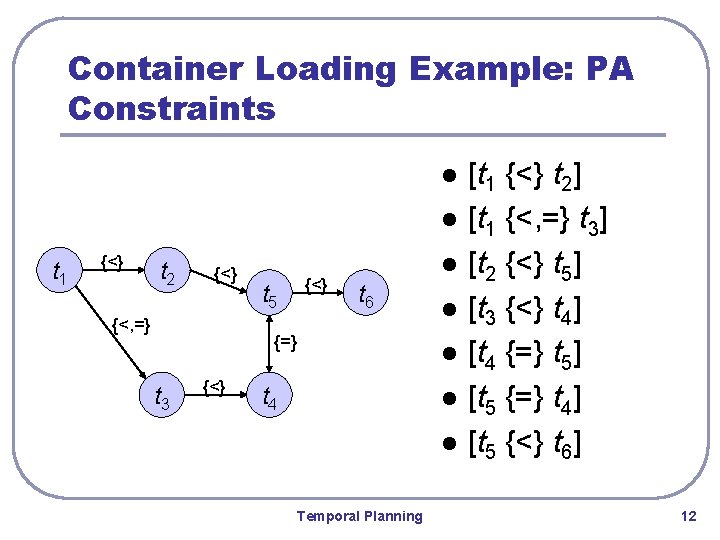
Container Loading Example: PA Constraints l l t 1 {<} t 2 {<} {<, =} t 5 {<} l t 6 {=} t 3 {<} l l t 4 l l Temporal Planning [t 1 {<} t 2] [t 1 {<, =} t 3] [t 2 {<} t 5] [t 3 {<} t 4] [t 4 {=} t 5] [t 5 {=} t 4] [t 5 {<} t 6] 12
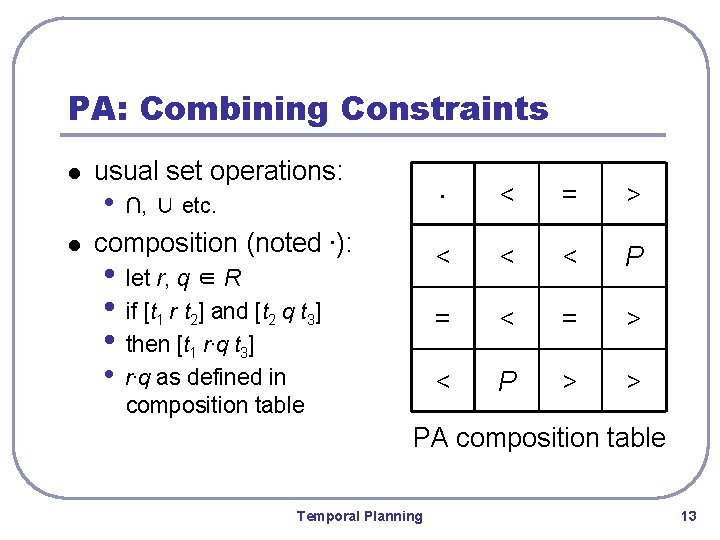
PA: Combining Constraints l l usual set operations: • ∩, ∪ etc. composition (noted ∙): • let r, q ∈ R • if [t 1 r t 2] and [t 2 q t 3] • then [t 1 r∙q t 3] • r∙q as defined in composition table ∙ < = > < < < P = < = > < P > > PA composition table Temporal Planning 13
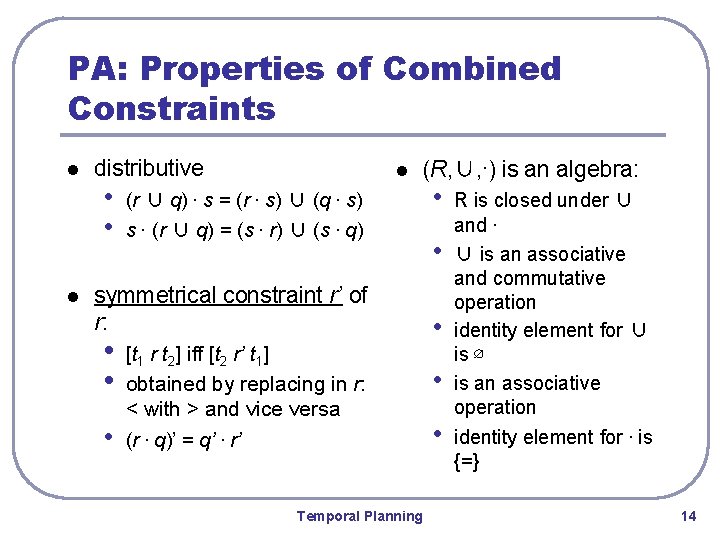
PA: Properties of Combined Constraints l l distributive • • l (R, ∪, ∙) is an algebra: (r ∪ q) ∙ s = (r ∙ s) ∪ (q ∙ s) s ∙ (r ∪ q) = (s ∙ r) ∪ (s ∙ q) symmetrical constraint r’ of r: • • • [t 1 r t 2] iff [t 2 r’ t 1] obtained by replacing in r: < with > and vice versa (r ∙ q)’ = q’ ∙ r’ Temporal Planning • • • R is closed under ∪ and ∙ ∪ is an associative and commutative operation identity element for ∪ is ∅ is an associative operation identity element for ∙ is {=} 14
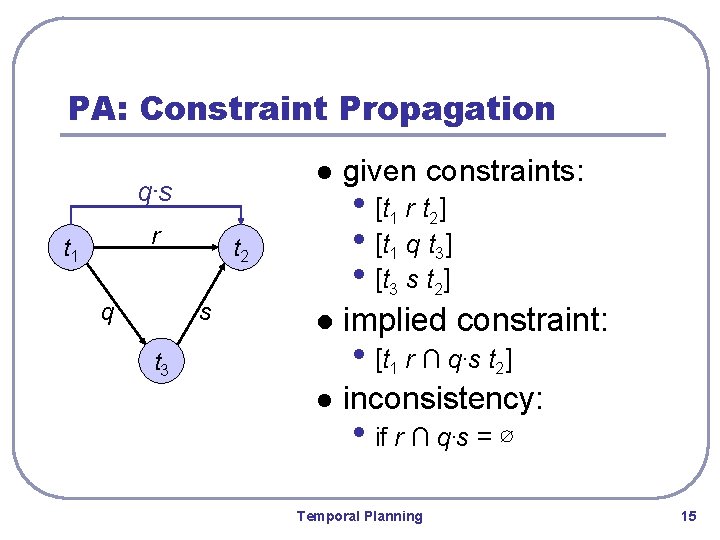
PA: Constraint Propagation q∙s r t 1 q l given constraints: l implied constraint: l inconsistency: t 2 s t 3 • [ t 1 r t 2] • [ t 1 q t 3] • [ t 3 s t 2] • [t 1 r ∩ q∙s t 2] • if r ∩ q∙s = ∅ Temporal Planning 15
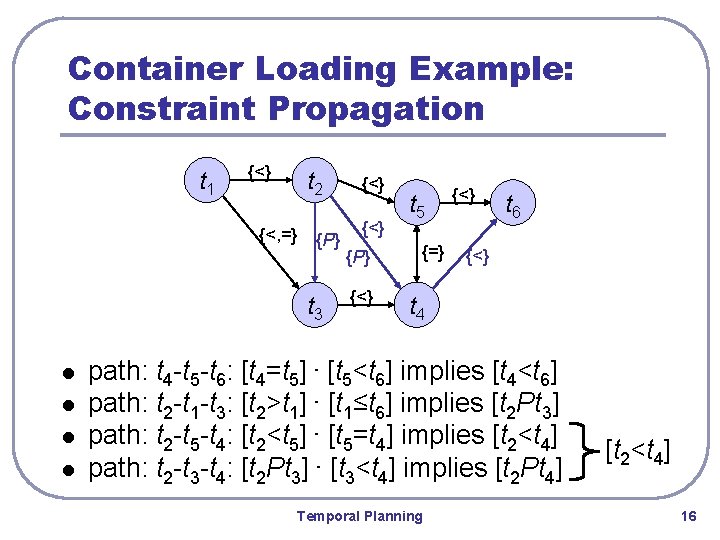
Container Loading Example: Constraint Propagation t 1 {<} t 2 {<, =} {P} t 3 l l {<} {P} {<} t 5 {=} {<} t 6 {<} t 4 path: t 4 -t 5 -t 6: [t 4=t 5] ∙ [t 5<t 6] implies [t 4<t 6] path: t 2 -t 1 -t 3: [t 2>t 1] ∙ [t 1≤t 6] implies [t 2 Pt 3] path: t 2 -t 5 -t 4: [t 2<t 5] ∙ [t 5=t 4] implies [t 2<t 4] path: t 2 -t 3 -t 4: [t 2 Pt 3] ∙ [t 3<t 4] implies [t 2 Pt 4] Temporal Planning [t 2<t 4] 16
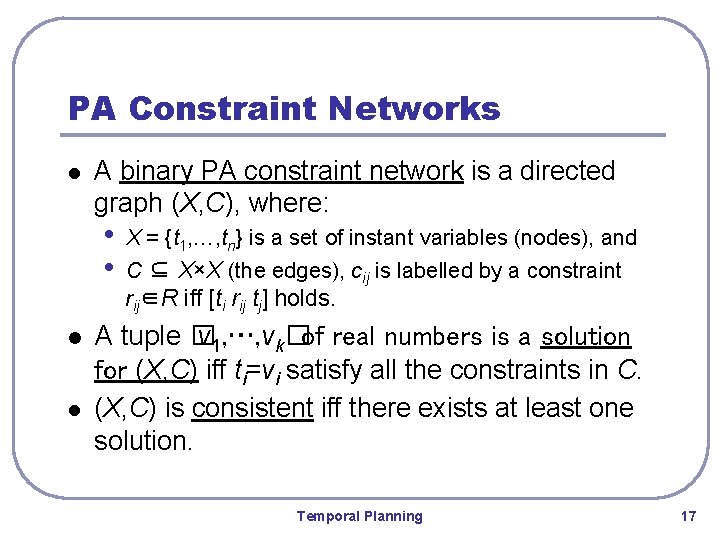
PA Constraint Networks l A binary PA constraint network is a directed graph (X, C), where: • • l l X = {t 1, …, tn} is a set of instant variables (nodes), and C ⊆ X×X (the edges), cij is labelled by a constraint rij∈R iff [ti rij tj] holds. A tuple � v 1, …, vk�of real numbers is a solution for (X, C) iff ti=vi satisfy all the constraints in C. (X, C) is consistent iff there exists at least one solution. Temporal Planning 17
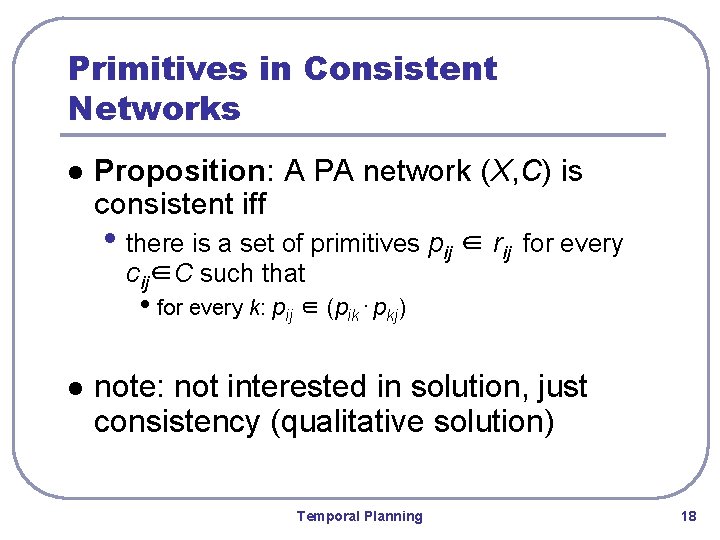
Primitives in Consistent Networks l Proposition: A PA network (X, C) is consistent iff • there is a set of primitives pij ∈ rij cij∈C such that for every • for every k: pij ∈ (pik ∙ pkj) l note: not interested in solution, just consistency (qualitative solution) Temporal Planning 18
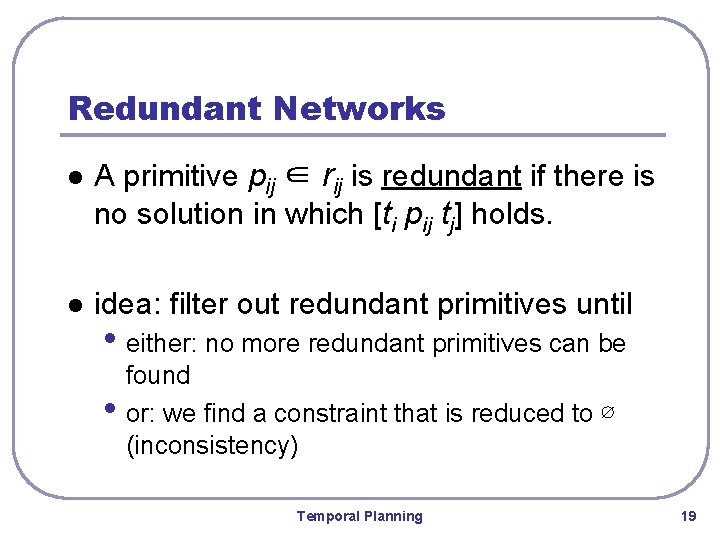
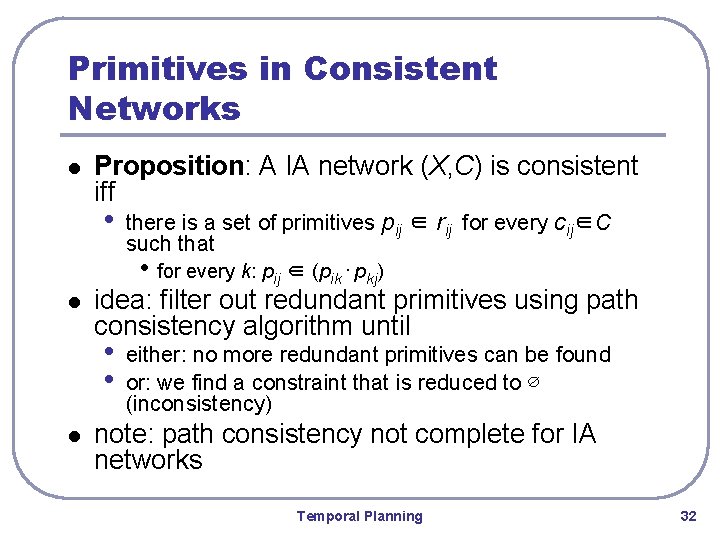
Redundant Networks l A primitive pij ∈ rij is redundant if there is no solution in which [ti pij tj] holds. l idea: filter out redundant primitives until • either: no more redundant primitives can be • found or: we find a constraint that is reduced to ∅ (inconsistency) Temporal Planning 19
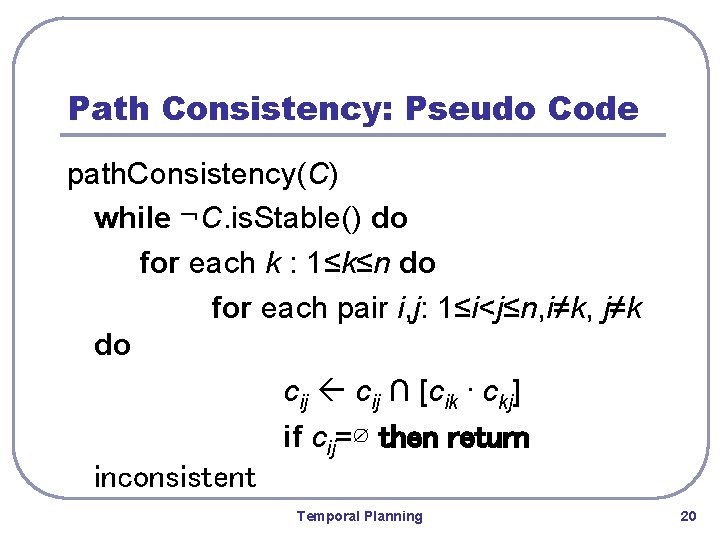
Path Consistency: Pseudo Code path. Consistency(C) while ¬C. is. Stable() do for each k : 1≤k≤n do for each pair i, j: 1≤i<j≤n, i≠k, j≠k do cij ∩ [cik ∙ ckj] if cij=∅ then return inconsistent Temporal Planning 20
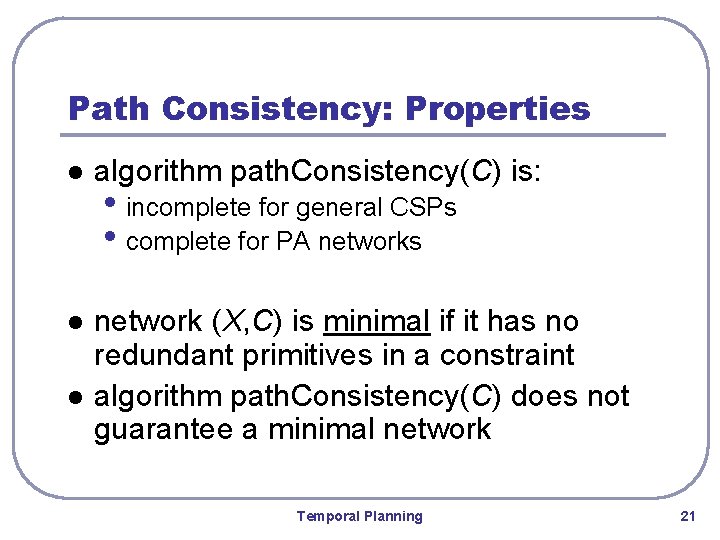
Path Consistency: Properties l algorithm path. Consistency(C) is: l network (X, C) is minimal if it has no redundant primitives in a constraint algorithm path. Consistency(C) does not guarantee a minimal network l • incomplete for general CSPs • complete for PA networks Temporal Planning 21
Overview l l Actions and Time Points Interval Algebra and Quantitative Time Planning with Temporal Operators Temporal Planning 22
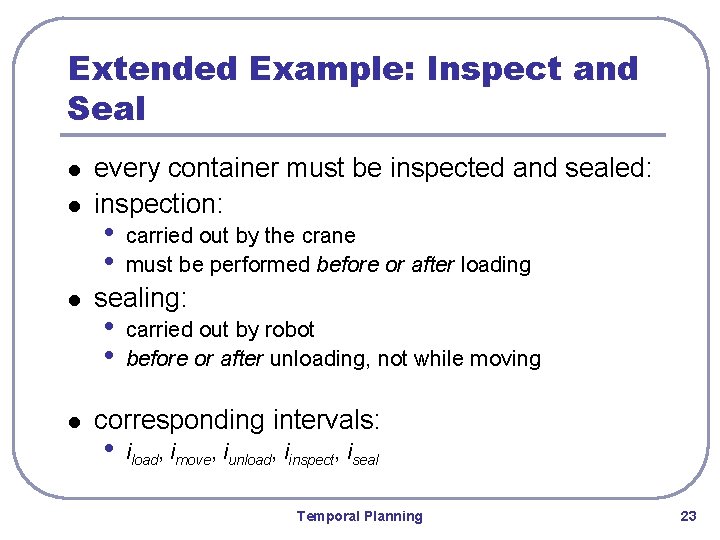
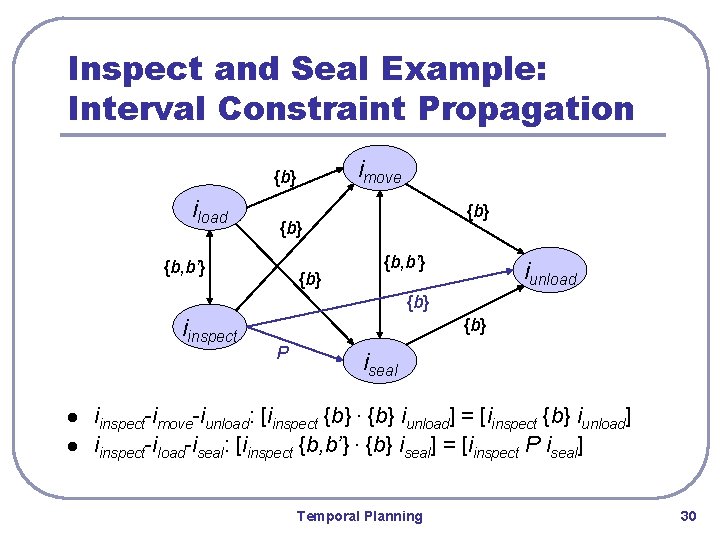
Extended Example: Inspect and Seal l l every container must be inspected and sealed: inspection: • • carried out by the crane must be performed before or after loading sealing: • • carried out by robot before or after unloading, not while moving corresponding intervals: • iload, imove, iunload, iinspect, iseal Temporal Planning 23
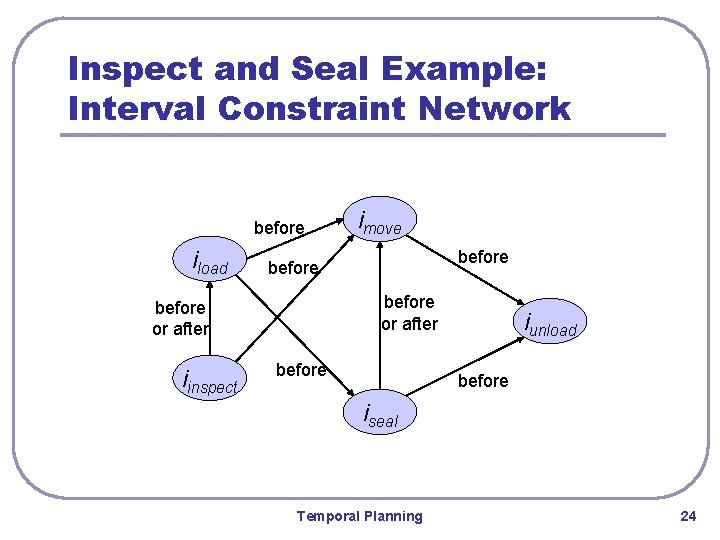
Inspect and Seal Example: Interval Constraint Network before iload before or after iinspect imove before iunload before iseal Temporal Planning 24
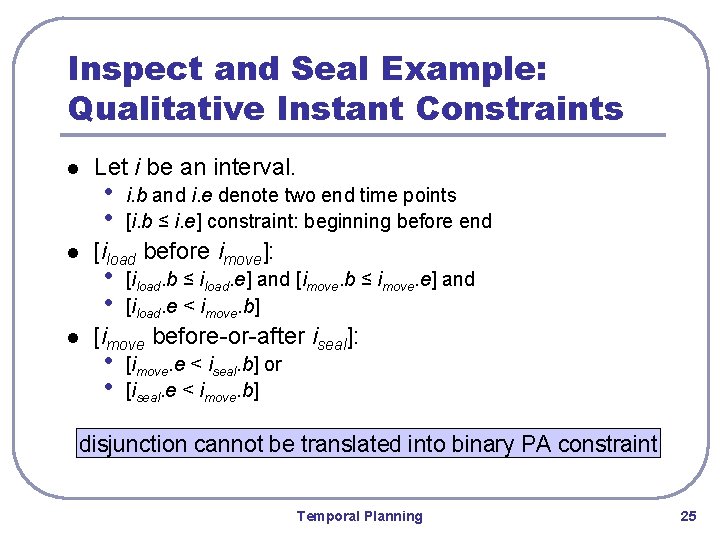
Inspect and Seal Example: Qualitative Instant Constraints l l l Let i be an interval. • • i. b and i. e denote two end time points [i. b ≤ i. e] constraint: beginning before end [iload before imove]: • • [iload. b ≤ iload. e] and [imove. b ≤ imove. e] and [iload. e < imove. b] [imove before-or-after iseal]: • • [imove. e < iseal. b] or [iseal. e < imove. b] disjunction cannot be translated into binary PA constraint Temporal Planning 25
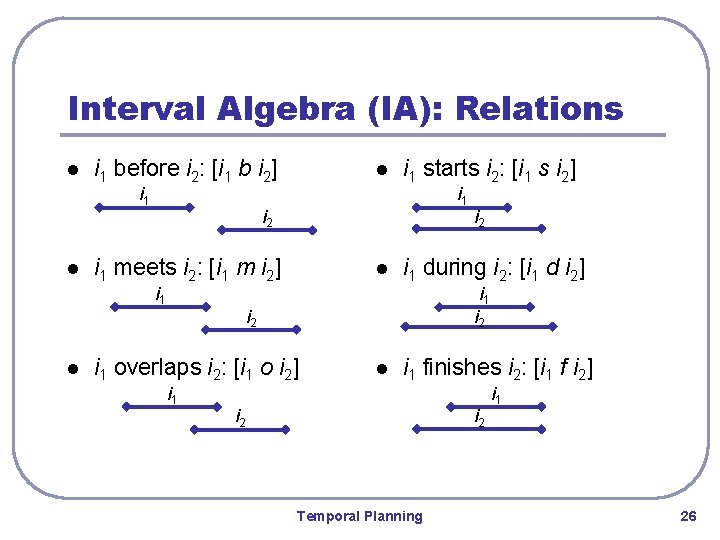
Interval Algebra (IA): Relations l i 1 before i 2: [i 1 b i 2] i 1 l i 1 starts i 2: [i 1 s i 2] i 1 i 2 i 1 meets i 2: [i 1 m i 2] i 1 l l l i 1 during i 2: [i 1 d i 2] i 1 i 2 i 1 overlaps i 2: [i 1 o i 2] i 1 i 2 l i 1 finishes i 2: [i 1 f i 2] i 2 Temporal Planning i 1 26
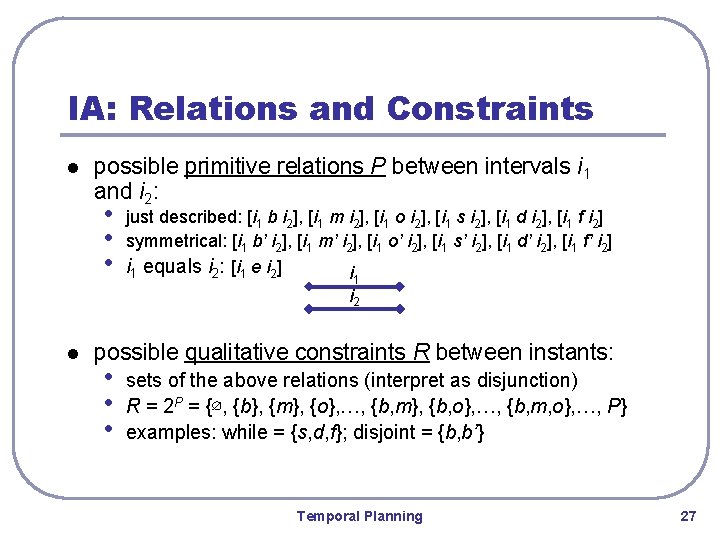
IA: Relations and Constraints l possible primitive relations P between intervals i 1 and i 2: • • • just described: [i 1 b i 2], [i 1 m i 2], [i 1 o i 2], [i 1 s i 2], [i 1 d i 2], [i 1 f i 2] symmetrical: [i 1 b’ i 2], [i 1 m’ i 2], [i 1 o’ i 2], [i 1 s’ i 2], [i 1 d’ i 2], [i 1 f’ i 2] i 1 equals i 2: [i 1 e i 2] i 1 i 2 l possible qualitative constraints R between instants: • • • sets of the above relations (interpret as disjunction) R = 2 P = {∅, {b}, {m}, {o}, …, {b, m}, {b, o}, …, {b, m, o}, …, P} examples: while = {s, d, f}; disjoint = {b, b’} Temporal Planning 27
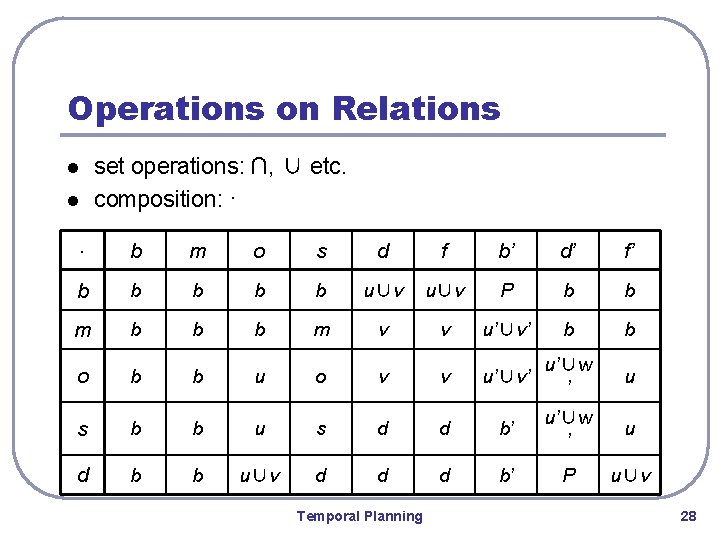
Operations on Relations set operations: ∩, ∪ etc. composition: ∙ l l ∙ b m o s d f b’ d’ f’ b b b u∪v P b b m b b b m v v u’∪v’ b b o b b u o v v u’∪v’ u’∪w ’ u s b b u s d d b’ u’∪w ’ u d b b u∪v d d d b’ P u∪v Temporal Planning 28
Properties of Composition l l l transitive • if [i 1 r i 2] and [i 2 q i 3] then [i 1 (r ∙ q) i 3] • • (r ∪ q) ∙ s = (r ∙ s) ∪ (q ∙ s) s ∙ (r ∪ q) = (s ∙ r) ∪ (s ∙ q) • • [i 1 (r ∙ q) i 2] does not imply [i 1 (q ∙ r) i 2] example: d ∙b = {b}; b ∙ d = {b, m, o, s, d} distributive not commutative i 2 i 1 i 2 i 3 [i 1 (d ∙ b) i 3] i 1 i 3 [i 1 (b ∙ d) i 3] Temporal Planning 29
Inspect and Seal Example: Interval Constraint Propagation imove {b} iload {b} {b, b’} iunload {b} iinspect l l {b} P iseal iinspect-imove-iunload: [iinspect {b} ∙ {b} iunload] = [iinspect {b} iunload] iinspect-iload-iseal: [iinspect {b, b’} ∙ {b} iseal] = [iinspect P iseal] Temporal Planning 30
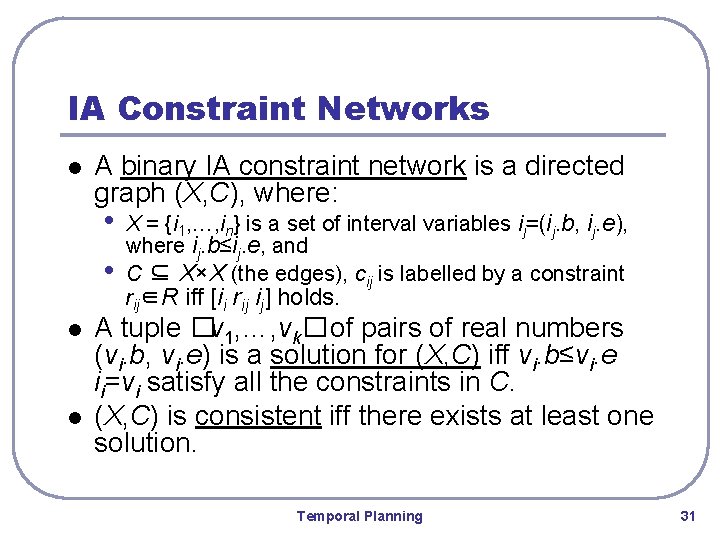
IA Constraint Networks l A binary IA constraint network is a directed graph (X, C), where: • • l l X = {i 1, …, in} is a set of interval variables ij=(ij. b, ij. e), where ij. b≤ij. e, and C ⊆ X×X (the edges), cij is labelled by a constraint rij∈R iff [ii rij ij] holds. A tuple �v 1, …, vk�of pairs of real numbers (vi. b, vi. e) is a solution for (X, C) iff vi. b≤vi. e ii=vi satisfy all the constraints in C. (X, C) is consistent iff there exists at least one solution. Temporal Planning 31
Primitives in Consistent Networks l Proposition: A IA network (X, C) is consistent iff • l idea: filter out redundant primitives using path consistency algorithm until • • l there is a set of primitives pij ∈ rij for every cij∈C such that • for every k: pij ∈ (pik ∙ pkj) either: no more redundant primitives can be found or: we find a constraint that is reduced to ∅ (inconsistency) note: path consistency not complete for IA networks Temporal Planning 32
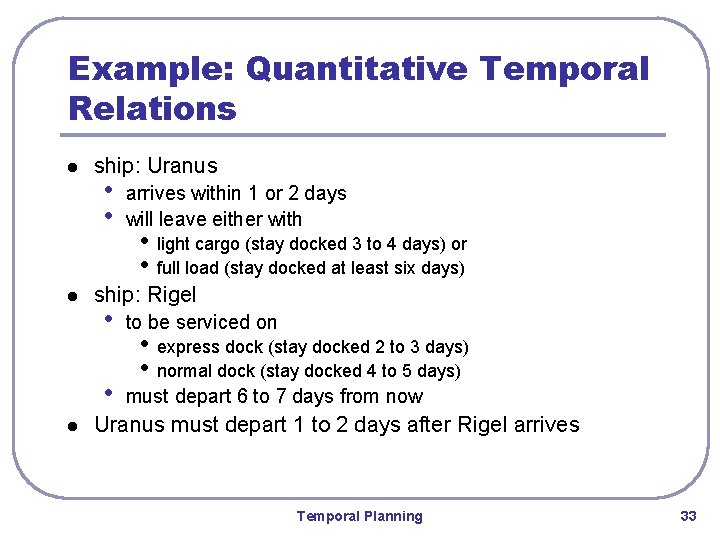
Example: Quantitative Temporal Relations l l ship: Uranus • • light cargo (stay docked 3 to 4 days) or full load (stay docked at least six days) ship: Rigel • • l arrives within 1 or 2 days will leave either with to be serviced on • • express dock (stay docked 2 to 3 days) normal dock (stay docked 4 to 5 days) must depart 6 to 7 days from now Uranus must depart 1 to 2 days after Rigel arrives Temporal Planning 33
Example: Quantitative Temporal Constraint Network [1, 2] AUranus now [3, 4] or [6, ∞] ARigel [1, 2] [2, 3] or [4, 5] [6, 7] l l DUranus DRigel 5 instants related by quantitative constraints • e. g. (2 ≤ DRigel-ARigel ≤ 3) ⋁ (4 ≤ DRigel-ARigel ≤ 5) • • • When should the Rigel arrive? Can it be serviced on a normal dock? Can the Uranus take a full load? possible questions: Temporal Planning 34
Overview l l Actions and Time Points Interval Algebra and Quantitative Time Planning with Temporal Operators Temporal Planning 35
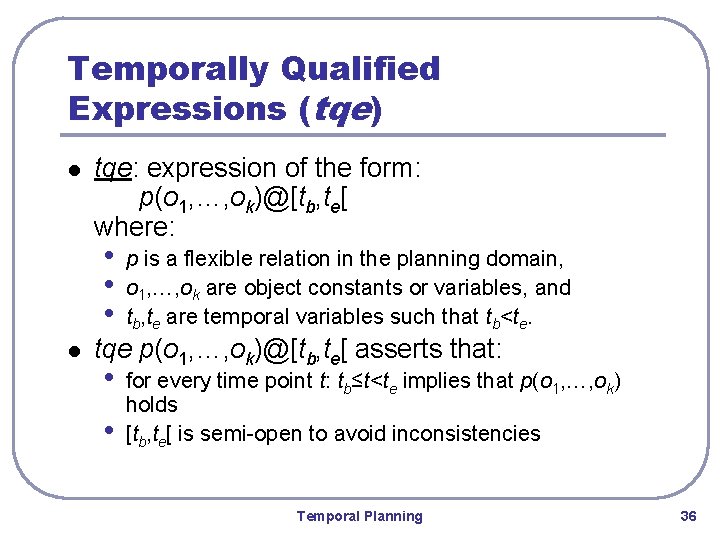
Temporally Qualified Expressions (tqe) l tqe: expression of the form: p(o 1, …, ok)@[tb, te[ where: • • • l p is a flexible relation in the planning domain, o 1, …, ok are object constants or variables, and tb, te are temporal variables such that tb<te. tqe p(o 1, …, ok)@[tb, te[ asserts that: • • for every time point t: tb≤t<te implies that p(o 1, …, ok) holds [tb, te[ is semi-open to avoid inconsistencies Temporal Planning 36
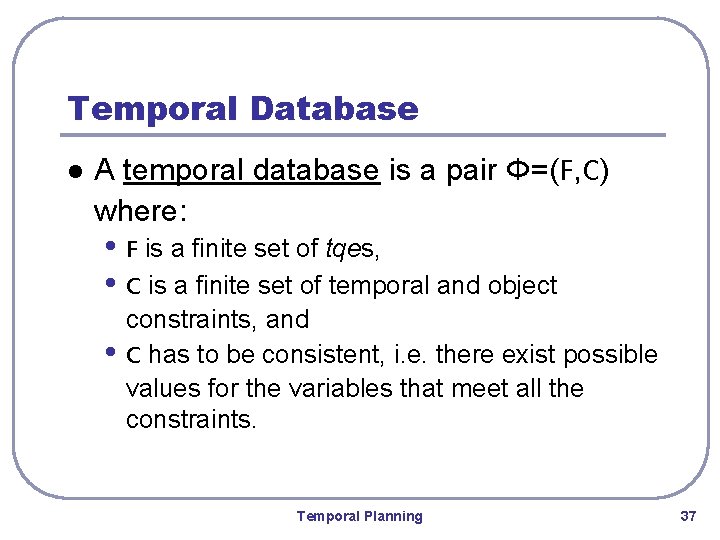
Temporal Database l A temporal database is a pair Φ=(F, C) where: • F is a finite set of tqes, • C is a finite set of temporal and object constraints, and • C has to be consistent, i. e. there exist possible values for the variables that meet all the constraints. Temporal Planning 37
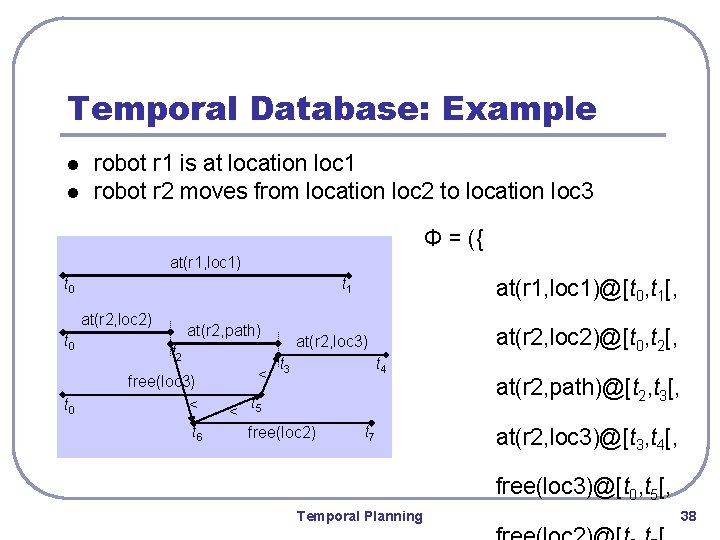
Temporal Database: Example l l robot r 1 is at location loc 1 robot r 2 moves from location loc 2 to location loc 3 Φ = ({ at(r 1, loc 1) t 0 t 1 at(r 2, loc 2) t 0 at(r 2, path) t 2 free(loc 3) < t 6 < < at(r 1, loc 1)@[t 0, t 1[, at(r 2, loc 3) t 3 t 4 t 5 free(loc 2) t 7 at(r 2, loc 2)@[t 0, t 2[, at(r 2, path)@[t 2, t 3[, at(r 2, loc 3)@[t 3, t 4[, free(loc 3)@[t 0, t 5[, Temporal Planning 38
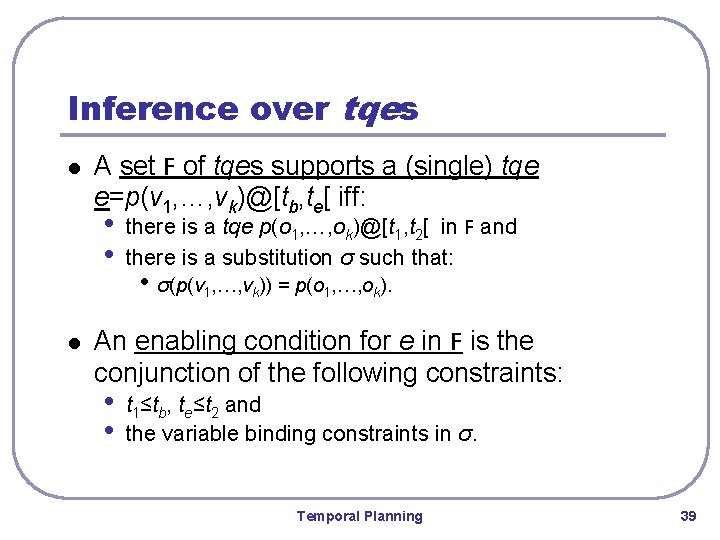
Inference over tqes l A set F of tqes supports a (single) tqe e=p(v 1, …, vk)@[tb, te[ iff: • • l there is a tqe p(o 1, …, ok)@[t 1, t 2[ in F and there is a substitution σ such that: • σ(p(v 1, …, vk)) = p(o 1, …, ok). An enabling condition for e in F is the conjunction of the following constraints: • • t 1≤tb, te≤t 2 and the variable binding constraints in σ. Temporal Planning 39
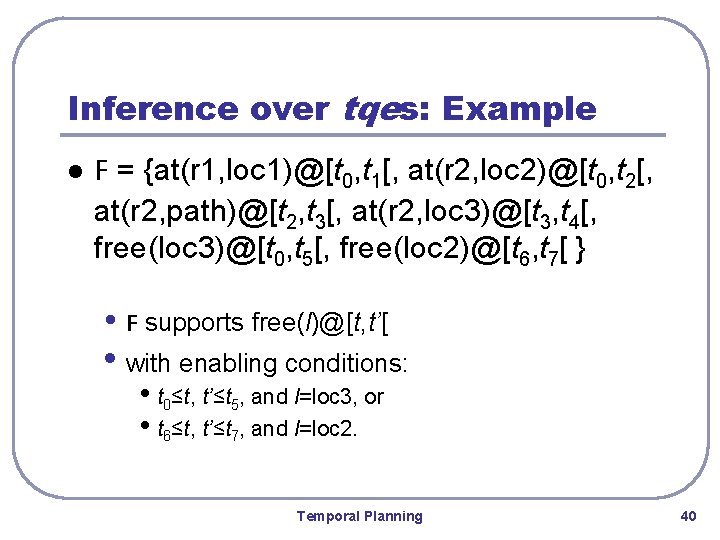
Inference over tqes: Example l F = {at(r 1, loc 1)@[t 0, t 1[, at(r 2, loc 2)@[t 0, t 2[, at(r 2, path)@[t 2, t 3[, at(r 2, loc 3)@[t 3, t 4[, free(loc 3)@[t 0, t 5[, free(loc 2)@[t 6, t 7[ } • F supports free(l)@[t, t’[ • with enabling conditions: • t 0≤t, t’≤t 5, and l=loc 3, or • t 6≤t, t’≤t 7, and l=loc 2. Temporal Planning 40
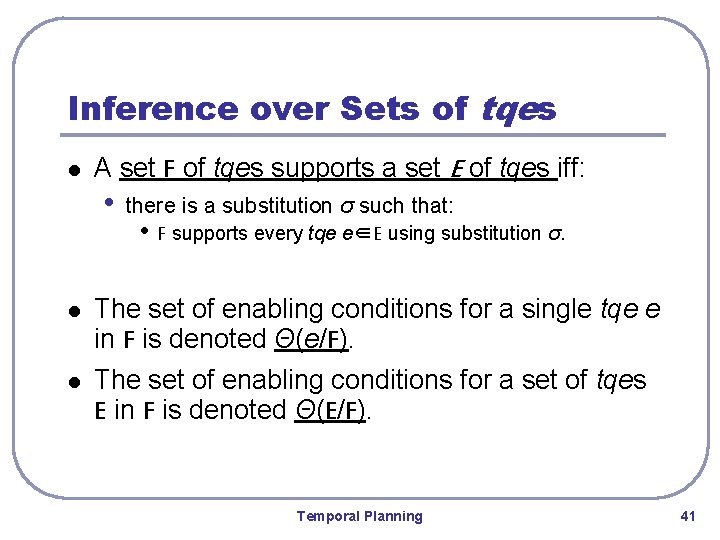
Inference over Sets of tqes l A set F of tqes supports a set E of tqes iff: • there is a substitution σ such that: • F supports every tqe e∈E using substitution σ. l The set of enabling conditions for a single tqe e in F is denoted Θ(e/F). l The set of enabling conditions for a set of tqes E in F is denoted Θ(E/F). Temporal Planning 41
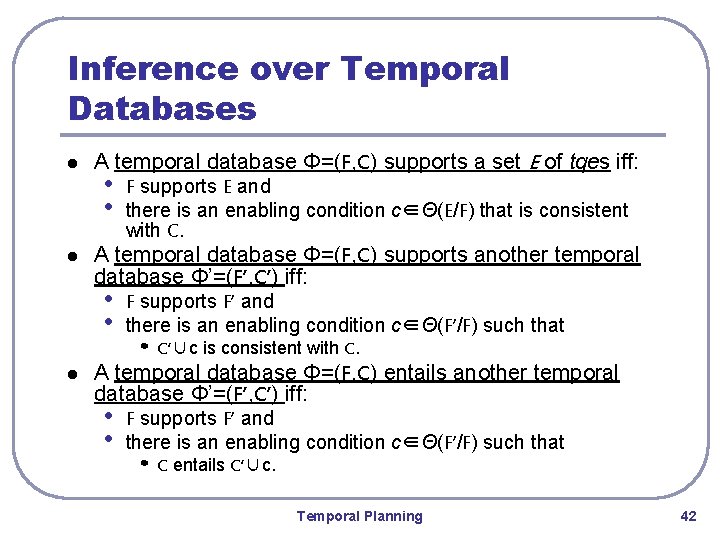
Inference over Temporal Databases l l A temporal database Φ=(F, C) supports a set E of tqes iff: • • A temporal database Φ=(F, C) supports another temporal database Φ’=(F’, C’) iff: • • l F supports E and there is an enabling condition c∈Θ(E/F) that is consistent with C. F supports F’ and there is an enabling condition c∈Θ(F’/F) such that • C’∪c is consistent with C. A temporal database Φ=(F, C) entails another temporal database Φ’=(F’, C’) iff: • • F supports F’ and there is an enabling condition c∈Θ(F’/F) such that • C entails C’∪c. Temporal Planning 42
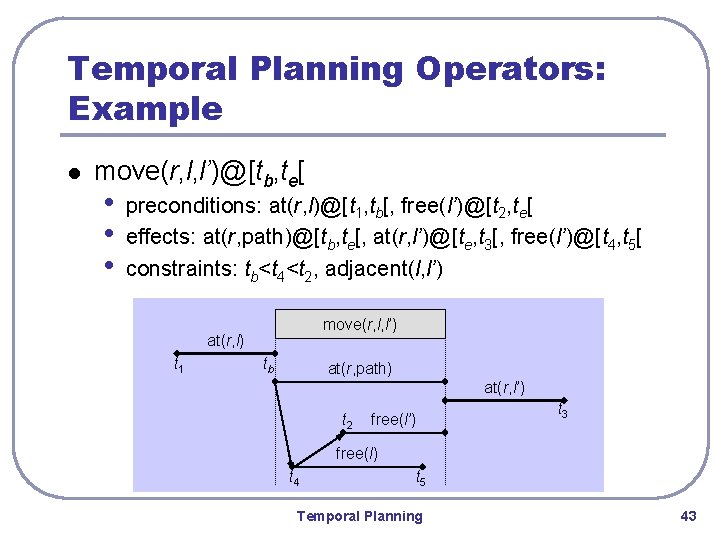
Temporal Planning Operators: Example l move(r, l, l’)@[tb, te[ • • • preconditions: at(r, l)@[t 1, tb[, free(l’)@[t 2, te[ effects: at(r, path)@[tb, te[, at(r, l’)@[te, t 3[, free(l’)@[t 4, t 5[ constraints: tb<t 4<t 2, adjacent(l, l’) move(r, l, l’) at(r, l) t 1 tb at(r, path) at(r, l’) t 2 free(l’) t 3 free(l) t 4 t 5 Temporal Planning 43
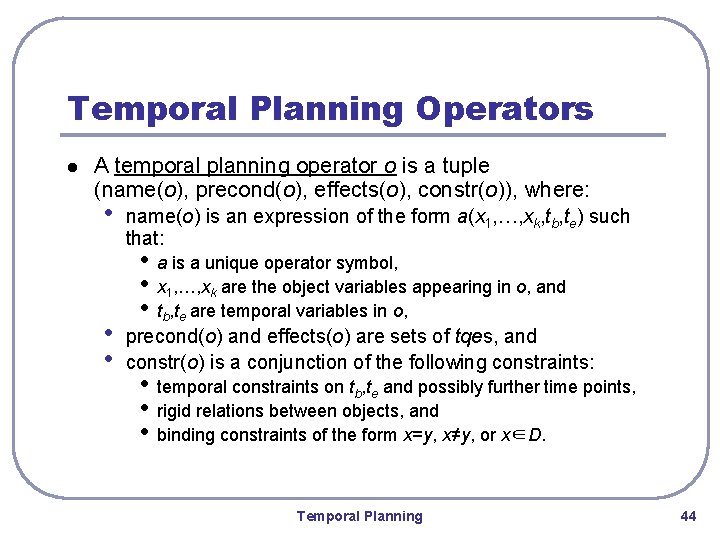
Temporal Planning Operators l A temporal planning operator o is a tuple (name(o), precond(o), effects(o), constr(o)), where: • • • name(o) is an expression of the form a(x 1, …, xk, tb, te) such that: • • • a is a unique operator symbol, x 1, …, xk are the object variables appearing in o, and tb, te are temporal variables in o, precond(o) and effects(o) are sets of tqes, and constr(o) is a conjunction of the following constraints: • • • temporal constraints on tb, te and possibly further time points, rigid relations between objects, and binding constraints of the form x=y, x≠y, or x∈D. Temporal Planning 44
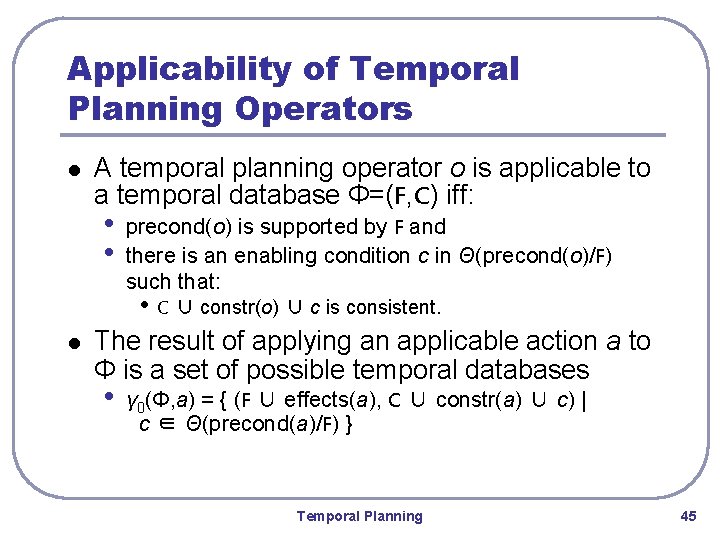
Applicability of Temporal Planning Operators l A temporal planning operator o is applicable to a temporal database Φ=(F, C) iff: • • precond(o) is supported by F and there is an enabling condition c in Θ(precond(o)/F) such that: • C ∪ constr(o) ∪ c is consistent. l The result of applying an applicable action a to Φ is a set of possible temporal databases • γ 0(Φ, a) = { (F ∪ effects(a), C ∪ constr(a) ∪ c) | c ∈ Θ(precond(a)/F) } Temporal Planning 45
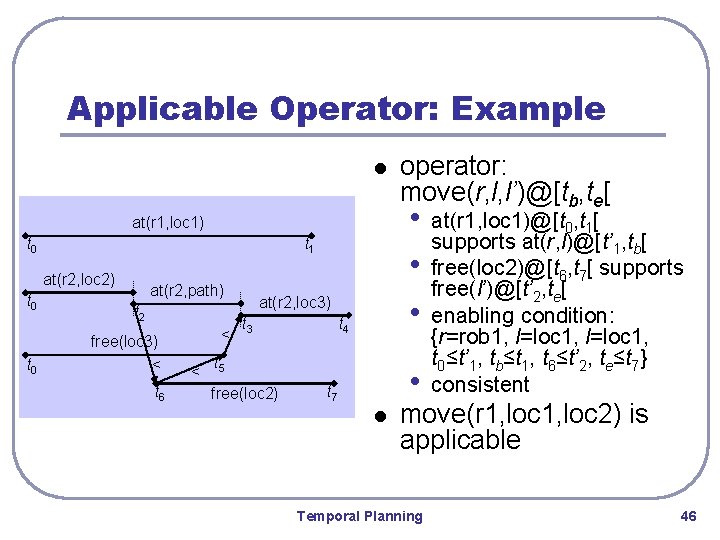
Applicable Operator: Example l • • • at(r 1, loc 1) t 0 t 1 at(r 2, loc 2) t 0 at(r 2, path) t 2 free(loc 3) < t 6 < < at(r 2, loc 3) t 3 t 4 t 5 free(loc 2) operator: move(r, l, l’)@[tb, te[ • t 7 l at(r 1, loc 1)@[t 0, t 1[ supports at(r, l)@[t’ 1, tb[ free(loc 2)@[t 6, t 7[ supports free(l’)@[t’ 2, te[ enabling condition: {r=rob 1, l=loc 1, t 0≤t’ 1, tb≤t 1, t 6≤t’ 2, te≤t 7} consistent move(r 1, loc 2) is applicable Temporal Planning 46
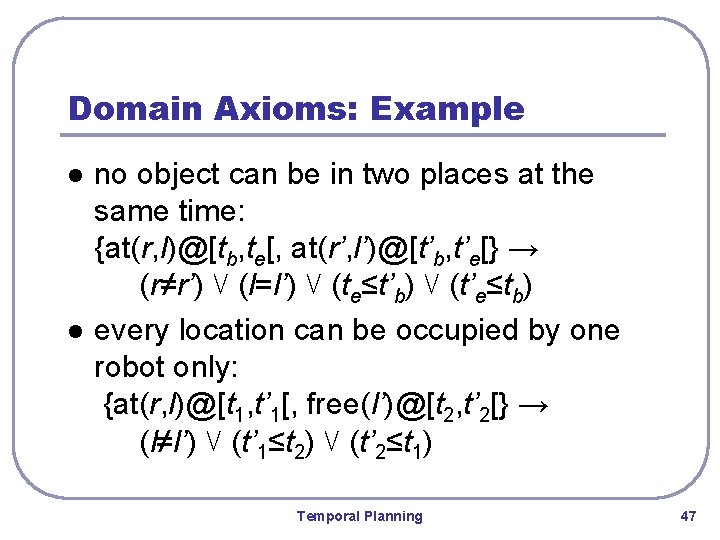
Domain Axioms: Example l l no object can be in two places at the same time: {at(r, l)@[tb, te[, at(r’, l’)@[t’b, t’e[} → (r≠r’) ⋁ (l=l’) ⋁ (te≤t’b) ⋁ (t’e≤tb) every location can be occupied by one robot only: {at(r, l)@[t 1, t’ 1[, free(l’)@[t 2, t’ 2[} → (l≠l’) ⋁ (t’ 1≤t 2) ⋁ (t’ 2≤t 1) Temporal Planning 47
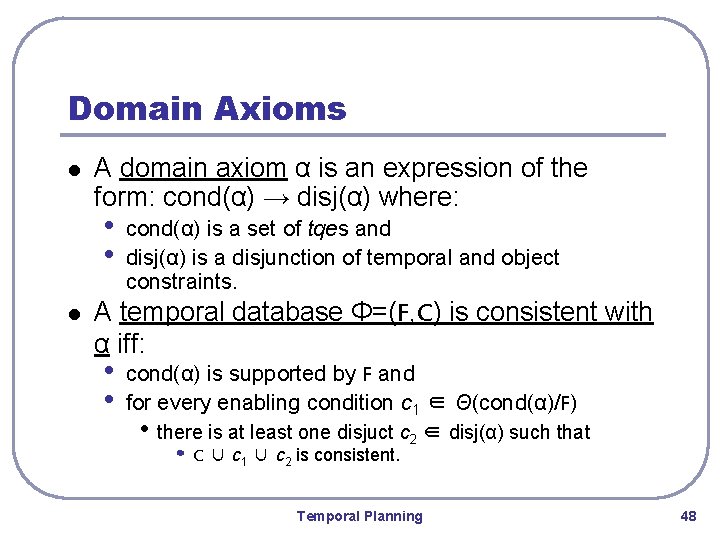
Domain Axioms l A domain axiom α is an expression of the form: cond(α) → disj(α) where: • • l cond(α) is a set of tqes and disj(α) is a disjunction of temporal and object constraints. A temporal database Φ=(F, C) is consistent with α iff: • • cond(α) is supported by F and for every enabling condition c 1 ∈ Θ(cond(α)/F) • there is at least one disjuct c 2 ∈ disj(α) such that • C ∪ c 1 ∪ c 2 is consistent. Temporal Planning 48
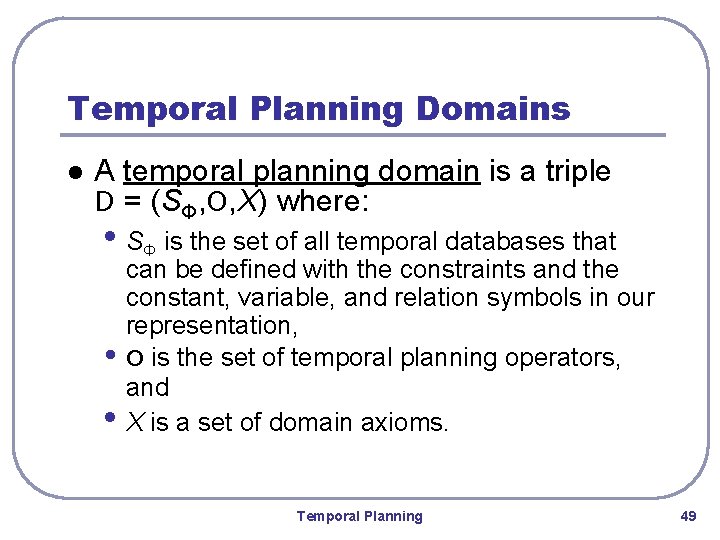
Temporal Planning Domains l A temporal planning domain is a triple D = (SΦ, O, X) where: • SΦ is the set of all temporal databases that can be defined with the constraints and the constant, variable, and relation symbols in our representation, • O is the set of temporal planning operators, and • X is a set of domain axioms. Temporal Planning 49
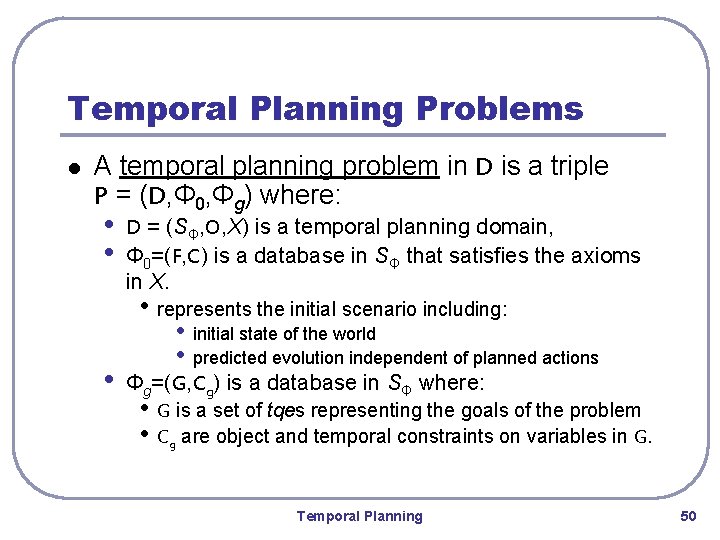
Temporal Planning Problems l A temporal planning problem in D is a triple P = (D, Φ 0, Φg) where: • D = (SΦ, O, X) is a temporal planning domain, • Φ 0=(F, C) is a database in SΦ that satisfies the axioms in X. • represents the initial scenario including: • • • initial state of the world predicted evolution independent of planned actions Φg=(G, Cg) is a database in SΦ where: • G is a set of tqes representing the goals of the problem • Cg are object and temporal constraints on variables in G. Temporal Planning 50
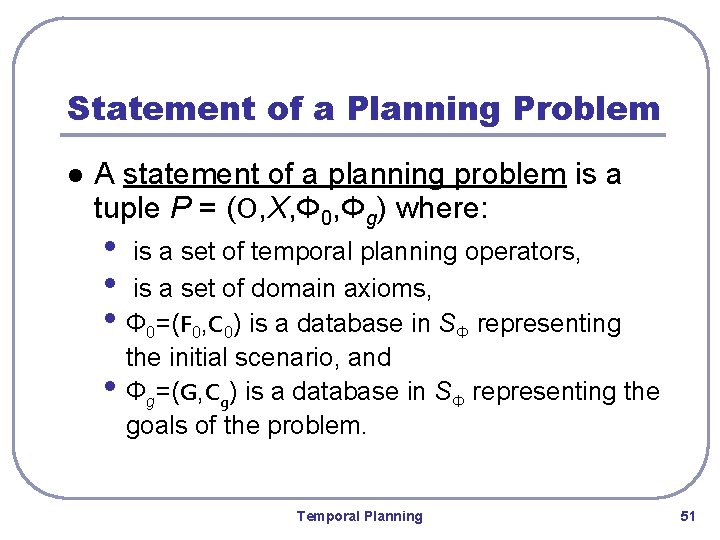
Statement of a Planning Problem l A statement of a planning problem is a tuple P = (O, X, Φ 0, Φg) where: • is a set of temporal planning operators, • is a set of domain axioms, • Φ 0=(F 0, C 0) is a database in SΦ representing • the initial scenario, and Φg=(G, Cg) is a database in SΦ representing the goals of the problem. Temporal Planning 51
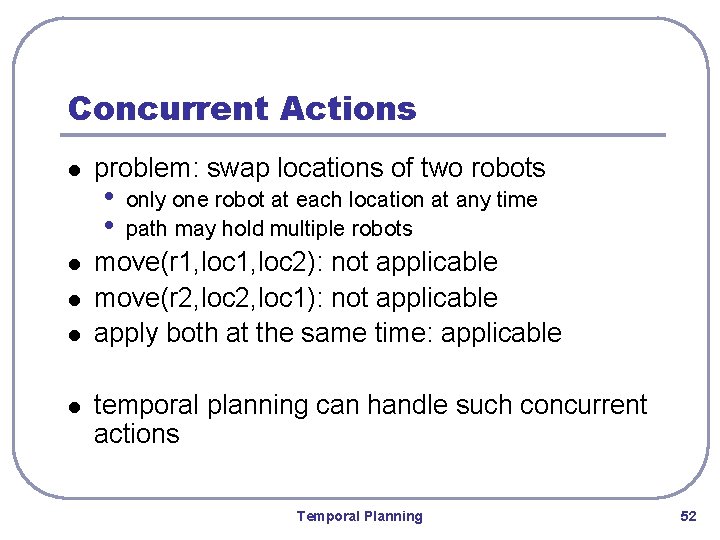
Concurrent Actions l l l problem: swap locations of two robots • • only one robot at each location at any time path may hold multiple robots move(r 1, loc 2): not applicable move(r 2, loc 1): not applicable apply both at the same time: applicable temporal planning can handle such concurrent actions Temporal Planning 52
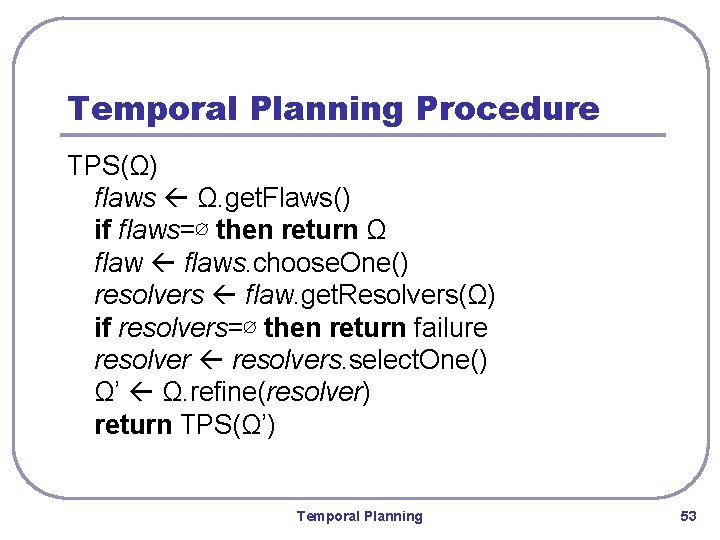
Temporal Planning Procedure TPS(Ω) flaws Ω. get. Flaws() if flaws=∅ then return Ω flaws. choose. One() resolvers flaw. get. Resolvers(Ω) if resolvers=∅ then return failure resolvers. select. One() Ω’ Ω. refine(resolver) return TPS(Ω’) Temporal Planning 53
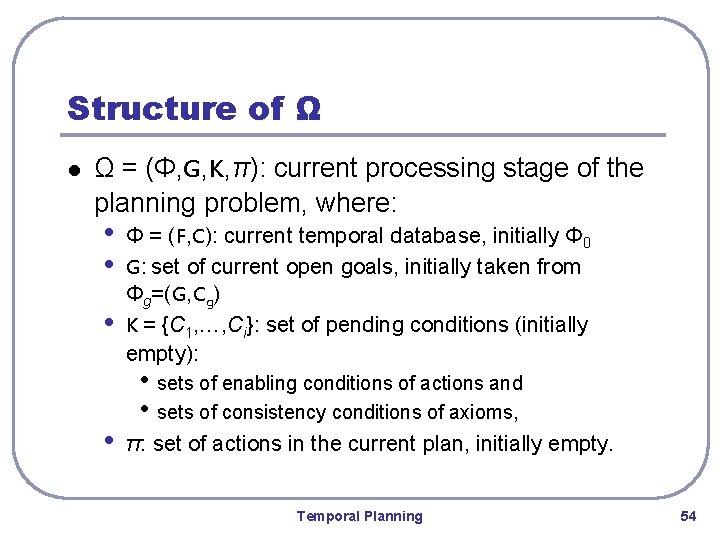
Structure of Ω l Ω = (Φ, G, K, π): current processing stage of the planning problem, where: • Φ = (F, C): current temporal database, initially Φ 0 • G: set of current open goals, initially taken from • • Φg=(G, Cg) K = {C 1, …, Ci}: set of pending conditions (initially empty): • sets of enabling conditions of actions and • sets of consistency conditions of axioms, π: set of actions in the current plan, initially empty. Temporal Planning 54
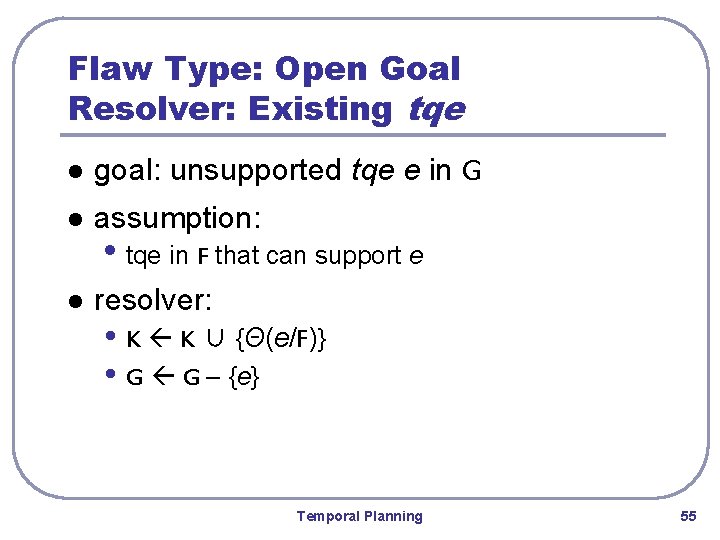
Flaw Type: Open Goal Resolver: Existing tqe l goal: unsupported tqe e in G l assumption: l resolver: • tqe in F that can support e • K K ∪ {Θ(e/F)} • G G – {e} Temporal Planning 55
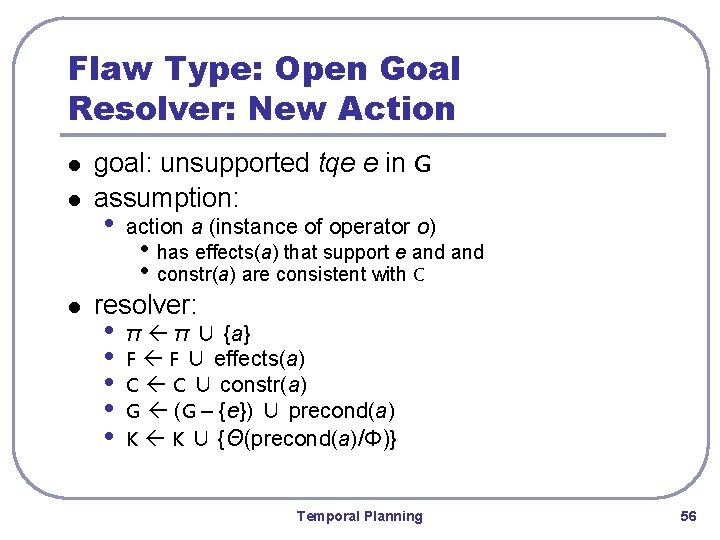
Flaw Type: Open Goal Resolver: New Action l l l goal: unsupported tqe e in G assumption: • action a (instance of operator o) • has effects(a) that support e and • constr(a) are consistent with C resolver: • π π ∪ {a} • F F ∪ effects(a) • C C ∪ constr(a) • G (G – {e}) ∪ precond(a) • K K ∪ {Θ(precond(a)/Φ)} Temporal Planning 56
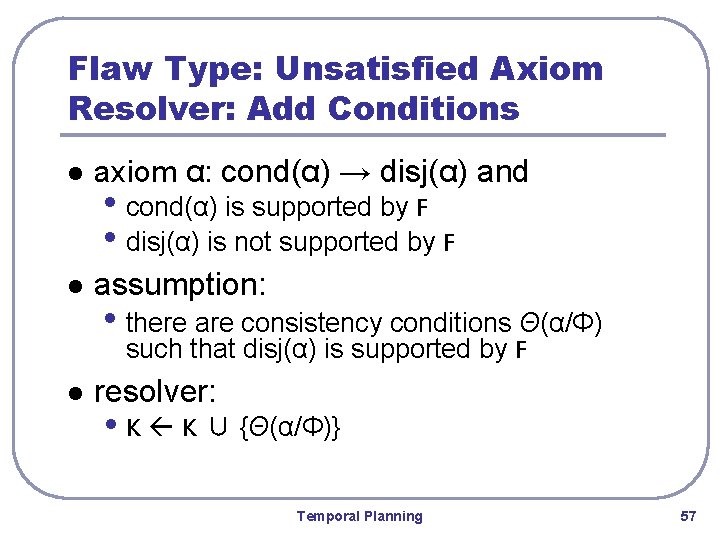
Flaw Type: Unsatisfied Axiom Resolver: Add Conditions l axiom α: cond(α) → disj(α) and l assumption: • cond(α) is supported by F • disj(α) is not supported by F • there are consistency conditions Θ(α/Φ) such that disj(α) is supported by F l resolver: • K K ∪ {Θ(α/Φ)} Temporal Planning 57
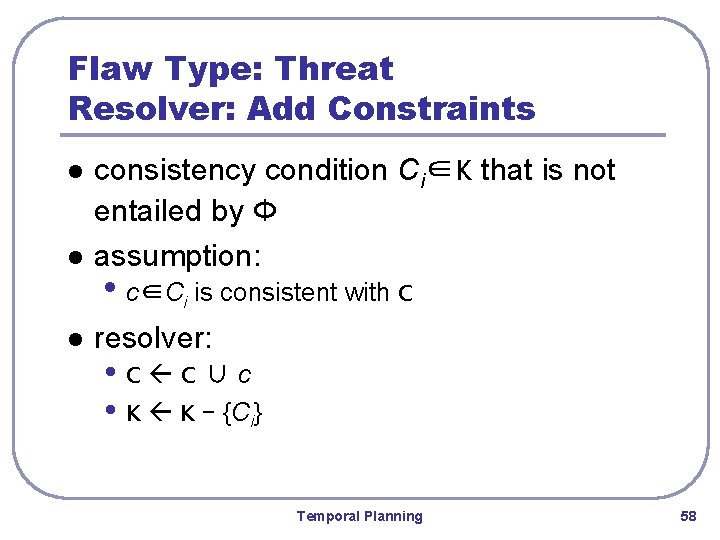
Flaw Type: Threat Resolver: Add Constraints l consistency condition Ci∈K that is not entailed by Φ assumption: l resolver: l • c∈Ci is consistent with C • C C∪c • K K - {Ci} Temporal Planning 58
Overview l l l Actions and Time Points Interval Algebra and Quantitative Time Planning with Temporal Operators Temporal Planning 59