
Temporal genetic patterns of diversity and structure evidence
- Slides: 1
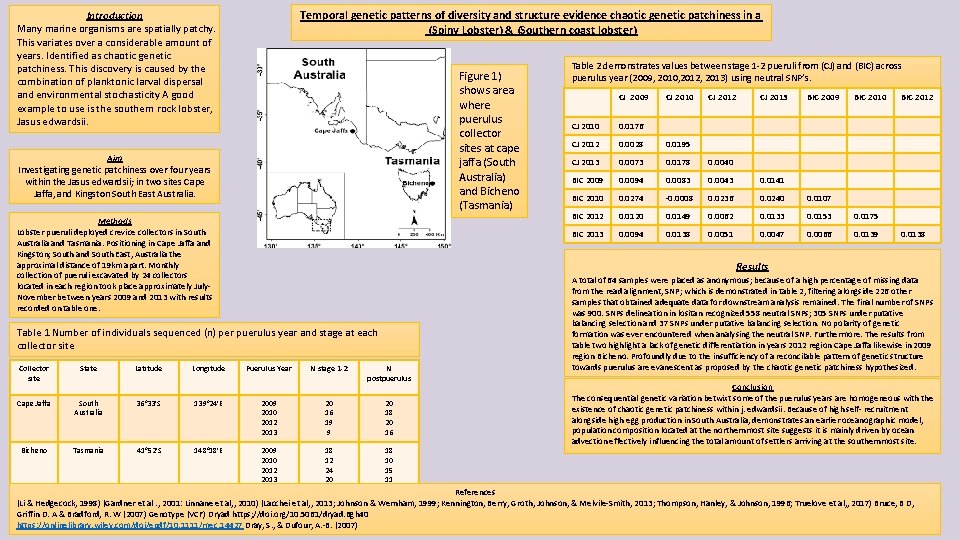
Temporal genetic patterns of diversity and structure evidence chaotic genetic patchiness in a (Spiny Lobster) & (Southern coast lobster) Introduction Many marine organisms are spatially patchy. This variates over a considerable amount of years. Identified as chaotic genetic patchiness. This discovery is caused by the combination of planktonic larval dispersal and environmental stochasticity A good example to use is the southern rock lobster, Jasus edwardsii. Figure 1) shows area where puerulus collector sites at cape jaffa (South Australia) and Bicheno (Tasmania) Aim Investigating genetic patchiness over four years within the Jasus edwardsii; in two sites Cape Jaffa, and Kingston South East Australia. Methods Lobster pueruli deployed crevice collectors in South Australia and Tasmania. Positioning in Cape Jaffa and Kingston; South and South East, Australia the approximal distance of 19 km apart. Monthly collection of pueruli excavated by 24 collectors located in each region took place approximately July. November between years 2009 and 2013 with results recorded on table one. Longitude CJ 2009 CJ 2010 CJ 2012 CJ 2013 BIC 2009 BIC 2010 CJ 2010 0. 0176 CJ 2012 0. 0028 0. 0195 CJ 2013 0. 0073 0. 0178 0. 0040 BIC 2009 0. 0094 0. 0083 0. 0043 0. 0141 BIC 2010 0. 0274 -0. 0008 0. 0236 0. 0240 0. 0107 BIC 2012 0. 0120 0. 0149 0. 0062 0. 0133 0. 0153 0. 0175 BIC 2013 0. 0094 0. 0138 0. 0051 0. 0047 0. 0066 0. 0139 BIC 2012 0. 0138 Results Table 1 Number of individuals sequenced (n) per puerulus year and stage at each collector site Latitude Table 2 demonstrates values between stage 1 -2 pueruli from (CJ) and (BIC) across puerulus year (2009, 2010, 2012, 2013) using neutral SNP’s. Collector site State Puerulus Year N stage 1 -2 N postpuerulus Cape Jaffa South Australia 36° 33’S 139° 24’E 2009 2010 2012 2013 20 16 19 9 20 18 20 16 Bicheno Tasmania 41° 52’S 148° 18’E 2009 2010 2012 2013 18 12 24 20 18 10 15 11 A total of 64 samples were placed as anonymous; because of a high percentage of missing data from the read alignment, SNP; which is demonstrated in table 2, filtering alongside 226 other samples that obtained adequate data for downstream analysis remained. The final number of SNPs was 900. SNPs delineation in lositan recognized 558 neutral SNPs; 305 SNPs under putative balancing selection and 37 SNPs under putative balancing selection. No polarity of genetic formation was ever encountered when analysing the neutral SNP. Furthermore. The results from table two highlight a lack of genetic differentiation in years 2012 region Cape Jaffa likewise in 2009 region Bicheno. Profoundly due to the insufficiency of a reconcilable pattern of genetic structure towards puerulus are evanescent as proposed by the chaotic genetic patchiness hypothesized. Conclusion The consequential genetic variation betwixt some of the puerulus years are homogeneous with the existence of chaotic genetic patchiness within j. edwardsii. Because of high self- recruitment alongside high egg production in South Australia, demonstrates an earlier oceanographic model, population composition located at the northernmost site suggests it is mainly driven by ocean advection effectively influencing the total amount of settlers arriving at the southernmost site. References (Li & Hedgecock, 1998) (Gardner et al. , 2001: Linnane et al, , 2010) (Lacchei et al, , 2013; Johnson & Wernham, 1999; Kennington, Berry, Groth, Johnson, & Melvile-Smith, 2013; Thompson, Hanley, & Johnson, 1996; Truelove et al, , 2017) Bruce, B D, Griffin D. A & Bradford, R. W (2007) Genotype (VCF) Dryad https; //doi. org/10. 5061/dryad. 6 gh 40 https: //onlinelibrary. wiley. com/doi/epdf/10. 1111/mec. 14427 Dray, S. , & Dufour, A. -B. (2007)