
Template for Community Action Grantee Logic Models October
Template for Community Action Grantee Logic Models October 30 2019
Instructions • There is an empty template for your activities and a sample logic model to illustrate how a completed template should work. • Each of the priorities may have multiple planned strategies/activities. Type those strategies into the boxes in the appropriate area. You may copy and delete boxes to accurately reflect your plan. • Identify your short-term outcomes for the strategies. As a result of the activity, what do you expect to achieve in the 12 months after implementing the project? • Use arrows to indicate which mid-term strategies are related to which short-term outcomes. How do those short-term outcomes relate to the State’s desired intermediate outcomes? Use arrows to indicate which short-term outcomes are related to which intermediate outcomes. Each strategy/activity and short-term outcome must be linked to at least one mid-term outcome. Vermont Department of Health 2
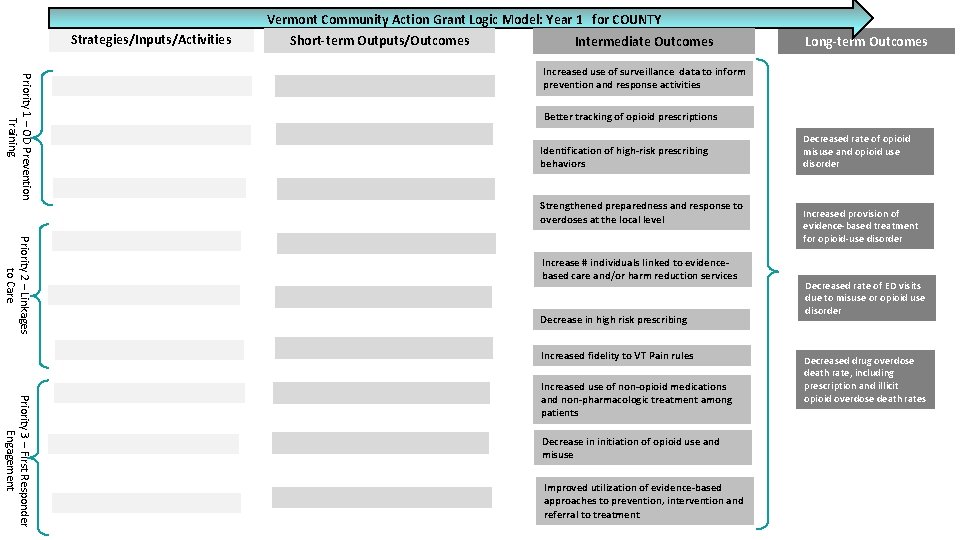
Vermont Community Action Grant Logic Model: Year 1 for COUNTY Strategies/Inputs/Activities Short-term Outputs/Outcomes Intermediate Outcomes Long-term Outcomes Priority 1 – OD Prevention Training Increased use of surveillance data to inform prevention and response activities Better tracking of opioid prescriptions Identification of high-risk prescribing behaviors Strengthened preparedness and response to overdoses at the local level Priority 2 – Linkages to Care Increase # individuals linked to evidencebased care and/or harm reduction services Decrease in high risk prescribing Increased fidelity to VT Pain rules Priority 3 – First Responder Engagement Increased use of non-opioid medications and non-pharmacologic treatment among patients Decrease in initiation of opioid use and misuse Improved utilization of evidence-based approaches to prevention, intervention and referral to treatment Decreased rate of opioid misuse and opioid use disorder Increased provision of evidence-based treatment for opioid-use disorder Decreased rate of ED visits due to misuse or opioid use disorder Decreased drug overdose death rate, including prescription and illicit opioid overdose death rates
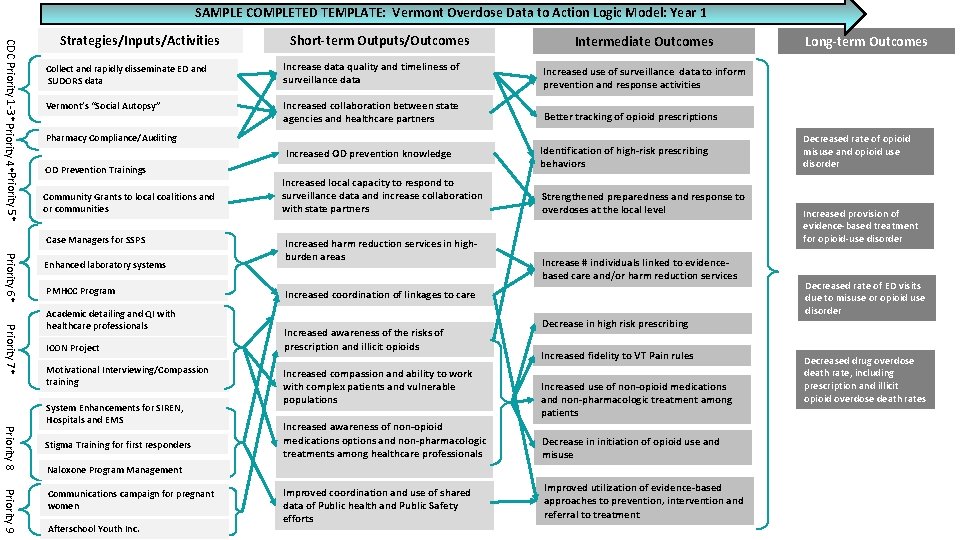
SAMPLE COMPLETED TEMPLATE: Vermont Overdose Data to Action Logic Model: Year 1 CDC Priority 1 -3*Priority 4*Priority 5* Strategies/Inputs/Activities Short-term Outputs/Outcomes Intermediate Outcomes Collect and rapidly disseminate ED and SUDORS data Increase data quality and timeliness of surveillance data Increased use of surveillance data to inform prevention and response activities Vermont’s “Social Autopsy” Increased collaboration between state agencies and healthcare partners Better tracking of opioid prescriptions Pharmacy Compliance/Auditing Increased OD prevention knowledge OD Prevention Trainings Community Grants to local coalitions and or communities Case Managers for SSPS Priority 6* Enhanced laboratory systems PMHCC Program Priority 7* Academic detailing and QI with healthcare professionals ICON Project Motivational Interviewing/Compassion training System Enhancements for SIREN, Hospitals and EMS Priority 8 Stigma Training for first responders Increased local capacity to respond to surveillance data and increase collaboration with state partners Increased harm reduction services in highburden areas Identification of high-risk prescribing behaviors Strengthened preparedness and response to overdoses at the local level Increase # individuals linked to evidencebased care and/or harm reduction services Increased coordination of linkages to care Increased awareness of the risks of prescription and illicit opioids Increased compassion and ability to work with complex patients and vulnerable populations Decrease in high risk prescribing Increased fidelity to VT Pain rules Increased use of non-opioid medications and non-pharmacologic treatment among patients Priority 9 Increased awareness of non-opioid medications options and non-pharmacologic treatments among healthcare professionals Decrease in initiation of opioid use and misuse Improved coordination and use of shared data of Public health and Public Safety efforts Improved utilization of evidence-based approaches to prevention, intervention and referral to treatment Naloxone Program Management Communications campaign for pregnant women Afterschool Youth Inc. Long-term Outcomes Decreased rate of opioid misuse and opioid use disorder Increased provision of evidence-based treatment for opioid-use disorder Decreased rate of ED visits due to misuse or opioid use disorder Decreased drug overdose death rate, including prescription and illicit opioid overdose death rates
- Slides: 4