
Temperature vs Altitude INTRODUCTION RESULT Liftoff Going into
- Slides: 1
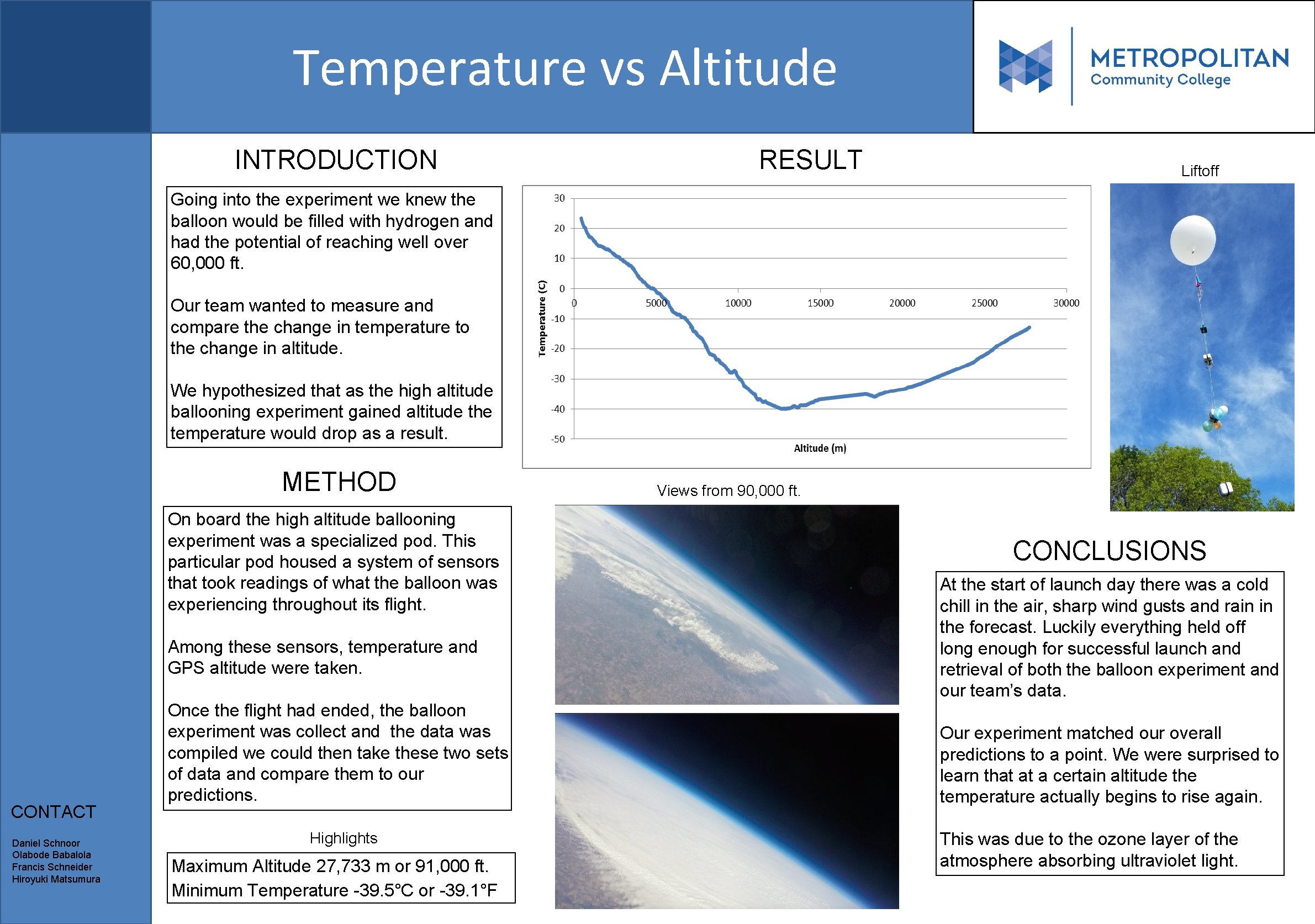
Temperature vs Altitude INTRODUCTION RESULT Liftoff Going into the experiment we knew the balloon would be filled with hydrogen and had the potential of reaching well over 60, 000 ft. Our team wanted to measure and compare the change in temperature to the change in altitude. We hypothesized that as the high altitude ballooning experiment gained altitude the temperature would drop as a result. METHOD On board the high altitude ballooning experiment was a specialized pod. This particular pod housed a system of sensors that took readings of what the balloon was experiencing throughout its flight. Among these sensors, temperature and GPS altitude were taken. CONTACT Daniel Schnoor Olabode Babalola Francis Schneider Hiroyuki Matsumura Once the flight had ended, the balloon experiment was collect and the data was compiled we could then take these two sets of data and compare them to our predictions. Highlights Maximum Altitude 27, 733 m or 91, 000 ft. Minimum Temperature -39. 5°C or -39. 1°F Views from 90, 000 ft. CONCLUSIONS At the start of launch day there was a cold chill in the air, sharp wind gusts and rain in the forecast. Luckily everything held off long enough for successful launch and retrieval of both the balloon experiment and our team’s data. Our experiment matched our overall predictions to a point. We were surprised to learn that at a certain altitude the temperature actually begins to rise again. This was due to the ozone layer of the atmosphere absorbing ultraviolet light.